Proceedings of the 2019 Conference on Empirical Methods in Natural Language Processing 1273
Semi-Supervised Bootstrapping of Dialogue State Trackers
for Task-Oriented Modelling
Bo-Hsiang Tseng1, Marek Rei2,4, Paweł Budzianowski1,3,5 Richard E. Turner1, Bill Byrne1, Anna Korhonen3
1Engineering Department, Cambridge University, UK 2Computer Laboratory, Cambridge University, UK 3Language Technology Lab, Cambridge University, UK
4Department of Computing, Imperial College London 5PolyAI Limited, London, UK
Abstract
Dialogue systems benefit greatly from opti-mizing on detailed annotations, such as tran-scribed utterances, internal dialogue state rep-resentations and dialogue act labels. However, collecting these annotations is expensive and time-consuming, holding back development in the area of dialogue modelling. In this paper, we investigate semi-supervised learning meth-ods that are able to reduce the amount of re-quired intermediate labelling. We find that by leveraging un-annotated data instead, the amount of turn-level annotations of dialogue state can be significantly reduced when build-ing a neural dialogue system. Our analysis on the MultiWOZ corpus, covering a range of domains and topics, finds that annotations can be reduced by up to 30% while maintain-ing equivalent system performance. We also describe and evaluate the first end-to-end di-alogue model created for the MultiWOZ cor-pus.
1 Introduction
Task-oriented dialogue models aim at assisting with well-defined and structured problems like booking tickets or providing information to visi-tors in a new city (Raux et al., 2005). Most cur-rent industry-oriented systems rely on modular, domain-focused frameworks (Young et al.,2013;
Sarikaya et al., 2016), with separate components for user understanding (Henderson et al., 2014), decision making (Gaši´c et al., 2010) and system answer generation (Wen et al., 2015). Recent progress in sequence-to-sequence (seq2seq) mod-elling has enabled the development of fully neu-ral end-to-end architectures, allowing for differ-ent compondiffer-ents to be optimized jointly in order to share information (Wen et al.,2017;Zhao et al.,
2017;Budzianowski and Vuli´c,2019).
Dialogue systems benefit greatly from optimiz-ing on detailed annotations, such as turn-level
dia-logue state labels (Henderson et al., 2014) or di-alogue actions (Rieser and Lemon, 2011), with end-to-end architectures still relying on interme-diate labels in order to obtain satisfactory results (Lei et al.,2018). Collecting these labels is often the bottleneck in dataset creation, as the process is expensive and time-consuming, requiring domain and expert knowledge (Asri et al.,2017). Due to this restriction, existing datasets for task-oriented dialogue are several orders of magnitude smaller compared to general open-domain dialogue cor-pora (Lowe et al.,2015;Henderson et al.,2019).
Arguably, one of the most challenging parts of dialogue modelling is maintaining an interpretable internal memory over crucial domain concepts (Williams et al.,2016). Although there is increas-ing research effort to learn Dialogue State Track-ing (DST) jointly with the text generation compo-nent (Eric et al.,2017;Wu et al.,2019), the most effective models use it as an intermediate signal (Wen et al., 2017; Lei et al., 2018). The diffi-culty of state tracking has made this task a driving force behind most of the Dialog System Technol-ogy Challenges in recent years (Henderson et al.,
2014;Kim et al.,2017).
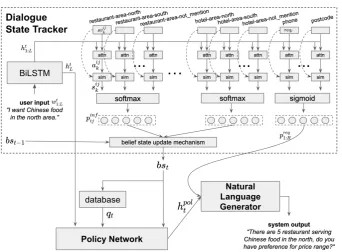
meth-Figure 1: Overview of our end-to-end neural dialogue model. It is composed of three main components: Dialogue State Tracker, Policy Network and Natural Language Generator.
ods can reduce intermediate annotation by up to 30% while maintaining equivalent system perfor-mance. We also describe and evaluate the first end-to-end dialogue model created for the MultiWOZ corpus.
2 End-to-end Neural Dialogue Model
We now present the end-to-end neural dialogue model composed of three main components: dia-logue state tracker, policy network and natural lan-guage generator. These components are trained jointly as a connected network and will be intro-duced in detail in the next paragraphs. The overall architecture can be seen in Figure1.
Dialogue State Tracker (DST) The DST is re-sponsible for both understanding the input user ut-terance and updating the internal dialogue state for the downstream components. There are two types of slots which can be detected in the input: in-formable slots and requestable slots. The former describes the attributes of the entity that the user is looking for, e.g.,pricerangeof a hotel. The latter captures information that the user desires to know about the entity, e.g., postcode of a ho-tel. Each informable slot contains several possible values with two special labels:not-mentioned anddon’t-care. A good DST should be able to correctly recognize the mentioned slot-value pairs in the user utterance and to maintain the updated
dialogue (belief) state.
Leti,jandkdenote the index of domain, slot and value. As depicted at the top of Figure1, the user utterancew1:wL at turntis first encoded by
the BiLSTM to obtain the hidden statesht1:L. The encoding of the slot-value pair svkij is the output of the affine layer that takes the concatenation of the embeddings of domaini, slotjand valuekas the input. The context vectoraijk is then computed by the attention mechanism, denoted asattn in Figure1, followingLuong et al.(2015):
el=sim(hl, svkij) (1)
aijk = L ∑
l=1
elhl, (2)
where l is the word index of the user utterance andsim denotes any function that calculates the similarity of two vectors. We adopt here the dot product function, followingMrkši´c et al. (2017);
Zhong et al.(2018);Ramadan et al.(2018). The similarity score sijk betweenaijk andsvijk is then computed to see whether the slot-value pairsvijk
is mentioned in the utterance. The mentioned pair should have higher similarity score to its context vector than those which are not mentioned. The softmax layer is then applied to form the prob-ability distribution pinfij for each informable slot
[image:2.595.129.472.57.309.2]the highest probability. The same attention mech-anism is used for each requestable slotreqrto
de-cide whether the user has asked for the slot in the current turn. The sigmoid layer is used instead as it is a binary classification problem. The predic-tion of requestable slots will be used as input to the natural language generator.
The belief state is the concatenation of the dis-tributions over all informable slot-value pairs that is updated at each turn to keep track of the in-formation provided by the user during the en-tire conversation. To form the belief state bst at
turn t, for each informable slot sinfij the update mechanism checks if the predicted value is either not-mention or dont-care for the current turn. If it is, then the probabilistic distributionpinfij
inbst−1is kept, otherwise it is updated by the new
distributionpinfij at the current turn.
Policy Network The policy network is respon-sible for fusing the signals from the belief state bt, the encoding of the user utterancehtLand the
database query result qt. The database query is
constructed from the predicted belief state. The number of all entities that match the predictions of the DST form the database query vector1. We use a simple feedforward layer as the policy network:
zt=tanh(Wz∗[bt,htL,qt]). (3)
where [*] denotes the concatenation of vectors.
Natural Language Generator Taking the input zt from the policy network and predictions of
re-questable slots from the tracker, the generator out-puts a system response word-by-word until the <EOS> token is generated. To improve the
gener-ation of correct slots corresponding to the user in-put, we adopt the semantically-conditioned LSTM (Wen et al., 2015) that contains a self-updating gate memory to record the produced slots in the generated sentence.
Optimization The model is optimized jointly against two sources of information – DST inter-mediate labels and system utterances. The DST loss consists of the cross-entropy over the multi-class multi-classification of informable slots while
bi-1Following (Wen et al.,2017), by querying the database usingbtas query,qtis the 1-hot representation with each
el-ement indicating different number of the matching entities in the database. We use 5 bins to indicate the matching number from 0 to 3 and more than 3.
nary cross-entropy is used for requestable slots:
Ldst=− ∑
i ∑
j
tinfij logpinfij −∑
r
treqr logpreqr ,
(4) where i, j and r are the index of domain, in-formable slot and requestable slot respectively;t∗
is the target distribution. The generation error is a standard cross-entropy between the predicted words and target words:
Lgen=− ∑
l′
tl′logpl′, (5)
where l′ is the word index in the generated sen-tence. To jointly train the DST, the policy network, and the generator as a connected network, the final objective function becomesL=Ldst+Lgen.
Semi-supervised Training The DST loss re-quires each turn to be manually annotated with the correct slot-value pairs. We experiment with two different semi-supervised training methods that take advantage of unlabelled examples instead, al-lowing us to reduce the amount of required anno-tation. The first approach is based on the pseudo-labellingstrategy byChapelle et al.(2009). If the prediction probability of an unlabelled data point for a particular class is larger than a given thresh-oldν, the example is included in the DST loss with the predicted label. Theνparameter is optimized on the validation set during development.
The second semi-supervised technique investi-gated is theΠ-model (Sajjadi et al., 2016) where the input is perturbed with random noise ϵ ∼
N(0, σ). The perturbations are applied to both la-belled and unlala-belled data points at the level of embedding of user utterance. The model is then required to produce similar predictionspinfij over the belief state compared to the original input, op-timized with an additional loss:
L3 =α 1 N
∑
N ∑
ij
(tinfij −pinfij )2, (6)
whereN is the batch size andαis a hyperparame-ter controlling the weight of the loss.
3 Experiments
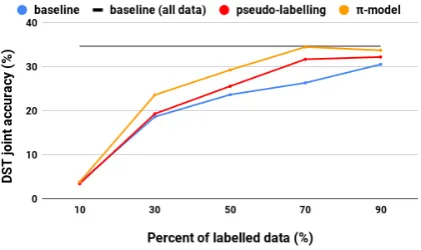
Figure 2: The DST joint accuracy for the three consid-ered models as the amount of labelled data varies. The horizontal line denotes the baseline model trained on 100% labelled data.
Figure 3: Success rate for different methods as the amounts of labelled data varies. Horizontal line de-notes the baseline model trained on 100% labelled data.
Dataset The three analyzed models are eval-uated on the MultiWOZ dataset consisting of 10,438 task-oriented dialogues (Budzianowski et al., 2018). The conversations in MultiWOZ are natural as they were gathered based on human-to-human interactions following the Wizard-of-Oz paradigm. The corpus includes multi-domain con-versations spanning across 7 domains including Restaurant, Hotel, Attraction, Train and Taxi. The size of the dataset allows us to control the amount of available fully labelled datapoints.
Metrics There are two metrics of importance when evaluating task-oriented dialogue systems. The first is the DST joint goal accuracy, defined as an average joint accuracy over all slots per turn (Williams et al.,2016). The second is theSuccess
metric that informs how many times systems have presented the entity satisfying the user’s goal and provided them with all the additional requested in-formation (Wen et al.,2017). The models are op-timized using the validation set and the results are averaged over 10 different seeds.
Varying data amount We examine the perfor-mance of the baseline model compared to the two semi-supervised models as the amount of labelled data varies. The result of the DST joint accuracy is presented in Figure2. Thepseudo-labellingmodel performs better than the baseline when more than 50% of the dataset is labelled. At the scarce data levels (10% and 30%) , thepseudo-labelling
model is not producing pseudo training points that help improve DST predictions. In contrast, the
Π-model takes advantages of the additional regu-larization loss and effectively leverages unlabelled data to enhance the performance over the baseline. The improvements are consistently more than 5% when training with 30 to 90% of labelled data and even reach the performance of the fully trained baseline model with only 70% labelled data.
Figure3shows theSuccessmetric results. The
pseudo-labelling method is not able to improve performance over the baseline regardless of the amount of labelled data. However, theΠ-modelis capable of improving the success rate consistently and manages to reach the performance of the fully trained model with only 50% of the intermediate DST signal. Note that a better DST joint accuracy does not necessarily translate to a better success rate as the final metric is also influenced by the quality of the generator.
No. of examples 0 1-5 6-10 10-15 16-20
Baseline 6.17 15.93 25.71 35.07 28.88
Pseudo-labelling 6.5 16.27 26.96 33.46 28.55
Π-model 6.6 21.93 31.29 36.22 30.72
Table 1: The accuracy (%) of different classification of slot-value pairs in terms of their number of training examples.
[image:4.595.76.285.264.386.2]Figure 4: Success rates in each domain in the case of 50% labelled data.
Domain analysis We also investigate if the im-provements in the success rate are consistent among all domains. Figure 4 shows the success rate on individual domains in the case of 50% of data is labelled. Both semi-supervised models improve performance over the baseline in all do-mains except for the taxi domain. We hypothesize this comes from the fact that the taxi domain is a relatively easy domain with only4possible slots.
4 Conclusions and Future Work
In this paper, we have analyzed how much semi-supervised techniques could help to reduce the need for intermediate-level annotations in train-ing neural task-oriented dialogue models. The results suggest that we do not need to annotate all intermediate signals and are able to leverage unannotated examples for training these compo-nents instead. In the future, we plan to experi-ment with other intermediate signals like dialogue acts. Further improvements could potentially be obtained from employing more advanced regular-ization losses (Oliver et al.,2018).
Acknowledgments
Bo-Hsiang Tseng is supported by Cambridge Trust and the Ministry of Education, Taiwan. Marek Rei’s research is supported by Cam-bridge English via the ALTA Institute. Paweł Budzianowski is funded by an EPSRC grant (EP/M018946/1) and by Toshiba Research Europe Ltd, Cambridge Research Laboratory (RG85875).
References
Layla El Asri, Hannes Schulz, Shikhar Sharma, Jeremie Zumer, Justin Harris, Emery Fine, Rahul Mehrotra, and Kaheer Suleman. 2017. Frames: A
corpus for adding memory to goal-oriented dialogue systems.Proceedings of SigDial, pages 207–219.
Paweł Budzianowski and Ivan Vuli´c. 2019. Hello, it’s GPT-2 - how can I help you? towards the use of pre-trained language models for task-oriented dialogue systems.arXiv preprint arXiv:1907.05774.
Paweł Budzianowski, Tsung-Hsien Wen, Bo-Hsiang Tseng, Iñigo Casanueva, Stefan Ultes, Osman Ra-madan, and Milica Gasic. 2018. MultiWOZ-A Large-scale multi-domain wizard-of-oz dataset for task-oriented dialogue modelling. InProceedings of EMNLP, pages 5016–5026.
Olivier Chapelle, Bernhard Scholkopf, and Alexander Zien. 2009. Semi-supervised learning (chapelle, o. et al., eds.; 2006)[book reviews].IEEE Transactions on Neural Networks, 20(3):542–542.
Mihail Eric, Lakshmi Krishnan, Francois Charette, and Christopher D. Manning. 2017. Key-value retrieval networks for task-oriented dialogue. InProceedings of SigDial, pages 37–49.
Milica Gaši´c, Filip Jurˇcíˇcek, Simon Keizer, François Mairesse, Blaise Thomson, Kai Yu, and Steve Young. 2010. Gaussian processes for fast policy
op-timisation of pomdp-based dialogue managers. In
Proceedings of SigDial, pages 201–204.
Matthew Henderson, Paweł Budzianowski, Iñigo Casanueva, Sam Coope, Daniela Gerz, Girish Ku-mar, Nikola Mrkši´c, Georgios Spithourakis, Pei-Hao Su, Ivan Vuli´c, and Tsung-Hsien Wen. 2019. A repository of conversational datasets. In Proceed-ings of the Workshop on NLP for Conversational AI.
Matthew Henderson, Blaise Thomson, and Jason D Williams. 2014.The third dialog state tracking
chal-lenge. InSpoken Language Technology Workshop
(SLT), 2014 IEEE, pages 324–329. IEEE.
Seokhwan Kim, Luis Fernando DHaro, Rafael E Banchs, Jason D Williams, and Matthew Hender-son. 2017. The fourth dialog state tracking chal-lenge. InDialogues with Social Robots, pages 435– 449. Springer.
Wenqiang Lei, Xisen Jin, Min-Yen Kan, Zhaochun Ren, Xiangnan He, and Dawei Yin. 2018. Sequicity: Simplifying task-oriented dialogue systems with sin-gle sequence-to-sequence architectures. In Proceed-ings of ACL, pages 1437–1447.
Ryan Lowe, Nissan Pow, Iulian V Serban, and Joelle Pineau. 2015. The ubuntu dialogue corpus: A large dataset for research in unstructured multi-turn
di-alogue systems. In 16th Annual Meeting of the
Special Interest Group on Discourse and Dialogue, page 285.
Nikola Mrkši´c, Diarmuid Ó Séaghdha, Tsung-Hsien Wen, Blaise Thomson, and Steve Young. 2017. Neu-ral belief tracker: Data-driven dialogue state track-ing. InProceedings of the 55th Annual Meeting of the Association for Computational Linguistics (Vol-ume 1: Long Papers), volume 1, pages 1777–1788.
Avital Oliver, Augustus Odena, Colin A Raffel, Ekin Dogus Cubuk, and Ian Goodfellow. 2018. Re-alistic evaluation of deep semi-supervised learning algorithms. InAdvances in Neural Information Pro-cessing Systems, pages 3235–3246.
Osman Ramadan, Paweł Budzianowski, and Milica Gaši´c. 2018. Large-scale multi-domain belief track-ing with knowledge shartrack-ing. InProceedings of ACL, pages 432–437.
Antoine Raux, Brian Langner, Dan Bohus, Alan W Black, and Maxine Eskenazi. 2005. Let’s go pub-lic! taking a spoken dialog system to the real world. InNinth European Conference on Speech Communi-cation and Technology.
Verena Rieser and Oliver Lemon. 2011. Reinforce-ment learning for adaptive dialogue systems: a data-driven methodology for dialogue management and natural language generation. Springer Science & Business Media.
Mehdi Sajjadi, Mehran Javanmardi, and Tolga Tas-dizen. 2016. Regularization with stochastic transfor-mations and perturbations for deep semi-supervised
learning. In Advances in Neural Information
Pro-cessing Systems, pages 1163–1171.
Ruhi Sarikaya, Paul A Crook, Alex Marin, Minwoo Jeong, Jean-Philippe Robichaud, Asli Celikyilmaz, Young-Bum Kim, Alexandre Rochette, Omar Zia Khan, Xiaohu Liu, et al. 2016. An overview of end-to-end language understanding and dialog
management for personal digital assistants. In
2016 IEEE Spoken Language Technology Workshop (SLT), pages 391–397. IEEE.
Tsung-Hsien Wen, Milica Gaši´c, Nikola Mrkši´c, Pei-Hao Su, David Vandyke, and Steve Young. 2015. Se-mantically conditioned lstm-based natural language generation for spoken dialogue systems. In Proceed-ings of the 2015 Conference on Empirical Methods in Natural Language Processing (EMNLP).
Tsung-Hsien Wen, David Vandyke, Nikola Mrkši´c, Milica Gaši´c, Lina M Rojas-Barahona, Pei-Hao Su, Stefan Ultes, and Steve Young. 2017. A network-based end-to-end trainable task-oriented dialogue
system. InProceedings of EACL, pages 438–449.
Jason Williams, Antoine Raux, and Matthew Hender-son. 2016. The dialog state tracking challenge se-ries: A review.Dialogue & Discourse, 7(3):4–33.
Chien-Sheng Wu, Richard Socher, and Caiming Xiong. 2019. Global-to-local memory pointer networks for task-oriented dialogue.ICLR.
Steve Young, Milica Gaši´c, Blaise Thomson, and Ja-son D. Williams. 2013. POMDP-based statistical
spoken dialog systems: A review. Proceedings of
the IEEE, 101(5):1160–1179.
Tiancheng Zhao, Ran Zhao, and Maxine Eskenazi. 2017. Learning discourse-level diversity for neural dialog models using conditional variational autoen-coders. InProceedings of ACL, pages 654–664.