Proceedings of the 2019 Conference on Empirical Methods in Natural Language Processing
4884
Reviews Meet Graphs: Enhancing User and Item Representations for
Recommendation with Hierarchical Attentive Graph Neural Network
Chuhan Wu1, Fangzhao Wu2, Tao Qi1, Suyu Ge1, Yongfeng Huang1,and Xing Xie2
1Department of Electronic Engineering, Tsinghua University, Beijing 100084, China 2Microsoft Research Asia, Beijing 100080, China
{wu-ch19, qit16, gsy17, yfhuang}@mails.tsinghua.edu.cn,
{fangzwu, xing.xie}@microsoft.com
Abstract
User and item representation learning is crit-ical for recommendation. Many of exist-ing recommendation methods learn represen-tations of users and items based on their rat-ings and reviews. However, the user-user and item-item relatedness are usually not consid-ered in these methods, which may be insuffi-cient. In this paper, we propose a neural rec-ommendation approach which can utilize use-ful information from both review content and user-item graphs. Since reviews and graphs have different characteristics, we propose to use a multi-view learning framework to in-corporate them as different views. In the re-view content-re-view, we propose to use a hier-archical model to first learn sentence repre-sentations from words, then learn review rep-resentations from sentences, and finally learn user/item representations from reviews. In addition, we propose to incorporate a three-level attention network into this view to se-lect important words, sentences and reviews for learning informative user and item repre-sentations. In the graph-view, we propose a hierarchical graph neural network to jointly model the user-item, user-user and item-item relatedness by capturing the first- and second-order interactions between users and items in the user-item graph. In addition, we apply at-tention mechanism to model the importance of these interactions to learn informative user and item representations. Extensive experiments on four benchmark datasets validate the effec-tiveness of our approach.
1 Introduction
Precisely learning user and item representations is critical for recommendation (Tay et al.,2018). Many existing recommendation methods learn user and item representations from their rating ma-trix (Koren et al.,2009;Mnih and Salakhutdinov,
2008;Berg et al., 2017). For example, Koren et
I feel this is a must read for any Star Wars fan of the prequels and original trilogy. The story is very well written and makes it hard to put this book down.
I loved this book. I believe this is the 17th Star Wars book I've read. I've read from the from the earliest days, before the old republic up until Rogue One and cover to cover, this is hands down the best book I've read thus far.
User-1
User-2
Item-1
[image:1.595.308.524.223.371.2]Item-2
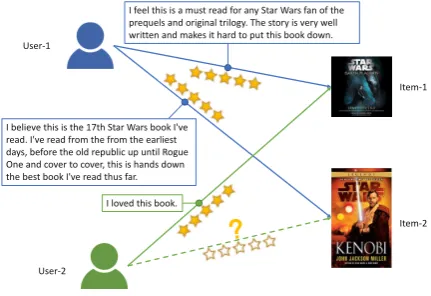
Figure 1: Two example users and items.
al. (2009) proposed to use singular value decom-position (SVD) to learn latent user and item rep-resentations based on the review ratings that users gave to items. However, there are massive users and items in online platforms, making the rating matrix between users and items very sparse. Thus, it is difficult for these methods to learn accurate user and item representations (Zheng et al.,2017). In recent years, several deep learning based rec-ommendation methods are proposed to learn user and item representations from review texts (Zheng et al.,2017;Catherine and Cohen,2017). For ex-ample, Zheng et al. (2017) proposed a DeepCoNN approach to learn the representations of users and items from their reviews via convolutional neu-ral networks (CNN). However, these methods only consider the interactions of user-item pairs, while the relatedness between users or items are ignored, which may be insufficient for learning accurate user and item representations.
same user may also have relatedness. For exam-ple, in Fig.1both items are commented by User-1, and they share the same topics on Star Wars. Third, modeling the user-user and item-item in-teractions is useful for recommendation. For ex-ample, in Fig.1 both users may have similar in-terests on Star Wars, and both books have related topics. Thus, it may be effective to recommend Item-2 to User-2. Fourth, the interactions between users and items, e.g., reviews, may have different importance for representing users and items. For example, in Fig. 1 the interaction between User-1 and Item-User-1 is more important than that between User-2 and Item-1 in representing this item, since the review of User-1 contain more details about item properties. In addition, different words and sentences in the same review may also have dif-ferent importance. For instance, the sentence “this is the best book I’ve read thus far” is more impor-tant than “I’ve read from the earliest days”, and the word “best” is more important than “read” in the former sentence.
In this paper, we propose a reviews meet graphs approach (RMG) to combine reviews and the in-formation of user-item graphs via a multi-view learning framework. In the review content-view, we use a hierarchical model to learn user and item representations. It first learns sentence represen-tations from words, then learn review representa-tions from sentences, and finally learn user/item representations from reviews. In addition, we pro-pose to apply a three-level attention network to select important words, sentences and reviews to learn informative user and item representations. In the graph-view, we propose to use a graph neural network to capture the item, user-user, and item-item relatedness in the user-item bipartite graphs by modeling the first-order and second-order interactions between different users and items. In addition, we propose to incorpo-rate attention mechanism into the graph neural net-work to model the importance of these interactions for informative user and item representation learn-ing. Extensive experiments on four benchmark datasets validate that our approach can effectively improve the performance of recommendation and outperform many baseline methods.
2 Related Work
Many previous works have studied the prob-lem of learning user and item representations
from reviews for recommendation (Zhang et al.,
2014; Diao et al., 2014; He et al., 2015; Tan et al., 2016; Ren et al., 2017). Many of exist-ing methods rely on topic models to extract top-ics from reviews for user and item representa-tion (McAuley and Leskovec, 2013; Ling et al.,
2014;Bao et al., 2014). For example, McAuley and Leskovec (2013) proposed a Hidden Fac-tors as Topics (HFT) method to learn latent user and item factors from review content via a la-tent Dirichlet allocation (LDA) model. Ling et al. (2014) proposed a Ratings Meet Reviews (RMR) approach to represent users and items by first extracting topics from reviews and then align-ing the dimensions of these topics with the latent user factors learned from review ratings via matrix factorization. Bao et al. (2014) proposed a Top-icMF method to represent users and items by in-corporate the topics extracted from review texts to enhance the learning of latent user and item fac-tors from the rating matrix via non-negative ma-trix factorization (NMF). However, these methods only extract topics from reviews, and cannot ef-fectively utilize the contexts and word orders in reviews, both of which are important for learning accurate user and item representations.
In recent years, several deep learning based methods proposed to learn user and item repre-sentations from original review texts (Zhang et al.,
2016; Zheng et al., 2017; Catherine and Cohen,
their texts together, and cannot fully model their informativeness. Different from these methods, in our approach we propose a review meet graph ap-proach which can combine reviews with user-item graphs via a multi-view learning framework to en-hance user and item representation learning. In the review text-view, we use a hierarchical frame-work to learn sentence representations from words first, then learn review representations form sen-tences, and finally learns user/item representations from their reviews. In addition, we apply attention network at each level to select important words, sentences and reviews. In the graph-view, our ap-proach uses a hierarchical graph neural network to mine the user-item, user-user and item-item relat-edness from user-item graphs, and attentively se-lects the interactions between users and items. Ex-periments on four benchmark datasets validate the effectiveness of our approach in recommendation.
3 Our Approach
In this section, we will introduce our reviews meet graphs approach for recommendation (denoted as
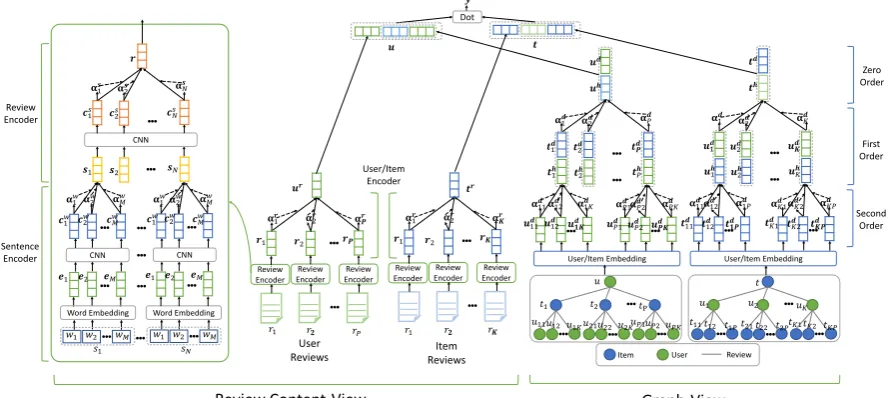
RMG). The architecture of our basic RMG ap-proach is shown in Fig.2. Our approach consists of two different views, i.e., areview content-view
and agraph-view.
3.1 Review Content View
The review content-view module is used to learn representations of users and items from their re-view texts. It contains three modules, i.e,sentence encoder,review encoderanduser/item encoder.
There are three layers in thesentence encoder. The first one is word embedding. It is used to con-vert a sentencesinto a low-dimensional semantic vector sequence. Denote the word sequence of s
as[w1, w2, ..., wM], where M is its length. It is converted into a vector sequence [e1,e2, ...,eM] via a pre-trained embedding matrix.
The second one is a convolutional neural net-work (CNN). Local contexts are important for re-view representation learning. For example, in the sentence “I am a star wars fan”, the local contexts of “wars” such as “star” and “fan” are useful for inferring this sentence is about a famous movie series. Thus, we employ a CNN over word em-beddings to learn contextual word representations by capturing local contexts. It takes the embed-ding sequence [e1,e2, ...,eM] as input, and out-puts a sequence of word contextual representation
vectors[cw1,cw2, ...,cwM].
The third layer is a word-level attention net-work. Different words in the same sentence may have different informativeness in represent-ing users and items. For example, in the sentence “This story book is very interesting” , the word “interesting” is more important than the word “story” in representing this book. Thus, we use an attention network over word representations to learn informative sentence representations by se-lecting important words. The attention weight of thei-th wordwiis computed as follows:
awi = tanh(ww×cwi +bw), (1)
αwi = exp(a
w i )
PM
j=1exp(awj)
, (2)
wherewwandbware parameters. The final repre-sentation of the sentencesis the summation of the contextual word representations weighted by their attention weights, i.e.,s=PM
i=1αwi cwi .
Thereview encodermodule is used to learn resentations of reviews from their sentence rep-resentations. There are two layers in the review encoder module. The first layer is a sentence-level CNN network. Neighboring sentences usu-ally have some relatedness in their content. For example, in the book review “The book is very well written. I will recommend it to others”, the two neighboring sentences have close relatedness and they both express positive opinion towards the book. Thus, we use a sentence-level CNN net-work to learn contextual sentence representations by capturing sentence-level local contexts. We de-note the representation sequence of the sentences in a reviewr as [s1,s2, ...,sN]. The CNN layer takes the representation sequence as input, and outputs a sequence of contextual sentence repre-sentations, denoted as[cs1,cs2, ...,csN].
The second layer is a sentence-level attention network. Different sentences in the same review may have different informativeness for modeling users and items. For example, the sentence “The book tells a good story” is more informative than the sentence “I read this book today” in represent-ing this book. Thus, we use a sentence-level atten-tion network to select important sentences to learn informative representations of reviews for recom-mendation. The attention weight αs
i of the i-th sentence is formulated as follows:
CNN CNN CNN
𝒖𝒖𝒓𝒓
�𝒚𝒚
𝒕𝒕𝒓𝒓
Dot
𝒆𝒆1 𝒆𝒆2 𝒆𝒆𝑀𝑀 𝒆𝒆1 𝒆𝒆2 𝒆𝒆𝑀𝑀 𝒄𝒄1𝑤𝑤𝒄𝒄2𝑤𝑤 𝒄𝒄𝑀𝑀𝑤𝑤
𝒔𝒔1 𝒔𝒔2 𝒔𝒔𝑁𝑁 𝒄𝒄1𝑠𝑠 𝒄𝒄2𝑠𝑠 𝒄𝒄𝑁𝑁𝑠𝑠
𝒓𝒓1 𝒓𝒓2 𝒓𝒓𝑲𝑲 𝒄𝒄1𝑤𝑤𝒄𝒄2𝑤𝑤 𝒄𝒄𝑀𝑀𝑤𝑤
𝑤𝑤1 𝑤𝑤2 𝑤𝑤𝑀𝑀 𝑤𝑤1 𝑤𝑤2 𝑤𝑤𝑀𝑀
Word Embedding Review
Encoder
Sentence Encoder
𝑠𝑠1 𝑠𝑠𝑁𝑁
𝑟𝑟1 𝑟𝑟𝑃𝑃 𝒖𝒖
𝒓𝒓1 𝒓𝒓2 𝒓𝒓𝑷𝑷
Review
Encoder EncoderReview EncoderReview EncoderReview EncoderReview EncoderReview
𝑟𝑟1 𝑟𝑟𝑲𝑲 𝒓𝒓
Word Embedding
𝑟𝑟𝟐𝟐 𝑟𝑟𝟐𝟐
First Order
Second Order
User
Reviews ReviewsItem
𝒕𝒕1𝒉𝒉 𝒕𝒕2𝒉𝒉 𝒕𝒕𝑃𝑃𝒉𝒉
𝒖𝒖11𝒅𝒅 𝒖𝒖12𝒅𝒅 𝒖𝒖𝟏𝟏𝑲𝑲𝒅𝒅 𝒖𝒖𝒉𝒉 𝒖𝒖𝒅𝒅
𝒖𝒖1𝒉𝒉 𝒖𝒖2𝒉𝒉 𝒖𝒖𝐾𝐾𝒉𝒉 𝒕𝒕𝒉𝒉 𝒕𝒕𝒅𝒅
𝛂𝛂1𝑤𝑤𝛂𝛂2𝑤𝑤 𝛂𝛂𝑀𝑀𝑤𝑤 𝛂𝛂1𝑤𝑤𝛂𝛂2𝑤𝑤 𝛂𝛂𝑀𝑀𝑤𝑤
𝛂𝛂1𝒔𝒔 𝛂𝛂2𝒔𝒔 𝛂𝛂𝑁𝑁𝒔𝒔
𝛂𝛂1𝒓𝒓 𝛂𝛂2𝒓𝒓 𝛂𝛂𝑷𝑷𝒓𝒓
Item User Review
𝒖𝒖𝑃𝑃1𝒅𝒅 𝒖𝒖𝑃𝑃2𝒅𝒅 𝒖𝒖𝑷𝑷𝑲𝑲𝒅𝒅 𝒕𝒕11𝒅𝒅 𝒕𝒕12𝒅𝒅 𝒕𝒕𝟏𝟏𝑷𝑷𝒅𝒅 𝒕𝒕𝐾𝐾1𝒅𝒅 𝒕𝒕𝐾𝐾2𝒅𝒅 𝒕𝒕𝑲𝑲𝑷𝑷𝒅𝒅
User/Item Embedding User/Item Embedding
𝒕𝒕1𝒅𝒅 𝒕𝒕2𝒅𝒅 𝒕𝒕𝑷𝑷𝒅𝒅 𝒖𝒖1𝒅𝒅 𝒖𝒖2𝒅𝒅 𝒖𝒖𝑲𝑲𝒅𝒅
𝛂𝛂1𝒓𝒓 𝛂𝛂2𝒓𝒓 𝛂𝛂𝑲𝑲𝒓𝒓 𝒕𝒕
Zero Order
𝛂𝛂1𝒅𝒅 𝛂𝛂2𝒅𝒅 𝛂𝛂𝑃𝑃𝒅𝒅 𝛂𝛂1𝒅𝒅 𝛂𝛂2𝒅𝒅 𝛂𝛂𝐾𝐾𝒅𝒅
𝛂𝛂11𝒅𝒅𝛂𝛂12𝒅𝒅 𝛂𝛂1𝐾𝐾𝒅𝒅 𝛂𝛂𝑃𝑃1𝒅𝒅𝛂𝛂𝑃𝑃2𝒅𝒅 𝛂𝛂𝑃𝑃𝐾𝐾𝒅𝒅 𝛂𝛂11𝒅𝒅𝛂𝛂12𝒅𝒅 𝛂𝛂1𝑃𝑃𝒅𝒅 𝛂𝛂𝐾𝐾1𝒅𝒅𝛂𝛂𝐾𝐾2𝒅𝒅 𝛂𝛂𝐾𝐾𝑃𝑃𝒅𝒅
Review Content-View Graph-View
User/Item Encoder
𝑢𝑢 𝑡𝑡
𝑡𝑡1 𝑡𝑡2 𝑡𝑡P 𝑢𝑢11𝑢𝑢12𝑢𝑢1𝐾𝐾𝑢𝑢21𝑢𝑢22𝑢𝑢2𝐾𝐾𝑢𝑢𝑃𝑃1𝑢𝑢𝑃𝑃2𝑢𝑢𝑃𝑃𝐾𝐾
[image:4.595.76.524.67.266.2]𝑢𝑢1 𝑢𝑢2 𝑢𝑢𝐾𝐾 𝑡𝑡11𝑡𝑡12 𝑡𝑡1𝑃𝑃𝑡𝑡21𝑡𝑡22 𝑡𝑡2𝑃𝑃𝑡𝑡𝐾𝐾1𝑡𝑡𝐾𝐾2𝑡𝑡𝐾𝐾𝑃𝑃
Figure 2: The framework of ourRMGapproach.
αsi = exp(a
s i)
PN
j=1exp(asj)
, (4)
where ws and bs are parameters in the attention network. The final contextual representation of the reviewrthe summation of the contextual sen-tence representations weighted by their attention weights, i.e., r = PN
i=1αsicsi. We apply the
re-view encoder to encode the reviews of users and items into their representation vectors.
Theuser/item encoderis used to learn represen-tations of users and items from the their review representations. Different reviews usually have different informativeness in characterizing users and items. For example, in Fig.1, the first review of Item-1 is more informative than its second re-view. Thus, we use a review-level attention net-work to recognize informative reviews and attend to them. Denote the reviews written by a user as
[r1, r2, ..., rP], whereP is the number of reviews. The attention weight of the reviewriis formulated as follows:
ari = tanh(wr×ri+br), (5)
αri = exp(a
r i)
PP
j=1exp(arj)
, (6)
where wr and br are parameters. The user rep-resentation learned from reviews is the summa-tion of the review representasumma-tions weighted by their attention weights, i.e., ur = PP
i=1αriri. Denote theK reviews commented on an item as
[r1, r2, ..., rK]. The item representationtrlearned from these reviews is computed similarly, i.e.,
tr =PK
i=1αriri,whereαri is the attention weight of the reviewri.
3.2 User-Item Graph View
The graph-view module is used to learn repre-sentations of users and items by modeling their interactions in the user-item bipartite graph, as shown in Fig. 2. In this bipartite graph, users and items are represented as nodes, and the inter-actions of user-item pairs are regarded as edges. However, different from typical graph neural net-works (Veliˇckovi´c et al., 2017), the input of typ-ical review-based recommender systems is only a user-item pair (two nodes with an edge) rather than the entire user-item graph. Therefore, it is diffi-cult to directly capture high-order interactions be-tween users and items via a stacked graph neural networks. To solve this problem, in our approach we propose a hierarchical attentive graph neural network for recommendation which can model high-order user-item interactions. It contains three core components, i.e.,second-orderencoder, first-order encoder, and zero-order encoder. We will introduce each one as follows.
user-user and item-item relatedness by modeling the second-order interactions in the user-item graph, as shown in Fig.2. For each user-item pair(u, t)
in the training set, we denote the items that this user gave ratings to as[t1, t2, ..., tP]. Among these items, we denote the users who commented thei -th item as[ui1, ui2, ..., uiK]. Motivated by typical graph neural networks (Veliˇckovi´c et al., 2017), we incorporate the embedding of user and item IDs as the node representation in the user-item graph, and then learn the representations of each item from the representations of the users who has commented this item. Usually different users who bought the same item may have different informa-tiveness in representing this item. For example, in Fig.1, the first user is more important than second user in representing the first item. Thus, we pro-pose to use an attentive graph neural network to model the importance of the users that connected to the item node. Denote the representations of these users as [ui1,ui2, ...,uiK]. The attention weightadijof thej-th user who comments the item
tiis computed as:
adij = tanh(w2×uij+b2), (7)
αdij = exp(a
d ij)
PK
k=1exp(adik)
, (8)
wherew2 and b2 are parameters in this network.
The user-based representationthi of the itemti is the summation of the embeddings of its related user weighted by their attention weights, which is formulated as:
thi =
K
X
k=1
αdikuik, (9)
The second one is afirst-orderencoder. Since some latent properties of this item may not be re-vealed by the interactions with users, we incorpo-rate the embedding of item IDs to enhance rep-resentation learning. The final reprep-resentation of nodeti is the concatenation of the item node rep-resentation thi learned from user node represen-tations and the item ID embedding tdi, i.e., ti =
[th
i,tdi]. The representations of the users (denoted as [u1,u2, ...,uK]) who interact with the item t are computed similarly. Similar with the second-orderencoder, we first learn the item-based repre-sentationuhof the userufrom the representations of its neighbor item nodes in an attentive manner.
Denote the attention weight of the i-th item that the useru commented as adi, which is computed as:
adi = tanh(w1×ti+b1), (10)
αdi = exp(a
d i)
PP
p=1exp(adp)
, (11)
wherew1 andb1are parameters. The item-based
representationuhof the useruis the summation of the item representations associated with this user weighted by their attention weights, which is for-mulated as:
uh =
P
X
p=1
αdptp, (12)
The third one iszero-orderencoder. It learns the graph-based representation of useruby using the concatenation of the user node representation uh
and the user ID embeddingud, i.e.,ug= [uh,ud]. The representation of the itemtis computed sim-ilarly. Denote the representation of the item t
learned from user-item interactions asth, and the embedding of its ID as td. Then its graph-based representationtgis calculated astg = [th,td].
3.3 Rating Scoring
In our approach, the final representations of users and items are the concatenation of the represen-tations learned from the review content-view and graph-view, i.e., u = [ug,ur] andt = [tg,tr]. The rating score of a user-item pair is predicted by the inner product of user and item representations, i.e.,yˆ=uTt.
3.4 Model Training
For model training, mean squared error is used as the loss function:
L= 1
T
T
X
i=1
(ˆyi−yi)2, (13)
where T denotes the number of user-item pairs for training,yˆiandyi respectively denote the pre-dicted and gold rating score of the i-th user-item pair. By optimizing the loss function, all parame-ters can be tuned via backward propagation.
4 Experiments
4.1 Datasets and Experimental Settings
Dataset #users #items #reviews
Toys 19,412 11,924 167,597
Kindle 68,223 61,935 982,619
Movies 123,960 50,052 1,679,533
[image:6.595.83.283.62.132.2]Yelp 199,445 119,441 3,072,129
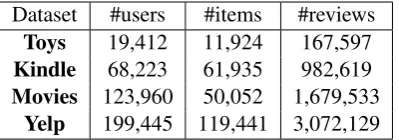
Table 1: Statistics of the benchmark datasets.
scales to validate the effectiveness of our ap-proach. Following (Chen et al., 2018), we used three datasets from the Amazon collection1(He and McAuley, 2016), i.e.,Toys and Games, Kin-dle Store, and Movies and TV (respectively de-noted as Toys, Kindle and Movies). Another dataset is from Yelp Challenge 20172(denoted as Yelp), which is a large collection of restaurant re-views. Following (Chen et al.,2018), we only kept the users and items which have at least 5 reviews. The detailed statistics of the four datasets are sum-marized in Table1. The ratings in these datasets are ranged in [1, 5].
In our experiments, the word embeddings were 300-dimensional. We used the pre-trained Google embedding (Mikolov et al., 2013) for initializa-tion. The CNNs had 150 filters and their window sizes were set to 3. The user and item embedding vector was 100-dimensional. We applied 25% dropout (Srivastava et al., 2014) to each layer in our model to mitigate overfitting. Adam (Kingma and Ba,2014) was used as the optimization algo-rithm. The batch size was set to 20. We randomly selected 80% of the user-item pairs in each dataset for training, 10% for validation and 10% for test. All hyperparameters were tuned according to the validation set. We independently repeated each experiment 5 times and reported the average Root Mean Square Error (RMSE).
4.2 Performance Evaluation
We evaluate the performance of our approach by comparing it with several baseline methods3. The methods to be compared include:
• PMF: Probabilistic Matrix Factorization, which models users and items based on ratings via matrix factorization (Mnih and Salakhutdinov,2008).
1
http://jmcauley.ucsd.edu/data/amazon
2https://www.yelp.com/dataset challenge
3Since in our framework the input is a single user-item
pair, other popular graph neural architectures such as GCN may not be applicable. We will also explore incorporating them in our future work.
• NMF: Non-negative Matrix Factorization for recommendation based on rating scores (Lee and Seung,2001).
• SVD++: The recommendation method based on rating matrix via SVD and similarities be-tween items (Koren,2008).
• HFT: Hidden Factor as Topic (HFT), a method to combine reviews with ratings via LDA (McAuley and Leskovec,2013).
• DeepCoNN: Deep Cooperative Neural Net-works, a neural method to jointly model users and items from their reviews via CNN (Zheng et al.,2017).
• Attn+CNN: Attention-based CNN, which uses both CNN and attention over word em-beddings to learn user and item representa-tion from reviews (Seo et al.,2017b).
• NARRE: Neural Attentional Rating Regres-sion with Review-level Explanations, which uses attention mechanism to model the in-formativeness of reviews for recommenda-tion (Chen et al.,2018).
• RMG-review: A variant of our approach with the review content-view only.
• RMG: Our reviews meet graphs approach.
In Table2, we present a simple comparison of different methods by summarizing the informa-tion they incorporated. Tradiinforma-tional matrix factor-ization methods such asPMF,NMF andSVD++
Information PMF NMF SVD++ HFT DeepCoNN Attn+CNN NARRE RMG-review RMG
Rating score X X X X X X X X X
Review text X X X X X X
Context & word order X X X X X
Review attention X X X
Word attention X X X
Sentence attention X X
[image:7.595.73.528.60.156.2]User-item graph X
Table 2: Comparisons of the information used in different methods.
Methods Toys Kindle Movies Yelp
PMF 1.3076 0.9914 1.2920 1.3340 NMF 1.0399 0.9023 1.1125 1.2916 SVD++ 0.8860 0.7928 1.0447 1.1735 HFT 0.8925 0.7917 1.0291 1.1699 DeepCoNN 0.8890 0.7876 1.0128 1.1642 Attn+CNN 0.8805 0.7796 0.9984 1.1588 NARRE 0.8769 0.7783 0.9965 1.1559 RMG-review 0.8685 0.7511 0.9679 1.1310
[image:7.595.75.287.198.315.2]RMG 0.8438 0.7366 0.9514 1.1113
Table 3: The performance of different methods on the benchmark datasets. The metric is RMSE.
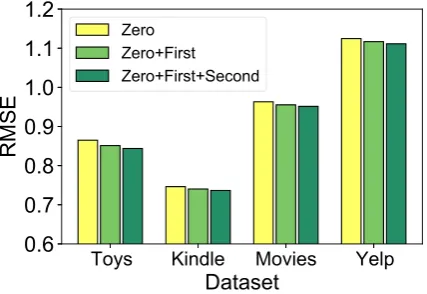
Figure 3: The influence of the depth of the hierarchical attentive graph neural network.
approach can learn user and item representations from both reviews and graphs, which has the po-tential to learn more informative user and item rep-resentations.
The performance of different methods is sum-marized in Table3. The results lead to several ob-servations. First, the methods which combine re-views and ratings (e.g.,HFT,DeepCoNN,NARRE
andRMG) usually outperform the methods based on ratings only (PMF, NMF and SVD++). This is probably because reviews usually contain rich clues on user preferences and item properties, which is useful for user and item representation learning for recommendation.
Second, among the methods considering the content information of reviews, neural network based methods (e.g., DeepCoNN, Attn+CNN,
NARRE and RMG) usually outperform HFT, which is based on topic models. This is prob-ably becauseHFT rely on bag-of-words features to extract topics from reviews, and cannot utilize the contexts and orders of words. Different from topic model based methods, neural methods can better model user preferences and item properties by utilizing the rich semantic information in re-views, which is beneficial for recommendation.
Third, among the methods based on deep learn-ing, RMG-reviewandRMG can consistently out-perform other baseline methods. This is because different words, sentences and reviews usually have different informativeness for modeling users and items. Different fromAttn+CNN,NARREand
DeepCoNN, bothRMG-reviewandRMGuse a hi-erarchical model to learn user and item representa-tions. In addition, our approach can select impor-tant words, sentences and reviews via a three-level attention network to help learn more accurate user and item representations for recommendation.
Fourth, our RMG approach which incorpo-rates information of user-item graph outperforms other methods based on reviews only (e.g., RMG-review), and further hypothesis test results show that the advantage over RMG-review is signifi-cant. This is because the information of user-item graphs is useful for recommendation, and model-ing the interactions between users amd items in graphs can help learn more accurate user and item representations. This result validates the effective-ness of our approach.
4.3 Influence of the Depth of Graph Neural Network
[image:7.595.76.290.368.515.2](a) Attentions in the review content-view.
[image:8.595.75.292.74.275.2](b) Attentions in the graph-view.
Figure 4: The effectiveness of different attentions.
with the zero-order encoder only or with both the zero- and first-order encoder. The results are il-lustrated in Fig. 3. According to the results, we find the performance of our approach can be con-sistently improved as the depth increases. This is because the first-order information of graph con-tains the interactions between users and items, and the second-order information can reveal the user-user and item-item relatedness. Thus, more infor-mation can be incorporated as the depth increases, which can benefit user and item representation learning. Although the performance may be fur-ther improved when the depth gets deeper, in our approach we only set the depth of the graph neural network to 2. This is because the item, user-user and item-item interactions are usually suffi-cient for modeling users and items, and their high-order relatedness is usually weak. In addition, the computational cost is huge when higher-order in-formation is considered. Thus, a moderate depth of the graph neural network (i.e., 2) is the most appropriate for our approach.
4.4 Effectiveness of Attention Mechanism
In this section, we conducted experiments to ex-plore the effectiveness of the attention networks in our approach. First, we want to validate the effectiveness of the attention network in the re-view content-re-view. We compare the performance of several variants of our approach with one kind of attention network removed to evaluate the con-tribution of different attentions. The results are shown in Fig.4(a). From Fig.4(a), the word-level attention can effectively improve the performance of our approach. This is because different words in the same review have different importance in rep-resenting this review. Therefore, selecting impor-tant words via a word-level attention network can learn more informative sentence representations. In addition, the sentence-level attention is also useful. This is because different sentences also have different informativeness, and selecting im-portant sentences using a sentence-level attention network can benefit review representation learn-ing. Besides, the review-level attention is also use-ful in our approach. This is because different re-views have different informativeness for learning user and item representations, and distinguishing informative reviews from the uninformative ones can help learn more accurate user and item repre-sentations. Moreover, combining all three kinds of attentions can further improve our approach, which validates the effectiveness of our hierarchi-cal attention framework.
Then, we want to validate the effectiveness of the attention network in the graph-view. We com-pare our approach with its variants by removing the attention networks in the first-order or second-order encoder to validate the effectiveness of them. The results are shown in Fig.4(b). According to Fig. 4(b), we find the attention networks in both first- and second-order encoders are important in our approach. This may be because the interac-tions between users and items usually have differ-ent importance in represdiffer-enting them, and distin-guish informative interactions from uninformative ones is useful for learning better user and item rep-resentations. These results validate the effective-ness of the attention networks in the graph-view.
4.5 Case Study
[image:8.595.75.292.193.390.2](a) RMG-review (b)RMG
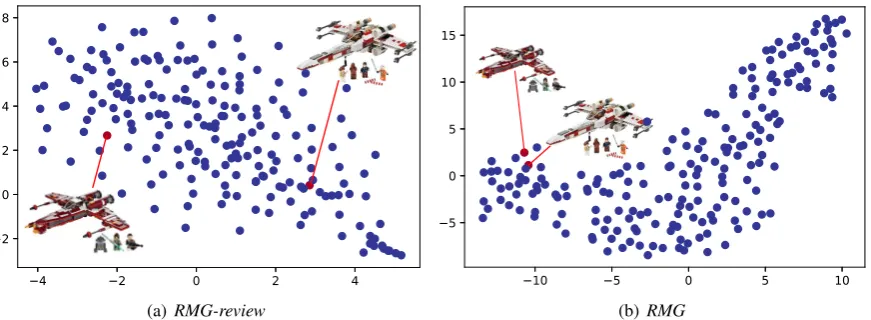
Figure 5: Visualization of the item representations learned byRMG-reviewandRMGvia t-SNE. Each point repre-sents an item. The red points represent two similar items.
we use t-SNE to visualize the representations of several randomly selected items in theToysdataset learned by RMG-review andRMG. Among these items there are two very similar items, both of which are Lego toys of the planes in Star Wars. The results are respectively shown in Fig. 5(a)
and5(b)4. From the results, we find the distance between the representations of these two items learned byRMG-reviewis large, which usually in-dicates their similarity is low. This may be because the reviews of both items are insufficient (only 3 reviews appeared in the training set), making it difficult for RMG-review to learn accurate repre-sentations of them. Different from RMG-review, our RMG approach can correctly recognize that both items are very similar. This is probably be-cause our approach can mine the user-user and item-item relatedness by modeling the first-order and second-order interactions between users and items. Thus, ourRMG approach can learn better user and item representations.
5 Conclusion and Future Work
In this paper, we propose a reviews meet graphs approach for recommendation which can exploit information of user-item graphs. In our approach, we use a multi-view framework to incorporate re-view texts and user-item graphs as different re-views. In the review content-view, we use a hierarchical model to first learn sentence representations from words, then learn review representations from sen-tences, and finally learn user/item representations
4We aims to show the relative similarities between the
representations of the two items, and their absolute distances are not comparable in the two figures.
from reviews. In addition, we apply a three-level attention network to select important words, sen-tences and reviews for informative representation learning. In the graph-view, we propose to use a graph neural network to jointly mine user-item, user-user and item-item relatedness by modeling the first- and second-order interactions between users and items in graphs. In addition, we pro-pose to apply attention mechanism to model the importance of these interactions to learn more ac-curate user and item representations. Experiments on four benchmark datasets validate the effective-ness of our approach.
In our future work, we will explore several po-tential directions. First, since we only use the local neighbors of nodes in the user-item graph, we will explore the use of other kinds of graph neural net-works to further enhance the learning of users and items. Second, since there are also other kinds of user and item information, we will explore how to incorporate heterogeneous user and item infor-mation to benefit recommendation. Third, we will work on how to reduce the computational cost of our approach, which can improve the applicability of our approach.
Acknowledgments
References
Yang Bao, Hui Fang, and Jie Zhang. 2014. Topicmf: Simultaneously exploiting ratings and reviews for recommendation. InAAAI, volume 14, pages 2–8.
Rianne van den Berg, Thomas N Kipf, and Max Welling. 2017. Graph convolutional matrix comple-tion. arXiv preprint arXiv:1706.02263.
Rose Catherine and William Cohen. 2017. Transnets: Learning to transform for recommendation. In Rec-Sys, pages 288–296. ACM.
Chong Chen, Min Zhang, Yiqun Liu, and Shaoping Ma. 2018. Neural attentional rating regression with review-level explanations. In WWW, pages 1583– 1592.
Qiming Diao, Minghui Qiu, Chao-Yuan Wu, Alexan-der J Smola, Jing Jiang, and Chong Wang. 2014. Jointly modeling aspects, ratings and sentiments for movie recommendation (jmars). In KDD, pages 193–202.
Ruining He and Julian McAuley. 2016. Ups and downs: Modeling the visual evolution of fashion trends with one-class collaborative filtering. In WWW, pages 507–517.
Xiangnan He, Tao Chen, Min-Yen Kan, and Xiao Chen. 2015. Trirank: Review-aware explainable recommendation by modeling aspects. In CIKM, pages 1661–1670.
Diederik P Kingma and Jimmy Ba. 2014. Adam: A method for stochastic optimization. arXiv preprint arXiv:1412.6980.
Yehuda Koren. 2008. Factorization meets the neigh-borhood: a multifaceted collaborative filtering model. InKDD, pages 426–434.
Yehuda Koren, Robert Bell, and Chris Volinsky. 2009. Matrix factorization techniques for recommender systems. Computer, (8):30–37.
Daniel D Lee and H Sebastian Seung. 2001. Al-gorithms for non-negative matrix factorization. In NIPS, pages 556–562.
Guang Ling, Michael R Lyu, and Irwin King. 2014. Ratings meet reviews, a combined approach to rec-ommend. InRecSys, pages 105–112.
Julian McAuley and Jure Leskovec. 2013. Hidden fac-tors and hidden topics: understanding rating dimen-sions with review text. InRecSys, pages 165–172.
Tomas Mikolov, Ilya Sutskever, Kai Chen, Greg S Cor-rado, and Jeff Dean. 2013. Distributed representa-tions of words and phrases and their compositional-ity. InNIPS, pages 3111–3119.
Andriy Mnih and Ruslan R Salakhutdinov. 2008. Prob-abilistic matrix factorization. InNIPS, pages 1257– 1264.
Zhaochun Ren, Shangsong Liang, Piji Li, Shuaiqiang Wang, and Maarten de Rijke. 2017. Social collabo-rative viewpoint regression with explainable recom-mendations. InWSDM, pages 485–494.
Sungyong Seo, Jing Huang, Hao Yang, and Yan Liu. 2017a. Interpretable convolutional neural networks with dual local and global attention for review rating prediction. InRecSys, pages 297–305. ACM.
Sungyong Seo, Jing Huang, Hao Yang, and Yan Liu. 2017b. Representation learning of users and items for review rating prediction using attention-based convolutional neural network. InMLRec.
Nitish Srivastava, Geoffrey E Hinton, Alex Krizhevsky, Ilya Sutskever, and Ruslan Salakhutdinov. 2014. Dropout: a simple way to prevent neural networks from overfitting. Journal of machine learning re-search, 15(1):1929–1958.
Yunzhi Tan, Min Zhang, Yiqun Liu, and Shaoping Ma. 2016. Rating-boosted latent topics: Understanding users and items with ratings and reviews. InIJCAI, pages 2640–2646.
Yi Tay, Anh Tuan Luu, and Siu Cheung Hui. 2018. Multi-pointer co-attention networks for recommen-dation. InKDD, pages 2309–2318.
Petar Veliˇckovi´c, Guillem Cucurull, Arantxa Casanova, Adriana Romero, Pietro Lio, and Yoshua Bengio. 2017. Graph attention networks. arXiv preprint arXiv:1710.10903.
Chuhan Wu, Fangzhao Wu, Junxin Liu, and Yongfeng Huang. 2019. Hierarchical user and item represen-tation with three-tier attention for recommendation. InNAACL, pages 1818–1826.
Wei Zhang, Quan Yuan, Jiawei Han, and Jianyong Wang. 2016. Collaborative multi-level embedding learning from reviews for rating prediction. In IJ-CAI, pages 2986–2992.
Yongfeng Zhang, Guokun Lai, Min Zhang, Yi Zhang, Yiqun Liu, and Shaoping Ma. 2014. Explicit fac-tor models for explainable recommendation based on phrase-level sentiment analysis. InSIGIR, pages 83–92.