Proceedings of the 2019 Conference on Empirical Methods in Natural Language Processing
4323
Patient Knowledge Distillation for BERT Model Compression
Siqi Sun, Yu Cheng, Zhe Gan, Jingjing Liu Microsoft Dynamics 365 AI Research
{Siqi.Sun,Yu.Cheng,Zhe.Gan,jingjl}@microsoft.com
Abstract
Pre-trained language models such as BERT have proven to be highly effective for natu-ral language processing (NLP) tasks. How-ever, the high demand for computing resources in training such models hinders their applica-tion in practice. In order to alleviate this re-source hunger in large-scale model training, we propose a Patient Knowledge Distillation approach to compress an original large model (teacher) into an equally-effective lightweight shallow network (student). Different from pre-vious knowledge distillation methods, which only use the output from the last layer of the teacher network for distillation, our student modelpatientlylearns from multiple interme-diate layers of the teacher model for incremen-tal knowledge extraction, following two strate-gies: (i) PKD-Last: learning from the last k layers; and (ii) PKD-Skip: learning from ev-ery k layers. These two patient distillation schemes enable the exploitation of rich infor-mation in the teacher’s hidden layers, and en-courage the student model to patiently learn from and imitate the teacher through a multi-layer distillation process. Empirically, this translates into improved results on multiple NLP tasks with significant gain in training ef-ficiency, without sacrificing model accuracy.1
1 Introduction
Language model pre-training has proven to be highly effective in learning universal language representations from large-scale unlabeled data. ELMo (Peters et al.,2018), GPT (Radford et al., 2018) and BERT (Devlin et al., 2018) have achieved great success in many NLP tasks, such as sentiment classification (Socher et al.,2013), natu-ral language inference (Williams et al.,2017), and question answering (Lai et al.,2017).
1Code will be avialable at https://github.com/
intersun/PKD-for-BERT-Model-Compression.
Despite its empirical success, BERT’s compu-tational efficiency is a widely recognized issue be-cause of its large number of parameters. For exam-ple, the original BERT-Base model has 12 layers and 110 million parameters. Training from scratch typically takes four days on 4 to 16 Cloud TPUs. Even fine-tuning the pre-trained model with task-specific dataset may take several hours to finish one epoch. Thus, reducing computational costs for such models is crucial for their application in prac-tice, where computational resources are limited.
Motivated by this, we investigate the redun-dancy issue of learned parameters in large-scale pre-trained models, and propose a new model compression approach,Patient Knowledge Distil-lation (Patient-KD), to compress original teacher (e.g., BERT) into a lightweight student model without performance sacrifice. In our approach, the teacher model outputs probability logits and predicts labels for the training samples (extend-able to additional unannotated samples), and the student model learns from the teacher network to mimic the teacher’s prediction.
Different from previous knowledge distillation methods (Hinton et al., 2015; Sau and Balasub-ramanian,2016;Lu et al., 2017), we adopt a pa-tientlearning mechanism: instead of learning pa-rameters from only the last layer of the teacher, we encourage the student model to extract knowl-edge also from previous layers of the teacher net-work. We call this ‘Patient Knowledge Distilla-tion’. This patient learner has the advantage of dis-tilling rich information through the deep structure of the teacher network for multi-layer knowledge distillation.
to teach the student; and (ii) PKD-Skip: the stu-dent learns from everyklayers of the teacher, sug-gesting that the lower layers of the teacher network also contain important information and should be passed along for incremental distillation.
We evaluate the proposed approach on sev-eral NLP tasks, including Sentiment Classifi-cation, Paraphrase Similarity Matching, Natu-ral Language Inference, and Machine Reading Comprehension. Experiments on seven datasets across these four tasks demonstrate that the pro-posed Patient-KD approach achieves superior per-formance and better generalization than standard knowledge distillation methods (Hinton et al., 2015), with significant gain in training efficiency and storage reduction while maintaining compa-rable model accuracy to original large models. To the authors’ best knowledge, this is the first known effort for BERT model compression.
2 Related Work
Language Model Pre-training Pre-training has been widely applied to universal language repre-sentation learning. Previous work can be divided into two main categories: (i) feature-based ap-proach; (ii) fine-tuning approach.
Feature-based methods mainly focus on learn-ing: (i) context-independent word representa-tion (e.g., word2vec (Mikolov et al., 2013), GloVe (Pennington et al., 2014), FastText (Bo-janowski et al., 2017)); (ii) sentence-level rep-resentation (e.g., Kiros et al. (2015); Conneau et al. (2017); Logeswaran and Lee (2018)); and (iii) contextualized word representation (e.g., Cove (McCann et al.,2017), ELMo (Peters et al., 2018)). Specifically, ELMo (Peters et al., 2018) learns high-quality, deep contextualized word rep-resentation using bidirectional language model, which can be directly plugged into standard NLU models for performance boosting.
On the other hand, fine-tuning approaches mainly pre-train a language model (e.g., GPT (Radford et al., 2018), BERT (Devlin et al., 2018)) on a large corpus with an unsu-pervised objective, and then fine-tune the model with in-domain labeled data for downstream applications (Dai and Le, 2015; Howard and Ruder,2018). Specifically, BERT is a large-scale language model consisting of multiple layers of Transformer blocks (Vaswani et al., 2017). BERT-Base has 12 layers of Transformer and 110
million parameters, while BERT-Large has 24 layers of Transformer and 330 million parameters. By pre-training via masked language modeling and next sentence prediction, BERT has achieved state-of-the-art performance on a wide-range of NLU tasks, such as the GLUE benchmark (Wang et al.,2018) and SQuAD (Rajpurkar et al.,2016).
However, these modern pre-trained language models contain millions of parameters, which hin-ders their application in practice where computa-tional resource is limited. In this paper, we aim at addressing this critical and challenging prob-lem, taking BERT as an example, i.e., how to compress a large BERT model into a shallower one without sacrificing performance. Besides, the proposed approach can also be applied to other large-scale pre-trained language models, such as recently proposed XLNet (Yang et al.,2019) and RoBERTa (Liu et al.,2019b).
Model Compression & Knowledge Distillation
Our focus is model compression,i.e.,making deep neural networks more compact (Han et al.,2016; Cheng et al., 2015). A similar line of work has focused on accelerating deep network inference at test time (Vetrov et al.,2017) and reducing model training time (Huang et al.,2016).
A conventional understanding is that a large number of connections (weights) is necessary for training deep networks (Denil et al., 2013; Zhai et al., 2016). However, once the network has been trained, there will be a high degree of pa-rameter redundancy. Network pruning (Han et al., 2015; He et al., 2017), in which network con-nections are reduced or sparsified, is one com-mon strategy for model compression. Another di-rection is weight quantization (Gong et al.,2014; Polino et al.,2018), in which connection weights are constrained to a set of discrete values, allowing weights to be represented by fewer bits. However, most of these pruning and quantization approaches perform on convolutional networks. Only a few work are designed for rich structural information such as deep language models (Changpinyo et al., 2017).
large model can serve as hints to improve the train-ing process and the final performance of the com-pact model. Chen et al. (2015) introduced tech-niques for efficiently transferring knowledge from an existing network to a deeper or wider network. More recently,Liu et al.(2019a) used knowledge from ensemble models to improve single model performance on NLU tasks. Tan et al. (2019) tried knowledge distillation for multilingual trans-lation. Different from the above efforts, we inves-tigate the problem of compressing large-scale lan-guage models, and propose a novelpatient knowl-edge distillation approach to effectively transfer-ring knowledge from a teacher to a student model.
3 Patient Knowledge Distillation
In this section, we first introduce a vanilla knowl-edge distillation method for BERT compression (Section 3.1), then present the proposed Patient Knowledge Distillation (Section3.2) in details.
Problem Definition The original large teacher network is represented by a function f(x;θ), wherexis the input to the network, andθdenotes the model parameters. The goal of knowledge dis-tillation is to learn a new set of parametersθ0 for a shallower student networkg(x;θ0), such that the student network achieves similar performance to the teacher, with much lower computational cost. Our strategy is to force the student model to imi-tate outputs from the teacher model on the training dataset with a defined objectiveLKD.
3.1 Distillation Objective
In our setting, the teacher f(x;θ) is defined as a deep bidirectional encoder, e.g., BERT, and the studentg(x;θ0)is a lightweight model with fewer layers. For simplicity, we use BERTk to denote
a model with k layers of Transformers. Follow-ing the original BERT paper (Devlin et al.,2018), we also use BERT-Base and BERT-Large to de-note BERT12and BERT24, respectively.
Assume {xi,yi}Ni=1 are N training samples,
where xi is the i-th input instance for BERT,
and yi is the corresponding ground-truth label.
BERT first computes a contextualized embedding hi = BERT(xi) ∈ Rd. Then, a softmax layer
ˆ
yi = P(yi|xi) =sof tmax(Whi)for
classifica-tion is applied to the embedding of BERT output, whereWis a weight matrix to be learned.
To apply knowledge distillation, first we need to train a teacher network. For example, to train a
12-layer BERT-Base as the teacher model, the learned parameters are denoted as:
ˆ
θt= arg min
θ
X
i∈[N]
LtCE(xi,yi; [θBERT12,W])
(1)
where the superscript t denotes parameters in the teacher model,[N]denotes set{1,2, . . . , N}, LtCE denotes the cross-entropy loss for the teacher training, and θBERT12 denotes parameters
of BERT12.
The output probability for any given input xi
can be formulated as:
ˆ
yi=Pt(yi|xi) =sof tmax
Whi T
=sof tmax
W·BERT12(xi; ˆθt) T
(2)
wherePt(·|·)denotes the probability output from the teacher. yˆi is fixed as soft labels, and T
is the temperature used in KD, which controls how much to rely on the teacher’s soft predic-tions. A higher temperature produces a more di-verse probability distribution over classes (Hinton et al., 2015). Similarly, let θs denote parameters to be learned for the student model, and Ps(·|·) denote the corresponding probability output from the student model. Thus, the distance between the teacher’s prediction and the student’s prediction can be defined as:
LDS=−
X
i∈[N] X
c∈C
h
Pt(yi=c|xi; ˆθt)·
logPs(yi =c|xi;θs)
i
(3)
wherec is a class label and C denotes the set of class labels.
Besides encouraging the student model to imi-tate the teacher’s behavior, we can also fine-tune the student model on target tasks, where task-specific cross-entropy loss is included for model training:
LsCE =− X
i∈[N] X
c∈C
h
1[yi=c]·
logPs(yi=c|xi;θs)
i
(4)
Thus, the final objective function for knowledge distillation can be formulated as:
LKD = (1−α)LsCE +αLDS (5)
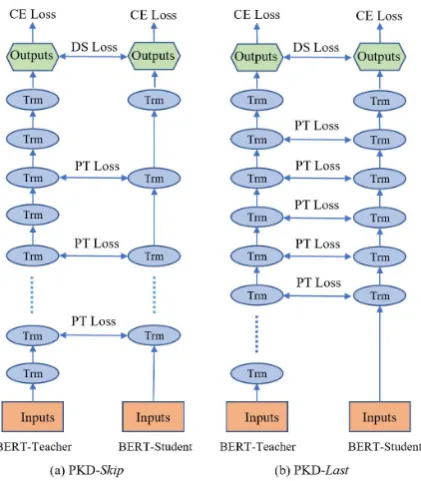
Figure 1: Model architecture of the proposed Patient Knowledge Distillation approach to BERT model com-pression. (Left) PKD-Skip: the student network learns the teacher’s outputs in every 2 layers. (Right) PKD-Last: the student learns the teacher’s outputs from the last 6 layers. Trm: Transformer.
3.2 Patient Teacher for Model Compression
Using a weighted combination of ground-truth la-bels and soft predictions from the last layer of the teacher network, the student network can achieve comparable performance to the teacher model on the training set. However, with the number of epochs increasing, the student model learned with this vanilla KD framework quickly reaches satura-tion on the test set (see Figure2in Section4).
One hypothesis is that overfitting during knowl-edge distillation may lead to poor generalization. To mitigate this issue, instead of forcing the stu-dent to learn only from the logits of the last layer, we propose a “patient” teacher-student mecha-nism to distill knowledge from the teacher’s inter-mediate layers as well. Specifically, we investi-gate two patient distillation strategies: (i) PKD-Skip: the student learns from everyklayers of the teacher (Figure 1: Left); and (ii) PKD-Last: the student learns from thelastklayers of the teacher (Figure1: Right).
Learning from the hidden states of all the to-kens is computationally expensive, and may intro-duce noise. In the original BERT implementation (Devlin et al., 2018), prediction is performed by only using the output from the last layer’s[CLS]
token. In some variants of BERT, like SDNet (Zhu et al., 2018), a weighted average of all lay-ers’ [CLS] embeddings is applied. In general, the final logit can be computed based onhfinal = P
j∈[k]wjhj, wherewjcould be either learned
pa-rameters or a pre-defined hyper-parameter, hj is
the embedding of [CLS] from the hidden layer j, andkis the number of hidden layers. Derived from this, if the compressed model can learn from the representation of[CLS]in the teacher’s inter-mediate layers for any given input, it has the po-tential of gaining a generalization ability similar to the teacher model.
Motivated by this, in our Patient-KD frame-work, the student is cultivated to imitate the repre-sentations only for the[CLS]token in the inter-mediate layers, following the intuition aforemen-tioned that the [CLS]token is important in pre-dicting the final labels. For an inputxi, the outputs
of the[CLS]tokens for all the layers are denoted as:
hi= [hi,1,hi,2, . . . ,hi,k] =BERTk(xi)∈Rk×d
(6)
We denote the set of intermediate layers to dis-till knowledge from as Ipt. Take distilling from
BERT12to BERT6 as an example. For the
PKD-Skip strategy, Ipt = {2,4,6,8,10}; and for the
PKD-Last strategy, Ipt = {7,8,9,10,11}. Note
thatk= 5for both cases, because the output from the last layer (e.g., Layer 12 for BERT-Base) is omitted since its hidden states are connected to the softmax layer, which is already included in the KD loss defined in Eqn. (5). In general, for BERT stu-dent withnlayers,kalways equals ton−1.
The additional training loss introduced by the patient teacher is defined as the mean-square loss between the normalized hidden states:
LP T = N
X
i=1 M
X
j=1
hsi,j ||hsi,j||2
− h
t i,Ipt(j) ||hti,I
pt(j)||2
2
2 (7)
whereM denotes the number of layers in the stu-dent network, N is the number of training sam-ples, and the superscriptssandtinhindicate the student and the teacher model, respectively. Com-bined with the KD loss introduced in Section3.1, the final objective function can be formulated as:
LP KD= (1−α)LsCE +αLDS+βLP T (8)
4 Experiments
In this section, we describe our experiments on ap-plying the proposed Patient-KD approach to four different NLP tasks. Details on the datasets and experimental results are provided in the following sub-sections.
4.1 Datasets
We evaluate our proposed approach on Sentiment Classification, Paraphrase Similarity Matching, Natural Language Inference, and Machine Read-ing Comprehension tasks. For Sentiment Clas-sification, we test on Stanford Sentiment Tree-bank (SST-2) (Socher et al., 2013). For Para-phrase Similarity Matching, we use Microsoft Re-search Paraphrase Corpus (MRPC) (Dolan and Brockett,2005) and Quora Question Pairs (QQP)2 datasets. For Natural Language Inference, we evaluate on Multi-Genre Natural Language Infer-ence (MNLI) (Williams et al.,2017), QNLI3 (Ra-jpurkar et al.,2016), and Recognizing Textual En-tailment (RTE).
More specifically, SST-2 is a movie review dataset with binary annotations, where the bi-nary label indicates positive and negative re-views. MRPC contains pairs of sentences and corresponding labels, which indicate the semantic equivalence relationship between each pair. QQP is designed to predict whether a pair of questions is duplicate or not, provided by a popular on-line question-answering website Quora. MNLI is a multi-domain NLI task for predicting whether a given premise-hypothesis pair is entailment, contradiction or neural. Its test and develop-ment datasets are further divided into in-domain (MNLI-m) and cross-domain (MNLI-mm) splits to evaluate the generality of tested models. QNLI is a task for predicting whether a question-answer pair is entailment or not. Finally, RTE is based on a series of textual entailment challenges, cre-ated by General Language Understanding Evalua-tion (GLUE) benchmark (Wang et al.,2018).
For the Machine Reading Comprehension task, we evaluate on RACE (Lai et al., 2017), a large-scale dataset collected from English exams, con-taining 25,137 passages and 87,866 questions. For each question, four candidate answers are
pro-2
https://data.quora.com/First-Quora-Dataset-Release-Question-Pairs
3The dataset is derived from Stanford Question Answer
Dataset (SQuAD).
vided, only one of which is correct. The dataset is further divided into RACE-M and RACE-H, con-taining exam questions for middle school and high school students.
4.2 Baselines and Training Details
For experiments on the GLUE benchmark, since all the tasks can be considered as sentence (or sentence-pair) classification, we use the same ar-chitecture in the original BERT (Devlin et al., 2018), and fine-tune each task independently.
For experiments on RACE, we denote the in-put passage asP, the question asq, and the four answers as a1, . . . , a4. We first concatenate the
tokens inq and eachai, and arrange the input of
BERT as[CLS]P[SEP]q+ai[SEP]for each
input pair(P, q+ai), where[CLS]and[SEP]
are the special tokens used in the original BERT. In this way, we can obtain a single logit value for eachai. At last, a softmax layer is placed on top of
these four logits to obtain the normalized probabil-ity of each answerai being correct, which is then
used to compute the cross-entropy loss for model-ing trainmodel-ing.
We fine-tune BERT-Base (denoted as BERT12)
as the teacher model to compute soft labels for each task independently, where the pretrained model weights are obtained from Google’s offi-cial BERT’s repo4, and use 3 and 6 layers of Transformers as the student models (BERT3 and
BERT6), respectively. We initialize BERTk with
the first k layers of parameters from pre-trained BERT-Base, where k ∈ {3,6}. To validate the effectiveness of our proposed approach, we first conduct direct fine-tuning on each task without us-ing any soft labels. In order to reduce the hyper-parameter search space, we fix the number of hid-den units in the final softmax layer as 768, the batch size as 32, and the number of epochs as 4 for all the experiments, with a learning rate from {5e-5, 2e-5, 1e-5}. The model with the best vali-dation accuracy is selected for each setting.
Besides direct fine-tuning, we further imple-ment a vanilla KD method on all the tasks by optimizing the objective function in Eqn. (5). We set the temperature T as {5, 10, 20}, α = {0.2,0.5,0.7}, and perform grid search overT,α and learning rate, to select the model with the best validation accuracy. For our proposed Patient-KD approach, we conduct additional search over β
Model SST-2 MRPC QQP MNLI-m MNLI-mm QNLI RTE
(67k) (3.7k) (364k) (393k) (393k) (105k) (2.5k)
BERT12(Google) 93.5 88.9/84.8 71.2/89.2 84.6 83.4 90.5 66.4
BERT12(Teacher) 94.3 89.2/85.2 70.9/89.0 83.7 82.8 90.4 69.1
BERT6-FT 90.7 85.9/80.2 69.2/88.2 80.4 79.7 86.7 63.6
BERT6-KD 91.5 86.2/80.6 70.1/88.8 80.2 79.8 88.3 64.7
BERT6-PKD 92.0 85.0/79.9 70.7/88.9 81.5 81.0 89.0 65.5
BERT3-FT 86.4 80.5/72.6 65.8/86.9 74.8 74.3 84.3 55.2
BERT3-KD 86.9 79.5/71.1 67.3/87.6 75.4 74.8 84.0 56.2
[image:6.595.81.522.298.411.2]BERT3-PKD 87.5 80.7/72.5 68.1/87.8 76.7 76.3 84.7 58.2
Table 1: Results from the GLUE test server. The best results for 3-layer and 6-layer models are in-bold. Google’s submission results are obtained from official GLUE leaderboard. BERT12 (Teacher) is our own implementation
of the BERT teacher model. FT represents direct fine-tuning on each dataset without using knowledge distillation. KD represents using a vanilla knowledge distillation method. And PKD represents our proposed Patient-KD-Skip approach. Results show that PKD-Skip outperforms the baselines on almost all the datasets except for MRPC. The numbers under each dataset indicate the corresponding number of training samples.
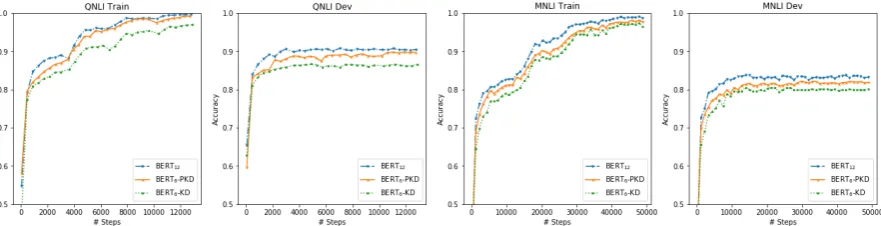
Figure 2: Accuracy on the training and dev sets of QNLI and MNLI datasets, by directly applying vanilla knowl-edge distillation (KD) and the proposed Patient-KD-Skip. The teacher and the student networks are BERT12and
BERT6, respectively. The student network learned with vanilla KD quickly saturates on the dev set, while the
proposed Patient-KD starts to plateau only in a later stage.
from{10,100,500,1000}on all the tasks. Since there are so many hyper-parameters to learn for Patient KD, we fix α and T to the values used in the model with the best performance from the vanilla KD experiments, and only search over β and learning rate.
4.3 Experimental Results
We submitted our model predictions to the offi-cial GLUE evaluation server to obtain results on the test data. Results are summarized in Table1. Compared to direct fine-tuning and vanilla KD, our Patient-KD models with BERT3 and BERT6
students perform the best on almost all the tasks except MRPC. For MNLI-m and MNLI-mm, our 6-layer model improves 1.1% and 1.3% over fine-tune (FT) baselines; for QNLI and QQP, even though the gap between BERT6-KD and BERT12
teacher is relatively small, our approach still suc-ceeded in improving over both FT and KD
base-lines and further closing the gap between the stu-dent and the teacher models.
Furthermore, in 5 tasks out of 7 (SST-2 (-2.3% compared to BERT-Base teacher), QQP (-0.1%), MNLI-m (-2.2%), MNLI-mm (-1.8%), and QNLI (-1.4%)), the proposed 6-layer student coached by the patient teacher achieved similar performance to the original BERT-Base, demonstrating the ef-fectiveness of our approach. Interestingly, all those 5 tasks have more than 60k training sam-ples, which indicates that our method tends to per-form better when there is a large amount of train-ing data.
For the QQP task, we can further reduce the model size to 3 layers, where BERT3-PKD can
Patient-Model SST-2 MRPC QQP MNLI-m MNLI-mm QNLI RTE
BERT6(PKD-Last) 91.9 85.1/79.5 70.5/88.9 80.9 81.0 88.2 65.0
BERT6(PKD-Skip) 92.0 85.0/79.9 70.7/88.9 81.5 81.0 89.0 65.5
Table 2: Performance comparison between PKD-Last and PKD-Skip on GLUE benchmark.
KD keeps learning from the teacher and improving accuracy, only starting to plateau in a later stage.
For the MRPC dataset, one hypothesis for the reason on vanilla KD outperforming our model is that the lack of enough training samples may lead to overfitting on the dev set. To further investigate, we repeat the experiments three times and com-pute the average accuracy on the dev set. We ob-serve that fine-tuning and vanilla KD have a mean dev accuracy of 82.23% and 82.84%, respectively. Our proposed method has a higher mean dev accu-racy of 83.46%, hence indicating that our Patient-KD method slightly overfitted to the dev set of MRPC due to the small amount of training data. This can also be observed on the performance gap between teacher and student on RTE in Table 5, which also has a small training set.
We further investigate the performance gain from two different patient teacher designs: PKD-Last vs. PKD-Skip. Results of both PKD variants on the GLUE benchmark (with BERT6 as the
stu-dent) are summarized in Table 2. Although both strategies achieved improvement over the vanilla KD baseline (see Table 1), PKD-Skip performs slightly better than PKD-Last. Presumably, this might be due to the fact that distilling informa-tion across every k layers captures more diverse representations of richer semantics from low-level to high-level, while focusing on the last klayers tends to capture relatively homogeneous semantic information.
Results on RACE are reported in Table3, which shows that the Vanilla KD method outperforms di-rect fine-tuning by 4.42%, and our proposed pa-tient teacher achieves further 1.6% performance lift, which again demonstrates the effectiveness of Patient-KD.
4.4 Analysis of Model Efficiency
We have demonstrated that the proposed Patient-KD method can effectively compress BERT12into
BERT6 models without performance sacrifice. In
this section, we further investigate the efficiency of Patient-KD on storage saving and inference-time speedup. Parameter statistics and inference time
Model RACE RACE-M RACE-H
BERT12(Leaderboard) 65.00 71.70 62.30
BERT12(Teacher) 65.30 71.17 62.89
BERT6-FT 54.32 61.07 51.54
BERT6-KD 58.74 64.69 56.29
BERT6-PKD-Skip 60.34 66.57 57.78
Table 3: Results on RACE test set. BERT12
(Leaderboard) denotes results extracted from the of-ficial leaderboard (http://www.qizhexie.com/ /data/RACE_leaderboard). BERT12 (Teacher)
is our own implementation. Results of BERT3are not
included due to the large gap between the teacher and the BERT3student.
are summarized in Table4. All the models share the same embedding layer with 24 millon param-eters that map a 30k-word vocabulary to a 768-dimensional vector, which leads to 1.64 and 2.4 times of machine memory saving from BERT6and
BERT3, respectively.
To test the inference speed, we ran experiments on 105k samples from QNLI training set (Ra-jpurkar et al., 2016). Inference is performed on a single Titan RTX GPU with batch size set to 128, maximum sequence length set to 128, and FP16 activated. The inference time for the em-bedding layer is negligible compared to the Trans-former layers. Results in Table 4 show that the proposed Patient-KD approach achieves an almost linear speedup, 1.94 and 3.73 times for BERT6and
BERT3, respectively.
4.5 Does a Better Teacher Help?
To evaluate the effectiveness of the teacher model in our Patient-KD framework, we conduct ad-ditional experiments to measure the difference between BERT-Base teacher and BERT-Large teacher for model compression.
Each Transformer layer in BERT-Large has 12.6 million parameters, which is much larger than the Transformer layer used in BERT-Base. For a compressed BERT model with 6 layers, BERT6with BERT-Base Transformer (denoted as
# Layers # Param (Emb) # Params (Trm) Total Params Inference Time (s) 3 23.8M 21.3M 45.7M (2.40×) 27.35 (3.73×) 6 23.8M 42.5M 67.0M (1.64×) 52.51 (1.94×) 12 23.8M 85.1M 109M (1×) 101.89 (1×)
Table 4: The number of parameters and inference time for BERT3, BERT6and BERT12. Parameters in
Transform-ers (Trm) grow linearly with the increase of layTransform-ers. Note that the summation of # Param (Emb) and # Param (Trm) does not exactly equal to Total Params, because there is another softmax layer with 0.6M parameters.
Setting Teacher Student SST-2 MRPC QQP MNLI-m MNLI-mm QNLI RTE N/A N/A BERT12(Teacher) 94.3 89.2/85.2 70.9/89.0 83.7 82.8 90.4 69.1
N/A N/A BERT24(Teacher) 94.3 88.2/84.3 71.9/89.4 85.7 84.8 92.2 72.8
#1 BERT12 BERT6[Base]-KD 91.5 86.2/80.6 70.1/88.8 79.7 79.1 88.3 64.7
#2 BERT24 BERT6[Base]-KD 91.2 86.1/80.7 69.4/88.6 80.2 79.7 87.5 65.7
#3 BERT24 BERT6[Large]-KD 89.6 79.0/70.0 65.0/86.7 75.3 74.6 83.4 53.7
#4 BERT24 BERT6[Large]-PKD 89.8 77.8/68.3 67.1/87.9 77.2 76.7 83.8 53.2
Table 5: Performance comparison with different teacher and student models. BERT6[Base]/[Large] denotes a
BERT6model with a BERT-Base/Large Transformer in each layer. For PKD, we use the PKD-Skip architecture.
while BERT6 with BERT-Large Transformer
(de-noted as BERT6[Large]) has 108.4 million
param-eters. Since the size of the[CLS]token embed-ding is different between Large and BERT-Base, we cannot directly compute the patient teacher loss (7) for BERT6[Base] when
BERT-Large is used as teacher. Hence, in the case where the teacher is BERT-Large and the student is BERT6[Base], we only conduct experiments in
the vanilla KD setting.
Results are summarized in Table 5. When the teacher changes from BERT12 to BERT24 (i.e.,
Setting #1 vs. #2), there is not much differ-ence between the students’ performance. Specif-ically, BERT12 teacher performs better on SST-2,
QQP and QNLI, while BERT24performs better on
MNLI-m, MNLI-mm and RTE. Presumably, dis-tilling knowledge from a larger teacher requires a larger training dataset, thus better results are ob-served on MNLI-m and MNLI-mm.
We also report results on using BERT-Large as the teacher and BERT6[Large] as the
stu-dent. Interestingly, when comparing Setting #1 with #3, BERT6[Large] performs much worse
than BERT6[Base] even though a better teacher
is used in the former case. The BERT6[Large]
student also has 1.6 times more parameters than BERT6[Base]. One intuition behind this is that the
compression ratio for the BERT6[Large] model is
4:1 (24:6), which is larger than the ratio used for the BERT6[Base] model (2:1 (12:6)). The higher
compression ratio renders it more challenging for the student model to absorb important weights.
When comparing Setting # 2 and #3, we
ob-serve that even when the same large teacher is used, BERT6[Large] still performs worse than
BERT6[Base]. Presumably, this may be due
to initialization mismatch. Ideally, we should pre-train BERT6[Large] and BERT6[Base] from
scratch, and use the weights learned from the pre-training step for weight initialization in KD ing. However, due to computational limits of train-ing BERT6from scratch, we only initialize the
stu-dent model with the first six layers of BERT12 or
BERT24. Therefore, the first six layers of BERT24
may not be able to capture high-level features, leading to worse KD performance.
Finally, when comparing Setting #3 vs. #4, where for setting #4 we use Patient-KD-Skip in-stead of vanilla KD, we observe a performance gain on almost all the tasks, which indicates Patient-KD is a generic approach independent of the selection of the teacher model (BERT12 or
BERT24).
5 Conclusion
In this paper, we propose a novel approach to compressing a large BERT model into a shal-low one via Patient Knowledge Distillation. To fully utilize the rich information in deep struc-ture of the teacher network, our Patient-KD ap-proach encourages the student model to patiently learn from the teacher through a multi-layer distil-lation process. Extensive experiments over four NLP tasks demonstrate the effectiveness of our proposed model.
issue, and potentially modify the proposed method such that it could also help during pre-training. Designing more sophisticated distance metrics for loss functions is another exploration direction. We will also investigate Patient-KD in more com-plex settings such as multi-task learning and meta learning.
References
Piotr Bojanowski, Edouard Grave, Armand Joulin, and Tomas Mikolov. 2017. Enriching word vectors with subword information. TACL.
Soravit Changpinyo, Mark Sandler, and Andrey Zhmoginov. 2017. The power of sparsity in convolutional neural networks. arXiv preprint arXiv:1702.06257.
Tianqi Chen, Ian J. Goodfellow, and Jonathon Shlens. 2015. Net2net: Accelerating learning via knowl-edge transfer.arXiv preprint arXiv:1511.05641.
Yu Cheng, Felix X. Yu, Rogerio S. Feris, Sanjiv Kumar, Alok Choudhary, and Shi-Fu Chang. 2015. An ex-ploration of parameter redundancy in deep networks with circulant projections. InICCV.
Alexis Conneau, Douwe Kiela, Holger Schwenk, Loic Barrault, and Antoine Bordes. 2017. Supervised learning of universal sentence representations from natural language inference data. InEMNLP.
Andrew M Dai and Quoc V Le. 2015. Semi-supervised sequence learning. InNIPS.
Misha Denil, Babak Shakibi, Laurent Dinh, Marc’Aurelio Ranzato, and Nando de Freitas. 2013. Predicting parameters in deep learning. In
NIPS.
Jacob Devlin, Ming-Wei Chang, Kenton Lee, and Kristina Toutanova. 2018. Bert: Pre-training of deep bidirectional transformers for language understand-ing. arXiv preprint arXiv:1810.04805.
William B Dolan and Chris Brockett. 2005. Automati-cally constructing a corpus of sentential paraphrases. InProceedings of the Third International Workshop on Paraphrasing.
Yunchao Gong, Liu Liu, Ming Yang, and Lubomir D. Bourdev. 2014. Compressing deep convolutional networks using vector quantization. arXiv preprint arXiv:1412.6115.
Song Han, Huizi Mao, and William J Dally. 2016. Deep compression: Compressing deep neural net-works with pruning, trained quantization and huff-man coding. InICLR.
Song Han, Jeff Pool, John Tran, and William J. Dally. 2015. Learning both weights and connections for efficient neural networks. InNIPS.
Yihui He, Xiangyu Zhang, and Jian Sun. 2017. Chan-nel pruning for accelerating very deep neural net-works. InICCV.
Geoffrey Hinton, Oriol Vinyals, and Jeff Dean. 2015. Distilling the knowledge in a neural network. arXiv preprint arXiv:1503.02531.
Jeremy Howard and Sebastian Ruder. 2018. Universal language model fine-tuning for text classification. In
ACL.
Gao Huang, Yu Sun, Zhuang Liu, Daniel Sedra, and Kilian Q. Weinberger. 2016. Deep networks with stochastic depth. InECCV.
Ryan Kiros, Yukun Zhu, Ruslan R Salakhutdinov, Richard Zemel, Raquel Urtasun, Antonio Torralba, and Sanja Fidler. 2015. Skip-thought vectors. In
NIPS.
Guokun Lai, Qizhe Xie, Hanxiao Liu, Yiming Yang, and Eduard Hovy. 2017. Race: Large-scale reading comprehension dataset from examinations. arXiv preprint arXiv:1704.04683.
Xiaodong Liu, Pengcheng He, Weizhu Chen, and Jianfeng Gao. 2019a. Improving multi-task deep neural networks via knowledge distillation for natural language understanding. arXiv preprint arXiv:1904.09482.
Yinhan Liu, Myle Ott, Naman Goyal, Jingfei Du, Man-dar Joshi, Danqi Chen, Omer Levy, Mike Lewis, Luke Zettlemoyer, and Veselin Stoyanov. 2019b. Roberta: A robustly optimized BERT pretraining approach.arXiv preprint arXiv:1907.11692.
Lajanugen Logeswaran and Honglak Lee. 2018. An efficient framework for learning sentence represen-tations. InICLR.
Liang Lu, Michelle Guo, and Steve Renals. 2017. Knowledge distillation for small-footprint highway networks. InICASSP.
Bryan McCann, James Bradbury, Caiming Xiong, and Richard Socher. 2017. Learned in translation: Con-textualized word vectors. InNIPS.
Tomas Mikolov, Ilya Sutskever, Kai Chen, Greg S Cor-rado, and Jeff Dean. 2013. Distributed representa-tions of words and phrases and their compositional-ity. InNIPS.
Jeffrey Pennington, Richard Socher, and Christopher Manning. 2014. Glove: Global vectors for word representation. InEMNLP.
Matthew E Peters, Mark Neumann, Mohit Iyyer, Matt Gardner, Christopher Clark, Kenton Lee, and Luke Zettlemoyer. 2018. Deep contextualized word rep-resentations. InNAACL.
Alec Radford, Karthik Narasimhan, Tim Salimans, and Ilya Sutskever. 2018. Improving language under-standing by generative pre-training.arXiv.
Pranav Rajpurkar, Jian Zhang, Konstantin Lopyrev, and Percy Liang. 2016. Squad: 100,000+ questions for machine comprehension of text. InEMNLP.
Adriana Romero, Nicolas Ballas, Samira Ebrahimi Ka-hou, Antoine Chassang, Carlo Gatta, and Yoshua Bengio. 2015. Fitnets: Hints for thin deep nets. In
ICLR.
Bharat Bhusan Sau and Vineeth N Balasubrama-nian. 2016. Deep model compression: Distilling knowledge from noisy teachers. arXiv preprint arXiv:1610.09650.
Richard Socher, Alex Perelygin, Jean Wu, Jason Chuang, Christopher D Manning, Andrew Ng, and Christopher Potts. 2013. Recursive deep models for semantic compositionality over a sentiment tree-bank. InEMNLP.
Xu Tan, Yi Ren, Di He, Tao Qin, Zhou Zhao, and Tie-Yan Liu. 2019. Multilingual neural machine trans-lation with knowledge distiltrans-lation. InICLR.
Ashish Vaswani, Noam Shazeer, Niki Parmar, Jakob Uszkoreit, Llion Jones, Aidan N Gomez, Łukasz Kaiser, and Illia Polosukhin. 2017. Attention is all you need. InNIPS.
Dmitry P. Vetrov, Jonathan Huang, Li Zhang, Maxwell Collins, Michael Figurnov, Ruslan Salakhutdinov, and Yukun Zhu. 2017. Spatially adaptive compu-tation time for residual networks. InCVPR.
Alex Wang, Amapreet Singh, Julian Michael, Felix Hill, Omer Levy, and Samuel R Bowman. 2018. Glue: A multi-task benchmark and analysis platform for natural language understanding. arXiv preprint arXiv:1804.07461.
Adina Williams, Nikita Nangia, and Samuel R Bow-man. 2017. A broad-coverage challenge corpus for sentence understanding through inference. arXiv preprint arXiv:1704.05426.
Zhilin Yang, Zihang Dai, Yiming Yang, Jaime Car-bonell, Ruslan Salakhutdinov, and Quoc V Le. 2019. Xlnet: Generalized autoregressive pretrain-ing for language understandpretrain-ing. arXiv preprint arXiv:1906.08237.
Shuangfei Zhai, Yu Cheng, Weining Lu, and Zhongfei Mark Zhang. 2016. Doubly convolutional neural networks. InNIPS.
Chenguang Zhu, Michael Zeng, and Xuedong Huang. 2018. Sdnet: Contextualized attention-based deep network for conversational question answering.