Proceedings of the 2019 Conference on Empirical Methods in Natural Language Processing 1990
How to Build User Simulators to Train RL-based Dialog Systems
Weiyan Shi⇤1, Kun Qian⇤1, Xuewei Wang2 and Zhou Yu1 1 University of California, Davis,2Carnegie Mellon University
{wyshi, kunqian, joyu}@ucdavis.edu, [email protected]
Abstract
User simulators are essential for training rein-forcement learning (RL) based dialog models. The performance of the simulator directly im-pacts the RL policy. However, building a good user simulator that models real user behaviors is challenging. We propose a method of stan-dardizing user simulator building that can be used by the community to compare dialog sys-tem quality using the same set of user simu-lators fairly. We present implementations of six user simulators trained with different dia-log planning and generation methods. We then calculate a set of automatic metrics to eval-uate the quality of these simulators both di-rectly and indidi-rectly. We also ask human users to assess the simulators directly and indirectly by rating the simulated dialogs and interacting with the trained systems. This paper presents a comprehensive evaluation framework for user simulator study and provides a better under-standing of the pros and cons of different user simulators, as well as their impacts on the trained systems. 1
1 Introduction
Reinforcement Learning has gained more and more attention in dialog system training because it treats the dialog planning as a sequential deci-sion problem and focuses on long-term rewards (Su et al., 2017). However, RL requires inter-action with the environment, and obtaining real human users to interact with the system is both time-consuming and labor-intensive. Therefore, building user simulators to interact with the sys-tem before deployment to real users becomes an economical choice (Williams et al.,2017;Li et al.,
2016). But the performance of the user simula-tor has a direct impact on the trained RL policy.
* Equal contribution.
1The code and data are released athttps://github.
com/wyshi/user-simulator.
Such an intertwined relation between user simula-tor and dialog system makes the whole process a “chicken and egg” problem. This naturally leads to the question of how different user simulators impact the system performance, and how to build appropriate user simulators for different tasks.
In previous RL-based dialog system literature, people reported their system’s performance, such as success rate, on their specific user simulators (Liu and Lane,2017;Shi and Yu, 2018), but the details of the user simulators are not sufficient to reproduce the results. User simulators’ quality can vary in multiple aspects, which could lead to un-fair comparison between different trained systems. For instance, RL systems built with more compli-cated user simulators will have lower scores on the automatic metrics, compared to those built using simpler user simulators. However, the good per-formance may not necessarily transfer when the system is tested by real users. In fact, models that have a low score but are trained on better simula-tors may actually perform better in real situations because they have experienced more complex sce-narios. In order to obtain a fairer comparison be-tween systems, we propose a set of standardized user simulators. We pick the popular restaurant search task from Multiwoz (Budzianowski et al.,
2018) and analyze the pros and cons of different user simulator building methods.
both rate the dialogs generated by the user simu-lators, and interact with the dialog systems trained with them, in order to quantify the gap between the automatic metrics and human evaluation.
This paper presents three contributions: first, we annotate the user dialog acts in the restau-rant domain in Multiwoz 2.0; second, we build multiple user simulators in the standard restaurant search domain and publish the code to facilitate further development of RL-based dialog system training algorithms; third, we perform comprehen-sive evaluations on the user simulators and trained RL systems, including automatic evaluation, hu-man rating simulated dialogs, huhu-man interacting with trained systems and cross study between sim-ulators and systems, to measure the gap between automatic dialog completion metrics with real hu-man satisfaction, and provide meaningful insights on how to develop better user simulators.
2 Related work
One line of prior user simulator research focuses on agenda-based user simulator (ABUS) ( Schatz-mann et al.,2006,2007;Schatzmann and Young,
2009; Li et al., 2016) and it is most commonly used in task-oriented dialog systems. An agenda-based user simulator is built on hand-crafted rules according to an agenda provided at the beginning of a dialog. This mechanism of ABUS makes it easier to explicitly integrate context and agenda into the dialog planning. Schatzmann and Young
(2009) presented a statistical hidden agenda user simulator, tested it against real users and showed that a superior result in automatic metrics does not guarantee a better result in the real situation. Li et al.(2016) proposed an agenda-based user simu-lator in the movie domain and published a generic user simulator building framework. In this work, we build a similar agenda-based user simulator in the restaurant domain, and focus more on analyz-ing the effects of usanalyz-ing different user simulators.
However, it’s not feasible to build agenda-based user simulators for more complex tasks without an explicit agenda. Therefore, people have also stud-ied how to build user simulators in a data-driven fashion.He et al.(2018) fit a supervised-learning-based user simulator to perform RL training on a negotiation task. Asri et al. (2016) developed a seq2seq model for user simulation in the restau-rant search domain, which took the dialog con-text into consideration without the help of external
data structure. Kreyssig et al. (2018) introduced the Neural User Simulator (NUS) which learned user behaviour from a corpus and generates nat-ural language directly instead of semantic output such as dialog acts. However, unlike in ABUS, how to infuse the agenda into the dialog planning and assure consistency in data-driven user simula-tors has been an enduring challenge. In this paper, we present a supervised-learning-based user simu-lator and integrate the agenda into the policy learn-ing. Furthermore, we compare such a data-driven method with its agenda-based counterpart.
Another line of user simulator work treats the user simulator itself as a dialog system, and train the simulator together with the RL system itera-tively (Liu and Lane, 2017; Shah et al., 2018).
Shah et al. (2018) proposed the Machines Talk-ing To Machines (M2M) framework to bootstrap both user and system agents with dialog self-play.
Liu and Lane(2017) presented a method for iter-ative dialog policy training and address the prob-lem of building reliable simulators by optimizing the system and the user jointly. But such itera-tive approach requires extra effort in setting up RL and designing reward for the user simulator, which may result in the two agents exploiting the task, and leads to numerical instability.
Another challenging research question is how user simulator performance can be evaluated (Schatztnann et al.,2005;Ai and Litman,2011a,b;
Engelbrecht et al.,2009;Hashimoto et al.,2019).
Pietquin and Hastie(2013) conducted a compre-hensive survey over metrics that have been used to assess user simulators, such as perplexity and BLEU score (Papineni et al., 2002). However, some of the metrics are designed specifically for language generation evaluation, and as Liu et al.
3 Dataset
We choose the restaurant domain in Multiwoz 2.0 (Budzianowski et al.,2018) as our dataset, because it’s the most classic domain in task-oriented dia-log systems. The system’s task is to help users find restaurants, provide restaurant information and make reservations. There are a total of 1,310 dialogs annotated withinformableslots (e.g.food, area) that narrow downs the restaurant choice, and requestable slots (e.g. address, phone) that track users’ detailed requests about the restaurant. But because the original task in Multiwoz was to model the system response, it only contains dia-log act annotation on the system-side but not on the user-side. To build user simulators, we need to model user behaviors, and therefore, we anno-tate the user intent in Multiwoz. In order to build user simulators, we need to model user behavior and therefore, we annotate the user-side dialog act in the restaurant domain of Multiwoz. Two hu-man expert annotators analyze the data and agree on a set of seven user dialog acts (U serActs):
“inform restaurant type”,“inform restaurant type change”, “anything else”, “request restaurant info”, “make reservation”, “make reservation change time”, and“goodbye”. Because the data is relatively clean and constrained in domain, the an-notation is performed by designing regular expres-sion first and cleaned by human annotators later. We manually checked 10% of the data (around 500 utterances) and the accuracy for automatic annota-tions is 94%. These annotated user dialog acts will serve as the foundation of the user simulator action spaceU serActs. The annotated data is released to
facilitate user simulator study.
4 User Simulator Design
According to Li et al. (2016), user simulator building eventually boils down to two important tasks: building 1) a dialog manager (DM) ( Hen-derson et al.,2014;Cuay´ahuitl et al.,2015;Young et al., 2013) that governs the simulator’s next move; and 2) a natural language generation mod-ule (NLG) (Tran and Nguyen, 2017; Duˇsek and Jurˇc´ıˇcek, 2016) that translates the semantic out-put from dialog manager into natural language. The user simulator can adopt eitheragenda-based
approach or model-based approach for the dia-log manager. While for NLG, the user simula-tor can use the dialog act to select pre-defined templates, retrieve user utterances from previously
collected dialogs, or generate the surface form ut-terance directly with pre-trained language model (Jung et al.,2009).
The dialog manager module ensures the intrin-sic logical consistency of the user simulator, while the NLG module controls the extrinsic language fluency. DM and NLG play an equally important role in the user simulator design and must go hand-in-hand to imitate user behaviours. Therefore, we propose to test different combinations of DM and NLG methods to answer the question of how to build the best user simulator.
In task-oriented dialog systems, the user simu-lator’s task is to complete a pre-defined goal by interacting with the system. Multiwoz provides detailed goals for each dialog, which serves as the goal database. These goals consist of sub-tasks, such as request information or make reser-vation. An example goal is, “You’re looking for an Italian restaurant in the moderate price range in the east. Once you find the restaurant, you want to book a table for 5 people at 12:15 on Monday. Make sure you get the reference num-ber.” During initial RL experiments, we find that similar to supervised learning, the data imbalance in goals will impact the reinforce learning in the simulated tasked-oriented dialog setting. We find that 2/3 of the goals contain the sub-task “ask info” and the rest 1/3 are about “make reserva-tion”. Because the user simulators are all goal-driven, the RL policy is only able to experience the “reservation” scenario 1/3 of the time on av-erage, which will result in the model favoring the “ask info” scenario more, especially in the early training stage. This further misleads the policy (Su et al.,2017). Therefore, we augment the goal set with more “make reservation” sub-task from Mul-tiWoz to make the sub-tasks of “make reservation” and “ask info” even. This augmented goal set with more even distribution serves as our goal database. We randomly sample a goal from the goal database during training. A user goal defines the agenda the user simulator needs to follow, so we’ll use “goal” and “agenda” interchangeably in this paper.
4.1 Dialog Manager
dialog act transition is governed by hand-set rules and probabilities based on the initial goal. For example, after the system makes a recommenda-tion, the user can go on to the next sub-task, or ask if there is another option. Fig.1shows a typ-ical agenda. Because the restaurant task is a user-initiated task, agenda-based simulator’s first dia-log act is always “inform restaurant type”. The
di-Figure 1: An example user agenda for the restaurant task
alog history is managed with the user dialog state by pushing and popping important slots to ensure consistency. Although the restaurant search task is simple, designing an agenda-based system for the task is non-trivial, because there are many cor-ner cases to be handled. However, the advantage of building agenda-based system is that it does not require thousands of annotated dialogs.
[image:4.595.332.482.68.231.2]Model-basedIt requires specific human expertise to design rules for agenda-based user simulators (compared to more easily accessible annotation), and the process is both labor-intensive and error-prone. Moreover, for complicated tasks such as negotiation, it is not practical to design rules in the policy (He et al., 2018). Therefore, we ex-plore the possibility of building dialog manager with supervised learning methods. Compared to agenda-based simulators which require special ex-pert knowledge, supervised learning methods re-quire less expert involvement. We utilize Sequic-ity (Lei et al., 2018) to construct model-based user simulator. Sequicity is a simple seq2seq di-alog system model with copy and attention mech-anism. It also used belief span to track the dia-log states. For example, inform:{Name:“Caffee Uno”; Phone:“01223448620”} records the in-formation that the system offers and this would be kept in belief span throughout the dialog, while request:{“food”, “price range”} means the system is asking for more information from
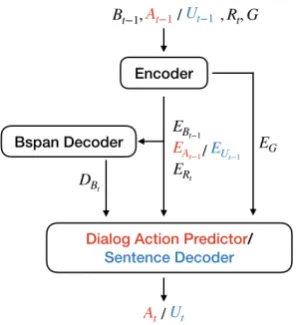
Figure 2: The end-to-end simulator and user dialog act predictor share the most part of their model, colored in black, except the decoder. All the parameters colored in red are related to the dialog act predictor and the parameters in blue color are for sentence decoder.
user to locate a restaurant, which would be re-moved from belief span once the request is ful-filled. There are 13 types of system dialog acts. To focus on the valuable information to fit the model, we combine these dialog acts into 5 categories: {“inform”,“request”,“book
inform”,“select”, “recommend”}. Similarly,
we define three types of user goals “in-form”,“request”and“book”, and record them in belief span, denoted asG. So, at timet, we first
update belief span with a seq2seq model, based on current system responseRt, previous belief state
Bt 1and previous user utteranceUt 1:
Bt=seq2seq(Bt 1, Ut 1, Rt)
Then we incorporate user goal and the context above to generate current user utterance:
Ut=seq2seq(Bt 1, Ut 1, Rt|Bt, G)
As illustrated in Fig. 2, we build a GRU-based encoder for all the Bt 1, Ut 1, Rt and the goal
G. Then we decode the current belief span and user utterance separately. Both decoders are a one-layer GRU with copy and attention mechanism. To evaluate the dialog manager alone, we also modify the Sequicity’s second decoder to generate system dialog act (At) instead of system utterances.
At=seq2seq(Bt 1, Ut 1, Rt|Bt, G)
4.2 Natural Language Generation
Dialog act-based NLG is formalized as Ut =
[image:4.595.130.234.188.307.2]dialog manager,Utis the generated user utterance.
We describe three different dialog-act-based NLG methods.
Template Template method requires human ex-perts to write a variety of delexicalized templates for each dialog act. By searching in the templates, it translates At into human-readable utterances.
The quality of the templates have direct impact on the NLG quality.
Retrieval Template method suffers from limited vocabulary size and language diversity. An alter-native method is Retrieval-based NLG (Wu et al.,
2016;Hu et al., 2014). The model retrieves user utterances withAtas their dialog act in the
train-ing dataset. Followtrain-ingHe et al. (2018), we rep-resent the context by a TF-IDF weighted bag-of-words vector and compute the similarity score be-tween the candidate’s context vector and the cur-rent context vector to retrievalUt.
Generation Generation method (Wen et al.,
2015a,b) does not need expert involvement to rewrite templates, but requires dialog act annota-tion similar to retrieval method. We build a vanilla seq2seq (Sutskever et al., 2014) model using the annotated data addingAtin the input.
5 Dialog System Training Setting
Traditionally, hand-crafted dialog acts plus slot values are used as the discrete action space in RL training (Raux et al.,2005). Dialog action space can also be on the word-level. However, previ-ous study shows degenerate behavior when using word-level action space (Zhao et al., 2019), as it is difficult to design a reward. We choose the first approach and use the discrete action space with six system dialog acts: “ask restaurant type”, “present restaurant search result”, “provide restau-rant info”, “ask reservation info”, “inform reserva-tion result”, “goodbye”. Simple acreserva-tion masks are applied to avoid impossible actions such as mak-ing reservation before presentmak-ing a restaurant.
We use a 2-layer bidirectional-GRU with 200 hidden units to train a NLU module. For sim-plicity, we use the template-based method in the system’s NLG module. We used policy gradient method to train dialog systems (Williams,1992). During RL training, a discounted factor of 0.9 is applied to all the experiences with the maximum number of turns to be 10. We also apply the ✏
-greedy exploration strategy (Tokic,2010). All the RL systems use the same RL state representation,
which consists of traditional dialog state and word count vector of the current utterance. The same reward function is used, which is+1for task
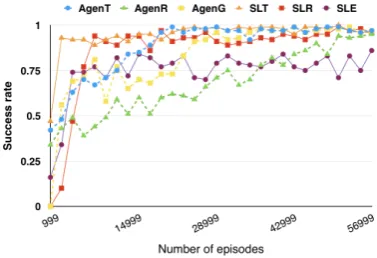
suc-cess, 1 for task failure and 0.1for each addi-tional turn to encourage the RL policy to finish the task faster rather than slower. We fix the RL model every 1,000 episodes and test for 100 dialogs to calculate the average success rate, shown in Fig.3. Besides RL systems, we also build a rule-based system Rule-System, which serves as the third-party system to interact with each user simulator and generate simulated dialogs for human evalu-ation. The only difference betweenRule-System
and the RL-based systems is their policy selec-tion module, whereRule-Systemuses hand-crafted rules while RL-based systems use RL policy.
6 User Simulator Evaluation
Evaluating the quality of a user simulator is an en-during challenge. Traditionally, we report direct
automatic metrics of the user simulator, such as perplexity (Ai and Litman, 2011b; Pietquin and Hastie,2013). Besides, the performance of the RL system trained with a specific simulator gives us anindirectassessment of the user simulator’s abil-ity to imitate user behaviours.
The ultimate goal of the user simulator is to build a task-oriented RL system to serve real users. Therefore, the most ideal evaluation should be conducted by human. Therefore, we first asked human to read the simulated dialogs and rate the user simulator’s performance directly. We then hired Amazon Mechanic Turkers (AMT) to inter-act with the RL systems trained with different sim-ulators and rate their performance. Besides, we also performed cross study between user simula-tors and systems trained with different simulasimula-tors to see if the systems’ performance can be trans-ferred to a different simulated setting. Finally, we measure the gap between the automatic metrics and human evaluation scores, and share insights on how to evaluate user simulator effectively.
6.1 Automatic Evaluation
Simulators NLU DM NLG PPL Vocab Utt Hu.Fl Hu.Co Hu.Go Hu.Div Hu.All
Agenda-Template (AgenT) SL Agenda Template 10.32 180 9.65 4.07 4.56 4.88 2.4 4.50 Agenda-Retrieval (AgenR) SL Agenda Retrieval 33.90 383 11.61 3.50 4.22 4.58 3.9 3.74 Agenda-Generation (AgenG) SL Agenda Generation 7.49 159 8.07 3.32 3.92 4.64 2.5 3.36 SL-Template (SLT) SL Template 9.32 192 9.83 4.80 4.80 4.98 2.6 4.74
SL-Retrieval (SLR) SL Retrieval 29.36 346 11.06 4.40 3.99 4.88 4.3 4.01 SL-End2End (SLE) End-to-End 13.47 205 10.95 3.32 2.62 3.18 2.7 2.64
Table 1: Automatic metrics and human evaluation scores of different user simulators. Automatic metrics include, perplexity per word (PPL), vocabulary size (Vocab), average utterance length (Utt). Human evaluation metrics include, sentence fluency (Hu.Fl), coherent (Hu.Co), goal adherence (Hu.Go), language diversity (Hu.Div) and overall score (Hu.All).
sampled from MultiWoz. Although the perplexity for retrieval models is the highest in both agenda-based and SL-agenda-based simulators, it also possesses the biggest vocabulary set and the longest av-erage utterance length. Another common auto-matic metrics used to assess the language model is BLEU, but since this is a user simulator study and we don’t have ground truth, BLEU score is not available.
Vocabulary Size (Direct) Vocabulary size is a simple and straightforward metric that measures the language diversity. As expected, retrieval-based models have the biggest vocabulary set. However, Agenda-Generation has the smallest vo-cabulary set. The possible reason behind is that we adopt a vanilla greedy seq2seq that suffers from generating the most frequent words. SL-End2End in Table1 trains the NLU, DM and NLG jointly, and therefore, the vocabulary size is slightly larger than the template-based methods.
Average utterance length (Direct)Average utter-ance length is another simple metric to assess the language model and language diversity. As ex-pected, retrieval-based methods are doing the best, but SL-End2End is also doing a good job in gen-erating long sentences.
[image:6.595.309.498.215.344.2]Success Rate (Indirect) The success rate is the most commonly used metric in reporting RL di-alog system performance. Also, it can reflect the user simulator’s certain behaviour. The suc-cess rate of various user simulators are shown in Fig.3. SL-based user simulators converge faster than rule-based simulators. It can be explained by the observation that SL tries to capture the ma-jor paths in the original data, and counts those as success, instead of exploring all the possible paths like in the agenda-based simulators. In gen-eral, retrieval-based simulators converge slower than other NLG methods because retrieval-based approach has a bigger vocabulary size.
Figure 3: Average success rate during RL training.
6.2 Human Direct Evaluation
The direct evaluation of the user simulator is con-ducted by asking 10 volunteers to read the sim-ulated dialogs between different simulators and the third-partyRule-System. Each of the 10 vol-unteers would rate five randomly-selected dialogs generated from each model, and the average of the total 50 ratings is reported as the final human-evaluation score. TheRule-Systemis built solely based on hand-crafted rules with no knowledge about any of the simulators, and therefore is fair to all of them. We design four metrics to assess the user simulator’s behaviour from multiple aspects. The results are shown in Table1.
Fluencyfocuses on the language quality, such as grammar, within each utterance unit. Agenda-Template (AgenT) and SL-Agenda-Template (SLT) re-ceived the two highest fluency scores because the templates are all written by human.
Coherence focuses on the relation quality be-tween different turns within one dialog. SL-Template (SLT) simulator performs the best in co-herence, but agenda-based simulators in general are a bit more coherence than SL-based ones.
RL System Solved Ratio Satisfaction Efficiency Naturalness Rule-likeness Dialog Length Auto Success
Sys-AgenT 0.814±0.06 4.29±0.20 4.35±0.21 3.96±0.23 4.49±0.15 8.95±0.38 0.983±0.01 Sys-AgenR 0.906±0.05 4.52±0.15 4.45±0.16 4.23±0.19 4.59±0.14 8.73±0.31 0.925±0.02 Sys-AgenG 0.904±0.05 4.38±0.18 4.46±0.19 4.33±0.17 4.51±0.16 9.48±0.45 0.980±0.01 Sys-SLT 0.781±0.07 3.87±0.22 3.81±0.22 3.63±0.22 4.08±0.21 9.61±0.76 0.978±0.01 Sys-SLR 0.823±0.05 4.23±0.20 4.20±0.10 3.99±0.20 4.42±0.17 8.92±0.70 0.965±0.01 Sys-SLE 0.607±0.06 3.42±0.22 3.41±0.23 3.59±0.20 4.22±0.20 9.44±0.69 0.798±0.03
Table 2: Human evaluation of RL systems trained with different simulators on AMT with 95% confidence intervals. Each row represents one RL system, e.g. Sys-AgenT means the RL system trained with the AgenT simulator.
SL-End2End (SLE). This may be because SLE is training all the modules together and thus has more difficulty infusing the goal.
Diversity focuses on the language diversity be-tween simulated dialogs of the same simulator. Each simulator will be given one diversity score. Retrieval-based methods surpass other methods in diversity, but it is not as good in fluency, while template-based methods outperform in fluency but suffer on diversity as expected. Generative meth-ods suffer from generating generic sentences as mentioned before.
OverallWe ask the human to rate the overall sim-ulator quality. Except for SL-End2End, SL-based methods are favoured by human over agenda-based methods. Agenda-Template is comparable to SL-based simulators because of its fluent re-sponses and carefully-designed policy.
6.3 Human Indirect Evaluation on AMT
The ultimate goal of user simulator building is to train better system policies. Automatic met-rics such as success rate can give us a sense on the system’s performance, but the ultimate evalua-tion should be conducted on human so that we can know the real performance of the system policy when deployed.
Motivated by this, we tested the RL systems trained with various user simulators on Amazon Mechanical Turk (AMT) (Miller et al.,2017), and asked Turkers to interact with the system and ob-tained their opinions. Each system is tested on 100 Turkers. The results are shown in Table 2. The AMT interface is in the Appendix.
We also listed two common automatic metrics in Table 2 to compare. The “Dialog Length” column shows the average dialog length of the Turker-Machine dialogs, which reflects the sys-tem’s efficiency to some extent. The “Auto Success” column represents the automatic suc-cess rate. It’s the convergent sucsuc-cess rate from Fig.3, measured by freezing the policy and
test-ing against the user simulator for 100 episodes. Previous approaches have utilized these two auto-matic metrics to evaluate the system’s efficiency and success (Williams et al., 2017; Shi et al.,
2019), but we find that due to user individual dif-ference, such automatic metrics have relatively big variances and don’t always correlate with ef-ficiency perceived by human. For example, some users tend to provide all slots in one turn, while others provide slots only when necessary; some users would even go off-the-script and ask about restaurants not mentioned in the goal. Therefore, we should caution against relying solely on the automatic metrics to represent user opinion and the best way is to ask the users directly for their thoughts on the system’s performance from multi-ple aspects as follows.
Usr\Sys Sys-AgenT Sys-AgenR Sys-AgenG Sys-SLT Sys-SLR Sys-SLE
AgenT 0.975 0.960 0.790 0.305 0.300 0.200
AgenR 0.540 0.900 0.785 0.230 0.230 0.235
AgenG 0.725 0.975 0.950 0.355 0.300 0.20
SLT 0.985 0.985 0.985 0.990 0.965 0.730
SLR 0.925 0.975 0.965 0.975 0.935 0.630
SLE 0.770 0.820 0.815 0.840 0.705 0.770
Average 0.820 0.935 0.882 0.616 0.573 0.461
Table 3: Cross study results. Each row represents one user simulator, each column represents one RL system trained with a specific simulator. Each entry shows the average success rate obtained by having the user simulator interacting with the RL system for 200 times.
Satisfaction. Solving the user’s problem doesn’t necessarily lead to user satisfaction sometimes. It also depends on the system’s efficiency and la-tency. Therefore, besides Solved Ratio, we also directly ask Turkers how satisfied they are with the system. The result shows that among all systems, Sys-AgenR model received the highest score. The positive correlation between the “Solved Ratio” and “Satisfaction” in Table1 also indicates auto-matic task completion rate is a good estimator for user satisfaction.
Efficiency. We directly ask Turkers how efficient the system is in solving their problems since dia-log length doesn’t always correlate with the sys-tem efficiency. For example, although the dialog length of Sys-AgenG and Sys-SLE are similar to each other, users rated Sys-AgenG to be the most efficient one and Sys-SLE to be the most ineffi-cient one. Again we suspect this is caused by different user communication pattern where some users prefer providing slots across multiple turns while others prefer providing all slots in one turn.
Naturalness. We ask the Turkers to rate the nat-uralness of the system responses. All the systems share the same template-based NLG module de-signed by human experts, thus there shouldn’t be a significant difference in the naturalness score. However, according to Table 2, we find that the naturalness score seems to correlate with the over-all system performance. A possible reason is that the end-user is rating the system’s naturalness by the overall performance instead of the system re-sponses alone. When the dialog policy is bad, even if the NLG module can generate natural system re-sponses, the users would still think the system is unnatural. This suggests that when designing di-alog systems, NLG and policy selection modules should go hand-in-hand in evaluation.
Rule-likenessWe also ask the users to what
ex-tend they think the system is designed by hand-crafted rules on a scale from 1 to 5, five means it is heavily handcrafted. Among all the models, Sys-SLT that is trained with the SL-Template sim-ulator receives the lowest score, meaning it’s the least rigid system. This is because SL-Template’s dialog manager is learned with supervised learn-ing, less rigid than the agenda-based dialog policy, which further leads to a less rigid behaviour of the trained dialog system.
6.4 Cross Study of Simulators and Systems
From the last column in Table2, we find that al-though the automatic success rates claimed by the user simulator used to train the system are all rela-tively high, the high automatic success rate doesn’t transfer to real human satisfaction. In our setting, each simulator can be viewed as a new user with different communicating habits; therefore, we are curious to see if the performance can transfer to a different simulator when we test the RL system trained with simulator A against simulator B. Ta-ble 3 shows a cross study between the six user simulators and the six systems trained with dif-ferent simulators, where we fix the systems, have each simulator interact with each system for 200 episodes, and calculate the average success rate. The diagonal should reflect the “Auto Success” column in Table2, but since the 200 episodes are random and the “Auto Success” is the convergent success rate, the exact number won’t be the same. The last row in Table 3 shows the average success rate of each system across user simula-tors. There are some interesting findings. 1) Sys-AgenR that is trained with the Agenda-Retrieval simulator has the best average success rate, which agrees with the human evaluation on MTurk. 2) A common practice to compare RL systemsS1, ...
com-Figure 4: Correlation between sentence fluency and perplexity, and correlation between sentence diversity and perplexity. Green circles represent the human rated score, while the blue squares are the average score over different raters.
pare the success rate ofS1, ...,SnonU. However,
by looking at the fifth row for the SL-Retrieval simulator, it will prefer SLT (0.975) over Sys-AgenG (0.965), but actually the average perfor-mance of AgenG (0.882) is better than Sys-SLT (0.616) from the last row. This suggests that when we want to compare two systems but don’t have the resource to do human evaluation on the system performance, instead of solely comparing their success rates tested on one simulator, we should build different types of user simulators and test the systems against multiple simulators to get a more holistic view of the systems. 3) The diago-nal in the table is usually the highest, meaning that RL policy does a good job optimizing for its own simulator but may not generalize to other user sim-ulators. For example, the upper right corner per-forms the worst because the systems trained with SL-based simulators are worse in general, whose reason we will discuss later.
6.5 Human Correlation Study
To test if the automatic metrics can reflect hu-man evaluation, we compute the correlation be-tween perplexity (PPL) and human evaluated flu-ency (Hu.Fl) and the correlation between perplex-ity and human evaluated diversperplex-ity score (Hu.Div), which are 0.21 with p > 0.05 and 0.95 with p = 0.003respectively. We also visualize these
metrics in Fig. 4. It shows that as an automatic metric, perplexity is a good estimator for language diversity but not for language fluency.
7 Discussion and Future Work
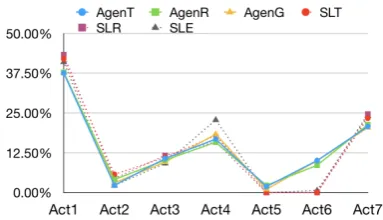
[image:9.595.76.286.63.136.2]SL-based simulators perform relatively worse than Agenda-based simulators when interacting with real users. We investigate the data and find it’s caused by SL-based simulators not exploring all possible paths. We draw the different dialog act
Figure 5: Dialog act distribution comparison. Act1 to Act7 corresponds to the seven user dialog acts,“inform
restaurant type”, “inform restaurant type change”,
“ask info”, “make reservation”, “make reservation
change time”,“anything else”, and“goodbye”
distributions on simulated conversations in Fig.5. For example, in agenda-based simulators, we ex-plicitly have a rule for the dialog act “anything else” (Act6 in Fig.5) but no such rules exist in SL-based simulators. Therefore, the RL model will experience the “anything else” scenario more in Agenda-based simulators than in SL-based simu-lators. When real users ask about “anything else”, RL systems trained with Agenda-based simula-tors will have more experiences in handling such a case, compared to systems trained with SL-based simulators.
In this paper, we perform in-depth studies on the restaurant domain as it’s the most well-studied do-main in task-oriented dialog systems, yet there’s still no standard user simulator available. In the future we plan to include more domain using vari-ous domain-adaptive methods (Qian and Yu,2019;
Tran and Nguyen,2018;Gaˇsi´c et al.,2017) to sup-port multi-domain dialog system research, and in-corporate our work into more and more standard-ized dialog system platforms (Lee et al.,2019).
8 Conclusions
[image:9.595.311.503.68.178.2]References
Hua Ai and Diane Litman. 2011a. Assessing user sim-ulation for dialog systems using human judges and automatic evaluation measures. Natural Language Engineering, 17(4):511–540.
Hua Ai and Diane Litman. 2011b. Comparing user simulations for dialogue strategy learning. ACM Transactions on Speech and Language Processing (TSLP), 7(3):9.
Layla El Asri, Jing He, and Kaheer Suleman. 2016. A sequence-to-sequence model for user simula-tion in spoken dialogue systems. arXiv preprint
arXiv:1607.00070.
Paweł Budzianowski, Tsung-Hsien Wen, Bo-Hsiang Tseng, I˜nigo Casanueva, Stefan Ultes, Osman Ra-madan, and Milica Gaˇsi´c. 2018. Multiwoz-a large-scale multi-domain wizard-of-oz dataset for task-oriented dialogue modelling. arXiv preprint
arXiv:1810.00278.
Heriberto Cuay´ahuitl, Simon Keizer, and Oliver Lemon. 2015. Strategic dialogue management via deep reinforcement learning. arXiv preprint
arXiv:1511.08099.
Ondˇrej Duˇsek and Filip Jurˇc´ıˇcek. 2016. Sequence-to-sequence generation for spoken dialogue via deep syntax trees and strings. arXiv preprint
arXiv:1606.05491.
Klaus-Peter Engelbrecht, Michael Quade, and Sebas-tian M¨oller. 2009. Analysis of a new simulation ap-proach to dialog system evaluation. Speech Commu-nication, 51(12):1234–1252.
Milica Gaˇsi´c, Nikola Mrkˇsi´c, Lina M Rojas-Barahona, Pei-Hao Su, Stefan Ultes, David Vandyke, Tsung-Hsien Wen, and Steve Young. 2017. Dialogue man-ager domain adaptation using gaussian process rein-forcement learning. Computer Speech & Language, 45:552–569.
Tatsunori B Hashimoto, Hugh Zhang, and Percy Liang. 2019. Unifying human and statistical evaluation for natural language generation. arXiv preprint
arXiv:1904.02792.
He He, Derek Chen, Anusha Balakrishnan, and Percy Liang. 2018. Decoupling strategy and gener-ation in negotigener-ation dialogues. arXiv preprint
arXiv:1808.09637.
Matthew Henderson, Blaise Thomson, and Jason D Williams. 2014. The third dialog state tracking chal-lenge. In2014 IEEE Spoken Language Technology
Workshop (SLT), pages 324–329. IEEE.
Baotian Hu, Zhengdong Lu, Hang Li, and Qingcai Chen. 2014. Convolutional neural network architec-tures for matching natural language sentences. In Advances in neural information processing systems, pages 2042–2050.
Sangkeun Jung, Cheongjae Lee, Kyungduk Kim, Min-woo Jeong, and Gary Geunbae Lee. 2009. Data-driven user simulation for automated evaluation of spoken dialog systems. Computer Speech &
Lan-guage, 23(4):479–509.
Alfred Kobsa. 1994. User modeling and user-adapted interaction. In CHI Conference Companion, pages 415–416.
Florian Kreyssig, Inigo Casanueva, Pawel Budzianowski, and Milica Gasic. 2018. Neural user simulation for corpus-based policy optimisa-tion for spoken dialogue systems. arXiv preprint
arXiv:1805.06966.
Sungjin Lee, Qi Zhu, Ryuichi Takanobu, Xiang Li, Yaoqin Zhang, Zheng Zhang, Jinchao Li, Baolin Peng, Xiujun Li, Minlie Huang, et al. 2019. Con-vlab: Multi-domain end-to-end dialog system plat-form.arXiv preprint arXiv:1904.08637.
Wenqiang Lei, Xisen Jin, Min-Yen Kan, Zhaochun Ren, Xiangnan He, and Dawei Yin. 2018. Sequic-ity: Simplifying task-oriented dialogue systems with single sequence-to-sequence architectures. In Pro-ceedings of the 56th Annual Meeting of the Associa-tion for ComputaAssocia-tional Linguistics (Volume 1: Long Papers), pages 1437–1447.
Xiujun Li, Zachary C Lipton, Bhuwan Dhingra, Lihong Li, Jianfeng Gao, and Yun-Nung Chen. 2016. A user simulator for task-completion dialogues. arXiv preprint arXiv:1612.05688.
Bing Liu and Ian Lane. 2017. Iterative policy learn-ing in end-to-end trainable task-oriented neural dia-log models. In2017 IEEE Automatic Speech
Recog-nition and Understanding Workshop (ASRU), pages
482–489. IEEE.
Chia-Wei Liu, Ryan Lowe, Iulian V Serban, Michael Noseworthy, Laurent Charlin, and Joelle Pineau. 2016. How not to evaluate your dialogue system: An empirical study of unsupervised evaluation met-rics for dialogue response generation. arXiv preprint
arXiv:1603.08023.
Alexander H Miller, Will Feng, Adam Fisch, Jiasen Lu, Dhruv Batra, Antoine Bordes, Devi Parikh, and Ja-son Weston. 2017. Parlai: A dialog research soft-ware platform.arXiv preprint arXiv:1705.06476. Kishore Papineni, Salim Roukos, Todd Ward, and
Wei-Jing Zhu. 2002. Bleu: a method for automatic eval-uation of machine translation. In Proceedings of the 40th annual meeting on association for compu-tational linguistics, pages 311–318. Association for Computational Linguistics.
Olivier Pietquin and Helen Hastie. 2013. A survey on metrics for the evaluation of user simulations. The knowledge engineering review, 28(1):59–73. Kun Qian and Zhou Yu. 2019. Domain adaptive
di-alog generation via meta learning. arXiv preprint
Antoine Raux, Brian Langner, Dan Bohus, Alan W Black, and Maxine Eskenazi. 2005. Let’s go pub-lic! taking a spoken dialog system to the real world.
InNinth European conference on speech
communi-cation and technology.
Jost Schatzmann, Blaise Thomson, Karl Weilhammer, Hui Ye, and Steve Young. 2007. Agenda-based user simulation for bootstrapping a pomdp dialogue sys-tem. InHuman Language Technologies 2007: The Conference of the North American Chapter of the Association for Computational Linguistics;
Com-panion Volume, Short Papers, pages 149–152.
As-sociation for Computational Linguistics.
Jost Schatzmann, Karl Weilhammer, Matt Stuttle, and Steve Young. 2006. A survey of statistical user sim-ulation techniques for reinforcement-learning of di-alogue management strategies. The knowledge en-gineering review, 21(2):97–126.
Jost Schatzmann and Steve Young. 2009. The hid-den agenda user simulation model. IEEE
transac-tions on audio, speech, and language processing,
17(4):733–747.
Jost Schatztnann, Matthew N Stuttle, Karl Weilham-mer, and Steve Young. 2005. Effects of the user model on simulation-based learning of dialogue strategies. InIEEE Workshop on Automatic Speech
Recognition and Understanding, 2005., pages 220–
225. IEEE.
Pararth Shah, Dilek Hakkani-T¨ur, Gokhan T¨ur, Ab-hinav Rastogi, Ankur Bapna, Neha Nayak, and Larry Heck. 2018. Building a conversational agent overnight with dialogue self-play. arXiv preprint
arXiv:1801.04871.
Weiyan Shi and Zhou Yu. 2018. Sentiment adap-tive end-to-end dialog systems. arXiv preprint
arXiv:1804.10731.
Weiyan Shi, Tiancheng Zhao, and Zhou Yu. 2019. Un-supervised dialog structure learning. arXiv preprint
arXiv:1904.03736.
Pei-Hao Su, Pawel Budzianowski, Stefan Ultes, Mil-ica Gasic, and Steve Young. 2017. Sample-efficient actor-critic reinforcement learning with supervised data for dialogue management. arXiv preprint
arXiv:1707.00130.
Ilya Sutskever, Oriol Vinyals, and Quoc V Le. 2014. Sequence to sequence learning with neural net-works. InAdvances in neural information process-ing systems, pages 3104–3112.
Michel Tokic. 2010. Adaptive "-greedy exploration in reinforcement learning based on value differ-ences. In Annual Conference on Artificial Intelli-gence, pages 203–210. Springer.
Van-Khanh Tran and Le-Minh Nguyen. 2017. Seman-tic refinement gru-based neural language generation
for spoken dialogue systems. InInternational Con-ference of the Pacific Association for Computational Linguistics, pages 63–75. Springer.
Van-Khanh Tran and Le-Minh Nguyen. 2018. Ad-versarial domain adaptation for variational neural language generation in dialogue systems. arXiv preprint arXiv:1808.02586.
Tsung-Hsien Wen, Milica Gasic, Dongho Kim, Nikola Mrksic, Pei-Hao Su, David Vandyke, and Steve Young. 2015a. Stochastic language generation in dialogue using recurrent neural networks with convolutional sentence reranking. arXiv preprint
arXiv:1508.01755.
Tsung-Hsien Wen, Milica Gasic, Nikola Mrksic, Pei-Hao Su, David Vandyke, and Steve Young. 2015b. Semantically conditioned lstm-based natural lan-guage generation for spoken dialogue systems. arXiv preprint arXiv:1508.01745.
Jason D Williams, Kavosh Asadi, and Geoffrey Zweig. 2017. Hybrid code networks: practical and efficient end-to-end dialog control with super-vised and reinforcement learning. arXiv preprint
arXiv:1702.03274.
Ronald J Williams. 1992. Simple statistical gradient-following algorithms for connectionist reinforce-ment learning. Machine learning, 8(3-4):229–256.
Yu Wu, Wei Wu, Chen Xing, Ming Zhou, and Zhoujun Li. 2016. Sequential matching network: A new architecture for multi-turn response selec-tion in retrieval-based chatbots. arXiv preprint
arXiv:1612.01627.
Steve Young, Milica Gaˇsi´c, Blaise Thomson, and Ja-son D Williams. 2013. Pomdp-based statistical spo-ken dialog systems: A review. Proceedings of the IEEE, 101(5):1160–1179.