Proceedings of the 2019 Conference on Empirical Methods in Natural Language Processing 4622
Integrating Text and Image: Determining Multimodal Document Intent in
Instagram Posts
Julia Kruk1∗, Jonah Lubin2∗, Karan Sikka1, Xiao Lin1, Dan Jurafsky3, Ajay Divakaran1†,
∗equal contribution
1SRI International, Princeton, NJ 2The University of Chicago, Chicago, Illinois
3Stanford University, Stanford, CA
Abstract
Computing author intent from multimodal data like Instagram posts requires modeling a complex relationship between text and image. For example, a caption might evoke an ironic contrast with the image, so neither caption nor image is a mere transcript of the other. In-stead they combine—via what has been called
meaning multiplication Bateman (2014)—to create a new meaning that has a more complex relation to the literal meanings of text and im-age. Here we introduce a multimodal dataset of1299Instagram posts labeled for three or-thogonal taxonomies: the authorial intent be-hind the image-caption pair, the contextual re-lationship between the literal meanings of the image and caption, and the semiotic relation-ship between the signified meanings of the im-age and caption. We build a baseline deep multimodal classifier to validate the taxonomy, showing that employing both text and image improves intent detection by9.6%compared to using only the image modality, demonstrat-ing the commonality of non-intersective mean-ing multiplication. The gain with multimodal-ity is greatest when the image and caption di-verge semiotically. Our dataset offers a new resource for the study of the rich meanings that result from pairing text and image.
1 Introduction
Multimodal social platforms such as Instagram let content creators combine visual and textual
modalities. The resulting widespread use of
text+image makes interpreting author intent in multimodal messages an important task for NLP for document understanding.
There are many recent language processing studies of images accompanied by basic text labels
∗
Work done while Julia (from Cornell University) and Jonah were interns at SRI International.
†
[image:1.595.307.544.206.336.2]Corresponding author, [email protected].
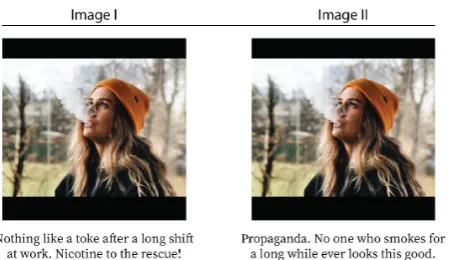
Figure 1: Image-Caption meaning multiplication: A change in the caption completely changes the overall meaning of the image-caption pair.
or captions (Chen et al.,2015;Faghri et al.,2018, inter alia). But prior work on image–text pairs has generally been asymmetric, regarding either im-age or text as the primary content, and the other as mere complement. Scholars from semiotics as well as computer science have pointed out that this is insufficient; often text and image are not com-bined by a simple addition or intersection of the
component meanings (Bateman,2014;Marsh and
Domas White,2003;Zhang et al.,2018).
Rather, determining author intent with
text+image content requires a richer kind of
meaning composition that has been called
mean-ing multiplication(Bateman, 2014): the creation of new meaning through integrating image and
text. Meaning multiplication includes simple
meaning intersection or concatenation (a picture of a dog with the label “dog”, or the label
“Ru-fus”). But it also includes more sophisticated
used to highlight relaxation through smoking. Pairing II uses the tension between her image and the implications of her actions to highlight the dangers of smoking.
Computational models that detect complex re-lationships between text and image and how they cue author intent could be significant for many ar-eas, including the computational study of adver-tising, the detection and study of propaganda, and our deeper understanding of many other kinds of persuasive text, as well as allowing NLP applica-tions to news media to move beyond pure text.
To better understand author intent given such meaning multiplication, we create three novel tax-onomies related to the relationship between text and image and their combination/multiplication in Instagram posts, designed by modifying
exist-ing taxonomies (Bateman, 2014; Marsh and
Do-mas White, 2003) from semiotics, rhetoric, and
media studies. Our taxonomies measure the
au-thorial intentbehind the image-caption pair and
two kinds of text-image relations: thecontextual
relationship between the literal meanings of the
image and caption, and thesemiotic relationship
between the signified meanings of the image and caption. We then introduce a new dataset, MDID
(Multimodal Document Intent Dataset), with1299
Instagram posts covering a variety of topics, anno-tated with labels from our three taxonomies.
Finally, we build a deep neural network model for annotating Instagram posts with the labels from each taxonomy, and show that combining text and image leads to better classification, es-pecially when the caption and the image diverge. While our goal here is to establish a computational framework for investigating multimodal meaning multiplication, in other pilot work we have be-gun to consider some applications, such as us-ing intent for social media event detection and for user engagement prediction. Both these directions highlight the importance of the intent and semiotic structure of a social media posting in determining its influence on the social network as a whole.
2 Prior Work
A wide variety of work in multiple fields has ex-plored the relationship between text and image and extracting meaning, although often assigning a subordinate role to either text or images, rather than the symmetric relationship in media such as Instagram posts. The earliest work in the
Barthe-sian tradition focuses on advertisements, in which the text serves as merely another connotative as-pect to be incorporated into a larger connotative
meaning (Heath et al., 1977). Marsh and
Do-mas White (2003) offer a taxonomy of the re-lationship between image and text by consider-ing image/illustration pairs found in textbooks or manuals. We draw on their taxonomy, although as we will see, the connotational aspects of Instagram posts require some additions.
For our model of speaker intent, we draw on
the classic concept of illocutionary acts (Austin,
1962) to develop a new taxonomy of illocutionary
acts focused on the kinds of intentions that tend to occur on social media. For example, we rarely see commissive posts on Instagram and Facebook because of the focus on information sharing and constructions of self-image.
Computational approaches to multi-modal doc-ument understanding have focused on key
prob-lems such as image captioning (Chen et al.,2015;
Faghri et al., 2018), visual question answering (Goyal et al., 2017;Zellers et al., 2018;Hudson and Manning, 2019), or extracting the literal or
connotative meaning of a post (Soleymani et al.,
2017). More recent work has explored the role
of image as context for interaction and
pragmat-ics, either in dialog (Mostafazadeh et al., 2016,
2017), or as a prompt for users to generate
de-scriptions (Bisk et al., 2019). Another important
direction has looked at an image’sperlocutionary
force(how it is perceived by its audience),
includ-ing aspects such as memorability (Khosla et al.,
2015), saliency (Bylinskii et al., 2018),
popular-ity (Khosla et al., 2014) and virality (Deza and
Parikh,2015;Alameda-Pineda et al.,2017).
Some prior work has focused on intention. Joo
et al. (2014) and Huang and Kovashka (2016) study prediction of intent behind politician por-traits in the news. Hussain et al.(2017) study the understanding of image and video advertisements,
predicting topic, sentiment, and intent. Alikhani
et al. (2019) introduce a corpus of the coher-ence relationships between recipe text and
im-ages. Our work builds onSiddiquie et al.(2015),
who focused on a single type of intent (detect-ing politically persuasive video on the internet)
and even more closely on Zhang et al. (2018),
par-allel equivalent (image-text deliver same point at equal strength), parallel non-equivalent (image-text deliver the same point at different levels) and non-parallel (text or image alone is insufficient in point delivery). They also identify the novel issue of understanding the complex, non-literal ways in
which text and image interacts. Weiland et al.
(2018) study the non-literal meaning conveyed by
image-caption pairs and draw on a knowledge-base to generate the gist of the image-caption pair.
3 Taxonomies
AsBerger(1972) points out in discussing the rela-tionship between one image and its caption:
It is hard to define exactly how the words have changed the image but un-doubtedly they have. (p. 28).
We propose three taxonomies in an attempt to an-swer Berger’s implicit question, two (contextual and semiotic) to capture different aspects of the re-lationship between the image and the caption, and one to capture speaker intent.
3.1 Intent Taxonomy
The proposed intent taxonomy is a generalization and elaboration of existing rhetorical categories pertaining to illocution, that targets multimodal social networks like Instagram. We developed a set of eight illocutionary intents from our exam-ination and clustering of a large body of repre-sentative Instagram content, informed by previ-ous studies of intent in Instagram posts. There is some overlap between categories; to bound the burden on the annotators, however, we asked them to identify intent for the image-caption pairing as a whole and not for the individual components
For example drawing on Goffman’s idea of the
presentation of self (Goffman, 1978), Mahoney
et al.(2016) in their study of Scottish political In-stagram posts define acts like Presentation of Self,
which, followingHogan(2010) we refer to as
ex-hibition, or Personal Political Expression, which
we generalize toadvocative. Following are our
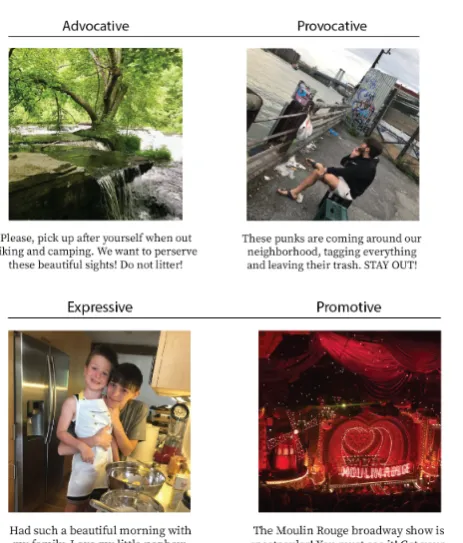
fi-nal eight labels; Figure2shows some examples.
1. advocative: advocate for a figure, idea, movement, etc.
[image:3.595.304.536.57.329.2]2. promotive: promote events, products, orga-nizations etc.
Figure 2: Examples of multimodal document intent: advocative, provocative, expressive and promotive con-tent
3. exhibitionist: create a self-image reflecting the person, state etc. for the user using selfies, pictures of belongings (e.g. pets, clothes) etc.
4. expressive: express emotion, attachment, or admiration at an external entity or group.
5. informative: relay information regarding a subject or event using factual language.
6. entertainment: entertain using art, humor, memes, etc.
7. provocative/discrimination: directly attack an individual or group.
8. provocative/controversial: be shocking.
3.2 The Contextual Taxonomy
The contextual relationship taxonomy captures the relationship between the literal meanings of the image and text. We draw on the three top-level
cat-egories of theMarsh and Domas White(2003)
Intent
Category # Samples
Provocative 84
Informative 119
Advocative 97
Entertainment 310
Expositive 237
Expressive 95
Promotive 162
Semiotic Category # Samples
Divergent 115
Additive 277
Parallel 712
Contextual Relationship Category # Samples
Minimal 372
Close 585
[image:4.595.99.498.62.188.2]Transcendent 147
Table 1: Counts of different labels in the Multimodal Document Intent Dataset (MDID).
top-level categories taxonomy ofMarsh and
Do-mas White(2003) to make them symmetric for the Instagram domain:
Minimal Relationship: The literal meanings of the caption and image overlap very little. For example, a selfie of a person at a waterfall with the caption “selfie”. While such a terse caption does nevertheless convey a lot of in-formation, it still leaves out details such as the location, description of the scene, etc. that are found in typical loquacious Insta-gram captions.
Close Relationship: The literal meanings of the caption and the image overlap considerably. For example, a selfie of a person at a crowded waterfall, with the caption “Selfie at Hemlock falls on a crowded sunny day”.
Transcendent Relationship: The literal meaning of one modality picks up and expands on the literal meaning of the other. For example, a selfie of a person at a crowded waterfall with the caption “Selfie at Hemlock Falls on a sunny and crowded day. Hemlock falls is a popular picnic spot. There are hiking and biking trails, and a great restaurant 3 miles down the road ...”.
Note that while the labels “minimal” and ”close” could be thought of as lying on a continuous scale indicating semantic overlap, the label “transcen-dent” indicates an expansion of the meaning that cannot be captured by such a continuous scale.
3.3 The Semiotic Taxonomy
The contextual taxonomy described above does not deal with the more complex forms of “mean-ing multiplication” illustrated inFigure 1. For ex-ample, an image of three frolicking puppies with the caption “My happy family,” sends a message
of pride in one’s pets that is not directly reflected in either modality taken by itself. First, it forces the reader to step back and consider what is being signified by the image and the caption, in effect of-fering a meta-comment on the text-image relation. Second, there is a tension between what is signi-fied (a family and a litter of young animals respec-tively) that results in a richer idiomatic meaning.
Our third taxonomy therefore captures the
re-lationship between what is signified by the
re-spective modalities, theirsemiotics. We draw on
the earlier 3-way distinction of Kloepfer (1977)
as modeled by Bateman (2014) and the two-way
(parallel vs. non-parallel) distinction of Zhang
et al.(2018) to classify the semiotic relationship of image/text pairs as divergent, parallel and
addi-tive. Adivergentrelationship occurs when the
im-age and text semiotics pull in opposite directions, creating a gap between the meanings suggested by
the image and text. Aparallelrelationship occurs
when the image and text independently contribute
to the same meaning. Anadditiverelationship
oc-curs when the image and text semiotics amplify or modify each other.
Figure 3: The top three images exemplify the semiotic categories. Images I-VI show instances of divergent semiotic relationships.
Figure 3 further illustrates the proposed semi-otic classification. The first three image-caption pairs (ICP’s) exemplify the three semiotic relation-ships. To give further insights into the rich com-plexity of the divergent category, the six ICP’s be-low showcase the kinds of divergent relationships we observed most frequently on Instagram.
ICP I exploits the tension between the refer-ence to retirement expressed in the caption and the youth projected by the two young women in the image to convey irony and thus humor in what is perhaps a birthday greeting or announcement. Many ironic and humorous posts exhibit divergent semiotic relationships. ICP II has the structure of a classic Instagram meme, where the focus is on the image, and the caption is completely unrelated to the image. This is also exhibited in the divergent “Good Morning” caption in the top row. ICP III is an example of a divergent semiotic relationship within an exhibitionist post. A popular commu-nicative practice on Instagram is to combine self-ies with a caption that is some sort of inside joke. The inside joke in ICP III is a lyric from a song a group of friends found funny and discussed the
night this photo was taken. ICP IV is an aesthetic photo of a young woman, paired with a caption that has no semantic elements in common with the photo. The caption may be a prose excerpt, the author’s reflection on what the image made them think or feel, or perhaps just a pairing of pleas-ant visual stimulus with pleaspleas-ant literary material. This divergent relationship is often found in pho-tography, artistic and other entertainment posts. ICP V uses one of the most common divergent re-lationships, in which exhibitionist visual material is paired with reflections or motivational captions. ICP V is thus similar to ICP III, but without the inside jokes/hidden meanings common to ICP III. ICP VI is an exhibitionist post that seems to be common recently among public figures on Insta-gram. The image appears to be a classic selfie or often a professionally taken image of the individ-ual, but the caption refers to that person’s opinions or agenda(s). This relationship is divergent—there are no common semantic elements in the image and caption—but the pair paints a picture of the individual’s current state or future plans.
4 The MDID Dataset
Our dataset, MDID (theMultimodal Document
In-tent Dataset) consists of 1299 public Instagram posts that we collected with the goal of develop-ing a rich and diverse set of posts for each of the eight illocutionary types in our intent taxonomy.
For each intent we collected at least 16 hashtags
or users likely to yield a high proportion of posts that could be labeled by that heading.
For the advocative intent, we selected mostly
hashtags advocating and spanning political or so-cial ideology such as #pride and #maga. For the promotiveintent we relied on the #ad tag that In-stagram has recently begun requiring for
spon-sored posts. Forexhibitionistintent we used tags
that focused on the self as the most important as-pect of the post such as #selfie and #ootd (outfit
of the day). The expressive posts were retrieved
influ-enced or provoked by the post (#redpill, #antifa, #eattherich, #snowflake).
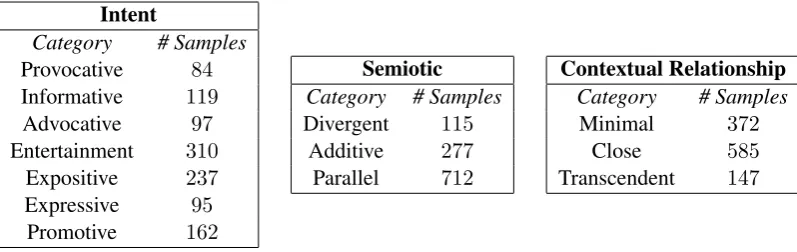
Data Labeling: Data was pre-processed (for ex-ample to convert all albums to single image-caption pairs). We developed a simple annotation toolkit that displayed an image–caption pair and asked the annotator to confirm whether the pair was relevant (contains both an image and text in English) and if so to identify the post’s intent (ad-vocative, promotive, exhibitionist, expressive, in-formative, entertainment, provocative), contextual relationship (minimal, close, transcendent), and semiotic relationship (divergent, parallel, addi-tive). Two of the authors collaborated on the label-ers manual and then labeled the data by consensus, and any label on which the authors disagreed af-ter discussion was removed. Dataset statistics are
shown inTable 1; seehttps://www.ksikka.
com/document_intent.htmlfor the data.
5 Computational Model
We train and test a deep convolutional neural net-work (DCNN) model on the dataset, both to of-fer a baseline model for users of the dataset, and to further explore our hypothesis about meaning multiplication.
Our model can take as input either image (Img), text (Txt) or both (Img + Txt), and consists of modality specific encoders, a fusion layer, and a class prediction layer. We use the ResNet-18 net-work pre-trained on ImageNet as the image
en-coder (He et al., 2016). For encoding captions,
we use a standard pipeline that employs a RNN model on word embeddings. We experiment with both word2vec type (word token-based)
embed-dings trained from scratch (Mikolov et al.,2013)
and pre-trained character-based contextual
embed-dings (ELMo) (Peters et al., 2018). For our
pur-pose ELMo character embeddings are more useful since they increase robustness to noisy and often misspelled Instagram captions. For the combined model, we implement a simple fusion strategy that first linearly projects encoded vectors from both the modalities in the same embedding space and then adds the two vectors. Although naive, this strategy has been shown to be effective at a vari-ety of tasks such as Visual Question Answering (Nguyen and Okatani, 2018) and image-caption
matching (Ahuja et al., 2018). We then use the
fused vector to predict class-wise scores using a fully connected layer.
6 Experiments
We evaluate our models on predicting intent, semi-otic relationships, and image-text relationships from Instagram posts, using image only, text only, and both modalities.
6.1 Dataset, Evaluation and Implementation
We use the 1299-sample MDID dataset (
sec-tion 4). We only use corresponding image and text information for each post and do not use other meta-data to preserve the focus on image-caption joint meaning. We perform basic pre-processing on the captions such as removing stopwords and non-alphanumeric characters. We do not perform any pre-processing for images.
Due to the small dataset, we perform 5-fold cross-validation for our experiments reporting
av-erage performance across all splits. We report
classification accuracy (ACC) and also area un-der the ROC curve (AUC) (since AUC is more robust to class-skew), using macro-average across all classes (Jeni et al.,2013;Stager et al.,2006).
We use a pre-trained ResNet-18 model as the
image encoder. For word token based
embed-dings we use300dimensional vectors trained from
scratch. For ELMo we use a publicly available
API1and use a pre-trained model with two layers
resulting in a2048dimensional input. We use a
bi-directional GRU as the RNN model with256
di-mensional hidden layers. We set the didi-mensional- dimensional-ity of the common embedding space in the fusion
layer to 128. In case there is a single modality,
the fusion layer only projects features from that modality. We train with the Adam optimizer with
a learning rate of 0.00005, which is decayed by
0.1after every15 epochs. We report results with
the best model selected based on performance on a mini validation set.
6.2 Quantitative Results
We show results inTable 2. For the intent
taxon-omy images are more informative than (word2vec)
text (76%for Img vs72.7%for Txt-emb) but with
ELMo text outperforms just using images (82.6%
for Txt-ELMo, 76.0%for Img). ELMo similarly
improves performance on the contextual taxon-omy but not the semiotic taxontaxon-omy.
For the semiotic taxonomy, ELMo and
word2vec embeddings perform similarly, (67.8%
1https://github.com/allenai/allennlp/
Method Intent Semiotic Contextual
ACC AU C ACC AU C ACC AU C
Chance 28.1 50.0 64.5 50.0 53.0 50.0
Img 42.9(±0.0) 76.0(±0.5) 61.5(±0.0) 59.8(±3.0) 52.5(±0.0) 62.5(±1.3)
Txt-emb 42.9(±0.0) 72.7(±1.5) 58.9(±0.0) 67.8(±1.7) 60.7(±0.5) 74.9(±3.0)
Txt-ELMo 52.7(±0.0) 82.6(±1.2) 61.7(±0.0) 66.5(±1.9) 65.4(±0.0) 78.5(±2.1)
Img + Txt-emb 48.1(±0.0) 80.8(±1.2) 60.4(±0.0) 69.7(±1.8) 60.8(±0.0) 76.0(±2.5)
[image:7.595.63.532.62.172.2]Img + Txt-ELMo 56.7(±0.0) 85.6(±1.3) 61.8(±0.0) 67.8(±1.8) 63.6(±0.5) 79.0(±1.4)
Table 2: Table showing results with various DCNN models– image-only (Img), text-only (emb and Txt-ELMo), and combined model (Img + Txt-emb and Img + Txt-ELMo). Hereembis the model using standard word (token) based embeddings, whileELMois the pre-trained ELMo based word embeddings (Peters et al.,2018). The numbers in Table2 are standard deviations across 5 folds.
for Txt-emb vs. 66.5%for Txt-ELMo),
suggest-ing that individual words are sufficient for the semiotic labeling task, and the presence of the sentence context (as in ELMo) is not needed.
Combining visual and textual modalities helps across the board. For example, for intent taxon-omy the joint model Img + Txt-ELMo achieves
85.6%compared to82.6%for Txt-ELMo. Images seem to help even more when using a word
embed-ding based text model (80.8%for Img + Txt-emb
vs. 72.7% for Txt-emb). Joint models also im-prove over single-modality on labeling the image-text relationship and the semiotic taxonomy. We show class-wise performances with the single- and
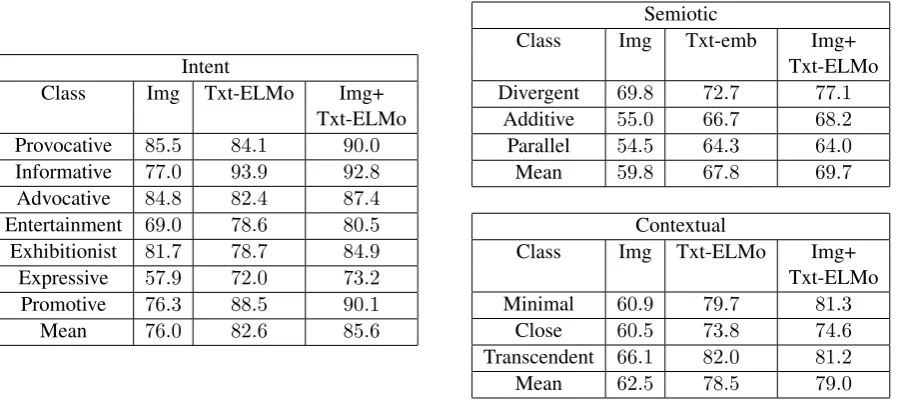
multi-modality models inTable 3. It is particularly
interesting that in the semiotic taxonomy, multi-modality helps the most with divergent semiotics
(gain of4.4%compared to the image-only model).
Figure 4: Confusion between intent classes for the in-tent classification task. The confusion matrix was ob-tained using the Img + Txt-ELMo model and the results are averaged over the5splits.
6.3 Discussion
In general, using both text and image is helpful, a fact that is unsurprising since combinations of text and image are known to increase performance on tasks such as predicting post popularity or user personality (Hessel et al.,2017;Wendlandt et al.,
2017). Most telling, however, were the differences
in this helpfulness across items. In the semiotic category the greatest gain came when the text-image semiotics were “divergent”. By contrast, multimodal models help less when the image and text are additive, and help the least when the image and text are parallel and provide less novel infor-mation. Similarly, with contextual relationships, multimodal analysis helps the most with the “min-imal” category (1.6%). This further supports the idea that on social media such as Instagram, the relation between image and text can be richly di-vergent and thereby form new meanings.
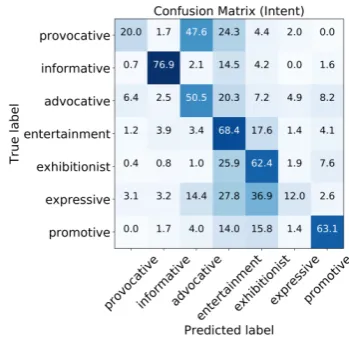
The category confusion matrix inFigure 4
pro-vides further insights. The least confused category is informative. Informative posts are least similar to the rest of Instagram, since they consist of de-tached, objective posts, with little use of first per-son pronouns like “I” or “me.” Promotive posts are also relatively easy to detect, since they are for-mally informative, telling the viewer the advan-tages and logistics of an item or event, with the ad-dition of a persuasive intent reflecting the poster’s personal opinions (“I love this watch”.). We found
that the entertainment label is often misapplied;
perhaps to some extent all posts have a goal of en-tertaining, and any analysis must account for this
filter of entertainment. The Exhibitionist intent
[image:7.595.91.266.521.691.2]Intent
Class Img Txt-ELMo Img+
Txt-ELMo
Provocative 85.5 84.1 90.0
Informative 77.0 93.9 92.8
Advocative 84.8 82.4 87.4
Entertainment 69.0 78.6 80.5
Exhibitionist 81.7 78.7 84.9
Expressive 57.9 72.0 73.2
Promotive 76.3 88.5 90.1
Mean 76.0 82.6 85.6
Semiotic
Class Img Txt-emb Img+
Txt-ELMo
Divergent 69.8 72.7 77.1
Additive 55.0 66.7 68.2
Parallel 54.5 64.3 64.0
Mean 59.8 67.8 69.7
Contextual
Class Img Txt-ELMo Img+
Txt-ELMo
Minimal 60.9 79.7 81.3
Close 60.5 73.8 74.6
Transcendent 66.1 82.0 81.2
[image:8.595.79.528.62.264.2]Mean 62.5 78.5 79.0
Table 3: Class-wise results (AUC) for the three taxonomies with different DCNN models on the MDID dataset. Except for the semiotic taxonomy we used ELMo text representations (based on the performance inTable 2).
like “I love my new hair”). There is a great deal of confusion, however, between the expressive and exhibitionist categories, since the only distinction lies in whether the post is about a general topic or about the poster, and between the provocative and advocative categories, perhaps because both often seek to prove points in a similar way.
With the contextual and semiotic taxonomies, some good results are obtained with text alone. In the “transcendent” contextual case, it is not neces-sarily surprising that using text alone enables 82% AUC because whenever a caption is really long or has many adverbs, adjectives or abstract concepts, it is highly likely to be transcendent. In the “diver-gent” semiotics case, we were surprised that text alone would predict divergence with 72.7% AUC. Examining these cases showed that many of them had lexical cues suggesting irony or sarcasm, al-lowing the system to infer that the image will di-verge in keeping with the irony. There is, how-ever, a consistent improvement when both modal-ities are used for both taxonomies.
6.4 Sample Outputs
We show some sample successful outputs of the
(multimodal) model inFigure 5, in which the
high-est probability class in each of the three dimen-sion corresponds to our gold labels. The top-left Image-caption pair (Image I) is classified as ex-hibitionist, closely followed by expressive; it is a picture of someone’s home with a caption describ-ing a domestic experience. The semiotic relation-ship is classified as additive; the image and caption
together signify the concept of spending winter at home with pets before the fireplace. The contex-tual relationship is classified as transcendental; the caption indeed goes well beyond the image.
The top-right image-caption pair (Image II) is classified as entertainment; the image caption pair works as an ironic reference to dancing (“yeet”) grandparents, who are actually reading, in lan-guage used usually by young people that a typ-ical grandparent would never use. The semiotic relationship is classified as divergent and the con-textual relationship is classified as minimal; there is semantic and semiotic divergence of the image-caption pair caused by the juxtaposition of youth-ful references with older people.
To further understand the role of meaning mul-tiplication, we consider the change in intent and semiotic relationships when the same image of the British Royal Family is matched with two
differ-ent captions in the bottom row ofFigure 5(Image
IV). In both cases the semiotic relationship is par-allel, perhaps due to the match between the
multi-figure portrait setting and the word family. But
Figure 5: Sample successful output predictions for the three taxonomies, showing ranked classes and predicted probabilities. In images IV the same image when paired with a different caption gives rise to a different intent.
7 Conclusion
We have proposed a model to capture the complex meaning multiplication relationship between im-age and text in multimodal Instagram posts. Our three new taxonomies, adapted from the media and semiotic literature, allow the literal, semiotic, and illocutionary relationship between text and image to be coded. Of course our new dataset and the baseline classifier models are just a preliminary ef-fort, and future work will need to examine larger datasets, consider additional data such as hashtags, richer classification schemes, and more sophisti-cated classifiers. Some of these may be
domain-specific. For example,Alikhani et al.(2019) show
how to develop rich coherence relations that model the contextual relationship between recipe text and accompanying images (specific versions of Elabo-ration or Exemplification such as “Shows a tool used in the step but not mentioned in the text”). Expanding our taxonomies with richer sets like these is an important goal. Nonetheless, the fact that we found multimodal classification to be most
helpful in cases where the image and text diverged semiotically points out the importance of these complex relations, and our taxonomies, dataset, and tools should provide impetus for the commu-nity to further develop more complex models of this important relationship.
8 Acknowledgment
References
Karuna Ahuja, Karan Sikka, Anirban Roy, and Ajay Divakaran. 2018. Understanding visual ads by aligning symbols and objects using co-attention.
arXiv preprint arXiv:1807.01448.
Xavier Alameda-Pineda, Andrea Pilzer, Dan Xu, Nicu Sebe, and Elisa Ricci. 2017. Viraliency: Pooling local virality. InCVPR.
Malihe Alikhani, Sreyasi Nag Chowdhury, Gerard de Melo, and Matthew Stone. 2019. CITE: A cor-pus of image–text discourse relations. InNAACL.
John Langshaw Austin. 1962. How to Do Things with Words. Clarendon Press.
John Bateman. 2014. Text and image: A critical intro-duction to the visual/verbal divide. Routledge.
John Berger. 1972.Ways of Seeing. Penguin.
Yonatan Bisk, Jan Buys, Karl Pichotta, and Yejin Choi. 2019. Benchmarking hierarchical script knowledge. InProceedings of NAACL 2019, pages 4077–4085.
Zoya Bylinskii, Tilke Judd, Aude Oliva, Antonio Tor-ralba, and Fr´edo Durand. 2018. What do differ-ent evaluation metrics tell us about saliency models?
PAMI.
Xinlei Chen, Hao Fang, Tsung-Yi Lin, Ramakr-ishna Vedantam, Saurabh Gupta, Piotr Doll´ar, and C Lawrence Zitnick. 2015. Microsoft coco captions: Data collection and evaluation server. arXiv preprint arXiv:1504.00325.
Arturo Deza and Devi Parikh. 2015. Understanding image virality. InCVPR, pages 1818–1826.
Fartash Faghri, David J Fleet, Jamie Ryan Kiros, and Sanja Fidler. 2018. Vse++: Improving visual-semantic embeddings with hard negatives. In
BMVC.
Erving Goffman. 1978. The presentation of self in ev-eryday life. Anchor Books, New York, NY.
Yash Goyal, Tejas Khot, Douglas Summers-Stay, Dhruv Batra, and Devi Parikh. 2017. Making the v in vqa matter: Elevating the role of image under-standing in visual question answering. InCVPR, 2, page 3.
Kaiming He, Xiangyu Zhang, Shaoqing Ren, and Jian Sun. 2016. Deep residual learning for image recog-nition. InCVPR, pages 770–778.
Stephen Heath et al. 1977. Image-music-text. Fontana, London.
Jack Hessel, Lillian Lee, and David Mimno. 2017. Cats and captions vs. creators and the clock: Com-paring multimodal content to context in predicting relative popularity. InWWW, pages 927–936.
Bernie Hogan. 2010. The presentation of self in the age of social media: Distinguishing performances and exhibitions online. Bulletin of Science, Technology & Society, 30(6):377–386.
Xinyue Huang and Adriana Kovashka. 2016. Inferring visual persuasion via body language, setting, and deep features. InCVPRW, pages 73–79.
Drew A. Hudson and Christopher D. Manning. 2019. Gqa: A new dataset for real-world visual reasoning and compositional question answering. In Proceed-ings of the IEEE Conference on Computer Vision and Pattern Recognition, pages 6700–6709.
Zaeem Hussain, Mingda Zhang, Xiaozhong Zhang, Keren Ye, Christopher Thomas, Zuha Agha, Nathan Ong, and Adriana Kovashka. 2017. Automatic un-derstanding of image and video advertisements. In
CVPR, pages 1100–1110. IEEE.
L´aszl´o A Jeni, Jeffrey F Cohn, and Fernando De La Torre. 2013. Facing imbalanced data– recommendations for the use of performance met-rics. InACII, pages 245–251. IEEE.
Jungseock Joo, Weixin Li, Francis F Steen, and Song-Chun Zhu. 2014. Visual persuasion: Inferring com-municative intents of images. InCVPR, pages 216– 223.
Aditya Khosla, Atish Das Sarma, and Raffay Hamid. 2014. What makes an image popular? InWWW, pages 867–876. ACM.
Aditya Khosla, Akhil S Raju, Antonio Torralba, and Aude Oliva. 2015. Understanding and predicting image memorability at a large scale. InICCV, pages 2390–2398.
R Kloepfer. 1977. Komplementaritat von Sprache und Bild, Am Beispiel von Comic, Karikatur, und Reklame. In R. Posner and H.-P. Reinecke, edi-tors,Zeichenprozesse, Semiotische Forschung in den Einzelwissenschaften, pages 129–145. Athenaum.
Jamie Mahoney, Tom Feltwell, Obinna Ajuruchi, and Shaun Lawson. 2016. Constructing the visual on-line political self: an analysis of Instagram use by the Scottish Electorate. InCHI, pages 3339–3351. ACM.
Emily E Marsh and Marilyn Domas White. 2003. A taxonomy of relationships between images and text.
Journal of Documentation, 59(6):647–672.
Tomas Mikolov, Ilya Sutskever, Kai Chen, Greg S Cor-rado, and Jeff Dean. 2013. Distributed representa-tions of words and phrases and their compositional-ity. InNIPS, pages 3111–3119.
natural question and response generation. In Pro-ceedings of the Eighth International Joint Confer-ence on Natural Language Processing, pages 462– 472.
Nasrin Mostafazadeh, Ishan Misra, Jacob Devlin, Mar-garet Mitchell, Xiaodong He, and Lucy Vander-wende. 2016. Generating natural questions about an image. InProceedings of the ACL 2016, pages 1802–1813.
Duy-Kien Nguyen and Takayuki Okatani. 2018. Im-proved fusion of visual and language representations by dense symmetric co-attention for visual question answering. arXiv preprint arXiv:1804.00775.
Matthew E Peters, Mark Neumann, Mohit Iyyer, Matt Gardner, Christopher Clark, Kenton Lee, and Luke Zettlemoyer. 2018. Deep contextualized word rep-resentations. arXiv preprint arXiv:1802.05365.
Behjat Siddiquie, David Chisholm, and Ajay Di-vakaran. 2015. Exploiting multimodal affect and semantics to identify politically persuasive web videos. InICMI, pages 203–210.
Mohammad Soleymani, David Garcia, Brendan Jou, Bj¨orn Schuller, Shih-Fu Chang, and Maja Pantic. 2017. A survey of multimodal sentiment analysis.
IVC, 65:3–14.
Mathias Stager, Paul Lukowicz, and Gerhard Troster. 2006. Dealing with class skew in context recogni-tion. InICDCSW, pages 58–58. IEEE.
Lydia Weiland, Ioana Hulpus, Simone Paolo Ponzetto, Wolfang Effelsberg, and Laura Dietz. 2018. Knowledge-rich image gist understanding beyond literal meaning. arXiv preprint 1904.08709.
Laura Wendlandt, Rada Mihalcea, Ryan L. Boyd, and James W. Pennebaker. 2017. Multimodal analysis and prediction of latent user dimensions. In Interna-tional Conference on Social Informatics, pages 323– 340.
Rowan Zellers, Yonatan Bisk, Ali Farhadi, and Yejin Choi. 2018. From recognition to cognition: Vi-sual commonsense reasoning. arXiv preprint arXiv:1811.10830.