Proceedings of the 2019 Conference on Empirical Methods in Natural Language Processing 2652
Original Semantics-Oriented Attention and Deep Fusion Network
for Sentence Matching
Mingtong Liu, Yujie Zhang, Jinan Xu, Yufeng Chen
School of Computer and Information Technology, Beijing Jiaotong University, Beijing, China
{16112075,yjzhang,jaxu,chenyf}@bjtu.edu.cn
Abstract
Sentence matching is a key issue in natural lan-guage inference and paraphrase identification. Despite the recent progress on multi-layered neural network with cross sentence attention, one sentence learns attention to the inter-mediate representations of another sentence, which are propagated from preceding layers and therefore are uncertain and unstable for matching, particularly at the risk of error prop-agation. In this paper, we present an original semantics-oriented attention and deep fusion network (OSOA-DFN) for sentence matching. Unlike existing models, each attention layer of OSOA-DFN is oriented to the original seman-tic representation of another sentence, which captures the relevant information from a fixed matching target. The multiple attention lay-ers allow one sentence to repeatedly read the important information of another sentence for better matching. We then additionally design deep fusion to propagate the attention informa-tion at each matching layer. At last, we in-troduce a self-attention mechanism to capture global context to enhance attention-aware rep-resentation within each sentence. Experiment results on three sentence matching benchmark datasets SNLI, SciTail and Quora show that OSOA-DFN has the ability to model sentence matching more precisely.
1 Introduction
Natural language sentence matching is a key tech-nique of comparing two sentences and identifying the semantic relationship between them, which is usually viewed as a classification problem (Wang et al., 2017). The technique has applications in natural language inference to judge whether a hy-pothesis sentence can be inferred from a premise sentence (Bowman et al.,2015) and in paraphrase identification to determine whether two sentences express the equivalent meaning or not (Yin et al.,
2015). The core issue for sentence matching is to model the relatedness between two sentences (Rockt¨aschel et al., 2015; Parikh et al., 2016; Wang et al.,2017;Duan et al.,2018).
Recently, neural network-based models for sen-tence matching have attracted more attention for their powerful ability to learn sentence represen-tation (Bowman et al., 2015; Wang et al., 2017; Duan et al., 2018). There are mainly two types of frameworks: sentence encoding based frame-work and attention-based frameframe-work. For the first type of framework, a simple and effective model is proposed by using two sentence vectors (Bowman et al.,2015), but the interaction between two sen-tences is neglected. For the second type of frame-work, attention mechanism is introduced to model word-level interaction between two sentences and a higher accuracy is achieved (Rockt¨aschel et al., 2015; Parikh et al., 2016; Wang et al., 2017). Particularly, multi-layered deep matching network with attention shows that deeper models outper-form shallower models (Duan et al.,2018).
However, the existing attention mechanism still has some limitations. When one sentence learns attention to another sentence, the attention is per-formed between two parallel layers and oriented to the intermediate representations from the pre-ceding layer of another one. As a result, seman-tics to be paid attention are uncertain and unsta-ble for matching because semantics are changed at different layers. On the other hand, the interme-diate representations tend to be affected by error propagation in multi-layered attentions, in which if the first attention aligns the wrong position, the second attention will now have the incorrect infor-mation as input for alignment.
sub-components: (1) original semantics-oriented cross sentence attention; (2) deep fusion; and (3) self-attention mechanism. The cross sentence self-attention is oriented to the original semantic representations of another sentence, so as to be able to capture in-herent semantics by relying on the fixed matching target. The multiple cross attention operations al-low one sentence to repeatedly read the important information of another sentence for better inter-action. We then design a deep fusion in addition to usual fusion to augment the propagation of at-tention information at each matching layer. The self-attention mechanism is also introduced at the last to capture global context to enhance attention-aware representation within each sentence. Exper-iment results demonstrate that OSOA-DFN has the ability to model sentence matching more precisely on the SNLI, the SciTail, and the Quora datasets.
Our contributions can be summarized as fol-lows:
• We pay attention to the original semantic representations for cross sentence interaction and the matching target of attention for a cer-tain sentence is therefore ensured to be fixed in spite of multiple layers. The multiple cross attention operations allow one sentence to re-peatedly read the important information of another sentence for better interaction.
• We design a deep fusion in addition to usual fusion to augment the propagation of at-tention information for matching, and intro-duce a self-attention mechanism at the last to capture global context to enhance attention-aware representation within each sentence.
• We evaluate our model on three challenging datasets and show that the proposed model has the ability to model sentence matching more precisely and significantly improves the performance.
2 General Neural Attention-Based Model for Sentence Matching
Formally, we can define the sentence matching as follows. Given two sentencesP= [p1,· · ·,pi,· · ·,
pm] and Q= [q1, · · ·, qj, · · ·,qn], the goal is to
predict a label y∗ ∈ Y, where Y = {entailment, contradiction, neutral} in natural language infer-ence andY = {0,1} in paraphrase identification, indicating the logic semantic relationship between
two sentencesPandQ(Wang et al.,2017).
y∗= arg max y∈Y
Pr(y|P,Q) (1)
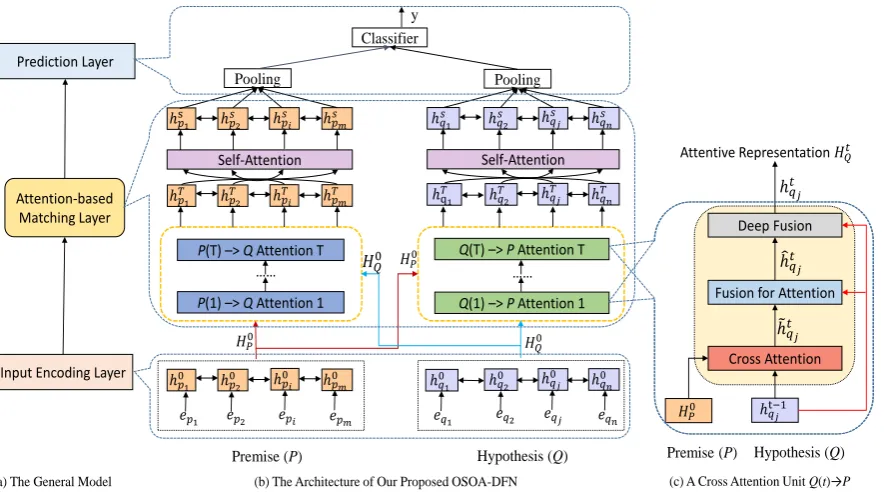
Generally, the architecture of neural attention-based models for sentence matching includes three components (Wang et al.,2017;Duan et al.,2018): (1) input encoding layerencodes each sentence into semantic representation; (2)attention-based matching layermodels word-level alignment be-tween two sentences and produces attention-aware representation for each sentence; and (3) predic-tion layerpredicts the semantic relation between two sentences. Figure 1(a) illustrates the general model.
2.1 Input Encoding Layer
For the given sentence pairsP= [p1,· · ·,pi,· · ·,
pm] and Q= [q1, · · ·, qj, · · ·, qn], where pi and
qj indicate thei-th and j-th word in Pand Q
re-spectively, the input encoding layer first converts words ofPandQinto vectors [ep1, · · ·,epi,· · ·,
epm] and [eq1,· · ·,eqj,· · ·,eqn] by looking upM
respectively, whereM∈Rd×|V|is the embedding table.dis the dimension of embeddings and|V|is the size of the vocabulary.
In order to encode contextual information into word representations, we use a BiLSTM neu-ral network (Hochreiter and Schmidhuber, 1997) to encode two sentences P and Q. The sequen-tial BiLSTM calculates a new hidden state condi-tioned on the previous states to incorporate con-textual information, and several previous works have shown its effectiveness for sentence match-ing (Rockt¨aschel et al., 2015; Wang et al., 2017; Duan et al.,2018).
h0pi = BiLSTM(epi, − →
h0pi−1,←−h0pi+1) (2)
h0qj = BiLSTM(eqj, − →
h0qj−1,←−h0qj+1) (3)
Then the two sentences are converted to H0P = [h0p1,· · ·,h0pi,· · ·,h0pm] andH0Q= [h0q1,· · ·,h0qj,
· · ·,h0qn]. Hereafter, we callH0P andH0Qas origi-nal semantic representations of sentencesPandQ
respectively. In this paper, we will use them as the targets of cross sentence attention.
2.2 Attention-Based Matching Layer
ℎ𝑝01 ℎ𝑝02 ℎ𝑝𝑖
0 ℎ
𝑝𝑚
0 ℎ
𝑞1
0 ℎ
𝑞2
0 ℎ
𝑞𝑗
0 ℎ
𝑞𝑛
0
Q(1) –> P Attention 1
Q(T) –> PAttention T ……
P(1) –> QAttention 1
P(T) –> QAttention T ……
𝑒𝑝1 𝑒𝑝2 𝑒𝑝𝑖 𝑒𝑝𝑚
ℎ𝑝1
𝑇 ℎ
𝑝2
𝑇 ℎ
𝑝𝑖
𝑇 ℎ
𝑝𝑚
𝑇
ℎ𝑝1
s ℎ
𝑝2
𝑠 ℎ
𝑝𝑖
𝑠 ℎ
𝑝𝑚
𝑠
Self-Attention
ℎq1
𝑇 ℎ
𝑞2
𝑇 ℎ
𝑞𝑗
𝑇 ℎ
𝑞𝑛
𝑇
ℎ𝑞1
𝑠 ℎ
𝑞2
𝑠 ℎ
𝑞𝑗
𝑠 ℎ
𝑞𝑛
𝑠 Classifier
Pooling Pooling
y
Premise (P) Hypothesis (Q)
𝑒𝑞1 𝑒𝑞2 𝑒𝑞𝑗 𝑒𝑞𝑛
Self-Attention
𝐻𝑃0 𝐻
𝑄0
𝐻𝑃0 𝐻𝑄0
Input Encoding Layer Attention-based
Matching Layer Prediction Layer
Deep Fusion
Fusion for Attention
𝐻𝑃0
Cross Attention
ℎ𝑞t−1𝑗
Premise (P) Hypothesis (Q) Attentive Representation 𝐻𝑄𝑡
෨ℎ𝑞𝑗𝑡 ℎ𝑞𝑗 𝑡 ℎ𝑞𝑗
𝑡
(c) A Cross Attention Unit Q(t)→P
(b) The Architecture of Our Proposed OSOA-DFN (a) The General Model
Figure 1: (a) is the general model for sentence matching. (b) is an overview architecture of our proposed OSOA-DFN. (c) is an original semantics-oriented cross attention unit that learns the interaction information from the original semantic representation of another sentence.
two sentences. It can be formulated as:
VP = Match(H0P,H0Q),VQ= Match(H0Q,H0P)
(4) where Match(·)is a neural attention-based match-ing function, VP = [vp1, · · ·, vpi, · · ·, vpm]
and VQ = [vq1, · · ·, vqj, · · ·, vqn] are new
attention-aware representations for P and Q, re-spectively. This layer is the core layer for sen-tence matching. Match(·) is mainly focused by researches and some effective frameworks are pro-posed (Rockt¨aschel et al.,2015;Wang et al.,2017; Duan et al., 2018). In this paper, we also focus on this layer, and propose an original semantics-oriented attention and deep fusion network. The details will be described in Section 3.
2.3 Prediction Layer
A pooling layer is used to convert the resulting representations of all position in P and Q into a fixed-length vector and feed it into a classifier to determine the semantic relationship between the two sentences.
A mean pooling is usually adopted on each sentence for capturing all of the information and also a max pooling for highlighting the significant properties. In this paper, we get a fixed dimen-sional representationVby concatenating them
to-gether as (Chen et al.,2017;Duan et al.,2018).
VPmean =
1
m
m
X
i=1
vpi,VPmax = m
max
i=1 vpi (5)
VQmean =
1
n
n
X
j=1
vqj,VQmax = n
max
j=1 vqj (6)
V= [VPmean;VPmax;VQmean;VQmax] (7)
Finally, we pass representationVinto a multilayer perceptron (MLP) classifier to calculate the prob-abilityPr(·)of each label.
Pr(·|P, Q) = softmax(W2ReLU(W1V+b1)+b2)
(8) where,W1,W2,b1,b2are learnable parameters.
3 Original Semantics-Oriented Attention and Deep Fusion Network
[image:3.595.79.523.64.310.2]form one unit of cross attention, as shown in Fig-ure 1(c), and there are T units in attention-based matching layer. Finally, one layer of self-attention is introduced after theT units of cross attention.
3.1 Original Semantics-Oriented Cross Sentence Attention
Cross sentence attention is utilized to model the relevance between two sentences. In the t-th at-tention layer, we useP(t)→Qto annotate that the sentence P learns attention to the sentence Q to extract the relevant information fromQ.
Given the representations of P andQ:HtP−1 = [htp−11, · · ·, htp−i1, · · ·, htp−m1] andHQ0 = [h0q1,· · ·,
h0qj, · · ·, hq0n], each cross attention P(t)→Q will use the original semantics H0Q of Q for interac-tion, where t = {1, · · ·, T} and t = 1 represents
P using the original representation H0P. We first compute the unnormalized attention weights as the similarity ofP(t) andQ, the alignment matrix
At∈Rm×nis defined as follows:
Atij =htp−i1TWth0qj+hUpt,htp−i1i+hUtq,h0qji (9)
where Wt ∈ Rh×h, Utp, Utq ∈ Rh are learnable parameters, andh·,·idenotes the inner production operation.pi andpj are the thei-th andj-th word
in thePandQrespectively. Next, the semantics of sentenceQrelated tohtp−i1is extracted to compute
e
htpi according toAt, as shown in Equation (10).
e
htpi =
n
X
j=1
exp(Atij)
Pn
k=1exp(A t ik)
h0qj (10)
Intuitively,eh
t
pi is a representation by using
atten-tive information in H0Q that is softly aligned to
htp−i1, and the semantics of H0Q is more probably selected if it is more related tohtp−i1.
3.2 Deep Fusion
To further enrich the interaction, we first perform an usual fusion and then design a deep fusion for each cross attention to augment the propagation of attention information.
The usual fusion (Wang and Jiang,2016a;Duan et al., 2018) can be formulated as the Equations (11) - (13).
htpi= [htp−i1;eh
t pi;|h
t−1 pi −eh
t pi |;h
t−1 pi eh
t pi] (11)
e
htpi = ReLU(Wthhtpi+bth) (12)
b
htpi = BiLSTM(eh
t pi,
− →
htpi−1,←−htpi+1) (13)
where [·;·;·;·] refers to the concatenation opera-tion. In matching operation, the concatenation can retain all the information (Wang and Jiang,2016a; Chen et al., 2017). We use a neural nonlinear transformation ReLU (Glorot et al., 2011) as lo-cal comparison function. This operation helps the model to better fuse the attention information and also reduce the complexity of vector representa-tion. Since the understanding of some word-level alignments may rely on the contextual matching information, we then apply a BiLSTM to incor-porate the sequential matching information, which further gathers interactive features between two sentences.
We design the deep fusion layer as follows. A gated connection layer is used to learn adaptively controlling how much information to be stored and carried to the next attention layer. It can be formu-lated as Equations (14) - (17):
rtpi =σ(Wtr[htp−i1;bh
t pi;h
t−1 pi bh
t pi] +b
t
r) (14)
ztpi =σ(Wtz[htp−i1;bh
t pi;h
t−1 pi bh
t pi] +b
t z) (15)
ec
t
pi = tanh(W t
c[rtpih t−1 pi ;bh
t pi] +b
t
c) (16)
hpti =ztpihpt−i1+ (1−ztpi)ectpi (17)
whereWt∗andbt∗are the learnable parameters,htpi
is the result of current layer,htp−i1is the result from preceding layer,σis a sigmoid function, the value ofrtpi andztpi is between 0 and 1. Intuitively, the model can learn to set the rtpi andztpi close to 1, thus the more attention information from the pre-ceding layers will be propagated to the following attention layers for matching, and close to 0 im-plying that the information of preceding layers is less propagated.
After the t-th layer of the original semantics-oriented cross attention, each wordpi in sentence Pis newly represented byhtpi. Similarly, we con-duct cross attention for Q(t)→P, implying that the sentence Q learns attention to the sentence
P, which will be oriented to the original seman-tic representationH0P ofPto derive the attention-aware representationhtqj for each wordqj ofQ.
3.3 Self-Attention Mechanism
For sentenceP, its attentive representationHTp = [hTp1,· · ·,hTpi,· · ·,hTpm] is computed afterT lay-ers of original semantics-oriented cross sentence attention. We first compute a self-attention matrix
Ss∈Rm×mas Equation (9).
Ssij =hhTpi,hTpji (18)
where,Ssij indicates the relevance between thei-th word and j-th word in P. Then, the self-attention vector for each word inPis computed as follows:
e
hspi =
m
X
j=1
exp(Ssij)
Pm
k=1exp(Ssik)
hTpj (19)
Intuitively,eh
s
piaugments each word representation
with global context of the sentenceP.
After that, an usual fusion augmented by deep fusion, as described in Section 3.2, is also intro-duced to further enhance the self-attention infor-mation within each sentence as follows:
hspi = [hTpi;eh
s pi;|h
T pi−eh
s pi |;h
T pieh
s
pi] (20)
e
hspi = ReLU(Wshhsp
i +b
s
h) (21)
b
hspi = BiLSTM(eh
s pi,
− →
hspi−1,←−hspi+1) (22)
The deep fusion after the self-attention layer is computed as Equations (14) and (17), which fuses thehTpi from original semantics-oriented cross at-tention and the bh
s
pi from self-attention to get the
final attention-ware representation.
Similarly, we conduct self-attention and deep fusion operations to the sentence Qto derive the attention-aware representation hsqj for each word
qj ofQ. Then, two sentences are converted toHsP
= [hsp1,· · ·,hspi,· · ·,hspm] andHsQ= [hsq1,· · ·,hsqj,
· · ·,hsqn]. Finally,HsP andHsQ are passed into the prediction layer as inputVP andVQfor deciding
their semantic relationship.
4 Training
For model training, we employ cross-entropy as the loss function since the goal is the make the correct classification. Considering the model com-plexity, we also add l2-norm of all learnable
pa-rameters to the final loss function. Finally, the ob-ject is to minimize the following obob-jective func-tionJ(θ), which can be formulated as:
J(θ) =−1
N
N
X
i=1
logP(y(i)|P(i), Q(i);θ)+1 2λkθk
2 2
(23)
Dataset Train Dev Test Avg.L Vocab
SNLI 549K 9.8K 9.8K 14 8 36K
SciTail 23K 1.3K 2.1K 17 12 24K
[image:5.595.309.522.62.105.2]Quora 384K 10K 10K 12 12 107K
Table 1: Statistics of datasets: SNLI, SciTail and Quora. Avg.L refers to average length of a pair of sen-tences.
whereθdenotes all the learnable parameters of our model,N is the number of instances in the train-ing set,(P(i), Q(i))are the sentence pairs, andy(i)
denotes the corresponding annotated label for the
i-th instance.
Word Embedding Following (Tay et al.,2017), to represent each input word, we concatenate three types of vectors: a pre-trained vector, a learnable vector for each word type, and a learnable vector for the POS tag of the word. We use NLTK 1 to acquire POS tags. Finally, we apply a nonlinear transformation ReLU to the concatenated vector to get the final word embedding.
5 Experiments
5.1 Dataset
We evaluate our model on natural language infer-ence and paraphrase identification tasks with three datasets: the Stanford Natural Language Inference (SNLI) dataset (Bowman et al.,2015), the SciTail dataset (Khot et al., 2018), and the Quora Ques-tions Pairs dataset (Quora).
SNLI is a natural language inference dataset (Bowman et al., 2015). The original data set contains 570,152 sentence pairs, each labeled with one of the following relationships: Y =
{entailment, contradiction, neutral}. We follow the same data split as in (Bowman et al.,2015).
SciTail is a binary entailment classification task andY ={entailment, neutral}. We have the same data split as in (Khot et al., 2018). Notably, the premise and the corresponding hypothesis have high lexical similarity both for entailed and non-entailed pairs, which makes the task particularly difficult.
Quora consists of over 400,000 question pairs andY ={0, 1} indicating whether two questions are paraphrases of each other. We have the same data split as in (Wang et al.,2017).
Models Train Test LstmAtt(Rockt¨aschel et al.,2015) 85.3 83.5
mLSTM (Wang and Jiang,2016b) 92.0 86.1
LSTMN (Cheng et al.,2016) 88.5 86.3
DecompAtt (Parikh et al.,2016) 89.5 86.8
re-read (Sha et al.,2016) 90.7 87.5
btree-LSTM (Paria et al.,2016) 88.6 87.6
SAN (Im and Cho,2017) 89.6 86.3
BiMPM (Wang et al.,2017) 90.9 87.5
ESIM (Chen et al.,2017) 92.6 88.0
DIIN (Gong et al.,2017) 91.2 88.0
AF-DMN (Duan et al.,2018) 94.5 88.6
OSOA-DFN (single) 92.3 88.8
BiMPM (ensemble) 93.2 88.8
ESIM (ensemble) 93.5 88.6
DIIN (ensemble) 92.3 88.9
AF-DMN (ensemble) 94.9 89.0
[image:6.595.81.283.59.243.2]OSOA-DFN (ensemble) 93.5 89.3
Table 2: Comparative results with previous models on SNLI dataset.
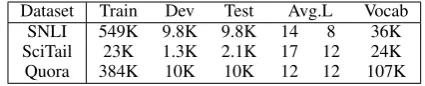
The detailed statistical information of the three datasets is shown in Table 1.
5.2 Implementation Details
We set word embeddings and all of the hidden states of BiLSTMs and MLPs to 300 dimensions. Pre-trained word vectors are 300-dimensional
Glove840B(Pennington et al.,2014) and without updating during training. The learnable word vec-tors and POS vecvec-tors have 30 dimensions. For all datasets, there are 3 cross sentence attention lay-ers and 1 self-attention layer. The batch size is set to 64 for SNLI and Quora, 32 for SciTail. We use the Adam method (Kingma and Ba,2014) for model training. We set the initial learning rate to 5e-4 with a decay ratio of 0.95 for each epoch, and
l2 regularizer strength to 6e-5. To prevent
over-fitting, we use dropout regularization (Srivastava et al.,2014) with a drop rate of 0.2 for all MLPs.
5.3 Ensemble
The ensemble strategy has been proved to effec-tively improve model accuracy. Following (Duan et al., 2018), our ensemble model averages the probability distributions from three individual sin-gle OSOA-DFNs, and each of them has the same architecture but different parameter initialization.
5.4 Comparison on Natural Language Inference
SNLI We compare our model with the follow-ing previous models on SNLI dataset, and show the results in Table 2. LstmAtt (Rockt¨aschel et al., 2015) extend the general LSTM model with
at-Models Dev Test
Majority class 63.3 60.3
Ngram 65.0 70.6
DecompAtt 75.4 72.3
ESIM 70.5 70.6
DGEM 79.6 77.3
DEISTE 82.4 82.1
CAFE - 83.3
AF-DMN (re-imp) 87.2 84.4
OSOA-DFN 88.9 86.8
Table 3: Comparative results with previous models on SciTail dataset.
tention mechanism. mLSTM (Wang and Jiang, 2016b) exploit LSTM with memory. Decom-pAtt (Parikh et al., 2016) propose a decompos-able word-by-word matching model with atten-tion, and use pre-trained word vector without rely-ing on any word-order information. SAN (Im and Cho, 2017) is a distance-based self-attention net-work. BiMPM (Wang et al.,2017) design a bilat-eral multi-perspective matching model from both directions. ESIM (Chen et al.,2017) incorporate the chain LSTM and tree LSTM. Recently, AF-DMN (Duan et al., 2018) adopt attention-fused deep matching network by using multiple stacked cross attention and self-attention layers.
In Table 2, our single OSOA-DFN achieves 88.8% test accuracy. Moreover, we also report the ensemble result, and the test accuracy is 89.3%. Comparative results show that our model outper-forms the previous models on single and ensemble scenarios on SNLI dataset. ELMO (Peters et al., 2018) and BERT (Devlin et al., 2018) have been well known as pre-trained language model for ac-quiring contextual word vectors. However, our model has less computing complexity (340M pa-rameters in BERT while 10M in our model), but obtained competitive performance. We will con-duct the comparison with them in the future. In this paper, we evaluated the contribution of origi-nal semantics-oriented cross attention and deep fu-sion to our model.
[image:6.595.348.485.61.164.2]fea-Models Test
Siamese-CNN 79.60
Multi-Perspective-CNN 81.38
Siamese-LSTM 82.58
Multi-Perspective-LSTM 83.21
L.D.C 85.55
BiMPM 88.17
AF-DMN 88.72
[image:7.595.112.252.60.156.2]OSOA-DFN 89.03
Table 4: Comparative results with previous models on Quora dataset.
Models Dev Test
OSOA-DFN (ori-attention) 88.9 86.8
[image:7.595.376.458.62.123.2]OSOA-DFN (inter-attention) 87.1 84.2
Table 5: Effect of original semantics-oriented cross sentence attention on SciTail dataset.
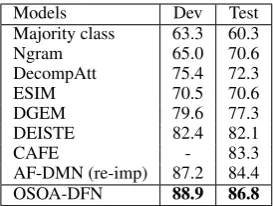
tures. DEISTE (Yin et al.,2018) propose deep ex-plorations of inter-sentence interaction. AF-DMN (re-imp) is our re-implementation of the multi-layered attention model in (Duan et al.,2018) that have not reported the results on this dataset.
On this dataset, our single OSOA-DFN signifi-cantly outperforms these strong baselines, achiev-ing the state-of-the-art performance with 86.8% accuracy on the test set. It demonstrates that our model has the ability to improve semantic match-ing on the challengmatch-ing SciTail dataset.
5.5 Comparison on Paraphrase Identification
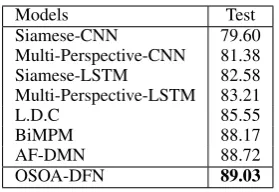
Quora We compare our model with the follow-ing previous models on Quora dataset, and show the results in Table 4. The Siamese-CNN model and Siamese-LSTM model encode sentences with CNN and LSTM respectively, and then predict the relationship between them based on the cosine similarity (Wang et al.,2017). Multi-Perspective-CNN and Multi-Perspective-LSTM adopt multi-ple perspective cosine matching function (Wang et al., 2017). L.D.C (Wang et al., 2016) and BiMPM (Wang et al.,2017) adopt attention-based framework that performs word-level matching.
As we can see, our single OSOA-DFN outper-forms the baselines and achieves 89.03% accuracy on the test set. The results prove that our model is very effective for paraphrase identification task.
5.6 Effect of Original Semantics-Oriented Cross Sentence Attention
To verify the effect of original semantics-oriented cross sentence attention, we first implement a variant of our model, namely OSOA-DFN
(inter-Num Dev Test
1 86.9 84.0
2 88.6 85.1
3 88.9 86.8
4 89.1 87.2
5 89.2 87.4
Table 6: Effect of cross sentence attention layers on SciTail dataset.
Models Dev Test
OSOA-DFN 88.9 86.8
- Deep fusion 85.8 84.7
- Self-attention 88.1 84.8
- BiLSTM fusion 87.2 83.2
Table 7: Effect of components on SciTail dataset.
attention), as shown in Table 5. As in the model of (Duan et al.,2018), we make the cross sentence attention oriented to the intermediate representa-tions from the preceding layer of another sentence, where cross attention is performed on parallel lay-ers between two sentences. The results show that our method achieves higher accuracy on the test set of SciTail dataset, which proves the effect of original semantics-oriented cross attention on ex-tracting expressive features from another sentence for semantic matching.
We further verify the effect of the depth of cross sentence attention on performance, as shown in Table 6. As the number of stacked attention layers increases from 1 to 5, we can see that the perfor-mance increases both on the development set and the test set of SciTail dataset. But from 3 to 5, the increased accuracy is slower. We can conclude that the multiple original semantics-oriented atten-tions are effective in improving matching perfor-mance. However, the parameters will grow rapidly with the increasing of the number of stacked at-tention layer, and a large of number of parameters will increase model complexity. Because of com-putational cost, we just set the number of cross at-tention layers to 3 in our experiment.
5.7 Effect of Deep Fusion and Self-Attention Mechanism
[image:7.595.350.481.174.228.2]prop-(a) 1st cross attention. (b) 2nd cross attention. (c) 3rd cross attention. (d) self-attention.
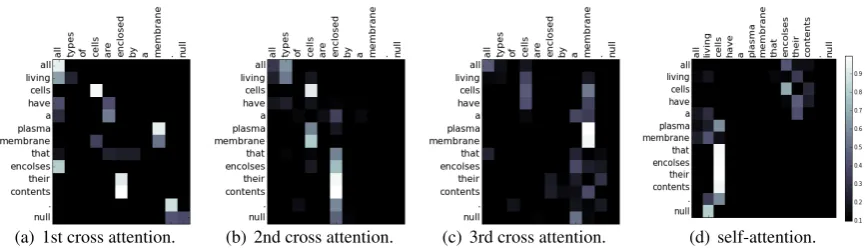
Figure 2: The visualization of alignment matrices in the three cross sentence attention layers and the self-attention layer.
agating attention information through the network for deep interaction. Without the self-attention, the accuracy is degraded to 84.8%. This indicates that the self-attention mechanism is effective in capturing global context information for augment-ing attention-aware semantic representation.
We also verify the effect of BiLSTM fusion, without the BiLSTM fusion, the accuracy is de-graded to 83.2%. This shows contextual informa-tion gathered by BiLSTM fusion is important for interaction between two sentences.
5.8 What is Learned by Attention ?
We further investigate the results of the multi-layered cross sentence attention and the self-attention and then visualize the results in Figure 2. This is an instance from the test set of the SciTail dataset: {P:all living cells have a plasma mem-brane that encloses their contents. Q:all types of cells are enclosed by a membrane. The label y:
entailment.}. The results are produced by OSOA-DFN with 3 original semantics-oriented cross sen-tence attentionsP(t)→Qand 1 self-attention. We visualize the attention matrices for each layer to show the dynamic attention changes.
From the results, we observe that the first at-tention layer may have erroneous alignments. We can find that the premise word “encloses” is in-correctly aligned with hypothesis word “all”. In the second attention layer, the alignment quality is improved dramatically, where the “encloses” is correctly aligned to “enclosed”. It shows that the second attention layer effectively revises the errors from the first attention layer. In the sec-ond and third attention layers, the attention gradu-ally tends to capture phrase-level alignments, such as “that encloses their contents” and “enclosed”, and “cells have a plasma membrane” and “
mem-brane”. Meanwhile, with the increment of interac-tion, the high attention layers also tend to capture new alignment information from another sentence that is not captured in low attention layers.
In the self-attention layer, we observe that the phrase “plasma membrane that encloses their con-tents” is strongly aligned to the phrase “living cells”. This layer captures long-distance semantic dependency within the sentence. The visualiza-tion of attenvisualiza-tion further shows that our proposed model is capable of capturing alignment informa-tion from two sentences for better semantic match-ing.
6 Related Works
Recently, deep neural network models have achieved promising results in modeling sentence matching. A standard practice is to encode each sentence as a vector with a neural network (Bow-man et al., 2015; Mou et al., 2015; Tan et al., 2015), and then the relation is decided based on the two sentence vectors. This kind of framework ignores the interaction between two sentences.
network (AD-DMN), which is based on layered attention mechanism and shows that multi-ple stacked attention layers can improve matching performance. Besides cross sentence attention, the self-attention mechanism is proposed to solve the limitations of RNN model on the long-term depen-dency problem, which aims to align the sentence with itself and has been used in a variety of tasks (Lin et al.,2017;Duan et al.,2018).
Our proposed OSOA-DFN conducts original semantics-oriented cross sentence attention to model the matching. We design deep fusion to augment the propagation of attention information. At last, we introduce a self-attention mechanism to capture global context to enhance semantic rep-resentation. Compared to AF-DMN (Duan et al., 2018), we just use one self-attention layer instead of multiple layers, which reduces model complex-ity but achieves outperformed accuracy.
7 Conclusions and Future Work
In this paper, we propose an original semantics-oriented attention and deep fusion network (OSOA-DFN) for sentence matching. It lever-ages original semantics-oriented cross sentence at-tention, deep fusion and self-attention mechanism jointly. We compare our model with the previous models on two sentence matching tasks: natural language inference and paraphrase identification. Experiment results show that OSOA-DFN has the ability to model sentence matching more precisely and significantly improves the performance.
In the future, we will further investigate the effect of the network depth on sentence match-ing and explore introducmatch-ing external knowledge, such as pre-trained language model BERT (De-vlin et al., 2018) and paraphrase database (Gan-itkevitch et al.,2013), to help learning more accu-rate and robust sentence representation.
Acknowledgement
The research work descried in this paper has been supported by the National Nature Science Foun-dation of China (Nos. 61876198, 61976015, 61370130 and 61473294), and also supported by the Fundamental Research Funds for the Cen-tral Universities (No. 2018YJS025), the Bei-jing Municipal Natural Science Foundation (No. 4172047), and the International Science and Tech-nology Cooperation Program of China under Grant No. K11F100010. The authors would like
to thank the anonymous reviewers for their valu-able comments and suggestions to improve this paper.
References
Samuel R Bowman, Gabor Angeli, Christopher Potts, and Christopher D Manning. 2015. A large anno-tated corpus for learning natural language inference. arXiv preprint arXiv:1508.05326.
Qian Chen, Xiaodan Zhu, Zhen-Hua Ling, Si Wei, Hui Jiang, and Diana Inkpen. 2017. Enhanced lstm for natural language inference. InProc. ACL.
Jianpeng Cheng, Li Dong, and Mirella Lapata. 2016. Long short-term memory-networks for machine reading.arXiv preprint arXiv:1601.06733.
Jacob Devlin, Ming-Wei Chang, Kenton Lee, and Kristina Toutanova. 2018. Bert: Pre-training of deep bidirectional transformers for language understand-ing.arXiv preprint arXiv:1810.04805.
Chaoqun Duan, Lei Cui, Xinchi Chen, Furu Wei, Con-ghui Zhu, and Tiejun Zhao. 2018. Attention-fused deep matching network for natural language infer-ence. InIJCAI, pages 4033–4040.
Juri Ganitkevitch, Benjamin Van Durme, and Chris
Callison-Burch. 2013. Ppdb: The paraphrase
database. InProceedings of the 2013 Conference of the North American Chapter of the Association for Computational Linguistics: Human Language Tech-nologies, pages 758–764.
Xavier Glorot, Antoine Bordes, and Yoshua Bengio. 2011. Deep sparse rectifier neural networks. In Pro-ceedings of the Fourteenth International Conference on Artificial Intelligence and Statistics, pages 315– 323.
Yichen Gong, Heng Luo, and Jian Zhang. 2017. Natu-ral language inference over interaction space. arXiv preprint arXiv:1709.04348.
Kaiming He, Xiangyu Zhang, Shaoqing Ren, and Jian Sun. 2016. Deep residual learning for image recog-nition. In Proceedings of the IEEE conference on computer vision and pattern recognition, pages 770– 778.
Sepp Hochreiter and J¨urgen Schmidhuber. 1997.
Long short-term memory. Neural computation,
9(8):1735–1780.
Jinbae Im and Sungzoon Cho. 2017. Distance-based self-attention network for natural language infer-ence. arXiv preprint arXiv:1712.02047.
Diederik Kingma and Jimmy Ba. 2014. Adam: A method for stochastic optimization. arXiv preprint arXiv:1412.6980.
Zhouhan Lin, Minwei Feng, Cicero Nogueira dos San-tos, Mo Yu, Bing Xiang, Bowen Zhou, and Yoshua Bengio. 2017. A structured self-attentive sentence embedding. arXiv preprint arXiv:1703.03130.
Lili Mou, Rui Men, Ge Li, Yan Xu, Lu Zhang, Rui Yan, and Zhi Jin. 2015. Natural language inference by tree-based convolution and heuristic matching. arXiv preprint arXiv:1512.08422.
Biswajit Paria, KM Annervaz, Ambedkar Dukkipati,
Ankush Chatterjee, and Sanjay Podder. 2016. A
neural architecture mimicking humans end-to-end
for natural language inference. arXiv preprint
arXiv:1611.04741.
Ankur P Parikh, Oscar T¨ackstr¨om, Dipanjan Das, and Jakob Uszkoreit. 2016. A decomposable attention model for natural language inference. arXiv preprint arXiv:1606.01933.
Jeffrey Pennington, Richard Socher, and Christopher
Manning. 2014. Glove: Global vectors for word
representation. InProceedings of the 2014 confer-ence on empirical methods in natural language pro-cessing (EMNLP), pages 1532–1543.
Matthew E Peters, Mark Neumann, Mohit Iyyer, Matt Gardner, Christopher Clark, Kenton Lee, and Luke Zettlemoyer. 2018. Deep contextualized word rep-resentations. arXiv preprint arXiv:1802.05365.
Tim Rockt¨aschel, Edward Grefenstette, Karl Moritz Hermann, Tom´aˇs Koˇcisk`y, and Phil Blunsom. 2015. Reasoning about entailment with neural attention. arXiv preprint arXiv:1509.06664.
Lei Sha, Baobao Chang, Zhifang Sui, and Sujian Li. 2016. Reading and thinking: Re-read lstm unit for textual entailment recognition. In COLING, pages 2870–2879.
Nitish Srivastava, Geoffrey E Hinton, Alex Krizhevsky, Ilya Sutskever, and Ruslan Salakhutdinov. 2014. Dropout: a simple way to prevent neural networks from overfitting. Journal of machine learning re-search, 15(1):1929–1958.
Ming Tan, Cicero dos Santos, Bing Xiang, and Bowen
Zhou. 2015. Lstm-based deep learning models
for non-factoid answer selection. arXiv preprint arXiv:1511.04108.
Yi Tay, Luu Anh Tuan, and Siu Cheung Hui. 2017. A compare-propagate architecture with alignment factorization for natural language inference. arXiv preprint arXiv:1801.00102.
Shuohang Wang and Jing Jiang. 2016a. A compare-aggregate model for matching text sequences. arXiv preprint arXiv:1611.01747.
Shuohang Wang and Jing Jiang. 2016b. Learning natu-ral language inference with lstm. InProceedings of NAACL-HLT, pages 1442–1451.
Zhiguo Wang, Wael Hamza, and Radu Florian. 2017. Bilateral multi-perspective matching for natural lan-guage sentences. corr abs/1702.03814.
Zhiguo Wang, Haitao Mi, and Abraham Ittycheriah.
2016. Sentence similarity learning by lexical
decomposition and composition. arXiv preprint
arXiv:1602.07019.
Wenpeng Yin, Hinrich Sch¨utze, and Dan Roth. 2018. End-task oriented textual entailment via deep explo-rations of inter-sentence interactions.arXiv preprint arXiv:1804.08813.