Learning Semantic Composition to Detect Non-compositionality
of Multiword Expressions
Majid Yazdani Computer Science
Department University of Geneva [email protected]
Meghdad Farahmand Computer Science
Department University of Geneva meghdad.farahmand@
unige.ch
James Henderson Xerox Research Center Europe
james.henderson@ xrce.xerox.com
Abstract
Non-compositionality of multiword ex-pressions is an intriguing problem that can be the source of error in a variety of NLP tasks such as language genera-tion, machine translation and word sense disambiguation. We present methods of non-compositionality detection for En-glish noun compounds using the unsu-pervised learning of a semantic compo-sition function. Compounds which are not well modeled by the learned semantic composition function are considered non-compositional. We explore a range of dis-tributional vector-space models for seman-tic composition, empirically evaluate these models, and propose additional methods which improve results further. We show that a complex function such as polyno-mial projection can learn semantic compo-sition and identify non-compocompo-sitionality in an unsupervised way, beating all other baselines ranging from simple to complex. We show that enforcing sparsity is a useful regularizer in learning complex composi-tion funccomposi-tions. We show further improve-ments by training a decomposition tion in addition to the composition func-tion. Finally, we propose an EM algo-rithm over latent compositionality annota-tions that also improves the performance. 1 Introduction
Multiword Expressions (MWEs) are sequences of words that exhibit some kind of idiosyncrasy. This idiosyncrasy can be semantic, statistical, or syn-tactic1. Ivory tower, speed limit, and at large
1MWEs can have other less significant kinds of idiosyn-crasies. For instance lexical idiosyncrasy as inad hoc, and pragmatic idiosyncrasy as in good morning (Baldwin and Kim, 2010)
are examples of semantically, statistically and syn-tactically idiosyncratic MWEs respectively. Note that an MWE can be idiosyncratic at several lev-els. In general, semantically idiosyncratic MWEs are commonly referred to as non-compositional (Baldwin and Kim, 2010) and statistically idiosyn-cratic MWEs are commonly referred to as col-locations (Sag et al., 2002). Non-compositional MWEs are those whose meaning can not be read-ily inferred from the meaning of their constituents and collocations are those MWEs whose con-stituents co-occur more than expected by chance. Collocations constitute the largest subset of all kinds of MWEs, however, non-compositional ones cause more problems in various NLP tasks, for ex-ample word sense disambiguation (McCarthy et al., 2003) and machine translation (Lin, 1999). It may also be more challenging to model non-compositionality than collocational weight as the former has to do with modelling the semantics and the latter can to some extent be modeled by con-ventional statistical measures such as mutual in-formation. Detecting non-compositionality in an automatic fashion has been the aim of much pre-vious research.
In this paper, we capture non-compositionality of English Noun Compounds (NCs)2based on the assumption that the majority of the compounds are compositional, for which a composition func-tion can be learned. This implies that the com-pounds for which a composition function cannot be learned with a relatively low error are non-compositional.
In previous work on vector-space models of dis-tributional semantics, semantic composition has been commonly assumed to be a trivial predeter-mined function such as addition, multiplication,
2MWEs have various syntactic categories such as noun compounds, verb particle constructions, light verb tions, etc., with noun compounds and verb particle construc-tions constituting the most prominent categories of MWEs.
and their weighted variations (Mitchell and Lap-ata, 2008; Reddy et al., 2011; Salehi et al., 2015). Nevertheless there is some work that regards com-position as a more complex function. For in-stance Widdows (2008) who propose (but doesn’t empirically test) the use of Tensor and Convolu-tion products for modelling non-composiConvolu-tionality, Baroni and Zamparelli (2010) who regard adjec-tives in adjectival-noun compositions as matri-ces that can be learned by linear regression, and Socher et al. (2012) who present a model that learns phrase composition by means of a recursive neural network. The two latter works show that complex composition models significantly outper-form additive and multiplicative functions. In this work, we too assume that composition is ar-guably a complex function. We believe simpli-fied composition functions, such as additive and multiplicative functions and their weighted varia-tions, while having advantages such as being im-pervious to overfitting, can not completely cap-ture semantic composition. Nevertheless mod-elling composition by means of a powerful func-tion can be equally inadequate for our purposes. An overly powerful composition function mem-orizes all compositional and non-compositional compounds, resulting in overfitting and low learn-ing error that hinders discrimination between com-positional and non-comcom-positional compounds. We examine various classes of composition functions, ranging from the least to the most powerful (in terms of learning capacity). We show that com-plex functions clearly do a better job in mod-elling semantic composition and in detecting non-compositionality compared to commonly used ad-ditive and multiplicative functions.
Compositional compounds are also decompos-able; intuitively, their semantics is the union of the semantics of their components. More for-mally, conditioned on the vector of the com-pound, vectors of the component words should be independently predictable. This principle, to-gether with the assumption that most of the com-pounds are compositional, leads to the conclusion that a model of composition should be able to be auto-reconstructive: the composition function that maps component-words’ vectors to their com-pound vector should have an associated decom-position function that independently predicts each of the component-words’ vectors from this com-pound vector. An auto-reconstructive model
en-ables us to exploit more data in order to learn se-mantic composition and predict compositionality. We show that auto-reconstruction can improve the accuracy of composition functions and improve detecting non-compositionality.
To further improve non-compositionality de-tection, we propose an EM-like detection algo-rithm based on hidden compositionality annota-tions. The best composition is the one that is the best fit on all the data points except the non-compositional ones. Since we don’t use annotated data at training time, we assume annotations to be hidden variables and iteratively alternate between optimizing the composition function and optimiz-ing the hidden compositionality annotations. We show that this iterative algorithm increases the accuracy of non-compositionality detection com-pared to the case when training is done on all ex-amples.
We run our experiments on the data set of Farahmand et al. (2015) who provide a set of English NCs which are annotated with non-compositionality judgments. We show that quadratic regression significantly outperforms ad-ditive and multiplicative baselines and all other models in modelling semantic composition and identifying the non-compositional NCs. In short, the contributions of our work are: to empirically evaluate various composition functions ranging from simple to overly complex in order to find the most accurate function; to propose, to the best of our knowledge for the first time, a method of iden-tifying non-compositional phrases as phrases for which a composition function cannot be readily learned; to propose learning decomposability as another criterion to detect non-compositionality; and to examine possible ways of improving the ac-curacy of the models by means of EM on hidden compositionality annotations.
2 Related Work
id-iomatic nature. Lin (1999) argues that the mu-tual information between the constituents of a non-compositional phrase is significantly differ-ent from that of a phrase created by substitut-ing the constituents of that phrase with their sim-ilar words. Their evaluation reveals a low pre-cision (16 − 39%) and recall (14 − 21%). In any case this method is not able to discrimi-nate non-compositional MWEs from collocational MWEs as they share the same property of non-substitutability (their constituents cannot be re-placed with their synonyms). Baldwin et al. (2003) present a method that decides about the non-compositionality of English NCs and verb particle constructions by using latent semantic analysis to calculate the similarity between a MWE and its components. They argue that a higher similarity indicates a higher degree of com-positionality. McCarthy et al. (2003) devise a number of measures based on comparison of the neighbors of phrasal verbs and their correspond-ing simplex verbs. They evaluate these measures by calculating their correlation with human com-positionality judgments on a set of phrasal verbs. They show that some of the measures have signifi-cant correlations with human judgments. Venkata-pathy and Joshi (2005) present a supervised model that benefits from both collocational and con-textual information and ranks the MWE candi-dates based on their non-compositionality. Katz and Giesbrecht (2006) use distributional semantics and LSA as a model of context similarity to test whether the local context of a MWE can distin-guish its idiomatic use from literal use. They fur-ther compare the context of a MWE with the con-text of its components and show that this can be used to decide whether the expression is idiomatic or not. Cook et al. (2007) is a relatively differ-ent work where the authors propose a syntactic ap-proach to identify semantic non-compositionality of verb-noun MWEs. McCarthy et al. (2007) use various models of selectional preferences for de-tecting non-compositional verb-object pairs.
Reddy et al. (2011) employ the additive and multiplicative composition functions presented by Mitchell and Lapata (2008)3 and several
similar-3Mitchell and Lapata (2008) present an analysis of vector-based additive and multiplicative semantic composition mod-els where each words is represented by its distributional vec-tor. They conclude that multiplicative and combined models do a better job in modelling vector-based semantic composi-tion than other models.
ity based models to measure the compositionality of MWEs. Similarity based models measure the similarity of a MWE vector and sum/product of its constituents’ vectors. Their evaluation (which is carried out on a set of 90 annotated NCs) shows that there is a relatively high correlation (Spear-man ρ of between 0.51 and 0.71) between their models’ predictions and human judgments on non-compositionality of English NCs, with weighted additive function outperforming all the other mod-els. Kiela and Clark (2013) present a model of de-tecting non-compositionality based on the hypoth-esis that the average distance between a phrase vector and its substituted phrase vectors is related to its compositionality. In particular composi-tional phrases are less similar to their neighbors in semantic space. The distributional vectors repre-senting the semantics of words were created using the standard window method and 50,000 most fre-quent context words. They show that their model slightly (+0.014 and +0.007) outperforms their baselines (Venkatapathy and Joshi, 2005; Mc-Carthy et al., 2007).
All of the models mentioned so far are based on conventional4 or count based vector space repre-sentation of the words. More recent works how-ever are based on representation learning of word embeddings. Baroni and Zamparelli (2010) regard adjective as matrices and nouns as real-valued vec-tors for Italian adjective noun composition. They learn the adjective matrices by linear regression. In this work, however, every adjective is presented by a new matrix which leads to a large number of parameters. Socher et al. (2012) suggest that composition function is a matrix that multiplies on the word vectors, and Mikolov et al. (2013b) present a model of learning non-compositional phrases by calculating a data-driven score for cer-tain frequent phrases (up to size two) and learn them as a whole. Salehi et al. (2015) borrow the word embeddings from (Mikolov et al., 2013a) to model the semantics of words and use sev-eral composition functions from (Mitchell and La-pata, 2008; Reddy et al., 2011) to predict the non-compositionality of MWEs. They compare the performance of word embeddings with con-ventional distributional vector representations and discover the superiority of word embeddings in predicting non-compositionality of MWEs.
3 Representation of Words and Compounds
In order to represent words and compounds we use word embeddings, which are a form of vec-tor space models. Vecvec-tor space models represent the semantics of words and phrases with real val-ued vectors. Word embeddings have proven to be effective models of semantic representation of words and outperform the count-based models in various NLP tasks (Baroni et al., 2014; Collobert et al., 2011; Collobert and Weston, 2008; Yaz-dani and Popescu-Belis, 2013; Huang et al., 2012; Mikolov et al., 2013c). They have been success-fully applied to semantic composition (Mikolov et al., 2013b) and outperformed the conventional count based contextual models in predicting non-compositionality of MWEs (Salehi et al., 2015).
In this work we use word embeddings of Mikolov et al. (2013a) to represent the seman-tics of words and compounds. We chose an En-glish Wikipedia dump as our corpus. After fil-tering HTML tags and noise we POS-tagged the corpus and extracted ≈ 70k compounds whose frequency of occurrence was above50. We learn the embeddings of these compounds as single to-kens using the word2vec5bag-of-word model. We also learn the embeddings of the compounds of the evaluation set, plus the embeddings of all the com-pounds’ component words. Comcom-pounds’ sizes are restricted to two (i.e. bigrams) for the sake of sim-plicity and to respect the evaluation set standards. The compounds and word embeddings are then used as supervised signals to learn a composition function.
4 Supervised Models of Composition on Word Embeddings
After the unsupervised learning of word embed-dings and candidate compound embedembed-dings (see section 3), we use these embeddings as supervised signals in order to train our composition func-tions. The term supervised might be misleading as the models do not have any information about the compositionality of the compounds during the training phase, and in that respect it is unsuper-vised. To describe the models in a formal way, throughout the paper we use the following nota-tions: drepresents the size of embeddings,φ(wi)
represents embedding of wi, and φ˜(wi−wj) =
5https://code.google.com/p/word2vec/
f(φ(wi), φ(wj)) represents the learned embed-ding of bigram wi−wj by the composition func-tionf. The training error of bigramwi−wj by f iseij =kφ˜(wi−wj)−φ(wi, wj)k, andkkis norm 2. The composition functions are described in the following sections.
Given unsupervised embeddings for both words and compounds, a composition model is trained to map the word embeddings to the compound embeddings, with norm 2 error eij defined above. Then this same error for this same task (norm 2 between predicted and unsupervised compound embeddings) is used to measure non-compositionality. In other words, we learn a com-position function (with several models) and iden-tify non-compositional expressions as those for which the error of this composition function is high.
We explore various classes of composition functions of word embeddings, ranging from sim-ple to comsim-plex, to find the most effective one. We want a composition function that is pow-erful enough to learn composition for composi-tional compounds, but simple enough that it fails to learn composition for non-compositional com-pounds. To this end, we investigate linear pro-jections, polynomial propro-jections, and neural net-works. We try these models with and without spar-sity regularisation, which reduces the number of non-zero parameters while otherwise keeping the complexity of the function that can be learned.
4.1 Linear Projection
In this model we assume that the embedding of a bigram is a linear projection of its component words’ embeddings.
f(φ(wi), φ(wj)) = [φ(wi), φ(wj)]θ2d×d
To train this function we optimize the least square error, which gives us a multi-variant linear regres-sion.
min
θ k[φ(wi), φ(wj)]θ2d×d−φ(wi, wj)k
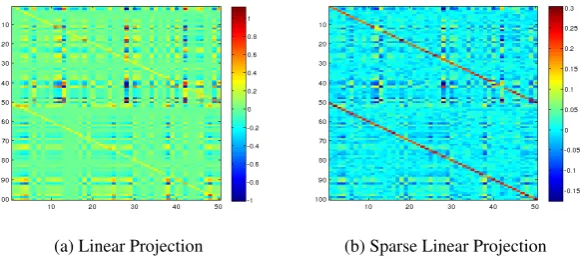
(a) Linear Projection (b) Sparse Linear Projection
Figure 1: Linear transformation matrix of compositionality for embeddings of size 50
[image:5.595.153.446.242.369.2](a) Pure Quadratic (b) Sparse Pure Quadratic
Figure 2: Pure quadratic transformation matrix of compositionality for embeddings of size 50
In case of sparse linear projections, only a few el-ements of the projection matrix θ are non-zero. This means that not all dimensions of the latent space has a role in all dimensions of the compound embedding.
To apply sparsity onθ, we add a norm 1 penalty on it and add that to the least square optimization. This forms a multi-variant lasso regression (Tib-shirani, 2011).
min
θ k[φ(wi), φ(wj)]θ−φ(wi, wj)k+λ|θ|
Figure 1 shows the transformation matrices of linear projection and sparse linear projection. The two diagonals of the matrices correspond to the sum of the two embeddings, which we can see are the main component of the sparse function, and play an important role in the non-sparse one. We will see that despite being an important compo-nent of these functions, sum alone is not capable of accurately modelling semantic composition.
4.2 Polynomial Projection
Polynomial projection is a non-linear projection that assumes the relation between compound em-bedding and the component words’ emem-beddings
should be a polynomial of degreen. This can be viewed as a form of linear regression where first a polynomial transformation is applied to the in-put vector and then a linear projection is fitted. If ψ shows the polynomial transformation then we have:
f(φ(wi), φ(wj)) =ψ([φ(wi), φ(wj)])θ
We couldn’t successfully apply any polynomial beyond quadratic transformation without overfit-ting. The case of a quadraticψtransformation is:
ψ(x) = x| {z }21,· · ·x2n Pure quadratic
, x|1x2,· · ·{zxn−1xn}
interaction terms
, x| {z }1,· · ·xn
linear terms
4.3 Neural Networks
A feed forward neural network is a universal ap-proximator (Cybenko, 1989): feed-forward net-work with a single hidden layer can approximate any continuous function, provided it has enough hidden units. Therefore we use neural networks as a powerful class of learning models to learn se-mantic composition. The number of hidden units gives us a measure to control expressiveness of our model.
f(φ(wi), φ(wj)) =σ([φ(wi), φ(wj)]Wih)Who
Similar to the previous models, we optionally impose sparsity over weight matrices of the neu-ral network to be able to induce more meaningful learning errors.
4.4 Experimental Results
We evaluated the above models on the data set of Farahmand et al. (2015). They provide a set of 1042 English NCs with four non-compositionality judgments. The judgments are binary decisions taken by four experts about whether or not a com-pound is non-compositional. We calculate a vote-based non-compositionality score for each of the data set compounds by summing over its non-compositionality judgments. The neural network models are trained using stochastic gradient de-scent. We use the additive and multiplicative mod-els of modelling composition and detecting non-compositionality presented by Salehi et al. (2015) and (Reddy et al., 2011) as state of the art base-lines.
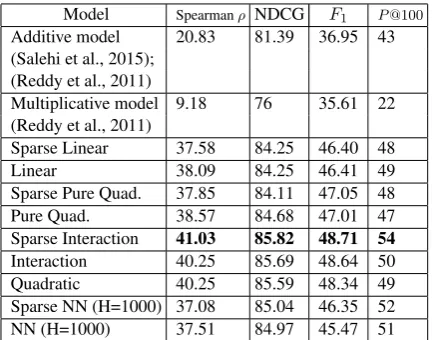
The results are shown in Table 1. The sec-ond column shows the correlation between dif-ferent models’ predictions and the annotated data in terms of Spearman ρ. The last three columns show the performance of different mod-els in terms of Normalized Discounted Cumu-lative Gain (NDCG), F1 score and and
Preci-sion at 100 (P@100). For these three scores we consider the problem of predicting non-compositional NCs a problem with a binary so-lution where we assume compounds (of the evalu-ation set) with at least two non-compositionality votes are non-compositional. NDCG assigns a higher score to a ranked list of compounds if the non-compositional ones are ranked higher in the list. F1 column represents the maximum F1
score on the top-n elements of the ranked list re-turned by the corresponding model for all n in
Model Spearmanρ NDCG F1 P@100
Additive model 20.83 81.39 36.95 43 (Salehi et al., 2015);
(Reddy et al., 2011)
Multiplicative model 9.18 76 35.61 22 (Reddy et al., 2011)
Sparse Linear 37.58 84.25 46.40 48
Linear 38.09 84.25 46.41 49
Sparse Pure Quad. 37.85 84.11 47.05 48 Pure Quad. 38.57 84.68 47.01 47 Sparse Interaction 41.03 85.82 48.71 54
[image:6.595.309.526.61.231.2]Interaction 40.25 85.69 48.64 50 Quadratic 40.25 85.59 48.34 49 Sparse NN (H=1000) 37.08 85.04 46.35 52 NN (H=1000) 37.51 84.97 45.47 51 Table 1: Results for each model’s ability to predict non-compositionality.
[1−size-of-ranked-list]. P@100 shows the pre-cision at the first 100 compounds ranked as non-compositional. The models are listed in the or-der of complexity of the composition function. The addition-based baseline which was explored in a variety of previous work does not seem to be as powerful as the other models. It is outper-formed by almost all learned models. In general, we can see that more complex functions tend to learn compositionality in a more effective way.
As mentioned earlier, overly powerful learners overfit and do not produce meaningful errors for the detection task. Sparsity seems to address this issue by reducing the number of non-zero param-eters while the function can still keep the complex terms if needed. In general sparse models show improvement over their non-sparse counterparts, specifically for more powerful models.
5 Auto-reconstructive Models
on prearrangement or signal6), we can not readily predict one of its component words without know-ing the other. Now consider the compositional compoundhip injury. Given the semantics of this compound it is much easier to predict each of its component words independently.
In the previous section, the training signals came from the embeddings of the candidate com-pounds and their component words. In this section we extend our model such that it can benefit from more training signals. To this end, we formal-ize the assumption that a compositional compound is also decomposable as an auto-reconsructive model. We thus add this hypothesis to the learn-ing process: a good composition function not only builds the semantics of the compound from the semantics of its component words, but it also al-lows the independent prediction of the semantics of its component words from the compound se-mantics. In the following sections we add this as-sumption to both linear projection (which encom-passes polynomial) and Neural Network models.
5.1 Auto-reconstructive Linear Models
Let YM×d be a matrix whose rows are the pre-computed compound embeddings, andXM×2dbe a matrix whose rows are the concatenation of the embeddings for the words of these compounds. Let AN×2d be another matrix where every row contains the concatenation of the embeddings for the words of a compound, but this matrix in-cludes many compounds for which we did not pre-compute compound embeddings. We assume that the rows of matrixAinclude the rows of matrixX. In linear models the auto-reconstructive objective function is as follows:
min
θ,θ0 kXθ−Yk+λkAθθ 0−Ak
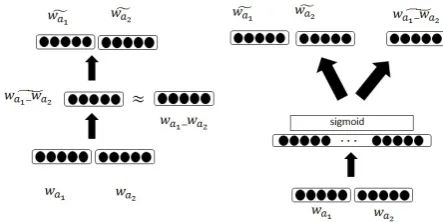
where λ is a meta-parameter for the importance of the auto-reconstruction in the objective. A schematic of this model is shown in Figure 3a.
We can look at this problem as the following weighted least square problem:
min
θ,θ0 k
X A
θ−
Y Aθ0T(θ0θ0T)−1
k
1
... λ
In the above matrix formula we transformed the auto-reconstruction part of the objective to a
6Definition taken from Merriam-Webster Dictionary
[image:7.595.308.530.63.174.2](a) Linear auto-reconstructive (b) NN Auto-reconstructive Figure 3: Auto-reconstructive linear and neural network models
pseudo regressand of the least square. To solve this optimization we design an efficient alternat-ing least squares algorithm.
First we initialize θ0 to be the answer of the
original multi-variant linear regression,θ0=X\Y
where X \=(XTX)−1XT is the pseudoinverse of X. Let us assume W is the diagonal matrix with firstM elements of the diagonal being 1 and the remaining N being λ. We alternate between the following formulas until the algorithm con-verges. First we approximate the nextθ0based on
the current approximation of θ, then we use this value ofθ0 to calculate the pseudo regressand part
of the least square. In the final step we solve the weighted least square for this new regressand ma-trix and continue iterating these stages until the al-gorithm converges.
θ0t= (Aθt)\A (1)
X2=
X A
Y2=
Y Aθ0T
t−1(θt0−1θt0T−1)−1
(2)
θt= (X2TW X2)−1(X2)TW Y2 (3)
The above algorithm can also be used in the case of polynomial regression. The only thing that needs to be done is to replace X andA by their polynomial transformations.
5.2 Auto-reconstructive Neural Networks
The auto-reconstructive neural network follows the same idea. The objective function changes to:
min
Wih,Whi,Wohkσ(XWih)Who−Yk+
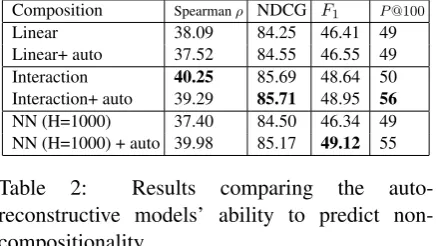
Composition Spearmanρ NDCG F1 P@100
Linear 38.09 84.25 46.41 49
Linear+ auto 37.52 84.55 46.55 49 Interaction 40.25 85.69 48.64 50 Interaction+ auto 39.29 85.71 48.95 56
NN (H=1000) 37.40 84.50 46.34 49 NN (H=1000) + auto 39.98 85.17 49.12 55 Table 2: Results comparing the auto-reconstructive models’ ability to predict non-compositionality.
Figure 3b shows the schematic of this model. We optimize this objective using stochastic gradi-ent descgradi-ent with early stopping. The results are shown in Table 2. We choose the first 300K fre-quent noun-noun compounds from the corpus in order to build matrix A. Each row of A cre-ated by concatenating the component words vec-tors. The results show that the auto-reconstructive models generally improve over their counterparts. As mentioned earlier, the improvement comes from two facts. On the one hand we increase the training signals by implementing the decom-posability hypothesis. On the other hand, the auto-reconstructive model enables us to exploit more data in addition to the candidate compounds. There is almost no improvement in the case of linear model because this model does not have enough learning capacity to benefit from a higher number of training signals.
6 Non-compositionality Detection Using Latent Annotations
All the models discussed in this paper are unsu-pervised since they don’t have any access to la-bels specifying compositionality of compounds. The above models simply assume that most com-pounds are compositional, and therefore train their composition and decomposition functions on all compounds. In this section we incorporate in the models an intrinsic uncertainty about the compo-sitionality annotation of the training set.
The best (optimum) composition function is the one that fits well all the compositional com-pounds and does not fit the non-compositional ones. But we assume that we do not have train-ing labels indicattrain-ing compositionality. To over-come this uncertainty and improve the learning process, we introduce latent compositionality la-bels to the model. We assume each candidate com-pound has a latent annotation, 1 or 0, showing
Composition Spearmanρ NDCG F1 P@100
Linear 38.09 84.25 46.41 49
[image:8.595.73.293.63.186.2]Linear+ LA 37.80 84.60 46.29 48 Interaction 40.25 85.69 48.64 50 Interaction+ LA 40.56 86.30 48.34 51 NN (H=1000) 37.40 84.50 46.34 49 NN (H=1000) + LA 39.23 85.36 48.15 55
Table 3: Results comparing the latent annotation models’ ability to predict non-compositionality.
whether or not it is compositional. Let us assume a non-compositionality detection system that re-turnsBnon-compositional candidates that should have their own lexical unit and parameters. The objective of this composition function training is to minimize the error of compositional compounds and not the error of non-compositional ones. In order to implement this objective we use the fol-lowing loss function:
min
λij,θ
X
ij λije2ij
s.tλij ∈ {0,1}, X
ij
λij =N−B
whereλij represents the hidden compositionality annotation and eij is again the learning error for the pairwi−wj. We want to find theBpoints such that annotating them as non-compositional results in the minimum error of this objective. The algo-rithm that alternates between optimizing the com-position learning and the hidden annotations even-tually converges to this solution.
of precision at 100. This is expected since at train-ing time we consider a model that returnsB non-compositional compounds and therefore precision at 100 is optimized. The latent annotations do not improve the linear model since the model is simple and there is not much room to improve its learning.
7 Conclusions
We proposed a framework to detect non-compositional compounds as the compounds that stand out as outliers in the process of learning compositionality of English noun compounds. We proposed and evaluated a range of functions with a variety of complexities that model semantic com-position. We showed that learners such as poly-nomial projection and neural networks which are distinctly more complex than commonly used ad-ditive and multiplicative functions can model se-mantic composition more effectively. We showed that a function as complex as quadratic projection is a better learner of compositionality than simpler models. We further showed that enforcing sparsity is an effective way of learning a complex compo-sition function while avoiding overfitting and pro-ducing meaningful learning errors. Furthermore, we improved our models by incorporating an auto-reconstructive loss function that enables us to ben-efit from more training signals and cover more data. Finally, we addressed the intrinsic label un-certainty in training data by considering latent an-notations, and showed that it can further improve the results.
Acknowledgments
This research was partially funded by Hasler foun-dation project no. 15019, “Deep Neural Network Dependency Parser for Context-aware Represen-tation Learning”.
References
Timothy Baldwin and Su Nam Kim. 2010. Multiword expressions. Handbook of Natural Language Pro-cessing, second edition. Morgan and Claypool.
Timothy Baldwin, Colin Bannard, Takaaki Tanaka, and Dominic Widdows. 2003. An empirical model of multiword expression decomposability. In Pro-ceedings of the ACL 2003 workshop on Multiword expressions: analysis, acquisition and treatment-Volume 18, pages 89–96. Association for Computa-tional Linguistics.
Marco Baroni and Roberto Zamparelli. 2010. Nouns are vectors, adjectives are matrices: Representing adjective-noun constructions in semantic space. In Proceedings of the 2010 Conference on Empirical Methods in Natural Language Processing, pages 1183–1193. Association for Computational Linguis-tics.
Marco Baroni, Georgiana Dinu, and Germ´an Kruszewski. 2014. Don’t count, predict! a systematic comparison of context-counting vs. context-predicting semantic vectors. InProceedings of the 52nd Annual Meeting of the Association for Computational Linguistics, volume 1, pages 238–247.
Ronan Collobert and Jason Weston. 2008. A unified architecture for natural language processing: Deep neural networks with multitask learning. In Pro-ceedings of the 25th International Conference on Machine Learning, ICML ’08, pages 160–167, New York, NY, USA. ACM.
Ronan Collobert, Jason Weston, L´eon Bottou, Michael Karlen, Koray Kavukcuoglu, and Pavel Kuksa. 2011. Natural language processing (almost) from scratch. The Journal of Machine Learning Re-search, 12:2493–2537.
Paul Cook, Afsaneh Fazly, and Suzanne Stevenson. 2007. Pulling their weight: Exploiting syntactic forms for the automatic identification of idiomatic expressions in context. InProceedings of the work-shop on a broader perspective on multiword expres-sions, pages 41–48. Association for Computational Linguistics.
G. Cybenko. 1989. Approximation by superpositions of a sigmoidal function. Mathematics of Control, Signals and Systems, 2(4):303–314.
Meghdad Farahmand, Aaron Smith, and Joakim Nivre. 2015. A multiword expression data set: Anno-tating non-compositionality and conventionalization for english noun compounds. InProceedings of the 11th Workshop on Multiword Expressions (MWE-NAACL 2015). Association for Computational Lin-guistics.
Eric H. Huang, Richard Socher, Christopher D. Man-ning, and Andrew Y. Ng. 2012. Improving Word Representations via Global Context and Multiple Word Prototypes. In Annual Meeting of the Asso-ciation for Computational Linguistics (ACL). Graham Katz and Eugenie Giesbrecht. 2006.
Au-tomatic identification of non-compositional multi-word expressions using latent semantic analysis. In Proceedings of the Workshop on Multiword Expres-sions: Identifying and Exploiting Underlying Prop-erties, MWE ’06, pages 12–19, Stroudsburg, PA, USA. Association for Computational Linguistics. Douwe Kiela and Stephen Clark. 2013.
Dekang Lin. 1999. Automatic identification of non-compositional phrases. In Proceedings of the 37th Annual Meeting of the Association for Compu-tational Linguistics on CompuCompu-tational Linguistics, ACL ’99, pages 317–324, Stroudsburg, PA, USA. Association for Computational Linguistics.
Diana McCarthy, Bill Keller, and John Carroll. 2003. Detecting a continuum of compositionality in phrasal verbs. InProceedings of the ACL-SIGLEX Workshop on Multiword Expressions: Analysis, Ac-qusation and Treatment, pages 73–80.
Diana McCarthy, Sriram Venkatapathy, and Aravind K Joshi. 2007. Detecting compositionality of verb-object combinations using selectional preferences. InEMNLP-CoNLL, pages 369–379.
Tomas Mikolov, Kai Chen, Greg Corrado, and Jef-frey Dean. 2013a. Efficient estimation of word representations in vector space. arXiv preprint arXiv:1301.3781.
Tomas Mikolov, Ilya Sutskever, Kai Chen, Greg S Cor-rado, and Jeff Dean. 2013b. Distributed representa-tions of words and phrases and their compositional-ity. InAdvances in Neural Information Processing Systems, pages 3111–3119.
Tomas Mikolov, Wen tau Yih, and Geoffrey Zweig. 2013c. Linguistic regularities in continuous space word representations. In Proceedings of the 2013 Conference of the North American Chapter of the Association for Computational Linguistics: Human Language Technologies (NAACL-HLT-2013). Asso-ciation for Computational Linguistics, May. Jeff Mitchell and Mirella Lapata. 2008. Vector-based
models of semantic composition. InProceedings of ACL-08: HLT, pages 236–244.
Siva Reddy, Diana McCarthy, and Suresh Manandhar. 2011. An empirical study on compositionality in compound nouns. InIJCNLP, pages 210–218. Ivan A Sag, Timothy Baldwin, Francis Bond, Ann
Copestake, and Dan Flickinger. 2002. Multiword expressions: A pain in the neck for nlp. In Compu-tational Linguistics and Intelligent Text Processing, pages 1–15. Springer.
Bahar Salehi, Paul Cook, and Timothy Baldwin. 2015. A word embedding approach to predicting the com-positionality of multiword expressions. In Proceed-ings of NAACL HLT. Association for Computational Linguistics.
Richard Socher, Brody Huval, Christopher D Manning, and Andrew Y Ng. 2012. Semantic compositional-ity through recursive matrix-vector spaces. In Pro-ceedings of the 2012 Joint Conference on Empiri-cal Methods in Natural Language Processing and Computational Natural Language Learning, pages 1201–1211. Association for Computational Linguis-tics.
Richard Socher, Alex Perelygin, Jean Wu, Jason Chuang, Christopher D. Manning, Andrew Y. Ng, and Christopher Potts. 2013. Recursive deep mod-els for semantic compositionality over a sentiment treebank. InProceedings of the 2013 Conference on Empirical Methods in Natural Language Process-ing, pages 1631–1642, Stroudsburg, PA, October. Association for Computational Linguistics.
Pasi Tapanainen, Jussi Piitulainen, and Timo J¨arvinen. 1998. Idiomatic object usage and support verbs. In Proceedings of the 36th Annual Meeting of the Association for Computational Linguistics and 17th International Conference on Computational Lin-guistics - Volume 2, ACL ’98, pages 1289–1293, Stroudsburg, PA, USA. Association for Computa-tional Linguistics.
Robert Tibshirani. 2011. Regression shrinkage and selection via the lasso: a retrospective. Journal of the Royal Statistical Society: Series B (Statistical Methodology), 73(3):273–282.
Sriram Venkatapathy and Aravind K. Joshi. 2005. Measuring the relative compositionality of verb-noun (v-n) collocations by integrating features. In Proceedings of the Conference on Human Lan-guage Technology and Empirical Methods in Natu-ral Language Processing, HLT ’05, pages 899–906, Stroudsburg, PA, USA. Association for Computa-tional Linguistics.
Dominic Widdows. 2008. Semantic vector products: Some initial investigations. In Second AAAI Sym-posium on Quantum Interaction, volume 26, page 28th.