Improving Distant Supervision for Information Extraction Using Label
Propagation Through Lists
Lidong Bing§ Sneha Chaudhari§ Richard C. Wang\ William W. Cohen§ §
Carnegie Mellon University, Pittsburgh, PA 15213
\US Development Center, Baidu USA, Sunnyvale, CA 94089 §{lbing@cs, sschaudh@andrew, wcohen@cs}.cmu.edu
Abstract
Because of polysemy, distant labeling for information extraction leads to noisy train-ing data. We describe a procedure for re-ducing this noise by using label propaga-tion on a graph in which the nodes are entity mentions, and mentions are cou-pled when they occur in coordinate list structures. We show that this labeling ap-proach leads to good performance even when off-the-shelf classifiers are used on the distantly-labeled data.
1 Introduction
In distantly-supervised information extraction (IE), a knowledge base (KB) of relation or concept instances is used to train an IE sys-tem. For instance, a set of facts like adverse-EffectOf(meloxicam, stomachBleeding), interacts-With(meloxicam, ibuprofen), might be used to train an IE system that extracts these relations from documents. In distant supervision, instances are first matched against a corpus, and the match-ing sentences are then used to generate trainmatch-ing data consisting of labeled entity mentions. For in-stance, matching the KB above might lead to la-beling passage 1 from Table1 as support for the factadverseEffectOf(, stomachBleeding).
A weakness of distant supervision is that it pro-duces noisy training data: for instance, match-ing the adverse effect weakness might lead to incorrectly-labeled mention examples. Distant su-pervision is often coupled with learning methods that allow for this sort of noise by introducing la-tent variables for each entity mention (e.g., ( Hoff-mann et al., 2011; Riedel et al., 2010; Surdeanu et al., 2012)); by carefully selecting the entity mentions from contexts likely to include specific KB facts (Wu and Weld, 2010); by careful
filter-1. “Avoid drinking alcohol. It may increase your risk of stomach bleeding.”
2. “Get emergency medical help if you have chest pain, weakness, shortness of breath, slurred speech, or problems with vision or balance.”
Table 1: Passages from a page discussing the drug meloxicam.
ing of the KB strings used as seeds ( Movshovitz-Attias and Cohen, 2012); or by making use of named-entity linking methods and co-reference to improve the matching phase of distant learning (Koch et al., 2014).
Here we explore an alternative approach of Distant IE using coordinate-term Lists (DIEL) based on detection oflistsin text, such as the one illustrated in passage2in Table1. Since list items are usually of the same type, the unambiguous mention chest pain here disambiguates the men-tion weakness. Label propagation methods (Zhu et al., 2003; Lin and Cohen, 2010) can be used to exploit this intuition, by propagating the low-confidence labels associated with distance super-vision through an appropriate graph.
2 DIEL:DistantIEUsing CoordinateLists
2.1 Corpus and KB
We consider extending the coverage of Free-base in the medical domain, which is currently fairly limited: e.g., a Freebase snapshot from April 2014 has (after filtering noise with sim-ple rules such as length greater than 60 char-acters and containing comma) only 4,605 dis-ease instances and 4,383 drug instances, whereas dailymed.nlm.nih.gov contains data on over 74k drugs, and malacards.org lists nearly 10k diseases. We use a corpus down-loaded fromdailymed.nlm.nih.govwhich contains 28,590 XML documents, each of which describes a drug that can be legally prescribed in the United States. We focus here on extracting in-stances of four semantic types, without explicitly extracting relationships between them.
We used the GDep parser (Sagae and Tsujii, 2007), a dependency parser trained on the GENIA Treebank, to parse this corpus. We used a simple POS-tag based noun-phrase (NP) chunker, and ex-tract a list for each coordinating conjunction that modifies a nominal. For each NP we extract fea-tures (described below); and for each identified coordinate-term list, we extract its items, and a similar feature set describing the list.
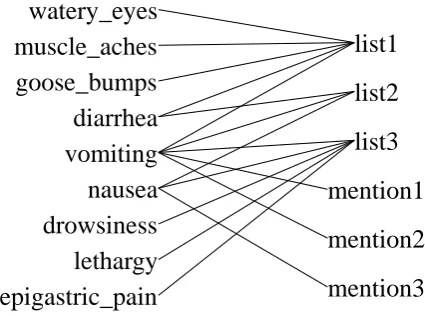
The extracted lists and their items, as well as entity mentions and their corresponding NPs, can be viewed as a bipartite graph, where one set of vertices are identifiers for the lists and entity men-tions, and the other set of vertices are the strings that occur as items of those lists, or as NPs of those mentions. Note that list items are also NPs. A mention can be regarded as a singleton list that contains only one item, and a list can be regarded as a complexus mention that contains a few men-tions. If an item is contained by a list, an edge between the item vertex and the list vertex is in-cluded in the graph. An example bipartite graph is given in Figure 1, in which there are nine symp-toms from three lists and three mentions. Some symptoms are common, such as vomiting, while some others are not, such as epigastric pain.
2.2 Label Propagation
It seems intuitive to assume that if two items co-occur in a coordinate-term list, they are very likely to have the same type, so it seems plausible to use label propagation on this graph to propagate types from NPs with known types (e.g., that match
enti-drowsiness
vomiting
list2
diarrhea
nausea
lethargy
epigastric_pain
list3
list1
watery_eyes
muscle_aches
goose_bumps
mention1
mention2
[image:2.595.310.523.62.220.2]mention3
Figure 1: A bipartite graph example.
ties in the KB) to lists, and then from lists to NPs, across this graph.
This can be viewed as semi-supervised learn-ing (SSL) of the NPs that may denote a type (e.g., diseases or adverse effects). We adopt an exist-ing multi-class label propagation method, namely, MultiRankWalk (MRW) (Lin and Cohen, 2010), to handle our task, which is a graph-based SSL related to personalized PageRank (PPR) ( Haveli-wala et al., 2003) (aka random walk with restart (Tong et al., 2006)). MRW can be described as simply computing one personalized PageRank vector for each class, where each vector is com-puted using a personalization vector that is uni-form over the seeds, and finally assigning to each node the class associated with its highest-scoring vector. MRW’s final scores depend on centrality of nodes, as well as proximity to the seeds, and in this respect MRW differs from other label propagation methods (e.g., (Zhu et al., 2003)): in particular, it will not assign identical scores to all seed exam-ples. The MRW implementation we use is based on ProPPR (Wang et al., 2013).
2.3 Classification
One could imagine using the output of MRW to extend a KB directly. However, the process de-scribed above cannot be used conveniently to la-bel new documents as they appear. Since this is also frequently a goal, we use the MRW output to train a classifier, which can be then used to classify the entity mentions (singleton lists) and coordinate lists in any new document.
Run 1 2 3 4 5 6 7 8 9 10 Avg. DIEL 0.418 0.390 0.404 0.420 0.400 0.397 0.404 0.403 0.409 0.404 0.405 DS-baseline 0.394 0.342 0.400 0.373 0.342 0.297 0.326 0.332 0.330 0.352 0.349 LP-baseline 0.167 0.167 0.162 0.155 0.150 0.159 0.157 0.165 0.167 0.167 0.162 Upper bound 0.617 0.616 0.615 0.619 0.620 0.614 0.618 0.617 0.615 0.618 0.617
Table 2: Recall on the held-out set.
of these tokens; tokens from the sentence contain-ing the NP; and tokens and bigrams from a win-dow around the NPs. From the dependence parse, we also find the verb which is the closest ancestor of the head of the NP, all modifiers of this verb, and the path to this verb. For a list, the dependency features are computed relative to the head of the list. We used an SVM classifier (Chang and Lin, 2001) and discard singleton features, and also the frequent 5% of all features (as a stop-wording vari-ant). We train a binary classifier on the top N lists (including entity mentions and coordinate lists) of each type, as scored by MRW. A linear kernel and defaults for all other parameters are used. If a new list or mention is not classified as positive by all binary classifiers, it is predicted as “other”.
3 Experimental Results
3.1 Results of Recovering KB
In this experiment, we examine the capability of our approach in recovering KB type instances. The targeted types are diseases, symptoms treated and adverse effects (symptom for short), drugs, and drug ingredients. We released some data at
http://www.cs.cmu.edu/∼wcohen.
3.1.1 Baselines
We implemented a distant-supervision-based baseline (DS-baseline). It attempts to classify each NP in the input corpus into one of the four types or “other” with the training seeds as distance supervision. Each sentence is processed with the same reprocessing pipeline to detect NPs. Then, these NPs are labeled with the training seeds. The features are defined and extracted in the same way as we did for DIEL, and four binary classifiers are trained with the same method. Another baseline is developed with the output of MRW LP (LP-baseline) that contains labeled lists and mentions. Specifically, the labeled coordinate lists are broken into items each of which has the list class, and evaluation is conducted with these items together with the labeled mentions as
positive predictions.
3.1.2 Settings
We extracted the seeds of these types from Free-base, and got 4,605, 1,244, 4,383, and 4,066 in-stances, respectively. The seeds are split into velopment set and held-out evaluation set. The de-velopment set is further split into a training set and a validating set in the ratio of 4:1. The validating set will be used in the next subsection to validate different parameter settings, and the training set is used in this experiment as MRW seeds and the distant supervision of DS-baseline.
For getting the development set, the polyse-mous instances (i.e., “headache”, belonging to multiple classes: disease and symptom) are dis-carded since such instances will bring in ambigu-ity to the training examples of DS-baseline and MRW LP. After that, we randomly take half of the single-type instances as development set, and the remaining single-type instances together with the polysemous instances are used as held-out set. We report the performance of 10 runs, and each run has its own randomly generated training set (containing 1,980 diseases, 310 symptoms, 1,066 drugs, and 911 ingredients on average) and held-out set (containing 2,130 diseases, 857 symptoms, 3,051 drugs, and 2,927 ingredients on average). For DS-baseline, 35,689 training examples are collected on average for each run. For evaluation metric, we calculate recall on the instances in the held-out set.1
3.1.3 Results
DIEL can classify both NPs and coordinate lists, and the lists are also broken into items for recall calculation. The training examples of DIEL are prepared with the top 20,000 lists of each type, as scored by MRW with the training seeds. After re-moving the multiple-class ones, we obtained, on average, 58,614 training examples for each run.
1Because the outputs contain many correct instances that
2.5% 7.5% 12.5% 25% 50% 75% 100%
N P R P R P R P R P R P R P R
DIEL
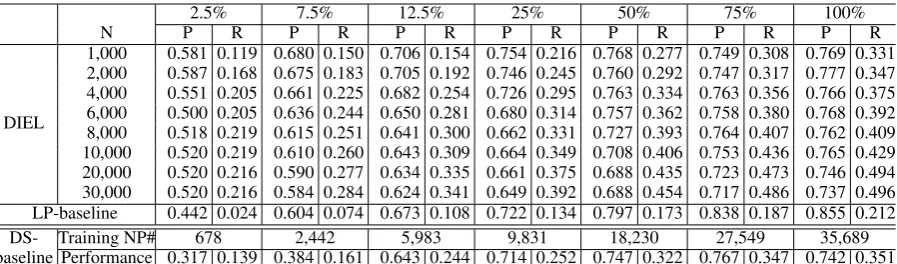
[image:4.595.76.525.61.193.2]1,000 0.581 0.119 0.680 0.150 0.706 0.154 0.754 0.216 0.768 0.277 0.749 0.308 0.769 0.331 2,000 0.587 0.168 0.675 0.183 0.705 0.192 0.746 0.245 0.760 0.292 0.747 0.317 0.777 0.347 4,000 0.551 0.205 0.661 0.225 0.682 0.254 0.726 0.295 0.763 0.334 0.763 0.356 0.766 0.375 6,000 0.500 0.205 0.636 0.244 0.650 0.281 0.680 0.314 0.757 0.362 0.758 0.380 0.768 0.392 8,000 0.518 0.219 0.615 0.251 0.641 0.300 0.662 0.331 0.727 0.393 0.764 0.407 0.762 0.409 10,000 0.520 0.219 0.610 0.260 0.643 0.309 0.664 0.349 0.708 0.406 0.753 0.436 0.765 0.429 20,000 0.520 0.216 0.590 0.277 0.634 0.335 0.661 0.375 0.688 0.435 0.723 0.473 0.746 0.494 30,000 0.520 0.216 0.584 0.284 0.624 0.341 0.649 0.392 0.688 0.454 0.717 0.486 0.737 0.496 LP-baseline 0.442 0.024 0.604 0.074 0.673 0.108 0.722 0.134 0.797 0.173 0.838 0.187 0.855 0.212 DS- Training NP# 678 2,442 5,983 9,831 18,230 27,549 35,689 baseline Performance 0.317 0.139 0.384 0.161 0.643 0.244 0.714 0.252 0.747 0.322 0.767 0.347 0.742 0.351
Table 4: The classification performance of the three methods with different parameters.
Type Disease Drug Ingredient Symptom DIEL 0.369 0.312 0.489 0.555
DS-baseline 0.375 0.300 0.408 0.224 LP-baseline 0.185 0.101 0.117 0.453 Upper bound 0.445 0.652 0.700 0.697
Table 3: Recall on individual types.
The results are given in Table 2. DIEL out-performs the baselines in all runs. It shows that our result is consistently better. The reason is twofold. First, DIEL can avoid the effect of noisy training data by disambiguation with the coordi-nate relation in the list, so that the training exam-ples are of high quality. Second, with label prop-agation, we have a larger number of training ex-amples, which helps the recall. Compared with DS-baseline, DIEL’s performance is more stable in different runs. It is because DS-baseline suffers from the noisy training data and training seed sets of different runs may bring in different levels of noisy data. Thus, its run 3 achieves 0.400, while run 6 only achieves 0.297. We also examined the upper bound recall that a system can achieve on our corpus. The results are given in the last row of Table2. On average, the best performance of a system can achieve is 0.617.
The results for individual types are given in Ta-ble3. DIEL and DS-baseline achieve similar re-sults for disease and drug. Especially, both sys-tems cover more than 80% of the held-out dis-ease instances that exist in the corpus. DS-baseline performs poorly for symptom. The reason is that symptom instances are more ambiguous than other types, and they lead to more incorrectly-labeled mention examples. LP-baseline achieves an en-couraging recall for symptom, which shows that
coordinate lists are very helpful for disambiguat-ing those symptom mentions.
3.2 Classification Results and Parameters
We present another experiment to examine the pre-cision of the systems, and investigate the effect of training size and top N numbers on the results.
3.2.1 Setting
The evaluation data is generated with the validat-ing set of each run. Specifically, for DIEL and LP-baseline, the evaluation data is prepared with the top 500 lists (singleton and coordinate lists) of each type, as scored by MRW with the validat-ing instances as seeds. 2,000 testvalidat-ing examples are collected in total since no multiple-class ones are found. Manual checking on 200 random examples shows that 99% of them are correct. The systems are evaluated by their performance for classifying these example lists. DIEL predicts the class of a list with its feature vector, while LP-baseline de-termines the class of a list by checking its pre-dicted class in the result of MRW with the cor-responding training instances as seeds. For DS-baseline, the testing NP examples are obtained by distant labeling with validating instances, and on average 8,270 examples are collected for each run.
3.2.2 Results
2.5% 7.5%
12.5% 25%
50% 75%
100%
1000 2000 4000 6000 8000 10000 20000 30000
0.1 0.2 0.3 0.4 0.5 0.6
Percentage of training seeds Top N
F1 values
[image:5.595.88.511.72.285.2]0.15 0.2 0.25 0.3 0.35 0.4 0.45 0.5
Figure 2: F1 values of DIEL under different settings.
into training set and validating set.
In general, for all systems, larger number of training seeds leads to better performance. For DIEL, smaller N values achieve higher precision, but lower recall. For smaller seed numbers, the precision value is more sensitive to N. This is be-cause the quality of training examples drops faster compared with that from larger seed numbers. For larger seeds numbers, the recall values are im-proved more significantly when the N value is larger. The reported results of DIEL in the pre-vious experiment are obtained with top 20,000 ex-amples from 100% seeds as training data, since this setting achieves the highest F1 value as shown in Figure2.
For the DS-baseline, the number of training NPs obtained with different portions of the training set is given in the penultimate row. The recall val-ues of this baseline are low. The reason is that it only uses the training examples that are distantly labeled with training seeds, thus, the trained clas-sifier may not have good generalization on the test-ing examples labeled with validattest-ing seeds. In ad-dition, its performance is more sensitive on the amount of training data. When the percentage is lower than 25%, its precision and recall drop significantly. Its F1 values are 0.381, 0.399 and 0.402 for 50%, 75%, and 100%, respectively. LP-baseline achieves the highest precision when using all training instances. It shows that MRW does label the testing lists very accurately in condition
0 0.1 0.2 0.3 0.4 0.5 0.6
2.5% 7.5% 12.5% 25% 50% 75% 100% DIEL LP-baseline DS-baseline
Figure 3: F1 comparison under different portions of the training seeds. For DIEL, top N = 20,000.
that the lists are traversed in the propagation with the training instances as seeds. However, its recall is much lower than DIEL. It is because, with the training seeds, MRW cannot effectively walk to testing lists that are generated with the validating set, having no intersection with the training set.
4 Conclusions
[image:5.595.309.526.338.440.2]Acknowledgments
This work was funded by a grant from Baidu USA and by the NSF under research grant IIS-1250956.
References
[Chang and Lin2001] Chung Chang and
Chih-Jen Lin, 2001. LIBSVM: a library for
sup-port vector machines. Software available at http://www.csie.ntu.edu.tw/˜cjlin/libsvm.
[Haveliwala et al.2003] Taher Haveliwala, Sepandar
Kamvar, Ar Kamvar, and Glen Jeh. 2003. An an-alytical comparison of approaches to personalizing pagerank. Technical report, Stanford University.
[Hoffmann et al.2011] Raphael Hoffmann, Congle
Zhang, Xiao Ling, Luke Zettlemoyer, and Daniel S Weld. 2011. Knowledge-based weak supervision for information extraction of overlapping relations. In Proceedings of the 49th Annual Meeting of the Association for Computational Linguistics: Human Language Technologies-Volume 1, pages 541–550. Association for Computational Linguistics.
[Koch et al.2014] Mitchell Koch, John Gilmer, Stephen Soderland, and Daniel S. Weld. 2014. Type-aware distantly supervised relation extraction with linked
arguments. In Proceedings of the 2014
Confer-ence on Empirical Methods in Natural Language Processing, EMNLP 2014, October 25-29, 2014, Doha, Qatar, A meeting of SIGDAT, a Special In-terest Group of the ACL, pages 1891–1901.
[Lin and Cohen2010] Frank Lin and William W. Co-hen. 2010. Semi-supervised classification of
net-work data using very few labels. In Nasrullah
Memon and Reda Alhajj, editors, ASONAM, pages
192–199. IEEE Computer Society.
[Movshovitz-Attias and Cohen2012] Dana
Movshovitz-Attias and William W. Cohen. 2012. Bootstrapping biomedical ontologies for scientific
text using nell. In Proceedings of the 2012
Work-shop on Biomedical Natural Language Processing, BioNLP ’12, pages 11–19, Stroudsburg, PA, USA. Association for Computational Linguistics.
[Riedel et al.2010] Sebastian Riedel, Limin Yao, and Andrew McCallum. 2010. Modeling relations and
their mentions without labeled text. In Machine
Learning and Knowledge Discovery in Databases, pages 148–163. Springer.
[Sagae and Tsujii2007] K. Sagae and J. Tsujii. 2007. Dependency parsing and domain adaptation with lr
models and parser ensembles. In Proceedings of
the CoNLL 2007 Shared Task in the Joint Confer-ences on Empirical Methods in Natural Language Processing and Computational Natural Language Learning (EMNLP-CoNLL’07 shared task), pages 1044–1050.
[Surdeanu et al.2012] Mihai Surdeanu, Julie Tibshirani, Ramesh Nallapati, and Christopher D. Manning. 2012. Multi-instance multi-label learning for
rela-tion extracrela-tion. In Proceedings of the 2012 Joint
Conference on Empirical Methods in Natural guage Processing and Computational Natural Lan-guage Learning, EMNLP-CoNLL ’12, pages 455– 465, Stroudsburg, PA, USA. Association for Com-putational Linguistics.
[Tong et al.2006] Hanghang Tong, Christos Faloutsos, and Jia-Yu Pan. 2006. Fast random walk with restart and its applications. InICDM, pages 613–622. IEEE Computer Society.
[Wang et al.2013] William Yang Wang, Kathryn
Mazaitis, and William W Cohen. 2013.
Pro-gramming with personalized pagerank: a locally
groundable first-order probabilistic logic. In
Proceedings of the 22nd ACM international confer-ence on Conferconfer-ence on information & knowledge management, pages 2129–2138. ACM.
[Wu and Weld2010] Fei Wu and Daniel S Weld. 2010.
Open information extraction using wikipedia. In
Proceedings of the 48th Annual Meeting of the As-sociation for Computational Linguistics, pages 118– 127. Association for Computational Linguistics.
[Zhu et al.2003] X. Zhu, Z. Ghahramani, and J. Laf-ferty. 2003. Semi-supervised learning using
Gaus-sian fields and harmonic functions. InProceedings