Convolutional Sentence Kernel from
Word Embeddings for Short Text Categorization
Jonghoon Kim François Rousseau
LIX, École Polytechnique, France
Michalis Vazirgiannis
Abstract
This paper introduces a convolutional sen-tence kernel based on word embeddings. Our kernel overcomes the sparsity issue that arises when classifying short docu-ments or in case of little training data. Ex-periments on six sentence datasets showed statistically significant higher accuracy over the standard linear kernel with n-gram features and other proposed models. 1 Introduction
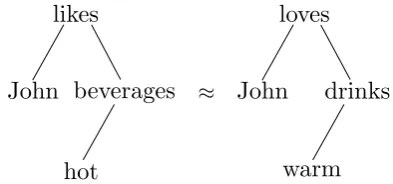
With the proliferation of text data available on-line, text categorization emerged as a prominent research topic. Traditionally, words (unigrams) and phrases (n-grams) have been considered as document features and subsequently fed to a clas-sifier such as an SVM (Joachims, 1998). In the SVM dual formulation that relies on kernels, i. e. similarity measures between documents, a linear kernel can be interpreted as the number of ex-act matching n-grams between two documents. Consequently, for short documents or when lit-tle training data is available, sparsity issues due to word synonymy arise, e. g., the sentences ‘John likes hot beverages’ and ‘John loves warm drinks’ have little overlap and therefore low linear kernel value (only 1) in the n-gram feature space, even with dependency tree representations and down-ward paths forn-grams as illustrated in Figure 1.
We propose to relax the exact matching between words by capitalizing on distances in word embed-dings. We smooth the implicit delta word kernel, i. e. a Dirac similarity function between unigrams, behind the traditional linear document kernel to capture the similarity between words that are dif-ferent, yet semantically close. We then aggregate these word and phrase kernels into sentence and documents kernels through convolution resulting in higher kernel values between semantically re-lated sentences (e. g., close to 7 compared to 1
John
likes
beverages
hot
(a) ‘John likes hot beverages’
≈
John
loves
drinks
warm
[image:1.595.315.512.203.295.2](b) ‘John loves warm drinks’
Figure 1: Dependency tree representations of se-mantically related sentences yet with little overlap.
with bigram downward paths in Figure 1). Ex-periments on six standard datasets for sentiment analysis, subjectivity detection and topic spotting showed statistically significant higher accuracy for our proposed kernel over the bigram approaches. Our main goal is to demonstrate empirically that word distances from a given word vector space can easily be incorporated in the standard kernel be-tween documents for higher effectiveness and lit-tle additional cost in efficiency.
The rest of this paper is structured as follows. Section 2 reviews the related work. Section 3 gives the detailed formulation of our kernel. Section 4 describes the experimental settings and the results we obtained on several datasets. Finally, Section 5 concludes our paper and mentions future work.
2 Related work
Siolas and d’Alché Buc (2000) pioneered the idea of semantic kernels for text categorization, cap-italizing on WordNet (Miller, 1995) to propose continuous word kernels based on the inverse of the path lengths in the tree rather than the com-mon delta word kernel used so far, i. e. exact matching between unigrams. Bloehdorn et al. (2006) extended it later to other tree-based simi-larity measures from WordNet while Mavroeidis et al. (2005) exploited its hierarchical structure to define a Generalized Vector Space Model kernel.
In parallel, Collins and Duffy (2001) devel-oped the firsttree kernelsto compare trees based on their topology (e. g., shared subtrees) rather than the similarity between their nodes. Culotta and Sorensen (2004) used them as Dependency Tree Kernels (DTK) to capturesyntactic similar-ities while Bloehdorn and Moschitti (2007) and Croce et al. (2011) used them on parse trees with respectively Semantic Syntactic Tree Ker-nels (SSTK) and Smoothing Partial Tree KerKer-nels (SPTK), adding node similarity based on Word-Net to capturesemantic similaritiesbut limiting to comparisons between words of the same POS tag. Similarly, Gärtner et al. (2003) developedgraph kernelsbased on random walks and Srivastava et al. (2013) used them on dependency trees with Vector Tree Kernels (VTK), adding node simi-larity based on word embeddings from SENNA (Collobert et al., 2011) and reporting improve-ments over SSTK. The change from WordNet to SENNA was supported by the recent progress in low-dimension Euclidean vector space representa-tions of words that are better suited for computing distances between words. Actually, in our exper-iments, word2vec by Mikolov et al. (2013a) led to better results than with SENNA for both VTK and our kernels. Moreover, it possesses an addi-tional additive composiaddi-tionality property obtained from the Skip-gram training setting (Mikolov et al., 2013b), e. g., the closest word to ‘Germany’ + ‘capital’ in the vector space is found to be ‘Berlin’. More recently, for short text similarity, Song and Roth (2015) and Kenter and de Rijke (2015) proposed additional semantic meta-features based on word embeddings to enhance classification. 3 Formulation
We denote the embedding of a wordwbyw.
3.1 Word Kernel (WK)
We define a kernel between two words as a poly-nomial kernel over a cosine similarity in the word embedding space:
WK(w1, w2) =
1 2
1 + hw1,w2i
kw1kkw2k
α (1)
where α is a scaling factor. We also tried Gaus-sian, Laplacian and sigmoid kernels but they led to poorer results in our experiments. Note that a delta word kernel, i. e. the Dirac function1w1=w2, leads to a document kernel corresponding to the standard linear kernel overn-grams.
3.2 Phrase Kernel (PhK)
Next we define a kernel between phrases consist-ing of several words. In our work, we considered two types of phrases: (1) co-occurrence phrases defined as contiguous sequences of words in the text; and (2) syntactic phrases defined as down-ward paths in the dependency tree representation, e. g., respectively ‘hot beverages’ and ‘beverages hot’ in Figure 1. With this dependency tree in-volved, we expect to have phrases that are syntac-tically more meaningful. Note that VTK consid-ers random walks in dependency trees instead of downward paths, i. e. potentially taking into ac-count same nodes multiple times for phrase length greater than two, phenomenon known as tottering. Once we have phrases to compare, we may con-struct a kernel between them as the product of word kernels if they are of the same lengthl. That is, we define the Product Kernel (PK) as:
PK(p1, p2) =
l Y
i=1
WK(w1
i, wi2) (2)
wherewji is thei-th word in phrasepj of lengthl. Alternatively, in particular for phrases of different lengths, we may embed phrases into the embed-ding space by taking a composition operation on the constituent word embeddings. We considered two common forms of composition (Blacoe and Lapata, 2012): vector addition (+) and element-wise multiplication (). Then we define the Com-position Kernel (CK) between phrases as:
CK(p1, p2) =WK(p1,p2) (3)
wherepj, the embedding of the phrasepj, can be obtained either by addition (pj=Pli=1wji) or by element-wise multiplication (pj=Jli=1wji) of its word embeddings. For CK, we do not require the two phrases to be of the same length so the kernel has a desirable property of being able to compare ‘Berlin’ with ‘capital of Germany’ for instance.
3.3 Sentence Kernel (SK)
We can then formulate a sentence kernel in a sim-ilar way to Zelenko et al. (2003). It is defined through convolution as the sum of all local phrasal similarities, i. e. kernel values between phrases contained in the sentences:
SK(s1, s2) =
X
p1∈φ(s1), p2∈φ(s2)
whereφ(sk)is the set of either statistical or syn-tactic phrases (or set of random walks for VTK) in sentence sk, λ1 is a decaying factor
penaliz-ing longer phrases,=max{|p1|,|p2|}is the
max-imum length of the two phrases,λ2 is a distortion
parameter controlling the length differenceη be-tween the two phrases (η=||p1| − |p2||) and PhK
is a phrase kernel, either PK, CK+or CK. Since the composition methods we consider are associative, we employed a dynamic programming approach in a similar fashion to Zelenko et al. (2003) to avoid duplicate computations.
3.4 Document Kernel
Finally, we sum sentence kernel values for all pairs of sentences between two documents to get the document kernel. Once we have obtained all doc-ument kernel valuesKijbetween documentsiand j, we may normalize them by pKiiKjj as the length of input documents might not be uniform.
4 Experiments
We evaluated our kernel with co-occurrence and syntactic phrases on several standard text catego-rization tasks.
4.1 Datasets
We considered four tasks: (1) binary sentiment analysis with a movie review dataset of 10,662 sentences (PL05) (Pang and Lee, 2005) and a product review dataset (Amazon) of 2,000 multi-line documents for 4 different product groups (Blitzer et al., 2007) (we will report the average ef-fectiveness over the 4 sub-collections); (2) ternary sentiment analysis with the SemEval 2013 Task B dataset (Twitter) containing 12,348 tweets clas-sified as positive, neutral or negative (Nakov et al., 2013); (3) binarysubjectivity detectionwith a dataset of 10,000 sentences (PL04) (Pang and Lee, 2004) and another of 11,640 sentences (MPQA) (Wiebe et al., 2005); and (4) seven-class topic spotting with a news dataset (News) of 32,602 one-line news summaries (Vitale et al., 2012).
4.2 Experimental settings
In all our experiments, we used the FANSE parser (Tratz and Hovy, 2011) to generate dependency trees and the pre-trained version of word2vec1, a 300 dimensional representation of 3 million En-glish words trained over a Google News dataset
1https://code.google.com/p/word2vec
of 100 billion words using the Skip-gram model and a context size of 5. While fine-tuning the em-beddings to a specific task or on a given dataset may improve the result for that particular task or dataset (Levy et al., 2015), it makes the expected results less generalizable and the method harder to use as an off-the-shelf solution – re-training the neural network to obtain task-specific embeddings requires a certain amount of training data, admit-tedly unlabeled, but still not optimal under our sce-nario with short documents and little task-specific training data available. Moreover, tuning the hy-perparameters to maximize the classification accu-racy needs to be carried out on a validation set and therefore requires additional labeled data. Here, we are more interested in showing that distances in a given word vector space can enhance classi-fication in general. As for the dependency-based word embeddings proposed by Levy and Goldberg (2014), we do not think they are better suited for the problem we are tackling. As we will see in the results, we do benefit from the dependency tree structure in the phrase kernel but we still want the word kernel to be based on topical similarity rather than functional similarity.
To train and test the SVM classifier, we used the LibSVM library (Chang and Lin, 2011) and employed the one-vs-one strategy for multi-class tasks. To prevent overfitting, we tuned the pa-rameters using cross-validation on 80% of PL05 dataset (α = 5, λ1 = 1for PK since there is no
need for distortion as the phrases are of the same length by definition, andλ1 =λ2 = 0.5for CK)
and used the same set of parameters on the remain-ing datasets. We performed normalization for our kernel and baselines only when it led to perfor-mance improvements on the training set (PL05, News, PL04 and MPQA).
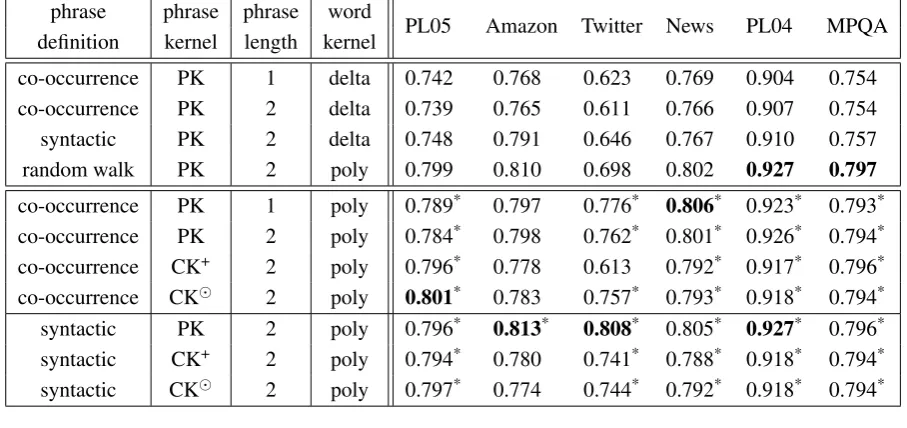
Table 1: Accuracy results on the test set for PL05 (20%), standard test split for Twitter (25%) and News (50%) and from 5-fold CV for the other datasets (Amazon, PL04 and MPQA). Bold font marks the best performance in the column. *indicates statistical significance atp < 0.01using micro sign test against the bigram baseline (delta word kernel) of the same column and with the same phrase definition.
phrase phrase phrase word PL05 Amazon Twitter News PL04 MPQA definition kernel length kernel
co-occurrence PK 1 delta 0.742 0.768 0.623 0.769 0.904 0.754 co-occurrence PK 2 delta 0.739 0.765 0.611 0.766 0.907 0.754 syntactic PK 2 delta 0.748 0.791 0.646 0.767 0.910 0.757 random walk PK 2 poly 0.799 0.810 0.698 0.802 0.927 0.797
co-occurrence PK 1 poly 0.789* 0.797 0.776* 0.806* 0.923* 0.793* co-occurrence PK 2 poly 0.784* 0.798 0.762* 0.801* 0.926* 0.794* co-occurrence CK+ 2 poly 0.796* 0.778 0.613 0.792* 0.917* 0.796* co-occurrence CK 2 poly 0.801* 0.783 0.757* 0.793* 0.918* 0.794* syntactic PK 2 poly 0.796* 0.813* 0.808* 0.805* 0.927* 0.796* syntactic CK+ 2 poly 0.794* 0.780 0.741* 0.788* 0.918* 0.794* syntactic CK 2 poly 0.797* 0.774 0.744* 0.792* 0.918* 0.794*
4.3 Results
Table 1 presents results from our convolutional sentence kernel and the baseline approaches. Note again that a delta word kernel leads to the typi-cal unigram and bigram baseline approaches (first three rows). The 3rdrow corresponds to DTK (Cu-lotta and Sorensen, 2004) and the 4thone to VTK (Srivastava et al., 2013) – the difference with our model on the 9th row lies in the functionφ(·)that enumerates all random walks in the dependency tree representation following Gärtner et al. (2003) whereas we only consider the downward paths.
Overall, we obtained better results than the n -gram baselines, DTK and VTK, especially with syntactic phrases. VTK shows good performance across all datasets but its computation was more than 700% slower than with our kernel. Regarding the phrase kernels, PK generally produced better results than CK, implying that the semantic lin-earity and ontological relation encoded in the em-bedding is not sufficient enough and treating them separately is more beneficial. However, we be-lieve CK has more room for improvement with the use of more accurate phrase embeddings such as the ones from Le and Mikolov (2014), Yin and Schütze (2014) and Yu and Dredze (2015).
There was little contribution to the accuracy from non-unigram features, indicating that large part of the performance improvement is credited to the word embedding resolving the sparsity issue.
0 1000 2000 3000 4000 5000 6000 7000 8000 Number of training examples
0.74 0.78 0.82 0.86 0.90 0.94
Accuracy
PK (poly)
PK (delta)
Figure 2: Test accuracy vs. number of training examples for our kernel and the bigram baseline.
This can be well observed with the following ex-periment on the number of training examples. Fig-ure 2 shows the accuracy on the same test set (20% of the dataset) when the learning was done on 1% to 100% of the training set (80% of the dataset) for the bigram baseline and our bigram PK phrase kernel, both with dependency tree representation, on PL04. We see that our kernel starts to plateau earlier in the learning curve than the baseline and also reaches the maximum baseline accuracy with only about 1,500 training examples.
4.4 Computational complexity
[image:4.595.72.526.129.343.2]adjacency matrix of the product graph, and since we require kernel values between all documents, it requiresO(N2(n2d+n4L))time wheredis the
dimension of the word embedding space.
Our kernel is the sum of phrase kernels (PhK) starting from every pair of nodes between two sen-tences, for all phrase lengths (l) and distortions (λ2) under consideration. By storing
intermedi-ate values of composite vectors, a phrase kernel can be computed in O(d) time regardless of the phrase length, therefore the whole computation process has O(N2n2L2d) complexity. Although
our kernel has the squared terms of the baseline’s complexity, we are tackling the sparsity issue that arises with short text (smalln) or when little train-ing data is available (small N). Moreover, we were able to get better results with only bigrams (smallL). Hence, the loss in efficiency is accept-able considering significant gains in effectiveness. 5 Conclusion
In this paper, we proposed a novel convolutional sentence kernel based on word embeddings that overcomes the sparsity issue, which arises when classifying short documents or when little training data is available. We described a general frame-work that can encompass the standard n-gram baseline approach as well as more relaxed ver-sions with smoother word and phrase kernels. It achieved significant improvements over the base-lines across all datasets when taking into account the additional information from the latent word similarity (word embeddings) and the syntactic structure (dependency tree).
Future work might involve designing new ker-nels for syntactic parse trees with appropriate sim-ilarity measures between non-terminal nodes as well as exploring recently proposed phrase em-beddings for more accurate phrase kernels.
References
William Blacoe and Mirella Lapata. 2012. A Com-parison of Vector-based Representations for
Seman-tic Composition. InProceedings of the 2012 Joint
Conference on Empirical Methods in Natural guage Processing and Computational Natural Lan-guage Learning, EMNLP-CoNLL ’12, pages 546– 556. ACL.
John Blitzer, Mark Dredze, and Fernando Pereira. 2007. Biographies, bollywood, boomboxes and blenders: Domain adaptation for sentiment
classi-fication. In Proceedings of the 45th Annual
Meet-ing of the Association of Computational LMeet-inguistics, ACL ’07, pages 440–447. ACL.
Stephan Bloehdorn and Alessandro Moschitti. 2007. Structure and Semantics for Expressive Text
Ker-nels. InProceedings of the 16th ACM international
conference on Information and knowledge
manage-ment, CIKM ’07, pages 861–864. ACM.
Stephan Bloehdorn, Roberto Basili, Marco Cammisa, and Alessandro Moschitti. 2006. Semantic kernels for text classification based on topological measures of feature similarity. InProceedings of the 6th IEEE International Conference on Data Mining, ICDM ’06, pages 808–812. IEEE Computer Society. Chih-Chung Chang and Chih-Jen Lin. 2011.
LIB-SVM: A library for support vector machines. ACM
Transactions on Intelligent Systems and Technology, 2(3):27:1–27:27.
Michael Collins and Nigel Duffy. 2001. Convolution
Kernels for Natural Language. InAdvances in
Neu-ral Information Processing Systems 14, NIPS ’01, pages 625–632. The MIT Press.
Ronan Collobert, Jason Weston, Léon Bottou, Michael Karlen, Koray Kavukcuoglu, and Pavel Kuksa. 2011. Natural Language Processing (Almost) from
Scratch. Journal of Machine Learning Research,
12:2493–2537, November.
Danilo Croce, Alessandro Moschitti, and Roberto Basili. 2011. Structured Lexical Similarity via
Con-volution Kernels on Dependency Trees. In
Proceed-ings of the 2011 Conference on Empirical Meth-ods in Natural Language Processing, EMNLP ’11, pages 1034–1046. ACL.
Aron Culotta and Jeffrey Sorensen. 2004. Dependency
Tree Kernels for Relation Extraction. In
Proceed-ings of the 42nd Annual Meeting of the Association for Computational Linguistics, ACL ’04, pages 423– 429. ACL.
Thomas Gärtner, Peter Flach, and Stefan Wrobel. 2003. On graph kernels: Hardness results and
efficient alternatives. In Proceedings of the
An-nual Conference on Computational Learning
The-ory, COLT ’03, pages 129–143.
Thorsten Joachims. 1998. Text categorization with Support Vector Machines: Learning with many rel-evant features. InProceedings of the 10th European Conference on Machine Learning, ECML ’98, pages 137–142.
Tom Kenter and Maarten de Rijke. 2015. Short text
similarity with word embeddings. InProceedings of
the 24th ACM international conference on Informa-tion and knowledge management, CIKM ’15. ACM. Quoc Le and Tomas Mikolov. 2014. Distributed
Rep-resentations of Sentences and Documents. In
1188–1196. JMLR Workshop and Conference Pro-ceedings.
Omer Levy and Yoav Goldberg. 2014.
Dependency-Based Word Embeddings. In Proceedings of the
52nd Annual Meeting of the Association for Com-putational Linguistics, volume 2 ofACL ’14, pages 302–308. ACL.
Omer Levy, Yoav Goldberg, and Ido Dagan. 2015. Im-proving distributional similarity with lessons learned
from word embeddings. Transactions of the
Associ-ation for ComputAssoci-ational Linguistics, 3:211–225. Dimitrios Mavroeidis, George Tsatsaronis, Michalis
Vazirgiannis, Martin Theobald, and Gerhard Weikum. 2005. Word Sense Disambiguation for Exploiting Hierarchical Thesauri in Text Classifica-tion. InProceedings of the 9th European conference on Principles and Practice of Knowledge Discovery in Databases, ECML PKDD ’05, pages 181–192. Springer-Verlag Berlin.
Tomas Mikolov, Kai Chen, Greg S. Corrado, and Jef-frey Dean. 2013a. Efficient estimation of word
representations in vector space. InProceedings of
Workshop at International Conference on Learning Representations, ICLR ’13.
Tomas Mikolov, Ilya Sutskever, Kai Chen, Greg S. Cor-rado, and Jeffrey Dean. 2013b. Distributed repre-sentations of words and phrases and their
composi-tionality. InAdvances in Neural Information
Pro-cessing Systems 26, NIPS ’13, pages 3111–3119. Neural Information Processing Systems.
George A. Miller. 1995. WordNet: A Lexical
Database for English. Communications of the ACM,
38(11):39–41, November.
Preslav Nakov, Zornitsa Kozareva, Alan Ritter, Sara Rosenthal, Veselin Stoyanov, and Theresa Wilson. 2013. Semeval-2013 task 2: Sentiment analysis in twitter. In Proceedings of the 7th International Workshop on Semantic Evaluation, SemEval-2013. Bo Pang and Lilian Lee. 2004. A sentimental
educa-tion: sentiment analysis using subjectivity
summa-rization based on minimum cuts. InProceedings of
the 42nd Annual Meeting on Association for Compu-tational Linguistics, ACL ’04, pages 271–278. ACL. Bo Pang and Lilian Lee. 2005. Seeing stars: exploiting class relationships for sentiment categorization with respect to rating scales. InProceedings of the 43rd Annual Meeting on Association for Computational Linguistics, ACL ’05, pages 115–124. ACL. Georges Siolas and Florence d’Alché Buc. 2000.
Sup-port Vector Machines Based on a Semantic
Ker-nel for Text Categorization. InProceedings of the
IEEE-INNS-ENNS International Joint Conference on Neural Networks, volume 5 ofIJCNN ’00, pages 205–209. IEEE Computer Society.
Yangqiu Song and Dan Roth. 2015. Unsupervised Sparse Vector Densification for Short Text
Sim-ilarity. In Proceedings of the 2015 Conference
of the North American Chapter of the Association for Computational Linguistics: Human Language Technologies, NAACL-Short ’15, pages 1275–1280. ACL.
Shashank Srivastava, Dirk Hovy, and Eduard H. Hovy. 2013. A Walk-Based Semantically Enriched Tree Kernel Over Distributed Word Representations. In
Proceedings of the 2013 Conference on Empirical Methods in Natural Language Processing, EMNLP ’13, pages 1411–1416. ACL.
Stephen Tratz and Eduard H. Hovy. 2011. A Fast, Accurate, Non-projective, Semantically-enriched
Parser. In Proceedings of the 2011 Conference on
Empirical Methods in Natural Language
Process-ing, EMNLP ’11, pages 1257–1268. ACL.
Daniele Vitale, Paolo Ferragina, and Ugo Scaiella. 2012. Classification of Short Texts by Deploying
Topical Annotations. In Proceedings of the 34th
European Conference on Information Retrieval, ECIR’12, pages 376–387. Springer-Verlag.
Janyce M. Wiebe, Theresa Wilson, and Claire Cardie. 2005. Annotating expressions of opinions and
emo-tions in language. Language resources and
evalua-tion, 39(2-3):165–210.
Yiming Yang and Xin Liu. 1999. A Re-examination
of Text Categorization Methods. InProceedings of
the 22nd annual international ACM SIGIR confer-ence on Research and development in information retrieval, SIGIR ’99, pages 42–49. ACM.
Wenpeng Yin and Hinrich Schütze. 2014. An Explo-ration of Embeddings for Generalized Phrases. In
Proceedings of the ACL Student Research Workshop, ACLstudent ’14, pages 41–47. ACL.
Mo Yu and Mark Dredze. 2015. Learning
Composi-tion Models for Phrase Embeddings. Transactions
of the Association for Computational Linguistics, 3:227–242.
Dmitry Zelenko, Chinatsu Aone, and Anthony Richardella. 2003. Kernel Methods for Relation
Extraction. Journal of Machine Learning Research,