A Sub-Character Architecture for Korean Language Processing
Karl Stratos
Toyota Technological Institute at Chicago [email protected]
Abstract
We introduce a novel sub-character ar-chitecture that exploits a unique com-positional structure of the Korean lan-guage. Our method decomposes each character into a small set of primitive phonetic units called jamo letters from which character- and word-level represen-tations are induced. The jamo letters di-vulge syntactic and semantic information that is difficult to access with conventional character-level units. They greatly alle-viate the data sparsity problem, reducing the observation space to 1.6% of the orig-inal while increasing accuracy in our ex-periments. We apply our architecture to dependency parsing and achieve dramatic improvement over strong lexical baselines.
1 Introduction
Korean is generally recognized as a language iso-late: that is, it has no apparent genealogical rela-tionship with other languages (Song,2006; Camp-bell and Mixco, 2007). A unique feature of the language is that each character is composed of a small, fixed set of basic phonetic units calledjamo letters. Despite the important role jamo plays in encoding syntactic and semantic information of words, it has been neglected in existing modern Korean processing algorithms. In this paper, we bridge this gap by introducing a novel composi-tional neural architecture that explicitly leverages the sub-character information.
Specifically, we perform Unicode decomposi-tion on each Korean character to recover its un-derlying jamo letters and construct character- and word-level representations from these letters. See
ᄉ ᅡ ᆫ을갔다
ᄀ ᅡ ᆻ다
ᄃ ᅡ
∅
ㅏ ㄷ ᄀ
ᅡ ᆻ
ㅆ ㅏ ㄱ ᄉ
ᅡ ᆫ을
ᄋ ᅳ ᆯ
ㄹ ㅡ ㅇ ᄉ
ᅡ ᆫ
[image:1.595.313.523.250.347.2]ㄴ ㅏ ㅅ
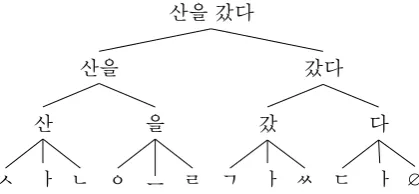
Figure 1: Korean sentence “산을갔다” (I went to the mountain) decomposed to words, characters, and jamos.
Figure 1 for an illustration of the decomposi-tion. The decomposition is deterministic; this is a crucial departure from previous work that uses language-specific sub-character information such as radical (a graphical component of a Chinese character). The radical structure of a Chinese character does not follow any systematic process, requiring an incomplete dictionary mapping be-tween characters and radicals to take advantage of this information (Sun et al.,2014;Yin et al.,2016). In contrast, our Unicode decomposition does not need any supervision and can extract correct jamo letters for all possible Korean characters.
Our jamo architecture is fully general and can be plugged in any Korean processing network. For a concrete demonstration of its utility, in this work we focus on dependency parsing.McDonald et al.
(2013) note that “Korean emerges as a very clear outlier” in their cross-lingual parsing experiments on the universal treebank, implying a need to tai-lor a model for this language isolate. Because of the compositional morphology, Korean suffers ex-treme data sparsity at the word level: 2,703 out of 4,698 word types (>57%) in the held-out portion of our treebank are OOV. This makes the language challenging for simple lexical parsers even when
augmented with a large set of pre-trained word representations.
While such data sparsity can also be alleviated by incorporating more conventional character-level information, we show that incorporating jamo is an effective and economical new approach to combating the sparsity problem for Korean. In experiments, we decisively improve the LAS of the lexical BiLSTM parser of Kiperwasser and Goldberg(2016) from 82.77 to 91.46 while reduc-ing the size of input space by 98.4% when we re-place words with jamos. As a point of reference, a strong feature-rich parser using gold POS tags obtains 88.61.
To summarize, we make the following contribu-tions.
• To our knowledge, this is the first work that leverages jamo in end-to-end neural Ko-rean processing. To this end, we develop a novel sub-character architecture based on de-terministic Unicode decomposition.
• We perform extensive experiments on depen-dency parsing to verify the utility of the ap-proach. We show clear performance boost with a drastically smaller set of parameters. Our final model outperforms strong baselines by a large margin.
• We release an implementation of our jamo ar-chitecture which can be plugged in any Ko-rean processing network.1
2 Related Work
We make a few additional remarks on related work to better situate our work. Our work fol-lows the successful line of work on incorporating sub-lexical information to neural models. Vari-ouscharacter-based architectures have been pro-posed. For instance,Ma and Hovy(2016) andKim et al. (2016) use CNNs over characters whereas
Lample et al.(2016) andBallesteros et al.(2015) use bidirectional LSTMs (BiLSTMs). Both ap-proaches have been shown to be profitable; we em-ploy a BiLSTM-based approach.
Many previous works have also considered
morphemes to augment lexical models (Luong et al., 2013;Botha and Blunsom,2014;Cotterell et al., 2016). Sub-character models are substan-tially rarer; an extreme case is considered by
1https://github.com/karlstratos/ koreannet
Gillick et al.(2016) who process text as a sequence of bytes. We believe that such byte-level models are too general and that there are opportunities to exploit natural sub-character structure for certain languages such as Korean and Chinese.
There exists a line of work on exploiting graph-ical components of Chinese characters called rad-icals (Sun et al., 2014;Yin et al., 2016). For in-stance,足(foot) is the radical of跑(run). While related, our work on Korean is distinguished in critical ways and should not be thought of as just an extension to another language. First, as mentioned earlier, the compositional structure is fundamentally different between Chinese and Ko-rean. The mapping between radicals and charac-ters in Chinese is nondeterministic and can only be loosely approximated by an incomplete dictionary. In contrast, the mapping between jamos and Ko-rean characters is deterministic (Section 3.1), al-lowing for systematic decomposition of all possi-ble Korean characters. Second, the previous work on Chinese radicals was concerned with learn-ing word embeddlearn-ings. We develop an end-to-end compositional model for a downstream task: pars-ing.
3 Method
3.1 Jamo Structure of the Korean Language LetW denote the set of word types andCthe set of character types. In many languages, c ∈ C is the most basic unit that is meaningful. In Korean, each character is further composed of a small fixed set of phonetic units called jamo lettersJ where |J |= 51. The jamo letters are categorized as head consonantsJh, vowelsJv, or tail consonantsJt. The composition is completely systematic. Given any characterc∈ C, there existch ∈ Jh,cv ∈ Jv, andct ∈ Jtsuch that their composition yieldsc. Conversely, anych ∈ Jh, cv ∈ Jv, andct ∈ Jt can be composed to yield a valid characterc∈ C.
As an example, consider the word갔다(went).
It is composed of two characters,갔,다∈ C. Each
character is furthermore composed of three jamo letters as follows:
• 갔 ∈ C is composed of ㄱ ∈ Jh,ㅏ ∈ Jv,
andㅆ∈ Jt.
• 다 ∈ C is composed of ㄷ ∈ Jh,ㅏ ∈ Jv,
and an empty letter∅∈ Jt.
Figure1illustrates the decomposition of a Korean sentence down to jamo letters.
Note that the number of possible characters is combinatorial in the number of jamo letters, loosely upper bounded by 513 = 132,651. This upper bound is loose because certain combina-tions are invalid. For instance,ㅁ ∈ Jh∩ Jtbut ㅁ6∈ Jv whereasㅏ∈ Jv butㅏ6∈ Jh∪ Jt.
The combinatorial nature of Korean characters motivates the compositional architecture below. For completeness, we describe the entire forward pass of the transition-based BiLSTM parser of
Kiperwasser and Goldberg(2016) that we use in our experiments.
3.2 Jamo Architecture
The parameters associated with the jamo layer are
• Embeddingel∈Rdfor each letterl∈ J
• UJ, VJ, WJ ∈Rd×dandbJ ∈Rd
Given a Korean characterc∈ C, we perform Uni-code decomposition (Section 3.3) to recover the underlying jamo lettersch, cv, ct ∈ J. We com-pose the letters to induce a representation ofcas
hc= tanh UJech+VJecv+WJect+bJ
This representation is then concatenated with a character-level lookup embedding, and the result is fed into an LSTM to produce a word representa-tion. We use an LSTM (Hochreiter and Schmidhu-ber,1997) simply as a mappingφ:Rd1×Rd2 → Rd2 that takes an input vectorxand a state vector hto output a new state vectorh0 = φ(x, h). The parameters associated with this layer are
• Embeddingec∈Rd0
for eachc∈ C
• Forward LSTMφf :Rd+d0
×Rd→Rd
• Backward LSTMφb :Rd+d0
×Rd→Rd
• UC∈Rd×2dandbC∈Rd
Given a wordw ∈ W and its character sequence c1. . . cm∈ C, we compute
fic=φf
hci
eci
, fic−1
∀i= 1. . . m
bci =φb
hci
eci
, bci+1
∀i=m . . .1
and induce a representation ofwas
hw = tanh
UC
fc m bc
1
+bC
Lastly, this representation is concatenated with a word-level lookup embedding (which can be ini-tialized with pre-trained word embeddings), and the result is fed into a BiLSTM network. The pa-rameters associated with this layer are
• Embeddingew ∈RdW for eachw∈ W • Two-layer BiLSTMΦthat mapsh1. . . hn∈
Rd+dW toz1. . . zn∈Rd∗
• Feedforward for predicting transitions
Given a sentence w1. . . wn ∈ W, the final d∗ -dimensional word representations are given by
(z1. . . zn) = Φ
hw1 ew1
. . .
hwn
ewn
The parser then uses the feedforward network to greedily predict transitions based on words that are active in the system. The model is trained end-to-end by optimizing a max-margin objective. Since this part is not a contribution of this paper, we refer toKiperwasser and Goldberg(2016) for details.
By setting the embedding dimension of jamos d, charactersd0, or wordsdW to zero, we can con-figure the network to use any combination of these units. We report these experiments in Section4. 3.3 Unicode Decomposition
Our architecture requires dynamically extracting jamo letters given any Korean character. This is achieved by simple Unicode manipulation. For any Korean characterc ∈ C with Unicode value U(c), let U(c) = U(c) − 44032 and T(c) = U(c) mod 28. Then the Unicode values U(ch), U(cv), andU(ct)corresponding to the head con-sonant, vowel, and tail consonant are obtained by
U(ch) = 1 +U(c) 588
+0x10ff
U(cv) = 1 +
(U(c)−T(c)) mod 588
28
+0x1160
U(ct) = 1 +T(c) +0x11a7
Training Development Test # projective trees 5,425 603 299
# non-projective trees 12 0 0
# # Ko Examples
[image:4.595.318.515.62.117.2]word 31,060 – 프로금ᅢᄅ보다갈비booz char 1,772 1,315 최귤 흠ᆼᅣᄂ셧캐쪽@正a jamo 500 48 ㄱ ㄳ ㄼ ㅏ ㅠ ㅢ@正a Table 1: Treebank statistics. Upper: Number of trees in the split. Lower: Number of unit types in the training portion. For simplicity, we include non-Korean symbols (e.g., @, 正, a) as charac-ters/jamos.
3.4 Why Use Jamo Letters?
The most obvious benefit of using jamo letters is alleviating data sparsity by flattening the combi-natorial space of Korean characters. We discuss some additional explicit benefits. First, jamo let-ters often indicate syntactic properties of words. For example, a tail consonantㅆstrongly implies
that the word is a past tense verb as in 갔다
(went),왔다 (came), and 했다 (did). Thus a
jamo-level model can identify unseen verbs more effectively than word- or character-level models. Second, jamo letters dictate the sound of a char-acter. For example,갔 is pronounced asgot
be-cause the head consonantㄱis associated with the
soundg, the vowelㅏwitho, and the tail
conso-nantㅆwitht. This is clearly critical for speech
recognition/synthesis and indeed has been investi-gated in the speech community (Lee et al.,1994;
Sakti et al.,2010). While speech processing is not our focus, the phonetic signals can capture useful lexical correlation (e.g., for onomatopoeic words).
4 Experiments
Data We use the publicly available Korean tree-bank in the universal treetree-bank version 2.0 ( Mc-Donald et al., 2013).2 The dataset comes with
a train/development/test split; data statistics are shown in Table 1. Since the test portion is sig-nificantly smaller than the dev portion, we report performance on both.
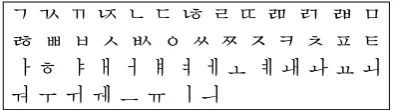
As expected, we observe severe data sparsity with words: 24,814 out of 31,060 elements in the vocabulary appear only oncein the training data. On the dev set, about 57% word types and 3% character types are OOV. Upon Unicode decom-position, we obtain the following 48 jamo types:
2https://github.com/ryanmcd/uni-dep-tb
ㄱ ㄳ ㄲ ㄵ ㄴ ㄷ ㄶ ㄹ ㄸ ㄻ ㄺ ㄼ ㅁ ㅀ ㅃ ㅂ ㅅ ㅄ ㅇ ㅆ ㅉ ㅈ ㅋ ㅊ ㅍ ㅌ ㅏ ㅎ ㅑ ㅐ ㅓ ㅒ ㅕ ㅔ ㅗ ㅖ ㅙ ㅘ ㅛ ㅚ ㅝ ㅜ ㅟ ㅞ ㅡ ㅠ ㅣ ㅢ
none of which is OOV in the dev set.
Implementation and baselines We implement our jamo architecture using the DyNet library (Neubig et al.,2017) and plug it into the BiLSTM parser ofKiperwasser and Goldberg(2016).3 For
Korean syllable manipulation, we use the freely available toolkit by Joshua Dong.4 We train the
parser for 30 epochs and use the dev portion for model selection. We compare our approach to the following baselines:
• McDonald13: A cross-lingual parser origi-nally reported inMcDonald et al.(2013). • Yara: A beam-search transition-based parser
ofRasooli and Tetreault(2015) based on the rich non-local features in Zhang and Nivre
(2011). We use beam width 64. We use 5-fold jackknifing on the training portion to provide POS tag features. We also report on usinggoldPOS tags.
• K&G16: The basic BiLSTM parser of Kiper-wasser and Goldberg(2016) without the sub-lexical architecture introduced in this work. • Stack LSTM: A greedy transition-based
parser based on stack LSTM representa-tions. Dyer15 denotes the word-level vari-ant (Dyer et al.,2015). Ballesteros15 denotes the character-level variant (Ballesteros et al.,
2015).
For pre-trained word embeddings, we apply the spectral algorithm of Stratos et al. (2015) on a 2015 Korean Wikipedia dump to induce 285,933 embeddings of dimension 100.
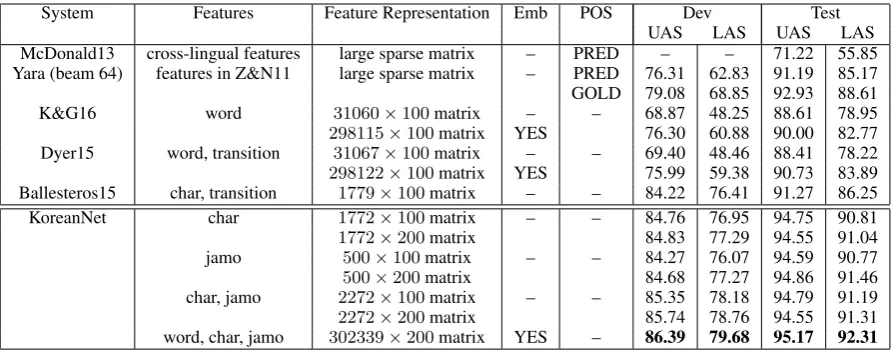
Parsing accuracy Table 2 shows the main re-sult. The baseline test LAS of the original cross-lingual parser of McDonald13 is 55.85. Yara achieves 85.17 with predicted POS tags and 88.61 with gold POS tags. The basic BiLSTM model of K&G16 obtains 82.77 with pre-trained word embeddings (78.95 without). The stack LSTM parser is comparable to K&G16 at the word level 3https://github.com/elikip/bist-parser 4https://github.com/JDongian/
[image:4.595.71.294.62.143.2]System Features Feature Representation Emb POS Dev Test
UAS LAS UAS LAS
McDonald13 cross-lingual features large sparse matrix – PRED – – 71.22 55.85 Yara (beam 64) features in Z&N11 large sparse matrix – PRED 76.31 62.83 91.19 85.17 GOLD 79.08 68.85 92.93 88.61
K&G16 word 31060×100matrix – – 68.87 48.25 88.61 78.95
298115×100matrix YES 76.30 60.88 90.00 82.77 Dyer15 word, transition 31067×100matrix – – 69.40 48.46 88.41 78.22 298122×100matrix YES 75.99 59.38 90.73 83.89 Ballesteros15 char, transition 1779×100matrix – – 84.22 76.41 91.27 86.25
KoreanNet char 1772×100matrix – – 84.76 76.95 94.75 90.81
1772×200matrix 84.83 77.29 94.55 91.04
jamo 500×100matrix – – 84.27 76.07 94.59 90.77
[image:5.595.76.523.61.237.2]500×200matrix 84.68 77.27 94.86 91.46 char, jamo 2272×100matrix – – 85.35 78.18 94.79 91.19 2272×200matrix 85.74 78.76 94.55 91.31 word, char, jamo 302339×200matrix YES – 86.39 79.68 95.17 92.31 Table 2: Main result. Upper: Accuracy with baseline models. Lower: Accuracy with different configu-rations of our parser network (word-only is identical to K&G16).
(Dyer15), but it performs significantly better at the character level (Ballesteros15) reaching 86.25 test LAS.
We observe decisive improvement when we in-corporate sub-lexical information into the parser of K&G16. In fact, astrictlysub-lexical parser us-ing only jamos or characters clearly outperforms its lexical counterpart despite the fact that the model is drastically smaller (e.g., 90.77 with500× 100jamo embeddings vs 82.77 with298115×100 word embeddings). Notably, jamos alone achieve 91.46 which is not far behind the best result 92.31 obtained by using word, character, and jamo units in conjunction. This demonstrates that our compo-sitional architecture learns to build effective rep-resentations of Korean characters and words for parsing from a minuscule set of jamo letters.
5 Discussion of Future Work
We have presented a natural sub-character archi-tecture to model the unique compositional orthog-raphy of the Korean language. The architecture in-duces word-/sentence-level representations from a small set of phonetic units called jamo letters. This is enabled by efficient and deterministic Unicode decomposition of characters.
We have focused on dependency parsing to demonstrate the utility of our approach as an eco-nomical and effective way to combat data sparsity. However, we believe that the true benefit of this ar-chitecture will be more evident in speech process-ing as jamo letters are definitions of sound in the language. Another potentially interesting applica-tion is informal text on the internet. Ill-formed words such asㅎㅎㅎ (shorthand for하하하, an
onomatopoeic expression of laughter) and ㄴㄴ
(shorthand for노노, a transcription ofno no) are
omnipresent in social media. The jamo architec-ture can be useful in this scenario, for instance by correlatingㅎㅎㅎand하하하which might
oth-erwise be treated as independent.
Acknowledgments
The author would like to thank Lingpeng Kong for his help with using the DyNet library, Mohammad Rasooli for his help with using the Yara parser, and Karen Livescu for helpful comments.
References
Miguel Ballesteros, Chris Dyer, and Noah A. Smith. 2015. Improved transition-based parsing by model-ing characters instead of words with lstms. InProc. EMNLP.
Jan A Botha and Phil Blunsom. 2014. Compositional morphology for word representations and language modelling. InICML, pages 1899–1907.
Lyle Campbell and Mauricio J Mixco. 2007. A glos-sary of historical linguistics. Edinburgh University Press.
Ryan Cotterell, Hinrich Sch¨utze, and Jason Eisner. 2016. Morphological smoothing and extrapolation of word embeddings. InProceedings of the 54th An-nual Meeting of the Association for Computational Linguistics, volume 1, pages 1651–1660.
Dan Gillick, Cliff Brunk, Oriol Vinyals, and Amarnag Subramanya. 2016. Multilingual language process-ing from bytes. InProceedings of NAACL.
Sepp Hochreiter and J¨urgen Schmidhuber. 1997. Long short-term memory. Neural computation, 9(8):1735–1780.
Yoon Kim, Yacine Jernite, David Sontag, and Alexan-der M Rush. 2016. Character-aware neural language models. InThirtieth AAAI Conference on Artificial Intelligence.
Eliyahu Kiperwasser and Yoav Goldberg. 2016. Sim-ple and accurate dependency parsing using bidirec-tional lstm feature representations. Transactions of the Association for Computational Linguistics, 4:313–327.
Guillaume Lample, Miguel Ballesteros, Sandeep Sub-ramanian, Kazuya Kawakami, and Chris Dyer. 2016. Neural architectures for named entity recognition. InProceedings of NAACL.
Geunbae Lee, Jong-Hyeok Lee, and Kyunghee Kim. 1994. Phonemie-level, speech and natural, language integration for agglutinative languages. GGGGGGGG 0.
Thang Luong, Richard Socher, and Christopher D Manning. 2013. Better word representations with recursive neural networks for morphology. In CoNLL, pages 104–113.
Xuezhe Ma and Eduard Hovy. 2016. End-to-end se-quence labeling via bi-directional lstm-cnns-crf. In Proceedings of the 54th Annual Meeting of the As-sociation for Computational Linguistics (Volume 1: Long Papers), pages 1064–1074, Berlin, Germany. Association for Computational Linguistics.
Ryan T McDonald, Joakim Nivre, Yvonne Quirmbach-Brundage, Yoav Goldberg, Dipanjan Das, Kuzman Ganchev, Keith B Hall, Slav Petrov, Hao Zhang, Os-car T¨ackstr¨om, et al. 2013. Universal dependency annotation for multilingual parsing. In ACL (2), pages 92–97.
Graham Neubig, Chris Dyer, Yoav Goldberg, Austin Matthews, Waleed Ammar, Antonios Anastasopou-los, Miguel Ballesteros, David Chiang, Daniel Clothiaux, Trevor Cohn, Kevin Duh, Manaal Faruqui, Cynthia Gan, Dan Garrette, Yangfeng Ji, Lingpeng Kong, Adhiguna Kuncoro, Gaurav Ku-mar, Chaitanya Malaviya, Paul Michel, Yusuke Oda, Matthew Richardson, Naomi Saphra, Swabha Swayamdipta, and Pengcheng Yin. 2017. Dynet: The dynamic neural network toolkit. arXiv preprint arXiv:1701.03980.
Mohammad Sadegh Rasooli and Joel R. Tetreault. 2015. Yara parser: A fast and accurate dependency parser.CoRR, abs/1503.06733.
Sakriani Sakti, Andrew Finch, Ryosuke Isotani, Hisashi Kawai, and Satoshi Nakamura. 2010. Ko-rean pronunciation variation modeling with proba-bilistic bayesian networks. InUniversal Communi-cation Symposium (IUCS), 2010 4th International, pages 52–57. IEEE.
Jae Jung Song. 2006.The Korean language: Structure, use and context. Routledge.
Karl Stratos, Michael Collins, and Daniel Hsu. 2015. Model-based word embeddings from decomposi-tions of count matrices. InProceedings of the 53rd Annual Meeting of the Association for Computa-tional Linguistics and the 7th InternaComputa-tional Joint Conference on Natural Language Processing (Vol-ume 1: Long Papers), pages 1282–1291, Beijing, China. Association for Computational Linguistics. Yaming Sun, Lei Lin, Nan Yang, Zhenzhou Ji, and
Xiaolong Wang. 2014. Radical-enhanced chinese character embedding. In International Conference on Neural Information Processing, pages 279–286. Springer.
Rongchao Yin, Quan Wang, Rui Li, Peng Li, and Bin Wang. 2016. Multi-granularity chinese word em-bedding. InProceedings of the Empiricial Methods in Natural Language Processing.