Efficient Discontinuous Phrase-Structure Parsing via the Generalized
Maximum Spanning Arborescence
Caio Corro Joseph Le Roux Mathieu Lacroix
Laboratoire d’Informatique de Paris Nord, Universit´e Paris 13 – SPC, CNRS UMR 7030,
F-93430, Villetaneuse, France
{corro,leroux,lacroix}@lipn.fr
Abstract
We present a new method for the joint task of tagging and non-projective depen-dency parsing. We demonstrate its use-fulness with an application to discontinu-ous phrase-structure parsing where decod-ing lexicalized spines and syntactic deriva-tions is performed jointly. The main con-tributions of this paper are (1) a reduction from joint tagging and non-projective de-pendency parsing to the Generalized Max-imum Spanning Arborescence problem, and (2) a novel decoding algorithm for this problem through Lagrangian relax-ation. We evaluate this model and obtain state-of-the-art results despite strong inde-pendence assumptions.
1 Introduction
Discontinuous phrase-structure parsing relies ei-ther on formal grammars such as LCFRS, which suffer from a high complexity, or on reductions to non-projective dependency parsing with complex labels to encode phrase combinations. We pro-pose an alternative approach based on a variant of spinal TAGs, which allows parses with disconti-nuity while grounding this work on a lexicalized phrase-structure grammar. Contrarily to previous approaches, (Hall and Nivre,2008;Versley,2014;
Fern´andez-Gonz´alez and Martins, 2015), we do not model supertagging nor spine interactions with a complex label scheme. We followCarreras et al.
(2008) but drop projectivity.
We first show that our discontinuous variant of spinal TAG reduces to the Generalized Max-imum Spanning Arborescence (GMSA) problem (Myung et al., 1995). In a graph where vertices are partitioned into clusters, GMSA consists in finding the arborescence of maximum weight
in-cident to exactly one vertex per cluster. This prob-lem is NP-complete even for arc-factored models. In order to bypass complexity, we resort to La-grangian relaxation and propose an efficient res-olution based on dual decomposition which com-bines a simple non-projective dependency parser on a contracted graph and a local search on each cluster to find a global consensus.
We evaluated our model on the discontinuous PTB (Evang and Kallmeyer, 2011) and the Tiger (Brants et al.,2004) corpora. Moreover, we show that our algorithm is able to quickly parse the whole test sets.
Section 2 presents the parsing problem. Sec-tion3introduces GMSA from which we derive an effective resolution method in Section 4. In Sec-tion 5 we define a parameterization of the parser which uses neural networks to model local prob-abilities and present experimental results in Sec-tion6. We discuss related work in Section7.
2 Joint Supertagging and Spine Parsing
In this section we introduce our problem and set notation. The goal of phrase-structure parsing is to produce a derived tree by means of a se-quence of operations called a derivation. For in-stance in context-free grammars the derived tree is built from a sequence of substitutions of a non-terminal symbol with a string of symbols, whereas in tree adjoining grammars (TAGs) a derivation is a sequence of substitutions and adjunctions over elementary trees. We are especially interested in building discontinuous phrase-structure trees which may contain constituents with gaps.1
We followShen(2006) and build derived trees from adjunctions performed on spines. Spines are lexicalized unary trees where each level represents
1Although we will borrow concepts from TAGs, we do not require derivations to be TAG compatible (i.e. well-nested dependencies with a bounded number of gaps).
What
WP WHNP
, I PRP
NP
said
VB VP S
, should MD
I PRP
NP
do
VB VP SQ SBARQ
?
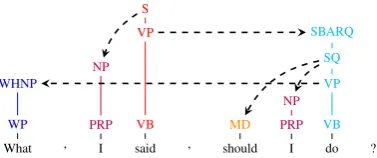
Figure 1: A derivation with spines and adjunc-tions (dashed arrows). The induced dependency tree is non-projective. Each color corresponds to a spine. We omit punctuation to simplify figures.
a lexical projection of the anchor. Carreras et al.
(2008) showed how spine-based parsing could be reduced to dependency parsing: since spines are attached to words, equivalent derivations can be represented as a dependency tree where arcs are la-beled by spine operations, an adjunction together with information about the adjunction site. How-ever, we depart from previous approaches (Shen and Joshi,2008;Carreras et al.,2008) by relaxing the projectivity constraint to represent all discon-tinuous phrase-structure trees (see Figure1).
We assume a finite set of spines S. A spine s can be defined as a sequence of grammatical cat-egories, beginning at root. For a sentence w = (w0, w1, . . . , wn)wherewkis the word at position
k and w0 is a dummy root symbol, a derivation is a triplet (d,s,l) defined as follows. Adjunc-tions are described by a dependency tree rooted at 0 written as a sequence of arcsd. If(h, m) ∈ d
with h ∈ {0, . . . , n} andm ∈ {1, . . . , n}, then the derivation contains an adjunction of the root of the spine at positionm to a node from the spine at position h. Supertagging, the assignment of a spine to each word, is represented by a sequence
s = (s0, s1, . . . , sn) ofn+ 1spines, each spine
sk being assigned to word wk. Finally, labeling l= (l1, . . . , ln)is a sequence wherelkis the label
of thekth arc(h, m)ofd. The label consists of a
couple(op, i)whereop is the type of adjunction, here sister or regular2, and i is the index of the
adjunction node insh.
Each derivation is assigned an arc-factored scoreσwhich is given by:
σ(d,s,l;w) = X (h,m)∈d
Ω(h, m, sh, sm, lhm;w)
For instance, following score functions
de-2The distinction is not crucial for the exposition. We refer readers to (Shen and Joshi,2008;Carreras et al.,2008).
veloped in (Carreras et al., 2008), this func-tion could read sh[i], sh[i+ 1] andsm[0], where
s[i]denotes thei-th grammatical category of the spine s. The score of the derivation in Fig-ure1 could then reflect that the spine WHNP-WP
associated with What is adjoined on the spine
SBARQ-SQ-VP-VB associated withdo on a site
with the grammatical triple[VP WHNP VB]. We assume thatΩaccounts for the contribution of arcs, spines and labels to the score. The de-tails of the contribution depend on the model. We choose the following:
σ(d,s,l;w) = X (h,m)∈d
(α(h, m;w)
+ν(sm;h, m,w)
+γ(lhm;h, m, sh,w))
where α is the score related to the dependency tree,ν is the supertagging score and γ the label-ing score. Note that functions α, ν and γ have access to the entire input string w. Score func-tion σ can be parameterized in many ways and we discuss our implementation in Section 5. In this setting, parsing a sentencewamounts to find-ing the highest-scorfind-ing derivation (d∗,s∗,l∗) =
arg max(d,s,l)σ(d,s,l;w).
Recovering the derived tree from a derivation is performed by recursively mapping each spine and its dependencies to a possibly gappy constituent. Given a spine sh and site index i, we look for
the leftmost sl and rightmost sr dependents
at-tached with regular adjunction. If any, we insert a new node betweensh[i]andsh[i+ 1] with the
same grammatical category as the first one. This new node fills the role of the foot node in TAGs. Every dependent ofsh[i] with anchor in interval
[l+ 1, r−1]is moved to the newly created node. Remaining sister and regular adjunctions are sim-ply attached tosh[i].
The complexity of the parsing problem depends on the type of dependency trees. In the case of projective trees, it has been shown (Eisner,2000;
[image:2.595.75.264.63.142.2]pruning is performed first in order to select a sub-set of spines at each position.
In the case of non-projective dependency trees, the problem has quadratic worst-case time com-plexity when supertags are fixed, since the prob-lem then amounts to non-projective parsing and reduces to the Maximum Spanning Arborescence problem (MSA) as in (McDonald et al., 2005). Unfortunately, the efficient algorithm for MSA is greedy and does not store potential substructure candidates. Hence, when supertags are not fixed beforehand, a new arborescence must be recom-puted for each choice of supertags. This problem can be seen as instance of the Generalized Max-imum Spanning Arborescence problem, an NP-complete problem, which we review in the next section. Note that arc labels do not impact the asymptotic complexity of an arc-factored model. Indeed, only the labeled arc with maximum weight between two vertices is considered when parsing.
3 The Generalized Maximum Spanning Arborescence
In this section, we first define GMSA introduced by Myung et al.(1995). We formulate this prob-lem as an integer linear program. We then ex-plain the reduction from the joint supertagging and spine parsing task to this problem.3
3.1 Problem definition
LetD= (V, A)be a directed graph. Given a sub-set T ⊆ A of arcs, V[T]denotes the set of ver-tices ofV which are the tail or the head of at least one arc of T. These vertices are said to be cov-ered by T. A subset T ⊆ Aof arcs is called an
arborescenceif the graph(V[T], T)is connected, acyclic and each vertex has at most one entering arc. The vertex with no entering arc is called the
rootofT. An arborescence covering all vertices is called aspanning arborescence.
Let π = {V0, . . . , Vn}, n ∈ N be a partition
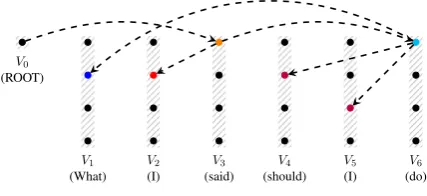
ofV. Each element ofπ is called acluster. An arborescenceT ofDcovering exactly one vertex per cluster ofπ is called a generalized spanning arborescence (GSA). Figure2 gives an example of a GSA. The partition of V is composed of a cluster having one vertex and six clusters having four vertices. Each cluster is depicted by a hatched area. The GSA is depicted by the dashed arcs.
3A similar reduction can be obtained in the reverse direc-tion, thus proving the NP-completeness of our problem.
Let W be a vertex subset of V. We denote δ−(W) (resp. δ+(W)) the set of arcs entering (resp. leaving)W andδ(W) =δ−(W)∪δ+(W).4
ContractingW consists in replacing in Dall ver-tices in W by a new vertex w, replacing each arc uv ∈ δ−(W) by the arc uw and each arc vu ∈ δ+(W) by wu. LetDπ be the graph
ob-tained by contracting each cluster ofπinD. Note that a GSA ofDandπinduces a spanning arbores-cence ofDπ.5 For instance, contracting each
clus-ter in the graph given by Figure2leads to a graph Dπ having 7 vertices and the set of dashed arcs
corresponds to a spanning arborescence ofDπ.
Given arc weightsφ∈RA, the weight of an
ar-borescence T is Pa∈Tφa. Given (D, π, φ), the Generalized Maximum Spanning Arborescence problem (GMSA)consists in finding a GSA ofD andπof maximum weight whose root is inV0.
3.2 Integer linear program
Given a setS,z ∈RS is a vector indexed by
ele-ments inS. ForS0⊆S,z(S0) =P
s∈S0zs.
A GSAT ⊆Ais represented by variablesx∈ {0,1}V andy∈ {0,1}Asuch thatxv(resp.ya) is
equal to 1 iffv∈V[T](resp.a∈T).
Since a GSA of D and π induces a spanning arborescence ofDπ, the arc-incidence vectory ∈
{0,1}Aof a GSA with root inV0satisfies the
fol-lowing, adapted from MSA (Schrijver,2003):
y(δ−(V0)) = 0 (1)
y(δ−(Vk)) = 1 ∀1≤k≤n, (2)
y(δ−( ∪
Vk∈π0Vk))≥1 ∀π
0⊆π\ {V
0}. (3)
Let Y denote all the arc-incidence vectors on D corresponding to a spanning arborescence in Dπ
whose root is the contraction ofV0. Then,
Y ={y∈ {0,1}A|ysatisfies (1)-(3)}. GMSA can be formulated with the following in-teger linear program:
max
x,y φ·y (4)
s.t. y∈ Y (5)
xv ≥ya ∀v∈V, a∈δ(v), (6)
xv(Vk) = 1 ∀0≤k≤n, (7)
xv ∈ {0,1} ∀v∈V. (8) 4By an abuse of notation, we identify any singleton{v} with its elementv.
5The converse does not hold: an arc subset ofA corre-sponding to a spanning arborescence of Dπ may not be a
LetW andT be the vertex and arc sets given by xv = 1 andya = 1 respectively. Since T is a
spanning arborescence ofDπ by (5),(V[T], T)is
an acyclic directed graph withnarcs such thatV0 has no entering arc and Vi, i ∈ {1, . . . , n}, has
one entering arc. By constraints (7),W contains one vertex per cluster ofπ. Moreover, by inequal-ities (6), V[T] ⊆ W. Since |W| = n+ 1 and |T|=n,W =V[T]and(V[T], T)is connected, so it is a GSA. Because its root is inV0 by (5), it is an optimal solution for GMSA by (4).
3.3 Reduction from joint parsing to GMSA Given an instance of the joint parsing problem, we construct an instance of GMSA as follows. With every spinesof every wordwkdifferent fromw0, we associate a vertex v. For k = 1, . . . , n, we denote by Vk the set of vertices associated with
the spines ofwk. We associate with w0 a set V0 containing only one vertex andV0 will now refer both the cluster and the vertex it contains depend-ing on the context. Let π = {V0, . . . , Vn} and
V = ∪n
k=0Vk. For every couple u, v of vertices
such thatu∈Vhandv∈Vm,h6=mandm6= 0,
we associate an arcuv corresponding to the best adjunction of the root of spinesmassociated with
vofVmto spineshassociated with vertexuofVh.
The weight of this arc is given by
φuv=α(h, m;w) +ν(sm;h, m,w)
+ max
lhm γ(lhm;h, m, sh,w)
which is the score of the best adjunction ofsm to
sh. This ends the construction of(D, π, φ).
There is a 1-to-1 correspondence between the solutions to GMSA and those to the joint supertag-ging and spine parsing task in which each adjunc-tion is performed with the label maximizing the score of the adjunction. Indeed, the vertices cov-ered by a GSAT with rootV0 correspond to the spines on which the derivation is performed. By definition of GSAs, one spine per word is chosen. Each arc ofT corresponds to an adjunction. The score of the arborescence is the sum of the scores of the selected spines plus the sum of the scores of the best adjunctions with respect toT. Hence, one can solve GMSA to perform joint parsing.
As an illustration, the GSA depicted in Figure2
represents the derivation tree of Figure1: the ver-tices ofV \V0covered by the GSA are those as-sociated with the spines of Figure 1and the arcs represent the different adjunctions. For instance
V0
(ROOT)
V1
[image:4.595.310.524.74.172.2](What) V(I)2 (said)V3 (should)V4 V(I)5 (do)V6
Figure 2: The generalized spanning arborescence inducing the derivation tree in Figure1.
the arc fromV3toV2 represents the adjunction of spineNP-PRPto spineS-VP-VBat index 0.
4 Efficient Decoding
Lagrangian relaxation has been successfully ap-plied to various NLP tasks (Koo et al., 2010;
Le Roux et al.,2013;Almeida and Martins,2013;
Das et al.,2012;Corro et al., 2016). Intuitively, given an integer linear program, it consists in re-laxing some linear constraints which make the program difficult to solve and penalizing their vi-olation in the objective function.
We propose a new decoding method for GMSA based on dual decomposition, a special flavor of Lagrangian relaxation where the problem is de-composed in several independent subproblems.
4.1 Dual decomposition
To perform the dual decomposition, we first refor-mulate the integer linear program (4)-(8) before relaxing linear constraints. For this purpose, we replace the variables y by three copies {yi} =
{y0, y1, y2},yi ∈ {0,1}A. We also consider
vari-ablesz ∈ RA. Let φ0, φ1 andφ2 be arc weight vectors such thatPiφi=φ.6 GMSA can then be
reformulated as:
max
x,{yi},z X
i
φi·yi (9)
s.t. y0 ∈ Y (10)
xv ≥ya1 ∀v∈V, a∈δ−(v), (11)
xv ≥ya2 ∀v∈V, a∈δ+(v), (12)
xv(Vk) = 1 ∀0≤k≤n, (13)
xv ∈ {0,1} ∀v∈V, (14)
z=yi ∀i. (15)
Note that variables z only appear in equa-tions (15). Their goal is to ensure equality be-tween copiesy0,y1andy2. Variableszare usually calledwitness variables(Komodakis et al.,2007). Equality betweeny0,y1 andy2 implies that (10 )-(12) are equivalent to (5) and (6).
We now relax constraints (15) and build the dual objective (Lemar´echal,2001)L∗({λi}):
max
x,{yi},z X
i
φi·yi+ X i∈{0,1,2}
λi·(z−yi)
s.t. (10)−(14)
where {λi} = {λ0, λ1, λ2}, λi ∈ RA for i =
0,1,2, is the set of Lagrangian multipliers. The dual problem is then:
min
{λi}L ∗({λi})
Note that, as there is no constraint onz, ifPiλi 6= 0 then L∗({λi}) = +∞. Therefore, we can
re-strict the domain of {λi} in the dual problem to
the setΛ ={{λi}|P
iλi =0}. This implies that
zmay be removed in the dual objective. This latter can be rewritten as:
L∗({λi}) = max
x,{yi} X
i
¯ φi·yi
s.t. (10)−(14)
whereφ¯i=φi−λifori= 0,1,2.
4.2 Computing the dual objective
Given {λi} ∈ Λ, computing the dual objective
L∗({λi})can be done by solving the two
follow-ing distinct subproblems:
P1( ¯φ0) = max
y0 φ¯0·y 0
s.t. y0∈ Y P2( ¯φ1,φ¯2) = max
x,y1,y2φ¯
1·y1+ ¯φ2·y2
s.t. (11)−(14)
yai ∈ {0,1} ∀a∈A, i= 1,2.
SubproblemP1 can be solved by simply running the MSA algorithm on the contracted graphDπ.
Subproblem P2 can be solved in a combinato-rial way. Indeed, observe that each value of y1 andy2 is only constrained by a single value ofx. The problem amounts to selecting for each cluster
a vertex as well as all the arcs with positive weight covering it. More precisely, for each vertexv∈V, compute thelocal weightcv defined by:
X
a∈δ−(v)
max{0,φ¯1}+ X
a∈δ+(v)
max{0,φ¯2}.
LetVmaxbe the set of vertices defined as fol-lows. For k = 0, . . . , n, add in Vmax the ver-texv ∈Vkwith the maximum weightcv. LetA1
andA2 be the sets of arcs such thatA1(resp.A2) contains all the arcs with positive weights entering (resp. leaving) a vertex ofVmax. The vectorsx,y1 andy2corresponding respectively to the incidence vectors ofVmax, A1 andA2 form an optimal so-lution toP2.
Hence, both supbroblems can be be solved with aO(|π|2) time complexity, that is quadratic w.r.t. the length of the input sentence.7
4.3 Decoding algorithm
Our algorithm seeks for a solution to GMSA by solving the dual problem since its solution is opti-mal to GMSA whenever it is a GSA. If not, a so-lution is constructed by returning the highest GSA on the spines computed during the resolution of the dual problem.
We solve the dual problem using a projected subgradient descent which consists in iteratively updating{λi}in order to reduce the distance to the
optimal assignment. Let{λi,t}denotes the value
of{λi}at iterationt. {λi,0}is initially set to0. At each iteration, the value of{λi,t+1}is computed from the value of{λi,t}thanks to a subgradient of
the dual objective. More precisely, we have {λi,t+1}={λi,t} −ηt× ∇L∗({λi,t})} where∇L∗({λi,t})is a subgradient ofL∗({λi,t})
andηt ∈ R is the stepsize at iterationt. We use
the projected subgradient from Komodakis et al.
(2007). Hence, at iterationt, we must solve repa-rameterized subproblemsP1 andP2 to obtain the current solution(¯xt,y¯0,t,y¯1,t,y¯2,t)of the dual
ob-jective. Then each multiplier is updated following
λi,t+1=λi,t−ηt×
y¯i,t−X2 j=0
¯ yj,t
3
.
Note that for any value of{λi},L∗({λi})gives
an upper bound for GMSA. So, whenever the
7In the general case, the time complexity isO(|V|2). But
optimal solution x¯t,{y¯i,t} to the dual objective
L∗({λi,t})at iteration tis a primal feasible
solu-tion, that is y¯0,t = ¯y1,t = ¯y2,t, it is an optimal
solution to GMSA and the algorithm ends. Other-wise, we construct apipeline solutionby perform-ing a MSA on the vertices given byx¯t.
If after a fixed number of iterations we have not found an optimal solution to GMSA, we return the pipeline solution with maximum weight.
4.4 Lagrangian enhancement
The previsouly defined Lagrangian dual is valid but may lead to slow convergence. Thus, we propose three additional techniques which empir-ically improve the decoding time and the conver-gence rate: constraint tightening, arc reweighing and problem reduction.
Constraint tightening: In subproblemP2, we consider a vertex and all of its adjacent arcs of pos-itive weight. However, we know that our optimal solution must satisfy tree-shape constraints (5). Thus, every cluster except the root must have ex-actly one incoming arc and there is at most one arc between two clusters. Both constraints are added toP2 without hurting its time complexity.
Reweighing: By modifying weights such that less incoming arcs have a positive weight, the so-lution ofP2tends to be an arborescence. For each clusterVk ∈π\V0, letAˆkbe the set of incoming
arcs with the highest weightφˆk. Then, letγk be
a value such thatφa−γkis positive only for arcs
inAˆk. Subtractingγkfrom the weightφaof each
arc ofδ−(Vk)and addingγkto the objective score
does not modify the weight of the solution because only one entering arc per cluster is selected.
Problem reduction: We use the pipeline solu-tions computed at each iteration to set the value of some variables. Let x,¯ {y¯i}be the optimal
solu-tion ofL∗({λi}) computed at any iteration of the
subgradient algorithm. For k = 1, . . . , n, let v¯ be the vertex ofVk such that x¯v¯ = 1. Using the local weights (Section4.2), for allv ∈ Vk\ {¯v},
L∗({λi})+c
v−c¯vis an upper bound on the weight
of any solution (x, y) to GMSA with xv = 1.
Hence, if it is lower than the weight of the best pipeline solution found so far, we can guarantee thatxv = 0in any optimal solution. We can check
the whole graph in linear time if we keep local weightscin memory.
5 Neural Parameterization
We present a probabilistic model for our frame-work. We implement our probability distributions with neural networks, more specifically we build a neural architecture on top of bidirectional recur-rent networks that compute context sensitive rep-resentations of words. At each step, the recurrent architecture is given as input a concatenation of word and part-of-speech embeddings. We refer the reader to (Kiperwasser and Goldberg,2016;Dozat and Manning) for further explanations about bidi-rectional LSTMs (Hochreiter and Schmidhuber,
1997). In the rest of this section,bm denotes the
context sensitive representation of wordwm.
We now describe the neural network models used to learn and assign weight functionsα,νand γ under a probabilistic model. Given a sentence
w of length n, we assume a derivation (d,s,l) is generated by three distinct tasks. By chain rule, P(d,s,l|w) = Pα(d|w) ×Pν(s|d,w) ×
Pγ(l|d,s,w). We follow a common approach in
dependency parsing and assign labelslin a post-processing step, although our model is able to in-corporate label scores directly. Thus, we are left with jointly decoding a dependency structure and assigning a sequence of spines. We notesitheith
spine:8
Pα(d|w)×Pν(s|d,w)
= Y
(h,m)∈d
Pα(h|m,w)×Pν(sm|m,d,w)
= Y
(h,m)∈d
Pα(h|m,w)×Pν(sm|m, h,w)
We suppose that adjunctions are generated by an arc-factored model, and that a spine prediction de-pends on both current position and head position.
Then parsing amounts to finding the most prob-able derivation and can be realized in the log space, which gives following weight functions:
α(h, m;w) = logPα(h|m,w)
ν(sm;h, m,w) = logPν(sm|m, h,w)
whereαrepresents the arc contribution andν the spine contribution (cf. Section2).
Word embeddings bk are first passed through
specific feed-forward networks depending on the
8We assume that the spine for the rootw
distribution and role. The result of the feed-forward transformation parameterized by set of parametersρ of a word embeddingbs is a vector
denoted b(sρ). We first define a biaffine attention
networks weighting dependency relations (Dozat and Manning):
o(h,mα) =b(α1)>
m W(α)b(hα2)+V(α)b(hα2)
where W(α) and V(α) are trainable parameters. Moreover, we define a biaffine attention classifier networks for classcas:
o(c,h,mτ) =b(τ1)>
m W(τc)b(hτ2)
+V(τc)b(τ1)
m ⊕b(hτ2)
+u(τc)
where ⊕is the concatenation. W(τc), V(τc) and u(τc)are trainable parameters. Then, we define the weight of assigning spinesto word at positionm with headhaso(s,h,mν) .
Distributions Pα andPν are parameterized by
these biaffine attention networks followed by a softmax layer:
Pα(h|m,w) = expo
(α)
h,m
P
h0expo(hα0,m)
Pν(s|h, m,w) = expo
(ν)
s,h,m
P
s0expo(sν0,h,m)
Now we move on to the post-processing step predicting arc labels. For each adjunction of spine s at position m to spinet at position h, instead of predicting a site index i, we predict the non-terminalntatt[i]with a biaffine attention classi-fier.9 The probability of the adjunction of spines
at positionmto a site labeled withnton spinetat positionhwith typea∈ {regular,sister}is:
Pγ(nt, a|h, m) =Pγ0(nt|h, m,w)
×Pγ00(a|h, mw)
Pγ and Pγ00 are again defined as distributions from the exponential family using biaffine atten-tion classifiers:
Pγ0(nt|h, m, t) = expo (γ0)
nt,h,m
P
nt0expo(γ 0)
nt,h,m
Pγ00(a|h, m, t) = expo (γ00)
t,h,m
P
a0expo(γ 00)
a0,h,m
9If a spine contains repeated non-terminal sequences, we select the lowest match.
We use embeddings of size 100 for words and size 50 for parts-of-speech tags. We stack two bidirectional LSTMs with a hidden layer of size 300, resulting in a context sensitive embedding of size 600. Embeddings are shared across distribu-tions. All feed-forward networks have a unique elu-activated hidden layer of size 100 (Clevert et al., 2016). We regularize parameters with a dropout ratio of 0.5 on LSTM input. We es-timate parameters by maximizing the likelihood of the training data through stochastic subgradi-ent descsubgradi-ent using Adam (Kingma and Ba,2015). Our implementation uses the Dynet library ( Neu-big et al.,2017) with default parameters.
6 Experiments
We ran a series of experiments on two corpora an-notated with discontinuous constituents.
EnglishWe used an updated version of the Wall Street Journal part of the Penn Treebank corpus (Marcus et al.,1994) which introduces discontinu-ity (Evang and Kallmeyer, 2011). Sections 2-21 are used for training, 22 for developpement and 23 for testing. We used gold and predicted POS tags by the Stanford tagger,10 trained with
10-jackknifing. Dependencies are extracted following the head-percolation table ofCollins(1997).
German We used the Tiger corpus (Brants et al.,2004) with the split defined for the SPMRL 2014 shared task (Maier, 2015; Seddah et al.,
2013). Following Maier (2015) and Coavoux and Crabb´e (2017), we removed sentences num-ber 46234 and 50224 as they contain anno-tation errors. We only used the given gold POS tags. Dependencies are extracted following the head-percolation table distributed with Tulipa (Kallmeyer et al.,2008).
We emphasize that long sentences are not fil-tered out. Our derivation extraction algorithm is similar to the one proposed in Carreras et al.
(2008). Regarding decoding, we use a beam of size 10 for spines w.r.t. Pν(sm|m,w) =
P
hPν(sm|h, m,w)×Pα(h|m,w)but allow
ev-ery possible adjunction. The maximum number of iterations of the subgradient descent is set to 500 and the stepsize ηt is fixed following the rule of Polyak(1987).
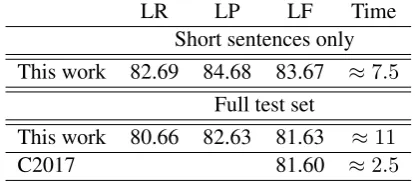
Parsing results and timing on short sentences only (≤ 40 words) and full test set using the
fault discodop11eval script are reported on Table1
and Table2.12 We report labeled recall (LR),
pre-cision (LP), F-measure (LF) and time measured in minutes. We also report results published by
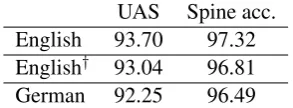
van Cranenburgh et al. (2016) for the discontin-uous PTB and Coavoux and Crabb´e (2017) for Tiger. Moreover, dependency unlabeled attach-ment scores (UAS) and tagging accuracies (Spine acc.) are given on Table 3. We achieve signif-icantly better results on the discontinuous PTB, while being roughly36times faster together with a low memory footprint.13 On the Tiger corpus, we
achieve on par results. Note however thatCoavoux and Crabb´e(2017) rely on a greedy parser com-bined with beam search.
Fast and efficient parsing of discontinuous con-stituent is a challenging task. Our method can quickly parse the whole test set, without any par-allelization or GPU, obtaining an optimality cer-tificate for more than 99% of the sentences in less than 500 iterations of the subgradient descent. When using a non exact decoding algorithm, such as a greedy transition based method, we may not be able to deduce the best opportunity for improv-ing scores on benchmarks, such as the parameter-ization method or the decoding algorithm. Here the behavior may be easier to interpret and direc-tions for future improvement easier to see. We stress that our method is able to produce an op-timality certificate on more than 99% of the test examples thanks to the enhancement presented in Section4.4.
7 Related Work
Spine-based parsing has been investigated in (Shen and Joshi,2005) for Lexicalized TAGs with a left-to-right shift-reduce parser which was sub-sequently extended to a bidirectional version in (Shen and Joshi,2008). A graph-based algorithm was proposed in (Carreras et al.,2008) for second-order projective dependencies, and for a form of non-projectivity occurring in machine translation (i.e. projective parses of permutated input sen-tences) in (Carreras and Collins,2009).
Discontinuous phrase-structure parsing through dependencies in contexts other that TAGs have
11https://github.com/andreasvc/disco-dop/
12C2017 processing time is 137.338 seconds plus approxi-matively 30 seconds for model and corpus loading (personnal communication).
13Execution times are not directly comparable because we report our experimental conditions and published results.
LR LP LF Time
Short sentences only This work 90.63 91.01 90.82 ≈4 This work† 89.57 90.13 89.85 ≈4
VC2016† 87.00 ≈180
Full test set
[image:8.595.310.523.62.183.2]This work 89.89 90.29 90.09 ≈6.5 This work† 88.90 89.45 89.17 ≈5.5
Table 1: Parsing results and processing time on the english discontinuous PTB corpus. Re-sults marked with † use predicted part-of-speech
tags. VC2016 indicates results of van Cranen-burgh et al.(2016).
LR LP LF Time
Short sentences only This work 82.69 84.68 83.67 ≈7.5
Full test set
This work 80.66 82.63 81.63 ≈11
C2017 81.60 ≈2.5
Table 2: Parsing results and processing time on the german Tiger corpus. C2017 indicates results ofCoavoux and Crabb´e(2017).
been explored in (Hall and Nivre, 2008;Versley,
2014; Fern´andez-Gonz´alez and Martins, 2015). The first two encode spine information as arc la-bels while the third one relaxes spine information by keeping only the root and height of the adjunc-tion, thus avoiding combinatorial explosion. La-beling is performed as a post-processing step in these approaches, since the number of labels can be very high. Our model also performs labeling after structure construction, but it could be per-formed jointly without major issue. This is one way our model could be improved.
GMSA has been studied mostly as a way to solve the non directed version (i.e. with symet-ric arc weights) (Myung et al., 1995), see (Pop,
[image:8.595.312.520.269.360.2]UAS Spine acc. English 93.70 97.32 English† 93.04 96.81
[image:9.595.108.255.63.117.2]German 92.25 96.49
Table 3: Dependency parsing and tagging re-sults. Results marked with † use predicted
part-of-speech tags.
it is the optimal solution (Beasley,1993), and thus the stopping criterion for the subgradient descent is usually slow to obtain. To our knowledge, our system is the first time that GMSA is used to solve a NLP problem.
Dual decomposition has been used to derive ef-ficient practical resolution methods in NLP, mostly for machine translation and parsing, see (Rush et al.,2010) for an overview and (Koo et al.,2010) for an application to dependency parsing.
To accelerate the resolution, our method re-lies heavily on problem reduction (Beasley,1993), which uses the primal/dual bounds to filter out suboptimal assignments. Exact pruning based on duality has already been studied in parsing, with branch and bound (Corro et al.,2016) or column generation (Riedel et al., 2012) and in machine translation with beam search (Rush et al.,2013).
8 Conclusion
We presented a novel framework for the joint task of supertagging and parsing by a reduction to GMSA. Within this framework we developed a model able to produce discontinuous constituents. The scoring model can be decomposed into tag-ging and dependency parsing and thus may rely on advances in those active fields.
This work could benefit from several exten-sions. Bigram scores on spines could be added at the expense of a third subproblem in the dual objective. High-order scores on arcs like grand-parent or siblings can be handled in subproblem P2 with the algorithms described in (Koo et al.,
2010). In this work, the parameters are learned as separate models. Joint learning in the max-margin framework (Komodakis, 2011; Komodakis et al.,
2015) may model interactions between vertex and arc weights better and lead to improved accuracy. Finally, we restricted our grammar to spinal trees but it could be possible to allow full lexicalized TAG-like trees, with substitution nodes and even obligatory adjunction sites. Derivations
compat-ible with the TAG formalism (or more generally LCFRS) could be recovered by the use of a con-strained version of MSA (Corro et al.,2016).
Acknowledgements
We thank the anonymous reviewers for their in-sightful comments. We thank Laura Kallmeyer and Kilian Evang for providing us with the script for the discontinuous PTB. First author is sup-ported by a public grant overseen by the French National Research Agency (ANR) as part of the Investissements d’Avenir program (ANR-10-LABX-0083). Second author, supported by a pub-lic grant overseen by the French ANR (ANR-16-CE33-0021), completed this work during a CNRS research leave at LIMSI, CNRS / Universit´e Paris Saclay.
References
Miguel Almeida and Andre Martins. 2013. Fast and ro-bust compressive summarization with dual decom-position and multi-task learning. In Proceedings of the 51st Annual Meeting of the Association for Computational Linguistics (Volume 1: Long Pa-pers), pages 196–206, Sofia, Bulgaria. Association for Computational Linguistics.
John Beasley. 1993. Modern heuristic techniques for combinatorial problems, chapter Lagrangian relax-ation. John Wiley & Sons, Inc.
Sabine Brants, Stefanie Dipper, Peter Eisenberg, Sil-via Hansen-Schirra, Esther K¨onig, Wolfgang Lezius, Christian Rohrer, George Smith, and Hans Uszkor-eit. 2004. Tiger: Linguistic interpretation of a ger-man corpus. Research on language and computa-tion, 2(4):597–620.
Xavier Carreras and Michael Collins. 2009. Non-projective parsing for statistical machine translation. In Proceedings of the 2009 Conference on Empiri-cal Methods in Natural Language Processing, pages 200–209, Singapore. Association for Computational Linguistics.
Xavier Carreras, Michael Collins, and Terry Koo. 2008. TAG, dynamic programming, and the perceptron for efficient, feature-rich parsing. InCoNLL 2008: Proceedings of the Twelfth Conference on Com-putational Natural Language Learning, pages 9– 16, Manchester, England. Coling 2008 Organizing Committee.
Maximin Coavoux and Benoit Crabb´e. 2017. Incre-mental discontinuous phrase structure parsing with the gap transition. InProceedings of the 15th Con-ference of the European Chapter of the Association for Computational Linguistics: Volume 1, Long Pa-pers, pages 1259–1270. Association for Computa-tional Linguistics.
Michael Collins. 1997. Three generative, lexicalised models for statistical parsing. InProceedings of the 35th Annual Meeting of the Association for Com-putational Linguistics, pages 16–23, Madrid, Spain. Association for Computational Linguistics.
Caio Corro, Joseph Le Roux, Mathieu Lacroix, An-toine Rozenknop, and Roberto Wolfler Calvo. 2016. Dependency parsing with bounded block degree and well-nestedness via lagrangian relaxation and branch-and-bound. InProceedings of the 54th An-nual Meeting of the Association for Computational Linguistics (Volume 1: Long Papers), pages 355– 366, Berlin, Germany. Association for Computa-tional Linguistics.
Andreas van Cranenburgh, Remko Scha, and Rens Bod. 2016. Data-oriented parsing with discontinu-ous constituents and function tags. Journal of Lan-guage Modelling, 4(1):57–111.
Dipanjan Das, Andr´e F. T. Martins, and Noah A. Smith. 2012. An exact dual decomposition algo-rithm for shallow semantic parsing with constraints. InThe First Joint Conference on Lexical and Com-putational Semantics, pages 209–217, Montr´eal, Canada. Association for Computational Linguistics.
Timothy Dozat and Christopher D. Manning. Deep bi-affine attention for neural dependency parsing. Pro-ceedings of the 2017 International Conference on Learning Representations.
Jason Eisner. 2000. Bilexical grammars and their cubic-time parsing algorithms. In New Develop-ments in Natural Language Parsing, pages 29–62. Kluwer Academic Publishers.
Kilian Evang and Laura Kallmeyer. 2011. PLCFRS parsing of english discontinuous constituents. In Proceedings of the 12th International Conference on Parsing Technologies, pages 104–116, Dublin, Ire-land. Association for Computational Linguistics.
Corinne Feremans, Martine Labb´e, and Gilbert La-porte. 1999. The generalized minimum spanning tree: Polyhedra and branch-and-cut. Electronic Notes in Discrete Mathematics, 3:45–50.
Daniel Fern´andez-Gonz´alez and Andr´e F. T. Martins. 2015. Parsing as reduction. InProceedings of the 53rd Annual Meeting of the Association for Compu-tational Linguistics and the 7th International Joint Conference on Natural Language Processing (Vol-ume 1: Long Papers), pages 1523–1533, Beijing, China. Association for Computational Linguistics.
Johan Hall and Joakim Nivre. 2008. Parsing discon-tinuous phrase structure with grammatical functions. In Advances in Natural Language Processing: 6th International Conference, GoTAL 2008 Gothenburg, Sweden, August 25-27, 2008 Proceedings, pages 169–180, Berlin, Heidelberg. Springer Berlin Hei-delberg.
Sepp Hochreiter and J¨urgen Schmidhuber. 1997. Long short-term memory. Neural computation, 9(8):1735–1780.
Laura Kallmeyer, Timm Lichte, Wolfgang Maier, Yannick Parmentier, Johannes Dellert, and Kilian Evang. 2008. Tulipa: Towards a multi-formalism parsing environment for grammar engineering. In Coling 2008: Proceedings of the workshop on Grammar Engineering Across Frameworks, pages 1–8, Manchester, England. Coling 2008 Organizing Committee.
Diederik Kingma and Jimmy Ba. 2015. Adam: A method for stochastic optimization. InProceedings of The International Conference on Learning Repre-sentations (ICLR).
Eliyahu Kiperwasser and Yoav Goldberg. 2016. Sim-ple and accurate dependency parsing using bidirec-tional lstm feature representations. Transactions of the Association for Computational Linguistics, 4:313–327.
Nikos Komodakis. 2011. Efficient training for pair-wise or higher order crfs via dual decomposition. In Computer Vision and Pattern Recognition (CVPR), 2011 IEEE Conference on, pages 1841–1848. IEEE. Nikos Komodakis, Nikos Paragios, and Georgios Tzir-itas. 2007. MRF optimization via dual decompo-sition: Message-passing revisited. In 2007 IEEE 11th International Conference on Computer Vision, pages 1–8. IEEE.
Nikos Komodakis, Bo Xiang, and Nikos Paragios. 2015. A framework for efficient structured max-margin learning of high-order mrf models. IEEE transactions on pattern analysis and machine intel-ligence, 37(7):1425–1441.
Terry Koo, Alexander M. Rush, Michael Collins, Tommi Jaakkola, and David Sontag. 2010. Dual decomposition for parsing with non-projective head automata. InProceedings of the 2010 Conference on Empirical Methods in Natural Language Process-ing, pages 1288–1298, Cambridge, MA. Associa-tion for ComputaAssocia-tional Linguistics.
Claude Lemar´echal. 2001. Lagrangian relaxation. In Computational combinatorial optimization, pages 112–156. Springer.
Zhenghua Li, Min Zhang, Wanxiang Che, Ting Liu, Wenliang Chen, and Haizhou Li. 2011. Joint mod-els for chinese pos tagging and dependency parsing. In Proceedings of the 2011 Conference on Empiri-cal Methods in Natural Language Processing, pages 1180–1191, Edinburgh, Scotland, UK. Association for Computational Linguistics.
Wolfgang Maier. 2015. Discontinuous incremental shift-reduce parsing. InProceedings of the 53rd An-nual Meeting of the Association for Computational Linguistics and the 7th International Joint Confer-ence on Natural Language Processing (Volume 1: Long Papers), pages 1202–1212. Association for Computational Linguistics.
Mitchell Marcus, Grace Kim, Mary Ann Marcinkiewicz, Robert MacIntyre, Ann Bies, Mark Ferguson, Karen Katz, and Britta Schas-berger. 1994. The penn treebank: annotating predicate argument structure. In HLT’94: Pro-ceedings of the workshop on Human Language Technology, pages 114–119, Morristown, NJ, USA. Association for Computational Linguistics.
Ryan McDonald, Fernando Pereira, Kiril Ribarov, and Jan Hajic. 2005. Non-projective dependency pars-ing uspars-ing spannpars-ing tree algorithms. In Proceed-ings of Human Language Technology Conference and Conference on Empirical Methods in Natural Language Processing, pages 523–530, Vancouver, British Columbia, Canada. Association for Compu-tational Linguistics.
Young-Soo Myung, Chang-Ho Lee, and Dong-Wan Tcha. 1995. On the generalized minimum spanning tree problem.Networks, 26(4):231–241.
Graham Neubig, Chris Dyer, Yoav Goldberg, Austin Matthews, Waleed Ammar, Antonios Anastasopou-los, Miguel Ballesteros, David Chiang, Daniel Clothiaux, Trevor Cohn, Kevin Duh, Manaal Faruqui, Cynthia Gan, Dan Garrette, Yangfeng Ji, Lingpeng Kong, Adhiguna Kuncoro, Gaurav Ku-mar, Chaitanya Malaviya, Paul Michel, Yusuke Oda, Matthew Richardson, Naomi Saphra, Swabha Swayamdipta, and Pengcheng Yin. 2017. Dynet: The dynamic neural network toolkit. arXiv preprint arXiv:1701.03980.
Boris T Polyak. 1987. Introduction to optimization. Optimization Software.
Petrica Claudiu Pop. 2002. The generalized minimum spanning tree problem. Twente University Press.
Petrica Claudiu Pop. 2009. A survey of different in-teger programming formulations of the generalized minimum spanning tree problem. Carpathian Jour-nal of Mathematics, 25(1):104–118.
Sebastian Riedel, David Smith, and Andrew McCal-lum. 2012. Parse, price and cut—delayed column and row generation for graph based parsers. In Pro-ceedings of the 2012 Joint Conference on Empirical Methods in Natural Language Processing and Com-putational Natural Language Learning, pages 732– 743, Jeju Island, Korea. Association for Computa-tional Linguistics.
Alexander Rush, Yin-Wen Chang, and Michael Collins. 2013. Optimal beam search for machine translation. InProceedings of the 2013 Conference on Empirical Methods in Natural Language Pro-cessing, pages 210–221, Seattle, Washington, USA. Association for Computational Linguistics.
Alexander M Rush, David Sontag, Michael Collins, and Tommi Jaakkola. 2010. On dual decomposition and linear programming relaxations for natural lan-guage processing. InProceedings of the 2010 Con-ference on Empirical Methods in Natural Language Processing, pages 1–11, Cambridge, MA. Associa-tion for ComputaAssocia-tional Linguistics.
A. Schrijver. 2003. Combinatorial Optimization -Polyhedra and Efficiency. Springer.
Djam´e Seddah, Reut Tsarfaty, Sandra K¨ubler, Marie Candito, D. Jinho Choi, Rich´ard Farkas, Jen-nifer Foster, Iakes Goenaga, Koldo Gojenola Gal-letebeitia, Yoav Goldberg, Spence Green, Nizar Habash, Marco Kuhlmann, Wolfgang Maier, Joakim Nivre, Adam Przepi´orkowski, Ryan Roth, Wolf-gang Seeker, Yannick Versley, Veronika Vincze, Marcin Woli´nski, Alina Wr´oblewska, and Ville-monte Eric de la Clergerie. 2013. Proceed-ings of the Fourth Workshop on Statistical Pars-ing of Morphologically-Rich Languages, chapter Overview of the SPMRL 2013 Shared Task: A Cross-Framework Evaluation of Parsing Morpho-logically Rich Languages. Association for Compu-tational Linguistics.
Libin Shen. 2006.Statistical LTAG Parsing. Ph.D. the-sis, University of Pennsylvania.
Libin Shen and Aravind Joshi. 2005. Incremental ltag parsing. InProceedings of Human Language Technology Conference and Conference on Empiri-cal Methods in Natural Language Processing, pages 811–818, Vancouver, British Columbia, Canada. Association for Computational Linguistics.
Libin Shen and Aravind Joshi. 2008. LTAG depen-dency parsing with bidirectional incremental con-struction. InProceedings of the 2008 Conference on Empirical Methods in Natural Language Process-ing, pages 495–504, Honolulu, Hawaii. Association for Computational Linguistics.