Adversarial Examples for Evaluating Reading Comprehension Systems
Robin Jia
Computer Science Department Stanford University
Percy Liang
Computer Science Department Stanford University
Abstract
Standard accuracy metrics indicate that reading comprehension systems are mak-ing rapid progress, but the extent to which these systems truly understand language remains unclear. To reward systems with real language understanding abili-ties, we propose an adversarial evalua-tion scheme for the Stanford Quesevalua-tion An-swering Dataset (SQuAD). Our method tests whether systems can answer ques-tions about paragraphs that contain adver-sarially inserted sentences, which are au-tomatically generated to distract computer systems without changing the correct an-swer or misleading humans. In this ad-versarial setting, the accuracy of sixteen published models drops from an average of 75% F1 score to 36%; when the ad-versary is allowed to add ungrammatical sequences of words, average accuracy on four models decreases further to7%. We hope our insights will motivate the de-velopment of new models that understand language more precisely.
1 Introduction
Quantifying the extent to which a computer sys-tem exhibits intelligent behavior is a longstanding problem in AI (Levesque,2013). Today, the stan-dard paradigm is to measure average error across a held-out test set. However, models can succeed in this paradigm by recognizing patterns that hap-pen to be predictive on most of the test examples, while ignoring deeper, more difficult phenomena (Rimell et al.,2009;Paperno et al.,2016).
In this work, we propose adversarial evaluation for NLP, in which systems are instead evaluated on adversarially-chosen inputs. We focus on the
Article:Super Bowl 50
Paragraph:“Peyton Manning became the first quarter-back ever to lead two different teams to multiple Super Bowls. He is also the oldest quarterback ever to play in a Super Bowl at age 39. The past record was held by John Elway, who led the Broncos to victory in Super Bowl XXXIII at age 38 and is currently Denver’s Execu-tive Vice President of Football Operations and General Manager.Quarterback Jeff Dean had jersey number 37 in Champ Bowl XXXIV.”
Question: “What is the name of the quarterback who was 38 in Super Bowl XXXIII?”
Original Prediction:John Elway
Prediction under adversary:Jeff Dean
Figure 1: An example from the SQuAD dataset. The BiDAF Ensemble model originally gets the answer correct, but is fooled by the addition of an adversarial distracting sentence (in blue).
SQuAD reading comprehension task (Rajpurkar et al., 2016), in which systems answer questions about paragraphs from Wikipedia. Reading com-prehension is an appealing testbed for adversarial evaluation, as existing models appear successful by standard average-case evaluation metrics: the current state-of-the-art system achieves84.7%F1 score, while human performance is just 91.2%.1 Nonetheless, it seems unlikely that existing sys-tems possess true language understanding and rea-soning capabilities.
Carrying out adversarial evaluation on SQuAD requires new methods that adversarially alter read-ing comprehension examples. Prior work in com-puter vision adds imperceptible adversarial pertur-bations to input images, relying on the fact that such small perturbations cannot change an image’s true label (Szegedy et al.,2014;Goodfellow et al., 2015). In contrast, changing even one word of a
1https://rajpurkar.github.io/
SQuAD-explorer/
paragraph can drastically alter its meaning. In-stead of relying on semantics-preserving perturba-tions, we create adversarial examples by adding distracting sentences to the input paragraph, as shown in Figure 1. We automatically generate these sentences so that they confuse models, but do not contradict the correct answer or confuse humans. For our main results, we use a simple set of rules to generate a raw distractor sentence that does not answer the question but looks related; we then fix grammatical errors via crowdsourc-ing. While adversarially perturbed images punish model oversensitivity to imperceptible noise, our adversarial examples target modeloverstability— the inability of a model to distinguish a sentence that actually answers the question from one that merely has words in common with it.
Our experiments demonstrate that no published open-source model is robust to the addition of ad-versarial sentences. Across sixteen such models, adding grammatical adversarial sentences reduces F1 score from an average of 75% to 36%. On a smaller set of four models, we run additional experiments in which the adversary adds non-grammatical sequences of English words, causing average F1 score to drop further to7%. To encour-age the development of new models that under-stand language more precisely, we have released all of our code and data publicly.
2 The SQuAD Task and Models
2.1 Task
The SQuAD dataset (Rajpurkar et al.,2016) con-tains 107,785 human-generated reading compre-hension questions about Wikipedia articles. Each question refers to one paragraph of an article, and the corresponding answer is guaranteed to be a span in that paragraph.
2.2 Models
When developing and testing our methods, we focused on two published model architectures: BiDAF (Seo et al.,2016) and Match-LSTM (Wang and Jiang,2016). Both are deep learning architec-tures that predict a probability distribution over the correct answer. Each model has a single and an ensemble version, yielding four systems in total.
We also validate our major findings on twelve other published models with publicly available test-time code: ReasoNet Single and Ensem-ble versions (Shen et al., 2017), Mnemonic
Reader Single and Ensemble versions (Hu et al., 2017), Structural Embedding of Dependency Trees (SEDT) Single and Ensemble versions (Liu et al., 2017), jNet (Zhang et al., 2017), Rumi-nating Reader (Gong and Bowman,2017), Multi-Perspective Context Matching (MPCM) Single version (Wang et al., 2016), RaSOR (Lee et al., 2017), Dynamic Chunk Reader (DCR) (Yu et al., 2016), and the Logistic Regression Baseline ( Ra-jpurkar et al.,2016). We did not run these models during development, so they serve as a held-out set that validates the generality of our approach. 2.3 Standard Evaluation
Given a modelf that takes in paragraph-question pairs(p, q)and outputs an answerˆa, thestandard accuracyover a test setDtestis simply
Acc(f)def= |D1
test|
X
(p,q,a)∈Dtest
v((p, q, a), f),
wherev is the F1 score between the true answer aand the predicted answerf(p, q)(seeRajpurkar et al.(2016) for details).
3 Adversarial Evaluation
3.1 General Framework
A model that relies on superficial cues without understanding language can do well according to average F1 score, if these cues happen to be predictive most of the time. Weissenborn et al. (2017) argue that many SQuAD questions can be answered with heuristics based on type and keyword-matching. To determine whether exist-ing models have learned much beyond such simple patterns, we introduce adversaries that confuse de-ficient models by altering test examples. Consider the example in Figure 1: the BiDAF Ensemble model originally gives the right answer, but gets confused when an adversarial distracting sentence is added to the paragraph.
We define an adversaryAto be a function that takes in an example (p, q, a), optionally with a model f, and returns a new example (p0, q0, a0).
Theadversarial accuracywith respect toAis
Adv(f)def= |D1
test| X
(p,q,a)∈Dtest
v(A(p, q, a, f), f)).
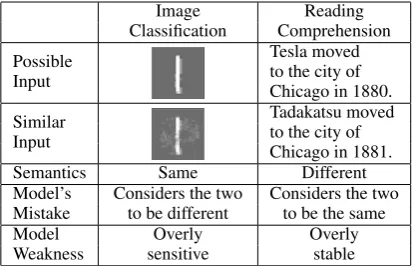
Image Reading Classification Comprehension Possible
Input
Tesla moved to the city of Chicago in 1880. Similar
Input
Tadakatsu moved to the city of Chicago in 1881.
Semantics Same Different
Model’s Considers the two Considers the two Mistake to be different to be the same
Model Overly Overly
Weakness sensitive stable
Table 1: Adversarial examples in computer vi-sion exploit model oversensitivity to small per-turbations. In contrast, our adversarial examples work because models do not realize that a small perturbation can completely change the meaning of a sentence. Images fromSzegedy et al.(2014).
the fraction over which the model isrobustly cor-rect, even in the face of adversarially-chosen alter-ations. For this quantity to be meaningful, the ad-versary must satisfy two basic requirements: first, it should always generate(p0, q0, a0)tuples that are
valid—a human would judgea0 as the correct
an-swer toq0 givenp0. Second, (p0, q0, a0)should be
somehow “close” to the original example(p, q, a).
3.2 Semantics-preserving Adversaries
In image classification, adversarial examples are commonly generated by adding an imperceptible amount of noise to the input (Szegedy et al.,2014; Goodfellow et al.,2015). These perturbations do not change the semantics of the image, but they can change the predictions of models that are over-sensitive to semantics-preserving changes. For language, the direct analogue would be to para-phrase the input (Madnani and Dorr,2010). How-ever, high-precision paraphrase generation is chal-lenging, as most edits to a sentence do actually change its meaning.
3.3 Concatenative Adversaries
Instead of relying on paraphrasing, we use pertur-bations that do alter semantics to build concatena-tive adversaries, which generate examples of the form (p+s, q, a) for some sentence s. In other words, concatenative adversaries add a new sen-tence to the end of the paragraph, and leave the question and answer unchanged. Valid adversarial examples are precisely those for whichsdoes not contradict the correct answer; we refer to such sen-tences as beingcompatiblewith(p, q, a). We use
semantics-altering perturbations to that ensure that s is compatible, even though it may have many words in common with the question q. Existing models are bad at distinguishing these sentences from sentences that do in fact address the question, indicating that they suffer not from oversensitivity but fromoverstabilityto semantics-altering edits. Table1summarizes this important distinction.
The decision to always appendsto the end of p is somewhat arbitrary; we could also prepend it to the beginning, though this would violate the expectation of the first sentence being a topic sen-tence. Both are more likely to preserve the validity of the example than insertingsin the middle ofp, which runs the risk of breaking coreference links.
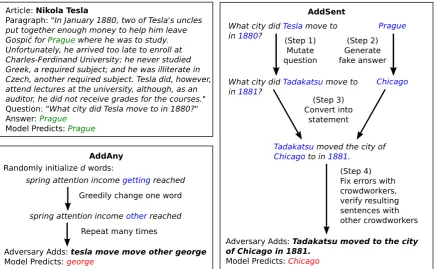
Now, we describe two concrete concatenative adversaries, as well as two variants. ADDSENT, our main adversary, adds grammatical sentences that look similar to the question. In contrast, ADDANY adds arbitrary sequences of English words, giving it more power to confuse models. Figure2illustrates these two main adversaries. 3.3.1 ADDSENT
ADDSENT uses a four-step procedure to generate sentences that look similar to the question, but do not actually contradict the correct answer. Refer to Figure2for an illustration of these steps.
In Step 1, we apply semantics-altering perturba-tions to the question, in order to guarantee that the resulting adversarial sentence is compatible. We replace nouns and adjectives with antonyms from WordNet (Fellbaum,1998), and change named en-tities and numbers to the nearest word in GloVe word vector space2(Pennington et al.,2014) with the same part of speech.3If no words are changed during this step, the adversary gives up and im-mediately returns the original example. For exam-ple, given the question “What ABC division han-dles domestic television distribution?”, we would change “ABC” to “NBC” (a nearby word in vec-tor space) and “domestic” to “foreign” (a WordNet antonym), resulting in the question, “What NBC division handles foreign television distribution?”
In Step 2, we create a fake answer that has the same “type” as the original answer. We define a set 2 We use 100-dimensional GloVe vectors trained on Wikipedia and Euclidean distance to define nearby words.
[image:3.595.78.286.62.195.2]Article: Nikola Tesla
Paragraph: "In January 1880, two of Tesla's uncles put together enough money to help him leave Gospić for Prague where he was to study. Unfortunately, he arrived too late to enroll at Charles-Ferdinand University; he never studied Greek, a required subject; and he was illiterate in Czech, another required subject. Tesla did, however, attend lectures at the university, although, as an auditor, he did not receive grades for the courses." Question: "What city did Tesla move to in 1880?" Answer: Prague
Model Predicts: Prague
Tadakatsu moved the city of
Chicago to in 1881.
Chicago
What city did Tesla move to in 1880?
What city did Tadakatsu move to in 1881?
Prague
Adversary Adds: Tadakatsu moved to the city of Chicago in 1881.
Model Predicts: Chicago
(Step 1) Mutate question
(Step 3) Convert into
statement
(Step 4) Fix errors with crowdworkers, verify resulting sentences with other crowdworkers
AddSent
spring attention income getting reached
spring attention income other reached
Adversary Adds: tesla move move other george
Model Predicts: george
Repeat many times Randomly initialize d words:
AddAny
Greedily change one word
[image:4.595.82.518.61.330.2](Step 2) Generate fake answer
Figure 2: An illustration of the ADDSENTand ADDANYadversaries.
of26types, corresponding to NER and POS tags from Stanford CoreNLP (Manning et al., 2014), plus a few custom categories (e.g., abbreviations), and manually associate a fake answer with each type. Given the original answer to a question, we compute its type and return the corresponding fake answer. In our running example, the correct an-swer was not tagged as a named entity, and has the POS tag NNP, which corresponds to the fake answer “Central Park.”
In Step 3, we combine the altered question and fake answer into declarative form, using a set of roughly50manually-defined rules over CoreNLP constituency parses. For example, “What ABC di-vision handles domestic teledi-vision distribution?” triggers a rule that converts questions of the form “what/which NP1 VP1 ?” to “The NP1 of
[Answer] VP1”. After incorporating the
alter-ations and fake answer from the previous steps, we generate the sentence, “The NBC division of Cen-tral Park handles foreign television distribution.”
The raw sentences generated by Step 3 can be ungrammatical or otherwise unnatural due to the incompleteness of our rules and errors in con-stituency parsing. Therefore, in Step 4, we fix er-rors in these sentences via crowdsourcing. Each sentence is edited independently by five workers on Amazon Mechanical Turk, resulting in up to
five sentences for each raw sentence. Three addi-tional crowdworkers then filter out sentences that are ungrammatical or incompatible, resulting in a smaller (possibly empty) set of human-approved sentences. The full ADDSENTadversary runs the modelf as a black box on every human-approved sentence, and picks the one that makes the model give the worst answer. If there are no human-approved sentences, the adversary simply returns the original example.
A model-independent adversary. ADDSENT requires a small number of queries to the model under evaluation. To explore the possibility of an adversary that is completely model-independent, we also introduce ADDONESENT, which adds a random human-approved sentence to the para-graph. In contrast with prior work in computer vision (Papernot et al., 2017; Narodytska and Kasiviswanathan, 2016;Moosavi-Dezfooli et al., 2017), ADDONESENTdoes not require any access to the model or to any training data: it generates adversarial examples based solely on the intuition that existing models are overly stable.
3.3.2 ADDANY
sentence s = w1w2. . . wd. Figure 2 shows an example of ADDANY withd = 5 words; in our experiments, we used= 10.
We first initialize words w1, . . . , wd randomly from a list of common English words.4 Then, we run6epochs of local search, each of which iterates over the indicesi∈ {1, . . . , d}in a random order. For eachi, we randomly generate a set of candi-date words W as the union of20 randomly sam-pled common words and all words inq. For each x∈W, we generate the sentence withxin thei-th position andwj in thej-th position for eachj6=i. We try adding each sentence to the paragraph and query the model for its predicted probability distri-bution over answers. We updatewito be thexthat minimizes the expected value of the F1 score over the model’s output distribution. We return imme-diately if the model’s argmax prediction has0F1 score. If we do not stop after 3 epochs, we ran-domly initialize4additional word sequences, and search over all of these random initializations in parallel.
ADDANYrequires significantly more model ac-cess than ADDSENT: not only does it query the model many times during the search process, but it also assumes that the model returns a probabil-ity distribution over answers, instead of just a sin-gle prediction. Without this assumption, we would have to rely on something like the F1 score of the argmax prediction, which is piecewise constant and therefore harder to optimize. “Probabilistic” query access is still weaker than access to gradi-ents, as is common in computer vision (Szegedy et al.,2014;Goodfellow et al.,2015).
We do not do anything to ensure that the sen-tences generated by this search procedure do not contradict the original answer. In practice, the generated “sentences” are gibberish that use many question words but have no semantic content (see Figure2for an example).
Finally, we note that both ADDSENT and ADDANYtry to incorporate words from the ques-tion into their adversarial sentences. While this is an obvious way to draw the model’s attention, we were curious if we could also distract the model without such a straightforward approach. To this end, we introduce a variant of ADDANY called ADDCOMMON, which is exactly like ADDANY except it only adds common words.
4 We define common words as the1000most frequent words in the Brown corpus (Francis and Kucera,1979).
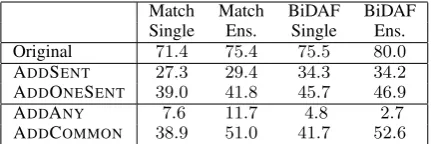
Match Match BiDAF BiDAF Single Ens. Single Ens. Original 71.4 75.4 75.5 80.0 ADDSENT 27.3 29.4 34.3 34.2 ADDONESENT 39.0 41.8 45.7 46.9
ADDANY 7.6 11.7 4.8 2.7
[image:5.595.309.525.62.134.2]ADDCOMMON 38.9 51.0 41.7 52.6 Table 2: Adversarial evaluation on the Match-LSTM and BiDAF systems. All four systems can be fooled by adversarial examples.
Model Original ADDSENT ADDONESENT
ReasoNet-E 81.1 39.4 49.8
SEDT-E 80.1 35.0 46.5
BiDAF-E 80.0 34.2 46.9
Mnemonic-E 79.1 46.2 55.3
Ruminating 78.8 37.4 47.7
jNet 78.6 37.9 47.0
Mnemonic-S 78.5 46.6 56.0
ReasoNet-S 78.2 39.4 50.3
MPCM-S 77.0 40.3 50.0
SEDT-S 76.9 33.9 44.8
RaSOR 76.2 39.5 49.5
BiDAF-S 75.5 34.3 45.7
Match-E 75.4 29.4 41.8
Match-S 71.4 27.3 39.0
DCR 69.3 37.8 45.1
Logistic 50.4 23.2 30.4 Table 3: ADDSENTand ADDONESENTon all six-teen models, sorted by F1 score the original exam-ples. S = single, E = ensemble.
4 Experiments
4.1 Setup
For all experiments, we measure adversarial F1 score (Rajpurkar et al., 2016) across 1000 ran-domly sampled examples from the SQuAD devel-opment set (the test set is not publicly available). Downsampling was helpful because ADDANY and ADDCOMMONcan issue thousands of model queries per example, making them very slow. As the effect sizes we measure are large, this down-sampling does not hurt statistical significance.
4.2 Main Experiments
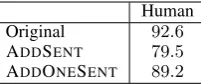
aver-Human Original 92.6 ADDSENT 79.5
[image:6.595.131.232.62.104.2]ADDONESENT 89.2
Table 4: Human evaulation on adversarial exam-ples. Human accuracy drops on ADDSENTmostly due to unrelated errors; the ADDONESENT num-bers show that humans are robust to adversarial sentences.
age F1 score to fall to46.1%, despite only adding common words.
We also verified that our adversaries were gen-eral enough to fool models that we did not use dur-ing development. We ran ADDSENT on twelve published models for which we found publicly available test-time code; we did not run ADDANY on these models, as not all models exposed out-put distributions. As seen in Table 3, no model was robust to adversarial evaluation; across the sixteen total models tested, average F1 score fell from75.4%to36.4%under ADDSENT.
It is noteworthy that the Mnemonic Reader models (Hu et al., 2017) outperform the other models by about6F1 points. We hypothesize that Mnemonic Reader’s self-alignment layer, which helps model long-distance relationships between parts of the paragraph, makes it better at locating all pieces of evidence that support the correct an-swer. Therefore, it can be more confident in the correct answer, compared to the fake answer in-serted by the adversary.
4.3 Human Evaluation
To ensure our results are valid, we verified that humans are not also fooled by our adversarial ex-amples. As ADDANY requires too many model queries to run against humans, we focused on ADDSENT. We presented each original and ad-versarial paragraph-question pair to three crowd-workers, and asked them to select the correct an-swer by copy-and-pasting from the paragraph. We then took a majority vote over the three responses (if all three responses were different, we picked one at random). These results are shown in Ta-ble 4. On original examples, our humans are actually slightly better than the reported number of 91.2 F1 on the entire development set. On ADDSENT, human accuracy drops by 13.1 F1 points, much less than the computer systems.
Moreover, much of this decrease can be ex-plained by mistakes unrelated to our adversarial
sentences. Recall that ADDSENT picks the worst case over up to five different paragraph-question pairs. Even if we showed the same original exam-ple to five sets of three crowdworkers, chances are that at least one of the five groups would make a mistake, just because humans naturally err. There-fore, it is more meaningful to evaluate humans on ADDONESENT, on which their accuracy drops by only3.4F1 points.
4.4 Analysis
Next, we sought to better understand the behavior of our four main models under adversarial evalua-tion. To highlight errors caused by the adversary, we focused on examples where the model origi-nally predicted the (exact) correct answer. We di-vided this set into “model successes”—examples where the model continued being correct during adversarial evaluation—and “model failures”— examples where the model gave a wrong answer during adversarial evaluation.
4.4.1 Manual verification
First, we verified that the sentences added by ADDSENT are actually grammatical and compat-ible. We manually checked 100 randomly cho-sen BiDAF Ensemble failures. We found only one where the sentence could be interpreted as an-swering the question: in this case, ADDSENT re-placed the word “Muslim” with the related word “Islamic”, so the resulting adversarial sentence still contradicted the correct answer. Addition-ally, we found 7 minor grammar errors, such as subject-verb disagreement (e.g., “The Alaskan Archipelagoaremade up almost entirely of ham-sters.”) and misuse of function words (e.g., “The gasofnitrogen makes up 21.8 % oftheMars’s at-mosphere.”), but no errors that materially impeded understanding of the sentence.
We also verified compatibility for ADDANY. We found no violations out of100randomly cho-sen BiDAF Ensemble failures.
4.4.2 Error analysis
29words—the length of the longest answer in the SQuAD development set—on5.0%of model fail-ures; for BiDAF Ensemble, this number was1.6%. Since the BiDAF models independently predict the start and end positions of the answer, they can predict very long spans when the end pointer is in-fluenced by the adversarial sentence, but the start pointer is not. Match-LSTM has a similar struc-ture, but also has a hard-coded rule that stops it from predicting very long answers.
We also analyzed human failures—examples where the humans were correct originally, but wrong during adversarial evaluation. Humans predicted from the adversarial sentence on only
27.3% of these error cases, which confirms that many errors are normal mistakes unrelated to ad-versarial sentences.
4.4.3 Categorizing ADDSENTsentences We then manually examined sentences generated by ADDSENT. In 100 BiDAF Ensemble fail-ures, we found 75 cases where an entity name was changed in the adversarial sentence,17cases where numbers or dates were changed, and 33
cases where an antonym of a question word was used.5 Additionally, 7 sentences had other mis-cellaneous perturbations made by crowdworkers during Step 4 of ADDSENT. For example, on a question about the “Kalven Report”, the adver-sarial sentence discussed “The statement Kalven cited” instead; in another case, the question, “How does Kenya curb corruption?” was met by the unhelpful sentence, “Tanzania is curbing corrup-tion” (the model simply answered, “corrupcorrup-tion”). 4.4.4 Reasons for model successes
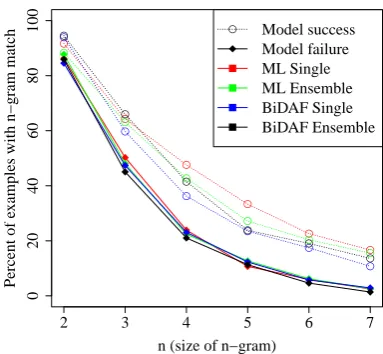
Finally, we sought to understand the factors that influence whether the model will be robust to ad-versarial perturbations on a particular example. First, we found that models do well when the ques-tion has an exactn-gram match with the original paragraph. Figure 3 plots the fraction of exam-ples for which ann-gram in the question appears verbatim in the original passage; this is much higher for model successes. For example, 41.5%
of BiDAF Ensemble successes had a 4-gram in common with the original paragraph, compared to only21.0%of model failures.
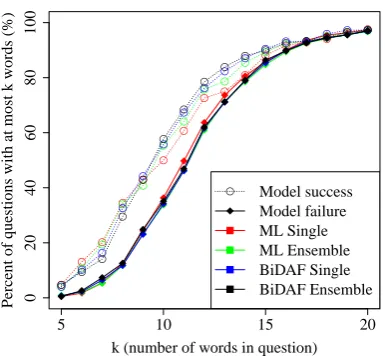
We also found that models succeeded more of-ten on short questions. Figure 4 shows the dis-5These numbers add up to more than100because more than one word can be altered per example.
2 3 4 5 6 7
0
20
40
60
80
100
n (size of n−gram)
Percent of e
xamples with n−gram match
●
●
●
●
● ●
●
●
●
● ●
● ●
●
●
● ●
●
●
●
●
● ●
● ● Model success
[image:7.595.312.504.60.237.2]Model failure ML Single ML Ensemble BiDAF Single BiDAF Ensemble
Figure 3: Fraction of model successes and fail-ures on ADDSENT for which the question has an exact n-gram match with the original paragraph. For each model and each value ofn, successes are more likely to have ann-gram match than failures.
Model under Evaluation Targeted Model SingleML Ens.ML BiDAFSingle BiDAFEns. ADDSENT
ML Single 27.3 33.4 40.3 39.1 ML Ens. 31.6 29.4 40.2 38.7 BiDAF Single 32.7 34.8 34.3 37.4 BiDAF Ens. 32.7 34.2 38.3 34.2 ADDANY
ML Single 7.6 54.1 57.1 60.9 ML Ens. 44.9 11.7 50.4 54.8 BiDAF Single 58.4 60.5 4.8 46.4 BiDAF Ens. 48.8 51.1 25.0 2.7 Table 5: Transferability of adversarial examples across models. Each row measures performance on adversarial examples generated to target one particular model; each column evaluates one (pos-sibly different) model on these examples.
[image:7.595.311.521.342.477.2]5 10 15 20
0
20
40
60
80
100
k (number of words in question)
Percent of questions with at most k w
ords (%)
● ●
● ●
● ●
● ● ●
● ● ●
● ● ● ●
● ●
● ●
● ●
● ● ●
● ● ●
● ● ● ●
● ●
● ●
● ●
● ●
● ● ●
● ● ● ● ●
● ●
● ●
● ●
● ●
● ● ●
● ● ● ● ●
● Model success
Model failure ML Single ML Ensemble BiDAF Single BiDAF Ensemble
Figure 4: For model successes and failures on ADDSENT, the cumulative distribution function of the number of words in the question (for eachk, what fraction of questions have≤kwords). Suc-cesses are more likely to involve short questions.
4.5 Transferability across Models
In computer vision, adversarial examples that fool one model also tend to fool other models (Szegedy et al., 2014; Moosavi-Dezfooli et al., 2017); we investigate whether the same pattern holds for us. Examples from ADDONESENTclearly do transfer across models, since ADDONESENT always adds the same adversarial sentence regardless of model. Table 5 shows the results of evaluating the four main models on adversarial examples gen-erated by running either ADDSENT or ADDANY against each model. ADDSENT adversarial ex-amples transfer between models quite effectively; in particular, they are harder than ADDONESENT examples, which implies that examples that fool one model are more likely to fool other mod-els. The ADDANYadversarial examples exhibited more limited transferability between models. For both ADDSENT and ADDANY, examples trans-ferred slightly better between single and ensemble versions of the same model.
4.6 Training on Adversarial Examples Finally, we tried training on adversarial examples, to see if existing models can learn to become more robust. Due to the prohibitive cost of running ADDSENTor ADDANYon the entire training set, we instead ran only Steps 1-3 of ADDSENT (ev-erything except crowdsourcing) to generate a raw adversarial sentence for each training example. We then trained the BiDAF model from scratch on
Training data Test data Original Augmented Original 75.8 75.1 ADDSENT 34.8 70.4 ADDSENTMOD 34.3 39.2
Table 6: Effect of training the BiDAF Single model on the original training data alone (first column) versus augmenting the data with raw ADDSENTexamples (second column).
the union of these examples and the original train-ing data. As a control, we also trained a second BiDAF model on the original training data alone.6 The results of evaluating these models are shown in Table6. At first glance, training on ad-versarial data seems effective, as it largely protects against ADDSENT. However, further investigation shows that training on these examples has only limited utility. To demonstrate this, we created a variant of ADDSENT called ADDSENTMOD, which differs from ADDSENT in two ways: it uses a different set of fake answers (e.g.,PERSON named entities map to “Charles Babbage” instead of “Jeff Dean”), and it prepends the adversarial sentence to the beginning of the paragraph in-stead of appending it to the end. The retrained model does almost as badly as the original one on ADDSENTMOD, suggesting that it has just learned to ignore the last sentence and reject the fake an-swers that ADDSENT usually proposed. In order for training on adversarial examples to actually improve the model, more care must be taken to ensure that the model cannot overfit the adversary.
5 Discussion and Related Work
Despite appearing successful by standard evalu-ation metrics, existing machine learning systems for reading comprehension perform poorly un-der adversarial evaluation. Standard evaluation is overly lenient on models that rely on superficial cues. In contrast, adversarial evaluation reveals that existing models are overly stable to perturba-tions that alter semantics.
To optimize adversarial evaluation metrics, we may need new strategies for training models. For certain classes of models and adversaries, efficient training strategies exist: for example, Globerson and Roweis (2006) train classifiers that are opti-mally robust to adversarial feature deletion. Ad-6 All previous experiments used parameters released by
[image:8.595.78.271.59.237.2] [image:8.595.330.502.61.113.2]versarial training (Goodfellow et al.,2015) can be used for any model trained with stochastic gra-dient descent, but it requires generating new ad-versarial examples at every iteration; this is fea-sible for images, where fast gradient-based adver-saries exist, but is infeasible for domains where only slower adversaries are available.
We contrast adversarial evaluation, as studied in this work, withgenerative adversarial models. While related in name, the two have very different goals. Generative adversarial models pit a gen-erative model, whose goal is to generate realis-tic outputs, against a discriminative model, whose goal is to distinguish the generator’s outputs from real data (Smith, 2012;Goodfellow et al.,2014). Bowman et al. (2016) and Li et al. (2017) used such a setup for sentence and dialogue generation, respectively. Our setup also involves a genera-tor and a discriminagenera-tor in an adversarial relation-ship; however, our discriminative system is tasked with finding the right answer, not distinguishing the generated examples from real ones, and our goal is to evaluate the discriminative system, not to train the generative one.
While we use adversaries as a way to evalu-ate language understanding, robustness to adver-sarial attacks may also be its own goal for tasks such as spam detection.Dalvi et al.(2004) formu-lated such tasks as a game between a classifier and an adversary, and analyzed optimal strategies for each player. Lowd and Meek(2005) described an efficient attack by which an adversary can reverse-engineer the weights of a linear classifier, in or-der to then generate adversarial inputs. In contrast with these methods, we do not make strong struc-tural assumptions about our classifiers.
Other work has proposed harder test datasets for various tasks. Levesque(2013) proposed the Winograd Schema challenge, in which comput-ers must resolve coreference resolution problems that were handcrafted to require extensive world knowledge. Paperno et al.(2016) constructed the LAMBADA dataset, which tests the ability of lan-guage models to handle long-range dependencies. Their method relies on the availability of a large initial dataset, from which they distill a difficult subset; such initial data may be unavailable for many tasks. Rimell et al. (2009) showed that de-pendency parsers that seem very accurate by stan-dard metrics perform poorly on a subset of the test data that has unbounded dependency
construc-tions. Such evaluation schemes can only test mod-els on phenomena that are moderately frequent in the test distribution; by perturbing test examples, we can introduce out-of-distribution phenomena while still leveraging prior data collection efforts.
While concatenative adversaries are well-suited to reading comprehension, other adversarial meth-ods may prove more effective on other tasks. As discussed previously, paraphrase generation sys-tems (Madnani and Dorr,2010) could be used for adversarial evaluation on a wide range of language tasks. Building on our intuition that existing mod-els are overly stable, we could apply meaning-altering perturbations to inputs on tasks like ma-chine translation, and adversarially choose ones for which the model’s output doesnotchange. We could also adversarially generate new examples by combining multiple existing ones, in the spirit of Data Recombination (Jia and Liang, 2016). The Build It, Break It shared task (Bender et al., 2017) encourages researchers to adversarially de-sign minimal pairs to fool sentiment analysis and semantic role labeling systems.
Progress on building systems that truly under-stand language is only possible if our evaluation metrics can distinguish real intelligent behavior from shallow pattern matching. To this end, we have released scripts to run ADDSENT on any SQuAD system, as well as code for ADDANY. We hope that our work will motivate the development of more sophisticated models that understand lan-guage at a deeper level.
Acknowledgments. We thank Pranav Rajpurkar for his help with various SQuAD models. This work was supported by the NSF Graduate Re-search Fellowship under Grant No. DGE-114747, and funding from Facebook AI Research and Mi-crosoft.
Reproducibility. All code, data, and
experiments for this paper are
avail-able on the CodaLab platform at https: //worksheets.codalab.org/worksheets/ 0xc86d3ebe69a3427d91f9aaa63f7d1e7d/.
References
E. M. Bender, H. Daume III, A. Ettinger, H. Kannan, S. Rao, and E. Rothschild. 2017. Build it, break it: The language edition. https://bibinlp. umiacs.umd.edu/.
R. Jozefowicz, and S. Bengio. 2016. Generating sentences from a continuous space. In Computa-tional Natural Language Learning (CoNLL).
N. Dalvi, P. Domingos, Mausam, S. Sanghai, and D. Verma. 2004. Adversarial classification. In Inter-national Conference on Knowledge Discovery and Data Mining (KDD).
C. Fellbaum. 1998. WordNet: An Electronic Lexical Database. MIT Press.
W. N. Francis and H. Kucera. 1979. Brown Corpus Manual.
A. Globerson and S. Roweis. 2006. Nightmare at test time: robust learning by feature deletion. In Inter-national Conference on Machine Learning (ICML), pages 353–360.
Y. Gong and S. R. Bowman. 2017. Ruminating reader: Reasoning with gated multi-hop attention. arXiv.
I. J. Goodfellow, J. Pouget-Abadie, M. Mirza, B. Xu, D. Warde-Farley, S. Ozair, A. Courville, and Y. Ben-gio. 2014. Generative adversarial nets. InAdvances in Neural Information Processing Systems (NIPS).
I. J. Goodfellow, J. Shlens, and C. Szegedy. 2015. Ex-plaining and harnessing adversarial examples. In
International Conference on Learning Representa-tions (ICLR).
M. Hu, Y. Peng, and X. Qiu. 2017. Mnemonic reader for machine comprehension.arXiv.
R. Jia and P. Liang. 2016. Data recombination for neu-ral semantic parsing. InAssociation for Computa-tional Linguistics (ACL).
K. Lee, S. Salant, T. Kwiatkowski, A. Parikh, D. Das, and J. Berant. 2017. Learning recurrent span repre-sentations for extractive question answering. arXiv.
H. J. Levesque. 2013. On our best behaviour. In Inter-national Joint Conference on Artificial Intelligence (IJCAI).
J. Li, W. Monroe, T. Shi, A. Ritter, and D. Jurafsky. 2017. Adversarial learning for neural dialogue gen-eration. arXiv preprint arXiv:1701.06547.
R. Liu, J. Hu, W. Wei, Z. Yang, and E. Nyberg. 2017. Structural embedding of syntactic trees for machine comprehension. arXiv.
D. Lowd and C. Meek. 2005. Adversarial learning. In
International Conference on Knowledge Discovery and Data Mining (KDD).
N. Madnani and B. J. Dorr. 2010. Generating phrasal and sentential paraphrases: A survey of data-driven methods. Computational Linguistics, 36(3):341– 387.
C. D. Manning, M. Surdeanu, J. Bauer, J. Finkel, S. J. Bethard, and D. McClosky. 2014. The stanford coreNLP natural language processing toolkit. In
ACL system demonstrations.
M. Marcus, B. Santorini, M. A. Marcinkiewicz, and A. Taylor. 1999. Treebank-3.
S. Moosavi-Dezfooli, A. Fawzi, O. Fawzi, and P. Frossard. 2017. Universal adversarial perturba-tions. InComputer Vision and Pattern Recognition (CVPR).
N. Narodytska and S. P. Kasiviswanathan. 2016. Sim-ple black-box adversarial perturbations for deep net-works. arXiv preprint arXiv:1612.06299.
D. Paperno, G. Kruszewski, A. Lazaridou, Q. N. Pham, R. Bernardi, S. Pezzelle, M. Baroni, G. Boleda, and R. Fernandez. 2016. The LAMBADA dataset: Word prediction requiring a broad discourse context. In
Association for Computational Linguistics (ACL).
N. Papernot, P. McDaniel, I. Goodfellow, S. Jha, Z. Ce-lik, and A. Swami. 2017. Practical black-box attacks against deep learning systems using adversarial ex-amples. InProceedings of the ACM Asia Conference on Computer and Communications Security.
J. Pennington, R. Socher, and C. D. Manning. 2014. Glove: Global vectors for word representation. In
Empirical Methods in Natural Language Processing (EMNLP).
P. Rajpurkar, J. Zhang, K. Lopyrev, and P. Liang. 2016. Squad: 100,000+ questions for machine comprehen-sion of text. InEmpirical Methods in Natural Lan-guage Processing (EMNLP).
L. Rimell, S. Clark, and M. Steedman. 2009. Un-bounded dependency recovery for parser evaluation. InEmpirical Methods in Natural Language Process-ing (EMNLP).
M. Seo, A. Kembhavi, A. Farhadi, and H. Hajishirzi. 2016. Bidirectional attention flow for machine com-prehension. arXiv.
Y. Shen, P. Huang, J. Gao, and W. Chen. 2017. Rea-sonet: Learning to stop reading in machine compre-hension. InInternational Conference on Knowledge Discovery and Data Mining (KDD).
N. A. Smith. 2012. Adversarial evaluation for models of natural language. arXiv preprint arXiv:1207.0245.
C. Szegedy, W. Zaremba, I. Sutskever, J. Bruna, D. Er-han, I. Goodfellow, and R. Fergus. 2014. Intriguing properties of neural networks. InInternational Con-ference on Learning Representations (ICLR). S. Wang and J. Jiang. 2016. Machine
Z. Wang, H. Mi, W. Hamza, and R. Florian. 2016. Multi-perspective context matching for machine comprehension. arXiv.
D. Weissenborn, G. Wiese, and L. Seiffe. 2017. Mak-ing neural qa as simple as possible but not simpler.
arXiv.
Y. Yu, W. Zhang, K. Hasan, M. Yu, B. Xiang, and B. Zhou. 2016. End-to-end answer chunk extraction and ranking for reading comprehension. arXiv. J. Zhang, X. Zhu, Q. Chen, L. Dai, S. Wei, and