Automatic Musical Pattern Feature Extraction
Using Convolutional Neural Network
Tom LH. Li
∗, Antoni B. Chan
∗and Andy HW. Chun
∗Abstract—Music genre classification has been a challenging yet promising task in the field of music information retrieval (MIR). Due to the highly elu-sive characteristics of audio musical data, retrieving informative and reliable features from audio signals is crucial to the performance of any music genre classi-fication system. Previous work on audio music genre classification systems mainly concentrated on using timbral features, which limits the performance. To address this problem, we propose a novel approach to extract musical pattern features in audio music using convolutional neural network (CNN), a model widely adopted in image information retrieval tasks. Our experiments show that CNN has strong capacity to capture informative features from the variations of musical patterns with minimal prior knowledge pro-vided.
Keywords: music feature extractor, music informa-tion retrieval, convoluinforma-tional neural network, multime-dia data mining
1
Introduction
Automatic music genre classification has grown in vast popularity in recent years as a result of the rapid devel-opment of the digital entertainment industry. As a first step of genre classification, feature extraction from musi-cal data will significantly influence the final classification accuracy. The annual international contest Music Infor-mation Retrieval Evaluation eXchange (MIREX) holds regular competitions for audio music genre classification that attracts tens of participating groups each year. Most of the systems rely heavily on timbral, statistical spectral features. Feature sets pertaining to other musicological aspects such as rhythm and pitch are also proposed, but their performance is far less reliable compared with the timbral feature sets. Additionally, there are few feature sets aiming at the variations of musical patterns. The in-adequateness of musical descriptors will certainly impose a constraint on audio music genre classification systems.
In this paper we propose a novel approach to automati-cally retrieve musical pattern features from audio music using convolutional neural network (CNN), a model that
∗Department of Computer Science, City University of Hong
Kong, Kowloon, Hong Kong, Email: [email protected], [email protected], [email protected]
is adopted in image information retrieval tasks. Migrat-ing technologies from another research field brMigrat-ings new opportunities to break through the current bottleneck of music genre classification. The proposed musical pat-tern feature extractor has advantages in several aspects. It requires minimal prior knowledge to build up. Once obtained, the process of feature extraction is highly ef-ficient. These two advantages guarantee the scalability of our feature extractors. Moreover, our musical pattern features are complementary to other main-stream feature sets used in other classification systems. Our experiments show that musical data have very similar characteristics to image data so that the variation of musical patterns can be captured using CNN. We also show that the mu-sical pattern features are informative for genre classifica-tion tasks.
2
Related Works
By the nature of data involved in analysis, the field of mu-sic genre classification is divided to two different scopes: symbolic and audio. Symbolic music genre classification studies songs in their symbolic format, such as MIDI, Mu-sicXML, etc. Various models (Basili et. al. [1], McKay et. al. [2], Ponce et. al. [3]) have been proposed to perform symbolic music genre classification. Feature sets representing instrumentation, musical texture, rhythm, dynamics, pitch statistics, melody, etc. are used as input for a wide variety of generic multi-class classifiers.
• Tzanetakis et. al. [4, 5, 6]: STFT, MFCC, Pitch
Histogram, Rhythm Histogram
• Bergstra et. al. [7]: STFT, RCEPS, MFCC,
Zero-crossing Rate, Spectral summary, LPC.
• Ellis et. al. [8]: MFCC, Chroma
• Lidy et. al. [9, 10]: Rhythm Pattern, Statistical
Spectrum Descriptor, Rhythm Hisitogram, Symbolic Feature from auto-transcribed music.
• Meng et. al. [11]: MFCC, Mean and variance
of MFCC, Filterbank Coefficients, Autoregressive model, Zero-crossing Rate, Short-time Energy Ra-tio.
Most of the proposed systems concentrate only on fea-ture sets extracted from a short window of audio signals, using statistical measurements such as maximum value, average, deviation, etc. Such features are representative of the ”musical texture” of the excerpt concerned, i.e. timbral description. Feature sets concerning other musi-cological aspects such as rhythm and pitch are also pro-posed, but their performance is usually far worse than their timbral counterparts. There are few feature sets which capture the musical variation patterns. Relying only on timbral descriptors would certainly limit the per-formance of genre classification systems; Aucouturier et. al. [12] indicates that a performance bottleneck exists if only timbral feature sets are used.
The dearth of musical pattern features can be ascribed to the elusive characteristics of musical data; it is typ-ically difficult to handcraft musical pattern knowledge into feature extractors, as they require extra efforts to handcraft specific knowledge into their computation pro-cesses, which would limit their scalability. To overcome this problem, we propose a novel approach to automat-ically obtain musical pattern extractors through super-vised learning, migrating a widely adopted technology in image information retrieval. We believe that introduc-ing technology in another field brintroduc-ings new opportunities to break through the current bottleneck of audio genre classificaion.
3
Methodology
In this section, we briefly review the CNN and the pro-posed music genre classification system.
3.1
Convolutional Neural Network
The design of convolutional neural network (CNN) has its origin in the study of biological neural system. The specific method of connections discovered in cats’ visual neurons is responsible for identifying the variations in the topological structure of objects seen [13]. LeCun incor-porate such knowledge in his design of CNN [14] so that
its first few layers serve as feature extractors that would be automatically acquired via supervised training. It is shown from extensive experiments [14] that CNN has con-siderable capacity to capture the topological information in visual objects.
There are few applications of CNN in audio analysis de-spite its successes in vision research. The core objective of this paper is to examine and evaluate the possibilies extending the application of CNN to music information retrieval. The evaluation can be further decomposed into the following hypotheses:
• The variations of musical patterns (after a certain
form of transform, such as FFT, MFCC) is similar to those in images and therefore can be extracted with CNN.
• The musical pattern descriptors extracted with CNN
are informative for distinguishing musical genres.
In the latter part of this paper, evidence supporting these two hypotheses will be provided.
3.2
CNN Architecture for Audio
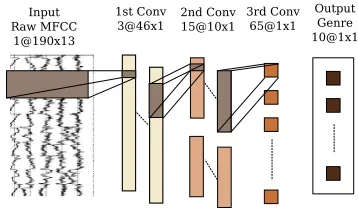
Input Raw MFCC 1@190x13
1st Conv 3@46x1
2nd Conv 15@10x1
3rd Conv 65@1x1
[image:2.595.337.516.377.485.2]Output Genre 10@1x1
Figure 1: CNN to extract musical patterns in MFCC
Figure 1 shows the architecture of our CNN model. There are five layers in total, including the input and output lay-ers. The first layer is a 190×13 map, which hosts the
13 MFCCs from 190 adjacent frames of one excerpt. The second layer is a convolutional layer of 3 different kernels of equal size. During convolution, the kernel surveys a fixed 10×13 region in the previous layer, multiplying the
input value with its associate weight in the kernel, adding the kernel bias and passing the squashing function. The result is saved and used as the input to the next convo-lutional layer. After each convolution, the kernel hops 4 steps forward along the input as a process of subsam-pling. The 3rd and 4th layer function very similarly to the 2nd layer, with 15 and 65 feature maps respectively. Their kernel size is 10×1 and their hop size is 4. Each
It can be observed from the topology of CNN that the model is a multi-layer neural network with special con-straints on the connections in the convolutional layers, so that each artificial neuron only concentrates on a small region of input, just like the receptive field of one bio-logical neuron. Because the kernel is shared across one feature map, it becomes a pattern detector that would acquire high activation when a certain pattern is shown in the input. In our experimental setting, each MFCC frame spans 23ms on the audio signal with 50% overlap with the adjacent frames. Therefore the first convolu-tional layer (2nd layer) detects basic musical patterns ap-pear in 127ms. Subsequent convolutional layers therefore capture musical patterns in windows size of 541ms and 2.2s, respectively. The CNN is trained using the stochas-tic gradient descent algorithm [15]. After convergence, the values in the intermediate convolutional layers can be exported as the features of the corresponding musical excerpt.
The model we use is a modified CNN model presented in [16]. Compared with the traditonal CNN model, we ob-served that the training is easier, and the capacity loss is negligible. In return, as much as66.8%of computational requirement is saved.
3.3
Music Genre Classification
Songs
MFCC Extraction
and Segmentation
Trained Musical Pattern Extractors
Generic Classifiers & Majority Voting
Genre Conv.
Neural Network
[image:3.595.311.527.250.459.2]Musical Pattern Extractors
Figure 2: Overview of the classification system
Figure 2 shows the overview of our classification system. The first step of the process is MFCC extraction from audio signals. MFCC is an efficient and highly informa-tive feature set that has been widely adopted for audio analysis since its proposal. After MFCC extraction, the input song is transformed into an MFCC map with 13 pixels wide which is then segmented to fit the input size of CNN. Provided the song label, the musical pattern ex-tractors are automatically aquired via supervised learn-ing. Those extractors are used to retrieve high-order, pattern-related features which will later serve as the in-put of generic, multi-class classifiers such as Decision Tree Classifiers, Support Vector Machine etc. After classifica-tion of each song segments, the result is aggregated in a majority voting process to produce the song-level label.
4
Results and Analysis
4.1
Dataset
The dataset of our experiment is the GTZAN dataset which has been used to evaluate various genre classi-fication systems [4, 7, 10]. It contains 1000 song ex-cerpts of 30 seconds, sampling rate 22050 Hz at 16 bit. Its songs are distributed evenly into 10 different genres: Blues, Classical, Country, Disco, Hiphop, Jazz, Metal, Pop, Reggae and Rock.
4.2
CNN Pattern Extractor
0 50 100 150 200
0.1 0.2 0.3 0.4 0.5 0.6 0.7 0.8 0.9
epoch
training error rate
3−genre 4−genre 5−genre 6−genre
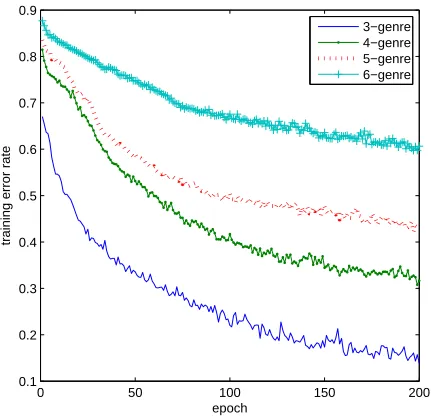
Figure 3: Convergence Curve in 200-epoch training
Figure 3 shows the convergence of the training error rate of our CNN model, on four sub-datasets extracted from the GTZAN dataset. The smallest dataset contains 3 genres: Classical, Jazz and Rock. The latter datasets in-crease in size as Disco, Pop and Blues genres are added. From the figure we can observe that the trend of conver-gence over different datasets is similar, however the train-ing on a 3-genre dataset converges much faster than the training on a 6-genre dataset. This shows the difficulty in training CNN increases drastically when the number of genres involved in training increases. We believe this is because the CNN gets confused with the complexity of the training data and therefore never obtains suitable pattern extractors in the first few layers. Additionally we also found that the combination of genres in the 3-genre subset will not affect the training of CNN. All combina-tions have very similar curve of convergence.
[image:3.595.62.278.449.529.2]gen-res, while one model is deliberately chosen to train on the 3 most difficult-to-classify genres shown in [4], i.e. Blues, Metal and Rock. Dividing the dataset into small subsets to train the CNN feature extractors may have the side-effect that features extracted to classify songs within one subset may not be effective in intersubset classifica-tion, and therefore it may seem more reasonable to select three 4-genre models instead of four 3-genre models. We observe from our experiments that such alternative is un-necessary since features extracted from individual subsets possess a good capacity for intersubset distinction. Ad-ditionally, we also observe that the training of 4-genre subsets is far less effective and less efficient compared with training of 3-genre subsets.
Extensive experiments are also performed towards the se-lection of CNN network parameters. First is the network layer number. We discover that CNN with more than 3 convolutional layers is exceptionally difficult to train for the network convergence will easily get trapped in lo-cal minimas. On the other hand, CNNs with less than 3 convolutional layers do not have sufficient capacity for music classification. The convolution/subsampling size is set at 10/4 for similar criteria. Larger convolutional sizes are difficult to train, while smaller ones are sub-jected to capacity limitation. To determine the feature map numbers in the three convolutional layers, we first set the three parameters sufficiently large, then watch the performance of CNN as we gradually reduce the number. We discover that 3, 15 and 65 is the optimal feature map numbers for the first three convolutional layers. Reduc-ing them further will drastically constrain the capacity of CNN feature extractors.
4.3
Evaluation
After obtaining 4 CNNs as described above, we apply the feature extractors on the full dataset to retrieve mu-sical pattern features. We deliberately reserve 20% songs in the training of CNN as to examine the ability of our feature extractors on unseen musical data. The musi-cal pattern features are evaluated using various models in the WEKA machine learning system [17]. We dis-cover that the features scored very well in the 10-genre training evaluation, using a variety of tree classifiers such as J48, Attribute Selected Classifier, etc. The classifi-cation accuracy is 84% before the majority voting, and gets even higher afterwards. Additionally, musical ex-cerpts not used in CNN training have minor difference in classification rate compared with excerpts used to train CNNs. This provides evidence to support our hypothesis in Section 3 that the variations of musical patterns in the form of MFCC is similar to those of image so that CNN can be used to automatically extract them. In addition, those patterns provide useful information to distinguish musical genres.
However, further experiments on the splitted test dataset
give very poor performance compared with the training evaluation; the accuracy of below 30% is therefore too low to make any reliable judgements. It reveals that our cur-rent musical pattern extraction model has the deficiency in generalizing the musical patterns learnt to unseen mu-sical data. We further study such phenomenon and found that the reason is two-fold: 1. Musical data is typically aboundant in its variation, and therefore it is hardly suf-ficient for 80 songs to represent all types of variations in one specific genre; 2. The MFCC feature is sensitive to the timbral, temple and key variation of music which further accentuates the shortage in training data.
One practical solution to these problems above is to en-large the training dataset by adding affine transforms of songs, such as key elevation/lowering, slight tempo shift, etc. Additional data smooths the variation within one genre and boosts the overall generalizability. Similar work can be found in [16]. Alternatively, the MFCC fea-ture input can be replaced with transforms insensitive to timbral, tempo and key variation, such as mel-frequency spectrum or chroma feature [8].
Our method on musical pattern extractor can be com-pared with the work in [18], which also applies an image model to audio music genre classification. It is shown that our system possesses better scalability. The texture-of-texture model used in [18] is so highly computational intensive that the authors reduce the training set to 17 songs each category. In comparison our CNN takes less than two hours to obtain feature extractors from a 3-genre, 240-song training set. The efficiency of process can be raised further with parallel computing on differ-ent combination of genres.
5
Conclusions and Future Work
In this paper we presented a methodology to automati-cally extract musical patterns features from audio music. Using the CNN migrated from the the image information retrieval field, our feature extractors need minimal prior knowledge to construct. Our experiments show that CNN is a viable alternative for automatic feature extraction. Such discovery lends support to our hypothesis that the intrinsic characteristics in the variation of musical data are similar to those of image data. Our CNN model is highly scalable. We also presented our discovery of the optimal parameter set and best practice using CNN on audio music genre classification.
References
[1] Basili, R. and Serafini, A. and Stellato, A. Classifica-tion of musical genre: a machine learning approach
Proceedings of ISMIR2004
[2] McKay, C. and Fujinaga, I. Classification of musical genre: a machine learning approach Proceedings of ISMIR 2004
[3] de Le´on, P.J.P. and Inesta, J.M., I. Musical style identification using self-organising mapsWeb Deliv-ering of Music, 2002. WEDELMUSIC 2002. Pro-ceedings. Second International Conference on p82– 89 2002
[4] Tzanetakis, G. and Cook, P. Musical genre classifi-cation of audio signals,IEEE Transactions on speech and audio processing Volume 10, Number 5, p293– 302, 2002
[5] Li, T. and Tzanetakis, G. Factors in automatic mu-sical genre classification of audio signalsIEEE WAS-PAA, p143–146, 2003
[6] Lippens, S. and Martens, J.P. and De Mulder, T. and Tzanetakis, G. A comparison of human and au-tomatic musical genre classification IEEE Interna-tional Conference on Acoustics, Speech, and Signal Processing, Volume 4, p233–236, 2004
[7] Bergstra, J. and Casagrande, N. and Erhan, D. and Eck, D. and K´egl, B. Aggregate features and Ad-aBoost for music classification Machine Learning, Volume 65, Number 2, p473–484, 2006
[8] Ellis, D.P.W. Classifying music audio with timbral and chroma featuresDins Proc. ISMIR 2007
[9] Lidy, T. and Rauber, A. Evaluation of feature extractors and psycho-acoustic transformations for music genre classificationProceedings of the 6th In-ternational Conference on Music Information Re-trieval (ISMIR05) p34–41
[10] Lidy, T. and Rauber, A. and Pertusa, A. and Inesta, J.M. Improving genre classification by combination of audio and symbolic descriptors using a transcrip-tion systemProc. ISMIR, Vienna, Austria 2007
[11] Anders Meng, Peter Ahrendt, Jan Larsen. Improv-ing Music Genre Classification by Short-time Fea-ture Integration.IEEE International Conference on Acoustics, Speech, and Signal Processing , 2005
[12] Pachet, F. and Aucouturier, J.J. Improving timbre similarity: How high is the sky? Journal of negative results in speech and audio sciences, 2004
[13] Movshon, JA and Thompson, ID and Tolhurst, DJ Spatial summation in the receptive fields of simple cells in the cat’s striate cortex.The Journal of Phys-iology Volume 283, Number 1, p53, 1978
[14] Bengio, Y. and LeCun, Y. Scaling learning al-gorithms towards AI Large-Scale Kernel Machines
2007
[15] Spall, J.CIntroduction to stochastic search and opti-mization: estimation, simulation, and control 2003, John Wiley and Sons
[16] Simard, P.Y. and Steinkraus, D. and Platt, J. Best practices for convolutional neural networks applied to visual document analysis International Confer-ence on Document Analysis and Recogntion (IC-DAR), IEEE Computer Society, Los Alamitosp958– 962, 2003
[17] Mark Hall, Eibe Frank, Geoffrey Holmes, Bernhard Pfahringer, Peter Reutemann, Ian H. Witten (2009); The WEKA Data Mining Software: An Update;
SIGKDD Explorations, Volume 11, Issue 1.