Proceedings of NAACL-HLT 2019, pages 138–148 138
Improving Knowledge Base Construction from Robust Infobox Extraction
Boya Peng∗ Yejin Huh Apple Inc.
1 Apple Park Way Cupertino, CA, USA
{yejin.huh,xiaoling}@apple.com
Xiao Ling Michele Banko∗
Sentropy Technologies
{emma,mbanko}@sentropy.io∗
Abstract
A capable, automatic Question Answering (QA) system can provide more complete and accurate answers using a comprehen-sive knowledge base (KB). One important approach to constructing a comprehensive knowledge base is to extract information from Wikipedia infobox tables to populate an ex-isting KB. Despite previous successes in the Infobox Extraction (IBE) problem (e.g., DB-pedia), three major challenges remain: 1) De-terministic extraction patterns used in DBpe-dia are vulnerable to template changes; 2) Over-trusting Wikipedia anchor links can lead to entity disambiguation errors; 3) Heuristic-based extraction of unlinkable entities yields low precision, hurting both accuracy and com-pleteness of the final KB. This paper presents a robust approach that tackles all three chal-lenges. We build probabilistic models to pre-dict relations between entity mentions directly from the infobox tables in HTML. The en-tity mentions are linked to identifiers in an ex-isting KB if possible. The unlinkable ones are also parsed and preserved in the final out-put. Training data for both the relation extrac-tion and the entity linking models are auto-matically generated using distant supervision. We demonstrate the empirical effectiveness of the proposed method in both precision and re-call compared to a strong IBE baseline, DBpe-dia, with an absolute improvement of41.3%
in average F1. We also show that our
ex-traction makes the final KB significantly more complete, improving the completeness score of list-value relation types by61.4%.
1 Introduction
Most existing knowledge bases (KBs) are largely incomplete. This can be seen in Wikidata ( Vran-deˇci´c and Krötzsch,2014), which is a widely used
∗
Work performed at Apple Inc.
knowledge graph created largely by human edi-tors. Only 46% of person entities in Wikidata have birth places available1. An estimate of 584 million facts are maintained in Wikipedia, not in Wikidata (Hellmann,2018). A downstream appli-cation such as Question Answering (QA) will suf-fer from this incompleteness, and fail to answer certain questions or even provide an incorrect an-swer especially for a question about a list of enti-ties due to a closed-world assumption. Previous work on enriching and growing existing knowl-edge bases includes relation extraction on nat-ural language text (Wu and Weld, 2007; Mintz et al.,2009;Hoffmann et al.,2011;Surdeanu et al.,
2012;Koch et al.,2014), knowledge base reason-ing from existreason-ing facts (Lao et al.,2011;Guu et al.,
2015;Das et al., 2017), and many others (Dong et al.,2014).
Wikipedia (https://wikipedia.org) has been one of the key resources used for knowledge base construction. In many Wikipedia pages, a summary table of the subject, called an infobox table, is presented in the top right region of the page (see the leftmost table in Figure1for the infobox table of The_Beatles). Infobox tables offer a unique opportunity for extracting information and populating a knowledge base. An infobox table is structurally formatted as an HTML table and therefore it is often not necessary to parse the text into a syntactic parse tree as in natural language extraction. Intra-Wikipedia anchor links are prevalent in infobox tables, often providing unambiguous references to en-tities. Most importantly, a significant amount of information represented in the infobox tables are not otherwise available in a more traditional structured knowledge base, such as Wikidata.
We are not the first to use infobox tables
for knowledge base completion. The pioneering work of DBpedia (Auer et al., 2007; Lehmann et al.,2015)2extracts canonical knowledge triples
(subject,relation type,object)from infobox tables with a manually created mapping from Me-diawiki3 templates to relation types. Despite the success of the DBpedia project, three major chal-lenges remain. First, deterministic mappings are sensitive to template changes. If Wikipedia modi-fies an infobox template (e.g., the attribute “birth-Date” is renamed to “dateOfBirth”), the DBpe-dia mappings need to be manually updated. Sec-ondly, while Wikipedia anchor links facilitate dis-ambiguation of string values in the infobox ta-bles, blindly trusting the anchor links can cause errors. For instance, both “Sasha” and “Malia,” children ofBarack Obama, are linked to a sec-tion of the Wikipedia page ofBarack_Obama, rather than their own pages. Finally, little atten-tion has been paid to the extracatten-tion of unlinkable entities. For example,Larry Kinghas married seven women, only one of which can be linked to a Wikipedia page. A knowledge base without the information of the other six entities will provide an incorrect answer to the question “How many women has Larry King married?”
In this paper, we present a system, RIBE, to tackle all three challenges: 1) We build proba-bilistic models to predict relations and object en-tity links. The learned models are more robust to changes in the underlying data representation than manually maintained mappings. 2) We incor-porate the information from HTML anchors and build an entity linking system to link string values to entities rather than fully relying on the anchor links. 3) We produce high-quality extractions even when the objects are unlinkable, which improves the completeness of the final knowledge base.
We demonstrate that the proposed method is ef-fective in extracting over 50 relation types. Com-pared to a strong IBE baseline, DBpedia, our extractions achieve significant improvements on both precision and recall, with a41.3% increase in averageF1score. We also show that the extracted triples add a great value to an existing knowledge
2Throughout the paper, we use “DBpedia” to refer to
its infobox extraction component rather than the DBpedia knowledge base unless specified. We use Wikidata as the baseline knowledge base for our experiments since it is up-dated more frequently. The last release DBpedia knowledge base was in 2016.
3Mediawiki is a markup language that defines the page
layout and presentation of Wikipedia pages.
base, Wikidata, improving an average recall of list-value relation types by61.4%.
To summarize, our contributions are three-fold:
• RIBE produces high-quality extractions, achieving higher precision and recall com-pared to DBpedia.
• Our extractions make Wikidata more com-plete by adding a significant number of triples for51relation types.
• RIBE extracts relations with unlinkable enti-ties, which are crucial for the completeness of list-value relation types and the question answering capability from a knowledge base.
2 Related Work
Auer and Lehmann(2007) proposed to extract in-formation from infobox tables by pattern match-ing against Mediawiki templates and parsmatch-ing and transforming them into RDF triples. However, re-lation types of the triples remain lexical and can be ambiguous. Lehmann et al.(2015) introduced an ontology to reduce the ambiguity in relation types. A mapping from infobox attributes to the ontology4is manually created, which is brittle to template changes. In contrast, RIBEis much more robust. It trains statistical models with distant su-pervision from Wikidata to automatically learn the mapping from infobox attributes to Wikidata re-lation types. RIBE properly parses infobox
val-ues into separate object mentions, instead of rely-ing on existrely-ing Mediawiki boundaries as in (Auer and Lehmann,2007;Lehmann et al.,2015). The RIBEentity linker learns to make entity link pre-dictions rather than a direct translation of anchor links (Auer and Lehmann, 2007;Lehmann et al.,
2015) vulnerable to human edit errors. While there is other relevant work, due to space con-straints, it is discussed throughout the paper and in the appendices as appropriate.
3 Problem Definition
We define a relation as a triple (e1, r, e2) or
r(e1, e2), where r is the relation type and e1,
e2 are thesubject and theobjectentities respec-tively5. We define an entity mention m as the surface form of an entity, and arelation mention
4
DBpedia Mappings Wiki at http://mappings. dbpedia.org.
5e
2can also be a literal value such as a number or a time
as a pair of entity mentions(m1, m2) for a rela-tion type r. We denote the set of infobox tables by T = {t1, t2, ..., tn} where ti appears in the
Wikipedia page of the entity ei 6. The Infobox
Extraction problem studied in this paper aims at extracting a set of relation triples r(e1, e2) from an input of Wikipedia infobox tablesT.
4 System Overview
We describe the RIBE system in this section. Wikidata (Vrandeˇci´c and Krötzsch, 2014) is em-ployed as the base external KB. We draw distant supervision from it by matching candidate men-tions against Wikidata relation triples for training statistical models. We also link our mentions to Wikidata entities7and compare our extractions to it for evaluation (Tables4,8). The final output of RIBEis a set of relation triplesR={ri(ei1, ei2)}.
4.1 Relation Extraction
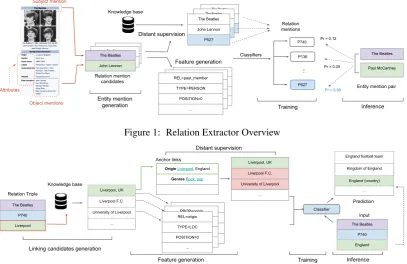
Figure1depicts an overview of the relation extrac-tor. It extracts relation mentionsr(m1, m2) from each infobox table inT in four stages: entity men-tion generamen-tion, feature generamen-tion, distant super-vision, and model training and inference.
4.1.1 Mention Generation
We parse each infobox table rendered in HTML, instead of the raw Mediawiki template, to gen-erate object mentions. As the infobox templates evolve over time, different Mediawiki templates have been used to describe the same type of things. Despite the difference in templates, the rendered infobox tables in HTML displays a surprisingly consistent format: each row contains an attribute cell and an attribute value cell.
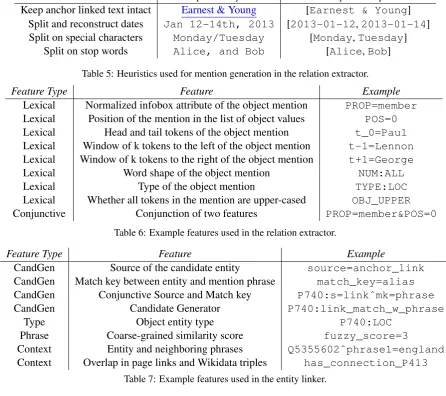
We chunk the text of each attribute value cell and generate object mentions using a few heuris-tics such as HTML tag boundaries. Table 5 in Appendix A shows the heuristics. Each pair of subject and object mentions becomes one relation mention candidate. Note that an off-the-shelf noun phrase chunker (Sang and Buchholz, 2000) or a Named Entity Recognition (NER) tagger (Finkel et al.,2005) doesn’t work well in this case as they are often trained on grammatical sentences instead of the textual segments seen in infobox tables.
6
We assume that only one representative infobox table is available on each page.
7Note that each Wikipedia page has a corresponding
Wikidata entry. Exceptions exist but are negligible. In this paper, we use “Wikipedia entity” and “Wikidata entity” in-terchangeably for the same real-world entity.
4.1.2 Feature Generation
For each relation mention, we generate features similar to the ones fromMintz et al.(2009), with some modifications. Since the subject of a rela-tion menrela-tion is outside the infobox, most gener-ated features focus on the object (e.g., the word shape of the object mention), and its context (e.g., the infobox attribute value). Table6in Appendix
Alists the complete set of features.
4.1.3 Distant Supervision
Instead of manually collecting training examples, we use distant supervision (Craven and Kumlien,
1999;Bunescu and Mooney, 2007; Mintz et al.,
2009) from Wikidata to automatically generate training data for relation extraction. We assume that a pair of mentions (me1, m2) expresses the relation type r if we are able to match m2 to
e2 where r(e1, e2) is a Wikidata relation. Since the object mentionm2 is non-canonical, we do a string match between the entity name and the men-tion text or a direct entity match if an anchor link exists for the mention. We construct the negative training data for a relation type r by combining positive examples of other relation types and a ran-dom sample of the unlabeled entity mention pairs.
4.1.4 Model Training and Inference
We train a binary logistic regression classi-fier (Friedman et al.,2001) for each relation type. The classifier predicts how likely a pair of entity mentions is to express a relation typer. We only output relations with probabilities higher than a thresholdθ(0.9is used empirically). Otherwise, a mention pair is deemed to not express any relation type. We choose one binary classifier for each type rather than a single multi-class classifier because one pair of mentions can express multiple relation types. For example, the mention pair (“The Beat-les”, “England”) under the attribute “Origin” (see Fig. 1) expresses two relation types: country of originandlocation of formation.
4.2 Entity Linking & Normalization
Figure2provides an overview of the entity linker in four stages: candidate generation, feature gen-eration, distant supervision, and model training and inference. The subjectmei of each extracted
relation mention r(mei, m2) is trivially linked to
the subject entity ei. The entity linker links the
Figure 1: Relation Extractor Overview
The Beatles
P740
Liverpool
Relation Triple Liverpool, UK
Liverpool F.C.
University of Liverpool
...
Knowledge base
Liverpool, UK
Liverpool F.C.
University of Liverpool
...
OriginLiverpool, England
GenresRock, pop ...
Anchor links
Distant supervision
PROP=origin
TYPE=LOC
POSITION=0
... PROP=origin
TYPE=LOC
POSITION=0
... REL=origin
TYPE=LOC
POSITION=0
...
Feature generation
Classifier
Linking
The Beatles
P740
England England football team
Kingdom of England
England (country)
...
Prediction Input
Training Inference Linking candidates generation
Figure 2: Entity Linker Overview
m2 an unlinkable entity. We normalize the literal values whenm2 is not an entity reference.8
4.2.1 Candidate Generation
We generate candidate entities{e˜i2}form2in each
r(me1, m2)extracted. Candidate entities are gen-erated from the anchor link associated with the mention if present, matching the surface form text of anchor links harvested from other pages for the same relation typer, and type-aware name match-ing with Wikidata entities. We determine the en-tity type(s) of the object for a relation typerfrom the statistics of existing relation triples in Wiki-data. In this work, we use a set of coarse-grained entity types: person, band, school, organization, location, event, creative work, and award.9
4.2.2 Feature Generation
We generate features for each candidate entity of
m2, including lexical features ofm2, textual sim-ilarity between the entity name and m2, how the candidate entity is generated (e.g., anchor link or name matching), and for name matching, the kind of names the mention is matched against (e.g.,
har-8For relation types with quantity objects such as
popu-lationandheight, date objects such asbirth date, or string values such aswebsite, we normalize them into a canonical form with respect to each data type.
9When the required entity type is absent from this set
(e.g., an object value of thelanguage spokenrelation type), no candidate is provided from type-aware name matching.
vested surface form text or an entity alias). Con-textual information surrounding m2 in the same infobox is also used for disambiguation.10
4.2.3 Distant Supervision
Similar to Sec.4.1.3, we use Wikidata to distantly supervise the entity linker. We compare each
r(me1,˜e
i
2) triple with all r(e1, e2) triples from Wikidata. The candidate entity in whiche˜i2 = e2 is labeled as a positive example, while the rest of the candidate entities are considered negative ex-amples. Note that the supervision is noisy because there may be multiple valid or very similar canoni-cal entities for the samer(me1, m2), especially for relation types such asgenre. Additional heuristic rules are used to denoise the supervision (cf. la-beling functionsinRatner et al.(2016)).
4.2.4 Model training & Inference
We use a logistic regression model to predict the probability of each candidate for a mention. The candidate entity with the highest probability for a mention is chosen. If the highest probability does not meet a threshold (0.5 is chosen empirically), we mark a mention an unlinkable entity. For location-type objects, we make a collective pre-diction that the entity choices of neighboring men-tions are decided altogether (see AppendixB.2).
5 Experiments
In this section, we conduct experiments to answer the following questions:
• Does RIBE produce high-quality
extrac-tions? (Sec.5.2)
• Are these extractions a significant addition to Wikidata? (Sec.5.3)
• How does the extraction with unlinkable en-tities affect the quality of the KB especially for the list-valued relation types? (Sec.5.4)
5.1 Data
We use Wikipedia infobox tables and Wikidata11 to construct our training and evaluation data set. We test RIBE on both coarse-grained entity types
such asperson,locationandeventas well as fine-grained ones such asbandandschool. We denote the set of entity typesET. A set of51 Wikidata relation typesRT is used as extraction targets, a sample of which is shown in Table412.
To assign types to entities, we first recursively traverse Wikidata to collect all sub-types of a tar-get entity typet∈ETvia thesubclass ofrelation. For example, bothcityandstateare subclasses of typelocation. Next, we use theinstance of rela-tion type to identify types for entities. An entity is deemed typetif and only if it appears as the sub-ject of aninstance of relation, where the object is one of the sub-types oft. Around 1.2 million in-fobox tables remain after a subject type filtering. Table1displays a type breakdown.
5.2 Extraction Quality
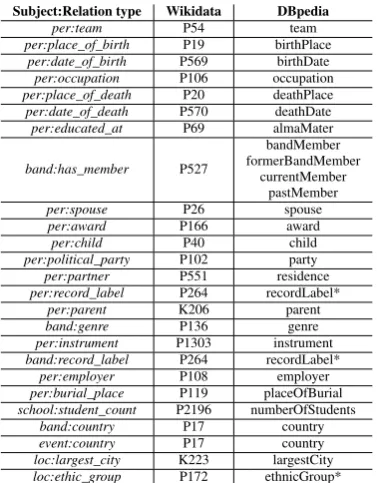
We compare RIBE with a strong IBE baseline, DBpedia (Lehmann et al.,2015). We obtain ex-tractions from DBpedia by running their extrac-tor13 on the same set of 1.2 million infobox ta-bles. We identified74mappings of relation types between DBpedia and Wikidata from the DBpe-dia ontology14.23of them overlap with our target relation setRT (see Table3). We divide DBpe-dia relation types by subject types. For instance, we create two sub-types person:record_labeland band:record_labelfrom the DBpedia relation type recordLabel, where the first one includes record-Label relations with subject typeperson, and the second one withband. Table2lists the complete
11
An 11/2018 Wikipedia and a 06/2018 Wikidata dump.
12
The full list is provided in Table8in AppendixC 13
https://github.com/dbpedia/extraction- framework/
14
https://wiki.dbpedia.org/Downloads2014#h395- 1
Subject entity type Percentage (%) Person 81.5
Event 10.4
Location 3.3
Band 2.7
[image:5.595.327.502.60.142.2]School 1.9
Table 1: Infobox subject entity type breakdown.
Subject:Relation type Wikidata DBpedia per:team P54 team per:place_of_birth P19 birthPlace
per:date_of_birth P569 birthDate per:occupation P106 occupation per:place_of_death P20 deathPlace per:date_of_death P570 deathDate per:educated_at P69 almaMater
band:has_member P527
bandMember formerBandMember
currentMember pastMember per:spouse P26 spouse per:award P166 award per:child P40 child per:political_party P102 party per:partner P551 residence per:record_label P264 recordLabel*
per:parent K206 parent band:genre P136 genre per:instrument P1303 instrument band:record_label P264 recordLabel*
per:employer P108 employer per:burial_place P119 placeOfBurial school:student_count P2196 numberOfStudents
band:country P17 country event:country P17 country loc:largest_city K223 largestCity loc:ethic_group P172 ethnicGroup*
Table 2: Mappings from Wikidata relation types to DB-pedia ones. The relation types followed by * are miss-ing from the output generated by the DBpedia extrac-tion code but present in the latest public DBpedia data release. We use the latter for those relation types for a fair comparison.
mappings of relation types from Wikidata to DB-pedia.
5.2.1 Evaluation Methodology
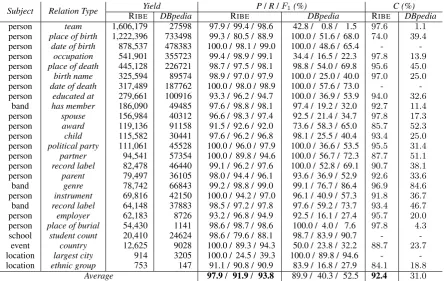
We evaluate the extraction quality for each rela-tion typer ∈ RT using four metrics: yield, pre-cision, recall, and F1 score. Yield (Y) is de-fined as the number of all uniquely extracted re-lations r(e1, e2). To compute precision and re-call, we first collect a ground truth set of relations
G = {Gr|r ∈ RT}.15 We create a union of
ex-tractions from RIBE and DBpedia, and randomly
sample around 100 entities with at least one re-lation extracted from either system. This is sim-ilar to the pooling methodology used in the TAC KBP evaluation process (TAC, 2017). The sam-pled extractions are graded by human annotators.
15If both systems have low true recall, this ground truth set
[image:5.595.322.511.163.405.2]Subject Relation Type Yield P/R/F1(%) C (%) RIBE DBpedia RIBE DBpedia RIBE DBpedia person team 1,606,179 27598 97.9 / 99.4 / 98.6 42.8 / 0.8 / 1.5 97.6 1.1
person place of birth 1,222,396 733498 99.3 / 80.5 / 88.9 100.0 / 51.6 / 68.0 74.0 39.4
person date of birth 878,537 478383 100.0 / 98.1 / 99.0 100.0 / 48.6 / 65.4 - -person occupation 541,901 355723 99.4 / 98.9 / 99.1 34.4 / 16.5 / 22.3 97.8 13.9
person place of death 445,128 226721 98.7 / 97.5 / 98.1 98.8 / 54.0 / 69.8 95.6 45.0
person birth name 325,594 89574 98.9 / 97.0 / 97.9 100.0 / 25.0 / 40.0 97.0 25.0
person date of death 317,489 187762 100.0 / 98.0 / 98.9 100.0 / 57.6 / 73.0 - -person educated at 279,661 100916 93.3 / 96.2 / 94.7 100.0 / 36.9 / 53.9 94.0 32.6
band has member 186,090 49485 97.6 / 98.8 / 98.1 97.4 / 19.2 / 32.0 92.7 11.4
person spouse 156,984 40312 96.6 / 98.3 / 97.4 92.5 / 21.4 / 34.7 97.8 17.3
person award 119,136 91158 91.5 / 92.6 / 92.0 73.6 / 58.3 / 65.0 85.7 52.3
person child 115,582 30441 97.6 / 96.2 / 96.8 98.1 / 25.5 / 40.4 93.4 25.0
person political party 111,061 45528 100.0 / 96.0 / 97.9 100.0 / 36.6 / 53.5 95.5 31.4
person partner 94,541 57354 100.0 / 89.8 / 94.6 100.0 / 56.7 / 72.3 87.7 51.1
person record label 82,478 46440 99.1 / 96.2 / 97.6 100.0 / 52.8 / 69.1 90.7 38.1
person parent 79,497 36105 98.0 / 94.4 / 96.1 93.6 / 36.9 / 52.9 92.6 33.6
band genre 78,742 66843 99.2 / 98.8 / 99.0 99.1 / 76.7 / 86.4 96.9 84.6
person instrument 69,816 42150 100.0 / 94.2 / 97.0 96.1 / 40.9 / 57.3 91.8 36.7
band record label 64,148 37883 98.5 / 97.2 / 97.8 97.6 / 59.2 / 73.7 93.4 46.7
person employer 62,183 8726 93.2 / 96.8 / 94.9 92.5 / 16.1 / 27.4 95.7 20.0
person place of burial 54,430 1141 98.6 / 98.7 / 98.6 100.0 / 4.0 / 7.6 97.8 4.3
school student count 20,410 24624 98.6 / 79.6 / 88.1 98.7 / 83.9 / 90.7 - -event country 12,625 9028 100.0 / 89.3 / 94.3 50.0 / 23.8 / 32.2 88.7 23.7
location largest city 914 3205 100.0 / 24.5 / 39.3 100.0 / 89.8 / 94.6 - -location ethnic group 753 147 91.1 / 90.8 / 90.9 83.9 / 16.8 / 27.9 84.1 18.8
[image:6.595.76.524.61.342.2]Average 97.9/ 91.9/ 93.8 89.9 / 40.3 / 52.5 92.4 31.0
Table 3: Comparison with DBpedia. P/R/F1 denotes Precision/Recall/F1 measures. Cdenotes the completeness score for
list-value relation types. An asterisk marks the relation types that are missing from the output generated by the DBpedia extraction code but present in the last public DBpedia release athttps://wiki.dbpedia.org/develop/datasets/ dbpedia-version-2016-10. We use the latter for those relation types to conduct a fair comparison.
According to our annotation guidelines, we mark an extraction incorrect if one of the the following is met.
• The relation is not expressed in the infobox.
• The object entity has an incorrect identifier.
• The object of a relation triple is unlinked by the system but should be linked in the ground truth. For instance, a string “United States” not linked to its entity identifier in Wikidata is considered incorrect.
• The object is incorrectly parsed. For exam-ple, “Sasha and Malia” would be an incorrect extraction for thechild relation of Barack Obama.
The final setGrconsists of all correct relations
of the sampled entities from both approaches. The number of labels varies from83forevent:country to557for band:has_member, resulting in a total of 4,858 labels on triples and an average of 194
per relation type. ThePrecision(P) of a systems, RIBE or DBpedia, is computed asPs
r = |Us
r∩Gr|
|Us r| ,
whereUrsis the set of all extracted relations ofrby systems. An absoluteRecall(R) of the universe is difficult to compute. We compute an estimated recallRs
r = |Us
r∩Gr|
|Gr| w.r.t the ground truth set. The
standardF1 Score(F1) is computed as a harmonic mean ofPrandRr.
5.2.2 Results
Relation type (Wikidata ID) Wikidata yield RIBEyield +Yield (%) Linked (%) Precision (%)
student count (P2196) 1,325 23,440 1758.5 N/A 94.78
doctoral student (P185) 2,998 9,131 263.0 78.8 97.96
has part (P527)* 105,825 185,804 166.2 18.9 100.00
recurring date (P837) 785 1,282 126.5 89.4 95.65
instrument (P1303) 56,877 69,800 93.3 98.6 100.00
member of sports team (P54) 1,190,242 1,600,285 51.3 95.0 96.69
unmarried partner (P451) 5,263 3,108 44.5 53.1 98.97
doctoral advisor (P184) 14,300 10,688 35.2 73.9 97.12
destination point (P1444) 4,942 1,824 19.1 98.8 100.00
award received (P166) 498,505 118,509 16.3 77.4 93.18
official website (P856) 525,496 100,623 11.0 N/A 100.00
population (P1082) 695,577 53,071 4.9 N/A 100.00
sibling (P3373) 188,328 12,129 4.1 75.4 100.00
[image:7.595.88.504.61.212.2]country of citizenship (P27) 2,687,600 239,798 2.4 98.6 100.00
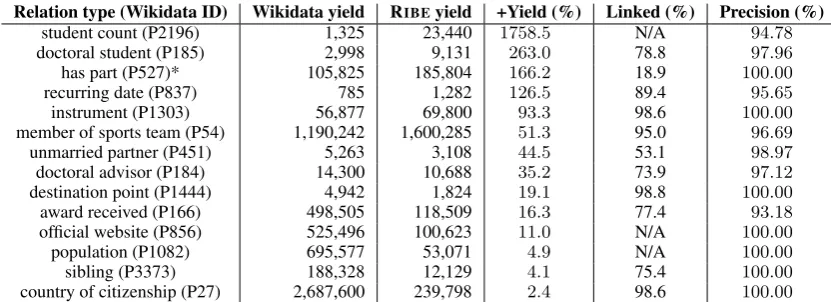
Table 4: Comparison with Wikidata for a sample of relation types. See Table8in AppendixCfor the full list. The column Wikidata yieldshows the total number of relation triples in Wikidata per relation type. RIBEyieldshows the total number of relation triples extracted by RIBE.+Yieldrepresents the number of relation triples we extract that are not in Wikidata divided by Wikidata counts. Data is added to Wikidata organically by editors and the source is not limited to infoboxes. Therefore yield comparison shows that extractions from infoboxes may complement Wikidata to construct a better knowledge graph.Linked (%)shows that the percentage of relation triples with their objects linked to Wikidata entities (“N/A” if the object type is a literal value).∗We use P527 to representband has memberwhere the subject entity is a band and the object entity is a current or past member of the band.
5.3 Complement to Wikidata
We compare RIBEto Wikidata using the same sub-ject type filter on Wikidata relation types. Table4
shows the evaluation for a sample of relation types (see Table8in AppendixCfor the complete list). To evaluate the quality of extra yield, we compute per-relation-type precision by randomly sampling
100relation triples that do not exist in Wikidata (around5.1k labels in total). The predictions are graded by human annotators and precision is com-puted as described in Sec. 5.2.1. RIBEachieves a significant increase in yield over Wikidata (17out of51relation types have100%+increase), while maintaining higher than95%precision for almost all relation types. This indicates that the extracted triples are high-quality and a critical complement to Wikidata.16 We observe that relation types with person object type have a lower linked ratio since not all objects have corresponding entities in Wiki-data (e.g., children of celebrities).
5.4 Completeness of list-value relation types
A list-value relation type allows multiple objects for the same subject (e.g., a person can have mul-tiple children). In order to measure the complete-ness of extractions for list-value relation types, we define a completeness score C for each relation type r using a set equality by comparing the ex-tracted set of object values for each subject en-tity to the ground truth set. To compute Cr, we
average the completeness scores over the sam-pled subject entities. The “C (%)” column of
Ta-16Wikidata is mostly curated by human edits and therefore
the Wikidata yield and RIBEyield is not directly comparable.
ble3shows that RIBEconsistently produces sub-stantially more complete extractions than DBpedia does.
6 Conclusion and Future Directions
We proposed a novel system, RIBE, that extracts
knowledge triples from Wikipedia infobox tables. The proposed system produces high-quality data and improves the averageF1 score over51 rela-tion types by 41.3% compared to a strong IBE system, DBpedia. We also empirically show the added value of the extracted knowledge with re-spect to Wikidata. Additionally, RIBE takes into account unlinkable entities, dramatically improv-ing the completeness of list-value relation types.
In future work, we would like to investigate its effectiveness and robustness in a cross-lingual setting. We would like to work on Entity Dis-covery (Hoffart et al., 2014; Wick et al., 2013) to discover and disambiguate the unlinkable enti-ties. We would also like to jointly model the rela-tion extractor and the entity linker to improve the model performance.
Acknowledgments
References
Sören Auer, Christian Bizer, Georgi Kobilarov, Jens Lehmann, Richard Cyganiak, and Zachary G. Ives. 2007. Dbpedia: A nucleus for a web of open data. In Proceedings of the 6th International Semantic Web Conference and 2nd Asian Semantic Web Con-ference (ISWC/ASWC-2007), pages 722–735.
Sören Auer and Jens Lehmann. 2007. What have inns-bruck and leipzig in common? extracting semantics from wiki content. InESWC.
Razvan Bunescu and Raymond Mooney. 2007. Learn-ing to extract relations from the web usLearn-ing mini-mal supervision. InAnnual meeting-association for Computational Linguistics, volume 45, page 576.
M. Craven and J. Kumlien. 1999. Constructing bio-logical knowledge bases by extracting information from text sources. In Proceedings of the Seventh International Conference on Intelligent Systems for Molecular Biology, August 6-10, 1999, Heidelberg, Germany, pages 77–86. AAAI.
S. Cucerzan. 2007. Large-scale named entity disam-biguation based on wikipedia data. InProceedings of EMNLP-CoNLL, volume 2007, pages 708–716.
Rajarshi Das, Arvind Neelakantan, David Belanger, and Andrew McCallum. 2017. Chains of reasoning over entities, relations, and text using recurrent neu-ral networks. InEACL.
Xin Dong, Evgeniy Gabrilovich, Geremy Heitz, Wilko Horn, Ni Lao, Kevin Murphy, Thomas Strohmann, Shaohua Sun, and Wei Zhang. 2014. Knowledge vault: a web-scale approach to probabilistic knowl-edge fusion. InKDD.
J.R. Finkel, T. Grenager, and C. Manning. 2005. In-corporating non-local information into information extraction systems by gibbs sampling. In Proceed-ings of the 43rd Annual Meeting on Association for Computational Linguistics, pages 363–370. Associ-ation for ComputAssoci-ational Linguistics.
Jerome Friedman, Trevor Hastie, and Robert Tibshi-rani. 2001. The elements of statistical learning, vol-ume 1. Springer series in statistics New York, NY, USA:.
Kelvin Guu, John Miller, and Percy Liang. 2015. Traversing knowledge graphs in vector space. In EMNLP.
Sebastian Hellmann. 2018. Wikidata Adoption
in Wikipedia. https://lists.wikimedia.
org/pipermail/wikidata/2018-December/ 012681.html.
Johannes Hoffart, Yasemin Altun, and Gerhard Weikum. 2014. Discovering emerging entities with ambiguous names. In Proceedings of the 23rd in-ternational conference on World wide web, pages 385–396. International World Wide Web Confer-ences Steering Committee.
Raphael Hoffmann, Congle Zhang, Xiao Ling, Luke Zettlemoyer, and Daniel S Weld. 2011. Knowledge-based weak supervision for information extraction of overlapping relations. InProceedings of the 49th Annual Meeting of the Association for Computa-tional Linguistics: Human Language Technologies, volume 1, pages 541–550.
Mitchell Koch, John Gilmer, Stephen Soderland, and Daniel S Weld. 2014. Type-aware distantly super-vised relation extraction with linked arguments. In EMNLP.
Sayali Kulkarni, Amit Singh, Ganesh Ramakrishnan, and Soumen Chakrabarti. 2009. Collective annota-tion of Wikipedia entities in web text. In Proceed-ings of the 15th ACM SIGKDD international con-ference on Knowledge discovery and data mining, pages 457–466. ACM.
Ni Lao, Tom M. Mitchell, and William W. Cohen. 2011. Random walk inference and learning in a large scale knowledge base. InEMNLP.
Jens Lehmann, Robert Isele, Max Jakob, Anja Jentzsch, Dimitris Kontokostas, Pablo N Mendes, Sebastian Hellmann, Mohamed Morsey, Patrick Van Kleef, Sören Auer, et al. 2015. Dbpedia–a large-scale, multilingual knowledge base extracted from wikipedia. Semantic Web, 6(2):167–195.
Xiao Ling, Sameer Singh, and Daniel S. Weld. 2015. Design challenges for entity linking. TACL, 3:315– 328.
Mike Mintz, Steven Bills, Rion Snow, and Dan Juraf-sky. 2009. Distant supervision for relation extrac-tion without labeled data. In Proceedings of the Joint Conference of the 47th Annual Meeting of the ACL and the 4th International Joint Conference on Natural Language Processing of the AFNLP: Vol-ume 2 - VolVol-ume 2, ACL ’09, pages 1003–1011, Stroudsburg, PA, USA. Association for Computa-tional Linguistics.
Alexander Ratner, Christopher De Sa, Sen Wu, Daniel Selsam, and Christopher Ré. 2016. Data program-ming: Creating large training sets, quickly. Ad-vances in neural information processing systems, 29:3567–3575.
Erik F. Tjong Kim Sang and Sabine Buchholz. 2000. Introduction to the conll-2000 shared task chunking. InCoNLL/LLL.
Mihai Surdeanu, Julie Tibshirani, Ramesh Nallapati, and Christopher D Manning. 2012. Multi-instance multi-label learning for relation extraction. In Pro-ceedings of the 2012 Joint Conference on Empirical Methods in Natural Language Processing and Com-putational Natural Language Learning, pages 455– 465. Association for Computational Linguistics.
Denny Vrandeˇci´c and Markus Krötzsch. 2014. Wiki-data: A free collaborative knowledgebase. Com-mun. ACM, 57(10):78–85.
Michael Wick, Sameer Singh, Harshal Pandya, and An-drew McCallum. 2013. A joint model for discover-ing and linkdiscover-ing entities. InProceedings of the 2013 workshop on Automated knowledge base construc-tion, pages 67–72. ACM.
Fei Wu and Daniel S. Weld. 2007. Autonomously se-mantifying wikipedia. InProceedings of the Inter-national Conference on Information and Knowledge Management (CIKM-2007), pages 41–50.
A Mention Generation Heuristics and Example Features
We present the heuristics used in mention gener-ation of the relgener-ation extractor in Table5 and ex-ample features in Table 6 and 7 for the relation extractor and the entity linker respectively.
B Implementation Details
In this appendix, we describe a few implementa-tion details in addressing the noise from distant supervision and making collective entity link pre-diction.
B.1 Denoise Distant Supervision
Distant supervision for relation extraction assumes that every occurrence of two entities that par-ticipate in a known relation expresses the re-lation. However, the assumption does not al-ways hold. For example, in the infobox table of
John Lennon (https://en.wikipedia.
org/wiki/John_Lennon), the object men-tion “Yoko Ono” appears under bothSpouse(s)
and Associated acts. Both occurrences of (“John Lennon”, “Yoko Ono”) will be labeled as positive instances of the spouse relation type in Wikidata, despite the second occurrence being un-related. Therefore, we introduce a whitelist Ar
of normalized infobox attributes17 if the relation typer is vulnerable to noise. A relation mention
r(m1, m2) (e.g., the second occurrence of John
LennonandYoko Ono) will be removed if the attributea(e.g.,associated_act) is not inAr
(e.g.,{spouse,wife,husband}).
B.2 Collective Entity Linking
Locations are often presented in multiple levels, such as “San Jose, CA, USA”. There are many candidate cities named “San Jose” in Wikidata. One candidateSan Jose, CAhas a relation lo-cated in 18 with California, which is a can-didate for the mention “CA”. Another cancan-didate
San Jose, Costa Rica does not have such
a relation with the neighboring mention and there-fore is less likely to be the correct entity. Similarly, if two cities are mentioned together, the candidate entities that are in the same country are more likely to be the correct prediction at the same time. This
17
We normalize a raw infobox attribute by singularizing and converting all tokens to lower case.
18It is equivalent to the Wikidata relation type P131,
Heuristic Input example Output example Keep anchor linked text intact Earnest & Young [Earnest & Young]
Split and reconstruct dates Jan 12-14th, 2013 [2013-01-12,2013-01-14] Split on special characters Monday/Tuesday [Monday,Tuesday]
[image:10.595.90.504.62.132.2]Split on stop words Alice, and Bob [Alice,Bob]
Table 5: Heuristics used for mention generation in the relation extractor.
Feature Type Feature Example
Lexical Normalized infobox attribute of the object mention PROP=member
Lexical Position of the mention in the list of object values POS=0
Lexical Head and tail tokens of the object mention t_0=Paul
Lexical Window of k tokens to the left of the object mention t-1=Lennon
Lexical Window of k tokens to the right of the object mention t+1=George
Lexical Word shape of the object mention NUM:ALL
Lexical Type of the object mention TYPE:LOC
Lexical Whether all tokens in the mention are upper-cased OBJ_UPPER
Conjunctive Conjunction of two features PROP=member&POS=0
Table 6: Example features used in the relation extractor.
Feature Type Feature Example
CandGen Source of the candidate entity source=anchor_link
CandGen Match key between entity and mention phrase match_key=alias
CandGen Conjunctive Source and Match key P740:s=linkˆmk=phrase
CandGen Candidate Generator P740:link_match_w_phrase
Type Object entity type P740:LOC
Phrase Coarse-grained similarity score fuzzy_score=3
Context Entity and neighboring phrases Q5355602ˆphrase1=england
[image:10.595.73.520.73.469.2]Context Overlap in page links and Wikidata triples has_connection_P413
Table 7: Example features used in the entity linker.
also applies to relation types such aseducated at, which expects schools as object entities. A loca-tion menloca-tion following the school name may help disambiguate.
We perform this collective entity linking ap-proach (Cucerzan, 2007; Kulkarni et al., 2009;
Ling et al.,2015) in the following way: for can-didate entitiesei andej of two neighboring
men-tions, we represent the relation between the two by
rij. From this we calculate the normalized score
(NS) for a location phrase with token length` de-fined as
NS=
αP`
ipi (`= 1)
1
`
P`
ipi+
1
(`
2)
P`
i,jri,j (` >1) , (1)
where
rij =
(
1.0 located_in(ei, ej)
0.5 same_country(ei, ej)
, (2)
pi is the local probability of ei being the correct
entity andαis a hyperparameter empirically set to
1.5. For` >1, the maximum NS allowed is 2. A score larger than1implies a presence of either lo-cated inorsame countryrelation. If NS is above a threshold, say1.3, we sort by(`, NS)in descend-ing order and choose the top set of entities. While we prefer entities that are consistent with a longer phrase, the threshold accounts for the incomplete-ness of the relationlocated in. If there is no candi-date with a NS above the threshold, we choose the candidate with the highest NS.
Conceptually the same method (with differ-ent link types rij) can be applied to all object
types. However in practice we found that for non-location entities the impact was small and not worth the increased computation.
C Supplementary Experimental Results
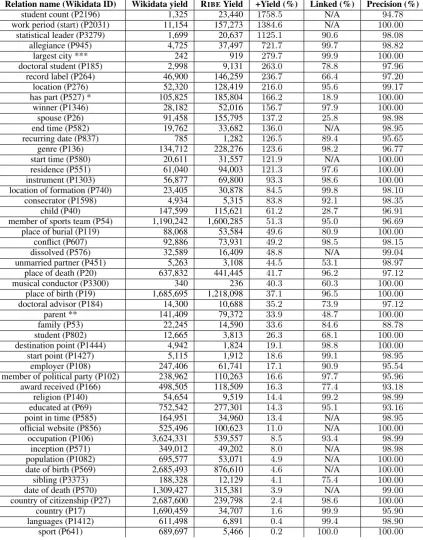
[image:10.595.71.293.639.732.2]Relation name (Wikidata ID) Wikidata yield RIBEYield +Yield (%) Linked (%) Precision (%)
student count (P2196) 1,325 23,440 1758.5 N/A 94.78
work period (start) (P2031) 11,154 157,273 1384.6 N/A 100.00
statistical leader (P3279) 1,699 20,637 1125.1 90.6 98.08
allegiance (P945) 4,725 37,497 721.7 99.7 98.82
largest city *** 242 919 279.7 99.9 100.00
doctoral student (P185) 2,998 9,131 263.0 78.8 97.96
record label (P264) 46,900 146,259 236.7 66.4 97.20
location (P276) 52,320 128,419 216.0 95.6 99.17
has part (P527) * 105,825 185,804 166.2 18.9 100.00
winner (P1346) 28,182 52,016 156.7 97.9 100.00
spouse (P26) 91,458 155,795 137.2 25.8 98.98
end time (P582) 19,762 33,682 136.0 N/A 98.95
recurring date (P837) 785 1,282 126.5 89.4 95.65
genre (P136) 134,712 228,276 123.6 98.2 96.77
start time (P580) 20,611 31,557 121.9 N/A 100.00
residence (P551) 61,040 94,003 121.3 97.6 100.00
instrument (P1303) 56,877 69,800 93.3 98.6 100.00
location of formation (P740) 23,405 30,878 84.5 99.8 98.10
consecrator (P1598) 4,934 5,315 83.8 92.1 98.35
child (P40) 147,599 115,621 61.2 28.7 96.91
member of sports team (P54) 1,190,242 1,600,285 51.3 95.0 96.69
place of burial (P119) 88,068 53,584 49.6 80.9 100.00
conflict (P607) 92,886 73,931 49.2 98.5 98.15
dissolved (P576) 32,589 16,409 48.8 N/A 99.04
unmarried partner (P451) 5,263 3,108 44.5 53.1 98.97
place of death (P20) 637,832 441,445 41.7 96.2 97.12
musical conductor (P3300) 340 236 40.3 60.3 100.00
place of birth (P19) 1,685,695 1,218,098 37.1 96.5 100.00
doctoral advisor (P184) 14,300 10,688 35.2 73.9 97.12
parent ** 141,409 79,372 33.9 48.7 100.00
family (P53) 22,245 14,590 33.6 84.6 88.78
student (P802) 12,665 3,813 26.3 68.1 100.00
destination point (P1444) 4,942 1,824 19.1 98.8 100.00
start point (P1427) 5,115 1,912 18.6 99.1 98.95
employer (P108) 247,406 61,741 17.1 90.9 95.54
member of political party (P102) 238,962 110,263 16.6 97.7 95.96
award received (P166) 498,505 118,509 16.3 77.4 93.18
religion (P140) 54,654 9,519 14.4 99.2 98.99
educated at (P69) 752,542 277,301 14.3 95.1 93.16
point in time (P585) 164,951 34,960 13.4 N/A 98.95
official website (P856) 525,496 100,623 11.0 N/A 100.00
occupation (P106) 3,624,331 539,557 8.5 93.4 98.99
inception (P571) 349,012 49,202 8.0 N/A 98.98
population (P1082) 695,577 53,071 4.9 N/A 100.00
date of birth (P569) 2,685,493 876,610 4.6 N/A 100.00
sibling (P3373) 188,328 12,129 4.1 75.4 100.00
date of death (P570) 1,309,427 315,381 3.9 N/A 99.00
country of citizenship (P27) 2,687,600 239,798 2.4 98.6 100.00
country (P17) 1,690,459 34,707 1.6 99.9 95.90
languages (P1412) 611,498 6,891 0.4 99.4 98.90
[image:11.595.88.512.85.626.2]sport (P641) 689,697 5,466 0.2 100.0 100.00
Table 8: Comparison with Wikidata. The column Wikidata yieldshows the total number of relation triples in Wikidata per relation type. RIBEyieldshows the total number of relation triples extracted by RIBE.+Yieldshows the number of relation triples we extract that are not in Wikidata.Linked (%)shows that the percentage of relation triples with their objects linked to Wikidata entities. ∗We use P527 to representband has member where the subject entity is a band and the object entity is a current or past member of the band. Note thatparentandlargest cityin Table8do not currently exist in Wikidata. ** We combine relations for Wikidata predicatesfather(P22) andmother(P25) to form theparentrelation type. *** We collect all the cities located in every location entity,e, in Wikidata that contains cities and use the city with the largest and latest population number as the largest city of