Proceedings of NAACL-HLT 2019, pages 2884–2891 2884
Review-Driven Multi-Label Music Style Classification
by Exploiting Style Correlations
Guangxiang Zhao1∗, Jingjing Xu2∗, Qi Zeng2, Xuancheng Ren2, Xu Sun1,2
1Center for Data Science, Beijing Institute of Big Data Research, Peking University 2MOE Key Lab of Computational Linguistics, School of EECS, Peking University
{zhaoguangxiang,jingjingxu,pkuzengqi,renxc,xusun}@pku.edu.cn
Abstract
This paper explores a new natural language processing task, review-driven multi-label mu-sic style classification. This task requires sys-tems to identify multiple styles of music based on its reviews on websites. The biggest chal-lenge lies in the complicated relations of mu-sic styles. To tackle this problem, we pro-pose a novel deep learning approach to auto-matically learn and exploit style correlations. Experiment results show that our approach achieves large improvements over baselines on the proposed dataset. Furthermore, the visu-alized analysis shows that our approach per-forms well in capturing style correlations.1
1 Introduction
As music style (e.g., Jazz, Pop, and Rock) is one of the most frequently used labels for music, music style classification is an important task for appli-cations of music recommendation, music informa-tion retrieval, etc. Several methods have been pro-posed for automatic music style classification (Qin and Ma, 2005; Zhou et al., 2006; Wang et al.,
2009;Choi et al.,2017). Most of them mainly fo-cus on using audio information to identify styles. Motivated by the fact that a pieces of music could has different styles, several studies (Wang et al.,
2009;Oramas et al.,2017) also aim at multi-label music style classification.
Although these methods make promising progress, they are limited in two aspects. First, not all audio data is available in real-world ap-plications because of copyright restrictions, which limits the generalization ability. Second, some of them are based on a strong assumption that a piece of music should be assigned with only one style. Different from these studies, we focus on using
∗
Equal Contribution
1The code and the dataset are available at https://
github.com/lancopku/RMSC
easily obtained reviews in conjunction with multi-label music style classification. The motivation comes from the fact that lots of user reviews con-tain rich style-related information, which can be used for music style classification.
The major challenge of this task lies in the com-plicated correlations of music styles. For exam-ple, Soul Music2 contains elements of R&B and Jazz. These three labels can be used alone or in combination. Traditional multi-label classification methods may mistake the true label [Soul Mu-sic, R&B, Jazz] for the false label [R&B, Jazz]. If well learned, style relations are useful knowl-edge for improving the performance, e.g., increas-ing the probability of Soul Music if we find that it is heavily linked with two high probability labels: R&B and Jazz. Therefore, to better exploit style correlations, we propose a novel deep learning ap-proach with two parts: a label-graph based neural network, and a soft training mechanism with cor-relation based continuous label representation.
Our contributions are listed as follows:
• To the best of our knowledge, this work is the first to explore review-driven multi-label music style classification.
• To learn the relations among music styles, we propose a label-graph based neural net-work and a soft training mechanism with correlation-based label representation.
2 Related work
This paper is related with music style classifica-tion and multi-label classificaclassifica-tion. In this secclassifica-tion, we give a detailed introduction about the related studies.
2Soul Music is a popular music genre that originated in
Music Title Mozart: The Great Piano Concertos, Vol.1 Styles Classical Music, Piano Music
Reviews
(1) I’ve been listening toclassicalmusic all the time.
(2) Mozart is always good. There is a reason he is ranked in the top 3 of lists of greatestclassical
composers.
[image:2.595.84.513.62.134.2](3) The sound ofpianobrings me peace and relaxation. (4) This volume of Mozart concertos is superb.
Table 1: An illustration of review-driven multi-label music style classification. For easy interpretation, we select a simple and clear example where styles can be easily inferred from reviews. In practice, the correlation between styles and associated reviews is relatively complicated.
2.1 Music Style Classification
Previous work mainly focuses on using audio information to identify music styles. Tradi-tional machine learning algorithms are adopted in these studies, such as Support Vector Ma-chine (SVM) (Xu et al., 2003), Hidden Markov Model (HMM) (Chai and Vercoe,2001;Pikrakis et al.,2006), and Decision Tree (DT) (Zhou et al.,
2006). In addition to audio information,Fell and Sporleder(2014) also propose to classify music by statistical analysis of lyrics. Motivated by the fact that a piece of music could has different styles, several studies (Wang et al.,2009;Oramas et al.,
2017) also aim at multi-label music style classifi-cation. Different from these studies, we focus on using easily obtained reviews in conjunction with multi-label music style classification.
2.2 Multi-Label Classification
Multi-label classification has been widely applied to diverse problems, including image classifica-tion (Qi et al.,2007;Wang et al.,2008), audio clas-sification (Boutell et al.,2004;Sanden and Zhang,
2011), web mining (Kazawa et al.,2004), informa-tion retrieval (Zhu et al.,2005;Gopal and Yang,
2010), etc. Compared with the existing multi-label learning methods (Wei et al.,2018;Li et al.,
2018b,a;Yang et al.,2018;Lin et al., 2018), our method has the following novelties: a label graph that explicitly models the relations of styles; a soft training mechanism that introduces correlation-based continuous label representation.
3 Review-Driven Multi-Label Music Style Classification
3.1 Task Definition
Given several reviews from a piece of music, this task requires models to predict a set of music styles. Assume thatX = {x1, . . . ,xi, . . . ,xK}
denotes the input K reviews, and xi = xi,1, . . . , xi,J represents the ith review with J
words. The termY = {y1, y2, . . . , yM}denotes
the gold set withM labels, andM varies in dif-ferent samples. The target of review-driven multi-label music style classification is to learn the map-ping from input reviews to style labels.
3.2 Dataset
The dataset is collected from a popular Chinese music review website,3 where registered users are allowed to comment on all released music albums. Each sample includes a music title, a set of human annotated styles, and associated reviews. An ex-ample is shown in Table1.
In order to build a high-quality dataset, we re-fer to the literature about music styles. We merge similar music styles and delete music styles that violate the music classification list. 22 styles are defined in our dataset.4 For user reviews, we first delete reviews with too little information by rule-based methods and then select top 40 voted reviews. Music samples with too few reviews are also deleted. The constructed datataset con-tains over 7.1k samples, 288K reviews, and 3.6M words.
4 Proposed Approach
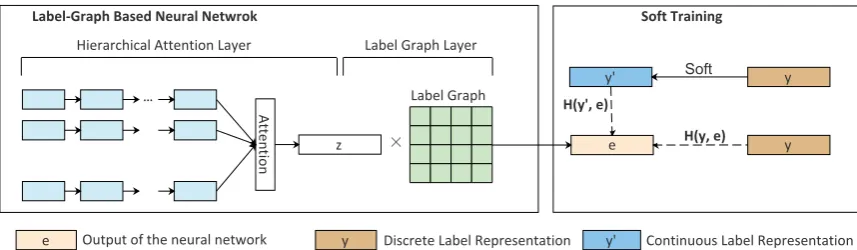
The proposed approach contains two parts: a label-graph based neural network and a soft train-ing mechanism with continuous label representa-tion. An illustration of the proposed method is shown in Figure1.
4.1 Label-Graph Based Neural Network
The first layer is a hierarchical attention layer (Yang et al., 2016) that lets the model to pay more or less attention to individual words
3https://music.douban.com 4
Attention
z Hierarchical Attention Layer
e y'
y Label Graph
Label-Graph Based Neural Netwrok Soft Training
H(y', e)
H(y, e)
y' Continuous Label Representation
y Discrete Label Representation
e Output of the neural network
Label Graph Layer
×
y Soft
[image:3.595.84.513.61.186.2]...
Figure 1: An illustration of the proposed approach. Left: The label-graph based neural network. Right: The soft training method. The label graph defines the relations of labels.eis the label probability distribution. Soft training means that we combine the continuous label representationy0 and the discrete label representationytogether to train the model. The hierarchical attention layer is responsible for extracting style-related information. The label graph layer and soft training are used for exploiting label correlations.
and reviews when constructing “raw” label probability distributionz.
Label Graph. To explicitly take advantage of the label correlations when classifying music styles, we add a label graph layer to the network. This layer takeszas input and generates a “soft” label probability distributione.
Formally, we denote G ∈ Rm×m as the label
graph, wheremis the number of labels,G is ini-tialized by an identity matrix. An elementG[li, lj]
is a real-value score indicating how likely labelli
and labelljare related. The graphGis a part of
pa-rameters and can be learned by back-propagation. Then, given the “raw” label probability distri-butionz and the label graph G, the output of this layer is:
e= sigmoid(z· G). (1)
The probability of lj is not only determined
by the current classification result, but also deter-mined by other labels probabilities and their corre-lations tolj. For example, the probability of a
bel heavily linked with many high-probability la-bels will be increased.
4.2 Soft Training
Given a predicted label probability distributione
and a target discrete label representation y, the typical loss function is computed as
L(θ) =H(y,e) =−
m
X
i=1
yilogei, (2)
whereθdenotes all parameters, andmis the num-ber of the labels. The functionHdenotes the cross entropy between two distributions.
However, the widely used discrete label repre-sentation does not apply to the task of music style classification, because the music styles are not mu-tually exclusive and highly related to each other. The discrete distribution without label relations makes the model over-distinguish the related la-bels. Therefore, it is hard for the model to learn the label correlations.
Instead, we propose a soft training method by combining a discrete label representation y with a correlated-based continuous label representation
y0. The probability gap between two similar labels iny0should not be large.
A straight-forward approach to produce the continuous label representation is to use the label graph matrixGto transform the discrete represen-tationyinto a continuous form:
y0=y· G. (3)
Based on the discrete label representationyand continuous label representation y0, we define the loss function as
Loss(θ) =H(e,y) +H(e,y0), (4)
where the lossH(e,y) aims to correctly classify labels, and the loss H(e,y0) aims to avoid the over-distinguishing problem and to better learn la-bel correlations.
5 Experiment
Models OE(-) HL(-) Macro F1(+) Micro F1(+) ML-KNN 77.3 0.094 23.6 38.1 Binary Relevance 74.4 0.083 24.7 41.8 Classifier Chains 67.5 0.107 29.9 44.3 Label Powerset 56.2 0.096 37.7 50.3 MLP 71.5 0.081 29.8 45.8 CNN 37.9 0.099 32.5 49.3 LSTM 30.5 0.089 33.0 53.9 HAN 25.9 0.079 52.1 61.0 +Label Graph 23.4 0.077 54.2 62.8 +Soft Training 22.6 0.074 54.4 64.5
Table 2: Comparisons between our approach and the baselines on the test set. OE and HL denote one-error and hamming loss respectively. HAN denotes the hier-archical attention network. “(+)” represents that higher scores are better and “(-)” represents that lower scores are better. It can be seen that the proposed approach significantly outperforms the baselines.
5.1 Evaluation Metrics
Multi-label classification requires different eval-uation metrics compared with traditional single-label classification. In this paper, we use the fol-lowing widely-used evaluation metrics for multi-label classification.
• F1-score: We calculate macro F1 and mi-cro F1, respectively. Mami-cro F1 computes the metric independently for each label and then takes the average as the final score. Micro F1 aggregates the contributions of all labels to compute the average score.
• One-Error: One-error evaluates the fraction of examples whose top-ranked label is not in the gold label set.
• Hamming Loss: Hamming loss counts the fraction of the wrong labels to the total num-ber of labels.
5.2 Baselines
We implement several widely-used multi-label classification methods as baselines, such as ML-KNN (Zhang and Zhou, 2007), Binary Relevance (Tsoumakas et al., 2010), Classi-fier Chains (Read et al., 2011), Label Power-set (Tsoumakas and Vlahavas,2007). The details of baselines can be found at Appendices.
5.3 Results
The results on the test set are summarized in Ta-ble2. The proposed approach significantly outper-forms the baselines, with micro F1 of 64.5, macro F1 of 54.4, and one-error of 22.6, improving the
metrics by 10.6, 21.4, and 7.9 respectively. The improvements are attributed to two parts, a hier-archical attention network and a label correlation mechanism. Only using the hierarchical attention network outperforms the baselines, which shows the effectiveness of hierarchically paying attention to different words and sentences. The greater F1-score is achieved by adding the proposed label graph, which demonstrates that the proposed la-bel graph helps a lot by taking advantage of lala-bel correlations.
It can be clearly seen that with the help of soft training, the proposed method achieves the best performance. Especially, the micro F-score is im-proved from 62.8 to 64.5, and the one-error is re-duced from 23.4 to 22.6. With the new loss func-tion, the model not only knows how to distinguish the right labels from the wrong ones, but also can learn the label correlations that are useful knowl-edge, especially when the input data contains too much style unrelated words for the model to ex-tract all necessary information.
[image:4.595.332.478.410.535.2]5.4 Visualization Analysis
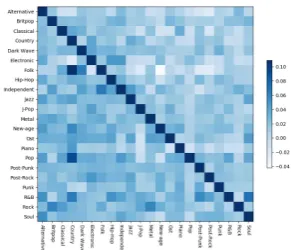
Figure 2: A heatmap of the automatically learned label graph. Deeper color represents closer relation. We can see that some obvious relations are well captured by the model, e.g., “Heavy Metal Music (Metal)” and “Rock”, “Country Music (Country)” and “Folk”.
cor-rectly captures that the most related label for them is “Rock”. For a more complicated relation where “Soul Music” is highly linked with two different labels, “R&B” and “Jazz”, the label graph also correctly capture such relation. These examples demonstrate that the proposed approach performs well in capturing relations among music styles.
5.5 Selected Exmaples
Ground Truth Without LCM With LCM Britpop5, Rock Britpop Britpop,Rock Hip-Hop6, Pop,
R&B7
Electronic Music,
Pop
Pop,R&B
Pop, R&B Pop, Rock, Britpop Pop,R&B Country Music,
Folk, Pop
Country Music,Pop Country Music,
Pop,Folk
Classical Music, New-Age Music8, Piano Music
Piano Music,
Clas-sical Music
Piano Music,
New-Age Music,
[image:5.595.74.290.195.303.2]Classical Music
Table 3: Examples generated by the methods with and without the label correlation mechanism (LCM). The labels correctly predicted by two methods are shown in blue. The labels correctly predicted by the method with the label correlation mechanism are shown in orange. We can see that the method with the label correlation mechanism classifies music styles more precisely.
For clearer understanding, we compare several examples generated with and without the label correlation mechanism in Table 3. By compar-ing gold labels and predicted labels generated by different methods, we find that the proposed label correlation mechanism identifies the related styles more precisely. This is mainly attributed to the learned label correlations. For example, the cor-rect prediction in the first example shows that the label correlation mechanism captures the close re-lation between “Britpop” and “Rock”, which helps the model to generate an appropriate prediction.
5.6 Error Analysis
Although the proposed method has achieved sig-nificant improvements, we also notice that there are some failure cases. In this section, we give the detailed error analysis.
First, the proposed method performs worse on the styles with low frequency in the training set.
5
Britpop is a style of British Rock. 6
Hip-Hop is a mainstream Pop style.
7Rhythm and Blues, often abbreviated as R&B, is a genre
of popular music.
8New-Age Music is a genre of music intended to create
artistic inspiration, relaxation, and optimism. It is used by listeners for yoga, massage, and meditation.
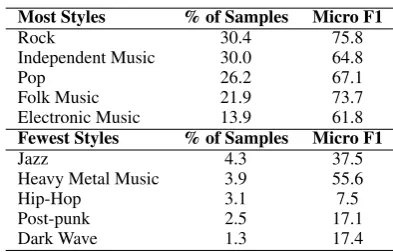
Table 4 compares the performance on the top 5 music styles of highest and lowest frequencies. As we can see, the top 5 fewest music styles get much worse results than top 5 most music styles. This is because the label distribution is highly imbal-anced where unpopular music styles have too little training data.
Second, we find that some music items are wrongly classified into the styles that are similar with the gold styles. For example, a sample with a gold set [Country Music] is wrongly classified into [Folk] by the model. The reason is that some mu-sic styles share many common elements and only subtly differ from each other. It poses a great chal-lenge for the model to distinguish them. For future work, we would like to research how to effectively address this problem.
Most Styles % of Samples Micro F1
Rock 30.4 75.8
Independent Music 30.0 64.8
Pop 26.2 67.1
Folk Music 21.9 73.7
Electronic Music 13.9 61.8 Fewest Styles % of Samples Micro F1
Jazz 4.3 37.5
Heavy Metal Music 3.9 55.6
Hip-Hop 3.1 7.5
Post-punk 2.5 17.1
Dark Wave 1.3 17.4
Table 4: The performance of the proposed method on the most and fewest styles.
6 Conclusions
In this paper, we focus on classifying multi-label music styles with user reviews. To meet the chal-lenge of label correlations, we propose a label-graph neural network and a soft training mecha-nism. Experiment results have showed the effec-tiveness of the proposed approach. The visualiza-tion of label graph also shows that our method per-forms well in capturing label correlations.
Acknowledgments
[image:5.595.316.513.301.427.2]References
Matthew R. Boutell, Jiebo Luo, Xipeng Shen, and Christopher M. Brown. 2004. Learning multi-label scene classification. Pattern Recognition, 37(9):1757–1771.
Wei Chai and Barry Vercoe. 2001. Folk music classi-fication using hidden markov models. In Proceed-ings of International Conference on Artificial Intel-ligence, volume 6.
Keunwoo Choi, Gy¨orgy Fazekas, Mark Sandler, and Kyunghyun Cho. 2017. Convolutional recurrent neural networks for music classification. In Acous-tics, Speech and Signal Processing (ICASSP), 2017 IEEE International Conference on, pages 2392– 2396.
Michael Fell and Caroline Sporleder. 2014. Lyrics-based analysis and classification of music. In Pro-ceedings of COLING 2014, the 25th International Conference on Computational Linguistics: Techni-cal Papers, pages 620–631, Dublin, Ireland. Dublin City University and Association for Computational Linguistics.
Siddharth Gopal and Yiming Yang. 2010. Multilabel classification with meta-level features. In Proceed-ing of the 33rd International ACM SIGIR Confer-ence on Research and Development in Information Retrieval, SIGIR 2010, Geneva, Switzerland, July 19-23, 2010, pages 315–322.
Geoffrey E. Hinton, Oriol Vinyals, and Jeffrey Dean. 2015. Distilling the knowledge in a neural network. CoRR, abs/1503.02531.
Hideto Kazawa, Tomonori Izumitani, Hirotoshi Taira, and Eisaku Maeda. 2004. Maximal margin label-ing for multi-topic text categorization. InAdvances in Neural Information Processing Systems 17 [Neu-ral Information Processing Systems, NIPS 2004, De-cember 13-18, 2004, Vancouver, British Columbia, Canada], pages 649–656.
Diederik P. Kingma and Jimmy Ba. 2014. Adam: A method for stochastic optimization. CoRR, abs/1412.6980.
Wei Li, Xuancheng Ren, Damai Dai, Yunfang Wu, Houfeng Wang, and Xu Sun. 2018a. Sememe prediction: Learning semantic knowledge from unstructured textual wiki descriptions. CoRR, abs/1808.05437.
Wei Li, Zheng Yang, and Xu Sun. 2018b. Exploration on generating traditional chinese medicine prescrip-tion from symptoms with an end-to-end method. CoRR, abs/1801.09030.
Junyang Lin, Qi Su, Pengcheng Yang, Shuming Ma, and Xu Sun. 2018. Semantic-unit-based dilated con-volution for multi-label text classification. arXiv preprint arXiv:1808.08561.
Tianyu Liu, Kexiang Wang, Baobao Chang, and Zhi-fang Sui. 2017. A soft-label method for noise-tolerant distantly supervised relation extraction. In Proceedings of the 2017 Conference on Empirical Methods in Natural Language Processing, pages 1790–1795, Copenhagen, Denmark. Association for Computational Linguistics.
Tomas Mikolov, Ilya Sutskever, Kai Chen, Greg S Cor-rado, and Jeff Dean. 2013. Distributed representa-tions of words and phrases and their compositional-ity. InAdvances in neural information processing systems, pages 3111–3119.
Sergio Oramas, Oriol Nieto, Francesco Barbieri, and Xavier Serra. 2017. Multi-label music genre clas-sification from audio, text, and images using deep features. arXiv preprint arXiv:1707.04916.
Aggelos Pikrakis, Sergios Theodoridis, and Dimitris Kamarotos. 2006. Classification of musical pat-terns using variable duration hidden markov models. IEEE Trans. Audio, Speech & Language Processing, 14(5):1795–1807.
Guo-Jun Qi, Xian-Sheng Hua, Yong Rui, Jinhui Tang, Tao Mei, and Hong-Jiang Zhang. 2007. Correlative multi-label video annotation. InProceedings of the 15th International Conference on Multimedia 2007, Augsburg, Germany, September 24-29, 2007, pages 17–26.
Dan Qin and GZ Ma. 2005. Music style identification system based on mining technology. Computer En-gineering and Design, 26:3094–3096.
Jesse Read, Bernhard Pfahringer, Geoff Holmes, and Eibe Frank. 2011. Classifier chains for multi-label classification.Machine learning, 85(3):333.
Chris Sanden and John Z. Zhang. 2011. Enhancing multi-label music genre classification through en-semble techniques. InProceeding of the 34th Inter-national ACM SIGIR Conference on Research and Development in Information Retrieval, SIGIR 2011, Beijing, China, July 25-29, 2011, pages 705–714.
Xu Sun, Bingzhen Wei, Xuancheng Ren, and Shuming Ma. 2017. Label embedding network: Learning la-bel representation for soft training of deep networks. CoRR, abs/1710.10393.
Grigorios Tsoumakas, Ioannis Katakis, and Ioannis P. Vlahavas. 2010. Mining multi-label data. InData Mining and Knowledge Discovery Handbook, 2nd ed., pages 667–685.
Fei Wang, Xin Wang, Bo Shao, Tao Li, and Mitsunori Ogihara. 2009. Tag integrated multi-label music style classification with hypergraph. InProceedings of the 10th International Society for Music Informa-tion Retrieval Conference, ISMIR 2009, Kobe Inter-national Conference Center, Kobe, Japan, October 26-30, 2009, pages 363–368.
Mei Wang, Xiangdong Zhou, and Tat-Seng Chua. 2008. Automatic image annotation via local multi-label classification. InProceedings of the 7th ACM International Conference on Image and Video Re-trieval, CIVR 2008, Niagara Falls, Canada, July 7-9, 2008, pages 17–26.
Bingzhen Wei, Xuancheng Ren, Xu Sun, Yi Zhang, Xi-aoyan Cai, and Qi Su. 2018. Regularizing output distribution of abstractive chinese social media text summarization for improved semantic consistency. CoRR, abs/1805.04033.
Changsheng Xu, Namunu C Maddage, Xi Shao, Fang Cao, and Qi Tian. 2003. Musical genre classifi-cation using support vector machines. In Acous-tics, Speech, and Signal Processing, 2003. Proceed-ings.(ICASSP’03). 2003 IEEE International Confer-ence on, volume 5, pages V–429.
Pengcheng Yang, Xu Sun, Wei Li, Shuming Ma, Wei Wu, and Houfeng Wang. 2018. Sgm: Sequence generation model for multi-label classification. In Proceedings of the 27th International Conference on Computational Linguistics, pages 3915–3926, Santa Fe, New Mexico, USA. Association for Computa-tional Linguistics.
Zichao Yang, Diyi Yang, Chris Dyer, Xiaodong He, Alex Smola, and Eduard Hovy. 2016. Hierarchi-cal attention networks for document classification. InProceedings of the 2016 Conference of the North American Chapter of the Association for Computa-tional Linguistics: Human Language Technologies, pages 1480–1489, San Diego, California. Associa-tion for ComputaAssocia-tional Linguistics.
Min-Ling Zhang and Zhi-Hua Zhou. 2007. ML-KNN: A lazy learning approach to multi-label learning. Pattern Recognition, 40(7):2038–2048.
Yatong Zhou, Taiyi Zhang, and Jiancheng Sun. 2006. Music style classification with a novel bayesian model. In Advanced Data Mining and Appli-cations, Second International Conference, ADMA 2006, Xi’an, China, August 14-16, 2006, Proceed-ings, pages 150–156.
A Appendices
A.1 Training Details
In the proposed method and baselines, we use skip gram (Mikolov et al.,2013) to get pre-trained word embeddings of reviews. The Jieba toolkit is used to split sentences into words. To help with the training of the label graph, we use soft tar-get mechanism on the continuous label represen-tations (Hinton et al.,2015;Sun et al.,2017;Liu et al., 2017) and add the negative of the l2 loss of the difference between the label graph and the identity matrix to the loss function. For evaluation, we introduce a hyper-parameter p. If the proba-bility of a style is greater than p, we consider it as one of the final music styles. We tune hyper-parameters based on the performance on the val-idation set. We set p to 0.2, hidden size to 128, embedding size to 128, vocabulary size to 135K, learning rate to 0.001, and batch size to 128. The optimizer is Adam (Kingma and Ba,2014) and the maximum training epoch is set to 100. We choose parameters with the best Micro F1 scores on the validation set and then use the selected parameters on the test set.
A.2 Baselines
We implement the following widely-used multi-label classification methods for comparison. Their inputs are the music representations which are pro-duced by averaging review representations. The review representation is obtained by averaging word embeddings.
• ML-KNN (Zhang and Zhou, 2007): It is a multi-label learning approach derived from the traditional K-Nearest Neighbor (KNN) algorithm.
• Binary Relevance (Tsoumakas et al., 2010): It decomposes a multi-label learning task into a number of independent binary learning tasks. It learns several single binary models without considering the dependencies among labels.
• Classifier Chains (Read et al.,2011): It takes label dependencies into account and keeps the computational efficiency of the binary rel-evance method.
• Label Powerset (Tsoumakas and Vlahavas,
2007): All classes assigned to an example are
combined into a new and unique class in this method.
• MLP: It feeds the music representations into a multi-layer perceptron, and generates the probability of music styles through a sigmoid layer.
Different from the above baselines, the following two methods only take word embeddings as in-puts. Similar to MLP, they produce label proba-bility distribution by a sigmoid function.
• CNN: It includes two layers of CNN which has multiple convolution kernels.