Proceedings of the Third Conference on Machine Translation (WMT), Volume 2: Shared Task Papers, pages 304–323
Findings of the Third Shared Task on Multimodal Machine Translation
Lo¨ıc Barrault1, Fethi Bougares1, Lucia Specia2,
Chiraag Lala2,Desmond Elliott3 and Stella Frank4
1LIUM, University of Le Mans
2Department of Computer Science, University of Sheffield 3Department of Computer Science, University of Copenhagen
4Centre for Language Evolution, University of Edinburgh
Abstract
We present the results from the third shared task on multimodal machine translation. In this task a source sentence in English is supple-mented by an image and participating systems are required to generate a translation for such a sentence into German, French or Czech. The image can be used in addition to (or instead of) the source sentence. This year the task was extended with a third target language (Czech) and a new test set. In addition, a variant of this task was introduced with its own test set where the source sentence is given in multiple languages: English, French and German, and participating systems are required to generate a translation in Czech. Seven teams submitted 45 different systems to the two variants of the task. Compared to last year, the performance of the multimodal submissions improved, but text-only systems remain competitive. 1 Introduction
The Shared Task on Multimodal Machine Transla-tion tackles the problem of generating a descripTransla-tion of an image in a target language using the image itself and its English description. This task can be addressed as either a pure translation task from the source English descriptions (ignoring the cor-responding image), or as a multimodal translation task where the translation process is guided by the image in addition to the source description.
Initial results in this area showed the potential for visual context to improve translation quality (Elliott et al., 2015; Hitschler et al., 2016). This was followed by a wide range of work in the first two editions of this shared task at the WMT in 2016 and 2017 (Specia et al., 2016; Elliott et al., 2017). This year we challenged participants to target the task of multimodal translation, with two variants:
• Task 1:Multimodal translationtakes an
im-age with a source languim-age description that is then translated into a target language. The training data consists of source-target parallel sentences and their corresponding images.
• Task 1b: Multisource multimodal transla-tiontakes an image with a description in three source languages that is then translated into a target language. The training data consists of source-target parallel data and their corre-sponding images, but where the source sen-tences are presented in three different lan-guages, all parallel.
Task 1 is identical to previous editions of the shared task, however, it now includes an addi-tional Czech target language. Therefore, partic-ipants can submit translations to any of the fol-lowing languages: German, French and Czech. This extension means the Multi30K dataset (Elliott et al., 2016) is now 5-way aligned, with images described in English, which are translated into Ger-man, French and Czech.1 Task 1b is similar to Task 1; the main difference is that multiple source lan-guages can be used (simultaneously) and Czech is the only target language.
We introduce two new evaluation sets that ex-tend the existing Multi30K dataset: a set of 1071 English sentences and their corresponding images and translations for Task 1, and 1,000 translations for the 2017 test set into Czech for Task 1b.
Another new feature of this year’s shared task is the introduction of a new evaluation metric: Lexi-cal Translation Accuracy (LTA), which measures
1The current version of the dataset can be found here:
https://github.com/multi30k/dataset
the accuracy of a system at translating correctly a subset of ambiguous source language words.
Participants could submit both constrained (shared task data only) and unconstrained (any data) systems for both tasks, with a limit of two systems per task variant and language pair per team.
2 Datasets
The Multi30K dataset (Elliott et al., 2016) is the primary resource for the shared task. It contains 31K images originally described in English (Young et al., 2014) with two types of multilingual data: a collection of professionally translated German sentences, and a collection of independently crowd-sourced German descriptions.
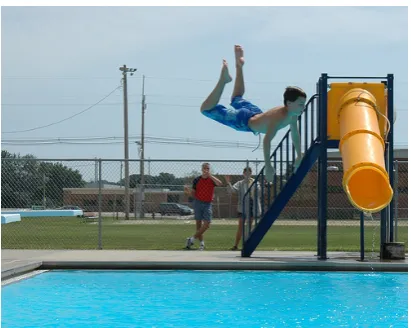
Over the two last years, we have extended the Multi30K dataset with 2,071 new images and two additional languages for the translation task: French and Czech. Table 1 presents an overview of the new evaluation datasets. Figure 1 shows an example of an image with an aligned English-German-French-Czech description.
This year we also released a new version of the evaluation datasets featuring a subset of sentences that contain ambiguous source language words, which may have different senses in the target lan-guage. We expect that these ambiguous words could benefit from additional visual context.
In addition to releasing the parallel text, we also distributed two types of visual features ex-tracted from a pre-trained ResNet-50 object recog-nition model (He et al., 2016) for all of the im-ages, namely the ‘res4 relu’ convolutional features (which preserve the spatial location of a feature in the original image) and averaged pooled features.
Multi30K Czech Translations
This year the Multi30K dataset was extended with translations of the image descriptions into Czech. The translations were produced by 15 workers (uni-versity and high school students and teachers, all with a good command of English) at the cost of EUR 3,500. The translators used the same platform that was used to collect the French translations for the Multi30K dataset. The Czech translators had access to the source segment in English and the image only (no automatic translation into Czech was presented). The translated segments were automatically checked for mismatching punctua-tion, spelling errors (usingaspell), inadequately short and long sentences, and non-standard
charac-En: A boy dives into a pool near a water slide.
De: Ein Junge taucht in der N¨ahe einer Wasserrutsche in ein Schwimmbecken.
[image:2.595.314.520.60.224.2]Fr: Un garc¸on plonge dans une piscine pr`es d’un toboggan. Cs: Chlapec sk´aˇce do baz´enu pobl´ıˇz skluzavky.
Figure 1: Example of an image with a source
de-scription in English, together with its German, French and Czech translations.
ters. The segments containing errors were manually checked and fixed if needed. In total, 5,255 trans-lated segments (16%) were corrected. After the manual correction, 1% of the segments were sam-pled and manually annotated for translation quality. This annotation task was performed by three anno-tators (and every segment was annotated by two different people to measure annotation agreement). We found that 94% of the segments did not contain any spelling errors, 96% of the segments fully pre-served the meaning, and 75% of translations were annotated as fluent Czech. The remaining 25% contained some stylistic problems (usually inap-propriate lexical choice and/or word order adopted from the English source segment). However, the annotation agreement for stylistic problems was substantially lower compared to other categories due to the subjectivity of deciding on the best style for a translation.
Test 2018 dataset
As our new evaluation data for Task 1, we col-lected German, French and Czech translations for the test set used in the 2017 edition of the Multi-lingual Image Description Generation task, which only contained English descriptions. This test set contains images from five of the six Flickr groups used to create the original Flickr30K dataset2. We
Training set Development set Test set 2018 - Task 1 Test set 2018 - Task 1b
[image:3.595.88.279.164.312.2]Instances 29,000 1,014 1071 1,000
Table 1: Overview of the Multi30K training, development and 2018 test datasets. The figures correspond
to tuples with an image and parallel sentences in four languages: English, German, French and Czech.
Group Task 1 Task 1b
Strangers! 154 150
Wild Child 83 83
Dogs in Action 92 78
Action Photography 259 238 Flickr Social Club 263 241 Everything Outdoor 214 206
Outdoor Activities 6 4
Table 2: Distribution of images in the Test 2018
dataset by Flickr group.
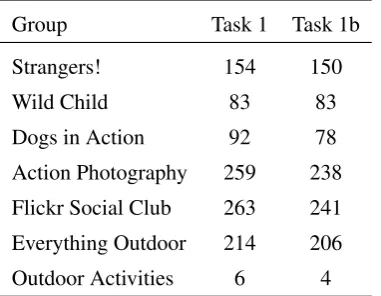
sampled additional images from two thematically related groups (Everything Outdoor and Flickr So-cial Club) because Outdoor Activities only returned 10 new CC-licensed images and Flickr-Social no longer exists. The translations were collected us-ing the same procedure as before for each of the languages: professional translations for German and internally crowdsourced translations for French and Czech (see (Elliott et al., 2017)), as described above. The new evaluation data for Task 1b con-sists of Czech translations, which we collected fol-lowing the procedure described above. Table 2 shows the distribution of images across the groups and tasks. We initially downloaded 2,000 images per Flickr group, which were then manually filtered by three of the authors. The filtering was done to re-move (near) duplicate images, clearly watermarked images, and images with dubious content. This process resulted in a total of 2,071 images, 1,000 were used for Task 1 and 1,071 for Task 1b.
Dataset for LTA
In this year’s task we also evaluate systems using Lexical Translation Accuracy (LTA) (Lala and Spe-cia, 2018). LTA measures how accurately a system translates a subset of ambiguous words found in the Multi30K corpus. To measure this accuracy, we extract a subset of triplets form the Multi30K dataset in the form(i, aw, clt)whereiis the index
representing an instance in the test set,aw is an ambiguous word in English found in that instance i, andcltis the set of correct lexical translations of awin the target language that conform to the con-texti. A word is said to be ambiguous in the source language if it has multiple translations (as given in the Multi30K corpus) with different meanings.
We prepared the evaluation dataset following the procedure described in Lala and Specia (2018), with some additional steps. First, the parallel text in the Multi30K training and the validation sets are decompounded with SECOS (Riedl and Biemann, 2016) (for German only) and lemmatised3. Sec-ond, we perform automatic word alignment using fast align (Dyer et al., 2013) to identify the English words that are aligned to two or more different words in the target language. This step results in a dictionary of{key : val} pairs, wherekey is a potentially ambiguous English word, andvalis the set of words in the target language that align tokey. This dictionary is then filtered by humans, students of translation studies who are fluent in both the source and target languages, to remove incorrect/noisy alignments and unambiguous in-stances, resulting in a cleaned dictionary contain-ing {aw : lt} pairs, where aw is an ambiguous English word, andlt is the set of lexical transla-tions ofawin the corpus. For English-Czech, we were unable to perform this ‘human filtering’ step, and so we use the unfiltered, noisy dictionary. Ta-ble 3 shows summary statistics about number of ambiguous words and the total number of their instances in the training and validation sets.
Given a dictionary, we identify instancesiin the test sets4 which contain an ambiguous word aw from the dictionary, resulting in triplets of the form
(i, aw, lt). At this stage we again involve human
3For English, German and French, we use the tool from
http://staffwww.dcs.shef.ac.uk/people/ A.Aker/activityNLPProjects.html. For Czech, we pre-processed the data using MorphoDiTa (Strakov´a et al., 2014) from http://ufal.mff.cuni.cz/ morphodita
Language Pair Ambiguous Words Instances
EN-DE 745 53,868
EN-FR 661 44,779
[image:4.595.314.519.61.198.2]EN-CS 3217 187,495
Table 3: Statistics of the ambiguous words extracted
from the training and validation sets after human filtering (dictionary filtering). For EN-CS, the num-bers are larger because we could not perform the dictionary filtering step.
annotators (students of translation studies) to select, from the set of lexical translationslt, only those translations, denoted asclt, which conform to the source contexti- both image and its English de-scription. For example, in the test instance shown in Figure 2, hat is an ambiguous word aw and
{kappe, m¨utze, h¨uten, kopf, kopfbedeckung,
kopf-bedeckungen, hut, helm, h¨ute, helmen, m¨utzen}is
the set of its lexical translations lt. The human annotator looked at both the image and its descrip-tion and then selected the following subset{kappe,
m¨utze, m¨utzen}as the correct lexical translations
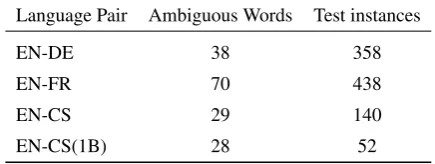
cltthat conform to the context of the test instance in Figure 2. We also asked annotators to expand thecltset with other synonyms outside thelt set that satisfy the context if they can. The number of ambiguous words and instances for each language pair in the resulting dataset for the test instances is given in Table 4. For English-Czech, while the first human filtering step (dictionary filtering) was not performed, the second human filtering step (test set filtering) was done. We note that this cleaning done by the Czech-English annotators was very se-lective, most likely due to the noisier nature of the initial annotations from the unfiltered dictionary.
Given a human filtered dictionary, the LTA eval-uation is straight forward: for each MT system submission, we check if any word incltis found in the translation of the submission’sithinstance.The preprocessing steps may result in mismatches due to sub-optimal handling of morphological variants, but we do not expect this to be a rare event because the dictionaries, gold standard text, and system sub-missions are pre-processed using the same tools.
3 Participants
This year we attracted submissions from seven groups. Table 5 presents an overview of the groups
En: a cute boy with hishatlooking out of a window. De: ein s¨uß jung mit m¨utze blicken aus einem fenster. aw:hat
lt:{kappe, m¨utze, h¨uten, kopf, kopfbedeckung, kopfbedeck-ungen, hut, helm, h¨ute, helmen, m¨utzen}
clt:{kappe, m¨utze, m¨utzen}
Figure 2: A test instance with ambiguous wordaw
and lexical translation optionslt. Human annotator corrects/selects those optionscltwhich conform to the source sentenceEnand corresponding image.
Language Pair Ambiguous Words Test instances
EN-DE 38 358
EN-FR 70 438
EN-CS 29 140
EN-CS(1B) 28 52
Table 4: Statistics of dataset used for the LTA eval-uation after human filtering.
and their submission identifiers.
AFRL-OHIO-STATE (Task 1)
The AFRL-OHIO-STATE team builds on their previous year Visual Machine Translation (VMT) submission by combining it with text-only trans-lation models. Two types of models were sub-mitted: AFRL-OHIO-STATE 1 2IMPROVE U is a system combination of the VMT system and an instantiation of a Marian NMT model (Junczys-Dowmunt et al., 2018), and AFRL-OHIO-STATE 1 4COMBO U is a systems combination of the VMT system along with instantiations of Marian, OpenNMT, and Moses (Koehn et al., 2007).
CUNI (Task 1)
[image:4.595.307.525.347.429.2]pseudo-in-ID Participating team
AFRL-OHIOSTATE Air Force Research Laboratory & Ohio State University (Gwinnup et al., 2018) CUNI Univerzita Karlova v Praze (Helcl et al., 2018)
LIUMCVC Laboratoire d’Informatique de l’Universit´e du Maine & Universitat Autonoma de Barcelona Computer Vision Center (Caglayan et al., 2018)
MeMAD Aalto University, Helsinki University & EURECOM (Gr¨onroos et al., 2018) OSU-BAIDU Oregon State University & Baidu Research (Zheng et al., 2018)
SHEF University of Sheffield (Lala et al., 2018)
UMONS Universit´e de Mons (Delbrouck and Dupont, 2018)
Table 5: Participants in the WMT18 multimodal machine translation shared task.
domain data from all available parallel corpora and mix it with the original Multi30k data and the EU Bookshop corpus. At inference time, both sub-mitted models use only the text input. The first model was trained using the parallel data only. The second model is a reimplementation of the Imag-ination model (Elliott and K´ad´ar, 2017) adapted to the Transformer architecture. During training, the model uses the encoder states to predict the image representation. This allows using additional English-only captions from the MSCOCO dataset (Lin et al., 2014).
LIUMCVC (Task 1)
LIUMCVC proposes a refined version of their multimodal attention model (Caglayan et al., 2016), where source-side information from the textual en-coder (i.e. last hidden state of the bidirectional gated recurrent units (GRU)) is now used to fil-ter the convolutional feature maps before the ac-tual decoder-side multimodal attention is computed. The authors also experiment with the impact of L2 normalisation and input image size for convolu-tional feature extraction process and found that multimodal attention without L2normalisation per-forms significantly worse than baseline NMT. MeMAD (Task 1)
The MeMAD team adapts the Transformer neu-ral machine translation architecture to a multimodal setting. They use global image features extracted from Detectron (Girshick et al., 2018), a pre-trained object detection and localisation neural network, and two additional training corpora: MS-COCO (Lin et al., 2014) (an English multimodal dataset, which they extend with synthetic multilingual data) and OpenSubtitles (Lison and Tiedemann, 2016)
(a multilingual, text-only dataset). Their experi-ments show that the effect of the visual features in the system is small; the largest differences in quality amongst the systems tested is attributed to the quality of the underlying text-only neural MT system.
OSU-BAIDU (Tasks 1 and 1b)
For Task 1, the OREGONSTATE system ensem-bles models including some neural machine trans-lation models which only consider text information and multimodal machine translation models which also consider image information. Both types of models use global attention mechanism to align source to target words. For the multimodal model, 1024 dimensional vectors are extracted as image information from a ResNet-101 convolutional neu-ral network and these are used to initialize the de-coder. The models are trained using scheduled sampling (Bengio et al., 2015) and reinforcement learning (Rennie et al., 2017) to further improve performance.
For Task 1b, for each language in the multisource inputs, single-source models are trained using the same architecture as in Task 1. The resulting mod-els are ensembled with different combinations. The final submissions only ensemble models trained from English-to-Czech pair, which outperforms other combinations on the development set. SHEF (Tasks 1 and 1b)
trans-lation candidates. In the second (re-ranking) step, the 10-best candidates are re-ranked using word sense disambiguation (WSD) approaches: (i) most frequency sense (MFS), (ii) lexical translation (LT) and, (iii) multimodal lexical translation (MLT). Models (i) and (ii) are baselines, whilst MLT is a novel multimodal cross-lingual WSD model. The main idea is to have the cross-lingual WSD model select the translation candidate which correctly dis-ambiguates ambiguous words in the source sen-tence and the intuition is that the image could help in the disambiguation process. The re-ranking cross-lingual WSD models are based on neural se-quence learning models for WSD (Raganato et al., 2017; Yuan et al., 2016) trained on the Multi-modal Lexical Translation Dataset (Lala and Spe-cia, 2018). More specifically, they train LSTMs as taggers to disambiguate/translate every word in the source sentence.
For Task 1b, the SHEF team explores three ap-proaches. The first approach takes the concate-nation of the 10-best translation candidates of German-Czech, French-Czech and English-Czech neural MT systems and then re-ranks them using the same multimodal cross-lingual WSD model as in Task 1. The second approach explores consen-sus between the different 10-best lists. The best hypothesis is selected according to the number of times it appears in the different n-bests. The high-est ranked hypothesis with the majority votes is se-lected. The third approach uses data augmentation: extra source (Czech) data is generated by building systems that translate from German into English and French into English. An English-Czech neural machine translation system is then built and the 10-best list is generated. For re-ranking, classifiers are trained to predict binary scores derived from Meteor for each hypothesis in the 10-best list using word embeddings and image features.
UMONS (Task 1)
The UMONS submission uses as baseline a con-ditional GRU decoder. The architecture is en-hanced with another GRU that receives as input the global visual features provided by the task (i.e. 2048-dimensional ResNet pool5 features) as well as the hidden state of the second GRU. Each GRU disposes of 256 computational units. All non-linear transformations in the decoder (apart from the tex-tual attention module) use gated hyperbolic tangent activations. Both visual and textual representation are separately projected onto a vocabulary-sized
space. At every timestep, the decoder ends up with two modality-dependent probability distributions over the target tokens, eventually merged with an element-wise addition.
Baseline (Tasks 1 and 1b) The baseline system for both tasks is a text-only neural machine transla-tion system built with the NMTPY (Caglayan et al., 2017) following a standard attentive approach (Bah-danau et al., 2015) with a conditional GRU decoder. The baseline was trained using the Adam optimizer, with a learning rate of 5e−5and a batch size of 64. The input embedding dimensionality was set to128
and the remainder of the hyperparameters were kept as default. Bite-pair encoding with 10,000 merge operations was used for all language pairs. For Task 1b, only the English-Czech portion of the training corpus is used.
4 Automatic Metric Results
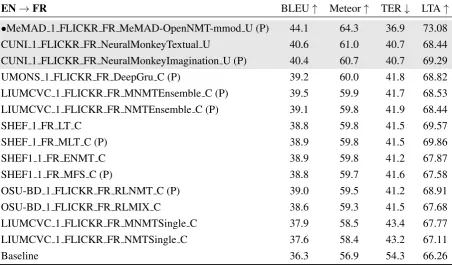
The submissions were evaluated against either pro-fessional or crowd-sourced references. All submis-sions and references were pre-processed to low-ercase, normalise punctuation, and tokenise the sentences using the Moses scripts.5 The eval-uation was performed using MultEval (Clark et al., 2011) with the primary metric of Meteor 1.5 (Denkowski and Lavie, 2014). We also report the results using BLEU (Papineni et al., 2002) and TER (Snover et al., 2006) metrics. The winning submissions are indicated by•. These are the top-scoring submissions and those that are not signifi-cantly different (based on Meteor scores) according the approximate randomisation test (with p-value
≤ 0.05) provided by MultEval. Submissions marked with * are not significantly different from the Baseline according to the same test.
4.1 Task 1: English→German
Table 6 shows the results on the Test 2018 dataset with a German target language. The first observation is that the best-performing system, MeMAD 1 FLICKR DE MeMAD-OpenNMT-mmod U, is substantially better than other systems, although it uses unconstrained data. The MeMAD team did not submit a constrained or monomodal submission, so we cannot conclude whether this improvement comes from the use of multimodal data or from the additional parallel data. However, as mentioned in Section 3, the
5https://github.com/moses-smt/
authors themselves state that the gains mainly come from the additional parallel text data in the monomodal system. The vast majority of systems beat the strong text-only Baseline by a considerable margin. For other teams submitting monomodal and multimodal versions of their systems (e.g. CUNI and LIUMCVC), there does not seem to be a marked difference in automatic metric scores.
We can also observe that the ambiguous word evaluations (LTA) does not lead to the same sys-tem ranking as the automatic metrics. While this could stem mainly from the fact that the LTA eval-uation is only performed on a small subset of the test cases, we consider that these two automatic evaluations are complementary. General transla-tion quality is measured with the standard metrics (BLEU, METEOR and TER), while the LTA evalu-ations captures the ability of the system to model complex words which, in many cases, could require the use of the image input to disambiguate them.
4.2 Task 1: English→French
Table 7 shows the results for the Test 2018 dataset with French as target language. Once again, the MeMAD 1 FLICKR FR MeMAD-OpenNMT-mmod U system performs significantly better than the other systems.6 For teams submitting monomodal and multimodal versions of their sys-tems (e.g. CUNI and LIUMCVC), there does not seem to be a marked difference in automatic met-ric scores. Another interesting observation is that in this case the clearly superior performance of the MeMAD 1 FLICKR FR MeMAD-OpenNMT-mmod U system also shows in the LTA evaluation. All submissions significantly outperformed the English→French baseline system. For this
lan-guage pair, the evaluation metrics are in better agreement about the ranking of the submissions, however, the LTA metric is once again less corre-lated.
4.3 Task 1: English→Czech
The Czech language is a new addition to the 2018 evaluation campaign. Table 8 shows the results for the Test 2018 dataset with Czech as target language. A smaller number of teams have submitted systems for this language pair. This is a more complex language pair as demonstrated
6We note that their original submission had tokenisation issues, which were fixed by the task organisers.
by the lower automatic scores obtained by the systems. The best results are obtained by the CUNI 1 FLICKR CS NeuralMonkeyImagination U system, under the unconstrained condi-tions. The constrained systems all per-form similarly to each other, and all except CUNI 1 FLICKR CS NeuralMonkeyTextual U are significantly better than the baseline system. Interestingly, for the OSU-BD submissions, LTA seems to disagree significantly with the other metrics. More analysis is necessary to understand why this is the case.
4.4 Task 1b: Multisource English, German, French→Czech
Multisource multimodal translation is a new task this year. This task invites participants to use mul-tiple source language inputs, as well as the image, in order to generate Czech translations. Only a few systems have been submitted compared to the other tasks. The results for the Test 2018 dataset are presented in Table 9. We observe that all teams outperformed the text-only baseline, even though in some cases the difference is not significant. No teams used unconstrained data in their submissions.
Again, the LTA results do not follow those of the automatic metrics, particularly for the two top submissions: LTA scores differ by a large mar-gin, while all other metric scores are the same or very similar. This could however result from the very small number of samples available for LTA evaluation for this task: only 52 test instances. Dif-ferences in the translation of a very few number of instances can therefore result in considerably differences in LTA scores.
5 Human Judgment Results
In addition to the automatic metrics evaluation, we conducted human evaluation to assess the transla-tion quality of the submissions. This evaluatransla-tion was undertaken for the Task 1 German, French and Czech outputs as well as for the Task 1b Czech outputs for the Test 2018 dataset. This section de-scribes how we collected the human assessments and computed the results. We are grateful to all of the assessors for their contributions.
5.1 Methodology
EN→DE BLEU↑ Meteor↑ TER↓ LTA↑
•MeMAD 1 FLICKR DE MeMAD-OpenNMT-mmod U (P) 38.5 56.6 44.5 47.49
CUNI 1 FLICKR DE NeuralMonkeyTextual U 32.5 52.3 50.8 46.37
CUNI 1 FLICKR DE NeuralMonkeyImagination U (P) 32.2 51.7 51.7 47.21
UMONS 1 FLICKR DE DeepGru C (P) 31.1 51.6 53.4 48.04
LIUMCVC 1 FLICKR DE NMTEnsemble C (P) 31.1 51.5 52.6 46.65
LIUMCVC 1 FLICKR DE MNMTEnsemble C (P) 31.4 51.4 52.1 45.81
OSU-BD 1 FLICKR DE RLNMT C (P) 32.3 50.9 49.9 45.25
OSU-BD 1 FLICKR DE RLMIX C 32.0 50.7 49.6 46.09
SHEF 1 DE LT C 30.4 50.7 53.0 48.04
SHEF 1 DE MLT C (P) 30.4 50.7 53.0 48.32
SHEF1 1 DE ENMT C 30.8 50.7 52.4 44.41
SHEF1 1 DE MFS C (P) 30.3 50.7 53.1 48.32
LIUMCVC 1 FLICKR DE MNMTSingle C 28.8 49.9 55.6 45.25
LIUMCVC 1 FLICKR DE NMTSingle C 29.5 49.9 54.3 47.77
Baseline 27.6 47.4 55.2 45.25
AFRL-OHIO-STATE 1 FLICKR DE 4COMBO U (P) 24.3 45.4 58.6 46.09
[image:8.595.81.533.73.366.2]AFRL-OHIO-STATE 1 FLICKR DE 2IMPROVE U 10.0 25.4 79.0 25.42
Table 6: Official automatic results for the MMT18 Task 1 on the English→German Test 2018 dataset
(ordered by Meteor). Grey background indicate use of resources that fall outside the constraints provided for the shared task. (P) indicate a primary system designated for human evaluation.
EN→FR BLEU↑ Meteor↑ TER↓ LTA↑
•MeMAD 1 FLICKR FR MeMAD-OpenNMT-mmod U (P) 44.1 64.3 36.9 73.08
CUNI 1 FLICKR FR NeuralMonkeyTextual U 40.6 61.0 40.7 68.44
CUNI 1 FLICKR FR NeuralMonkeyImagination U (P) 40.4 60.7 40.7 69.29
UMONS 1 FLICKR FR DeepGru C (P) 39.2 60.0 41.8 68.82
LIUMCVC 1 FLICKR FR MNMTEnsemble C (P) 39.5 59.9 41.7 68.53
LIUMCVC 1 FLICKR FR NMTEnsemble C (P) 39.1 59.8 41.9 68.44
SHEF 1 FR LT C 38.8 59.8 41.5 69.57
SHEF 1 FR MLT C (P) 38.9 59.8 41.5 69.86
SHEF1 1 FR ENMT C 38.9 59.8 41.2 67.87
SHEF1 1 FR MFS C (P) 38.8 59.7 41.6 67.58
OSU-BD 1 FLICKR FR RLNMT C (P) 39.0 59.5 41.2 68.91
OSU-BD 1 FLICKR FR RLMIX C 38.6 59.3 41.5 67.68
LIUMCVC 1 FLICKR FR MNMTSingle C 37.9 58.5 43.4 67.77
LIUMCVC 1 FLICKR FR NMTSingle C 37.6 58.4 43.2 67.11
Baseline 36.3 56.9 54.3 66.26
Table 7: Official automatic results for the MMT18 Task 1 on the English→French Test 2018 dataset
[image:8.595.77.530.442.707.2]EN→CS BLEU↑ Meteor↑ TER↓ LTA↑ •CUNI 1 FLICKR CS NeuralMonkeyImagination U (P) 31.8 30.6 48.2 70.00
OSU-BD 1 FLICKR CS RLMIX C 30.1 29.7 51.2 54.29
OSU-BD 1 FLICKR CS RLNMT C (P) 30.2 29.5 50.7 60.71
SHEF1 1 CS ENMT C 29.0 29.4 51.1 71.43
SHEF1 1 CS MFS C (P) 27.8 29.2 52.4 73.57
SHEF 1 CS LT C 28.3 29.1 51.7 72.14
SHEF 1 CS MLT C (P) 28.2 29.1 51.7 71.43
Baseline 26.5 27.7 54.4 62.14
[image:9.595.82.522.66.231.2]*CUNI 1 FLICKR CS NeuralMonkeyTextual U 26.8 27.1 55.2 52.14
Table 8: Official automatic results for the MMT18 Task 1 on the English→Czech Test 2018 dataset
(ordered by Meteor). Grey background indicate use of resources that fall outside the constraints provided for the shared task. (P) indicate a primary system designated for human evaluation. Submissions marked with * are not significantly different from the Baseline.
EN,DE,FR→CS BLEU↑ Meteor↑ TER↓ LTA↑
OSU-BD 1b CS RLMIX C 26.4 28.2 52.7 55.77
OSU-BD 1b CS RLNMT C (P) 26.4 28.0 52.1 61.54
SHEF 1b CS CON C 24.7 27.6 52.1 61.54
*SHEF 1b CS MLTC C (P) 24.5 27.5 52.5 61.54
SHEF1 1b CS ARNN C (P) 25.2 27.5 53.9 51.92
*SHEF1 1b CS ARF C 24.1 27.1 54.6 51.92
Baseline 23.6 26.8 54.1 53.85
Table 9: Official automatic results for the MMT18 Task 1b on the English,German,French→Czech Test
2018 dataset (ordered by Meteor). Submissions marked with * are not significantly different from the Baseline.
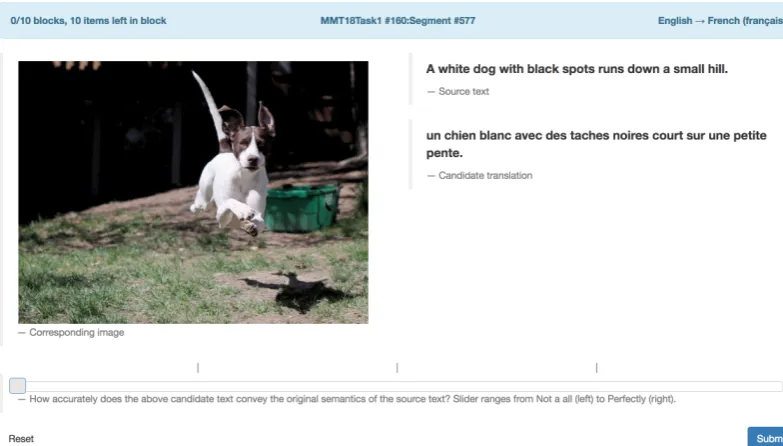
[image:9.595.100.492.509.732.2]the Appraise platform (Federmann, 2012). The annotators (mostly researchers) were asked to eval-uate the semantic relatedness between the source sentence in English and the target sentence in Ger-man, French or Czech. For the Multisource Task (1b), only the English source is presented. For the evaluation task, the image was shown along with the source sentence and the candidate translation. Evaluators were ask to rely on the image when necessary to obtain a better understanding of the source sentence (e.g. in cases where the text was ambiguous). Note that the reference sentence is not displayed during the evaluation to avoid influencing the assessment. Instead, as a control experiment to estimate the quality of the reference sentences (and test the quality of the annotations), we included the references as hypotheses for human evaluation. Figure 3 shows an example of the direct assessment interface used in the evaluation. The score of each translation candidate ranges from 0 (the meaning of the source is not preserved in the target language sentence) to 100 (the meaning of the source is “per-fectly” preserved). The overall score of a given system (z) corresponds to the mean standardised score of its translations.
5.2 Results
For Task 1 English-German translation, we col-lected 3,422 DAs, resulting in a minimum of 300 and a maximum of 324 direct assessments per sys-tem submission, respectively. We collected 2,938 DAs for the English-French translations. This re-sults in a minimum of 280 and a maximum of 307 direct assessments per system submission, re-spectively. We collected 8,096 DAs for the Task 1 English-Czech translation, representing a min-imum of 1,330 and a maxmin-imum of 1,370 direct assessments per system submission. For Task 1b English,German,French→Czech translation, we collected 6,827 direct assessments. The least eval-uated system received 1,345 assessments, while the most evaluated system received 1,386 direct assessments.
Tables 10, 11, 12 and 13 show the results of the human evaluation for the English to German, En-glish to French and EnEn-glish to Czech Multimodal Translation task (Test 2018 dataset) as well as the Multisource Translation task. The systems are or-dered by standardised mean DA scores and clus-tered according to the Wilcoxon signed-rank test at p-level p≤0.05. Systems within a cluster are
con-−0.5 −0.4 −0.3 −0.2 −0.1 0 0.1 0.2 0.3 0.4 0.5 45
46 47 48 49 50 51 52 53 54 55 56 57 58
Human judgments (z)
Meteor
MeMAD MeMAD-OpenNMT-mmod U SHEF 1 DE MLT C
CUNI NeuralMonkeyImagination U SHEF1 1 DE MFS C LIUMCVC MNMTEnsemble C UMONS DeepGru C LIUMCVC NMTEnsemble C OSU-BD RLNMT C AFRL-OHIO-STATE 4COMBO U baseline DE
Figure 4: System performance on the
English→German Test 2018 dataset as mea-sured by human evaluation against Meteor scores.
sidered tied. The supplementary Wilcoxon signed-rank scores can be found in Tables 14, 15 and 16 in Appendix A.
The comparison between automatic and human evaluation are presented in Figures 4, 5, 6 and 7. We can observe that METEOR scores are well cor-related with the human evaluation.
6 Discussion
As mentioned in Section 5, we included the refer-ence sentrefer-ences in the DA evaluation as if they were candidate translations generated by a system. The first observation is that for all language pairs and all tasks, the references (see gold * in Tables 10, 11, 12 and 13) are significantly better than all auto-matic systems with average raw scores above 90%. This does not only validates the references but also the DA evaluation process.
architec-English→German
# Ave % Avez System
1 91.7 0.69 gold DE 1
2 87.2 0.479 MeMAD MeMAD-OpenNMT-mmod U
3 73.5 -0.046 SHEF 1 DE MLT C
73.8 -0.066 CUNI NeuralMonkeyImagination U 72.6 -0.078 SHEF1 1 DE MFS C
71.6 -0.08 LIUMCVC MNMTEnsemble C
72.1 -0.11 UMONS DeepGru C
72.5 -0.112 LIUMCVC NMTEnsemble C 71.1 -0.179 OSU-BD RLNMT C
[image:11.595.155.445.104.296.2]68.6 -0.206 AFRL-OHIO-STATE 4COMBO U 67.4 -0.272 baseline DE
Table 10: Results of the human evaluation of the WMT18 English-German Multimodal Translation task
(Test 2018 dataset). Systems are ordered by standardized mean DA scores (z) and clustered according to Wilcoxon signed-rank test at p-level p≤0.05. Systems within a cluster are considered tied, although systems within a cluster may be statistically significantly different from each other (see Table 14). Systems using unconstrained data are identified with a gray background.
English→French
# Ave % Avez System 1 90.3 0.487 gold FR 1
2 86.8 0.349 MeMAD MeMAD-OpenNMT-mmod U
3 78.5 0.047 CUNI NeuralMonkeyImagination U 77.3 -0.005 UMONS DeepGru C
74.9 -0.05 LIUMCVC NMTEnsemble C 74.9 -0.075 SHEF1 1 FR MFS C
74.5 -0.088 SHEF 1 FR MLT C
73.0 -0.11 LIUMCVC MNMTEnsemble C
74.4 -0.12 OSU-BD RLNMT C
66.0 -0.376 baseline FR
Table 11: Results of the human evaluation of the WMT18 English-French Multimodal Translation task
(Test 2018 dataset). Systems are ordered by standardized mean DA score (z) and clustered according to Wilcoxon signed-rank test at p-level p≤0.05. Systems within a cluster are considered tied, although
[image:11.595.153.444.461.645.2]English→Czech
# Ave % Avez System 1 93.2 0.866 gold CS 1
2 70.2 0.097 CUNI NeuralMonkeyImagination U.txt 62.4 -0.162 SHEF 1 CS MLT C
[image:12.595.157.443.139.267.2]60.6 -0.225 SHEF1 1 CS MFS C 59.1 -0.248 OSU-BD RLNMT C 3 57.8 -0.337 baseline CS
Table 12: Results of the human evaluation of the WMT18 English-Czech Multimodal Translation task
(Test 2018 dataset). Systems are ordered by standardized mean DA score (z) and clustered according to Wilcoxon signed-rank test at p-level p≤0.05. Systems within a cluster are considered tied, although systems within a cluster may be statistically significantly different from each other (see Table 16). Systems using unconstrained data are identified with a gray background.
English,French,German→Czech
# Ave % Avez System 93.6 0.803 gold CS 1b
63.3 -0.149 SHEF 1b CS MLTC C 61.8 -0.178 SHEF1 1b CS ARNN C 62.1 -0.206 OSU-BD 1b CS RLNMT C 59.4 -0.284 baseline CS task1b
Table 13: Results of the human evaluation of the WMT18 English,French,German-Czech Multisource
Multimodal Translation task (Test 2018 dataset). Systems are ordered by standardized mean DA score (z) and clustered according to Wilcoxon signed-rank test at p-level p≤0.05. Systems within a cluster are
[image:12.595.180.418.506.608.2]−0.5 −0.4 −0.3 −0.2 −0.1 0 0.1 0.2 0.3 0.4 0.5 56
57 58 59 60 61 62 63 64 65
Human judgments (z)
Meteor
MeMAD MeMAD-OpenNMT-mmod U CUNI NeuralMonkeyImagination U UMONS DeepGru C LIUMCVC NMTEnsemble C SHEF1 1 FR MFS C SHEF 1 FR MLT C LIUMCVC MNMTEnsemble C OSU-BD RLNMT C baseline FR
Figure 5: System performance on the
English→French Test 2018 dataset as mea-sured by human evaluation against Meteor scores.
−0.5 −0.4 −0.3 −0.2 −0.1 0 0.1 0.2 0.3 0.4 0.5 27
27.5 28 28.5 29 29.5 30 30.5 31
Human judgments (z)
Meteor
CUNI NeuralMonkeyImagination U SHEF 1 CS MLT C SHEF1 1 CS MFS C OSU-BD RLNMT C baseline CS
Figure 6: System performance on the
English→Czech Test 2018 dataset as mea-sured by human evaluation against Meteor scores.
−0.5 −0.4 −0.3 −0.2 −0.1 0 0.1 0.2 0.3 0.4 0.5 26
26.5 27 27.5 28 28.5 29
Human judgments (z)
Meteor
SHEF 1b CS MLT C SHEF1 1 DE MFS C OSU-BD RLNMT C baseline DE
Figure 7: System performance on the
English,German,French→Czech Test 2018
dataset as measured by human evaluation against Meteor scores.
ture (as opposed to recurrent neural networks) com-bined with global image feature that are different from the ResNet features made available by the task organisers. However, according to the authors it seems that most of the improvements come from the additional parallel data.
Many teams proposed a combination of several systems. This is the case for AFRL-OHIO-STATE, LIUMCVC, OSU-BAIDU and SHEF teams. LI-UMCVC also submitted a non-ensembled version of each system. Their conclusion is that ensem-bling multiple systems benefit monomodal and mul-timodal systems.
Lexical Translation Accuracy LTA was a new evaluation for this campaign. Unlike other auto-matic metrics, LTA only evaluates a specific aspect of translation quality, namely lexical disambigua-tion. One of the motivations for multimodality in machine translation is that the visual features could help to disambiguate ambiguous words (El-liott et al., 2015; Hitschler et al., 2016). Our aims in introducing the LTA metric was to directly evaluate the disambiguation performance of participating systems.
The LTA columns in Tables 6, 7, 8, and 9 show some interesting trends. First, for teams submit-ting text-only and multimodal variants of models, the multimodal versions seem to perform better at LTA compared to their text-only counterparts (e.g. CUNI’s systems). This trend is not visible using the Meteor, BLEU, or TER metrics. Second, the SHEF systems that were built precisely to perform cross-lingual LTA-style WSD perform well on this metric but they are not always the best-performing system on this metric.
7 Conclusions
We presented the results of the third shared task on multimodal translation. The shared task attracted submissions from seven groups, who submitted a total of 45 systems across the two proposed tasks. The Multimodal Translation task attracted the ma-jority of the submissions, with fewer groups at-tempting multisource multimodal translation.
The main findings of the shared task are:
(i) Additional data can greatly improve the re-sults as demonstrated by the winning uncon-strained systems.
(ii) Almost all systems achieved better results compared to the baseline text-only translation system. Various text and visual integration schemes have been proposed, leading to only slight changes in the automatic and human evaluation results.
(iii) Automatic metrics and human evaluation pro-vided similar results. However, it is difficult to evaluate the impact of the multimodality. In the future, submission of monomodal equiv-alent of the systems will be encouraged in order to better emphasize the effect of using the visual inputs.
We are considering to change the data in favor of a more ambiguous task where all modalities should be used in order to generate the output. A possibility would be to re-use the list of ambiguous words extracted for LTA computation and select the image/sentence pairs containing one or more of those words.
Acknowledgements
This work was supported by the CHIST-ERA M2CR project (French National Research Agency No. ANR-15-CHR2-0006-01 – Lo¨ıc Barrault and Fethi Bougares), by the MultiMT project (EU H2020 ERC Starting Grant No. 678017 – Lucia Specia and Chiraag Lala), and by an Amazon Re-search Award (Desmond Elliott). We thank the Charles University team for collecting and describ-ing the Czech data. The Czech data collection was supported by the Czech Science Foundation, grant number P103/12/G084.
References
Dzmitry Bahdanau, Kyunghyun Cho, and Yoshua Ben-gio. 2015. Neural machine translation by jointly
learning to align and translate. In Proceedings of
the International Conference on Learning Represen-tations.
Samy Bengio, Oriol Vinyals, Navdeep Jaitly, and Noam Shazeer. 2015. Scheduled sampling for se-quence prediction with recurrent neural networks. InProceedings of the 28th International Conference on Neural Information Processing Systems - Volume
1, pages 1171–1179. MIT Press.
Ozan Caglayan, Adrien Bardet, Fethi Bougares, Lo¨ıc Barrault, Kai Wang, Marc Masana, Luis Herranz, and Joost van de Weijer. 2018. LIUM-CVC submis-sions for WMT18 multimodal translation task. In
Proceedings of the Third Conference on Machine Translation, Volume 2: Shared Task Papers, Brus-sels, Belgium. Association for Computational Lin-guistics.
Ozan Caglayan, Lo¨ıc Barrault, and Fethi Bougares.
2016. Multimodal attention for neural machine
translation.CoRR, abs/1609.03976.
Ozan Caglayan, Mercedes Garc´ıa-Mart´ınez, Adrien Bardet, Walid. Aransa, Fethi. Bougares, and Lo¨ıc Barrault. 2017. NMTPY: A Flexible Toolkit for
Ad-vanced Neural Machine Translation Systems. CoRR,
1706.00457.
Jonathan H Clark, Chris Dyer, Alon Lavie, and Noah A Smith. 2011. Better hypothesis testing for statistical machine translation: Controlling for optimizer insta-bility. In49th Annual Meeting of the Association for Computational Linguistics: Human Language Tech-nologies, pages 176–181.
Jean-Benoit Delbrouck and St´ephane Dupont. 2018. Umons submission for wmt18 multimodal
transla-tion task. In Proceedings of the Third Conference
on Machine Translation, Brussels, Belgium. Associ-ation for ComputAssoci-ational Linguistics.
Michael Denkowski and Alon Lavie. 2014. Meteor uni-versal: Language specific translation evaluation for
any target language. In EACL 2014 Workshop on
Statistical Machine Translation.
Chris Dyer, Victor Chahuneau, and Noah A Smith. 2013. A simple, fast, and effective
reparameteri-zation of IBM model 2. InProceedings of the
Hu-man Language Technology Conference of the North American Chapter of the Association for Computa-tional Linguistics (NAACL 2013), pages 644–649.
Desmond Elliott, Stella Frank, and Eva Hasler. 2015. Multi-language image description with neural
se-quence models. CoRR, abs/1510.04709.
Desmond Elliott, Stella Frank, Khalil Simaan, and Lu-cia SpeLu-cia. 2016. Multi30k: Multilingual
english-german image descriptions. In5th Workshop on
Vi-sion and Language, pages 70–74.
Desmond Elliott and ´Akos K´ad´ar. 2017. Imagination
improves Multimodal Translation. InProceedings
of the Eighth International Joint Conference on Nat-ural Language Processing (Volume 1: Long Papers), pages 130–141, Taipei, Taiwan.
Christian Federmann. 2012. Appraise: An open-source toolkit for manual evaluation of machine translation
output. The Prague Bulletin of Mathematical
Lin-guistics, 98:25–35.
Ross Girshick, Ilija Radosavovic, Georgia
Gkioxari, Piotr Doll´ar, and Kaiming He.
2018. Detectron. https://github.com/
facebookresearch/detectron.
Yvette Graham, Timothy Baldwin, Alistair Moffat, and Justin Zobel. 2015. Can machine translation
sys-tems be evaluated by the crowd alone. Natural
Lan-guage Engineering, 23(1):3–30.
Stig-Arne Gr¨onroos, Benoit Huet, Mikko Kurimo, Jorma Laaksonen, Bernard Merialdo, Phu Pham, Mats Sj¨oberg, Umut Sulubacak, J¨org Tiedemann, Raphael Troncy, and Ra´ul V´azquez. 2018. The MeMAD submission to the WMT18 multimodal
translation task. In Proceedings of the Third
Con-ference on Machine Translation, Brussels, Belgium. Association for Computational Linguistics.
Jeremy Gwinnup, Joshua Sandvick, Michael Hutt, Grant Erdmann, John Duselis, and James Davis. 2018. The afrl-ohio state wmt18 multimodal sys-tem: Combining visual with traditional. In Proceed-ings of the Third Conference on Machine
Transla-tion, Brussels, Belgium. Association for
Computa-tional Linguistics.
Kaiming He, Xiangyu Zhang, Shaoqing Ren, and Jian Sun. 2016. Deep residual learning for image
recog-nition. InIEEE Conference on Computer Vision and
Pattern Recognition, pages 770–778.
Jindrˇrich Helcl, Jindˇrich Libovick´y, and Duˇsan Variˇs. 2018. CUNI system for the WMT18 multimodal translation tasks. InProceedings of the Third Con-ference on Machine Translation, Brussels, Belgium. Association for Computational Linguistics.
Julian Hitschler, Shigehiko Schamoni, and Stefan Rie-zler. 2016. Multimodal Pivots for Image Caption
Translation. In 54th Annual Meeting of the
Asso-ciation for Computational Linguistics, pages 2399– 2409.
Marcin Junczys-Dowmunt, Roman Grundkiewicz, Tomasz Dwojak, Hieu Hoang, Kenneth Heafield, Tom Neckermann, Frank Seide, Ulrich Germann, Alham Fikri Aji, Nikolay Bogoychev, Andr´e F. T. Martins, and Alexandra Birch. 2018. Marian: Fast
neural machine translation in C++. InProceedings
of ACL 2018, System Demonstrations, pages 116– 121, Melbourne, Australia. Association for Compu-tational Linguistics.
Philipp Koehn, Hieu Hoang, Alexandra Birch, Chris Callison-Burch, Marcello Federico, Nicola Bertoldi, Brooke Cowan, Wade Shen, Christine Moran, Richard Zens, et al. 2007. Moses: Open source toolkit for statistical machine translation. In 45th Annual meeting of Association for Computational Linguistics, pages 177–180.
Chiraag Lala, Pranava Madhyastha, Carolina Scarton, and Lucia Specia. 2018. Sheffield submissions for
wmt18 multimodal translation shared task. In
Pro-ceedings of the Third Conference on Machine Trans-lation, Brussels, Belgium. Association for Computa-tional Linguistics.
Chiraag Lala and Lucia Specia. 2018. Multimodal Lex-ical Translation. InProceedings of the Eleventh In-ternational Conference on Language Resources and Evaluation (LREC 2018), Miyazaki, Japan.
Tsung-Yi Lin, Michael Maire, Serge J. Belongie, Lubomir D. Bourdev, Ross B. Girshick, James Hays, Pietro Perona, Deva Ramanan, Piotr Doll´ar, and C. Lawrence Zitnick. 2014. Microsoft COCO:
com-mon objects in context. CoRR, abs/1405.0312.
Pierre Lison and J¨org Tiedemann. 2016. Opensub-titles2016: Extracting large parallel corpora from movie and tv subtitles. InProceedings of the 10th In-ternational Conference on Language Resources and Evaluation (LREC 2016).
Kishore Papineni, Salim Roukos, Todd Ward, and Wei-Jing Zhu. 2002. Bleu: A method for automatic eval-uation of machine translation. In40th Annual Meet-ing on Association for Computational LMeet-inguistics, pages 311–318.
Alessandro Raganato, Claudio Delli Bovi, and Roberto Navigli. 2017. Neural sequence learning models for
word sense disambiguation. InProceedings of the
2017 Conference on Empirical Methods in Natural Language Processing, pages 1156–1167.
Steven J. Rennie, Etienne Marcheret, Youssef Mroueh, Jarret Ross, and Vaibhava Goel. 2017. Self-critical
sequence training for image captioning. In IEEE
Conference on Computer Vision and Pattern Recog-nition, pages 1179–1195, Honolulu, Hawaii. Martin Riedl and Chris Biemann. 2016. Unsupervised
Matthew Snover, Bonnie Dorr, Richard Schwartz, Lin-nea Micciulla, and John Makhoul. 2006. A study of translation edit rate with targeted human annotation. InProceedings of Association for Machine Transla-tion in the Americas.
Lucia Specia, Stella Frank, Khalil Sima’an, and Desmond Elliott. 2016. A shared task on multi-modal machine translation and crosslingual image
description. InFirst Conference on Machine
Trans-lation, pages 543–553.
Jana Strakov´a, Milan Straka, and Jan Hajiˇc. 2014. Open-Source Tools for Morphology, Lemmatiza-tion, POS Tagging and Named Entity Recognition. In Proceedings of 52nd Annual Meeting of the As-sociation for Computational Linguistics: System Demonstrations, pages 13–18, Baltimore, Maryland. Association for Computational Linguistics.
Ashish Vaswani, Noam Shazeer, Niki Parmar, Jakob Uszkoreit, Llion Jones, Aidan N Gomez, Łukasz Kaiser, and Illia Polosukhin. 2017. Attention is all
you need. InAdvances in Neural Information
Pro-cessing Systems, pages 5998–6008.
Peter Young, Alice Lai, Micah Hodosh, and Julia Hock-enmaier. 2014. From image descriptions to visual denotations: New similarity metrics for semantic in-ference over event descriptions. Transactions of the Association for Computational Linguistics, 2:67–78.
Dayu Yuan, Julian Richardson, Ryan Doherty, Colin Evans, and Eric Altendorf. 2016. Semi-supervised word sense disambiguation with neural models.
arXiv preprint arXiv:1603.07012.
Renjie Zheng, Yilin Yang, Mingbo Ma, and Liang Huang. 2018. Ensemble sequence level training for multimodal mt: Osu-baidu wmt18 multimodal
ma-chine translation system report. InProceedings of
the Third Conference on Machine Translation, Brus-sels, Belgium. Association for Computational Lin-guistics.
A Significance tests
English
→
Czech
goldCS 1
CUNINeuralMonk eyImagination
U
SHEF1 CSML TC
SHEF11 CSMFS C
OSU-BDRLNMT C
baselineCS encs
gold
CS
1
-6.9e-100
5.9e-150
3.6e-166
8.3e-158
1.3e-170
CUNI
NeuralMonk
eyImagination
U
-1.5e-10
1.4e-15
2.1e-16
1.5e-22
SHEF
1
CS
ML
T
C
-2.2e-02
6.7e-05
SHEF1
1
CS
MFS
C
-8.2e-03
OSU-BD
RLNMT
C
-2.8e-02
baseline
CS
encs
-Table
16
:
English
→
Czech
W
ilcoxon
signed-rank
test
at
p-le
vel
p
≤
0.05.
‘-’
means
that
the
value
is
higher
than
English,Fr
ench,German
→
Czech
goldCS 1b
SHEF1b CSML TCC
SHEF11b CSARNN C
OSU-BD1b CSRLNMT C
baselineCS .encs.task1b
gold
CS
task1b
-4.4e-127
1.3e-115
3.8e-116
4.1e-132
SHEF
1b
CS
ML
TC
C
-4.3e-03
SHEF1
1b
CS
ARNN
C
-1.2e-02
OSU-BD
1b
CS
RLNMT
C
-baseline
CS
task1b
-Table
17
:
English,French,German
→
Czech
W
ilcoxon
signed-rank
test
at
p-le
vel
p
≤
0.05.
‘-’
means
that
the
value
is
higher
than