Proceedings of the 15th SIGMORPHON Workshop on Computational Research in Phonetics, Phonology, and Morphology, pages 1–10 1
Efficient Computation of Implicational Universals in Constraint-Based
Phonology Through the Hyperplane Separation Theorem
Giorgio Magri CNRS, SFL, UPL [email protected]
Abstract
This paper focuses on the most basic im-plicational universals in phonological the-ory, calledT-orders after Anttila and Andrus (2006). It develops necessary and sufficient constraint characterizations of T-orders within Harmonic Grammar and Optimality Theory. These conditions rest on the rich convex ge-ometry underlying these frameworks. They are phonologically intuitive and have signifi-cant algorithmic implications.
1 Introduction
A typology T is a collection of grammars G1, G2, . . . For instance, T could be the set of syntactic grammars corresponding to all possi-ble combinations of values of a set of parame-ters (Chomsky,1981). Or the set of phonological grammars corresponding to all possible orderings of an underlying set of phonological rules ( Chom-sky and Halle 1968). Or the set of grammars cor-responding to all rankings of an underlying con-straint set (Prince and Smolensky,2004).
The structure induced by a typology T can be investigated though itsimplicational universalsof the form (1). This implication holds provided ev-ery grammar in the typology T that satisfies the
antecedent property P also satisfies the conse-quentpropertyPb(Greenberg 1963).
P −→T Pb (1)
To illustrate, suppose thatTis the typology of syn-tactic grammars. Consider the antecedent property P of having VSO as the basic word order. And the consequent propertyPbof having prepositions
(as opposed to postpositions). In this case, (1) is Greenberg’s implicational universal #3.
In this paper, we are interested in typologies of phonological grammars. We assume a
rep-resentational framework which distinguishes be-tween two representational levels:underlying rep-resentations (URs), denoted asx,bx, . . .; and
sur-face representations(SRs), denoted asy,by, . . . or
z,bz, . . .. A phonological grammar G is a func-tion which takes a URxand returns a SRy. For instance, the phonology of German maps the UR
x= /bE:d/to the SRy= [bE:t](‘bath’). A phono-logical typologyTis a collection of phonological grammars G1, G2, . . . that we assume are all de-fined over the same set of URs (Richness of the Baseassumption;Prince and Smolensky 2004).
Since phonological grammars are functions from URs to SRs, the most basic or atomic an-tecedent propertyP of an implicational universal (1) is the property of mapping a certain URx to a certain SRy. Analogously, the most basic con-sequent property Pb is the property of mapping a
certain UR bx to a certain SR by. We thus focus
on implicational universals of the form (2). This implication holds provided every grammar in the typologyTthat succeeds on the antecedent map-ping (i.e., it maps the antecedent URxto the an-tecedent SR y), also succeeds on the consequent mapping (i.e., it also maps the consequent URbxto
the consequent SRby). This definition makes sense because every grammar in the typology T is de-fined on every UR, so that every grammar can be applied to the two URsxandbx.
(x,y)−→T (bx,by) (2)
The relation→T thus defined over mappings turns out to be a partial order (under mild additional as-sumptions). It is called theT-orderinduced by the typologyT(Anttila and Andrus,2006).
Then the coda also deletes before consonants in that same dialect, so that the UR /cost me/ is re-alized as the SR [cos’ me] (Guy, 1991; Kiparsky,
1993;Coetzee,2004). In other words, the impli-cation(/tV/,[V]) →T (/tC/,[C]) holds relative to the typologyTof English dialects.
Two important phonological frameworks ex-plored in the literature are Harmonic Grammar
(HG;Legendre et al., 1990;Smolensky and Leg-endre, 2006; Potts et al., 2010) and Optimality Theory (OT; Prince and Smolensky, 2004). The crucial idea shared by HG and OT is that the rel-evant properties of phonological mappings are ex-tracted by a set ofnphonologicalconstraintsthat effectively represent discrete phonological map-pings as points ofRn. The goal of this paper is to express an implication(x,y) → (bx,by) in HG and OT in terms of the constraint violations of the two mappings(x,y)and(bx,by)and their competitors.
Section 2 presents the constraint condition for HG T-orders. It rests on the rich geometry un-derlying HG, as it follows from a classical re-sult of convex geometry (theHyperplane Separa-tion Theorem), as detailed in section3. Section4
presents the constraint condition for OT T-orders. It rests on an equivalence between OT and HG T-orders established in section5.
These constraint conditions admit a straightfor-ward interpretation and thus help us better under-stand the phonological import of T-orders. Fur-thermore, they allow us to compute T-orders effi-ciently, circumventing the laborious computation of the entire HG or OT typology (as it is currently done in the literature; see for instance the OT T-order GeneratorbyAnttila and Andrus,2006).
2 Constraint Conditions for HG T-orders
HG assumes a relation Gen which pairs each UR x with a set Gen(x) of candidate SRs. It also assumes a set ofn phonological constraints C1, . . . , Cn. Each constraint Ck takes a
phono-logical mapping(x,y)of a URxand a candidate SR y in Gen(x) and returns the corresponding
number of violations Ck(x,y) ∈ N, a nonnega-tive integer which quantifies the “badness” of that mapping(x,y)from the phonological perspective encoded by that constraint Ck. A weight vector
w = (w1, . . . , wn) ∈ Rn+ assigns a nonnegative weightwk ≥0to each constraintCk.
The w-harmony of a mapping (x,y) is the weighted sum of the constraint violations
multi-plied by −1, namely −Pn
k=1wkCk(x,y).
Be-cause of the minus sign, mappings with a large harmony have few constraint violations. TheHG grammar corresponding to a weight vector w maps a UR x to the candidate SR y in Gen(x)
such that the mapping (x,y) has a larger w-harmony than the mapping(x,z)corresponding to any other candidatezinGen(x)(Legendre et al.,
1990;Smolensky and Legendre,2006;Potts et al.,
2010). TheHG typology (relative to a candidate relation and a constraint set) consists of the HG grammars corresponding to all weight vectors.
We denote by(x,y) −→HG (bx,by) the implication between an antecedent mapping(x,y)and a con-sequent mapping (bx,by) relative to the HG
typol-ogy. We assume that the antecedent URxcomes with only a finite number m of antecedent loser
candidatesz1, . . . ,zmbesides theantecedent
win-nercandidatey. Analogously, we assume that the consequent UR bx comes with only a finite
num-bermb of consequent losercandidatesbz1, . . . ,bzmb
besides theconsequent winnercandidateby. This
assumption is nonrestrictive. In fact, a UR ad-mits only a finite number of HG optimal candi-dates (Magri, 2018). Candidate sets can thus be assumed to be finite without loss of generality.
For each antecedent loserzi, we define the an-tecedent difference vectorC(x,y,zi) as in (3). It
has a component for each constraint Ck defined
as theviolation differenceCk(x,y,zi)between the
number Ck(x,zi) of violations assigned by Ck
to the loser mapping (x,zi) minus the number
Ck(x,y) of violations assigned to the antecedent
winner mapping(x,y).
C(x,y,zi) =
C1(x,zi)−C1(x,y) ..
.
Ck(x,zi)−Ck(x,y)
.. .
Cn(x,zi)−Cn(x,y)
(3)
Theconsequent difference vectorC(bx,by,bzj)is
de-fined analogously, as pitting the consequent win-ner mapping(bx,by)against one of its losers(bx,bzj).
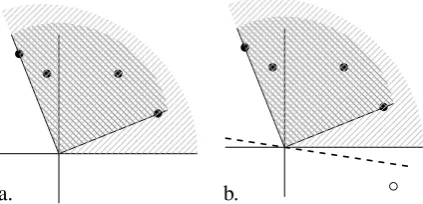
•
• •
•
a.
•
• •
•
[image:3.595.309.535.61.206.2]◦ b.
Figure 1: Geometric representation of condition (4).
complete (both necessary and sufficient) charac-terization of the HG implication(x,y)→HG (bx,by)in
terms of condition (4) stated entirely in terms of antecedent and consequent difference vectors.
Proposition 1 If the antecedent mapping(x,y)is HG feasible, the HG implication(x,y) →HG (bx,by)
holds if and only if for every consequent loser can-didatebzj with j = 1, . . . ,mb, there existm
non-negative coefficientsλ1, . . . , λm ≥0(one for each antecedent loser candidatez1, . . . ,zm) such that
C(bx,by,bzj)≥
m
X
i=1
λiC(x,y,zi) (4)
and furthermore at least one of these coefficients
λ1, . . . , λmis different from zero. 2
Proposition 1 admits the following phonologi-cal interpretation. Condition (4) says that each consequent loserbzjviolates the constraints at least
as much as (some conic combination of) the an-tecedent losers z1, . . . ,zm. In other words, the consequent losers are “worse” than the antecedent losers. The consequent winnerbythus has an
“eas-ier” time beating its losers than the antecedent winnery, as required by the definition of T-order.
Proposition 1 has important algorithmic impli-cations. In fact, checking the definition of T-order (in general, of any implicational universal) directly is costly, because it requires computing the entire typology, which can be large. But propo-sition1says that, in the case of HG, T-orders can be determined locally, by only looking at the an-tecedent and consequent mappings together with their losers. Indeed, this proposition effectively reduces the problem of computing HG T-orders to the problem of finding coefficients λi which
sat-isfy the inequality (4). The latter is a polyhedral feasibility problem that can be solved efficiently with standard linear programming technology. A Python package to compute HG T-orders using condition (4) will be released shortly.
ONS ET
NOC ODA
MAXDEPVDEPC
[image:3.595.77.289.76.178.2]/CC/ [null] 0 0 2 0 0
[CV.CV] 0 0 0 2 0
[CVC] 0 1 0 1 0
/CCC/ [null] 0 0 3 0 0
[CV.CV.CV] 0 0 0 3 0
[CV.CVC] 0 1 0 2 0
[CVC] 0 1 1 1 0
Table 1: Violation profiles for the mappings of the URs/CC/ and/CCC/to their non-harmonically bounded candidates.
Proposition 1 admits the following geometric interpretation. Suppose there are onlyn= 2 con-straints andm = 4antecedent difference vectors C(x,y,zi), represented as the black dots in fig-ure1a. The region{Pm
i=1λiC(x,y,zi)|λi ≥ 0} is the convex conegenerated by these antecedent difference vectors, depicted in dark gray in figure
1a. The region in light gray singles out the points which are at least as large (component by compo-nent) as some point in this cone. Condition (4) thus says that each consequent difference vector C(bx,by,bzj)must belong to this light gray region.
Indeed, suppose that some consequent differ-ence vector does not belong to this light gray re-gion, as represented by the white dot in figure1b. The dashed line leaves the antecedent difference vectors (black dots) and the consequent difference vector (white dot) on two different sides. This means that the HG grammar corresponding to a nonnegative weight vector orthogonal to this line succeeds on the antecedent mapping (x,y) but it fails on the consequent mapping(bx,by), defying the
implication(x,y)→HG (bx,by).
The existence of (a weight vector corresponding to) a dashed line such as the one depicted in figure
1b is geometrically obvious in the case with only n = 2constraints. For an arbitrary number nof constraints, a fundamental result of convex geom-etry, the Hyperplane Separation Theorem (HST;
Rockafellar,1970,§11;Boyd and Vandenberghe,
con-ONSET
NOCODA
MAX
DEPV
DEPC
0 0 3 −3 0
≥1.5 0 0 2 −2 0 +0 0 1 0 −1 0 , 0 1 0 −1 0 ≥0 0 0 2 −2 0 +1 0 1 0 −1 0 , 0 1 1 −2 0
≥0.5 0 0 2 −2 0 +1 0 1 0 −1 0
Table 2: Verifying that condition (4) holds for the HG implication(CC,CV.CV)→(CCC,CV.CV.CV).
straints: ONSET, which penalizes surface syllables starting with a vowel (V); NOCODA, which pe-nalizes surface syllables ending with a consonant (C); MAX, which penalizes deletion of underlying segments; and DEPV and DEPC, which penalize epenthetic vowels and consonants, respectively. We focus on the two URs/CC/and/CCC/. We only consider their non-harmonically bounded candi-dates, listed in table 1 with their constraint vio-lations (the candidate [CVC.CV] is omitted because
indistinguishable by the constraints from[CV.CVC]).
We focus on the implication (CC,CV.CV) → (CCC,CV.CV.CV). The antecedent UR x = /CC/ comes with the winner candidate y = [CV.CV] and the m = 2 loser candidates z1 = [null] and
z2 = [CVC]. There are therefore two antecedent difference vectorsC(x,y,zi), repeated on the right
hand side of each of the three inequalities in table
2. The consequent URbx=/CCC/comes with the winner candidateby = [CV.CV.CV]and themb = 3
loser candidatesbz1 = [null],bz2 = [CV.CVC], and
bz3 =[CVC]. There are therefore three consequent
difference vectorsC(bx,by,bzj), which appear on the
left hand side of the three inequalities in table2. Condition (4) holds: each consequent difference vector is at least as large as a conic combination of the antecedent difference vectors, as shown in table2. Proposition1thus establishes the HG im-plication(CC,CV.CV)→HG (CCC,CV.CV.CV).
Proposition 1can also be used to show that an implication fails in HG. To illustrate, we focus on the implication(CC,CVC) → (CCC,CV.CVC). We consider the consequent difference vector C(/CCC/,[CV.CVC],[null]), which appears on the left hand side of (5). There are two an-tecedent difference vectors C(/CC/,[CVC],[null])
andC(/CC/,[CVC],[CV.CV]), which appear on the right hand side of (5).
ONSET
NOCODA
MAX
DEPV DEPC
0 −1 3 −2 0
6≥λ1
0 −1 2 −1 0
+λ2
0 −1 0 1 0 (5)
Condition (4) fails: the consequent difference vec-tor is not larger than any conic combination of the two antecedent difference vectors, no mat-ter the choice of the coefficients λ1, λ2 ≥ 0. In fact, the inequality (5) for DEPV requires λ1 ≥ 2, whereby the inequality fails for MAX. Proposition1thus establishes that the implication
(CC,CVC)6→HG (CCC,CV.CVC)fails in HG.
3 Proof of Proposition1
The HST has a number of algebraic consequences known as theorems of the alternatives.1 One of these theorems is theMotzkin Transposition The-orem (MTT;Bertsekas, 2009, proposition 5.6.2), which is particularly suited to our needs. It states that conditions (C1) and (C2) below are mutually exclusive (one and only one of them holds) for any two matricesA∈Rp×nandB∈Rq×n.
(C1) There exists a vector w ∈ Rn such that
Aw<0andBw≤0.
(C2) There exist two nonnegative vectors ξ ∈ Rq+ and µ ∈ R
p
+ with µ 6= 0 such that ATµ+BTξ =0.
It is useful to specialize the MTT as follows. Consider some vectors a1, . . . ,am,b ∈ Rn. Let A be the matrix whose p = m rows are −aT1, . . . ,−aTm. Let Bbe the matrix whoseq = n+ 1rows are−eT1, . . . ,−eTn,bT(whereei ∈Rn has all components equal to 0 but for theith com-ponent which is equal to 1). The two conditions (C1) and (C2) thus become (C10) and (C20).
(C10) There exists a nonnegative vectorw ∈ Rn+ such that aT1w > 0, . . . ,aTmw > 0 but bTw≤0.
(C20) There exist some nonnegative coefficients µ1, . . . , µm, ξ ≥ 0 with at least one of
the coefficientsµ1, . . . , µmdifferent from0
such thatξb≥Pm
i=1µiai.
1Throughout this section, all vectors are column vectors;
[image:4.595.69.534.61.133.2]With these preliminaries in place, we now con-sider the HG implication(x,y)→HG (bx,by). Suppose that the HG grammar corresponding to some non-negative weight vector w ∈ Rn
+ succeeds on the antecedent mapping(x,y). This means that the w-harmony of this mapping(x,y) is larger than that of every antecedent loser mapping (x,zi). This condition can be stated in terms of the antecedent difference vectors as in (6), taking advantage of the linearity of the HG harmony.
C(x,y,zi)Tw>0, i= 1, . . . , m (6)
The implication(x,y) →HG (bx,by) then requires the HG grammar corresponding to that weight vec-torwto also succeed on the consequent mapping
(bx,by). This means that the w-harmony of this mapping(bx,by) is larger than that of every
conse-quent loser mapping(bx,bzj). This condition can be
stated in terms of the consequent difference vec-tors as in (7).
C(bx,by,bzj)Tw>0, j= 1, . . . ,mb (7)
In other words, the HG implication (x,y) →HG (bx,by) holds if and only if every nonnegative weight vectorw which satisfies (6) also satisfies (7). Equivalently, the HG T-order holds if and only if for everyj = 1, . . . ,mb, it is false that there ex-ists a nonnegative weight vector w ∈ Rn
+ such that C(x,y,zi)Tw > 0 for every i = 1, . . . , m but C(bx,by,bzj)
Tw ≤ 0. In other words, for
every j = 1, . . . ,mb, condition (C10) is false, with the positions ai = C(x,y,zi) and b =
C(bx,by,bzj). By the MTT, condition (C2
0) must
therefore be true for every j = 1, . . . ,mb. This means that there exist some non-negative coeffi-cientsµ1, . . . , µm, ξ ≥0such that at least one of
the coefficientsµ1, . . . , µmis strictly positive and
furthermore the inequality (8) holds.
ξC(bx,by,bzj)≥ m
X
i=1
µiC(x,y,zi) (8)
The coefficientξin (8) must be strictly positive. In fact, suppose by contradiction thatξ= 0, whereby inequality (8) becomes (9).
0≥
m
X
i=1
µiC(x,y,zi) (9)
Consider a weight vector w whose correspond-ing HG grammar maps the antecedent UR x to
the antecedent winnery, which exists by hypoth-esis. This weight vector w thus satisfies condi-tion (6). Sincewis non-negative, the scalar prod-uct of both sides of (9) with wpreserves the in-equality, yielding (10). But the latter inequality requiresµ1 = · · · = µm = 0, contradicting the
assumption that at least one of the nonnegative co-efficientsµ1, . . . , µm≥0is strictly positive.
0≥
m
X
i=1
µiC(x,y,zi)Tw
| {z }
>0
(10)
Since the coefficient ξ is strictly positive, both sides of (8) can be divided byξ, yielding the in-equality (4) with the positionλi=µi/ξ.
4 Constraint Conditions for OT T-orders
This section extends the convex geometric analy-sis of T-orders developed in the preceding sections from HG to OT. We start by recalling that in OT a constraintCkis said toprefera mapping(x,y)to
another mapping (x,z) provided Ck assigns less
violations to the former than to the latter, namely Ck(x,y) < Ck(x,z). Aconstraint ranking is an
arbitrary linear order over the constraint set. A constraint ranking prefersa mapping (x,y)
to another mapping(x,z)provided the highest -ranked constraint which distinguishes between the two mappings(x,y)and(x,z)prefers(x,y). The fact that the highest-ranked relevant constraint defines the preference of the entire ranking, irre-spectively of the preferences of lower -ranked constraints, is captured by saying that the former constraintstrictly dominatesthe latter constraints. The OT grammar corresponding to a ranking maps a URxto that SRysuch thatprefers the mapping (x,y) to the mapping(x,z) correspond-ing to any other candidatezinGen(x)(Prince and Smolensky,2004). The OT typology (for a given candidate relation and constraint set) consists of the OT grammars corresponding to all rankings.
1, . . . ,mb, no ranking is consistent simultaneously with the two mappings(x,y) and (bx,bzj). In this
section, we develop instead an alternative strategy which uses the HG-to-OT-portability result of Ma-gri (2013) to extend to OT the convex geometric characterization of HG T-orders developed in sec-tions2-3.
To start, we recall that an OT grammar can be construed as an HG grammar (as long as the con-straint violations are bounded, which is the case when the set of URs and the candidate sets are finite). In fact, OT’s strict domination can be mimicked through HG weights which decrease ex-ponentially. Indeed, if a weight is much larger than every smaller weight, the preferences of the constraint with the larger weight cannot be over-come by the preferences of the constraints with smaller weights (Prince and Smolensky, 2004;
Keller, 2006). Since the OT typology is a sub-set of the HG typology, whenever an implica-tion (x,y) →HG (bx,by)holds in HG, the implication (x,y)→OT (bx,by)holds in OT.
Lemma 1 slightly strengthens this conclusion. In fact, OT only cares about constraints’ prefer-ences. Equivalently, about the sign of the violation differences. Thus, the HG implication (x,y) →HG (bx,by) entails not only the corresponding OT im-plication (x,y) →OT (bx,by) but also any other OT implication(x∗,y∗) →OT (bx
∗,
by
∗)whose antecedent
and consequent mappings (x∗,y∗) and (bx∗,by∗)
yield violation differences with the same sign as the original antecedent and consequent mappings
(x,y)and(bx,by). The proof of this lemma simply
uses the observation that exponentially decaying HG weights mimic OT strict domination and it is therefore omitted.
Lemma 1 Given an antecedent mapping (x,y)
with itsmantecedent loser candidatesz1, . . . ,zm,
consider another mapping(x∗,y∗) with the same numbermof loser candidatesz∗1, . . . ,z∗msuch that the m corresponding violation differences have the same sign, in the sense that condition (11) holds fork= 1, . . . , nandi= 1, . . . , m.
Ck(x,y,zi)T0 ⇐⇒ Ck(x∗,y∗,z∗i)T0 (11)
Analogously, given the consequent mapping
(bx,by) with its mb consequent loser candidates
bz1, . . . ,bzmb, consider another mapping (bx ∗,
b
y∗)
with the same number mb of loser candidates
bz
∗ 1, . . . ,bz
∗
b
m such that themb corresponding
viola-tion differences have the same sign, in the sense
that condition (12) holds for k = 1, . . . , n and
j= 1, . . . ,mb.
Ck(bx,by,bzj)T0 ⇐⇒ Ck(bx
∗ ,by
∗ ,bz
∗
j)T0 (12)
The HG implication(x,y) −→HG (bx,by)then entails
the OT implication(x∗,y∗)−→OT (bx∗,by∗).
The preceding lemma establishes an entailment from HG to OT implications. We now want to in-vestigate the reverse entailment from OT to HG implications. Thus, we suppose that an implica-tion (x,y) →OT (bx,by) holds in OT. Of course, that does not entail that the implication(x,y)→HG (bx,by)
between the same two mappings also holds in HG. That is because the HG typology is usually a
propersuperset of the OT typology. And a larger typology yields sparser T-orders. Thus, it makes no sense to try to establish that the OT implica-tion (x,y) →OT (bx,by) entails the HG implication
(x,y)→HG (bx,by)between the same two mappings.
We will try to establish something weaker in-stead: the OT implication(x,y) →OT (bx,by) entails an HG implication(xdif,ydif) →HG (bx
easy,
by
easy)
be-tween an antecedent mapping(xdif,ydif)different from(x,y)and a consequent mapping(bx
easy,
b
yeasy)
different from(bx,by). And we will choose this new
antecedent mapping(xdif,ydif)and this new conse-quent mapping(bx
easy,
by
easy)in such a way that the
new HG implication(xdif,ydif) HG
→ (bxeasy,
b
yeasy)is “more likely to hold” than the original implication
(x,y) →HG (bx,by) and thus validates the entailment
from OT to HG implications.
mapping(bxeasy,
b
yeasy)in such a way that it is “eas-ier” to obtain in HG than the original consequent mapping(bx,by), whereby the superscript “easy”.
Let us now turn to the details. As discussed above around (6), it suffices to define the differ-ence vectors corresponding to the new difficult mapping antecedent(xdif,ydif). Given the original antecedent mapping (x,y) with its m loser can-didates z1, . . . ,zm, we assume that the new an-tecedent mapping(xdif,ydif)comes with the same numbermof loser candidateszdif1 , . . . ,zdifm whose violation differences are defined as in (13). Here,
Ωi is the total number of constraintsCksuch that
Ck prefers the original antecedent winner
map-ping (x,y) to the original antecedent loser map-ping(x,zi), in the sense thatCk(x,y,zi)>0.
Ck(xdif,ydif,zdifi ) =
=
1 ifCk(x,y,zi)>0
0 ifCk(x,y,zi) = 0
−Ωi−1 ifCk(x,y,zi)<0
(13)
The intuition behind this definition (13) is as follows. OT only cares about the sign of the vi-olation differences. Thus, the new vivi-olation dif-ferenceCk(xdif,ydif,zdifi )is defined in such a way
that it has the same sign as the original violation difference Ck(x,y,zi): one is positive or
nega-tive if and only if the other is as well. HG also cares about the size of the violation differences, not only about their sign. In order for the map-ping (xdif,ydif) to be “difficult” in HG, we want its positive violation differences to be as small as possible. For this reason, the positive violation dif-ferences in (13) have been set equal to 1, which is the smallest positive integer. Analogously, in or-der for the mapping(xdif,ydif) to be “difficult” in HG, we want its negative violation differences to be large (in absolute value) relative to the strength of the positive violation differences they have to “fight off”. Since the positive entries are all equal to 1 in (13), the “strength” of the positive entries only depends on their number Ωi. For this
rea-son, the absolute value of the negative violation differences in (13) has been set equal to Ωi + 1.
In conclusion, this definition (13) ensures that the mapping (xdif,ydif) is “difficult” in HG, because the positive violation differences are small and the negative ones are large (in absolute value).
We now turn to the consequents. Given the orig-inal consequent mapping (bx,by) with its mb loser
candidates bz1, . . . ,bzmb, we assume that the new
consequent mapping(bxeasy,
by
easy) comes with the
same numbermb of loser candidatesbz
easy 1 , . . . ,bz
easy
b
m
whose violation differences are defined as in (14). Here Λbj is the total number of constraints Ck
such thatCkprefers the original consequent loser
mapping(bx,bzj)to the original consequent winner
mapping(bx,by), in the sense thatCk(bx,by,bzj)<0.
Ck(bx
easy,
b
yeasy,bzeasyj ) =
=
b
Λj+ 1 ifCk(bx,by,zbj)>0
0 ifCk(bx,by,zjb) = 0
−1 ifCk(bx,by,zjb)<0
(14)
The intuition behind this definition (14) is as follows. Whenever the original violation differ-ence Ck(bx,by,bzj) is positive or negative, the new
violation difference Ck(bx
easy,
by
easy,
bz
easy
j ) is
posi-tive or negaposi-tive as well, so that the original and the new violation differences have the same sign. The size of the new violation differences has been chosen as follows. In order for the mapping
(bx
easy,
by
easy)to be “easy” in HG, we want its
nega-tive violation differences to be as small as possible (in absolute value). For this reason, the negative violation differences in (14) have been set equal to −1, which is the negative integer smallest in ab-solute value. Analogously, in order for the map-ping(bx
easy,
by
easy)to be “easy” in HG, we want its
positive violation differences to be large relative to the strength of the negative violation differences they have to “fight off”. Since the negative entries are all equal to−1 in (14), the “strength” of the negative entries only depends on their numberΛbj.
For this reason, the positive violation differences in (14) have been set equal toΛbj+ 1. In
conclu-sion, this definition (14) ensures that the mapping
(bx
easy,
by
easy)is “easy” in HG, because the positive
violation differences are large and the negative vi-olation differences are small (in absolute value).
We are now ready to put the pieces together. As anticipated, the OT implication (x,y) →OT (bx,by)
might not entail the HG implication (x,y) →HG (bx,by) with the same antecedent and consequent
mappings. Nonetheless, the following lemma 2
ensures that the OT implication (x,y) →OT (bx,by)
does entail the HG implication (xdif,ydif) →HG (bxeasy,byeasy). The intuition is that the lat-ter is less demanding than the HG implication
with many HG grammars). The proof of this lemma is provided in section5, mimicking a rea-soning inMagri(2013).
Lemma 2 The OT implication(x,y) →OT (bx,by) en-tails the HG implication(xdif,ydif)→HG (bx
easy,
b
yeasy)
between the antecedent mapping(xdif,ydif)and the consequent mapping(bxeasy,
by
easy)whose violation
differences are defined in (13) and (14). 2
As remarked explicitly above, (13) ensures that the original antecedent violation differences Ck(x,y,zi)and the new antecedent violation
dif-ferencesCk(xdif,ydif,zdifi ) have the same sign. In
other words, condition (11) holds with the posi-tionsx∗ = xdif, y∗ = ydif, andz∗
i = zdifi .
Anal-ogously, (14) ensures that the original consequent violation differencesCk(bx,by,bzj)and the new
con-sequent violation differencesCk(bx
easy,
by
easy,
bz
easy
i )
have the same sign. In other words, condition (12) holds with the positionsbx
∗ =
bx
easy,
by
∗=
by
easy, and
bz
∗
i =bz
easy
i . The two lemmas1and2can therefore
be combined into the following conclusion: the OT implication (x,y) →OT (bx,by) holds if and only
the HG implication (xdif,ydif) HG
→ (bxeasy,
b
yeasy) holds. We can thus extend to OT the characteri-zation of HG T-orders provided by the HG propo-sition1above, obtaining the following:
Proposition 2 If the antecedent mapping(x,y)is OT feasible, the OT implication (x,y) →OT (bx,by)
holds iff for everyj= 1, . . . ,mb, there existm
non-negative coefficientsλ1, . . . , λm≥0such that
C(bx
easy,
b
yeasy,bz
easy
j )≥ m
X
i=1
λiC(xdif,ydif,zdifi )
(15)
and furthermore at least one of these coefficients
λ1, . . . , λmis different from zero. 2
To illustrate, we have seen at the end of sec-tion 2 that the HG implication (CC,CVC) →HG
(CCC,CV.CVC) fails in HG because condition (4)
fails, as shown in (5). But this entailment
(CC,CVC) →OT (CCC,CV.CVC) does hold in OT. In
fact, the three “easy” consequent difference vec-torsC(bxeasy,
by
easy,
bz
easy
j )in this case are listed on
the left hand side of the three inequalities in ta-ble 3. The two “difficult” antecedent difference vectorsC(xdif,ydif,zdif
i ) are repeated on the right
hand side of the three inequalities. The table thus shows that condition (15) holds.
5 Proof of Lemma2
We assume that the OT implication (x,y) →OT (bx,by)holds. We consider an arbitrary nonnegative
weight vectorw = (w1, . . . , wn)which succeeds
on the “difficult” antecedent mapping (xdif,ydif) and we prove that it is also succeeds on the “easy” consequent mapping (bx
easy,
by
easy), thus securing
the HG implication(xdif,ydif)−→HG (bx
easy,
b
yeasy). The assumption that the weight vec-tor w succeeds on the “difficult” an-tecedent mapping (xdif,ydif) means that
Pn
k=1wkCk(xdif,ydif,zdifi ) > 0 for every
i = 1, . . . , m. The latter inequality can be unpacked as in (16). In step (16a), we have used the definition (13). Here W(x,y,zi) and L(x,y,zi) are the sets of winner-preferring and
loser-preferring constraints relative to the winner
(x,y)and the loser(x,zi). In step (16b), we have upper bounded the sum P
h∈W(x,y,zi)wh with its
largest termmaxh∈W(x,y,zi)wh times the number
Ωi of its addenda. In step (16c), we have lower
bounded the sumP
k∈L(x,y,zi)wk with one of its
terms, as the addenda are all non-negative.
n
X
k=1
wkCk(xdif,ydif,zdifi )>0
(a)
⇐⇒ X
h∈W(x,y,zi)
wh >(Ωi+ 1)
X
k∈L(x,y,zi) wk
(b)
=⇒ Ωi max
h∈W(x,y,zi)wh>(Ωi+ 1)
X
k∈L(x,y,zi) wk
(c)
=⇒ Ωi max
h∈W(x,y,zi)wh>(Ωi+ 1)wk
for everyk∈L(x,y,zi)
=⇒ max
h∈W(x,y,zi)wh > wk
(16) We now show that the conclusion reached in the last line of (16) entails that the strict inequality (17) holds for everyj= 1, . . . ,mb.
max
h∈W(bx,by,bzj)
wh> max k∈L(bx,by,bzj)
wk (17)
In fact, suppose by contradiction that (17) fails for some j = 1, . . . ,mb. Consider a ranking which respects the relative size of the weights, in the sense that conditions [A] and [B] hold for any two constraintsCs, Ctwith weightsws, wt.
[A] Ifws > wt, thenCsis-ranked aboveCk.
[B] Ifws = wt andCs ∈ L(bx,by,bzj) andCt ∈
ONSET
NOCODA
MAX
DEPV
DEPC
0 −1 3 −1 0
≥0.5 0 −2 1 −2 0 +0 0 −2 0 1 0 0 −1 0 2 0 ≥0 0 −2 1 −2 0
+0.5 0 −2 0 1 0 0 0 2 −1 0
≥0.5 0 −2 1 −2 0 +0 0 −2 0 1 0
Table 3: Verifying that condition (15) holds for the OT implication(CC,CVC)→(CCC,CV.CVC).
The ranking succeeds on the antecedent mapping (x,y). In fact, the condition obtained in the last line of (16) says that there exists a constraint which prefers the winner (x,y) to the loser(x,zi)whose weight is strictly larger than the
weight of every constraint which instead prefers the loser (x,zi) to the winner (x,y). By [A], this means that a constraint which prefers the winner (x,y)is-ranked above every constraint that instead prefers the loser (x,zi). The rank-ing therefore prefers the winner (x,y) to the loser (x,zi). Since this conclusion holds for
ev-eryi= 1, . . . , m, the ranking succeeds on the antecedent mapping(x,y).
On the other hand, the ranking fails on the consequent mapping(bx,by). In fact, the
con-tradictory assumption that (17) fails means that
maxh∈W(bx,by,bzj)wh ≤maxk∈L(bx,by,bzj)wk. In other
words, there exists a constraint which prefers the loser(bx,bzj) to the winner(bx,by) whose weight is
strictly larger than or equal to the weights of the constraints which instead prefer the winner(bx,by)
to the loser(bx,bzj). By [A] and [B], the ranking
cannot prefer(bx,by)to(bx,bzj).
The conclusion that succeeds on the an-tecedent (x,y) but fails on the consequent (bx,by)
contradicts the assumption that the implication
(x,y) →OT (bx,by) holds in OT, thus establishing the inequality (17). This inequality can in turn be unpacked as in (18). In step (18a), we have lower boundedΛbjmaxk∈L(
b
x,by,bzj)wkwith the sum P
k∈L(bx,by,bzj)
wk, becauseΛbj is the number of
ad-denda in the sum. In step (18b), we have upper bounded the maximum maxh∈W(bx,by,bzj)wh with
the sumP
h∈W(bx,by,bzj)
wh, because the weights
be-ing summed over are all non-negative. In step (18c), we have used the definition (14) of the
con-straint differencesCk(bx
easy,
by
easy,
bz
easy
j ).
max
h∈W(bx,by,bzj)
wh> max k∈L(bx,by,bzj)
wk=⇒
=⇒ (Λbj + 1) max
h∈W(bx,by,bzj)
wh >Λbj max
k∈L(bx,by,bzj) wk
(a)
=⇒ (Λbj + 1) max h∈W(bx,by,bzj)
wh >
X
k∈L(bx,by,bzj) wk
(b)
=⇒ (Λbj + 1) X
h∈W(bx,by,bzj) wh >
X
k∈L(bx,by,bzj) wk
(c)
=⇒
n
X
k=1
wkCk(bx
easy,
by
easy,
bz
easy
j )>0
(18) The inequality in the last line of (18) holds for ev-ery j = 1, . . . ,mb, ensuring that the weights w succeed on the consequent mapping(bx
easy,
by
easy).
6 Conclusions
A central task of linguistic theory is to character-ize the typological structure predicted by a gram-matical formalism in order to match it to linguistic data. A classical strategy to characterize typologi-cal structure is to chart the implicational universals predicted by the formalism. In this paper, we have focused on the two constraint-based phonological formalisms of HG and OT. And we have consid-ered the simplest type of implicational universals, namely T-orders. The main result of this paper has been a complete constraint characterization of T-orders in HG and OT. These constraint condi-tions rely on an elegant underlying convex geom-etry. These conditions are phonologically intuitive and have important algorithmic implications.
Acknowledgments
The research reported in this paper has been funded by the Agence National de la Recherche
References
Arto Anttila and Curtis Andrus. 2006. T-orders. Manuscript and software (Stanford).
Maximilian Bane and Jason Riggle. 2009. Evaluating Strict Domination: The typological consequences of weighted constraints. In Proceedings of the 45th annual meeting of the Chicago Linguistics Society, pages 13–27.
Dimitri P. Bertsekas. 2009. Convex Optimization The-ory. Athena Scientific, Belmont, MA, USA.
Stephen Boyd and Lieven Vandenberghe. 2004. Con-vex Optimization. Cambridge University Press.
Noam Chomsky. 1981. Lectures on Government and Binding. Mouton de Gruyter.
Noam Chomsky and Morris Halle. 1968. The Sound Pattern of English. Harper and Row, New York.
Andries W. Coetzee. 2004. What it Means to be a Loser: Non-Optimal Candidates in Optimality The-ory. Ph.D. thesis, University of Massachusetts, Amherst.
Joseph H. Greenberg. 1963. Some universals of gram-mar with particular reference to the order of mean-ingful elements. In Joseph H. Greenberg, editor, Universals of Language, pages 73–113. MIT Press, Cambridge, MA.
G. Guy. 1991. Explanation in variable phonology. Language Variation and Change, 3:1–22.
Frank Keller. 2006. Linear Optimality Theory as a model of gradience in grammar. In Gisbert Fanselow, Caroline F´ery, Ralph Vogel, and Matthias Schlesewsky, editors,Gradience in Grammar: Gen-erative Perspectives, pages 270–287. Oxford Uni-versity Press, Oxford.
Paul Kiparsky. 1993. An OT perspective on phonolog-ical variation. Handout (Stanford).
G´eraldine Legendre, Yoshiro Miyata, and Paul Smolensky. 1990. Harmonic Grammar: A for-mal multi-level connectionist theory of linguistic well-formedness: Theoretical foundations. In An-nual conference of the Cognitive Science Society 12, pages 388–395, Mahwah, NJ. Lawrence Erlbaum.
Giorgio Magri. 2013. HG has no computational ad-vantages over OT: towards a new toolkit for compu-tational OT.Linguistic Inquiry, 44.4:569–609.
Giorgio Magri. 2018. Finiteness of optima in constraint-based phonology. Manuscript, CNRS.
Christopher Potts, Joe Pater, Karen Jesney, Rajesh Bhatt, and Michael Becker. 2010. Harmonic Gram-mar with Linear Programming: From linear systems to linguistic typology.Phonology, 27(1):1–41.
Alan Prince and Paul Smolensky. 2004. Optimality Theory: Constraint Interaction in generative gram-mar. Blackwell, Oxford. Original version, Techni-cal Report CU-CS-696-93, Department of Computer Science, University of Colorado at Boulder, and Technical Report TR-2, Rutgers Center for Cogni-tive Science, Rutgers University, April 1993. Avail-able from the Rutgers Optimality Archive as ROA 537.
R. Tyrrell Rockafellar. 1970. Convex Analysis. Prince-ton Landmarks in Mathematics; PrincePrince-ton Univer-sity Press.
Paul Smolensky and G´eraldine Legendre. 2006. The Harmonic Mind. MIT Press, Cambridge, MA.