O
BJ2T
EXT: Generating Visually Descriptive Language from
Object Layouts
Xuwang Yin Vicente Ordonez
Department of Computer Science, University of Virginia, Charlottesville, VA.
[xy4cm, vicente]@virginia.edu
Abstract
Generating captions for images is a task that has recently received considerable at-tention. In this work we focus on caption generation for abstract scenes, or object layouts where the only information pro-vided is a set of objects and their locations. We propose OBJ2TEXT, a sequence-to-sequence model that encodes a set of ob-jects and their locations as an input se-quence using an LSTM network, and de-codes this representation using an LSTM language model. We show that our model, despite encoding object layouts as a se-quence, can represent spatial relationships between objects, and generate descriptions that are globally coherent and semanti-cally relevant. We test our approach in a task of object-layout captioning by us-ing only object annotations as inputs. We additionally show that our model, com-bined with a state-of-the-art object detec-tor, improves an image captioning model from 0.863 to 0.950 (CIDEr score) in the test benchmark of the standard MS-COCO Captioning task.
1 Introduction
Natural Language generation (NLG) is a long standing goal in natural language processing. There have already been several successes in ap-plications such as financial reporting (Kukich,
1983;Smadja and McKeown, 1990), or weather forecasts (Konstas and Lapata, 2012;Wen et al.,
2015), however it is still a challenging task for less structured and open domains. Given recent progress in training robust visual recognition mod-els using convolutional neural networks, the task of generating natural language descriptions for
ar-Word Embedding Location Encoder
group of people are flying a kite END a
Encoder Output START
person person kite
(a) Input Object Layout (b) LSTM Object Layout Encoder
[image:1.595.320.516.222.368.2](c) LSTM Language Model Decoder
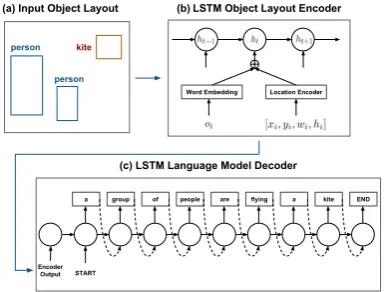
Figure 1: Overview of our proposed model for generating visually descriptive language from ob-ject layouts. The input (a) is an obob-ject layout that consists of object categories and their correspond-ing boundcorrespond-ing boxes, the encoder (b) uses a two-stream recurrent neural network to encode the in-put object layout, and the decoder (c) uses a stan-dard LSTM recurrent neural network to generate text.
bitrary images has received considerable atten-tion (Vinyals et al., 2015; Karpathy and Fei-Fei,
2015;Mao et al.,2015). In general, generating vi-sually descriptive language can be useful for vari-ous tasks such as human-machine communication, accessibility, image retrieval, and search. How-ever this task is still challenging and it depends on developing both a robust visual recognition model, and a reliable language generation model. In this paper, we instead tackle a task of describing ob-ject layouts where the categories for the obob-jects in an input scene and their corresponding locations are known. Object layouts are commonly used for story-boarding, sketching, and computer graphics applications. Additionally, using our object layout captioning model on the outputs of an object de-tector we are also able to improve image
ing models. Object layouts contain rich seman-tic information, however they also abstract away several other visual cues such as color, texture, and appearance, thus introducing a different set of challenges than those found in traditional image captioning.
We propose OBJ2TEXT, a sequence-to-sequence model that encodes object layouts using an LSTM network (Hochreiter and Schmidhuber,
1997), and decodes natural language descriptions using an LSTM-based neural language model1. Natural language generation systems usually con-sist of two steps: content planning, and surface realization. The first step decides on the content to be included in the generated text, and the second step connects the concepts using structural language properties. In our proposed model, OBJ2TEXT, content planning is performed by the encoder, and surface realization is performed by the decoder. Our model is trained in the standard MS-COCO dataset (Lin et al., 2014), which includes both object annotations for the task of object detection, and textual descriptions for the task of image captioning. While most previous research has been devoted to any one of these two tasks, our paper presents, to our knowledge, the first approach for learning mappings between object annotations and textual descriptions. Using several lesioned versions of the proposed model we explored the effect of object counts and loca-tions in the quality and accuracy of the generated natural language descriptions.
Generating visually descriptive language re-quires beyond syntax, and semantics; an under-standing of the physical word. We also take in-spiration from recent work by Schmaltz et al.
(2016) where the goal was to reconstruct a sen-tence from a bag-of-words (BOW) representation using a simple surface-level language model based on an encoder-decoder sequence-to-sequence ar-chitecture. In contrast to this previous approach, our model is grounded on visual data, and its cor-responding spatial information, so it goes beyond word re-ordering. Also relevant to our work isYao et al.(2016a) which previously explored the task of oracle image captioning by providing a lan-guage generation model with a list of manually defined visual concepts known to be present in the image. In addition, our model is able to leverage
1We build on neuraltalk2 and make our Torch code, and an interactive demo of our model available in the following url:
http://vision.cs.virginia.edu/obj2text
both quantity and spatial information as additional cues associated with each object/concept, thus al-lowing it to learn about verbosity, and spatial rela-tions in a supervised fashion.
In summary, our contributions are as follows:
• We demonstrate that despite encoding object layouts as a sequence using an LSTM, our model can still effectively capture spatial in-formation for the captioning task. We per-form ablation studies to measure the individ-ual impact of object counts, and locations.
• We show that a model relying only on ob-ject annotations as opposed to pixel data, per-forms competitively in image captioning de-spite the ambiguity of the setup for this task.
• We show that more accurate and compre-hensive descriptions can be generated on the image captioning task by combining our OBJ2TEXT model using the outputs of a state-of-the-art object detector with a stan-dard image captioning approach.
2 Task
We evaluate OBJ2TEXT in the task of object lay-out captioning, and image captioning. In the first task, the input is an object layout that takes the form of a set of object categories and bounding box pairs ho,li = {hoi, lii}, and the output is natural language. This task resembles the second task of image captioning except that the input is an object layout instead of a standard raster im-age represented as a pixel array. We experiment in the MS-COCO dataset for both tasks. For the first task, object layouts are derived from ground-truth bounding box annotations, and in the second task object layouts are obtained using the outputs of an object detector over the input image.
3 Related Work
Our work is related to previous works that used clipart scenes for visually-grounded tasks includ-ing sentence interpretation (Zitnick and Parikh,
common-sense knowledge about the world. The works ofVedantam et al.(2015b);Eysenbach et al.
(2016) proposed methods to learn common-sense knowledge from clipart scenes, while the method ofYatskar et al.(2016), similar to our work, lever-ages object annotations for natural imlever-ages. Un-derstanding abstract scenes has demonstrated to be a useful capability for both language and vision tasks and our work is another step in this direction. Our work is also related to other language gen-eration tasks such as image and video caption-ing (Farhadi et al., 2010; Ordonez et al., 2011;
Mason and Charniak,2014;Ordonez et al.,2015;
Xu et al.,2015;Donahue et al.,2015;Mao et al.,
2015;Fang et al., 2015). This problem is inter-esting because it combines two challenging but perhaps complementary tasks: visual recogni-tion, and generating coherent language. Fueled by recent advances in training deep neural net-works (Krizhevsky et al.,2012) and the availabil-ity of large annotated datasets with images and captions such as the MS-COCO dataset (Lin et al.,
2014), recent methods on this task perform end-to-end learning from pixels to text. Most re-cent approaches use a variation of an encoder-decoder model where a convolutional neural net-work (CNN) extracts visual features from the in-put image (encoder), and passes its outin-puts to a recurrent neural network (RNN) that generates a caption as a sequence of words (decoder) ( Karpa-thy and Fei-Fei,2015;Vinyals et al.,2015). How-ever, the MS-COCO dataset, containing object an-notations, is also a popular benchmark in com-puter vision for the task of object detection, where the objective is to go from pixels to a collection of object locations. In this paper, we instead frame our problem as going from a collection of object categories and locations (object layouts) to image captions. This requires proposing a novel encod-ing approach to encode these object layouts in-stead of pixels, and allows for analyzing the im-age captioning task from a different perspective. Several other recent works use a similar sequence-to-sequence approach to generate text from source code input (Iyer et al.,2016), or to translate text from one language to another (Bahdanau et al.,
2015).
There have also been a few previous works ex-plicitly analyzing the role of spatial and geomet-ric relations between objects for vision and lan-guage related tasks. The work ofElliott and Keller
(2013) manually defined a dictionary of object-object relations based on geometric cues. The work of Ramisa et al. (2015) is focused on pre-dicting preposition given two entities and their lo-cations in an image. Previous works ofPlummer et al. (2015) and Rohrbach et al. (2016) showed that switching from classification-based CNN net-work to detection-based Fast RCNN netnet-work im-proves performance for phrase localization. The work of Hu et al. (2016) showed that encoding image regions with spatial information is crucial for natural language object retrieval as the task ex-plicitly asks for locations of target objects. Unlike these previous efforts, our model is trained end-to-end for the language generation task, and takes as input a holistic view of the scene layout, poten-tially learning higher order relations between ob-jects.
4 Model
In this section we describe our base OBJ2TEXT model for encoding object layouts to produce text (section4.1), as well as two further variations to use our model to generate captions for real images: OBJ2TEXT-YOLO which uses the YOLO object detector (Redmon and Farhadi,2017) to generate layouts of object locations from real images (sec-tion 4.2), and OBJ2TEXT-YOLO + CNN-RNN which further combines the previous model with an encoder-decoder image captioning which uses a convolutional neural network to encode the im-age (section4.3).
4.1 OBJ2TEXT
OBJ2TEXT is a sequence-to-sequence model that encodes an input object layout as a sequence, and decodes a textual description by predicting the next word at each time step. Given a training data set comprisingN observationsho(n),l(n)i ,
where ho(n),l(n)i is a pair of sequences of
in-put category and location vectors, together with a corresponding set of target captionss(n) , the
encoder and decoder are trained jointly by mini-mizing a loss function over the training set using stochastic gradient descent:
W∗ = arg min
W N X
n=1
L(ho(n),l(n)i,s(n)), (1)
in whichW = W1 W2
function is a negative log likelihood function of the generated description given the encoded object layout
L(ho(n),l(n)i,s(n)) =−logp(sn|hn
L, W2), (2)
wherehn
Lis computed using the LSTM-based en-coder (eqs.3, and4) from the object layout inputs
ho(n),l(n)i, andp(sn|hn
L, W2)is computed using
the LSTM-based decoder (eqs.5,6and7). At inference time we encode an input layout
ho,liinto its representationhL, and sample a sen-tence word by word based on p(st|hL,s<t) as computed by the decoder in time-stept. Finding the optimal sentences∗ = arg maxsp(s|hL) re-quires the evaluation of an exponential number of sentences as in each time-step we haveKnumber of choices for a word vocabulary of sizeK. As a common practice for an approximate solution, we follow (Vinyals et al.,2015) and use beam search to limit the choices for words at each time-step by only using the ones with the highest probabilities.
Encoder: The encoder at each time-step t takes as input a pairhot, lti, whereot is the object cat-egory encoded as a one-hot vector of sizeV, and
lt = [Btx, Bty, Btw, Bth]is the location configura-tion vector that contains left-most posiconfigura-tion, top-most position, and the width and height of the bounding box corresponding to objectot, all nor-malized in the range [0,1] with respect to input im-age dimensions. ot andltare mapped to vectors with the same sizekand added to form the input
xtto one time-step of the LSTM-based encoder as follows:
xt=Woot+ (Wllt+bl), xt∈Rk, (3)
in whichWo ∈ Rk×V is a categorical embedding matrix (the word encoder), and Wl ∈ Rk×4 and bias bl ∈ Rk are parameters of a linear transfor-mation unit (the object location encoder).
Setting initial value of cell state vector ce
0 = 0
and hidden state vectorhe
0 = 0, the LSTM-based
encoder takes the sequence of input(x1, ..., xT1)
and generates a sequence of hidden state vectors (he
1, ..., heT1)using the following step function (we
omit cell state variables and internal transition gates for simplicity as we use a standard LSTM cell definition):
het =LSTM(het−1, xt;W1). (4)
We use the last hidden state vectorhL=heT1as the
encoded representation of the input layouthot,lti to generate the corresponding descriptions.
Decoder: The decoder takes the encoded layout
hL as input and generates a sequence of multino-mial distributions over a vocabulary of words us-ing an LSTM neural language model. The joint probability distribution of generated sentences=
(s1, ..., sT2) is factorized into products of
condi-tional probabilities:
p(s|hL) =
T2 Y
t=1
p(st|hL,s<t), (5)
where each factor is computed using a softmax function over the hidden states of the decoder LSTM as follows:
p(st|hL,s<t) =softmax(Whhdt−1+bh), (6)
hdt =LSTM(hdt−1, Wsst;W2), (7)
whereWsis the categorical embedding matrix for the one-hot encoded caption sequence of symbols. By settinghd
−1 = 0 andcd−1 = 0for the initial
hidden state and cell state, the layout representa-tion is encoded into the decoder network at the0 time step as a regular input:
hd0 =LSTM(hd−1, hL;W2). (8)
We use beam search to sample from the LSTM as is routinely performed in previous literature in order to generate text.
4.2 OBJ2TEXT-YOLO
For the task of image captioning we propose OBJ2TEXT-YOLO. This model takes an image as input, extracts an object layout (object categories and locations) with a state-of-the-art object detec-tion model YOLO (Redmon and Farhadi, 2017), and uses OBJ2TEXT as described in section4.1to generate a natural language description of the in-put layout and hence, the inin-put image. The model is trained using the standard back-propagation al-gorithm, but the error is not back-propagated to the object detection module.
4.3 OBJ2TEXT-YOLO + CNN-RNN
a group of people are flying a kite in the beach
Object Detection
Layout Encoding CNN Visual Features Extraction
[image:5.595.74.289.66.133.2]RNN Language Model
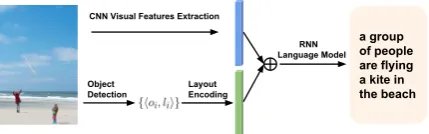
Figure 2: Image Captioning by joint learning of visual features and object layout encoding.
VGG-16 (Simonyan and Zisserman, 2015) con-volutional neural network pre-trained on the Im-ageNet classification task (Russakovsky et al.,
2015). Object layouts are extracted using the YOLO object detection system and its output ob-ject locations are encoded using our proposed OBJ2TEXT encoder. These two streams of in-formation are encoded into vectors of the same size and their sum is input to the language model to generate a textual description. The model is trained using the standard back-propagation al-gorithm where the error is back-propagated to both branches but not the object detection mod-ule. The weights of the image CNN model are fine-tuned only after the layout encoding branch is well trained but no significant overall performance improvements were observed.
5 Experimental Setup
We evaluate the proposed models on the MS-COCO (Lin et al., 2014) dataset which is a pop-ular image captioning benchmark that also con-tains object extent annotations. In the object lay-out captioning task the model uses the ground-truth object extents as input object layouts, while in the image captioning task the model takes raw images as input. The qualities of generated de-scriptions are evaluated using both human evalu-ations and automatic metrics. We train and vali-date our models based on the commonly adopted split regime (113,287 training images, 5000 val-idation and 5000 test images) used in (Karpathy et al., 2016), and also test our model in the MS-COCO official test benchmark.
We implement our models based on the open source image captioning system Neu-raltalk2 (Karpathy et al., 2016). Other config-urations including data preprocessing and train-ing hyper-parameters also follow Neuraltalk2. We trained our models using a GTX1080 GPU with 8GB of memory for 400k iterations using a batch
size of 16 and an Adam optimizer with alpha of 0.8, beta of 0.999 and epsilon of 1e-08. Descrip-tions of the CNN-RNN approach are generated us-ing the publicly available code and model check-point provided by Neuraltalk2 (Karpathy et al.,
2016). Captions for online test set evaluations are generated using beam search of size 2, but score histories on split validation set are based on cap-tions generated without beam search (i.e. max sampling at each time-step).
Ablation on Object Locations and Counts:. We setup an experiment where we remove the input locations from the OBJ2TEXT encoder to study the effects on the generated captions, and confirm whether the model is actually using spatial infor-mation during surface realization. In this restricted version of our model the LSTM encoder at each time step only takes the object category embed-ding vector as input. The OBJ2TEXT model ad-ditionally encodes different instances of the same object category in different time steps, potentially encoding in some of its hidden states information about how many objects of a particular class are in the image. For example, in the object annota-tion presented in the input in Figure1, there are two instances of “person”. We perform an addi-tional experiment where our model does not have access neither to object locations, nor the num-ber of object instances by providing only a set of object categories. Note that in this set of ex-periments the object layouts are given as inputs, thus we assume full access to ground-truth object annotations, even in the test split. In the exper-imental results section we use the “-GT” postfix to indicate that input object layouts are obtained from ground-truth object annotations provided by the MS-COCO dataset.
Image Captioning Experiment: In this exper-iment we assess whether the image captioning model OBJ2TEXT-YOLO that only relies on ob-ject categories and locations could give compara-ble performance with a CNN-RNN model based on Neuraltalk2 (Karpathy et al.,2016) that has full access to visual image features. We also explore how much does a combined OBJ2TEXT-YOLO + RNN model could improve over a CNN-RNN model by fusing object counts and location information that is not explicitly encoded in a tra-ditional CNN-RNN approach.
ap-proach to compare two methods that generate cap-tions. For this, we setup a task on Amazon Me-chanical Turk where users are presented with an image and two alternative captions, and they have to choose the caption that best describes the image. Users are not prompted to use any single criteria but rather a holistic assessment of the captions, in-cluding their semantics, syntax, and the degree to which they describe the image content. In our ex-periment we randomly sample 500 captions gen-erated by various models for MS COCO online test set images, and use three users per image to obtain annotations. Note that three users choos-ing randomly between two options have a chance of 25% to select the same caption for a given im-age. In our experiments comparing methodA vs method B, we report the percentage of times A
was picked overB(Choice-all), the percentage of times all users selected the same method, eitherA
orB, (Agreement), and the percentage of timesA
was picked overB only for these cases where all users agreed (Choice-agreement).
6 Results
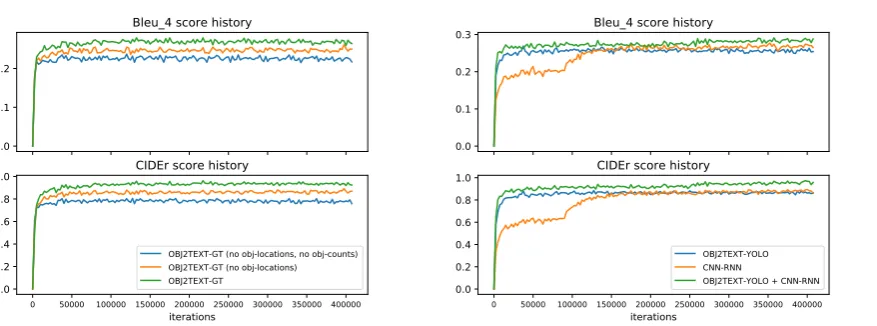
Impact of Object Locations and Counts: Fig-ure3ashows the CIDEr (Vedantam et al.,2015a), and BLEU-4 (Papineni et al., 2002) score his-tory on our validation set during 400k iterations of training of OBJ2TEXT, as well as a version of our model that does not use object locations, and a ver-sion of our model that does not use neither object locations nor object counts. These results show that our model is effectively using both object lo-cations and counts to generate better captions, and absence of any one of these two cues affects per-formance. Table 1 confirms these results on the test split after a full round of training.
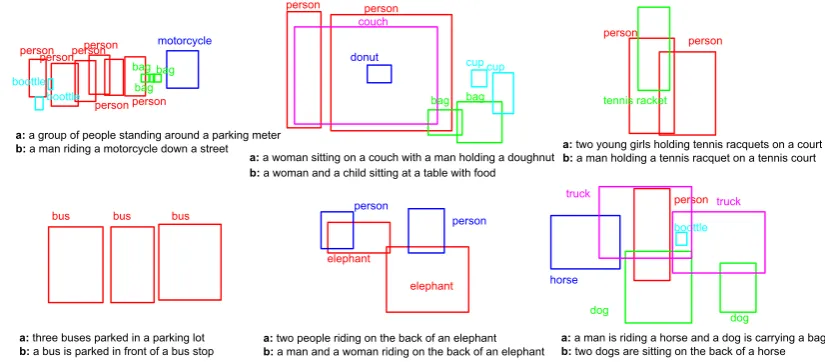
Furthermore, human evaluation results in the first row of Table 2 show that the OBJ2TEXT model with access to object locations is preferred by users, especially in cases where all evaluators agreed on their choice (62% over the baseline that does not have access to locations). In Figure4we additionally present qualitative examples showing predictions side-by-side between OBJ2TEXT-GT and OBJ2TEXT-GT (no obj-locations). These re-sults indicate that 1) perhaps not surprisingly, ob-ject counts is useful for generating better qual-ity descriptions, and 2) object location informa-tion when properly encoded, is an important cue for generating more accurate descriptions. We
ad-ditionally implemented a nearest neighbor base-line by representing the objects in the input layout using an orderless bag-of-words representation of object counts and the CIDEr score on the test split was only 0.387.
On top of OBJ2TEXT we additionally experi-mented with the global attention model proposed in (Luong et al.,2015) so that a weighted combi-nation of the encoder hidden states are forwarded to the decoding neural language model, however we did not notice any overall gains in terms of ac-curacy from this formulation. We observed that this model provided gains only for larger input se-quences where it is more likely that the LSTM network forgets its past history (Bahdanau et al.,
2015). However in MS-COCO the average num-ber of objects in each image is rather modest, so the last hidden state can capture well the overall nuances of the visual input.
Object Layout Encoding for Image Captioning:
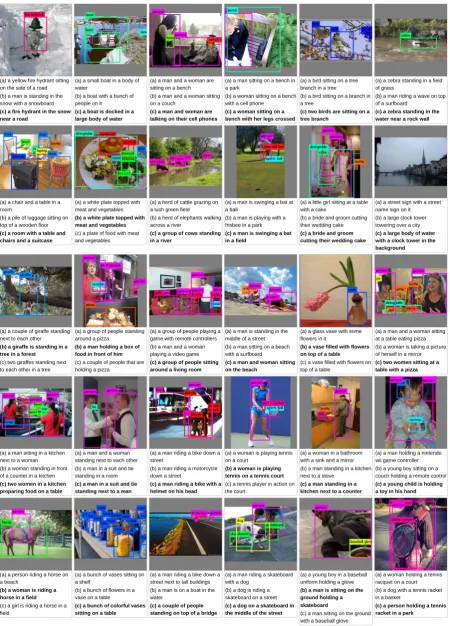
Figure 3b shows the CIDEr, and BLEU-4 score history on the validation set during 400k iterations of training of OBJ2TEXT-YOLO, CNN-RNN, and their combination. These results show that OBJ2TEXT-YOLO performs surprisingly close to CNN-RNN, and the model resulting from com-bining the two, clearly outperforms each method alone. Table 3 shows MS-COCO evaluation re-sults on the test set using their online benchmark service, and confirms results obtained in the vali-dation split, where CNN-RNN seems to have only a slight edge over OBJ2TEXT-YOLO which lacks access to pixel data after the object detection stage. Human evaluation results in Table 2rows 2, and 3, further confirm these findings. These results show that meaningful descriptions could be gen-erated solely based on object categories and loca-tions information, even without access to color and texture input.
lay-0.0 0.1 0.2
Bleu_4 score history
0 50000 100000 150000 200000 250000 300000 350000 400000 iterations
0.0 0.2 0.4 0.6 0.8
1.0 CIDEr score history
OBJ2TEXT-GT (no obj-locations, no obj-counts) OBJ2TEXT-GT (no obj-locations) OBJ2TEXT-GT
(a) Score histories of lesioned versions of the proposed model for the task of object layout captioning.
0.0 0.1 0.2
0.3 Bleu_4 score history
0 50000 100000 150000 200000 250000 300000 350000 400000 iterations
0.0 0.2 0.4 0.6 0.8
1.0 CIDEr score history
OBJ2TEXT-YOLO CNN-RNN
OBJ2TEXT-YOLO + CNN-RNN
[image:7.595.92.531.67.230.2](b) Score histories of image captioning models. Performance boosts of CNN-RNN and combined model around iteration 100K and 250K are due to fine-tuning of the image CNN model. Figure 3: Score histories of various models on the MS COCO split validation set.
Method Bleu 4 CIDEr METEOR ROUGE-L
OBJ2TEXT-GT (no obj-locations, counts) 0.21 0.759 0.215 0.464
OBJ2TEXT-GT (no obj-locations) 0.233 0.837 0.222 0.482
[image:7.595.100.498.304.360.2]OBJ2TEXT-GT 0.253 0.922 0.238 0.507
Table 1: Performance of lesioned versions of the proposed model on the MS COCO split test set.
out and visual features are complementary: neural network models for visual feature extraction are trained on a classification task where object-level information such as number of instances and lo-cations are ignored in the objective. Object lay-outs on the other hand, contain categories and their bounding-boxes but don’t have access to rich im-age features such as imim-age background, object at-tributes and objects with categories not present in the object detection vocabulary.
Figure 5 provides a three-way comparison of captions generated by the three image captioning models, with preferred captions by human evalu-ators annotated in bold text. Analysis on actual outputs gives us insights into the benefits of comb-ing object layout information and visual features obtained using a CNN. Our OBJ2TEXT-YOLO model makes many mistakes because of lack of image context information since it only has access to object layout, while CNN-RNN makes many mistakes because the visual recognition model is imperfect at predicting the correct content. The combined model is usually able to generate more accurate and comprehensive descriptions.
In this work we only explored encoding spa-tial information with object labels, but object
la-bels could be readily augmented with rich seman-tic features that are more detailed descriptions of objects or image regions. For example, the work ofYou et al.(2016) andYao et al.(2016b) showed that visual features trained with semantic concepts (text entities mentioned in captions) instead of ob-ject labels is useful for image captioning, although they didn’t consider encoding semantic concepts with spatial information. In case of object an-notations the MS-COCO dataset only provides object labels and bounding-boxes, but there are other datasets such as Flick30K Entities (Plummer et al.,2015), and the Visual Genome dataset ( Kr-ishna et al., 2017) that provide richer region-to-phrase correspondence annotations. In addition, the fusion of object counts and spatial information with CNN visual features could in principle bene-fit other vision and language tasks such as visual question answering. We leave these possible ex-tensions as future work.
7 Conclusion
Alternatives Choice-all Choice-agreement Agreement
OBJ2TEXT-GT vs. OBJ2TEXT-GT (no obj-locations) 54.1% 62.1% 40.6%
OBJ2TEXT-YOLO vs. CNN+RNN 45.6% 40.6% 54.7%
OBJ2TEXT-YOLO + CNN-RNN vs. CNN-RNN 58.1% 65.3% 49.5%
[image:8.595.74.535.193.320.2]OBJ2TEXT-GT vs. HUMAN 23.6% 9.9% 58.8%
Table 2: Human evaluation results using two-alternative forced choice evaluation. Choice-all is percent-age the first alternative was chosen. Choice-agreement is percentpercent-age the first alternative was chosen only when all annotators agreed. Agreement is percentage where all annotators agreed (random is 25%).
MS COCO Test Set Performance CIDEr ROUGE-L METEOR B-4 B-3 B-2 B-1
5-Refs
OBJ2TEXT-YOLO 0.830 0.497 0.228 0.262 0.361 0.500 0.681
CNN-RNN 0.857 0.514 0.237 0.283 0.387 0.529 0.705
OBJ2TEXT-YOLO + CNN-RNN 0.932 0.528 0.250 0.300 0.404 0.546 0.719
40-Refs
OBJ2TEXT-YOLO 0.853 0.636 0.305 0.508 0.624 0.746 0.858
CNN-RNN 0.863 0.654 0.318 0.540 0.656 0.775 0.877
[image:8.595.89.502.381.562.2]OBJ2TEXT-YOLO + CNN-RNN 0.950 0.671 0.334 0.569 0.686 0.802 0.896
Table 3: The 5-Refs and 40-Refs performances of OBJ2TEXT-YOLO, CNN-RNN and the combined approach on the MS COCO online test set. The 5-Refs performance is measured using 5 ground-truth reference captions, while 40-Refs performance is measured using 40 ground-truth reference captions.
a: three buses parked in a parking lot
b: a bus is parked in front of a bus stop
a: two people riding on the back of an elephant
b: a man and a woman riding on the back of an elephant
a: a man is riding a horse and a dog is carrying a bag
b: two dogs are sitting on the back of a horse
bus bus bus person person
elephant elephant
person
dog
dog boottle
truck
truck
horse a: a group of people standing around a parking meter
b: a man riding a motorcycle down a street
a: a woman sitting on a couch with a man holding a doughnut
b: a woman and a child sitting at a table with food
a: two young girls holding tennis racquets on a court
b: a man holding a tennis racquet on a tennis court
motorcycle person
personperson person
person person
bag bag
bag boottle
boottle
donut person person
bag bag cup cup
couch
person
person
tennis racket
Figure 4: Qualitative examples comparing generated captions of (a) OBJ2TEXT-GT, and (b) OBJ2TEXT-GT (no obj-locations).
shows that an orderless visual input representation of concepts is not enough to produce good de-scriptions, but object extents, locations, and object counts, all contribute to generate more accurate image descriptions. Crucially we show that our encoding mechanism is able to capture useful spatial information using an LSTM network to produce image descriptions, even when the input is provided as a sequence rather than as an explicit 2D representation of objects. Additionally, using
our proposed OBJ2TEXT model in combination with an existing image captioning model and a robust object detector we showed improved results in the task of image captioning.
Acknowledgments
7/16/2017 vision.cs.virginia.edu:8001
http://vision.cs.virginia.edu:8001/ 1/1
(a) a yellow fire hydrant sitting on the side of a road (b) a man is standing in the snow with a snowboard
(c) a fire hydrant in the snow near a road
(a) a small boat in a body of water
(b) a boat with a bunch of people on it
(c) a boat is docked in a large body of water
(a) a man and a woman are sitting on a bench (b) a man and a woman sitting on a couch
(c) a man and woman are talking on their cell phones
(a) a man sitting on a bench in a park
(b) a woman sitting on a bench with a cell phone
(c) a woman sitting on a bench with her legs crossed
(a) a bird sitting on a tree branch in a tree
(b) a bird sitting on a branch in a tree
(c) two birds are sitting on a tree branch
(a) a zebra standing in a field of grass
(b) a man riding a wave on top of a surfboard
(c) a zebra standing in the water near a rock wall
(a) a chair and a table in a room
(b) a pile of luggage sitting on top of a wooden floor
(c) a room with a table and chairs and a suitcase
(a) a white plate topped with meat and vegetables
(b) a white plate topped with meat and vegetables
(c) a plate of food with meat and vegetables
(a) a herd of cattle grazing on a lush green field (b) a herd of elephants walking across a river
(c) a group of cows standing in a river
(a) a man is swinging a bat at a ball
(b) a man is playing with a frisbee in a park
(c) a man is swinging a bat in a field
(a) a little girl sitting at a table with a cake
(b) a bride and groom cutting their wedding cake
(c) a bride and groom cutting their wedding cake
(a) a street sign with a street name sign on it (b) a large clock tower towering over a city
(c) a large body of water with a clock tower in the background
(a) a couple of giraffe standing next to each other
(b) a giraffe is standing in a tree in a forest
(c) two giraffes standing next to each other in a tree
(a) a group of people standing around a pizza
(b) a man holding a box of food in front of him
(c) a couple of people that are holding a pizza
(a) a group of people playing a game with remote controllers (b) a man and a woman playing a video game
(c) a group of people sitting around a living room
(a) a man is standing in the middle of a street (b) a man sitting on a beach with a surfboard
(c) a man and woman sitting on the beach
(a) a glass vase with some flowers in it
(b) a vase filled with flowers on top of a table
(c) a vase filled with flowers on top of a table
(a) a man and a woman sitting at a table eating pizza (b) a woman is taking a picture of herself in a mirror
[image:9.595.75.526.64.691.2](c) two women sitting at a table with a pizza
(a) a man sitting in a kitchen next to a woman (b) a woman standing in front of a counter in a kitchen
(c) two women in a kitchen preparing food on a table
(a) a man and a woman standing next to each other (b) a man in a suit and tie standing in a room
(c) a man in a suit and tie standing next to a man
(a) a man riding a bike down a street
(b) a man riding a motorcycle down a street
(c) a man riding a bike with a helmet on his head
(a) a woman is playing tennis on a court
(b) a woman is playing tennis on a tennis court
(c) a tennis player in action on the court
(a) a woman in a bathroom with a sink and a mirror (b) a man standing in a kitchen next to a stove
(c) a man standing in a kitchen next to a counter
(a) a man holding a nintendo wii game controller (b) a young boy sitting on a couch holding a remote control
(c) a young child is holding a toy in his hand
(a) a person riding a horse on a beach
(b) a woman is riding a horse in a field
(c) a girl is riding a horse in a field
(a) a bunch of vases sitting on a shelf
(b) a bunch of flowers in a vase on a table
(c) a bunch of colorful vases sitting on a table
(a) a man riding a bike down a street next to tall buildings (b) a man is on a boat in the water
(c) a couple of people standing on top of a bridge
(a) a man riding a skateboard with a dog
(b) a dog is riding a skateboard on a street
(c) a dog on a skateboard in the middle of the street
(a) a young boy in a baseball uniform holding a glove
(b) a man is sitting on the ground holding a skateboard
(c) a man sitting on the ground with a baseball glove
(a) a woman holding a tennis racquet on a court (b) a dog with a tennis racket in a basket
(c) a person holding a tennis racket in a park
References
Dzmitry Bahdanau, Kyunghyun Cho, and Yoshua Ben-gio. 2015. Neural machine translation by jointly learning to align and translate. InInternational Con-ference on Learning Representations (ICLR).
Jeffrey Donahue, Lisa Anne Hendricks, Sergio Guadar-rama, Marcus Rohrbach, Subhashini Venugopalan, Kate Saenko, and Trevor Darrell. 2015. Long-term recurrent convolutional networks for visual recogni-tion and descriprecogni-tion. In IEEE conference on com-puter vision and pattern recognition (CVPR), pages 2625–2634.
Desmond Elliott and Frank Keller. 2013. Image de-scription using visual dependency representations. InEMNLP, volume 13, pages 1292–1302.
Benjamin Eysenbach, Carl Vondrick, and Antonio Tor-ralba. 2016. Who is mistaken? arXiv preprint arXiv:1612.01175.
Hao Fang, Saurabh Gupta, Forrest Iandola, Rupesh K Srivastava, Li Deng, Piotr Doll´ar, Jianfeng Gao, Xi-aodong He, Margaret Mitchell, John C Platt, et al. 2015. From captions to visual concepts and back. InProceedings of the IEEE conference on computer vision and pattern recognition, pages 1473–1482.
Ali Farhadi, Mohsen Hejrati, Mohammad Amin Sadeghi, Peter Young, Cyrus Rashtchian, Julia Hockenmaier, and David Forsyth. 2010. Every pic-ture tells a story: Generating sentences from images. In European conference on computer vision, pages 15–29. Springer.
David F Fouhey and C Lawrence Zitnick. 2014. Pre-dicting object dynamics in scenes. InProceedings of the IEEE Conference on Computer Vision and Pat-tern Recognition (CVPR), pages 2019–2026. Sepp Hochreiter and J¨urgen Schmidhuber. 1997.
Long short-term memory. Neural computation, 9(8):1735–1780.
Ronghang Hu, Huazhe Xu, Marcus Rohrbach, Jiashi Feng, Kate Saenko, and Trevor Darrell. 2016. Nat-ural language object retrieval. InProceedings of the IEEE Conference on Computer Vision and Pattern Recognition, pages 4555–4564.
Srinivasan Iyer, Ioannis Konstas, Alvin Cheung, and Luke Zettlemoyer. 2016. Summarizing source code using a neural attention model. InProceedings of the 54th Annual Meeting of the Association for Com-putational Linguistics (Volume 1: Long Papers), pages 2073–2083, Berlin, Germany. Association for Computational Linguistics.
Andrej Karpathy and Li Fei-Fei. 2015. Deep visual-semantic alignments for generating image descrip-tions. In Proceedings of the IEEE Conference on Computer Vision and Pattern Recognition, pages 3128–3137.
Andrej Karpathy et al. 2016. Neuraltalk2.
https://github.com/karpathy/neuraltalk2/.
Ioannis Konstas and Mirella Lapata. 2012. Unsuper-vised concept-to-text generation with hypergraphs. InConference of the North American Chapter of the Association for Computational Linguistics: Human Language Technologies (NAACL-HLT), pages 752– 761.
Ranjay Krishna, Yuke Zhu, Oliver Groth, Justin John-son, Kenji Hata, Joshua Kravitz, Stephanie Chen, Yannis Kalantidis, Li-Jia Li, David A Shamma, et al. 2017. Visual genome: Connecting language and vision using crowdsourced dense image anno-tations. International Journal of Computer Vision, 123(1):32–73.
Alex Krizhevsky, Ilya Sutskever, and Geoffrey E Hin-ton. 2012. Imagenet classification with deep con-volutional neural networks. In Neural Information Processing Systems (NIPS), pages 1097–1105. Karen Kukich. 1983. Design of a knowledge-based
re-port generator. In Proceedings of the 21st annual meeting on Association for Computational Linguis-tics, pages 145–150. Association for Computational Linguistics.
Tsung-Yi Lin, Michael Maire, Serge Belongie, James Hays, Pietro Perona, Deva Ramanan, Piotr Doll´ar, and C Lawrence Zitnick. 2014. Microsoft coco: Common objects in context. InECCV, pages 740– 755. Springer.
Minh-Thang Luong, Hieu Pham, and Christo-pher D. Manning. 2015. Effective approaches to attention-based neural machine translation. CoRR, abs/1508.04025.
Junhua Mao, Wei Xu, Yi Yang, Jiang Wang, Zhiheng Huang, and Alan Yuille. 2015. Deep captioning with multimodal recurrent neural networks (m-rnn).
ICLR.
Rebecca Mason and Eugene Charniak. 2014. Nonpara-metric method for data-driven image captioning. In
ACL (2), pages 592–598.
Vicente Ordonez, Xufeng Han, Polina Kuznetsova, Girish Kulkarni, Margaret Mitchell, Kota Yam-aguchi, Karl Stratos, Amit Goyal, Jesse Dodge, Alyssa Mensch, III Daume, Hal, Alexander C. Berg, Yejin Choi, and Tamara L. Berg. 2015. Large scale retrieval and generation of image descriptions. In-ternational Journal of Computer Vision, pages 1–14. Vicente Ordonez, Girish Kulkarni, and Tamara L Berg. 2011. Im2text: Describing images using 1 million captioned photographs. InAdvances in Neural In-formation Processing Systems, pages 1143–1151. Kishore Papineni, Salim Roukos, Todd Ward, and
the 40th annual meeting on association for compu-tational linguistics, pages 311–318. Association for Computational Linguistics.
Bryan A Plummer, Liwei Wang, Chris M Cervantes, Juan C Caicedo, Julia Hockenmaier, and Svetlana Lazebnik. 2015. Flickr30k entities: Collecting region-to-phrase correspondences for richer image-to-sentence models. In Proceedings of the IEEE international conference on computer vision, pages 2641–2649.
Arnau Ramisa, JK Wang, Ying Lu, Emmanuel Del-landrea, Francesc Moreno-Noguer, and Robert Gaizauskas. 2015. Combining geometric, textual and visual features for predicting prepositions in im-age descriptions. InConference on Empirical Meth-ods in Natural Language Processing (EMNLP), pages 214–220. Association for Computational Lin-guistics.
Joseph Redmon and Ali Farhadi. 2017. YOLO9000: better, faster, stronger. InComputer Vision and Pat-tern Recognition (CVPR).
Anna Rohrbach, Marcus Rohrbach, Ronghang Hu, Trevor Darrell, and Bernt Schiele. 2016. Ground-ing of textual phrases in images by reconstruction. InEuropean Conference on Computer Vision, pages 817–834. Springer.
Olga Russakovsky, Jia Deng, Hao Su, Jonathan Krause, Sanjeev Satheesh, Sean Ma, Zhiheng Huang, Andrej Karpathy, Aditya Khosla, Michael Bernstein, et al. 2015. Imagenet large scale visual recognition chal-lenge. International Journal of Computer Vision, 115(3):211–252.
Allen Schmaltz, Alexander M. Rush, and Stuart Shieber. 2016. Word ordering without syntax. In Conference on Empirical Methods in Natural Language Processing (EMNLP), pages 2319–2324, Austin, Texas.
Karen Simonyan and Andrew Zisserman. 2015. Very deep convolutional networks for large-scale image recognition. International Conference on Learning Representations (ICLR).
Frank A Smadja and Kathleen R McKeown. 1990. Au-tomatically extracting and representing collocations for language generation. In Annual meeting of the Association for Computational Linguistics (ACL), pages 252–259.
Ramakrishna Vedantam, C Lawrence Zitnick, and Devi Parikh. 2015a. Cider: Consensus-based image de-scription evaluation. In Proceedings of the IEEE Conference on Computer Vision and Pattern Recog-nition, pages 4566–4575.
Ramakrishna Vedantam, Xiao Lin, Tanmay Batra, C Lawrence Zitnick, and Devi Parikh. 2015b. Learning common sense through visual abstraction. In Proceedings of the IEEE International Confer-ence on Computer Vision (ICCV), pages 2542–2550.
Oriol Vinyals, Alexander Toshev, Samy Bengio, and Dumitru Erhan. 2015. Show and tell: A neural im-age caption generator. InProceedings of the IEEE conference on computer vision and pattern recogni-tion, pages 3156–3164.
Tsung-Hsien Wen, Milica Gasic, Nikola Mrkˇsi´c, Pei-Hao Su, David Vandyke, and Steve Young. 2015. Semantically conditioned lstm-based natural lan-guage generation for spoken dialogue systems. In
Conference on Empirical Methods in Natural Lan-guage Processing (EMNLP), pages 1711–1721, Lis-bon, Portugal.
Kelvin Xu, Jimmy Ba, Ryan Kiros, Kyunghyun Cho, Aaron Courville, Ruslan Salakhudinov, Rich Zemel, and Yoshua Bengio. 2015. Show, attend and tell: Neural image caption generation with visual at-tention. In International Conference on Machine Learning, pages 2048–2057.
Li Yao, Nicolas Ballas, Kyunghyun Cho, John R. Smith, and Yoshua Bengio. 2016a. Oracle perfor-mance for visual captioning. InBritish Machine Vi-sion Conference (BMVC).
Ting Yao, Yingwei Pan, Yehao Li, Zhaofan Qiu, and Tao Mei. 2016b. Boosting image captioning with attributes. arXiv preprint arXiv:1611.01646. Mark Yatskar, Vicente Ordonez, and Ali Farhadi. 2016.
Stating the obvious: Extracting visual common sense knowledge. InProceedings of the 2016 Con-ference of the North American Chapter of the As-sociation for Computational Linguistics: Human Language Technologies, pages 193–198, San Diego, California. Association for Computational Linguis-tics.
Quanzeng You, Hailin Jin, Zhaowen Wang, Chen Fang, and Jiebo Luo. 2016. Image captioning with seman-tic attention. InProceedings of the IEEE Conference on Computer Vision and Pattern Recognition, pages 4651–4659.
C Lawrence Zitnick and Devi Parikh. 2013. Bring-ing semantics into focus usBring-ing visual abstraction. In Proceedings of the IEEE Conference on Com-puter Vision and Pattern Recognition (CVPR), pages 3009–3016.