402
14
Ireland
Daniel Faas and Rachael Fionda
14.1 National
context
14.1.1 The educational system of the country
The second-level education sector in Ireland comprises secondary, vocational, community, and comprehensive schools. Secondary schools, which educate approximately 54% of second-level students, are privately owned and man-aged. The majority are conducted by religious communities and the remainder by boards of governors or by individuals. Vocational schools and community colleges educate over 33% of all second-level students; they are administered by vocational education committees which are statutory bodies set up under the Vocational Education Act of 1930. Comprehensive schools are managed by a board of management representative of the diocesan religious authority, the vocational education committee of the area and the minister for education and skills. Community schools are managed by boards of management representa-tive of local interests. All schools are entirely funded by the state through the Department of Education and Skills (Eurydice, 2009). The second-level cur-riculum is divided into two cycles: a three-year junior cycle (generally catering for students 12–15 years of age) and a two-year senior cycle (generally catering for students 16–18 years of age). At both junior and senior level students can be ‘streamed’ according to ability; those considered to have higher academic potential study for and take exams at ‘Higher Level’ and those of average ability study at ‘Ordinary Level’. Mathematics, English, and Irish can also be studied at ‘Foundation Level’ (see www.curriculumonline.ie). Students can self-select which levels they take, in consultation with their subject teachers. There are significant implications; Higher Level exam results are worth double in the points system required for university entry (see www.cao.ie). Between the junior and senior cycles students may complete the Transition Year Programme. This is an option for students in some schools while it is compulsory in others. This program is not examinable and is characterized by curricular flexibility, cross-curricular initiatives, and school– community linkages. Senior-cycle education underwent significant change during the 1990s and is currently the subject of review by the National Council for Curriculum and Assessment (NCCA), includ-ing the introduction of a new subject ‘Politics and Society’. The Irish Times
newspaper publishes an annual league table of post-primary schools.
Training for teachers is offered by specialist colleges for primary-level teach-ers, while second-level teachers complete an undergraduate degree and then a one-year postgraduate course in education at an Irish university. Courses differ from university to university, and this system has been criticized as provid-ing inadequate preparation for post-primary school teachers (Eurydice, 2009). Whether the postgraduate education course provides prospective teachers with any grounding in educating the diverse classroom and migrant students var-ies from establishment to establishment. Diversity in education is either not covered, or is covered in a deficient manner:
dominance of the Catholic Church in areas such as school ownership and teacher training, and the persistently ethnocentric curriculum.
Nowlan (2008, p. 255)
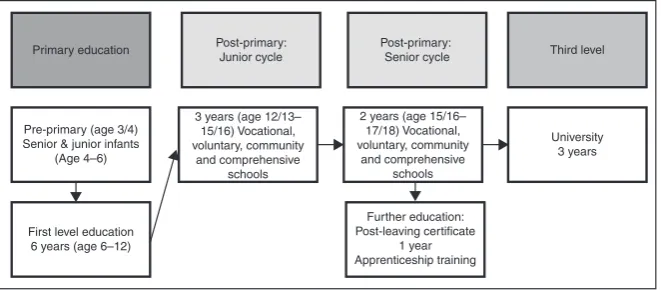
In recent years the Department of Education and Skills (DES) has restructured itself and assigned certain responsibilities to external agencies such as the State Examinations Commission (Devine, 2005; Smyth et al., 2007), the intention of this move being to allow the DES to concentrate on policy issues and allow schools’ management to direct the implementation of individual policy, establish their own ethos and organize the delivery of each student’s education (Figure 14.1).
Much literature claims that the disempowerment faced by many students is a reflection of the habitus of the individual educators (Nowlan, 2008; Fionda, 2011), of institution-wide and national policy (Lentin and McVeigh, 2006; Kuhling and Heohane, 2007) and of the society in which the educational institution is set. DES recognizes the role disadvantage plays in preventing groups of students from accessing mainstream education: ‘[educational disadvantage prevents] students from deriving appropriate benefit from education in schools’ (DES, 1998).
At present, the DES distributes ‘circulars’ to communicate to schools updates in policy, new policy initiatives, and general business. It is up to the individual school to decide on the best way to implement the policies as set out by the DES; the School Inspectorate examines whether the implementation meets the origi-nal demands of DES policy via a series of evaluations, either whole school or for each subject department. Little is known about effectiveness and best practices of implementing DES ‘circulars’ and other DES policies and initiatives (such as the NCCA Intercultural Guidelines, 2006, for example). Anecdotal evidence suggests such documents are not routinely used by teachers in practice (Fionda, 2011).
Primary education
Pre-primary (age 3/4) Senior & junior infants
(Age 4–6)
First level education 6 years (age 6–12)
3 years (age 12/13– 15/16) Vocational, voluntary, community
and comprehensive schools
2 years (age 15/16– 17/18) Vocational, voluntary, community
and comprehensive schools
University 3 years
Further education: Post-leaving certificate
1 year Apprenticeship training Post-primary:
Junior cycle
Post-primary:
Senior cycle Third level
Figure 14.1 Overview of the Irish education system
[image:3.442.60.391.63.208.2]14.1.2 Immigration to Ireland
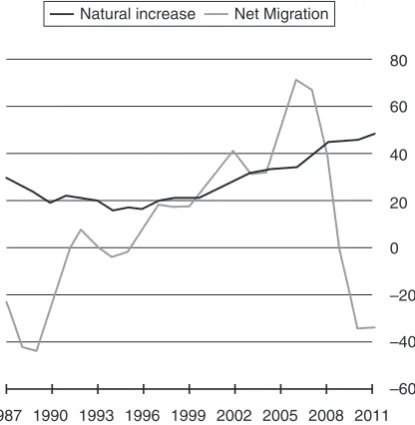
Although Ireland has always been a destination of in-migration including Celts, Normans, and British, it was the economic boom during the 1990s which brought unprecedented levels of prosperity and helped transform the country into one of net immigration by 1996 (Ruhs, 2005). For the first time in its history, Ireland experienced a significant inflow of migrants – both workers and asylum seekers – from outside the European Union (EU). Between 2001 and 2004, Ireland reached new peaks in non-EU immigration flows before a shift occurred toward intra-European mobility from East to West following eastern enlargement of the EU. Ireland, together with Sweden and the UK, allowed migrants from the new member states access to the labor market resulting in considerable inflows of Polish (63,090 in 2006) and Lithuanians (24,808 in 2006). Between 2007 and 2009, Ireland experienced reduced but still significant net immigration due to reduced inflows from Eastern Europe (Ruhs, 2009) (Figure 14.2). The groups which showed the largest increase between the Census 2006 and 2011 were those already well established in Ireland. The fastest growing groups were Romanians (from 8,566 to 17,995), Brazilians (from 4,720 to 9,298), Indians (from 9,342 to 17,856), Polish (from 63,090 to 115,193), Filipino (from 9,644 to 13,833), Latvians (from 13,999 to 19,989) and Lithuanians (from 24,808 to 34,847).
Now, in the context of an economic recession with unemployment around 13.5% (a threefold increase from the 4% in the mid-2000s), emigration has
Net Migration Natural increase
80 60 40 20 0
[image:4.442.118.326.343.556.2]1987 1990 1993 1996 1999 2002 2005 2008 2011 –20 –40 –60
Figure 14.2 Migration patterns 1987–2011
come to the fore again in the debates surrounding migration. For example, the Central Statistics Office noted that between April 2011 and April 2012, emi-gration is estimated to have reached 87,100 while the number of immigrants into Ireland fell slightly to 52,700 over the same period. Of the 87,100 people who emigrated in the year to April 2012, Irish nationals were the largest group accounting for 46,500 (CSO, 2012). Despite recent net emigration, children of immigrants and non-nationals account for 10% of the primary school level population (between four and 12 years of age) and 8% of the post-primary school level population (between 12 and 18 years of age). There is however a difference in the distribution of these students across schools at primary and post-primary levels. At post-primary level the vast majority of schools (90%) have so-called newcomer students, but many of them have a rather small pro-portion of between 2% and 9%. At primary level, over 40% of schools have no newcomers at all, but those that do, tend to have a greater proportion of newcomer students (ESRI, 2009; Byrne et al., 2010).
There are many studies which identify racist attitudes in Irish society in gen-eral, as well as in the education system (see for instance Lentin and McVeigh, 2006; Keogh and Whyte, 2003; Devine, 2005; Nowlan, 2008). ‘Ireland lies far behind other European countrie s in addressing racism in terms of anti-racist legislation’ (Tannam et al., 1998, p. 11). Theories of racism highlight a ten-dency to give with one hand while taking away with the other; this contradic-tion is discussed in Lentin and McVeigh (2006). Other studies claim there to be a comparatively sympathetic attitude towards migrants (Turner, 2010; such studies may be out of date considering recent economic decline.
14.1.3 Education and social policy
While many European states have adopted a number of different official poli-cies to deal with migration-related diversity such as assimilation, integration, interculturalism, or multiculturalism (Gray, 2006; Mac Éinrí, 2007), the debate about cultural diversity, including what the appropriate educational response should be, is still very much in its infancy in Ireland (Devine, 2011a). Thus immigration has posed a number of challenges for Irish schools, which have had little prior experience of dealing with diversity. These developments in Ireland reflect wider debates about the impact of increased ethnic, cultural, and linguistic diversity on traditional conceptions of citizenship and national identity, and how educational policies and curricula should respond to these challenges (O’Connor and Faas, 2012; Faas and Ross, 2012). The main focus has been on language support for newly arrived migrant students.
other studies propose solutions and recommendations (Little, 2008; Lyons and Little, 2009; Little and Lazenby-Simpson, 2009; Fionda, 2011). D ES response to the changing levels of diversity in society, and therefore in the student population, began in 1999 by making funding available for English language support (Nowlan, 2008). Circular 0053/2007 (DES, 2007) is entitled ‘Meeting the needs of pupils for whom English is a second language’ and this three-page document was issued by DES in 2007 to address a situation which had neces-sitated intervention since the arrival of Ireland’s new migrants at least a decade or two earlier. Earlier documents (see DES, 2003) set out availability of funding available to support migrants in the school system. Funding centers around offering language support to migrant students, which is meant to support and open access to students’ mainstream learning.
Circular 0053/2007 detailed the first guidelines for official educational pro-vision for migrant students. According to the circular, its purpose is ‘to assist schools in providing an inclusive school environment to meet the needs of pupils for whom English is a second language and outline the resources that are available to assist schools in this task’ (DES, 2007, p. 1). It goes on to pro-vide limited guidelines on the subject of creating an inclusive school environ-ment. The circular offers a brief description of the role of a language support teacher. Many such teachers describe a situation of confusion, isolation, and often blurred boundaries between a school’s language support program and its special needs department (Nowlan, 2008, p. 261). Many mainstream teachers appear not to inform themselves about matters related to migrant students (Fionda, 2011), even though the circulars clearly state that mainstream teachers are responsible for migrant students in their mainstream lessons (DES, 2007, 2009a).
Circular 0015/ 2009, intended to replace the previous one, came in response to the recession and subsequent budget cuts across many spheres of Irish life. A review of Circular 0015/2009 indicates that ESL support was reduced to two teachers per school, except for those schools where over 90 students require ESL support. Prior to 2009, a third ESL post required just 42 students. ESL funding was cut to 100 million from 137 million. A further circular (DES, 2012) states that language support is effectively discontinued, instead it will be officially merged with learning support, and that teaching allocation will be halved.
grounds of their religious background – a practice which has received heavy criticism. Devine (1999) draws our attention to the long history of domination by the church in the education system. The moralization of the young, through religious instruction, continued to be perceived to be ‘a fundamental part of the school course’ and in line with the overall principles of the curriculum, was to be implemented in an integrated and child-centered manner (Devine, 1999, p. 21).
Emerging literature in the field has identified gaps in provision for migrant students in the Irish post-primary system and contributes to emerging literature which addresses educational policies for Ireland’s migrant students and prac-tice in schools (Devine, 2005; IILT, 2007; Little, 2008; Lyons and Little; 2009; Ó’Riagáin, 2013, Fionda, 2011). Nonetheless, Irish schools perform reasonably well according to international evaluation studies such as the Programme for International Student Assessment (PISA). PISA 2009 showed that Irish-born (native) students and non-Irish-born migrants who speak English at home had significantly higher mean reading scores than migrant students who spoke other languages at home. Unlike in most other European countries, there is no statistically significant performance gap between (first-generation) migrant students and their native peers in Ireland (OECD, 2010), though at this early stage post the significant wave of immigration it is imprudent to compare to countries with a longer history of immigration. Ireland is also characterized as an inclusive system in terms of the even distribution of migrant students across schools compared to other OECD countries (OECD, 2009), despite there being no enforcement of school choice for migrants.
14.2 Methodology
Several factors make the Irish context unique: (a) a shorter history of students from immigrant backgrounds within the education system, (b) relatively heterogeneous distribution of languages within schools, and (c) fewer context-specific studies – research is emerging but very much in its infancy. The cur-rent economic situation appears to be reversing the trend of funding; interest and research into the area, however, remain. Many studies into the Irish edu-cational and migration context necessarily draw upon a wide range of inter-national studies, because Irish-specific research is still emergent and limited. This is due to several interconnected causes; first and foremost that Ireland is traditionally a country of net emigration, and only during its economic boom (the so-called ‘Celtic Tiger’) from the mid-1990s until the crash of 2008 was immigration widespread (see also Figure 14.2).
comparisons may be made with other chapters of this book. Furthermore, and in line with Stevens (2007) and Stevens et al. (2011), and a necessary limita-tion given the range of Irish literature which exclusively explores the nature of educational inequality and migration, our chapter is restricted to studies conducted between 1980 and 2012. Also in line with the methodologies cited above is the decision to restrict analysis to only secondary education (referred to as second-level education in Ireland), though further rationale behind the decision is particular to the Irish context: the holistic nature of first-level education means that much practical progress has been made regarding provi-sion for migrant students (see Little and Lazenby-Simpson, 2004). However, studies into second-level education are approached from a somewhat distinct perspective, partly due to the divided curriculum (into subject areas) and further divisions for the junior, senior and Transition Year cycles, exam type, and so forth.
In addition, the majority of the sources reviewed were peer-reviewed articles and edited books; however, this guideline was not adhered to as strictly because of the emergent nature of studies relating education and migration in Ireland much of the research carried out has not yet been published officially. Three distinct research approaches emerge from the Irish context: (1) charting ethnic inequalities and policy issues, (2) racism and education, and (3) developing newer and more critical research agendas.
14.3 Research
traditions
In this section, we focus on the specific research questions, methods, results, and related debates characteristic of each of the above-named research tradi-tions. Emphasis is placed on the Irish-specific developments in terms of social and educational policy and intellectual thought explaining each of the three identified research traditions: charting ethnic inequalities and policy issues; rac-ism and education; and developing newer and more critical research agendas.
14.3.1 Charting ethnic inequalities and policy issues
Lentin and McVeigh (2006) provide a key reference study which identifies how inequality in Ireland is addressed via research and policy agendas, but only within an antecedent framework of discrimination, which results in a dis-parity between policy and practice (a trend which is picked up again in the fol-lowing research traditions). According to them, racism in Irish society reflected as institutional racism in schools is revealed by, on the one hand, a tendency to ‘provide for’ minorities (Lentin and McVeigh, 2006, pp. 5–6), observe the current wave of ‘intercultural’ and ‘anti-racist’ education initiatives (NCCA, 2006), and on the other hand reluctance to fully implement educational pro-grams which enable migrants to learn. There is evidence to suggest that debate in Irish society tends therefore to reinforce the unequal distribution of power (Guerin, 2002), and attitudes in the media are visibly racist (McVeigh, 2002). Policy reflects the white, Catholic hegemony in its viewpoint that racism is ‘caused by the “strangeness” of incoming immigrant groups [rather than by the “host” society]’ (Lentin, 2002, p. 229).
There are a profusion of large-scale guidelines and policy documents also embedded in this research tradition; some studies cross over in their purpose between providing exploratory research and suggesting policy implications. The NCCA (2005, 2006) and Irish National Teachers’ Organisation (INTO) (2006) Intercultural Education Guidelines fall under this category. The more recent Intercultural Education Strategy (DES, 2010) was launched with the twofold aims of ensuring that
all students experience an education that ‘respects the diversity of values, beliefs, languages and traditions in Irish society and is conducted in a spirit of partnership’ … [and] all education providers are assisted with ensuring that inclusion and integration within an intercultural learning environment become the norm. (DES, 2010)
The strategy documents a macro-study of the context (demographic details, national legislation, and research overview) as well as setting out components of the strategy and how to implement it. It was launched by the DES in mid-September 2010 and came into practical relevance within schools with the start of the 2011/12 academic year. Anecdotal explorations show the document to be widely ignored in practice.
Early studies, and follow-up research of policy and guideline documents, argue that opening the doors to its schools but failing to provide the support necessary to access the curriculum is representative of Ireland’s migration policy: a policy characterized by legislation which is ‘intended to control
rather than liberate those people who are the subjects of Irish racism’ (Lentin and McVeigh, 2006, p. 2). The issue of race is ‘problematized’ and ‘common sense’ legislation (see Gramsci, 1971, p. 322, for discussion of ‘common sense’ notions) seeks to manage ‘the problem of racial and ethnic difference’ (Lentin and McVeigh, 2006, p. 2). There are a wealth of findings from the later research traditions which relate their agenda to the preceding context; namely the identification of structures which pre-date the large-scale increase of immigra-tion and concluding that as such, recent discriminaimmigra-tion is indicative of already present problems. Diversity in the Irish population is not new. ‘Minority ethnic groups, including the indigenous Traveller community, as well as relatively small immigrant Jewish, Italian and Chinese communities, for example, have been part of Irish society for a long time’ (Nowlan, 2008, p. 255). So, the recent influx of immigrants does not initiate or uncover a new problem, it reveals existing problems in the education system.
Studies from this research tradition set the tone that discrimination in schools reflects inequalities within the broader society. This largely descrip-tive and analytical research is limited to reviews of existing studies and policy documents. In drawing together existing research on education, legislation overviews, and large-scale demographic reports, the research highlights struc-tures which present obstacles to migrants. The findings also uncover constructs which historically discriminate against other minority groups before the wide-spread immigration, such as social, cultural and religious barriers, as well as linguistic ones.
14.3.2 Racism and education
Studies from the wider European context also contribute to this tradition. According to such research, ESL students do not fare well; students who speak a language other than English at home still face a gap in achievement:
The immigrant students in Ireland are a heterogeneous group. There is a gap in achievement between those students who speak English at home and those who do not. Ireland aims to provide ‘inclusive, high quality education for all students’.
(OECD, 2009, p. 9)
This tradition is characterized by a Bourdieuian analysis set in a framework which links academic potential to dominant cultural ideology. In schools, where the culture of the dominant group is promoted, educational differences and failure are often misrecognized as resulting from a lack of academic talent, when in reality they stem from class differences or cultural diversity (Bourdieu and Passeron, 1977, 1979). And so, while success at school is celebrated by the dominant social groups as based on merit, Bourdieuian theory questions the idea of a meritocracy and instead suggests a concern that schools merely repro-duce dominant ideology by simply refusing to recognize that the established order is problematic (Bourdieu, 1993; Mills and Gale, 2007). Wacquant (1998) elaborates the theory of cultural capital thus, ‘rather than education acting as an equalizer in a prejudiced society with all participants afforded equal oppor-tunity, success in education is based on the cultural experiences, social ties and economic resources that each student has access to’ (ibid., p. 216; Mills and Gale, 2007, p. 433). Irish studies initiated debate in the research which observed how migrants were subjected to ‘quick fix’ approaches which devalued their own ‘cultural capital’. Keogh and Whyte (2003, p. 8) refer to European and human rights philosophies in their observations that provision for migrant students means not simply asking the students themselves to ‘fit in’, but rather a long-term and sustained effort on the part of policy-makers and schools to include and value a diverse student population:
It means that every effort should be made to provide them with the support they need to achieve their potential and the same standard of education as their peers, without forcing them into a situation where they have to deny their ethnic and cultural heritage, traditions and beliefs.
(Keogh and Whyte, 2003, p. 8)
emerging Irish context). A significant conclusion is that practice in place for many ESL students maintains the privileges and power of dominant cultural ideology, at the cost of provision of equal chances for Ireland’s new migrant students. This practice is not overtly enforced but, as Gramscian hegemony illustrates (Gramsci, 1971; Cummins, 2000; Ferguson, 2006) quietly negotiated via procedures where educational structures exclude groups who fall outside the dominant culture, by promoting an assumption where biculturalism and bilingualism are viewed as deficits (Ward, 2006), and via a state of confusion which leads to a tolerance and perpetuation of ‘worst’ practice. In sum, this tradition sets its research in a Bourdieuian framework and focuses on describ-ing a rapidly emergdescrib-ing and new ‘status quo’ in relation to race and educa-tion. It seeks to illustrate, drawing on qualitative and quantitative methods, the challenges faced by education systems and students alike, and concludes that educational parity is not offered in favor of maintaining existing power structures. It is only tentative in any attempt to approach policy propositions, which leads us to the next tradition.
14.3.3 Developing newer and more critical research agendas
Key studies in this tradition set out to address what the ideal definition of ‘lan-guage support’ should be in Ireland and what provision for migrant students meets the specific needs of the Irish context. Researchers in this tradition sug-gest the disparity between policy and practice is an obstructive factor in achiev-ing parity of educational access. This tradition continues to set its agenda within a Bourdieuian framework, and again draws on qualitative strategies.
A key study in this area is the Lyons and Little (2009) research report which widely criticizes both provision and practice. Other studies in this tradition come to similar conclusions: discrimination in schools reflects inequalities within the broader society. ‘School practices are understood to be influenced by their location within the broader social and policy contexts, as well as by the individual actors in schools – students, teachers and parents’ (Nowlan, 2008, p. 254; Faas, 2010), and much recent research in the field of diversity in Irish schools has concentrated on such issues (Devine, 2005). Nowlan (2008) and Devine (2005, 2011b) are also key contributors to this tradition.
English language, schools have to value the cultural and personal backgrounds of the students.
Crozier et al. (2010: 209) identified the societal changes which have initiated research trends:
Irish society shifted from being one characterised by intensive periods of emigration, to one of intense immigration. This ‘unexpected immigration’ during a period of rapid economic development has given rise to renewed challenges related to definitions of national identity and citizenship. Coinciding with changes in the education system arising from processes of modernisation and intense educational reform, old certainties are replaced by insecurities and challenges as to how best to work with increasing ethnic diversity in classrooms and schools.
Crozier et al. (2010) are critical of Ireland’s approaches to policy development, and Kitching (2010) identifies the dangers in Ireland’s apparent reluctance to learn from the mistakes of countries such as the UK in avoiding tension between migrants and local communities.
Nowlan’s (2008, p. 253) findings confirm the challenges faced by a system so unprepared for the dramatic change in its student population:
Just as society is changing, the education system needs to change in order to ensure that the schooling provided to all people prepares them for life in an increasingly pluralist society. The needs of all students must be met, including those who are not from the majority ethnic group (i.e. Irish, white and Roman Catholic).
While diversity has always existed in Irish schools (on socio-economic back-ground and gender back-grounds, for example), recent immigration has uncovered insufficient provision for a diverse student body within the education system. ‘Second language learners, who were seen as the “barium meal in the X-ray” showing up deficiencies in the schooling system that affected the progress of many other students’ ( Bourne, 2003, p. 26). Critical pedagogy is concerned with the potential role of education as a true preparation for future citizens. ‘The social and political dimensions of schooling, the need to understand and transform schools and society, and the key role that educators in these pro-cesses play are core themes shared by many critical educators’ (Fischman and McLaren, 2005, p. 426).
out that many migrant students are placed disproportionately in lower stream groups.
Like many of the context-specific research into inequality, Nowlan’s (2008) research identified with Bourdieuian traditions (see preceding research tradition). Nowlan draws on Bourdieu’s ideas of cultural capital, arguing that ‘society was stratified according to the possession of cultural as well as eco-nomic capital’ (Nowlan, 2008, p. 254). Nowlan develops this point, reflecting that ‘minority language students in particular, may be discriminated against within the education system since they lack the means to acquire the par-ticular cultural capital which is necessary in order to do well at school’ and also therefore to participate equally in society after school. According to Bourdieu, migrant students do possess rich cultural capital, that of their varied linguistic abilities and cultural experiences which are distinct from the often (more) homogeneous linguistic and cultural experiences of students born in Ireland (not ignoring the differences in social background of these students). Research shows that ‘bilingual students’ linguistic abilities are not valued as cultural capital … there is a danger that stereotypes will emerge and become self perpetuating, resulting in lower expectations on the part of both students and teachers’ (Nowlan, 2008, p. 262). This contrasts, for instance, with the UK where Reay et al. (2011) found that the ‘socially inclusive middle-class’ student and family actively embraces diversity and is open to difference, seeing them-selves further enriched through the consumption of ethno-cultural – though not necessarily social – diversity.
Again, set within a Bourdieuian framework, this tradition is more progressive in its forthright approaches towards policy and ideal practice recommenda-tions. It links small-scale case-studies, interviews, and other qualitative meth-ods to broader theories which define some existing practices as inappropriate and puts forward model frameworks upon which to base policy.
14.3.4 Summary of research traditions
with qualitative components. The ESRI (2009, 2011) studies are structured in such a way as to include both qualitative and quantitative elements, and Lyons and Little (2009) emphasize that ‘chalk face’ narratives are imperative to obtain an accurate description of haphazard educational structures.
The research traditions all lead to the conclusion that the arrival of migrants has been useful in drawing more attention to such educational deficits, as the second research tradition (racism and discrimination at national policy level) highlights. Furthermore, studies in this area reveal a tendency to blame migra-tion ‘problems’ firmly in the hands of migrants themselves. The third research tradition, which looks at education practice since the mass immigration and attempts to develop a more critical perspective, focuses on studies which observe that as society has changed the education system has struggled to keep up with it and instead maintains the cultural status quo in terms of power dis-tribution. With Ireland’s idiosyncratic context meaning there is much overlap in the traditions, in part due to the rapid pace of migration, the relative hetero-geneous distribution of migrants, and then in necessary response to unstable economic conditions, the key defining features are notable. While the first research tradition, ‘charting ethnic inequalities and policy issues’, reviews pre-existing policy with a descriptive and analytical purpose, the second and third traditions (‘racism and education’ and ‘developing newer and more critical research agendas’) extend their methods to include qualitative analyses. The second tradition applies both quantitative and qualitative methods to describe emerging contexts, while the third tradition draws on mainly qualitative stud-ies and offers a more critical analysis in its objective of defining an ideal policy/ practice paradigm.
14.4 Conclusion and discussion
explore how migration is managed within educational settings and what best practices have emerged including a focus on how education management understands and deals with diversity. This links to existing and new literature in the field of new managerialism in education including tracking and stream-ing of students (see Lynch, Devine and Grummel, 2011).
Moreover, NCCA has not revised its curricula since the 1990s despite the influx in immigration. In 2003, NCCA initiated a program of curriculum review at primary level. This review was not a specific response to diversity or migration, but is rather a general review process concerning the effectiveness of the curriculum and the extent to which it enables teachers to support children in their learning. Phase one of the review focused on English, visual arts and mathematics. Phase two focused on a further three subjects, namely Irish lan-guage, science, and social, personal and health education (SPHE). There have been no changes to the SPHE curriculum as of yet following the review with the main issues highlighted being approaches to assessment and ‘curriculum overload’. History and geography have yet to be reviewed. Moreover, the Irish language requirement for primary school teachers has in effect made it very difficult to recruit teachers with a migration background. And the specificity of the Irish experience of migration includes the influence of the Catholic church in various societal sectors. Schools mediate city-level, regional, national and supranational policies in rather different ways depending on their ethos and management and future research should focus more on the micro level.
Until recently, Ireland has not formed part of larger-scale comparative migra-tion and educamigra-tion research. To do so will enable researchers to transfer best practices within Europe and to learn from the experiences of countries with a longer migration history. Most recently, for instance, Irish researchers formed part of two European Commission-funded FP7 projects exploring the trans-mission of religious beliefs and values through the education system and the family (REMC); and the meanings of tolerance in a variety of contexts with a special focus on ‘what needs to be done’ in Europe in order to proceed to more coherent societies, while respecting ethnic, religious and cultural plural-ity (the ACCEPT PLURALISM project). There are a range of largely unexplored migration research themes in Ireland and Europe including, for instance, the interface between migration and sexuality. Research on bullying (see O’Moore, 2010; O’Moore, 2008) could usefully focus more on homophobic bullying and link this with earlier emigration to places like the UK (see Ryan-Flood, 2009) and possible return migration following the Irish Civil Partnership Act in 2010. For many young members of the lesbian, gay, bi- and transsexual com-munity, sexual citizenship is replacing national identity as a master narrative (Valentine, 2001) yet very little is known about how young people from vari-ous ethno-cultural backgrounds in Ireland negotiate their belonging and what impacts their sexuality has on mobility, migration, and social well-being.
References
Bourdieu, P. (1991) Language and Symbolic Power. Cambridge: Polity Press. Bourdieu, P. (1993) The Field of Cultural Production. Cambridge: Polity Press.
Bourdieu, P. and Passeron, J. (1977) Reproduction in Education, Society and Culture. London: Sage.
Bourdieu, P. and Passeron, J. (1979) The Inheritors: French Students and Their Relation to Culture. Chicago: University of Chicago Press.
Bourne, J. (2003) Vertical Discourse: The Role of the Teacher in the Transmission and Acqui-sition of Decontextualised Language. European Educational Research Journal 2: 496–521. Byrne, D., McGinnity, F., Smyth, E. and Darmody, M. (2010) Immigration and School
Composition in Ireland. Irish Educational Studies 29(3): 271–288.
Central Statistics Office (2012) Population and Migration Estimates: April 2012, http:// www.cso.ie/en/media/csoie/releasespublications/documents/population/2012/ popmig_2012.pdf
Crozier, G., Bhopal, K. and Devine, D. (2010) Editorial. IrishEducational Studies, 29(3): 207–212.
Cummins, J. (2000) Language, Power and Pedagogy – Bilingual Children in the Crossfire. Clevedon: Multilingual Matters.
Darmody, M., Smyth, E., Byrne, D. and McGinnity, F. (2012) New School, New System: The Experiences of Immigrant Students in Irish Schools. International Handbook of Migration, Minorities and Education 2012, 2: 283–299.
Department of Education and Skills (2003) Summary of All Initiatives Funded by the Department to Help Alleviate Educational Disadvantage. Dublin: DES.
Department of Education and Skills (2004) A Brief Description of the Irish Education System. Dublin: DES.
Department of Education and Skills (2007) Circular 0053/2007 – Meeting the Needs of Pupils for Whom English Is a Second Language. Dublin: DES.
Department of Education and Skills (2009) Circular 0015/2009 – Meeting the Needs of Pupils Learning English as an Additional Language (EAL). Dublin: DES.
Department of Education and Skills (2012) Circular 0009/2012 – Staffing Arrangements in Post-Primary Schools for the 2012/13 School Year. Dublin: DES.
Devine, D. (1999) Children: Rights and Status in Education – A Socio-Historical Analysis. Irish Educational Studies, 18: 14–28.
Devine, D. (2005) Welcome to the Celtic Tiger? Teacher Responses to Immigration and Increasing Ethnic Diversity in Irish Schools. International Studies in Sociology of Education,15: 49–70.
Devine, D. (2011a) Immigration and Schooling in Ireland – Making a Difference? Manchester: Manchester University Press. In Darmody, M., Tyrrell, N., and Song, S. (Eds) The Changing Face of Ireland. Rotterdam: Sense Publishers.
Devine, D. (2011b) ‘Securing Migrant Children’s Educational Well-being: Perspectives on Policy and Practice in Irish Schools’, In Devine, D. (Ed.) Ethnic Minority Children and Youth in Ireland. Amsterdam: Springer.
Economic and Social Research Institute – ESRI (2009) Adapting to Diversity: Irish Schools and Newcomer Students, Research Series, Dublin: ESRI.
Economic and Social Research Institute – ESRI (2011) Immigration Monitor Ireland Research Series, Dublin: ESRI.
Eurydice (2009) Organisation of the Education System in Ireland, http://eacea.ec.europa.eu/ education/eurydice/documents/eurybase/eurybase_full_reports/IE_EN.pdf.
Faas, D. (2010) Negotiating Political Identities: Multiethnic Schools and Youth in Europe. Farnham: Ashgate.
Faas, D. and Ross, W. (2012) Identity, Diversity and Citizenship: A Critical Analysis of Textbooks and Curricula in Irish Schools. International Sociology, 27(4): 574–591. Ferguson, G. (2006) Language Planning and Education. Edinburgh: Edinburgh University
Press.
Fionda, R. (2011) Education is a Fundamental Right: Do Immigrant Students have Equal Access to Second Level Education in Ireland? Translocations 7.1 http://www. translocations.ie/docs/v07i01/Vol%207%20Issue%201%20-%20Peer%20Review%20-%20Education%20&%20Immigrants,%20Fionda.pdf.
Fischman, G. and Mclaren, P. (2005) Rethinking Critical Pedagogy and the Gramscian and Freirean Legacies: From Organic to Committed Intellectuals or Critical Pedagogy, Commitment, and Praxis. Cultural Studies ↔ Critical Methodologies 5: 425–446. Gramsci, A. (1971) Selections from the Prison Notebooks. London: Lawrence and Wishart. Gray, B. (2006) Migrant Integration Policy: A Nationalist Fantasy of Management and
Control. Translocations, 1(1): 121–141.
Guerin, P. (2002) Racism and the Media in Ireland: Setting the Anti-Immigrant Agenda. In Lentin, R. and McVeigh, R. (Eds) Racism and Anti-Racism in Ireland. Belfast: Beyond the Pale.
Hyland, A. (1999) Inclusiveness in Education. In Ward, N. and Dooney, T. (Eds) Irish Education for the 21st Century. Dublin: Oak Tree Press.
Keogh, A. and Whyte, J. (2003) Getting On: The Experiences of Immigrant Students in Second Level Schools Linked to the Trinity Access Programmes. Dublin: Children’s Research Centre, Trinity College Dublin.
Kitching, K. (2010) An Excavation of the Racialised Politics of Viability Underpinning Education Policy in Ireland, Irish Educational Studies,29(3): 213–229.
Kuhling, C. and Keohane, K. (2007) Cosmopolitan Ireland. London: Pluto Press.
Lentin, R. (2002) Anti-Racist Responses to the Racialisation of Irishness: Disavowed Multiculturalism and Its Discontents. In Lentin, R. and McVeigh, R. (Eds) Racism and Anti-Racism in Ireland. Belfast: Beyond the Pale.
Lentin, R. and McVeigh, R. (2006) After Optimism: Ireland, Racism and Globalisation, Dublin: Metro Éireann Publications.
Little, D. (2008) Language Learner Autonomy and the European Language Portfolio: Two English Examples. Language Teaching, 42: 222–233.
Little, D. and Lazenby-Simpson, B. (2004) Using the CEF to Develop an ESL Curriculum for Newcomer Pupils in Irish Primary Schools. In Morrow, K. (Ed.) Insights from the Common European Framework. Oxford: Oxford University Press.
Little, D. and Lazenby-Simpson, B. (2009) Immigration, Citizenship and Language. In Alderson, J. C. (Ed.) The Politics of Language Education: Individuals and Institutions. Cambridge: Cambridge University Press.
Lynch, K; Devine; D and Grummell, B (2011) New Managerialism and the Care Ceiling in Education. London: Palgrave.
Lyons, Z. and Little, D. (2009) English Language Support in Irish Post-Primary Schools: Policy, Challenges and Deficits. Dublin: TII, Trinity College.
Mac Éinrí, P. (2007) Integration Models and Choices. In Fanning, B. (ed.) Immigration and Social Change in Ireland. Manchester: Manchester University.
McGinnity, F., Quinn, E., O’Connell, P. and Donnelly, N. (2011) Immigration Monitor Ireland 2010. Dublin: ESRI.
McVeigh, R. (2002) Is There an Irish Anti-Racism? Building an Anti-Racist Ireland. In Lentin, R. and McVeigh, R. (Eds) Racism and Anti-racism in Ireland. Belfast: Beyond the Pale. Mills, C. and Gale, T. (2007) Researching Social Inequalities in Education: Towards a
Bourdieuian Methodology. International Journal of Qualitative Studies in Education, 20(4): 433–447.
Mühlau, P., Kaliszewska, M. and Röder, A. (2010) Polonia in Dublin: Preliminary report of survey findings (Report No.1, Demographic overview), Dublin: Trinity Immigration Initiative Trinity College Dublin.
National Council for Curriculum and Assessment (2006) Intercultural Education in the Post-Primary School. Dublin: DES.
Nowlan, E. (2008) Underneath the Band-Aid: Supporting Bilingual Students in Irish schools. Irish Educational Studies 27: 253–266.
O’Connor, L. and Faas, D. (2012) The Impact of Migration on National Identity in a Globalized Word: A Comparison of Civic Education Curricula in England, France and Ireland. Irish Educational Studies 31(1): 51–66.
Organization for Economic Cooperation and Development (2009) Reviews of Migrant Education: Ireland. Paris: OECD.
Organization for Economic Cooperation and Development (2010) PISA 2009 Results Learning Trends: Changes in Student Performance since 2000, Paris: OECD.
O’Moore (2008) Preventing School Bullying: The Irish Experience. In D. Pepler and W. Craig (Eds) Understanding and Addressing Bullying. Bloomington: Authorhouse. O’Moore, M. (2010) Understanding School Bullying: A Guide for Parents and Teachers.
Ó Riagáin, P. (2013) The Linguistic Challenge of Multi-cultural Ireland: Managing Language Diversity in Irish Schools. In J. Ulin, H. Edwards and S O’Brien (Eds) Race and Immigration in the New Ireland (pp. 107–129). South Bend: University of Notre Dame Press.
Reay, D., Crozier, G. and James, D. (2011) White Middle Class Identities and Urban Schooling. Basingstoke: Palgrave.
Ruhs, M. (2005) Managing the Immigration and Employment of non-EU Nationals in Ireland, Dublin: The Policy Institute, Trinity College Dublin.
Ruhs, M. (2009) Ireland: From Rapid Immigration to Recession, Migration Policy Institute, http://www.migrationinformation.org/Feature/display.cfm?ID=740.
Ryan-Flood, R. (2009) Lesbian Motherhood: Gender, Families and Sexual Citizenship. Basingstoke: Palgrave Macmillan.
Smyth, E., McCoy, S., Darmody, M. and Dunne, A. (2007) Changing Times, Changing Schools? Quality of Life for Students. In Fahey, T., Russell, H. and Whelan, C. (Eds) Best of Times? The Social Impact of the Celtic Tiger. Dublin: Institute of Public Administration. Stevens, P. (2007) Researching Race/Ethnicity and Educational Inequality in English
Secondary Schools: A Critical Review of the Research Literature between 1980 and 2005. Review of Educational Research, 77(2): 147–185.
Stevens, P., Clycq, N., Timmerman, C. and Van Houtte, M. (2011) Researching Race/ Ethnicity and Educational Inequality in the Netherlands: A Critical Review of the Research Literature between 1980 and 2008. British Educational Research Journal, 37(1): 5–43.
Tannam, M., Smith, S. and Flood, S. (1998) Anti-Racism: An Irish Perspective. Dublin: Harmony.
Turner, T. (2010) Why Are Irish Attitudes to Immigrants among the Most Liberal in Europe?, European Societies, 12(1): 25–44.
Valentine, G. (2001) Social Geographies: Society and Space. Longman: Harlow.
Wacquant, L. (1998) Pierre Bourdieu. In R. Stones (Ed.) Key Sociological Thinkers. New York: New York University Press.