Proceedings of the 2018 EMNLP Workshop W-NUT: The 4th Workshop on Noisy User-generated Text, pages 195–201
195
Low-resource named entity recognition
via multi-source projection: Not quite there yet?
Jan Vium Enghoff Søren Harrison Zeljko Agi´cˇ
Department of Computer Science IT University of Copenhagen
Rued Langgaards Vej 7, 2300 Copenhagen S, Denmark [email protected]
Abstract
Projecting linguistic annotations through word alignments is one of the most prevalent ap-proaches to cross-lingual transfer learning. Conventional wisdom suggests that annotation projection “just works” regardless of the task at hand. We carefully consider multi-source projection for named entity recognition. Our experiment with 17 languages shows that to detect named entities in true low-resource lan-guages, annotation projection may not be the right way to move forward. On a more posi-tive note, we also uncover the conditions that do favor named entity projection from multiple sources. We argue these are infeasible under noisy low-resource constraints.
1 Motivation
Annotation projection plays a crucial role in cross-lingual NLP. For instance, the state of the art ap-proaches to low-resource part-of-speech tagging (Das and Petrov, 2011; T¨ackstr¨om et al., 2013) and dependency parsing (Ma and Xia, 2014; Ra-sooli and Collins, 2015) all make use of paral-lel corpora under the source-target language di-chotomy in some way or another. Beyond syntac-tic tasks, aligned corpora facilitate cross-lingual transfer through multilingual embeddings (Ruder et al.,2017) across diverse tasks.
What about named entity recognition (NER)? This sequence labeling task with ample source lan-guages appears like an easy target for projection. However, as recently argued by Mayhew et al. (2017), the issue is more complex:
“For NER, the received wisdom is that parallel projection methods work very well, although there is no consensus on the necessary size of the parallel corpus. Most approaches require mil-lions of sentences, with a few exceptions
which require thousands. Accordingly, the drawback to this approach is the dif-ficulty of finding any parallel data, let alone millions of sentences. Religious texts (such as the Bible and the Koran) exist in a large number of languages, but the domain is too far removed from typ-ical target domains (such as newswire) to be useful. As a simple example, the Bible contains almost no entities tagged as organization.”
Our paperis a thorough empirical assessment of the quoted conjecture for named entity (NE) tag-ging in true low-resource languages. In specific, we ask the following questions:
– Are there conditions under which the projection of named entity labels from multiple sources yields feasible NE taggers?
– If yes, do these conditions scale down to real low-resource languages?
To answer these questions, we conduct an exten-sive study of annotation projection from multiple sources for low-resource NER. It includes 17 di-verse languages with heterogeneous datasets, and 2 massive parallel corpora. In terms of cross-lingual breadth, ours is one of the largest NER ex-periments to date,1 and the only one that focuses on standalone annotation projection. We uncover that the specific conditions that do make NER pro-jection work are not trivially met at a feasibly large scale by true low-resource languages.
2 Multilingual projection
We project NE labels from multiple sources into multiple targets through sentence and word
align-1
Figure 1: An illustration of named entity projection from two source sentences (Danish, English) to one target (Croatian). In this example, the voting of entity labels is weighted by tagger confidence and alignment probability. The outside label (O) is omitted for simplicity.
Algorithm 1:Multi-source label projection Data: Multilingual sentence graph
G= (Vs∪Vt, A); sequential labelsL; source label distributionsp(l|vs)
Result:A labeling of target wordsvt∈Vt
1 BALLOT←empty voting table
2 LABELING←empty label-to-vertex mapping
3 forvt∈Vtdo
4 forl∈Ldo
5 BALLOT(l|vt)← P
vs∈Vs
p(l|vs)·a(vs, vt)
6 LABELING(vt) = arg max
l BALLOT(l|vt)
7 returnBALLOT,LABELING
ments. Our projection requires source NE taggers and parallel corpora that are ideally large in both breadth (across many languages) and depth (num-ber of parallel sentences). Evidently, we require that i) the source language texts in the corpus are tagged for named entities, and that ii) the paral-lel corpora are aligned. Both conditions are typi-cally met under some noise: by applying source-language NE taggers, and unsupervised sentence and word aligners, respectively.
We view a parallel corpus as a large collection of multilingual sentences. A multilingual sentence is a graph G = (V, A) comprising a target sen-tencet andn source sentences. The vertice sets
V = V0 ∪ · · · ∪ Vn represent words in sen-tences, where the words vt ∈ V0 belong to the target sentence V0 = Vt, while all other words vs∈Vibelong to their respective source sentences
Vi, i ∈ {1, ..., n}. The graph is bipartite between
source verticesVs=V \Vtand target verticesVt, where the edges are word alignments with aligner confidences a(vs, vt) ∈ (0,1)as weights. Each
source tokenvsis associated with a label distribu-tion p(l|vs)that comes from a respective
source-language tagger and indicates its confidence over labelsl ∈ L. Here, the labelsLare NE tags, but elsewhere they could instantiate other sequence la-beling such as POS or shallow parses.
Under these assumptions, we implement projec-tion as weighted voting of source contribuprojec-tions to target words, such that for each target wordvtwe
collect votes into a ballot:
BALLOT(l|vt) =
X
vs∈Vs
p(l|vs)·a(vs, vt).
Here, each source tokenvs gets to cast a vote for
the future label ofvt. Each vote is weighted by its own tagger confidence and reliability of its align-ment to target token vt: p(l|vs)·a(vs, vt). The
individual votes are then summed and the tags for the target tokens are elected. We can train a NE tagger directly fromBALLOTprovided some nor-malization to(0,1), or we can decode a single ma-jority tag for each target word:
LABELING(vt) = arg max
l BALLOT(l|vt).
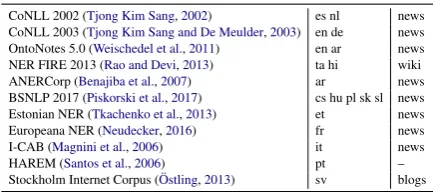
CoNLL 2002 (Tjong Kim Sang,2002) es nl news CoNLL 2003 (Tjong Kim Sang and De Meulder,2003) en de news OntoNotes 5.0 (Weischedel et al.,2011) en ar news NER FIRE 2013 (Rao and Devi,2013) ta hi wiki
ANERCorp (Benajiba et al.,2007) ar news
BSNLP 2017 (Piskorski et al.,2017) cs hu pl sk sl news Estonian NER (Tkachenko et al.,2013) et news
Europeana NER (Neudecker,2016) fr news
I-CAB (Magnini et al.,2006) it news
HAREM (Santos et al.,2006) pt –
[image:3.595.73.290.61.157.2]Stockholm Internet Corpus (Ostling,¨ 2013) sv blogs
Table 1: The NER datasets in our exepriment. We indicate the languages2and domains they cover.
We take into account a set of additional design choices in multi-source NER projection beyond what the algorithm itself encodes.
Sentence selection. We compare two ways to sample the target sentences for training: at ran-dom vs. through word-alignment coverage rank-ing. A target word covered if it has an incoming alignment edge from at least one source word. We mark the target sentences by percentage of cov-ered words from each source, and rank them by mean coverage across sources. We then select the topkranked sentences to train a tagger. We opti-mize this parameter for maximum NER scores on development data.
Language similarity. Some source languages arguably help some targets more than others. We model this relation through language similarity between source and target WALS feature vec-tors (Dryer and Haspelmath,2013):vsandvt. We
implement language similarity as inverse normal-ized Hamming distance between the two vectors:
1−dh(vs,vt). Only the non-null fields are taken
into account. Similarity is contrasted to random selection in our experiment.
Tagger performance. Some source NE taggers perform better than the others monolingually. We thus consider the option to weigh the source con-tributions not just by language similarity but also through their monolingual NER accuracy, so that the contributions by more accurate source taggers are selected more often.
3 Experiment setup
Sources and targets. Table 1 shows the NER-annotated datasets we used. These datasets ad-here to various differing standards of NE encod-ing. In a non-trivial effort, we semi-automatically normalize the data into 3-class CoNLL IO encod-ing (Tjong Kim Sang and De Meulder,2003), as
the common denominator for the widely heteroge-neous datasets. We thus detect names of locations (LOC), organizations (ORG), and persons (PER). Languages with more than 5k monolingual train-ing sentences serve as sources and development languages for parameter tuning, while the remain-der pose as low-resource targets; see Table2. For languages that have multiple datasets, we concate-nate the data. We end up with typologically di-verse sets of sources and targets. We use the pre-defined train-dev-test splits if available; if not, we split the data at 70-10-20%.
Parallel text. We contrast two sources of par-allel data: Europarl (Koehn, 2005) and Watch-tower (Agi´c et al., 2016). The former covers only 21 resource-rich languages but with 400k-2M parallel sentences for each language pair, while the latter currently spans over 300 languages, but with only 10-100k sentences per pair. Eu-roparl comes with near-perfect sentence align-ment and tokenization, and we align its words us-ing IBM2 (Dyer et al., 2013). For Watchtower we inherit the original noisy preprocessing: sim-ple whitespace tokenization, automatic sentence alignment, and IBM1 word alignments by Agi´c et al.(2016) as they show that IBM1 in particu-lar helps debias for low-resource languages.
Tagger. We implement a bi-LSTM NE tagger in-spired by Lample et al. (2016) and Plank et al. (2016). We tune it on English development data at two bi-LSTM layers (d = 300), a final dense layer (d = 4), 10 training epochs with SGD, and regular and recurrent dropout at p = 0.5. We use pretrained fastText embeddings (Bojanowski et al.,2017). Currently fastText supports 294 lan-guages and is superior to random initialization in our tagger. Other than through fastText, we don’t make explicit use of sub-word embeddings. Our monolingual F1 score on English is 86.35 under the more standard IOB2 encoding. We do not aim to produce a state-of-the-art model, but to con-trast the scores for various annotation projection parameters. We use our tagger both to annotate the source sides of parallel corpora, and to train pro-jected target language NER models. All reported NE tagging results are means over 4 runs.
4 Results
(a) Source language ordering (b) Optimal # of sources
[image:4.595.309.524.61.266.2](c) Parallel sentence sampling (d) Weights in label voting
Figure 2: Projection tuning on Europarl: a) Order-ing the sources by their monolOrder-ingualF1 scores× WALS similarity works best; b) Atn= 3sources the average rank ofF1 scores across development languages is lowest, which indicates that n = 3
is the optimal number of sources in Europarl pro-jection; c) Parallel sentences are best selected by mean word alignment coverage, in contrast to tag-ger confidence or random sampling; d) Weighted voting forLABELINGperforms best when weights are word alignment weights×tagger confidences. Results under (b), (c), and (d) all use the best source ordering approach from (a). For random sampling under (a), the sources were randomly se-lected 5 times for eachn.
scores and WALS similarities is the optimal source language ordering. The respective optimal num-ber of sources is n = 3 for Europarl. We show that the best way to sample parallel sentences is through mean word alignment coverage, where we find k = 70000 to roughly be the optimal num-ber of target sentences. Of the different weighting schemes in voting, we select the product of word alignment probability and NER tagger confidence as best. We visualize these experiments in Fig-ure2. Table2 shows stable performance on Eu-roparl across the languages, with meanF1 at 60.7 forn = 3and only +1.53 higher fornmaxwhich is in fact lower than 3.
Moving to Watchtower. Table 2 shows that the performance plunges across languages when Watchtower religious text replaces Europarl, with a meanF1of 16.3. There, the gap betweenn= 3 and mean nmax = 4.82 is much larger:
Watch-Europarl Watchtower
Sources sup. Fn=3
1 F1nmax nmax F1n=3 F1nmax nmax Arabic 78.21 – – – 05.50 09.84 5
Dutch 82.26 63.37 63.79 3 12.80 22.02 6 English 91.03 59.96 60.13 2 18.23 21.83 6 Estonian 85.77 63.20 63.82 3 13.14 21.63 7 French 67.98 50.10 50.10 4 10.24 14.12 2 German 80.82 61.44 62.81 2 06.26 09.62 6 Hindi 67.15 – – – 00.00 00.00 1 Hungarian 94.13 58.84 61.11 5 39.85 39.85 4 Italian 80.63 64.71 65.20 3 18.30 25.94 6 Spanish 82.91 63.26 65.67 3 21.02 31.36 7
Targets
Czech – 63.38 69.90 1 20.52 21.98 7 Polish – 71.00 71.86 3 32.42 32.42 4 Portuguese – 59.38 59.38 4 20.99 29.59 7
Slovak – 64.98 64.98 4 – – Slovene – 66.63 67.86 1 30.14 35.11 6 Swedish – 39.48 44.54 1 02.38 13.02 5 Tamil – – – – 09.04 09.64 3
[image:4.595.75.279.69.242.2]Means 81.09 60.70 62.23 2.29 16.30 21.12 4.82
Table 2: F1 scores for NER tagging in the exper-iment languages, shown separately for Europarl and Watchtower, also for fixed number of source languagesn= 3and optimalnmax. Full supervi-sion scores are reported for the source languages. All scores are given for 3-class IO encoding.
tower needs more sources, and even then the ben-efits are low, as the +4.82 increase gets us to an infeasible mean F1 of 21.12. In target sentence selection we findk = 20000to be roughly opti-mal for Watchtower, but we also observe very lit-tle change in F1 when moving to its full size of around 120 thousand target sentences.
To put the Watchtower results into perspective, we implement another simple baseline. Namely, we train a new monolingual English NER system, but instead of using monolingual fastText embed-dings, we create simple cross-lingual embeddings followingSøgaard et al.(2015) over Europarl for Dutch, German, and Spanish. In effect, the change to cross-lingual embeddings yields a multilingual tagger for these four languages. The respectiveF1 scores of this tagger are low (27-28%), but they still surpass Watchtower projection.
5 Discussion
We further depict the breakdown of Watchtower projection in two figures. Figure 3 shows pre-cision, recall, and F1 learning curves for the best projection setup on both parallel corpora. For Europarl, adding more sources always in-creases recall at the cost of precision: new weaker
2ISO 639-1 language codes were used:https://www.
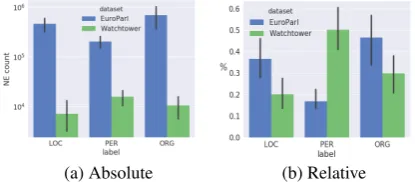
sources increase the noise, but also improve cover-age. For Watchtower, precision slightly increases with more sources, but the recall stays very low throughout, at around 5-12%. The distribution of labels in the source sides of the two parallel cor-pora (see Figure4) clarifies the learning curves is-sue of Watchtower. Namely, for both corpora the optimal word alignment coverage cutoff for select-ing target sentences is around 80% covered words (bestk = 70000for Europarl, whilek = 20000
for Watchtower). However, these cutoffs result in Europarl projections with nearly two orders of magnitude more named entities than in Watch-tower (LOC: 65 times more, ORG: 60, PER: 15), and with different distributions.
To summarize, our results show that there exists a setup in which standalone annotation projection from multiple sources does work for cross-lingual NER. Europarl is an instance of such setup, with its large data volume per language, high-quality preprocessing, and domain rich in named entities. Arguably, there are no parallel corpora of such vol-ume and quality that cover a multitude of true low-resource languages, and we have to do with more limited resources such as Watchtower. In turn, our experiment shows that in such setup standalone projection yields infeasible NE taggers, while it still may yield workable POS taggers or depen-dency parsers (cf.Agi´c et al. 2016).
Alternatives. In search for feasible alternatives, we conducted a proof-of-concept replication of the work byMayhew et al.(2017), who rely on “cheap translation” of training data from multiple sources using bilingual lexicons. The replication involved only one language, Dutch, and we limited the time investment in the effort. We used three translation sources: German, English, and Spanish. Together with instance selection through alignment cover-age, we reach a topF1score of 69.35 (with 3-class IO encoding), which surpasses even our best Eu-roparl projection for Dutch by 4.56 points.
6 Related work
There is ample work in cross-lingual NER that ex-ploits cross-lingual representations, comparable or parallel corpora together with entity dictionaries, translation, and the like (T¨ackstr¨om et al., 2012; Kim et al., 2012; Wang et al., 2013; Nothman et al.,2013;Tsai et al.,2016;Ni and Florian,2016; Ni et al., 2017). We highlight a set of contribu-tions that boast a larger cross-linguistic breadth.
[image:5.595.308.514.66.159.2](a) Europarl (b) Watchtower
Figure 3: Cross-lingual NER learning curves for precision, recall, andF1 in relation to the number
nof source languages in projection. Means for all experiment languages.
(a) Absolute (b) Relative
Figure 4: Absolute and relative counts for NE la-bels in Europarl and Watchtower for overlapping source languages.
Al-Rfou et al. (2015) work with 40 languages where NE annotations are derived from Wikipedia and Freebase, while they use a mix of human-annotated and machine-translated data for evalu-ation. Similarly,Pan et al.(2017) build and eval-uate Wikipedia-based models for 282 languages; out of those, 20 are evaluated for NE linking and 9 for NER on human annotations that are not from Wikipedia. Cotterell and Duh(2017) jointly predict NE for high- and low-resource languages with a character-level neural CRF model. Their evaluation involves 15 diverse languages across 5 language families. The DARPA LORELEI pro-gram (Christianson et al., 2018) features chal-lenges in low-resource NER development for “sur-prise” languages under time constraints.
7 Conclusions
[image:5.595.308.516.234.325.2]References
ˇ
Zeljko Agi´c, Dirk Hovy, and Anders Søgaard. 2015. If all you have is a bit of the bible: Learning pos tag-gers for truly low-resource languages. In Proceed-ings of the 53rd Annual Meeting of the Association for Computational Linguistics and the 7th Interna-tional Joint Conference on Natural Language Pro-cessing (Volume 2: Short Papers), pages 268–272, Beijing, China. Association for Computational Lin-guistics.
ˇ
Zeljko Agi´c, Anders Johannsen, Barbara Plank, H´ector Alonso Mart´ınez, Natalie Schluter, and An-ders Søgaard. 2016. Multilingual projection for parsing truly low-resource languages. Transactions of the Association for Computational Linguistics, 4:301–312.
Rami Al-Rfou, Vivek Kulkarni, Bryan Perozzi, and Steven Skiena. 2015. Polyglot-ner: Massive mul-tilingual named entity recognition. InProceedings of the 2015 SIAM International Conference on Data Mining, pages 586–594. SIAM.
Yassine Benajiba, Paolo Rosso, and Jos´e Miguel Bened´ıruiz. 2007. Anersys: An Arabic named en-tity recognition system based on maximum entropy. InInternational Conference on Intelligent Text Pro-cessing and Computational Linguistics, pages 143– 153. Springer.
Piotr Bojanowski, Edouard Grave, Armand Joulin, and Tomas Mikolov. 2017. Enriching word vectors with subword information. Transactions of the Associa-tion for ComputaAssocia-tional Linguistics, 5:135–146.
Caitlin Christianson, Jason Duncan, and Boyan Onyshkevych. 2018. Overview of the darpa lorelei program. Machine Translation, 32(1):3–9.
Ryan Cotterell and Kevin Duh. 2017. Low-resource named entity recognition with cross-lingual, character-level neural conditional random fields. In Proceedings of the Eighth International Joint Conference on Natural Language Processing (Volume 2: Short Papers), pages 91–96. Asian Fed-eration of Natural Language Processing.
Dipanjan Das and Slav Petrov. 2011. Unsupervised part-of-speech tagging with bilingual graph-based projections. In Proceedings of the 49th Annual Meeting of the Association for Computational Lin-guistics: Human Language Technologies, pages 600–609, Portland, Oregon, USA. Association for Computational Linguistics.
Matthew S. Dryer and Martin Haspelmath, editors. 2013. WALS Online. Max Planck Institute for Evo-lutionary Anthropology, Leipzig.
Chris Dyer, Victor Chahuneau, and Noah A. Smith. 2013. A simple, fast, and effective reparameteriza-tion of ibm model 2. In Proceedings of the 2013 Conference of the North American Chapter of the Association for Computational Linguistics: Human
Language Technologies, pages 644–648, Atlanta, Georgia. Association for Computational Linguistics.
Sungchul Kim, Kristina Toutanova, and Hwanjo Yu. 2012. Multilingual named entity recognition using parallel data and metadata from wikipedia. In Pro-ceedings of the 50th Annual Meeting of the Associa-tion for ComputaAssocia-tional Linguistics (Volume 1: Long Papers), pages 694–702, Jeju Island, Korea. Associ-ation for ComputAssoci-ational Linguistics.
Philipp Koehn. 2005. Europarl: A parallel corpus for statistical machine translation. InMT Summit, pages 79–86.
Guillaume Lample, Miguel Ballesteros, Sandeep Sub-ramanian, Kazuya Kawakami, and Chris Dyer. 2016. Neural architectures for named entity recognition. InProceedings of the 2016 Conference of the North American Chapter of the Association for Computa-tional Linguistics: Human Language Technologies, pages 260–270, San Diego, California. Association for Computational Linguistics.
Xuezhe Ma and Fei Xia. 2014. Unsupervised depen-dency parsing with transferring distribution via par-allel guidance and entropy regularization. In Pro-ceedings of the 52nd Annual Meeting of the Asso-ciation for Computational Linguistics (Volume 1: Long Papers), pages 1337–1348, Baltimore, Mary-land. Association for Computational Linguistics.
Bernardo Magnini, Emanuele Pianta, Christian Girardi, Matteo Negri, Lorenza Romano, Manuela Speranza, Valentina Bartalesi Lenzi, and Rachele Sprugnoli. 2006. I-CAB: The italian content annotation bank. InProceedings of the Fifth International Conference on Language Resources and Evaluation, pages 963– 968.
Stephen Mayhew, Chen-Tse Tsai, and Dan Roth. 2017. Cheap translation for cross-lingual named entity recognition. InProceedings of the 2017 Conference on Empirical Methods in Natural Language Pro-cessing, pages 2536–2545, Copenhagen, Denmark. Association for Computational Linguistics.
Clemens Neudecker. 2016. An open corpus for named entity recognition in historic newspapers. In Pro-ceedings of the Tenth International Conference on Language Resources and Evaluation.
Jian Ni, Georgiana Dinu, and Radu Florian. 2017. Weakly supervised cross-lingual named entity recognition via effective annotation and represen-tation projection. In Proceedings of the 55th An-nual Meeting of the Association for Computational Linguistics (Volume 1: Long Papers), pages 1470– 1480, Vancouver, Canada. Association for Compu-tational Linguistics.
Processing, pages 1275–1284, Austin, Texas. Asso-ciation for Computational Linguistics.
Joel Nothman, Nicky Ringland, Will Radford, Tara Murphy, and James R Curran. 2013. Learning mul-tilingual named entity recognition from wikipedia.
Artificial Intelligence, 194:151–175.
Robert ¨Ostling. 2013. Stagger: An open-source part of speech tagger for swedish. Northern European Journal of Language Technology, 3:1–18.
Xiaoman Pan, Boliang Zhang, Jonathan May, Joel Nothman, Kevin Knight, and Heng Ji. 2017. Cross-lingual name tagging and linking for 282 languages. In Proceedings of the 55th Annual Meeting of the Association for Computational Linguistics (Volume 1: Long Papers), pages 1946–1958. Association for Computational Linguistics.
Jakub Piskorski, Lidia Pivovarova, Jan ˇSnajder, Josef Steinberger, and Roman Yangarber. 2017. The first cross-lingual challenge on recognition, normaliza-tion, and matching of named entities in slavic lan-guages. In Proceedings of the 6th Workshop on Balto-Slavic Natural Language Processing, pages 76–85, Valencia, Spain. Association for Computa-tional Linguistics.
Barbara Plank, Anders Søgaard, and Yoav Goldberg. 2016. Multilingual part-of-speech tagging with bidirectional long short-term memory models and auxiliary loss. In Proceedings of the 54th An-nual Meeting of the Association for Computational Linguistics (Volume 2: Short Papers), pages 412– 418, Berlin, Germany. Association for Computa-tional Linguistics.
Pattabhi RK Rao and Sobha Lalitha Devi. 2013. NER-IL: Named entity recognition for Indian languages, 1st edition @ FIRE 2013 - an overview. InForum for Information Retrieval and Evaluation.
Mohammad Sadegh Rasooli and Michael Collins. 2015. Density-driven cross-lingual transfer of de-pendency parsers. InProceedings of the 2015 Con-ference on Empirical Methods in Natural Language Processing, pages 328–338, Lisbon, Portugal. Asso-ciation for Computational Linguistics.
Sebastian Ruder, Ivan Vuli´c, and Anders S¨ogaard. 2017. A survey of cross-lingual embedding models.
arXiv preprint arXiv:1706.04902.
Diana Santos, Nuno Seco, Nuno Cardoso, and Rui Vilela. 2006. Harem: An advanced NER evaluation contest for Portuguese. InProceedings of the Fifth International Conference on Language Resources and Evaluation.
Anders Søgaard, ˇZeljko Agi´c, H´ector Mart´ınez Alonso, Barbara Plank, Bernd Bohnet, and Anders Jo-hannsen. 2015. Inverted indexing for cross-lingual nlp. In Proceedings of the 53rd Annual Meeting of the Association for Computational Linguistics
and the 7th International Joint Conference on Natu-ral Language Processing (Volume 1: Long Papers), pages 1713–1722, Beijing, China. Association for Computational Linguistics.
Oscar T¨ackstr¨om, Dipanjan Das, Slav Petrov, Ryan McDonald, and Joakim Nivre. 2013. Token and type constraints for cross-lingual part-of-speech tagging.
Transactions of the Association for Computational Linguistics, 1:1–12.
Oscar T¨ackstr¨om, Ryan McDonald, and Jakob Uszko-reit. 2012. Cross-lingual word clusters for direct transfer of linguistic structure. In Proceedings of the 2012 Conference of the North American Chap-ter of the Association for Computational Linguis-tics: Human Language Technologies, pages 477– 487, Montr´eal, Canada. Association for Computa-tional Linguistics.
Erik F Tjong Kim Sang. 2002. Introduction to the conll-2002 shared task: Language-independent named entity recognition. In Proceedings of the Sixth conference on Natural language learning.
Erik F. Tjong Kim Sang and Fien De Meulder. 2003. Introduction to the CoNLL-2003 shared task: Language-independent named entity recognition. In
Proceedings of the Seventh Conference on Natural Language Learning, pages 142–147.
Alexander Tkachenko, Timo Petmanson, and Sven Laur. 2013. Named entity recognition in estonian. In Proceedings of the 4th Biennial International Workshop on Balto-Slavic Natural Language Pro-cessing, pages 78–83, Sofia, Bulgaria. Association for Computational Linguistics.
Chen-Tse Tsai, Stephen Mayhew, and Dan Roth. 2016. Cross-lingual named entity recognition via wikifica-tion. In Proceedings of The 20th SIGNLL Confer-ence on Computational Natural Language Learning, pages 219–228.
Mengqiu Wang, Wanxiang Che, and Christopher D. Manning. 2013. Joint word alignment and bilingual named entity recognition using dual decomposition. In Proceedings of the 51st Annual Meeting of the Association for Computational Linguistics (Volume 1: Long Papers), pages 1073–1082, Sofia, Bulgaria. Association for Computational Linguistics.