Abstract—Various contemporary technologies have improved the strategies for permanent female sterilization. At present, the transcervical approach is being used as a sterilization technique, which obviates the need for either general anesthesia or surgical incision. However, current methods of transcervical sterilization are unable to provide instant occlusion. This paper presents the design, development and verification of a novel mechanical occlusion device which achieve both instant and permanent female sterilization via a transcervical approach. The device is designed to provide an instant mechanical occlusion by deploying, under hysteroscopic visualization an implant into the intramural segment of the fallopian tube. The design of the device has been accomplished through Computer Aided Design (CAD), Finite Element Method (FEM) and experimental testing. Validation has been performed following a number of successful bench-top deployments in-air and in-vitro on animal tissue and explanted human uteri. During hydraulic pressure testing of the explanted uteri using saline solution and methylene blue, it was observed that the device provided an instant occlusion of the fallopian tubes. Initial results suggest that the device provides a safe, effective and instant method of permanent female sterilization. Further development work is ongoing in preparation for “first-in-man” clinical trials.
Index Terms—Instant Mechanical Occlusion, Hysteroscope, Transcervical sterilization.
I. INTRODUCTION
Surgical occlusion of the fallopian tubes is a widely used method of female sterilization because of its proven safety and effectiveness. The traditional surgical procedures are minilaparotomy and tubal ligation [1]. The advancements in these procedures have led to approaches such as electrocoagulation or clip or ring application to the tubes. However, such approaches to female sterilization are relatively high risk due to the requirement of general anesthesia with vascular damage, injury to the bowel, bladder, or uterus being potential complications. In addition, these procedures may be associated with postoperative pain [2].
The transcervical approach is an alternative to incisional procedures for interval tubal sterilization as it eliminates the requirement for general anesthesia and surgery. The most common methods of transcervical sterilization procedures depend on either destructive or mechanically occlusive approaches. Destructive methods have included chemical
Manuscript received January 13, 2010. This work is financially supported by Enterprise Ireland.
Rehan M. is with Dublin City University, Glasnevin, D9, Dublin, Ireland (phone: +353 851384034, email: [email protected])
Coleman J. E. is with Alta Science, Citywest Campus, Citywest, D24, Dublin, Ireland (email: [email protected])
Olabi A. G. is with Dublin City University, Glasnevin, D9, Dublin, Ireland (email: [email protected])
caustics, tissue adhesives, thermic induction and lasers [3], [4]. Destructive occlusion results in both a low success rate and morbidity [2], [3].
Contrary to the destructive methods of burning, freezing or fibrosing, the tubal ostia can be occluded by hysteroscopically applied mechanical devices. Such mechanical occlusion can be achieved either by placing a pre-formed plug or device in the uterotubal orifice or by formed-in-situ methods. The technological developments in endoscopes, light transmission devices, optical resolution, catheters and tubal cannulation evolved some new technologies such as the Adiana and Essure devices [3]. However, both the Adiana [5], [6] and Essure [7 to 9] procedures rely on tissue in-growth from the surrounding tubal walls and effectual 3 months after device placement. This can be inconvenient for the patient, who has to use an alternate contraception during this time, which means an additional cost of contraception and a procedure to confirm tubal occlusion. Therefore, the requirement was to develop a transcervical approach that can provide an instant occlusion of the fallopian tube.
This paper presents the design, development and verification of a novel mechanical occlusion device which achieves permanent female sterilization via the transcervical approach. Using a standard hysteroscope of 5-French (F) operating channel, the device deploy an implant [10] into the intramural section of the fallopian tube to provide an instant mechanical occlusion. The device comprises an implant, a guiding system and an actuator handle. The implant is made of biocompatible grade stainless steel (SS) 316LVM and includes a guide tip at the distal end and a novel design of laser cut slots on the cylindrical body. These slots transform into two sets of wings that penetrate into the ostium and uterine muscle tissue entrapping the tissue and thereby plugging the entrance of the fallopian tube. The ergonomically designed actuator controls the deployment and release of the implant at the target location by applying required forces in a specified sequence. The design of the device was achieved through FEA, prototyping and experimentations. FEA simulations were performed to simulate the mechanical behavior of the device during deployments and handling. The device was validated a number of times by successful deployments on the bench, in animal tissue and in explanted human uteri. During deployments in the latter, it was observed that the device provided both an instant and effective occlusion of the fallopian tube.
II. MATERIALS AND METHODS
The device is designed, under hysteroscopic visualization to deploy an implant into the intramural segment of the
Novel Mechanical Occlusion Device for
Transcervical Sterilization
operating channel of a standard hysteroscope. During insertion, the implant forms a low profile cylindrical shape and is advanced through the use of guiding system. After arriving at the target location within the human uterus, the required forces for the deployment and release of the implant are applied through the actuator in a specified sequence.
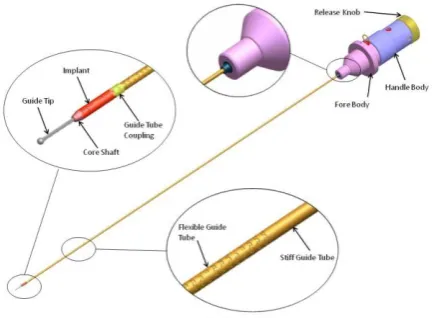
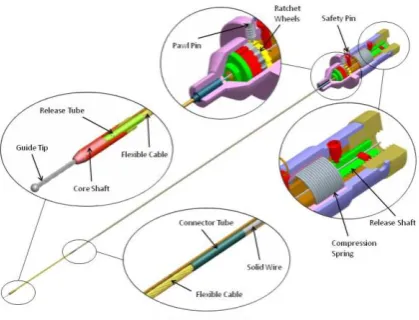
The Implant: The implant consists of a flexible guide tip at the distal end and a main cylindrical body housing an inner release system comprising of a core shaft and release tube as shown in Fig. 3. The implant main cylindrical body, with a length of 6.5mm, an outer diameter (Ø) of 1.535mm and a thickness of 0.1mm, is made of annealed SS-316LVM. It features two sets of six slots at the distal and proximal segments. Post deployment, these slots determine the implant final shape by formation of two set of six wings. These wings serve to anchor the implant by protruding into the tubal ostium and entrapping the tissue of the intramural section to instantaneously occlude the fallopian tubes. The proximal end of the implant includes straight splines used to couple with the guide tube. Fig. 4 depicts the comparison of the un-deployed and deployed implant. The guide tip is a Ø 0.5mm, multi-filament (7x7x7) cable with a spherical ball shape at the distal end. The guide tip is designed to guide the implant through the uterus into the fallopian tube. Hence, a fine balance between column strength (for push-ability and forward progression) and flexibility (to negotiate the curvatures of the uterus and fallopian tube) is required. The core shaft at the distal end of implant is a hardened SS-316LVM solid shaft, whose one end is conical and laser welded to the distal end of the implant and other end to the release tube. The release tube, with a length of 7mm, an outer Ø of 1mm and a thickness of 0.125mm is made of hardened
SS-tube and an inner guide wire. The guide SS-tube includes straight splines at the distal end which are matched exactly with the implant splines. These matching straight splines are used to couple the guide tube with the implant as shown in Fig. 2. The inner guide wire is attached to the implant’s release tube as shown in Fig. 3. In order to deal with the curvatures of the uterus and fallopian tube, the guide system needs to be flexible. On the other hand stiffness is required to transfer one-to-one torque to the implant. In order to acquire maximum torqability from the guiding system, a combination of flexibility and stiffness is designed into the guide system. As the device is delivered through the rigid channel of the hysteroscope and only a small distal portion of guide system comes out beyond the hysteroscope channel. Therefore, only distal portions of the guide tube and wire were designed flexible. The guide tube, with a diameter (Ø) 1.3mm and a thickness of 0.125mm is made of SS-316LVM hardened tube. The flexibility at the distal end of the guide tube was achieved by the addition of segmented (inter-segment gap of 0.32mm) chain of ―dove tail‖ shaped helical slots with a pitch of 0.87mm as shown in Fig. 2. These laser-cut slots shape was designed to provide the required flexibility and torqability. In order to obtain flexibility at the distal end of the guide wire, a multi-filament cable was laser welded with a single rigid wire as shown in Fig. 3. Thus, the 360mm long guide wire, comprises of a Ø 0.7mm multi-filament (1x7) SS-316LVM cable with a length of 65mm and a Ø 0.7mm annealed SS-316LVM wire.
[image:2.595.48.275.610.770.2]Actuator Handle: The proximal end of the guiding system is attached to the actuator handle. The material used for the components of the actuator is SS-316LVM. The actuator handle comprises a handle body of Ø 25mm adapted to hold the actuator. At the distal end, a fore body
[image:2.595.319.536.611.770.2]is slidably and rotatably connected to the handle body. The fore body is also operatively connected to handle body through a ratchet mechanism in which the handle body incorporates a pair of ratchet wheels and the fore body includes a pawl pin as shown in Fig. 3. These ratchets are used to control the precise clockwise and counter-clockwise movements by restricting any inadvertent reverse rotations. A compression spring is used in between the handle body and fore body to assist the movements in axial directions. The actuator also features a safety pin, which locks the actuator, preventing accidental deployment during handling or transportation. This safety pin needs to be removed prior to deployment. The proximal end of the handle body includes a release mechanism to control the release of the implant as shown in Fig. 3 and Fig. 4. This release mechanism includes a threaded release shaft slidably connected to the handle body and a release knob rotatably connected to the handle body. The power screw mechanism in between the release knob and release shaft converts the applied torque through the release knob into a tensile force on the release shaft. The release torque was limited to a value that a human hand can apply with an index finger on a cylinder of Ø 25mm. The guide tube connected to the fore body experiences compression and the guide wire connected to the release shaft experiences tension during clockwise rotation of the release knob. This results in breaking of the release tube from the specified location, releasing the implant.
A. Design and Finite Element Analysis
Designing a device through trial and error based prototyping and experimentation is both a time consuming and expensive process. Therefore, FEA simulation in conjunction with experimental testing was used to achieve the optimum design and first prototype of the device. Finite Element Analysis (FEA) software ANSYS Workbench (WB) was used in integrated mode with Pro/Engineer
(Pro/E) for FEA simulations. These simulations were performed to simulate implant deployment and to investigate the mechanical behavior of the device under deployment, release and handling forces. The device is designed to deploy and release in a five steps sequence: Step 1: The clockwise rotation of the fore body applies a 15.4N-mm clockwise torque to the implant, which generates an out-of-plane displacement in the distal slots. Step 2: The compression spring applies a 30N of axial compression force on the implant that plastically deforms the displaced slots into shape of the six distal wings. Step 3: The counter-clockwise rotation of the fore body applies a 16N-mm counter-clockwisetorque to the implant, which generates an out-of-plane displacement in the proximal slots.
Step 4: The compression spring applies a 25N of axial compression force on the implant that plastically deforms the displaced proximal slots into shape of the six proximal wings.
Step 5: The clockwise rotation of release knob applies a 70N of tensile force on the release tube allowing it to break at the designed location resulting in the release of the implant from actuator handle.
All the components of the device were analysed to simulate the actual scenario. Material properties used in these analysis are detailed in Table I.
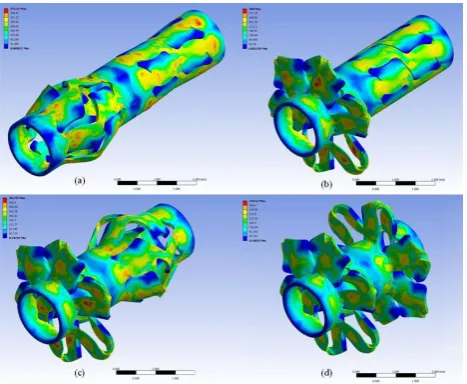
The Implant: The first objective of these simulations was to evaluate the slots shape, transformable into flat wings, capable to anchor, able to penetrate and entrap the tissue in between. Second, to investigate the mechanical behavior of the implant with the slots finalized profile. In order to simulate the deployment of the implant’s wings, a non-linear analysis was performed to cope with large deflections and plastic deformations. A bilinear isotropic hardening rule was adapted to describe the mechanical properties of the material. A sequence comprising of the above mentioned load steps was adopted to simulate the
Material Young Modulus
E (GPa)
Poisson Ratio
ν
Yield Strength
σy (MPa)
Tensile Strength
UTS(MPa)
Tangential Modulus
Et (GPa)
SS 316-LVM
(Annealed) 193 0.3 286 560 2.5
SS 316-LVM
(Hardened) 193 0.3 690 860 8.9
[image:3.595.316.548.49.204.2]TABLE I: Material Properties of SS 316-LVM FIGURE 3. Detailed Section view of the complete device
[image:3.595.53.263.50.210.2]deployment phases.
The load was applied in four load sets. The von-Mises stress distributions at the end of each load sets are shown in Fig. 5(a), (b), (c) and (d). During the deployment phase of the implant, the release tube experiences a maximum torque of 16N-mm and a tensile force of 30N. Therefore, the release tube was designed to withstand this torque and to break at a higher force of 70N (a safety factor of 2.3). The release tube includes a pair of slots having a rectangular shape in between and arcs at the ends. The in between gap of the end arcs forms a neck region and determines the breaking strength of the tube. This gap was optimized through FEA simulations to break at a force of 70N as shown in Fig. 6(a).
Guide System: During operation, the guide tube experiences the deployment and release forces, among which the maximum was the 16N-mm torque and compression of 70N. The guide tube was therefore designed to withstand these forces during operation. The intermittent slot chains on the guide tube have helical periodicity. These chains have repeatability after 315° with an intermittent gap of 36°. Therefore, only two chains were considered in the simulations. Fig. 6(b) shows the von-Mises stress distribution in the guide tube. On the other hand, the guide wire is comprise of standard components and therefore, was experimentally tested on a tensile testing machine (Lloyd Inc.) for break load.
Actuator Handle: The actuator handle was designed to withstand the deployment and release forces. However, the dominant loads were the handling loads. The handle body was analysed against the maximum grip force of a human
hand and the release force of the implant. A human hand wearing latex glove can apply a force of 826N on a Ø 25 mm cylinder [11]. Therefore, a 70N force was applied at the proximal end of the handle and a force of 826N was applied on the surface of the handle body in the form of pressure. Fig. 7(a) shows the von-Mises stress distribution in the handle body against these forces. The fore body was analysed against the deployment and release loads as shown in Fig. 7(b). During operation the only force, experienced by the ratchet mechanism is the frictional force in between the pawl pin and ratchet wheel. However, the worst-case scenario for the ratchet mechanism is the inadvertent reverse torque because of mishandling. The torque a human hand can apply on a Ø 25mm cylindrical body with an index finger and thumb is 520N-mm [12]. This value was experimentally validated by testing the actuator handle with the torque meter. The ratchet mechanism was analysed against this measured torque value. Fig. 7(c) shows the von-Mises stress distribution in the ratchet wheel and pawl pin. The torque on the release knob was calculated mathematically and was kept below 520N-mm. Release forces were applied on the release knob and the shaft to investigate their mechanical behavior as shown in Fig. 7(d).
B. Bench Testing
The device was evaluated a number of times (n>50) in the laboratory. The evaluations include bench-top deployments of the implant in-air and in-vitro. The
bench-top in-air and in-vitro testing were performed to assess
efficacy of the device and validate the individual components including the implant, the delivery system and the actuator handle. In the in-vitro study, the device was implanted in porcine tissue, arteries and fallopian tubes. Bench-top deployments involved the deployments of the device in-air to validate the results of the FEA simulations and evaluate the functionality and mechanical behavior of the device. Fig. 8 and Fig. 9 shows a device introduced into a 5-F hysteroscope pre-deployment and post-deployment, respectively.
[image:4.595.49.283.49.241.2]The implant deployments were performed under microscope to examine the implant wings formation and shape. The forces involved during the deployment were FIGURE 5. von-Mises Stress distribution in the Implant at
[image:4.595.309.548.49.239.2]the end of (a) Load Set 1 (b) Load Set 2 (c) Load Set 3 (d) Load Set 4
FIGURE 6. von-Mises Stress Distribution (a) Release Tube (b) Guide Tube
[image:4.595.48.275.673.766.2]also measured. The torque required to expand the wing slots to the requisite out-of-plane displacement was measured using a torque meter by deploying the implant. Therefore, instead of the actuator, the guide wire was held in the torque meter and torque was applied on the implant using a manual handle. The peak value of the torque was recorded and then compared with predicted values from FEA simulations. The compression force required to form the wings was measured using a tensile testing machine (Lloyd Inc.). For this measurement, a semi deployed implant, which was only gone through slot expansion, was laser welded to two pins at both the proximal and distal ends. These welded pins were then clamped into the jaws of the tensile testing machine for application of compression force through the load cell. The compression force achieved during this study was compared with the values of FEA simulations. The torque on the release knob was measured by holding the actuator in the torque meter and clamping the release tube in between fore body and release shaft. This measured force was compared with available studies [12] and FEA simulations.
In-vitro bench testing (n=10) was carried out on both
porcine tissue and fallopian tubes. These tests were performed to validate the deployment inside tissues against external loads, i.e. the loading exerted by tissue on the implant.
C. Xplant Studies
To evaluate the performance of the device in conditions
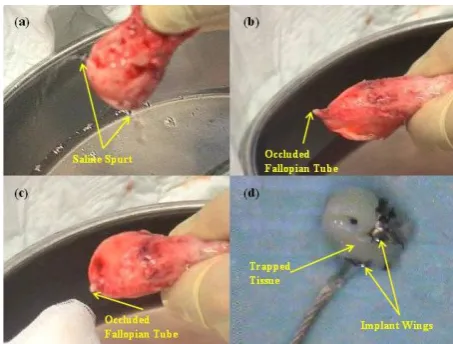
[image:5.595.316.549.49.176.2]very similar to in-vivo implementation, in-vitro experiments were conducted using explanted uteri. These uteri were removed at hysterectomy for various benign indications at the University Hospital, Mullingar, Ireland. Explanted uteri were chosen as the test model as this is most representative model of the in-vivo situation. These studies (n=7) were performed to validate the functionality, deliverability and effectiveness of the device for instant closure of human fallopian tubes. The device was delivered and deployed bilaterally into the tubal ostia. A small caliber hysteroscope with a 5-F operating channel was used to deliver the implant into the ostium tissue. The uterus was distended with normal saline and spurt of saline from the fallopian tubes confirmed the un-obstruction. The hysteroscope was introduced under direct vision into the uterus and both tubal opening were observed as shown in Fig. 10(a). After positioning, the device was guided through the hysteroscope as shown in Fig. 10(b). On approaching the tubal ostium, the implant was positioned in the intramural segment of the fallopian tube until the straight splines at the implant distal end became invisible as shown in Fig. 10(c). After optimal placement the implant was deployed and released from the delivery actuator as shown in Fig. 10(d). The delivery system was withdrawn and the procedure was repeated on the contra-lateral tube. After successful deployment of implants in both tubes, a hydraulic pressure test of the uterus was performed to verify occlusion of the fallopian tubes. In this test, saline solution and methylene blue were introduced into the uterus at a pressure of 300 FIGURE 8. Bench-top Pre-Deployed Device introduced into
[image:5.595.49.282.50.178.2]5F hysteroscope
FIGURE 9. Bench-top Post-Deployed Device introduced into 5F hysteroscope
FIGURE 10. Hysteroscopic views of Xplant Studies (a) Tubal Ostia (b) Implant Guide Tip ingoing Left Tubal Opening (c) Implant optimally placed at Left Tubal ostium (d) Deployed Implant at Left Tubal Ostium
[image:5.595.321.548.570.742.2] [image:5.595.49.278.573.743.2]paper has various advantages over tubal sterilization: avoiding general anesthesis, no incision in the body, a clinical procedure and decreased cost. Its main advantage over other transcervical procedures is the instant mechanical occlusion to effect female sterilization. The design of the device, 3D modeling and FEA simulations were performed using CAD and FEA software. The device was validated by experimentation and testing. The implant was fabricated using laser cutting machine (LPL Stent Cutter). The fabricated implant was deployed under microscope and its mechanical behavior was studied. The wing profile of the deployed implants was measured using video inspection probe and its profile was reconstructed using Pro/E. This experimentally measured profile of the wings was superimposed on the profile obtained from FEA simulations and compared. The standard error of mean of the difference of experimental and simulated profile was 0.003543 and the maximum percent error was 3.129%.
The forces required to deploy implants were validated experimentally on the test bench. On application of 16.0N-mm moment in ANSYS WB simulations, a 0.353 16.0N-mm out-of-plane displacement in implant slots was obtained at the end of load set 1. A comparable 15.4N-mm was measured experimentally using a torque meter when same amount of radial expansion (from Ø1.535mm to Ø2.241mm) in implant slots was achieved. In order to plastically deform these expanded implant slots, a force of 25.4 N was measured from tensile testing which is comparable to a force of 25 N obtained from the FEA simulations. In-house
in-vitro and mechanical bench testing validated the
mechanical behavior and functional aspects of the implant.
In-vitro deployments (n=7) of the implant into human
explanted uteri were performed. Fig. 11(a) shows the un-obstructed fallopian tubes before deployment. The occluded fallopian tube is shown in Fig 11(b). As expected, the device had successfully occluded the fallopian tubes in all uteri. Immediately after the bilateral deployment of device in the uteri, the hydraulic pressure tests using saline water and methylene blue at pressure of 300 mmHg were performed. It is apparent from Fig. 11(c) that there was no leakage during these hydraulic pressure testing. These uteri were dissected after hydraulic pressure testing and the implant along with some tissue was examined under microscope to further investigate the implant wings shape, deployed implant and tissue trapped as shown in Fig 11(d). It was observed in dissection that there was no indication of methylene blue after distal wings of the implant. This demonstrates the capability of the device to achieve instant occlusion of the fallopian tubes even at a pressure of 300 mmHg.
important in the development of the device as they provide a clear indication of the device’s capabilities and weaknesses prior to commencing in-vivo verification and validation activities. Data generated from investigations in explanted uteri verified the efficacy of the implant as well as minimizing the risk to patients participating in in-vivo
clinical studies. Further development work is underway in preparation for ―first-in-man‖ clinical trials. As an overall conclusion, this implant is effective, consistent and feasible for hysteroscopic occlusion of fallopian tubes.
ACKNOWLEDGEMENTS
The authors thank Vasorum /Alta Science team for their support. The authors thank Dr. Michael Gannon from the Midlands Regional Hospital, Mullingar, Ireland for the arrangement and performing in-vitro studies in human uteri.
REFERENCES
[1] Thurkow, A. L., Hysteroscopic sterilization: away with the laparoscope? International Congress Series, 1279, 184-188 (2005) [2] Magos, A. and Chapman, L., Hysteroscopic tubal sterilization;
Obstet. Gynecol. Clin. North Am., 31, 31705-31719 (2004) [3] Abbott, J., Transcervical sterilization, Best Pract. Res. Clin. Obstet.
Gynaecol., 19, 743-756 (2005)
[4] Brumsted, J. R., Shirk, G., Soderling, M. J. and Reed, T., Attempted transcervical occlusion of the fallopian tube with the Nd:YAG laser, Obstet. Gynecol., 77, 327-328 (1991)
[5] Carr-Brendel, V. E., Stewart, D. R., Harrington, D. C., Leal, J. G. G. and Vancaillie, T., A new transcervical sterilization procedure: results of a pilot implant study in humans, Obstet. Gynecol., 97, 8 (2001)
[6] Carr-Brendel, V. E., Stewart, D. R., Harrington, D. C., Dhaka, V. K., Breining, P. M. and Vancaillie, T., A new transcervical sterilization procedure—6-month preclinical results, Obstet. Gynecol., 97, 15-16 (2001)
[7] McSwain, H. and Brodie, M. F., Fallopian Tube Occlusion, An Alternative to Tubal Ligation, Tech. Vasc. Interv. Radiol., 9, 24-29 (2006)
[8] Ubeda, A., Labastida, R. and Dexeus, S., Essure®: a new device for hysteroscopic tubal sterilization in an outpatient setting, Fertil. Steril., 82, 196-199 (2004)
[9] Cooper, J. M., Carignan, C. S., Cher, D. and Kerin, J. F., Microinsert nonincisional hysteroscopic sterilization, Obstet. Gynecol., 102, 59-67 (2003)
[10] Rehan, M., Coleman, J. E. and Olabi, A. G., Novel Implant for Transcervical Sterilization, manuscript submitted, Journal of Bioscience and Bioengineering (2009)
[11] BryanWimer, Ren G. Dong, Daniel E.Welcome, ChristopherWarren, ThomasW. McDowell, Development of a new dynamometer for measuring grip strength applied on a cylindrical handle, Medical Engineering & Physics, 31, 695–704 (2009)