Supervised Morphological Segmentation in a Low-Resource Learning
Setting using Conditional Random Fields
Teemu Ruokolainena Oskar Kohonena Sami Virpiojaa Mikko Kurimob aDepartment of Information and Computer Science, Aalto University
bDepartment of Signal Processing and Acoustics, Aalto University
Abstract
We discuss data-driven morphological segmentation, in which word forms are segmented into morphs, the surface forms of morphemes. Our focus is on a low-resource learning setting, in which only a small amount of annotated word forms are available for model training, while unan-notated word forms are available in abun-dance. The current state-of-art methods 1) exploit both the annotated and unan-notated data in a semi-supervised man-ner, and 2) learn morph lexicons and sub-sequently uncover segmentations by gen-erating the most likely morph sequences. In contrast, we discuss 1) employing only the annotated data in a supervised man-ner, while entirely ignoring the unanno-tated data, and 2) directly learning to pre-dict morph boundaries given their local sub-string contexts instead of learning the morph lexicons. Specifically, we em-ploy conditional random fields, a popular discriminative log-linear model for seg-mentation. We present experiments on two data sets comprising five diverse lan-guages. We show that the fully super-vised boundary prediction approach out-performs the state-of-art semi-supervised morph lexicon approaches on all lan-guages when using the same annotated data sets.
1 Introduction
Modern natural language processing (NLP) appli-cations, such as speech recognition, information retrieval and machine translation, perform their tasks using statistical language models. For mor-phologically rich languages, estimation of the lan-guage models is problematic due to the high num-ber of compound words and inflected word forms.
A successful means of alleviating this data sparsity problem is to segment words into meaning-bearing sub-word units (Hirsimäki et al., 2006; Creutz et al., 2007; Turunen and Kurimo, 2011). In lin-guistics, the smallest meaning-bearing units of a language are called morphemes and their surface forms morphs. Thus, morphs are natural targets for the segmentation.
For most languages, existing resources contain large amounts of raw unannotated text data, only small amounts of manually prepared annotated training data, and no freely available rule-based morphological analyzers. The focus of our work is on performing morphological segmentation in this low-resource scenario. Given this setting, the cur-rent state-of-art methods approach the problem by learningmorph lexiconsfrom both annotated and unannotated data using semi-supervised machine learning techniques (Poon et al., 2009; Kohonen et al., 2010). Subsequent to model training, the methods uncover morph boundaries for new word forms by generating their most likely morph se-quences according to the morph lexicons.
In contrast to learning morph lexicons (Poon et al., 2009; Kohonen et al., 2010), we study mor-phological segmentation by learning to directly predictmorph boundariesbased on their local sub-string contexts. Specifically, we apply the linear-chain conditional random field model, a popular
discriminativelog-linear model for segmentation presented originally by Lafferty et al. (2001). Im-portantly, we learn the segmentation model from solely the small annotated data in a supervised
manner, while entirely ignoring the unannotated data. Despite not using the unannotated data, we show that by discriminatively learning to predict the morph boundaries, we are able to outperform the previous state-of-art.
We present experiments on Arabic and Hebrew using the data set presented originally by Snyder and Barzilay (2008), and on English, Finnish and
Turkish using the Morpho Challenge 2009/2010 data sets (Kurimo et al., 2009; Kurimo et al., 2010). The results are compared against two state-of-art techniques, namely the log-linear model-ing approach presented by Poon et al. (2009) and the semi-supervised Morfessor algorithm (Koho-nen et al., 2010). We show that when employ-ing the same small amount of annotated train-ing data, the CRF-based boundary prediction ap-proach outperforms these reference methods on all languages. Additionally, since the CRF model learns from solely the small annotated data set, its training is computationally much less demanding compared to the semi-supervised methods, which utilize both the annotated and the unannotated data sets.
The rest of the paper is organized as follows. In Section 2, we discuss related work in morpholog-ical segmentation and methodology. In Section 3, we describe our segmentation method. Our exper-imental setup is described in Section 4, and the obtained results are presented in Section 5. In Sec-tion 6, we discuss the method and the results. Fi-nally, we present conclusions on the work in Sec-tion 7.
2 Related work
The CRF model has been widely used in NLP seg-mentation tasks, such as shallow parsing (Sha and Pereira, 2003), named entity recognition (McCal-lum and Li, 2003), and word segmentation (Zhao et al., 2006). Recently, CRFs were also employed successfully in morphological segmentation for Arabic by Green and DeNero (2012) as a com-ponent of an English to Arabic machine trans-lation system. While the segmentation method of Green and DeNero (2012) and ours is very sim-ilar, our focuses and contributions differ in sev-eral ways. First, while in our work we consider the low-resource learning setting, in which a small annotated data set is available (up to 3,130 word types), their model is trained on the Arabic Tree-bank (Maamouri et al., 2004) constituting sev-eral times larger training set (588,244 word to-kens). Second, we present empirical comparison between the CRF approach and two state-of-art methods (Poon et al., 2009; Kohonen et al., 2010) on five diverse languages. Third, due to being a component of a larger system, their presentation on the method and experiments is rather undersp-eficied, while here we are able to provide a more
thorough description.
In the experimental section, we compare the CRF-based segmentation approach with two state-of-art methods, the log-linear modeling approach presented by Poon et al. (2009) and the semi-supervised Morfessor algorithm (Kohonen et al., 2010). As stated previously, the CRF-based seg-mentation approach differs from these methods in that it learns to predict morph boundaries from a small amount of annotated data, in contrast to learning morph lexicons from both annotated and large amounts of unannotated data.
Lastly, there exists ample work on varying un-supervised (and semi-un-supervised) morphological segmentation methods. A useful review is given by Hammarström and Borin (2011). The funda-mental difference between our approach and these techniques is that our method necessarily requires manually annotated training data.
3 Methods
In this section, we describe in detail the CRF-based approach for supervised morphological seg-mentation.
3.1 Morphological segmentation as a classification task
We represent the morphological segmentation task as a structured classification problem by assign-ing each character to one of four classes, namely {beginning of a multi-character morph (B), mid-dle of a multi-character morph (M),end of a multi-character morph (E),single character morph (S)}. For example, consider the English word form
drivers
with a corresponding segmentation
driv + er + s .
Using the classification notation, this segmenta-tion is represented as
START B M M E B E S STOP
<w> d r i v e r s </w>
where we have assumed additional word start and end markers<w> and</w>with respective classes START and STOP. As another example, consider the Finnish word form
autoilla (with cars)
with a corresponding segmentation
auto + i + lla .
START B M M E S B M E STOP <w> a u t o i l l a </w>
Intuitively, instead of the four class set {B, M, E, S}, a segmentation could be accomplished us-ing only a set of two classes {B, M} as in (Green and DeNero, 2012). However, similarly to Chi-nese word segmentation (Zhao et al., 2006), our preliminary experiments suggested that using the more fine-grained four class set {B, M, E, S} per-formed slightly better. This result indicates that morph segments of differerent lengths behave dif-ferently.
3.2 Linear-chain conditional random fields
We perform the above structured classification us-ing linear-chain conditional random fields (CRFs), a discriminative log-linear model for tagging and segmentation (Lafferty et al., 2001). The central idea of the linear-chain CRF is to exploit the de-pendencies between the output variables using a chain structured undirected graph, also referred to as a Markov random field, while conditioning the output globally on the observation.
Formally, the model for inputx(characters in a word) and outputy(classes corresponding to char-acters) is written as
p(y|x;w)∝ T
Y
t=2
expw>f(yt−1, yt,x, t)
,
(1) where t indexes the characters, T denotes word length, wthe model parameter vector, andf the vector-valued feature extracting function.
The purpose of the feature extraction function f is to capture the co-occurrence behavior of the tag transitions(yt−1, yt)and a set of features de-scribing character positiontof word formx. The strength of the CRF model lies in its capability to utilize arbitrary, non-independent features.
3.3 Feature extraction
The quality of the segmentation depends heavily on the choice of features defined by the feature extraction functionf. We will next describe and motivate the feature set used in the experiments.
Our feature set consists of binary indicator func-tions describing the position t of word x using all left and right substrings up to a maximum length δ. For example, consider the problem of deciding if the letter e in the word drivers
is preceded by a morph boundary. This deci-sion is now based on the overlapping substrings
to the left and right of this potential bound-ary position, that is {v,iv,riv,driv,<w>driv} and {e,er,ers,ers</w>}, respectively. The substrings to the left and right are considered indepen-dently. Naturally, if the maximum allowed sub-string length δ is less than five, the longest sub-strings are discarded accordingly. In general, the optimumδ depends on both the amount of avail-able training data and the language.
In addition to the substring functions, we use a bias function which returns value 1 independent of the inputx. The bias and substring features are combined with all the possible tag transitions.
To motivate this choice of feature set, consider formulating an intuitive segmentation rule for the English words talked, playedandspeed with the correct segmentations talk + ed, play + ed and
speed, respectively. Now, as a right context ed
is generally a strong indicator of a boundary, one could first formulate a rule
positiontis a segment boundary if its right context ised.
This rule would indeed correctly segment the words talked and played, but would incorrectly segmentspeed asspe + ed. This error can be re-solved if the left contexts are utilized as inhibitors by expanding the above rule as
positiontis a segment boundary
if its right context ised and the left context is notspe.
Using the feature set defined above, the CRF model can learn to perform segmentation in this rule-like manner according to the training data. For example, using the above example words and segmentations for training, the CRFs could learn to assign a high score for a boundary given that the right context ised and a high score for a non-boundary given the left contextspe. Subsequent to training, making segmentation decisions for new word forms can then be interpreted as voting based on these scores.
3.4 Parameter estimation
In perceptron training, the required graph infer-ence can be efficiently performed using the stan-dard Viterbi algorithm. Subsequent to training, the segmentations for test instances are acquired again using Viterbi search.
Compared to other training criteria, the struc-tured perceptron has the advantage of employing only a single hyperparameter, namely the number of passes over training data, making model esti-mation fast and straightforward. We optimize the hyperparameter using a separate development set. Lastly, we consider the longest substring lengthδ a second hyperparameter optimized using the de-velopment set.
4 Experimental setup
This section describes the data sets, evaluation metrics, reference methods, and other details con-cerning the evaluation of the methods.
4.1 Data sets
We evaluate the methods on two different data sets comprising five languages in total.
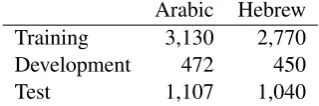
S&B data. The first data set we use is the He-brew Bible parallel corpus introduced by Snyder and Barzilay (2008). It contains 6,192 parallel phrases in Hebrew, Arabic, Aramaic, and English and their frequencies (ranging from 5 to 3517). The phrases have been extracted using automatic word alignment. The Hebrew and Arabic phrases have manually annotated morphological segmen-tations, and they are used in our experiments. The phrases are sorted according to frequency, and ev-ery fifth phrase starting from the first phrase is placed in the test set, every fifth starting from the second phrase in the development set (up to 500 phrases), and the rest of the phrases in the train-ing set. 1 The total numbers of word types in the
sets are shown in Table 1. Finally, the word forms in the training set are randomly permuted, and the first 25%, 50%, 75%, and 100% of them are se-lected as subsets to study the effect of training data size.
MC data. The second data set is based on the Morpho Challenge 2010 (Kurimo et al., 2010). It includes manually prepared morphological seg-mentations in English, Finnish and Turkish. The
1We are grateful to Dr. Hoifung Poon for providing us
instructions for dividing of the data set.
Arabic Hebrew Training 3,130 2,770 Development 472 450
[image:4.595.336.496.64.117.2]Test 1,107 1,040
Table 1: The numbers of word types in S&B data sets (Snyder and Barzilay, 2008).
English Finnish Turkish Unannot. 384,903 2,206,719 617,298
Training 1,000 1,000 1,000
Develop. 694 835 763
Test 10×1,000 10×1,000 10×1,000
Table 2: The numbers of word types in the MC data sets (Kurimo et al., 2009; Kurimo et al., 2010).
additional German corpus does not have segmen-tation annosegmen-tation and is therefore excluded. The annotated data sets include training, development, and test sets for each language. Following Virpi-oja et al. (2011), the test set results are based on ten randomly selected 1,000 word sets. Moreover, we divide the annotated training sets into ten par-titions with respective sizes of 100, 200, . . . , 1000 words so that each partition is a subset of the all larger partitions. The data is divided so that the smallest set had every 10th word of the original set, the second set every 10th word and the fol-lowing word, and so forth. For reference methods that require unannotated data, we use the English, Finnish and Turkish corpora from Competition 1 of Morpho Challenge 2009 (Kurimo et al., 2009). Table 2 shows the sizes of the MC data sets.
4.2 Evaluation measures
The word segmentations are evaluated by compar-ison with linguistic morphs usingprecision,recall, and F-measure. The F-measure equals the geo-metric mean of precision (the percentage of cor-rectly assigned boundaries with respect to all as-signed boundaries) and recall (the percentage of correctly assigned boundaries with respect to the reference boundaries). While using F-measure is a standard procedure, the prior work differ at least in three details: (1) whether precision and recall are calculated asmicro-averageover all segmenta-tion points or asmacro-averageover all the word forms, (2) whether the evaluation is based on word
reference segmentations have alternative correct choices for a single word type, and how to deal with them.
For the experiments with the S&B data sets, we follow Poon et al. (2009) and apply token-based micro-averages. For the experiments with the MC data sets, we follow Virpioja et al. (2011) and use type-based macro-averages. However, dif-fering from their boundary measure, we take the best match over the alternative reference analyses (separately for precision and recall), since none of the methods considered here provide multiple seg-mentations per word type. For the models trained with the full training set, we also report the F-measures of the boundary evaluation method by Virpioja et al. (2011) in order to compare to the results reported in the Morpho Challenge website.
4.3 CRF feature extraction and training
The features included in the feature vector in the CRF model (1) are described in Section 3.3. We include all substring features which occur in the training data.
The CRF model is trained using the averaged perceptron algorithm as described in Section 3.4. The algorithm initializes the model parameters with zero vectors. The model performance, mea-sured using F-measure, is evaluated on the devel-opment set after each pass over the training set, and the training is terminated when the perfor-mance has not improved during last 5 passes. The maximum length of substrings δ is optimized by consideringδ = 1,2,3, . . ., and the search is ter-minated when the performance has not improved during last 5 values. Finally, the algorithm returns the parameters yielding the highest F-measure on the development set.
For some words, the MC training sets include several alternative segmentations. We resolve this ambiguity by using the first given alternative and discarding the rest. During evaluation, the alter-native segmentations are taken into account as de-scribed in Section 4.2.
The experiments are run on a standard desktop computer using our own single-threaded Python-based implementation2.
4.4 Reference methods
We compare our method’s performance on Arabic and Hebrew data with semi-supervised Morfessor
2Available at http://users.ics.aalto.fi/
tpruokol/
(Kohonen et al., 2010) and the results reported by Poon et al. (2009). On Finnish, English and Turk-ish data, we compare the method only with semi-supervised Morfessor as we have no implementa-tion of the model by Poon et al. (2009).
We use a recently released Python implemen-tation of semi-supervised Morfessor3.
Semi-supervised Morfessor was trained separately for each training set size, always using the full unan-notated data sets in addition to the anunan-notated sets. The hyperparameters, the unannotated data weight αand the annotated data weightβ, were optimized with a grid search on the development set. For the S&B data, there are no separate unannotated sets. When the annotated training set size is varied, the remaining parts are utilized as unannotated data.
The log-linear model described in (Poon et al., 2009) and the semi-supervised Morfessor algo-rithm are later referred to as POON-2009 and S-MORFESSOR for brevity.
5 Results
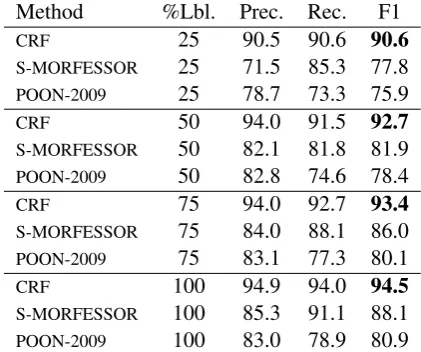
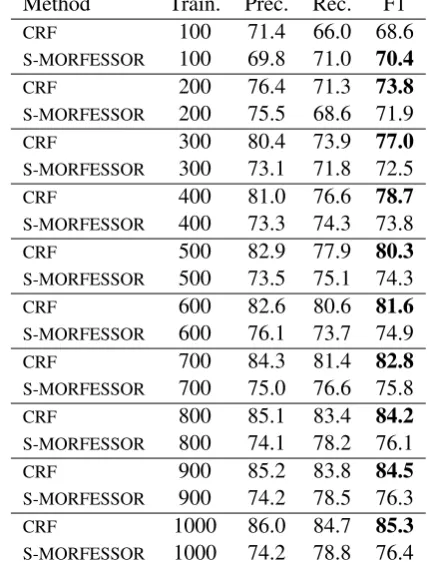
Method performances for Arabic and Hebrew on the S&B data are presented in Tables 3 and 4, re-spectively. The results for the POON-2009 model are extracted from (Poon et al., 2009). Perfor-mances for English, Finnish and Turkish on the MC data set are presented in Tables 5, 6 and 7, respectively.
On the Arabic and Hebrew data sets, the CRFs outperform POON-2009 and S-MORFESSOR substantially on all the considered data set sizes. On Finnish and Turkish data, the CRFs outper-form S-MORFESSOR except for the smallest sets of 100 instances. On English data, the CRFs out-perform S-MORFESSOR when the training set is 500 instances or larger.
Using our implementation of the CRF model, obtaining the results for Arabic, Hebrew, English, Finnish, and Turkish consumed 10, 11, 22, 32, and 28 minutes, respectively. These CPU times include model training and hyperparameter opti-mization. In comparison, S-MORFESSOR train-ing is considerably slower. For Arabic and He-brew, the S-MORFESSOR total training times were 24 and 22 minutes, respectively, and for En-glish, Finnish, and Turkish 4, 22, and 10 days, respectively. The higher training times of S-MORFESSOR are partly because of the larger
3Available at https://github.com/
grids in hyperparameter optimization. Further-more, the S-MORFESSOR training time for each grid point grows linearly with the size of the unannotated data set, resulting in particularly slow training on the MC data sets. All reported times are total CPU times for single-threaded runs, while in practice grid searches can be parallelized.
The perceptron algorithm typically converged after 10 passes over the training set, and never re-quired more than 40 passes to terminate. Depend-ing on the size of the trainDepend-ing data, the optimized maximum lengths of substrings varied in ranges {3,5}, {2,7}, {3,9}, {3,6}, {3,7}, for Arabic, He-brew, English, Finnish and Turkish, respectively.
Method %Lbl. Prec. Rec. F1
CRF 25 95.5 93.1 94.3
S-MORFESSOR 25 78.7 79.7 79.2
POON-2009 25 84.9 85.5 85.2
CRF 50 96.5 94.6 95.5
S-MORFESSOR 50 87.5 91.5 89.4
POON-2009 50 88.2 86.2 87.5
CRF 75 97.2 96.1 96.6
S-MORFESSOR 75 92.8 83.0 87.6
POON-2009 75 89.6 86.4 87.9
CRF 100 98.1 97.5 97.8
S-MORFESSOR 100 91.4 91.8 91.6
POON-2009 100 91.7 88.5 90.0
Table 3: Results for Arabic on the S&B data set (Snyder and Barzilay, 2008). The column ti-tled%Lbl.denotes the percentage of the annotated data used for training. In addition to the given per-centages of annotated data, POON-2009 and S-MORFESSOR utilized the remainder of the data as an unannotated set.
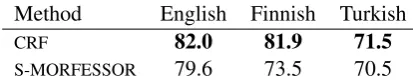
Finally, Table 8 shows the results of the CRF and S-MORFESSOR models trained with the full English, Finnish, and Turkish MC data sets and evaluated with the boundary evaluation method of Virpioja et al. (2011). That is, these numbers are directly comparable to the BPR-F column in the result tables presented at the Morpho Challenge website4. For each of the three languages, CRF
clearly outperforms all the Morpho Challenge sub-missions that have provided morphological seg-mentations.
4http://research.ics.aalto.fi/events/
morphochallenge/
Method %Lbl. Prec. Rec. F1
CRF 25 90.5 90.6 90.6
S-MORFESSOR 25 71.5 85.3 77.8
POON-2009 25 78.7 73.3 75.9
CRF 50 94.0 91.5 92.7
S-MORFESSOR 50 82.1 81.8 81.9
POON-2009 50 82.8 74.6 78.4
CRF 75 94.0 92.7 93.4
S-MORFESSOR 75 84.0 88.1 86.0
POON-2009 75 83.1 77.3 80.1
CRF 100 94.9 94.0 94.5
S-MORFESSOR 100 85.3 91.1 88.1
POON-2009 100 83.0 78.9 80.9
Table 4: Results for Hebrew on the S&B data set (Snyder and Barzilay, 2008). The column ti-tled%Lbl.denotes the percentage of the annotated data used for training. In addition to the given per-centages of annotated data, POON-2009 and S-MORFESSOR utilized the remainder of the data as an unannotated set.
6 Discussion
Intuitively, the CRF-based supervised learning ap-proach should yield high segmentation accuracy when there are large amounts of annotated train-ing data available. However, perhaps surpristrain-ingly, the CRF model yields state-of-art results already using very small amounts of training data. This result is meaningful since for most languages it is infeasible to acquire large amounts of annotated training data.
The strength of the discriminatively trained CRF model is that overlapping, non-independent features can be naturally employed. Importantly, we showed that simple, language-independent substring features are sufficient for high perfor-mance. However, adding new, task- and language-dependent features is also easy. One might, for ex-ample, explore features capturing vowel harmony in Finnish and Turkish.
[image:6.595.310.521.63.239.2]in-Method Train. Prec. Rec. F1
CRF 100 80.2 74.6 77.3
S-MORFESSOR 100 88.1 79.7 83.7
CRF 200 84.7 79.2 81.8
S-MORFESSOR 200 88.1 79.5 83.6
CRF 300 86.7 79.8 83.1
S-MORFESSOR 300 88.4 80.6 84.3
CRF 400 86.5 80.6 83.4
S-MORFESSOR 400 84.6 83.6 84.1
CRF 500 88.6 80.7 84.5
S-MORFESSOR 500 86.3 82.7 84.4
CRF 600 88.1 82.6 85.3
S-MORFESSOR 600 86.7 82.5 84.5
CRF 700 87.9 83.4 85.6
S-MORFESSOR 700 86.0 82.9 84.4
CRF 800 89.1 83.2 86.1
S-MORFESSOR 800 87.1 82.5 84.8
CRF 900 89.0 82.9 85.8
S-MORFESSOR 900 86.4 82.6 84.5
CRF 1000 89.8 83.5 86.5
[image:7.595.77.286.64.350.2]S-MORFESSOR 1000 88.8 80.1 84.3
Table 5: Results for English on the Morpho Chal-lenge 2009/2010 data set (Kurimo et al., 2009; Ku-rimo et al., 2010). The column titledTrain. de-notes the number of annotated training instances. In addition to the annotated data, S-MORFESSOR utilized an unannotated set of 384,903 word types.
corporated in the model would be unchanged, the choice of parameter estimation criterion and clas-sifier is unlikely to have a dramatic effect on the method performance.
In CRF training, we focused on the supervised learning scenario, in which no unannotated data is exploited in addition to the annotated training sets. However, there does exist ample work on extend-ing CRF trainextend-ing to the semi-supervised settextend-ing (for example, see Mann and McCallum (2008) and the references therein). Nevertheless, our re-sults strongly suggest that it is crucial to use the few available annotated training instances as ef-ficiently as possible before turning model train-ing burdensome by incorporattrain-ing large amounts of unannotated data.
Following previous work (Poon et al., 2009; Kohonen et al., 2010; Virpioja et al., 2011), we applied the boundary F-score evaluation measure, while Green and DeNero (2012) reported charac-ter accuracy. We consider the boundary F-score a better measure than accuracy, since the
boundary-Method Train. Prec. Rec. F1
CRF 100 71.4 66.0 68.6
S-MORFESSOR 100 69.8 71.0 70.4
CRF 200 76.4 71.3 73.8
S-MORFESSOR 200 75.5 68.6 71.9
CRF 300 80.4 73.9 77.0
S-MORFESSOR 300 73.1 71.8 72.5
CRF 400 81.0 76.6 78.7
S-MORFESSOR 400 73.3 74.3 73.8
CRF 500 82.9 77.9 80.3
S-MORFESSOR 500 73.5 75.1 74.3
CRF 600 82.6 80.6 81.6
S-MORFESSOR 600 76.1 73.7 74.9
CRF 700 84.3 81.4 82.8
S-MORFESSOR 700 75.0 76.6 75.8
CRF 800 85.1 83.4 84.2
S-MORFESSOR 800 74.1 78.2 76.1
CRF 900 85.2 83.8 84.5
S-MORFESSOR 900 74.2 78.5 76.3
CRF 1000 86.0 84.7 85.3
S-MORFESSOR 1000 74.2 78.8 76.4
Table 6: Results for Finnish on the Morpho Chal-lenge 2009/2010 data set (Kurimo et al., 2009; Ku-rimo et al., 2010). The column titledTrain. de-notes the number of annotated training instances. In addition to the annotated data, S-MORFESSOR utilized an unannotated set of 2,206,719 word types.
tag distribution is strongly skewed towards non-boundaries. Nevertheless, for completeness, we computed the character accuracy for our Arabic data set, obtaining the accuracy 99.1%, which is close to their reported accuracy of 98.6%. How-ever, these values are not directly comparable due to our use of the Bible corpus by Snyder and Barzi-lay (2008) and their use of the Penn Arabic Tree-bank (Maamouri et al., 2004).
7 Conclusions
[image:7.595.307.521.67.349.2]Method Train. Prec. Rec. F1
CRF 100 72.4 79.6 75.8
S-MORFESSOR 100 77.9 78.5 78.2
CRF 200 83.2 82.3 82.8
S-MORFESSOR 200 80.0 83.2 81.6
CRF 300 83.9 85.9 84.9
S-MORFESSOR 300 80.1 85.6 82.8
CRF 400 86.4 86.5 86.4
S-MORFESSOR 400 80.7 87.1 83.8
CRF 500 87.5 86.4 87.0
S-MORFESSOR 500 81.0 87.2 84.0
CRF 600 87.8 88.1 87.9
S-MORFESSOR 600 80.5 89.9 85.0
CRF 700 89.1 88.3 88.7
S-MORFESSOR 700 80.9 90.7 85.5
CRF 800 88.6 90.3 89.4
S-MORFESSOR 800 81.2 91.0 85.9
CRF 900 89.2 89.8 89.5
S-MORFESSOR 900 81.4 91.2 86.0
CRF 1000 89.9 90.4 90.2
[image:8.595.311.518.62.104.2]S-MORFESSOR 1000 83.0 91.5 87.0
Table 7: Results for Turkish on the Morpho Chal-lenge 2009/2010 data set (Kurimo et al., 2009; Ku-rimo et al., 2010). The column titledTrain. de-notes the number of annotated training instances. In addition to the annotated data, S-MORFESSOR utilized an unannotated set of 617,298 word types.
boundaries based on their local character substring contexts instead of learning a morph lexicon.
We showed that our supervised method yields improved results compared to previous state-of-art semi-supervised methods using the same small amount of annotated data, while not utilizing the unannotated data used by the reference methods. This result has two implications. First, supervised methods can provide excellent results in morpho-logical segmentation already when there are only a few annotated training instances available. This is meaningful since for most languages it is infea-sible to acquire large amounts of annotated train-ing data. Second, performtrain-ing morphological seg-mentation by directly modeling segment bound-aries can be advantageous compared to modeling morph lexicons.
A potential direction for future work includes evaluating the morphs obtained by our method in real world applications, such as speech recognition and information retrieval. We are also interested in extending the method from fully supervised to
Method English Finnish Turkish
CRF 82.0 81.9 71.5
S-MORFESSOR 79.6 73.5 70.5
Table 8: F-measures of the Morpho Chal-lenge boundary evaluation for CRF and S-MORFESSOR using the full annotated training data set.
semi-supervised learning.
Acknowledgements
This work was financially supported by Langnet (Finnish doctoral programme in language studies) and the Academy of Finland under the Finnish Centre of Excellence Program 2012–2017 (grant no. 251170), projectMultimodally grounded lan-guage technology(no. 254104), and LASTU Pro-gramme (nos. 256887 and 259934).
References
M. Collins. 2002. Discriminative training methods for hidden markov models: Theory and experiments with perceptron algorithms. In Proceedings of the 2002 Conference on Empirical Methods in Natural Language Processing (EMNLP 2002), volume 10, pages 1–8. Association for Computational Linguis-tics.
M. Creutz, T. Hirsimäki, M. Kurimo, A. Puurula, J. Pylkkönen, V. Siivola, M. Varjokallio, E. Arisoy, M. Saraçlar, and A Stolcke. 2007. Morph-based speech recognition and modeling of out-of-vocabulary words across languages. ACM Transac-tions on Speech and Language Processing, 5(1):3:1– 3:29, December.
S. Green and J. DeNero. 2012. A class-based agreement model for generating accurately inflected translations. In Proceedings of the 50th Annual Meeting of the Association for Computational Lin-guistics: Long Papers-Volume 1, pages 146–155. Association for Computational Linguistics.
H. Hammarström and L. Borin. 2011. Unsupervised learning of morphology. Computational Linguistics, 37(2):309–350, June.
T. Hirsimäki, M. Creutz, V. Siivola, M. Kurimo, S. Vir-pioja, and J. Pylkkönen. 2006. Unlimited vocabu-lary speech recognition with morph language mod-els applied to Finnish. Computer Speech and Lan-guage, 20(4):515–541, October.
[image:8.595.76.284.65.351.2]and Phonology, pages 78–86, Uppsala, Sweden, July. Association for Computational Linguistics.
M. Kurimo, S. Virpioja, V. Turunen, G. W. Blackwood, and W. Byrne. 2009. Overview and results of Mor-pho Challenge 2009. InWorking Notes for the CLEF 2009 Workshop, Corfu, Greece, September.
M. Kurimo, S. Virpioja, and V. Turunen. 2010. Overview and results of Morpho Challenge 2010. In
Proceedings of the Morpho Challenge 2010 Work-shop, pages 7–24, Espoo, Finland, September. Aalto University School of Science and Technology, De-partment of Information and Computer Science. Technical Report TKK-ICS-R37.
J. Lafferty, A. McCallum, and F.C.N. Pereira. 2001. Conditional random fields: Probabilistic models for segmenting and labeling sequence data. In Proceed-ings of the Eighteenth International Conference on Machine Learning, pages 282–289.
M. Maamouri, A. Bies, T. Buckwalter, and W. Mekki. 2004. The penn arabic treebank: Building a large-scale annotated arabic corpus. In NEMLAR Con-ference on Arabic Language Resources and Tools, pages 102–109.
G. Mann and A. McCallum. 2008. Generalized expec-tation criteria for semi-supervised learning of con-ditional random fields. In Proceedings of ACL-08: HLT, pages 870–878. Association for Compu-tational Linguistics.
A. McCallum and W. Li. 2003. Early results for named entity recognition with conditional random fields, feature induction and web-enhanced lexicons. InProceedings of the seventh conference on Natural language learning at HLT-NAACL 2003-Volume 4, pages 188–191. Association for Computational Lin-guistics.
A. McCallum, D. Freitag, and F. Pereira. 2000. Max-imum entropy Markov models for information ex-traction and segmentation. In Pat Langley, editor,
Proceedings of the Seventeenth International Con-ference on Machine Learning (ICML 2000), pages 591–598, Stanford, CA, USA. Morgan Kaufmann.
F. Peng, F. Feng, and A. McCallum. 2004. Chinese segmentation and new word detection using condi-tional random fields. InProceedings of the 20th In-ternational Conference on Computational Linguis-tics (COLING 2004), page 562. Association for Computational Linguistics.
H. Poon, C. Cherry, and K. Toutanova. 2009. Unsuper-vised morphological segmentation with log-linear models. InProceedings of Human Language Tech-nologies: The 2009 Annual Conference of the North American Chapter of the Association for Computa-tional Linguistics, pages 209–217. Association for Computational Linguistics.
F. Sha and F. Pereira. 2003. Shallow parsing with con-ditional random fields. InProceedings of the 2003 Conference of the North American Chapter of the Association for Computational Linguistics on Hu-man Language Technology-Volume 1, pages 134– 141. Association for Computational Linguistics.
B. Snyder and R. Barzilay. 2008. Crosslingual prop-agation for morphological analysis. InProceedings of the AAAI, pages 848–854.
M. Szummer, P. Kohli, and D. Hoiem. 2008. Learn-ing CRFs usLearn-ing graph cuts. Computer Vision–ECCV 2008, pages 582–595.
V. Turunen and M. Kurimo. 2011. Speech retrieval from unsegmented Finnish audio using statistical morpheme-like units for segmentation, recognition, and retrieval. ACM Transactions on Speech and Language Processing, 8(1):1:1–1:25, October.
S. Virpioja, V. Turunen, S. Spiegler, O. Kohonen, and M. Kurimo. 2011. Empirical comparison of eval-uation methods for unsupervised learning of mor-phology. Traitement Automatique des Langues, 52(2):45–90.