Exploiting multiple hypotheses for Multilingual Spoken Language
Understanding
Marcos Calvo, Fernando Garc´ıa, Llu´ıs-F. Hurtado, Santiago Jim´enez, Emilio Sanchis
Departament de Sistemes Inform`atics i Computaci´o Universitat Polit`ecnica de Val`encia, Val`encia, Spain
{mcalvo,fgarcia,lhurtado,sjimenez,esanchis}@dsic.upv.es
Abstract
In this work, we present an approach for multilingual portability of Spoken Lan-guage Understanding systems. The goal of this approach is to avoid the effort of ac-quiring and labeling new corpora to learn models when changing the language. The work presented in this paper is focused on the learning of a specific translator for the task and the mechanism of transmitting the information among the modules by means of graphs. These graphs represent a set of hypotheses (a language) that is the input to the statistical semantic decoder that pro-vides the meaning of the sentence. Some experiments in a Spanish task evaluated with input French utterances and text are presented. They show the good behavior of the system, mainly when speech input is considered.
1 Introduction
Spoken Language Understanding (SLU) is one of the key modules in many voice-driven human-computer interaction systems. Many successful SLU systems that have been developed in the last few years are based on statistical models automat-ically learned from semantautomat-ically labeled corpora (Maynard and Lef`evre, 2001; Segarra et al., 2002; He and Young, 2006; Lef`evre, 2007; De Mori et al., 2008). One of the advantages of statistical models is the capability of representing the vari-ability of lexical realizations of concepts (mean-ings). On the other hand, they are usually plain models, that is, they can not represent a hierarchi-cal semantic dependency, although there are some works in this area (He and Young, 2003). How-ever, this is not a problem in most Spoken Dialog Systems since the semantic information to be ex-tracted is not very hierarchically structured.
Another important aspect of these models is that they can be learned from corpora. The corpora used for training must be large enough to allow an accurate estimation of the probabilities, and it must represent the lexical and syntactic variabil-ity that is used in the language to express the se-mantics as much as possible. Although there are some approaches based on semi-supervised or un-supervised learning (T¨ur et al., 2005; Riccardi and Hakkani-T¨ur, 2005; Ortega et al., 2010), the most common approaches need to have a segmented and labeled training corpus. This is the case of discriminative models (like Conditional Random Fields (Hahn et al., 2010)), and generative models (such as Hidden Markov Models and Stochastic Finite State Automata (Segarra et al., 2002; Hahn et al., 2010)). In the case of supervised learn-ing, it is necessary to define a set of concepts that represent the semantic domain of the task and to associate these concepts to the corresponding se-quences of words in the sentences. This is the case of the French MEDIA corpus (Bonneau-Maynard et al., 2005), and the Spanish DIHANA corpus (Bened´ı et al., 2006). Since the corpus acquisi-tion and labeling require a great manual effort, be-ing able to reuse the corpus generated for a task to easily develop SLU systems for other tasks, or languages, is an important issue.
This work focuses on the problem of SLU porta-bility between languages (Garc´ıa et al., 2012; He et al., 2013; Jabaian et al., 2013). We propose a semi-supervised approach for adapting the system to tackle sentences that are uttered in a new lan-guage. In order to learn a domain-specific transla-tion model, a parallel corpus is automatically gen-erated from the training set by using web transla-tors. Due to the fact that the speech recognition and the translation phases can generate many er-rors, a mechanism to obtain the correct meaning despite these errors is needed. This can be per-formed by supplying many hypotheses between
the different stages, either as a set ofnsentences or as a graph that represents not only the original sentences but also an adequate generalization of them. This graph can be obtained from a Gram-matical Inference process. We have also devel-oped a specific algorithm to perform the semantic decoding by taking graphs of words as the input and considering statistical semantic models. We have applied these techniques for the DIHANA corpus, which is a task to access the information of train timetables and fares in Spanish by phone. This corpus was originally generated in Spanish, and we have evaluated our system by using input sentences in French.
2 Description of the system
One way of solving the SLU problem is to find the sequence of concepts Cˆ that best fits the
seman-tics contained in an utterance A. Considering a stochastic modelization, it can be stated as:
ˆ
C= argmax
C
p(C|A) (1)
In the case of Multilingual SLU, the user utters a sentence in a source language s, which is dif-ferent to the languagetof the original data of the SLU task. Thus, either the uttered sentence or the training data (or maybe both) should be translated into a common language in order to be able to ap-ply the semantic decoding process to the input terance. In our case, we recognize the input ut-terance by using an Automatic Speech Recognizer (ASR) in the source language, and we then trans-late the hypotheses provided by the ASR into the target languagetby means of a statistical Machine Translation system (see Figure 1). Consequently, by considering both the input sentenceWsuttered by the user and its translation into the target lan-guageWt, Equation (1) can be rewritten as:
ˆ
C = argmax
C
max
Ws,Wt
p(C, Ws, Wt|A) (2)
Equation (2) can be decomposed into several factors, as shown in Equation (3). This is achieved by applying the Bayes’ Rule and making some reasonable assumptions about the independence of the variables.
ˆ
C= argmax
C
max
Ws,Wt
p(A|Ws)·p(Ws|Wt)·p(Wt|C)·p(C)
p(A)
(3) To perform this maximization, we propose a de-coupled architecture, which sequentially applies
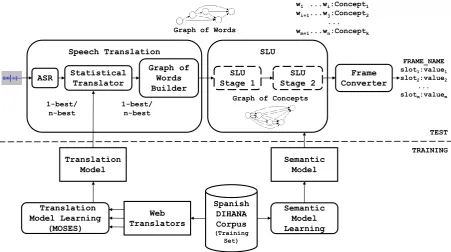
all the knowledge sources. One of the most impor-tant drawbacks of decoupled architectures is that the errors generated in one stage can not be recov-ered in following phases. To overcome this prob-lem, we propose an architecture in which the com-munication between the modules is done by means of structures that provide more than one hypothe-sis, liken-best and graphs of words. A scheme of this architecture is shown in Figure 1. Its modules are the following:
1. First, the input utterance is processed by an ASR in the source language, providing as its output either the 1-best or a set ofn-best tran-scriptions. We have used a general purpose, freely available web ASR, which means that the ASR has no specific information about the task.
2. These transcriptions are translated into the target language by means of a state-of-the-art Machine Translation system: MOSES (Koehn et al., 2007). The translation mod-els have been trained without using any man-ually generated data. Instead, a set of freely available web translators was used to trans-late the training sentences of the corpus from the target language (the original language of the corpus sentences) into the source lan-guage (the lanlan-guage of the speaker), thereby building a parallel training corpus. MOSES provides as its output a set of candidate trans-lations (n-best) of the transcriptions supplied by the ASR.
3. A graph of words is built from the n-best provided by the translator. This graph is built through a Grammatical Inference pro-cess. This way the graph not only represents the translations, but also a reasonable gener-alization of them. This makes it possible for the semantic decoder to consider some sen-tences that were not in the initial set but that are made of pieces of those sentences.
Speech Translation
TEST
TRAINING
SLU
SLU Stage 1
SLU Stage 2
Graph of Concepts
w1 ...wi:Concept1
wi+1...wj:Concept2
... wm+1...wn:Conceptk
Graph of Words
Graph of Words Builder
Frame Converter
FRAME_NAME slot1:value1
slot2:value2
... slotm:valuem
ASR Statistical
Translator
1-best/ n-best
1-best/ n-best
Spanish DIHANA Corpus (Training
Set) Translation
Model
Translation Model Learning
(MOSES)
Semantic Model Learning Web
Translators
[image:3.595.73.525.66.318.2]Semantic Model
Figure 1: Scheme of the decoupled architecture.
the graph of words. The output of this mod-ule is the best sequence of concepts Cˆ and
also its underlying sequence of wordsWt˜ in
the target language and a segmentation ofW˜t
according toCˆ.
5. Finally, the segmentation obtained in the pre-vious step is processed in order to convert it into a frame representation. This involves extracting the relevant information from the segmentation and representing it in a canoni-cal way.
Assuming that all the translations Wt that be-long to the language represented by the graph of words are a priori equiprobable in the target lan-guage, we can rewrite Equation (3) as follows:
ˆ
C= argmax
C
max
Ws,Wt
p(A|Ws)·p(Ws)·p(Wt|Ws)·p(Wt|C)·p(C)
p(A)
(4) The first three modules of the architecture can be viewed as a speech translation process, where the input is an utterance and the output is a set of possible translations of this utterance, represented as a graph of words. Each one of these translations is weighted with the probabilityp(Wt|A). Consid-ering that
p(Wt|A)≈max Ws
p(A|Ws)·p(Ws)·p(Wt|Ws) p(A)
it stands that Equation (4) can be rewritten as:
ˆ
C = argmax
C
max
Wt
p(Wt|A)·p(Wt|C)·p(C) (5)
The fact that the communication between the different modules is a set of hypotheses makes it possible to apply the different constraints (acous-tic, lexical, syntac(acous-tic, and semantic) in a global way, while the modular architecture allows local pruning taking into account only a subset of the knowledge sources. This way each of the modules contributes to the computation of the global max-imization, but it is not completely performed until the end of the process.
3 Learning of the translation model
the Internet) to automatically translate the task-specific training sentences into another language. Although these translators can generate many er-rors, they are an interesting way to obtain several hypotheses for a translation without much effort. However, the use of these translators at testing time is not very convenient due to the fact that the system would depend on the Internet connection and the reaction time of the corresponding web pages. Another drawback is that it is impossible to adapt them to a specific task, which could gen-erate many errors that are important to the task.
The approach that we propose attempts to take advantage of these resources, but for training pur-poses. In other words, given the training sentences in Spanish, they are translated into a new language (French in this case) by using several web transla-tors. This way we build a parallel corpus where each sentence has different translations associated to it. From this parallel corpus, we train a statisti-cal translator that is specific for the task. It should be noted that by means of this process, the learned translator can represent and modelize the variabil-ity generated by the different translators. How-ever, due to the difficulty of the problem, this mod-elization may not be enough. Therefore we can not guarantee that the best translation obtained by the model is consistent with the meaning of the origi-nal sentence. This is why it is convenient to supply more than one hypothesis to the semantic decod-ing module in order to have the possibility of find-ing the correct semantic meanfind-ing even when some errors were generated in the recognition and trans-lation processes. We think that separately process-ing then-best translated sentences (for each input sentence) generated by the translator is not the best solution. In contrast, it would be better to ade-quately combine segments of different sentences. Thus, we have developed a Grammatical Inference mechanism to build a graph of words from a set of hypotheses as described in the following section.
4 Generating the graphs of words
In this section, the process of obtaining the graphs of words in the target language from multiple translation hypotheses is explained. This process is divided into two steps:
1. The translation hypotheses are aligned using a Multiple Sequence Alignment (MSA) algo-rithm. The result of the MSA process is an alignment matrix.
2. The aligned sentences, represented by the alignment matrix, are used to obtain a weighted graph of words that will be the in-put to the graph-based SLU module.
A Multiple Sequence Alignment is a process of sequence alignment that involves more than two sequences. It takes a set of sequences of symbols (in our case, sequences of words) and provides the alignment of the elements of the set that minimizes the number of edit operations (substitutions, in-sertions, and deletions) among all the symbols of the sequences. In this work, a modification of the ClustalW (Larkin et al., 2007) Multiple Sequence Alignment software has been used.
The result of the MSA process is an alignment matrix. Each row in this matrix represents a differ-ent aligned sdiffer-entence, and each column represdiffer-ents the alignment of each symbol. The total number of columns is usually greater than the length of the longest sequence, since not all the symbols can be aligned. The special symbol ’-’ is used to rep-resent the positions of non-alignment points in a sentence.
A weighted directed acyclic graph of words is created from the MSA alignment matrix, The graph construction consists of creating as many nodes as columns in the alignment matrix plus one for the final state and as many arcs as cells in the matrix that contain a symbol different to ’-’. The arcs with the same source, destination, and symbol are joined, and the weights are obtained by nor-malizing these counters (Calvo et al., 2012).
trans-source le prix du billet de train de six heures trente-cinq
utterance (the price of the train ticket for six thirty-five)
(el precio del billete del tren de las seis treinta y cinco) le prix du billet train de sezer trente-cinq
multiple ASR le prix du billet train de six vers trente-cinq outputs le prix du billet train de six onze trente-cinq
le prix du billet train des six heures trente cinq el precio del billete de tren de sezer treinta y cinco
multiple el precio del billete de tren alrededor de las seis treinta y cinco translations el precio del billete del tren de las seis once y treinta y cinco
el precio del billete de tren de las seis treinta de las cinco de la tarde
el precio del billete de tren - de sezer treinta - - - y cinco - - -alignment el precio del billete de tren alrededor de las seis treinta - - y cinco - - -matrix el precio del billete del tren - de las seis once y treinta y cinco - - -el precio d-el billete de tren - de las seis treinta - de las cinco de la tarde
0 1
el (1.00) 2
precio (1.00) 3
del (1.00) 4
billete (1.00) 5
de (0.75)
del (0.25) 6
tren (1.00)
7
alrededor (0.25)
8
de (0.75)
de (1.00)
9
las (0.75) sezer (0.25) 10
seis (0.75) treinta (0.25)
11
once (0.25) treinta (0.50)
14
y (0.25)
12
y (0.33)
13
de (0.33)
y (0.33) treinta (1.00) las
(0.50) y (0.50)
15
cinco (0.25)
18
cinco (0.75)
16
de (1.00)
17
la (1.00) tarde
[image:5.595.72.535.60.311.2](1.00)
Figure 2: Steps for obtaining the graph of words from the original utterancele prix du billet de train de six heures trente-cinq, (the price of the train ticket for six thirty-five).
lation process. This process takes as its input an utterance and outputs a weighted graph of words, which represents the probability distribu-tion p(Wt|A). In other words, each full path in the graph of words (from the initial to the ending node) is a candidate translation of the input utter-ance, and is weighted with the probability of the translation given the utterance.
5 Performing the semantic decoding
Our semantic decoding process is based on the idea of finding segments of words contained in the graph of words that are relevant to each of the concepts of the task. In order to compactly repre-sent this set of segments and the concepts they are relevant to, a second graph is created, which we have called a graph of concepts. This graph has the same set of nodes as the graph of words, but each arc represents that there is a path in the graph of words between the initial and ending node of the arc, which induces a sequence of words that is relevant to some of the concepts of the task. Thus, each of these arcs is labeled with the correspond-ing sequence of words and the concept they repre-sent. To assign a proper weight to the arcs, both the weights represented in the graph of words and the semantic model are considered. As the set of nodes is the same as in the graph of words, we will say that for every two nodesi, j, it stands that
i < j if icomes before j in the topological or-der of the nodes in the graph of words (there is a topological order because the graph of words is directed and acyclic).
p(Wt|A)·p(Wt|C), for the sequence of concepts Cand the sentenceWtinduced by the path.
The set of arcs of the graph of concepts can be built by means of a Dynamic Programming (DP) algorithm that finds the sequence of words that maximizes the combined probability stated above, for each pair of nodes i, j and each concept c. Only the arc that represents the sequence of words of maximum probability is needed because this in-formation will afterwards be combined with the probability of the sequence of concepts to find the path of maximum probability (see Equation (5)), and if there are many arcs between nodesiandj corresponding to the conceptconly the one with maximum probability will be considered. This al-lows us to prune the arcs of the graph of concepts without any loss of information. For the DP al-gorithm, we will consider a representation of the LM corresponding to each concept as a Stochastic Finite State Automaton (SFSA). Then, in the DP process, for each conceptcwe will obtain the best path from nodeito node jin the graph of words such that its underlying sequence of words arrives to the state qc in the SFSA LMc (the LM of the conceptc). This can be achieved by means of the following algorithm:
M(i, j, qc) =
1 ifi=j∧qcis the initial state ofLMc
0 ifi=j∧qcis not the initial state ofLMc
0 ifj < i
max
∀a∈EGW:dest(a)=j ∀(q0c ,wd(a),qc)∈LMc
M(i,src(a), q0c)·p(q0c,wd(a), qc)·wt(a)
otherwise
(6) where dest(a) stands for the destination node of the arcain the graph of words, src(a) refers to its source node, and wd(a) and wt(a) refer to the word and the weight attached to the arc, respectively. Also, (q0c,wd(a), qc) represents a transition from
the stateq0c to the state qc labeled with wd(a) in the SFSA that representsLMc.
It is worth noting that this process must be per-formed for each concept in the task. Also, it is im-portant for the algorithm to keep track of the words that constitute the paths that maximize the expres-sion for each cell. When this matrix has been filled for a specific concept c, the cell that max-imizesM(i, j, qc) for each pairi andj becomes an arc in the graph of concepts between nodes i andj. This arc is labeled with the sequence un-derlying the winning path and the conceptcand is weighted with the score (probability) contained in M(i, j, qc).
This process shapes the first stage of the SLU process, which provides the graph of concepts as a result. Then, this graph of concepts is processed by a second stage. This second stage finds the path in the graph that maximizes the combination of its probability and the probability that a LM of bi-grams of concepts gives to the sequence of con-cepts underlying the path. The LM of bigrams of concepts is also part of the semantic model, and to train it we take advantage of the segmentation and labeling in term of concepts provided by the training corpus. Finding the best path this way completely fulfills what is stated in Equation (5). Also, this best path in the graph of concepts pro-vides the best sequence of conceptsC, the under-ˆ
lying sequence of wordsW˜t, and a segmentation
ofWt˜ according toC.ˆ
6 The DIHANA task and the semantic representation
The DIHANA task consists of a telephone-based information service for trains in Spanish. A set of 900 dialogs was acquired by using the Wizard of Oz technique. The number of user turns was 6,280 and the vocabulary was 823. As in many other dialog systems (Minker, 1999), the semantic representation chosen for the task is based on a frame representation. Therefore, the final output of the understanding process is one or more frames with their corresponding attributes.
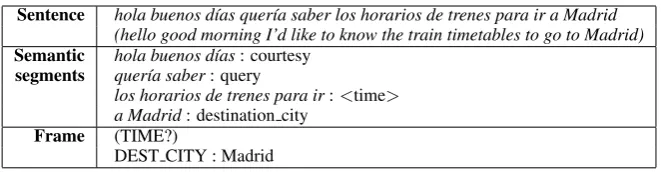
Even though the frame representation is the out-put of the system, we propose an intermediate se-mantic labeling that consists of assigning concepts to segments of the sentence in a sequential way. This is the output provided by the graph-based SLU module.
In order to represent the meaning of the utter-ances in terms of this intermediate semantic lan-guage, a set of 31 concepts was defined. Some of them are: query, affirmation, origin city, and
courtesy.
se-Sentence hola buenos d´ıas quer´ıa saber los horarios de trenes para ir a Madrid (hello good morning I’d like to know the train timetables to go to Madrid)
Semantic hola buenos d´ıas: courtesy segments quer´ıa saber: query
los horarios de trenes para ir:<time>
a Madrid: destination city Frame (TIME?)
[image:7.595.134.467.60.146.2]DEST CITY : Madrid
Table 1: Example of the outputs of the SLU and Frame Converter modules.
quences of semantic units can be learned.
Finally, a set of rules are used to transduce this intermediate representation into a frame. Since the intermediate language is close to the frame repre-sentation, only a small set of rules are required to build the frame. This phase consists of the fol-lowing: the deletion of irrelevant segments (such as courtesies), the reordering of the relevant con-cepts and attributes that appeared in the segmenta-tion following an order which has been defined a priori, the automatic instantiation of certain task-dependent values, etc.
Table 1 shows an example of the semantic rep-resentation in terms of the intermediate semantic segmentation provided by the SLU module and the final frame representation.
7 Experiments and results
To evaluate this architecture, we performed a set of experiments with the DIHANA corpus. The user turns of the corpus were split into a set of 4889 turns for training and 1227 turns for test. To train the translation models, the training set was automatically translated from Spanish into French by four freely available web translators (Apertium, Bing, Google, Lucy), which provided us a parallel training corpus. The semantic model was learned from the segmentation and labeling provided in the DIHANA corpus for the training sentences in Spanish. All the Language Models in the semantic model were bigram models trained using Witten-Bell smoothing.
For evaluation purposes, all the test set was manually translated into French, and 500 turns were uttered by four native French speakers. Thus, we have carried out experiments both considering as the input to our system the correct sentences in French (which is the same than assuming aperfect ASR) and the utterances. To recognize the utter-ances the Google ASR was used, which for this test set provides a Word Error Rate of 21.9% con-sidering only the 1-best recognized sentence.
For this experimentation we have considered three kinds of ASR outputs, namely, aPerfect ASR
(text input), the 1-best output, and finally the n-best hypotheses (withnranging from 1 to 20).
Also, we have configured the system in two dif-ferent ways:
• Configuration 1: The output of the statistical translation system are then-best translations for the input. Note that these n-best could contain repeated translations, which may lead to the reinforcement of some paths in the graphs of words.
• Configuration 2: The output of the statistical translation system is the set formed by the best n different (unique) translations that it can provide for the given input.
When the output of the ASR aren-best, we have only considered the Configuration 1.
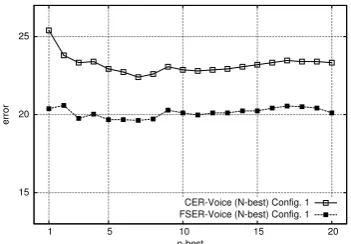
We have evaluated each experiment using two measures: the Concept Error Rate (CER), which corresponds to errors in the output of the SLU module, and the Frame-Slot Error Rate (FSER), which corresponds to errors in the slots of the frames in the final output of the system.
a better behavior. This is due to the fact that the errors introduced by the recognition of the speech input increases the errors in the translation stage. Thus, working with different alternatives makes it possible to recover some of the errors. Table 2 shows the results obtained when optimizing the FSER, and the number of hypotheses n used to build the graphs that provide the best results.
Figures 3 and 4 also show that the parameters that optimize FSER and CER may not be the same. This behavior is due to the different nature of both measures. While CER is defined in terms of the sequence of concepts extracted by the SLU mod-ule, FSER only takes into account those segments that have relevant information.
It can be seen in Figures 3 and 4 that, for Con-figuration 2, whenntakes the value18, both error
measures descend. However, after this, the errors continue with their ascending tendency. The rea-son for this is that with these parameters, the trans-lations provided by the translator generate a graph of words that allows the semantic model to better recover the semantics of the sentence. However, this effect is spurious, as for higher values ofnthe error measures present higher values.
15 20 25
1 5 10 15 20
error
n-best CER-Text Config. 1
FSER-Text Config. 1 CER-Text Config. 2 FSER-Text Config. 2
Figure 3: Results obtained with the text input.
ASR output Config. CER FSER n
Text input Config. 1 21.50 14.03 2
Config. 2 21.37 14.08 1
1-best Config. 1 24.27 19.11 3
Config. 2 24.13 19.28 3
n-best Config. 1 22.40 19.63 7
Table 2: Results obtained optimizing the FSER.
8 Conclusions
We have presented an approach for developing multilingual SLU systems without any manual
15 20 25
1 5 10 15 20
error
n-best
[image:8.595.326.502.268.390.2]CER-Voice (1-best) Config. 1 FSER-Voice (1-best) Config. 1 CER-Voice (1-best) Config. 2 FSER-Voice (1-best) Config. 2
Figure 4: Results obtained with the voice input, taking the 1-best from the ASR and the n-best from MOSES.
15 20 25
1 5 10 15 20
error
n-best
[image:8.595.91.266.415.540.2]CER-Voice (N-best) Config. 1 FSER-Voice (N-best) Config. 1
Figure 5: Results obtained with the voice input, taking the n-best from the ASR and the corre-sponding 1-best from MOSES.
fort in the adaptation of the models. It has been shown that the use of graphs of words, as a mech-anism of generalization and transmission of hy-potheses, is a good approach to recover from er-rors generated in the different phases of the sys-tem. As future work it may be interesting to ex-plore other Grammatical Inference techniques to combine then-best hypotheses generated by both the ASR and the translator. It would also be inter-esting to study the behavior of this approach with other languages that have greater differences than Spanish and French, for example non-Latin lan-guages like English and German.
Acknowledgements
References
Jos´e-Miguel Bened´ı, Eduardo Lleida, Amparo Varona, Mar´ıa-Jos´e Castro, Isabel Galiano, Raquel Justo, I˜nigo L´opez de Letona, and Antonio Miguel. 2006. Design and acquisition of a telephone spontaneous speech dialogue corpus in Spanish: DIHANA. In Proceedings of LREC 2006, pages 1636–1639, Genoa (Italy).
H. Bonneau-Maynard, Sophie Rosset, C. Ayache, A. Kuhn, and Djamel Mostefa. 2005. Semantic an-notation of the French MEDIA dialog corpus. In Proc. of InterSpeech 2005, pages 3457–3460, Portu-gal.
Marcos Calvo, Llu´ıs-F Hurtado, Fernando Garc´ıa, and Emilio Sanchis. 2012. A Multilingual SLU System Based on Semantic Decoding of Graphs of Words. InAdvances in Speech and Language Technologies for Iberian Languages, pages 158–167. Springer.
R. De Mori, F. Bechet, D. Hakkani-T¨ur, M. McTear, G. Riccardi, and G. T¨ur. 2008. Spoken language understanding: A survey. IEEE Signal Processing magazine, 25(3):50–58.
F. Garc´ıa, L.-F. Hurtado, E. Segarra, E. Sanchis, and G. Riccardi. 2012. Combining multiple translation systems for spoken language understanding porta-bility. In Spoken Language Technology Workshop (SLT), 2012 IEEE, pages 194–198. IEEE.
S. Hahn, M. Dinarelli, C. Raymond, F. Lef`evre, P. Lehnen, R. De Mori, A. Moschitti, H. Ney, and G. Riccardi. 2010. Comparing stochastic ap-proaches to spoken language understanding in multi-ple languages. IEEE Transactions on Audio, Speech, and Language Processing, 6(99):1569–1583.
Yulan He and S. Young. 2003. Hidden vector state model for hierarchical semantic parsing. In Proceedings of IEEE International Conference on Acoustics, Speech, and Signal Processing (ICASSP ’03), volume 1, pages 268–271.
Yulan He and Steve Young. 2006. Spoken language understanding using the hidden vector state model. Speech Communication, 48:262–275.
Xiaodong He, Li Deng, Dilek Hakkani-Tur, and Gokhan Tur. 2013. Multi-style adaptive training for robust cross-lingual spoken language understanding. InProc. ICASSP.
B. Jabaian, L. Besacier, and F. Lef`evre. 2013. Comparison and combination of lightly supervised approaches for language portability of a spoken language understanding system. Audio, Speech, and Language Processing, IEEE Transactions on, 21(3):636–648.
P. Koehn, H. Hoang, A. Birch, C. Callison-Burch, M. Federico, N. Bertoldi, B. Cowan, W. Shen, Moran C., R. Zens, C. Dyer, Bojar O., A. Con-stantin, and E. Herbst. 2007. Moses: Open source
toolkit for statistical machine translation. In Pro-ceedings of Association for Computational Linguis-tics (ACL’07), pages 177–180.
M. A. Larkin, G. Blackshields, N. P. Brown, R. Chenna, P. A. McGettigan, H. McWilliam, F. Valentin, I. M. Wallace, A. Wilm, R. Lopez, J. D. Thompson, T. J. Gibson, and D. G. Higgins. 2007. ClustalW and ClustalX version 2.0. Bioinformatics, 23(21):2947–2948.
F. Lef`evre. 2007. Dynamic bayesian networks and dis-criminative classifiers for multi-stage semantic in-terpretation. In Proceedings of IEEE International Conference on Acoustics, Speech and Signal Pro-cessing (ICASSP’07), volume 4, pages 13–16. IEEE.
Lambert Mathias and William Byrne. 2006. Statis-tical phrase-based speech translation. In Proceed-ings of IEEE International Conference on Acoustics, Speech, and Signal Processing (ICASSP’06), vol-ume 1, pages 561–564. IEEE.
H. Bonneau Maynard and F. Lef`evre. 2001. Investi-gating Stochastic Speech Understanding. In Proc. of IEEE Automatic Speech Recognition and Under-standing Workshop (ASRU’01).
W. Minker. 1999. Stocastically-based semantic analy-sis. InKluwer Academic Publishers, Boston, USA. Luc´ıa Ortega, Isabel Galiano, Llu´ıs-F. Hurtado, Emilio
Sanchis, and Encarna Segarra. 2010. A statistical segment-based approach for spoken language under-standing. InProc. of InterSpeech 2010, pages 1836– 1839, Makuhari, Chiba, Japan.
G. Riccardi and D. Hakkani-T¨ur. 2005. Active learn-ing: theory and applications to automatic speech recognition. IEEE Transactions on Speech and Au-dio Processing, 13(4):504 – 511.
E. Segarra, E. Sanchis, M. Galiano, F. Garc´ıa, and L. Hurtado. 2002. Extracting Semantic Information Through Automatic Learning Techniques. IJPRAI, 16(3):301–307.