Original Article
Value of continuing nursing in chronic heart failure and
its effect on patients’ cardiac function improvement
Cuifan Li1, Xiaofang Li2, Hui Li1, Yingdong Cao1
1Nursing School, Sias International University, Zhengzhou University, Xinzheng, Henan Province, China; 2 Depart-ment of Gastroenterology, Xuchang Central Hospital, Xuchang, Henan Province, China
Received June 9, 2018; Accepted August 18, 2018; Epub December 15, 2018; Published December 30, 2018
Abstract: Objective: To investigate the effect of continuing nursing on chronic heart failure and its effect on the im-provement of cardiac function. Methods: Ninety patients with chronic heart failure treated in Nursing School, Sias International University from April 2016 to August 2017 were included in this study. Using the digital random table method, participants were divided into observation groups (n=45 cases) and control group (n=45 cases) according to the retrospectively analyzed clinical data. Conventional intervention was used for the control group, and continu-ing nurscontinu-ing intervention was used for the observation group. Then the changes of cardiac function, quality of life, cognitive function, psychological state and treatment compliance before and after intervention in the two groups were compared. In addition, patients’ satisfaction of nursing care was also compared. Results: Some cardiac func-tion indexes which includes left ventricular ejecfunc-tion fracfunc-tion, fracfunc-tion shortening and 6-minute walk test, Minnesota living with heart failure questionnaire and mini-mental state examination scores after intervention were significantly higher than those before the intervention (all P<0.001). Moreover, scores of the observation group were signifi-cantly higher than those of the control group (all P<0.01); additionally, both self-rating anxiety scale and self-rating depression scale scores in the two groups after intervention were significantly lower than those before intervention (all P<0.001) and the scores of the observation group was significantly lower than those of the control group (both P<0.01). The evaluation index of treatment compliance in the observation group was significantly better than that in the control group (all P<0.05) and the satisfaction of the observation group was significantly higher than that of the control group (P=0.027). Conclusion: Continuing nursing care for patients with chronic heart failure can significantly improve their clinical symptoms, strengthen their cardiac and cognitive function, and relieve their anxiety. What’s more, the patients’ high treatment compliance has a significant effect on the improvement of their quality of life.
Keywords: Continuing nursing, chronic heart failure, quality of life, psychology, compliance, safety
Introduction
Chronic heart failure refers to the chronic com-prehensive disease caused by the degenera-tion and damage of the heart structure or its functional state resulting in dysfunction of ven-tricular filling or ejection. It is the ultimate out-come of the development of various types of heart disease. Chronic heart failure is prone to induce a variety of complications, with a long-term course of disease, high recurrence rate, high readmission rate, and then more burden are brought to patients and their family [1-4]. Nowadays, changes of people’s lifestyle and the acceleration of the life pace, have been driving the prevalence of chronic heart failure. With the continuous advancement of modern
medicine, the goal of treatment to patients with chronic heart failure not only improves their clinical symptoms, but also effectively relieves their adverse emotions, and further improves their quality of life. At the same time, readmis-sion can be avoided with increased survival rate [5]. Besides, patients with chronic heart failure mostly receive the treatment at home after hospital discharge, so the scientific and effective intervention model is the key to curb progression of this disease.
genital heart disease; (4) Patients with cardio-myopathy or cardiac valve disease; (5) Patients with poor compliance who couldn’t follow the doctor’s advice.
Methods
The control group took conventional interven-tions: the relevant medical staff gave oral or written knowledge guidance about chronic heart failure during hospitalization until dis-charge, including daily diet, rest and exercise, medication, return visit, condition observation, etc. The patients should be informed one day in advance of the outpatient review every 3 months after discharge.
The observation group adopted continuing nursing intervention: (1) Telephone follow-up: The relevant medical staff should conduct at least one telephone follow-up every week with-in one month after hospital discharge and at least 1 telephone follow-up every two weeks at the second and third months after hospital dis-charge. Telephone follow-up might involve the consolidation of chronic heart failure knowl-edge, guidance of daily life habits, aerobic exer-cise and rest, self-condition detection, psycho-logical intervention, etc. During the follow-up, medical staff should record the relevant con-tent in details and submit it to the superior doc-tor for evaluation. (2) Family follow-up: At the second week after hospital discharge, at least one family visit every month should be conduct-ed. Comprehensive assessment of the patient’s condition should be firstly finished during family follow-up to acquaint their daily salt intake, compliance medication, cardiac function, qual-ity of life and mental status. Then appropriate measures could be developed based on indi-vidual conditions and they would be checked in the next home visit; secondly, the patient’s medication situation and daily dose were care-fully evaluated; thirdly, movement guidance was given according to the patient’s cardiac function status. Activities contained climbing stairs, outdoor walking, Tai Chi, etc. In addition, patients with cardiac function in grade II could take all exercise, like outdoor walking (700 m/ time, 1~2 times/d), climbing stairs (15 min/ time, 1~2 times/d), Tai Chi, Qigong, etc. As for patients with cardiac function in grade III, they were limited to take all exercise, except indoor walking (15 min/time, 1~2 times/d). Patients in a timely manner after leaving hospital, which
was detrimental to disease control, leading to high readmission rate. Giving that the continu-ous nursing model is an intervention measure that extends hospital-related services to each patient’s family, it has been widely implement-ed in patients with hypertension and plays a positive role in stabilizing blood pressure and improving their quality of life [6]. However, there are currently few clinical reports on continuing nursing intervention for other chronic diseases, especially there is no study about the improve-ment of cardiac function brought by the con-tinuing nursing intervention. Therefore, we would like to explore the clinical value of con-tinuing nursing intervention in patients with chronic heart failure. Ninety patients with chronic heart failure on intervention treatment from April 2016 to August 2017 are included to observe its effect on the patient’s cardiac func-tion, quality of life, mental status, cognitive function and many other aspects. The results are as follows.
Materials and methods
General information
A total of 90 patients with chronic heart failure treated in the Department of Cardiology of Nursing School, Sias International University from April 2016 to August 2017 were included in this study. This study was examined and approved by the Medical Ethics Committee of Nursing School, Sias International University, and the participants themselves and their fami-lies signed informed consent. All participating patients were divided into observation group (n=45) and control group (n=45) according to the random number table method.
con-with cardiac function in grade IV needed abso-lute bed rest, and the family should be asked to assist patients with appropriate massage and passive activities (15 min/time, 1~2 times/d). Fourth, assessment of the patient’s daily diet was taken, the patient should be informed of light diet, instead of high-fat and high-salt foods, and they should drink adequate water rather than eating too much [8]. Concretely, patients in grade II, III and IV should intake less than 5 g, 2.5 g and 1 g of daily salt, respec-tively. Fifth, patients were told to actively par-ticipate in the lectures of health knowledge held by the hospital. During the lectures, doc-tors would actively interact with their patients to remove their doubts, correct their erroneous perceptions, and show exact demonstrations. Both groups were consecutively intervened for 6 months, and the curative effect was evaluat-ed after the intervention.
Outcome measures
(1) Left ventricular ejection fraction (LVEF) and fraction shortening (FS) were measured by echocardiography before and after intervention for two groups, and 6-minute walk test (6MWT) before and after intervention of two groups were recorded. (2) According to the Minnesota living with heart failure questionnaire (MLHFQ) scale, the quality of life of patients in the two groups before and after six months’ interven-tion was evaluated. And the higher the score is, the better the quality of life will be [9]. (3) The mini-mental state examination (MMSE) scale was used to measure the cognitive function before and after six-month intervention. The cognitive function will be better with the increasing scores [10]. (4) The self-rating anxi-ety scale (SAS) and self-rating depression scale (SDS) were used to evaluate the psychological status before and after six-month intervention, respectively. The higher the score is, the more
smoking cessation and abstinence. The com-plete compliance was defined that the patient’s completion rate of above five goals was over 90%; otherwise, that was the incomplete. (6) Satisfaction of nursing care was evaluated after 6 months of intervention by self-made sat-isfaction rating scale with 100 points. More than 85 were defined as satisfied, 70 to 84 as basically satisfied, less than 70 points as not satisfied, satisfaction = number of (satisfied + basically satisfied) cases/number of total cases * 100%.
Statistical analysis
SPSS20.0 software was used to analyze data. Measurement data were expressed as mean ± standard deviation (_x ± sd). Paired t test was used before and after intervention within groups. Independent sample t test was used for comparison between the two groups. Count data was expressed as ratio and X2 test was
used. The difference is statistically significant at P<0.05.
Results
Comparison of clinical data
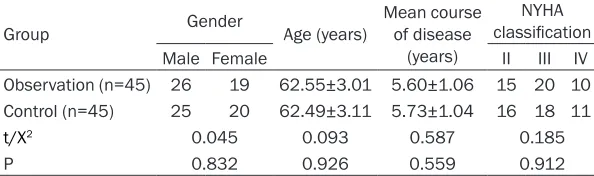
The main clinical baseline data such as gender, age, mean course of disease, and New York Heart Association classification of cardiac func-tion in the two groups were not statistically sig-nificant (all P>0.05). See Table 1.
Comparison of cardiac function before and after intervention
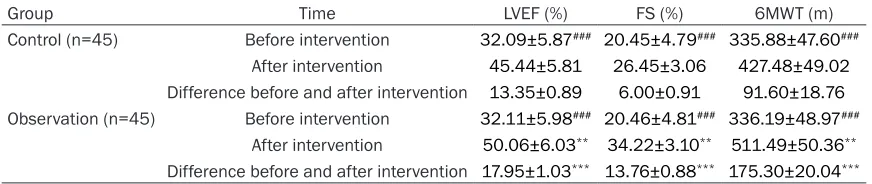
[image:3.612.91.388.87.175.2]There was no significant difference in the index-es of cardiac function between the two groups before intervention (all P>0.05). However, after intervention, LVEF, FS and 6MWT in the two groups were significantly higher than those before the intervention (all P<0.001), and the Table 1. Comparison of clinical outcome data in both groups
Group Gender Age (years) Mean course of disease (years)
NYHA classification
Male Female II III IV
Observation (n=45) 26 19 62.55±3.01 5.60±1.06 15 20 10 Control (n=45) 25 20 62.49±3.11 5.73±1.04 16 18 11
t/X2 0.045 0.093 0.587 0.185
P 0.832 0.926 0.559 0.912
Note: NYHA, New York heart association.
indexes of observation group were significantly higher than those of the control group (all P<0.01). See Table 2.
Comparison of scores of MLHFQ and MMSE before and after intervention
There was no significant difference in the scores of MLHFQ and MMSE between the two groups before the intervention of different nurs-ing modes (both P>0.05). The MLHFQ and MMSE scores of the two groups after interven-tion were significantly higher than those before interventions (all P<0.001). And scores of the observation group were significantly higher
than those of the control group (both P<0.01). See Table 3.
Comparison of psychological status before and after intervention
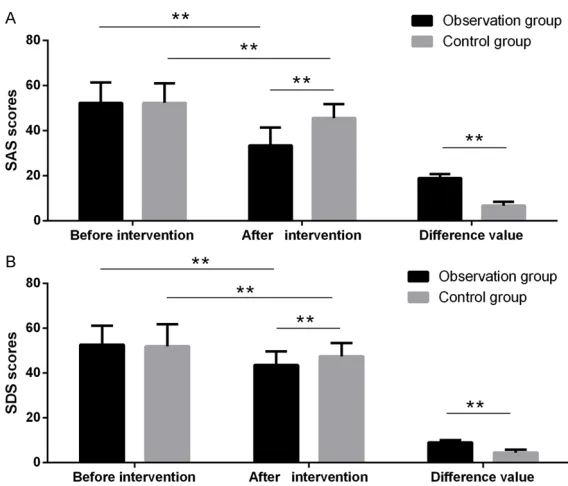
[image:4.612.89.525.89.181.2]There was no significant difference in the psy-chological status of the two groups before the intervention (both P>0.05). The SAS and SDS scores in the two groups after intervention were significantly lower than those before the intervention (all P<0.001), and the scores of observation group were significantly lower than those of the control group (both P<0.01). See Table 4 and Figure 1.
Table 2. Comparison of cardiac function before and after intervention in both groups (_x± sd)
Group Time LVEF (%) FS (%) 6MWT (m)
Control (n=45) Before intervention 32.09±5.87### 20.45±4.79### 335.88±47.60###
After intervention 45.44±5.81 26.45±3.06 427.48±49.02
Difference before and after intervention 13.35±0.89 6.00±0.91 91.60±18.76
Observation (n=45) Before intervention 32.11±5.98### 20.46±4.81### 336.19±48.97###
[image:4.612.91.523.252.344.2]After intervention 50.06±6.03** 34.22±3.10** 511.49±50.36** Difference before and after intervention 17.95±1.03*** 13.76±0.88*** 175.30±20.04*** Note: Comparison with control group, **P<0.01, ***P<0.001; comparison with after intervention within group, ###P<0.001. LVEF, left ventricular ejection fraction; FS, fraction shortening; 6MWT, 6-minute walk test.
Table 3. Comparison of scores of MLHFQ and MMSE scales before and after intervention in both groups (_x ± sd)
Group Time MLHFQ scale MMSE scale
Control (n=45) Before intervention 58.31±7.60### 15.40±3.07###
After intervention 73.22±9.63 22.30±2.86
Difference before and after intervention 14.91±1.98 6.90±0.91
Observation (n=45) Before intervention 58.29±7.54### 15.44±3.08###
[image:4.612.89.523.406.497.2]After intervention 80.09±10.57** 26.11±2.91** Difference before and after intervention 21.80±2.61*** 10.67±0.87*** Note: Comparison with control group, **P<0.01, ***P<0.001; comparison with after intervention within group, ###P<0.001. MLHFQ, Minnesota living with heart failure questionnaire; MMSE, mini-mental state examination.
Table 4. Comparison of psychological status before and after intervention in both groups (_x± sd)
Group Time SAS SDS
Control (n=45) Before intervention 52.28±8.77### 51.97±9.78###
After intervention 45.60±6.15 46.14±6.02
Difference before and after intervention 6.68±1.73 4.53±1.23
Observation (n=45) Before intervention 52.33±9.10### 52.61±8.56###
After intervention 33.44±7.96** 41.60±6.12**
Comparison of treatment compliance
The evaluation indicators of treatment compli-ance in the observation group were significantly better than those in the control group, with sta-tistically significant difference (all P<0.05). See Table 5.
Satisfaction evaluation
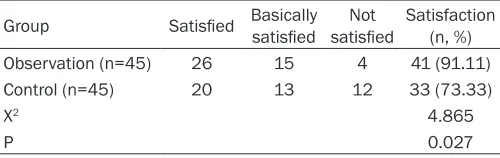
The satisfaction of the observation group was significantly higher than that of the control group, with statistically significant difference (P=0.027). See Table 6.
Discussion
Chronic heart failure is a common disease with high incidence in the cardiology department. According to epidemiological investigations, its incidence in the United States, Europe and China is 5.7 million, 15 million and 4.5 million, respectively; and it is the ultimate outcome of most cardiovascular and cerebrovascular dis-eases, and is also the main cause of high mor-tality [13]. As the cause of chronic heart failure is rather complex, the condition is protracted and refractory, and the main purpose of treat-ment in current clinical practice is to improve the clinical symptoms of patients and prolong
[image:5.612.89.373.68.311.2]the condition. Nowadays, there is no report on the effect of continuing nursing on the cardiac function in patients with chronic heart failure, but some scholars have reported that the use of comprehensive interventions can effectively improve their cardiac function [16]. In this study, 90 patients with chronic heart failure were included in the continuing nursing model to observe its effects on the patient’s cardiac function, quality of life, etc. The results of this study showed that LVEF, FS, and 6MWT were significantly higher after intervention, and were significantly higher in the observation group than in the control group. The SAS and SDS scores in the two groups after intervention were both significantly lower than those before intervention, and the observation group was significantly lower than the control group, showing that the continuing nursing interven-tion can significantly improve the patients’ car-diac function. It may lie in that this interven- tion can make up for the inadequacies of conventional interventions through telephone and family follow-up; this methods were ap- plied in patient’s family, to help them establish a positive and correct after-hospital behavior, correct their original poor behavior, and further improve their understanding the condition, in order to eliminate patients’ adverse emotions,
Figure 1. Comparison of psychological status before and after intervention in both groups. A: SAS scores. B: SDS scores. Comparison of psychological status before and after intervention in 2 groups, **P<0.01.
their lives so there will be long-term disease survival for most patients [14]. Some studies have found that rea-sonable and scientific nurs- ing interventions for patients with chronic heart failure can significantly increase their survival rate [15]. However, due to the impact of strain- ed doctor-patient relationship and low patient satisfaction, it is urgently needed to seek practical possible care mode and its effective transforma-tion is the key to cardiovascu-lar care.
and finally improve their treatment compliance [17].
The MLHFQ and MMSE scales can better reflect patients’ quality of life and cognitive function, respectively. Clinically, approximately 25% to 50% of patients with chronic heart failure have different levels of cognitive impairment, thus obviously affecting their quality of life. The results of this study showed that the MLHFQ and MMSE scales were significantly higher in both groups after intervention than those before intervention. And scores of the observa-tion group was significantly higher than those of the control group. It may be that continuing nursing fully shows the people-centered ing concept and the modern high-quality nurs-ing concept. It further unifies the health care and the patient’s coherence, and reflects the timeliness, effectiveness, initiative and conti-nuity of nursing care to the greatest extent. It can relieve anxiety and depression and sup-press the development of the condition [18, 19].
According to clinical studies, about 80% of patients return to their original lifestyle after discharge, and keep their unhealthy living hab-its [20, 21]. That is, knowledge propaganda and health education during hospitalization did not work, leading to recurrence of illness fur-ther reduced patients’ compliance and satis-faction. The results of this study showed that the evaluation indicators and nursing satisfac-tion of the observasatisfac-tion group were significantly better than the control group, and the
differ-stand the status and problems of the patients’ life after hospital discharge; then to improve their bad habits, improve their treatment com-pliance, prevent the development of the dis-ease [22, 23]. However, owing to small amount of samples, short study time, and lack of multi-center and large-scale parallel research, fur-ther research is needed.
In summary, the continuing nursing for patients with chronic heart failure can significantly improve their clinical symptoms, cardiac func-tion and cognitive funcfunc-tion. In addifunc-tion, it can ease their negative emotions, raise their treat-ment compliance, and finally improve their quality of life. This improvement has a signifi-cant effect, good results, and worthy of clinical application.
Disclosure of conflict of interest
None.
Address correspondence to: Yingdong Cao, Nursing School, Sias International University, Zhengzhou University, No. 168 East Renmin Road, Xinzheng 451150, Henan Province, China. Tel: +86-135- 23089930; E-mail: [email protected]
References
[image:6.612.90.525.87.162.2][1] Yu DS, Lee DT, Stewart S, Thompson DR, Choi KC and Yu CM. Effect of nurse-implemented transitional care for Chinese individuals with chronic heart failure in Hong Kong: a random-ized controlled trial. J Am Geriatr Soc 2015; 63: 1583-1593.
Table 5. Comparison of treatment compliance in both groups
Group Following the medical instructions Good mental state Smoking cessation and abstinence medicine timely Taking proper aerobic exerciseReasonable
Observation (n=45) 43 40 38 42 37
Control (n=45) 35 32 25 35 24
X2 6.154 4.444 8.942 4.406 8.598
P 0.013 0.035 0.003 0.036 0.003
Table 6. Patient satisfaction evaluation in both groups Group Satisfied Basically satisfied satisfiedNot Satisfaction (n, %)
Observation (n=45) 26 15 4 41 (91.11)
Control (n=45) 20 13 12 33 (73.33)
X2 4.865
P 0.027
[image:6.612.91.341.197.276.2]under-[2] Moore JA. Evaluation of the efficacy of a nurse practitioner-led home-based congestive heart failure clinical pathway. Home Health Care Serv Q 2016; 35: 39-51.
[3] Berger R, Moertl D, Huelsmann M, Ahmadi R and Pacher R. BNP guided care by a heart fail-ure specialist in addition to home-based nurse care in patients with chronic heart failure: a three-arm, prospective, randomized study. Journal of the American College of Cardiology 2006; 47: 89a.
[4] Olseng MW, Olsen BF, Hetland A, Fagermoen MS and Jacobsen M. Quality of life improves in patients with chronic heart failure and Cheyne-Stokes respiration treated with adaptive servo-ventilation in a nurse-led heart failure clinic. J Clin Nurs 2017; 26: 1226-1233.
[5] Ortega-Gutierrez A, Comin-Colet J, Quinones S, Morales J, Ruiz V, Garcia-Bascunana B, Ba-dosa N and Bruguera-Cortada J. 700 influence of perceived psychosocial support on self care behaviour of patients with chronic heart failure managed in nurse-led heart failure clinics. Eu-ropean Journal of Heart Failure Supplements 2015; 5: 160.
[6] Badosa N, Comin-Colet J, Ruiz S, Rizzo M, Am-mirati AL, Garcia-Bascunana B, Ivern C and Bruguera J. 341 Influence of affective status on NT-proBNP levels in patients with chronic heart failure followed in a nurse-led multidisci-plinary heart failure program. European Jour-nal of Heart Failure Supplements 2015; 6: 77. [7] Chinese Society of Cardiology of Chinese Medi-cal Association. The guideline for the diagnosis and treatment of chronic heart failure. Chi-nese Journal of Cardiology 2007; 35: 1076-1095.
[8] Parker A, Witte K, Cleland J and Clark A. 370 Nurse-led clinics for chronic heart failure im-proves and retains patients’ knowledge about their condition. European Journal of Heart Fail-ure Supplements 2015; 2: 73.
[9] Brady L. Chronic heart failure and the support-ive role of the practice nurse. Practice Nursing 2015; 26: 500-504.
[10] Bläuer C, Frei IA, Schnepp W and Spirig R. Im-plementation of a nurse-led education pro-gramme for chronic heart failure patients dur-ing hospitalisation, and strategies supportdur-ing their self-management at home: a practice development project in the context of the Swiss healthcare system. Communications in Theoretical Physics 2015; 21: 59-68.
[11] Scholes E, Tsang D, Neil C, Hornstra M, Zam-mit C and Long C. An article on implementing nurse led strategies to prevent 30 day hospital readmissions for patients with chronic heart failure. Heart Lung and Circulation 2016; 25: S96.
[12] Como JM. Health literacy and health status in people with chronic heart failure. Clin Nurse Spec 2018; 32: 29-42.
[13] Allida SM, Inglis SC, Davidson PM, Hayward CS, Shehab S and Newton PJ. A survey of views and opinions of health professionals manag-ing thirst in chronic heart failure. Contemp Nurse 2016; 52: 244-252.
[14] Riley JP, Astin F, Crespo-Leiro MG, Deaton CM, Kienhorst J, Lambrinou E, McDonagh TA, Rush-ton CA, Stromberg A, Filippatos G and Anker SD. Heart failure association of the European society of cardiology heart failure nurse curric-ulum. Eur J Heart Fail 2016; 18: 736-743. [15] Nasir U, Shahid H and Shabbir MO. Sleep
qual-ity and depression in hospitalized congestive heart failure patients. J Pak Med Assoc 2015; 65: 264-269.
[16] Stewart S, Chan YK, Wong C, Jennings G, Scuff-ham P, Esterman A, Carrington M; NIL-CHF In-vestigators. Impact of a nurse-led home and clinic-based secondary prevention programme to prevent progressive cardiac dysfunction in high-risk individuals: the nurse-led interven-tion for less chronic heart failure (NIL-CHF) ran-domized controlled study. Eur J Heart Fail 2015; 17: 620-630.
[17] Kane PM, Murtagh FE, Ryan KR, Brice M, Ma-hon NG, McAdam B, McQuillan R, O’Gara G, Raleigh C, Tracey C, Howley C, Higginson IJ, Daveson BA; BuildCARE. Strategies to address the shortcomings of commonly used advanced chronic heart failure descriptors to improve re-cruitment in palliative care research: a parallel mixed-methods feasibility study. Palliat Med 2018; 32: 517-524.
[18] Elder DH, Mohan M, Cochrane L, Charles H and Lang CC. Characterizing patients with chronic heart failure in community care after hospitalization: a potential role for ivabradine. Cardiovasc Ther 2015; 33: 104-108.
[19] Fergenbaum J, Bermingham S, Krahn M, Alter D and Demers C. Care in the home for the management of chronic heart failure: system-atic review and cost-effectiveness analysis. J Cardiovasc Nurs 2015; 30 Suppl 1: S44-51. [20] Carneiro Cde S, Oliveira AP, Lopes Jde L,
Ba-chion MM, Herdman TH, Moorhead SA, Barros AL. Outpatient clinic for health education: con-tribution to self-management and self-care for people with heart failure. Int J Nurs Knowl 2016; 27: 49-55.
co-morbidities aggravating heart failure (SICA-HF). ESC Heart Fail 2017; 4: 448-457.
[22] Testa G, Cacciatore F, Bianco A, Della-Morte D, Mazzella F, Galizia G, Gargiulo G, Curcio F, Liguori I, Sabusco A, Rengo F, Bonaduce D, Abete P. Chronic obstructive pulmonary dis-ease and long-term mortality in elderly sub-jects with chronic heart failure. Aging Clin Exp Res 2017; 29: 1157-1164.