Combining a self-organising map with memory-based learning
James Hammerton
[email protected]
Dept of Computer Science
University College Dublin
Ireland
Erik Tjong Kim Sang
[email protected]
CNTS – Language Technology Group
University of Antwerp
Belgium
Abstract
Memory-based learning (MBL) has enjoyed considerable success in corpus-based natural language process-ing (NLP) tasks and is thus a reliable method of getting a high-level of per-formance when building corpus-based NLP systems. However there is a bottleneck in MBL whereby any novel testing item has to be compared against all the training items in memory base. For this reason there has been some interest in various forms of memory editing whereby some method of selecting a subset of the memory base is employed to reduce the number of comparisons. This paper investigates the use of a modified self-organising map (SOM) to select a subset of the memory items for comparison. This method involves reducing the number of comparisons to a value proportional to the square root of the number of training items. The method is tested on the identification of base noun-phrases in the Wall Street Journal corpus, using sections 15 to 18 for training and section 20 for testing.
1
Introduction
Currently, there is considerable interest in ma-chine learning methods for corpus-based lan-guage learning. A promising technique here is
memory-based learning1 (MBL) (Daelemans et al., 1999a), where a task is redescribed as a classi-fication problem. The classiclassi-fication is performed by matching an input item to the most similar of a set of training items and choosing the most fre-quent classification of the closest item(s). Sim-ilarity is computed using an explicit simSim-ilarity metric.
MBL performs well by bringing all the training data to bear on the task. This is done at the cost, in the worst case, of comparing novel items to all of the training items to find the closest match. There is thus some interest in developing memory edit-ing techniques to select a subset of the items for comparison.
This paper investigates whether a self-organising map (SOM) can be used to perform memory editing without reducing performance. The system is tested on base noun-phrase (NP) chunking using the Wall Street Journal corpus (Marcus et al., 1993).
2
The Self-Organising Map (SOM)
The SOM was developed originally by Kohonen (1990) and has found a wide range of uses from classification to storing a lexicon. It operates as follows (see Figure 1). The SOM consists of two layers, an input layer and the map. Each unit in the map has a vector of weights associated with it that is the same size as that of the input layer. When an input is presented to the SOM, the unit whose weight vector is closest to the input vector is selected as a winner.
INPUTS MAP
Figure 1: The Self-Organising Map. The map units respond to the inputs. The map unit whose weight vector is closest to the input vector be-comes the winner. During training, after a winner is chosen, the weight vectors of the winner and a neighbourhood of surrounding units are nudged towards the current input.
During training, the weight vectors of winning unit and a set of units within the neighbourhood of the winner are nudged, by an amount deter-mined by the learning rate, towards the input vec-tor. Over time the size of the neighbourhood is decreased. Sometimes the learning rate may be too. At the end of training, the units form a map of the input space that reflects how the input space was sampled in the training data. In particular ar-eas of input space in which there were a lot of inputs will be mapped in finer detail, using more units than areas where the inputs were sparsely distributed.
3
Why use a SOM for memory editing
The SOM was chosen because the input is matched to the unit with the closest weight vec-tor. Thus it is motivated by the same principle as used to find the closest match in MBL. It is thus hoped that the SOM can minimise the risk of fail-ing to select the closest match, since the subset will be chosen according to similarity.
However, Daelemans et al (1999b) claim that, in language learning, pruning the training items is harmful. When they removed items from the memory base on the basis of their typicality (i.e. the extent to which the items were representative of other items belonging to the same class) or their class prediction strength (i.e. the extent to
which the item formed a predictor for its class), the generalisation performance of the MBL sys-tem dropped across a range of language learning tasks.
The memory editing approach used by Daele-mans et al removes training items independently of the novel items, and the remainder are used for matching with all novel items. If one selects a
different subset for each novel item based on
sim-ilarity to the novel item, then maybe the risk of degrading performance in memory editing will be reduced. This work aims to achieve precisely this.
4
A hybrid SOM/MBL classifier
4.1 Labelled SOM and MBL (LSOMMBL)
A modified SOM was developed called Labelled SOM. Training proceeds as follows:
Each training item has an associated label. Initially all the map units are unlabelled.
When an item is presented, the closest unit out of those with the same label as the input and those that are unlabelled is chosen as the winner. Should an unlabelled unit be chosen it gets labelled with the input’s label.
The weights for neighbouring units are up-dated as with the standard SOM if they share the same label as the input or are unlabelled.
When training ends, all the training inputs are presented to the SOM and the winners for each training input noted. Unused units are discarded.
Testing proceeds as follows:
When an input is presented a winning unit is found for each category.
The closest match is selected from the train-ing items associated with each of the win-ning units found.
The most frequent classification for that match is chosen.
Assuming each unit is equally likely to be cho-sen, the average number of comparisons here is given by where
is the number of categories,
is the number of units in the map and
is the number of training items. Choosing
minimises comparisons to
. In the experiments the size of the map was chosen to be close to
. This system is referred to as LSOMMBL.
4.2 SOM and MBL (SOMMBL)
In the experiments, a comparison with using the standard SOM in a similar manner was per-formed. Here the SOM is trained as normal on the training items.
At the end of training each item is presented to the SOM and the winning unit noted as with the modified SOM above. Unused units are discarded as above.
During testing, a novel item is presented to the SOM and the top C winners chosen (i.e. the
closest map units), where C is the number of cat-egories. The items associated with these win-ners are then compared with the novel item and the closest match found and then the most fre-quent classification of that match is taken as be-fore. This system is referred to as SOMMBL.
5
The task: Base NP chunking
The task is base NP chunking on section 20 of the Wall Street Journal corpus, using sections 15 to 18 of the corpus as training data as in (Ramshaw and Marcus, 1995). For each word in a sentence, the POS tag is presented to the system which out-puts whether the word is inside or outside a base NP, or on the boundary between 2 base NPs.
Training items consist of the part of speech (POS) tag for the current word, varying amounts of left and right context (POS tags only) and the classification frequencies for that combination of tags. The tags were represented by a set of vec-tors. 2 sets of vectors were used for comparison. One was an orthogonal set with a vector of all zeroes for the “empty” tag, used where the con-text extends beyond the beginning/end of a sen-tence. The other was a set of 25 dimensional vec-tors based on a representation of the words en-coding the contexts in which each word appears in the WSJ corpus. The tag representations were
obtained by averaging the representations for the words appearing with each tag. Details of the method used to generate the tag representations, known as lexical space, can be found in (Zavrel and Veenstra, 1996). Reilly (1998) found it ben-eficial when training a simple recurrent network on word prediction.
The self-organising maps were trained as fol-lows:
For maps with 100 or more units, the train-ing lasted 250 iterations and the neighbour-hood started at a radius of 4 units, reducing by 1 unit every 50 iterations to 0 (i.e. where only the winner’s weights are modified). The learning rate was constant at 0.1.
For the maps with 6 units, the training lasted 90 iterations, with an initial neighbourhood of 2, reducing by one every thirty iterations.
For the maps with 30 units, the training lasted 150 iterations, with an initial neigh-bourhood of 2, reduced by one every 50 iter-ations. A single training run is reported for each network since the results did not vary significantly for different runs.
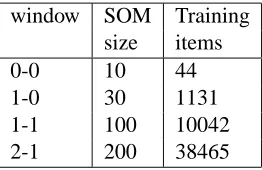
These map sizes were chosen to be close to the square root of the number of items in the training set. No attempt was made to systematically in-vestigate whether these sizes would optimise the performance of the system. They were chosen purely to minimise the number of comparisons performed.
6
Results
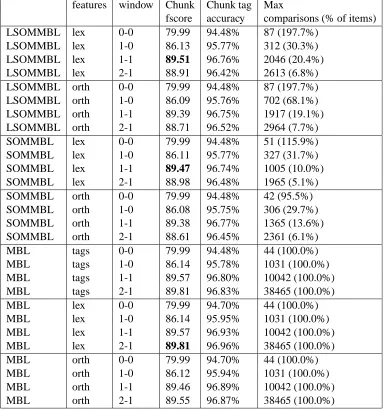
Table 1 gives the results of the experiments. The columns are as follows:
“features”. This column indicates how the features are made up.
features window Chunk Chunk tag Max
fscore accuracy comparisons (% of items) LSOMMBL lex 0-0 79.99 94.48% 87 (197.7%)
[image:4.612.107.493.16.426.2]LSOMMBL lex 1-0 86.13 95.77% 312 (30.3%) LSOMMBL lex 1-1 89.51 96.76% 2046 (20.4%) LSOMMBL lex 2-1 88.91 96.42% 2613 (6.8%) LSOMMBL orth 0-0 79.99 94.48% 87 (197.7%) LSOMMBL orth 1-0 86.09 95.76% 702 (68.1%) LSOMMBL orth 1-1 89.39 96.75% 1917 (19.1%) LSOMMBL orth 2-1 88.71 96.52% 2964 (7.7%) SOMMBL lex 0-0 79.99 94.48% 51 (115.9%) SOMMBL lex 1-0 86.11 95.77% 327 (31.7%) SOMMBL lex 1-1 89.47 96.74% 1005 (10.0%) SOMMBL lex 2-1 88.98 96.48% 1965 (5.1%) SOMMBL orth 0-0 79.99 94.48% 42 (95.5%) SOMMBL orth 1-0 86.08 95.75% 306 (29.7%) SOMMBL orth 1-1 89.38 96.77% 1365 (13.6%) SOMMBL orth 2-1 88.61 96.45% 2361 (6.1%) MBL tags 0-0 79.99 94.48% 44 (100.0%) MBL tags 1-0 86.14 95.78% 1031 (100.0%) MBL tags 1-1 89.57 96.80% 10042 (100.0%) MBL tags 2-1 89.81 96.83% 38465 (100.0%) MBL lex 0-0 79.99 94.70% 44 (100.0%) MBL lex 1-0 86.14 95.95% 1031 (100.0%) MBL lex 1-1 89.57 96.93% 10042 (100.0%) MBL lex 2-1 89.81 96.96% 38465 (100.0%) MBL orth 0-0 79.99 94.70% 44 (100.0%) MBL orth 1-0 86.12 95.94% 1031 (100.0%) MBL orth 1-1 89.46 96.89% 10042 (100.0%) MBL orth 2-1 89.55 96.87% 38465 (100.0%)
Table 1: Results of base NP chunking for section 20 of the WSJ corpus, using SOMMBL, LSOMMBL and MBL, training was performed on sections 15 to 18. The fscores of the best performers in each case for LSOMMBL, SOMMBL and MBL have been highlighted in bold.
“window”. This indicates the amount of con-text, in the form of “left-right” where “left” is the number of words in the left context, and “right” is the number of words in the right context.
“Chunk fscore” is the fscore for finding base NPs. The fscore ( ) is computed as
where
is the percentage of base NPs
found that are correct and is the
percent-age of base NPs defined in the corpus that were found.
“Chunk tag accuracy” gives the percentage of correct chunk tag classifications. This is
provided to give a more direct comparison with the results in (Daelemans et al., 1999a). However, for many NL tasks it is not a good measure and the fscore is more accurate.
“Max comparisons”. This is the maximum number of comparisons per novel item com-puted as
!
where
is the number of categories,
is the number of units and
window SOM Training size items
0-0 10 44
1-0 30 1131
[image:5.612.117.248.13.98.2]1-1 100 10042 2-1 200 38465
Table 2: Network sizes and number of training items
the maximum number of comparisons under MBL. The average number of comparisons is likely to be closer to the average men-tioned in Section 4.1.
Table 2 gives the sizes of the SOMs used for each context size, and the number of training items.
For small context sizes, LSOMMBL and MBL give the same performance. As the window size increases, LSOMMBL falls behind MBL. The worst drop in performance is just over 1.0% on the fscores (and just over 0.5% on chunk tag ac-curacy). This is small considering that e.g. for the largest context the number of comparisons used was at most 6.8% of the number of training items. To investigate whether the method is less risky than the memory editing techniques used in (Daelemans et al., 1999b), a re-analysis of their data in performing the same task, albeit with lex-ical information, was performed to find out the exact drop in the chunk tag accuracy.
In the best case with the editing techniques used by (Daelemans et al., 1999b), the drop in performance was 0.66% in the chunk tag accu-racy with 50% usage (i.e. 50% of the training items were used). Our best involves a drop of 0.23% in chunk tag accuracy and only 20.4% us-age. Furthermore their worst case involves a drop of 16.06% in chunk tag accuracy again at the 50% usage level, where ours involves only a 0.54% drop in accuracy at the 6.8% usage level. This confirms that our method may be less risky, al-though a more direct comparison is required to demonstrate this in a fully systematic manner. For example, our system does not use lexical informa-tion in the input where theirs does, which might make a difference to these results.
Comparing the SOMMBL results with the LSOMMBL results for the same context size
and tagset, the differences in performance are insignificant, typically under 0.1 points on the fscore and under 0.1% on the chunk tag accu-racy. Furthermore the differences sometimes are in favour of LSOMMBL and sometimes not. This suggests they may be due to noise due to differ-ent weight initialisations in training rather than a systematic difference.
Thus at the moment it is unclear whether SOMMBL or LSOMMBL have an advantage compared to each other. It does appear however that the use of the orthogonal vectors to repre-sent the tags leads to slightly worse performance than the use of the vectors derived from the lexical space representations of the words.
7
Discussion and future work
The results suggest that the hybrid system pre-sented here is capable of significantly reducing the number of comparisons made without risking a serious deterioration in performance. Certainly, the reduction in the number of comparisons was far greater than with the sampling techniques used by Daelemans et al while yielding similar levels of deterioration.
Given that a systematic investigation into what the optimal training regimes and network sizes are has not been performed the results thus seem promising.
With regard to the network sizes, for example, one reviewer commented that choosing the num-ber of units to be the square root of the numnum-ber of training items may not be optimal since the clusters formed in self-organising maps theoret-ically vary as the squared cube root of the den-sity, thus implying that a larger number of units may offer better performance. What impact us-ing this insight would have on the performance (as opposed to the speed) of the system however is unclear. Another variable that has not been sys-tematically investigated is the optimal number of winning units to choose during testing. Increasing this value should allow tuning of the system to balance deterioration of the performance against the reduction in comparisons made.
into account the distribution of the items around the centroid. As one reviewer suggested, it may be that if instead the comparison is made with the periphery of the cluster there would be a reduced risk of missing the closest item. One possibility for taking this into account would be to compute the average distance of the items from the cen-troid and subtract this from the raw distance com-puted between the input and the centroid. This would take into account how spread out the clus-ter is as well as how far the centroid is from the input item. This would be a somewhat more ex-pensive comparison to make but may be worth-while to improve the probability that the closest item is found in the clusters that are searched.
Future work will therefore include systemati-cally investigating these issues to determine the optimal parameter settings. Also a more system-atic comparison with other sampling techniques, especially other methods of clustering, is needed to confirm that this method is less risky than other techniques.
8
Conclusion
This work suggests that using the SOM for mem-ory editing in MBL may be a useful technique for improving the speed of MBL systems whilst min-imising reductions in performance. Further work is needed however to find the optimal training pa-rameters for the system and to confirm the utility of this approach.
Acknowledgements
The authors would like to thank the following people for their discussions and advice during this work; the reviewers of this paper for some help-ful comments, Antal van den Bosch for providing the data from (Daelemans et al., 1999b) for our analysis, Ronan Reilly for his discussions of this work, Walter Daelemans & other members of the CNTS who made the first author’s visit to CNTS an enjoyable and productive stay.
This work was supported by the EU-TMR project “Learning Computational Grammars”. The (L)SOMMBL simulations were performed using the PDP++ simulator. The MBL simula-tions were performed using the TiMBL package
References
W. Daelemans, S. Buchholz, and J. Veenstra. 1999a. Memory-based shallow parsing. In M. Osborne and E. Tjong Kim Sang, editors, Proceedings of the
Computational Natural Language Learning Work-shop (CoNLL-99), University of Bergen, Bergen, Norway, Somerset, NJ, USA. Association for
Com-putational Linguistics.
W. Daelemans, A. van den Bosch, and J. Zavrel. 1999b. Forgetting exceptions is harmful in lan-guage learning. Machine Learning, 34:11–43.
T. Kohonen. 1990. The self-organising map.
Pro-ceedings of the IEEE, 78(9):1464–1480.
M. Marcus, B. Santorini, and M. A. Marcinkiewicz. 1993. Building a large annotated corpus of English: the Penn Treebank. Computational Linguistics, 19.
L.A. Ramshaw and M.P. Marcus. 1995. Test chunking using transformation based learning. In
Proceed-ings of the Third Workshop on Very Large Corpora, Cambridge, MA, USA.
R.G. Reilly. 1998. Enriched lexical representations, large corpora and the performance of srns. In L. Niklasson, M. Bod`en, and T. Zemke, editors,
Proceedings of ICANN’98, Skovde, Sweden, pages
405–410.
J. Zavrel and J. Veenstra. 1996. The language envi-ronment and syntactic word class acquisition. In Koster C. and Wijnen F., editors, Proceedings of