Efficient Search for Inversion Transduction Grammar
Hao Zhang and Daniel Gildea
Computer Science Department University of Rochester
Rochester, NY 14627
Abstract
We develop admissible A* search heuris-tics for synchronous parsing with Inver-sion Transduction Grammar, and present results both for bitext alignment and for machine translation decoding. We also combine the dynamic programming hook trick with A* search for decoding. These techniques make it possible to find opti-mal alignments much more quickly, and make it possible to find optimal transla-tions for the first time. Even in the pres-ence of pruning, we are able to achieve higher BLEU scores with the same amount of computation.
1 Introduction
The Inversion Transduction Grammar (ITG) of Wu (1997) is a syntactically motivated algorithm for producing word-level alignments of pairs of translationally equivalent sentences in two lan-guages. The algorithm builds a synchronous parse tree for both sentences, and assumes that the trees have the same underlying structure but that the or-dering of constituents may differ in the two lan-guages. ITG imposes constraints on which align-ments are possible, and these constraints have been shown to be a good match for real bitext data (Zens and Ney, 2003).
A major motivation for the introduction of ITG was the existence of polynomial-time algorithms both for alignment and translation. Alignment, whether for training a translation model using EM or for finding the Viterbi alignment of test data, is O(n6) (Wu, 1997), while translation
(decod-ing) isO(n7)using a bigram language model, and
O(n11)with trigrams. While polynomitime
al-gorithms are a major improvement over the NP-complete problems posed by the alignment models of Brown et al. (1993), the degree of these
polyno-mials is high, making both alignment and decod-ing infeasible for realistic sentences without very significant pruning. In this paper, we explore use of the “hook trick” (Eisner and Satta, 1999; Huang et al., 2005) to reduce the asymptotic complexity of decoding, and the use of heuristics to guide the search.
Our search heuristics are a conservative esti-mate of the outside probability of a bitext cell in the complete synchronous parse. Some estimate of this outside probability is a common element of modern statistical (monolingual) parsers (Char-niak et al., 1998; Collins, 1999), and recent work has developed heuristics that areadmissiblefor A*
search, guaranteeing that the optimal parse will be found (Klein and Manning, 2003). We extend this type of outside probability estimate to include both word translation andn-gram language model
probabilities. These measures have been used to guide search in word- or phrase-based MT sys-tems (Wang and Waibel, 1997; Och et al., 2001), but in such models optimal search is generally not practical even with good heuristics. In this paper, we show that the same assumptions that make ITG polynomial-time can be used to efficiently com-pute heuristics which guarantee us that we will find the optimal alignment or translation, while significantly speeding the search.
2 Inversion Transduction Grammar
An Inversion Transduction Grammar can generate pairs of sentences in two languages by recursively applying context-free bilingual production rules. Most work on ITG has focused on the 2-normal form, which consists of unary production rules that are responsible for generating word pairs:
X→e/f
and binary production rules in two forms that are responsible for generating syntactic subtree pairs:
X →[Y Z]
and
X→ hY Zi
The rules with square brackets enclosing the right hand side expand the left hand side symbol into the two symbols on the right hand side in the same order in the two languages, whereas the rules with pointed brackets expand the left hand side symbol into the two right hand side symbols in re-verse order in the two languages.
3 A* Viterbi Alignment Selection
A* parsing is a special case of agenda-based chart parsing, where the priority of a nodeX[i, j]on the
agenda, corresponding to nonterminalXspanning
positionsithroughj, is the product of the node’s
current inside probability with an estimate of the outside probability. By the current inside proba-bility, we mean the probability of the so-far-most-probable subtree rooted on the nodeX[i, j], with
leaves beingiwj, while the outside probability is
the highest probability for a parse with the root beingS[0, N]and the sequence0wiXjwnforming
the leaves. The node with the highest priority is re-moved from the agenda and added to the chart, and then explored by combining with all of its neigh-boring nodes in the chart to update the priorities of the resulting nodes on the agenda. By using estimates close to the actual outside probabilities, A* parsing can effectively reduce the number of nodes to be explored before putting the root node onto the chart. When the outside estimate is both admissible and monotonic, whenever a node is put onto the chart, its current best inside parse is the Viterbi inside parse.
To relate A* parsing with A* search for find-ing the lowest cost path from a certain source node to a certain destination node in a graph, we view the forest of all parse trees as a hypergraph. The source node in the hypergraph fans out into the nodes of unit spans that cover the individual words. From each group of children to their par-ent in the forest, there is a hyperedge. The destina-tion node is the common root node for all the parse trees in the forest. Under the mapping, a parse is a hyperpath from the source node to the destination node. The Viterbi parse selection problem thus be-comes finding the lowest-cost hyperpath from the
source node to the destination node. The cost in this scenario is thus the negative of log probabil-ity. The inside estimate and outside estimate natu-rally correspond to thegˆandhˆ for A* searching,
respectively.
A stochastic ITG can be thought of as a stochas-tic CFG extended to the space of bitext. A node in the ITG chart is a bitext cell that covers a source substring and a target substring. We use the no-tion ofX[l, m, i, j]to represent a tree node in ITG
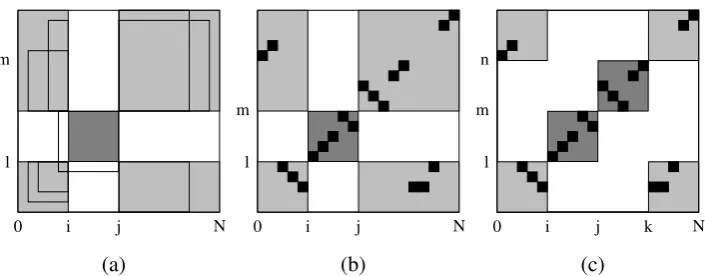
parse. It can potentially be combined with any bitext cells at the four corners, as shown in Fig-ure 1(a).
Unlike CFG parsing where the leaves are fixed, the Viterbi ITG parse selection involves finding the Viterbi alignment under ITG constraint. Good outside estimates have to bound the outside ITG Viterbi alignment probability tightly.
3.1 A* Estimates for Alignment
Under the ITG constraints, each source language word can be aligned with at most one target lan-guage word and vice versa. An ITG constituent
X[l, m, i, j] implies that the words in the source
substring in the span [l, m] are aligned with the
words in the target substring[i, j]. It further
im-plies that the words outside the span[l, m]in the
source are aligned with the words outside the span
[i, j]in the target language. Figure 1(b) displays
the tic-tac-toe pattern for the inside and outside components of a particular cell. To estimate the upper bound of the ITG Viterbi alignment proba-bility for the outside component with acceptable complexity, we need to relax the ITG constraint. Instead of ensuring one-to-one in both directions, we use a many-to-one constraint in one direction, and we relax all constraints on reordering within the outside component.
creat-l m
0 i j N
l m
0 i j N
l m n
0 i j k N
(a) (b) (c)
Figure 1: (a) A bitext cellX[l, m, i, j](shaded) for ITG parsing. The inside cell can be combined with
adjacent cells in the four outside corners (lighter shading) to expand into larger cells. One possible expansion to the lower left corner is displayed. (b) The tic-tac-toe pattern of alignments consistent with a given cell. If the inner box is used in the final synchronous parse, all other alignments must come from the four outside corners. (c) Combination of two adjacent cells shown with region for new outside heuristic.
ing a new cell whose probability is estimated using IBM Model 1. In contrast, the inside Viterbi align-ment satisfies the ITG constraint, implying only one solid cell in each column and each row. Math-ematically, our Model 1 estimate for the outside component is:
hM1(l, m, i, j) = Y
t<i, t>j
max s<l, s>m
P(ft, es)
This Model 1 estimate is admissible. Maximiz-ing over each column ensures that the translation probability for each target word is greater than or equal to the corresponding word translation prob-ability under the ITG constraint. Model 1 virtually assigns a probability of 1 for deleting any source word. As a product of word-to-word translation probabilities including deletions and insertions, the ITG Viterbi alignment probability cannot be higher than the product of maximal word-to-word translation probabilities using the Model 1 esti-mate.
The Model 1 estimate is also monotonic, a prop-erty which is best understood geometrically. A successor state to cell (l, m, i, j) in the search is
formed by combining the cell with a cell which is adjacent at one of the four corners, as shown in Figure 1(c). Of the four outside corner regions used in calculating the search heuristic, one will be the same for the successor state, and three will be a subset of the old corner region. Without loss of generality, assume we are combining a cell
(m, n, j, k)that is adjacent to(l, m, i, j)to the
up-per right. We define
HM1(l, m, i, j) =−loghM1(l, m, i, j) as the negative log of the heuristic in order to cor-respond to an estimated cost or distance in search terminology. Similarly, we speak of the cost of a chart entryc(X[l, m, i, j])as its negative log
prob-ability, and the cost of a cell c(l, m, i, j) as the
cost of the best chart entry with the boundaries
(l, m, i, j). The cost of the cell(m, n, j, k)which
is being combined with the old cell is guaranteed to be greater than the contribution of the columns
j throughk to the heuristicHM1(l, m, i, j). The contribution of the columns k through N to the
new heuristic HM1(l, n, i, k) is guaranteed to be greater in cost than their contribution to the old heuristic. Thus,
HM1(l, m, i, j)≤c(m, n, j, k) +c(X→Y Z)
+HM1(l, n, i, k) meaning that the heuristic is monotonic or consis-tent.
The Model 1 estimate can be applied in both translation directions. The estimates from both directions are an upper bound of the actual ITG Viterbi probability. By taking the minimum of the two, we can get a tighter upper bound.
We can precompute the Model 1 outside esti-mate for all bitext cells before parsing starts. A na¨ıve implementation would takeO(n6) steps of
computation, because there areO(n4)cells, each
[image:3.595.122.475.60.198.2]j
u v
</S> <S>
[image:4.595.126.472.65.206.2]i
Figure 2: The region within the dashed lines is the translation hypothesisX[i, j, u, v]. The word sequence
on the top is the Viterbi translation of the sentence on the bottom. Wide range word order change may happen.
nature of the cells, we can compute values for the inside and outside components of each cell using dynamic programming inO(n4)time (Zhang and Gildea, 2005).
4 A* Decoding
The of ITG decoding algorithm of Wu (1996) can be viewed as a variant of the Viterbi parsing al-gorithm for alignment selection. The task of stan-dard alignment is to find word level links between two fixed-order strings. In the decoding situation, while the input side is a fixed sequence of words, the output side is a bag of words to be linked with the input words and then reordered. Under the ITG constraint, if the target language substring[i, j]is
translated into s1 in the source language and the target substring[j, k]is translated intos2, thens1 ands2must be consecutive in the source language as well and two possible orderings,s1s2ands2s1, are allowed. Finding the best translation of the substring of[i, k]involves searching over all
pos-sible split points j and two possible reorderings
for each split. In theory, the inversion probabilities associated with the ITG rules can do the job of re-ordering. However, a language model as simple as bigram is generally stronger. Using ann-gram
lan-guage model implies keeping at leastn−1
bound-ary words in the dynamic programming table for a hypothetical translation of a source language sub-string. In the case of a bigram ITG decoder, a translation hypothesis for the source language sub-string[i, j]is denoted asX[i, j, u, v], whereuand v are the left boundary word and right boundary
word of the target language counterpart.
As indicated by the similarity of parsing item notation, the dynamic programming property of
the Viterbi decoder is essentially the same as the bitext parsing for finding the underlying Viterbi alignment. By permitting translation from the null target string of[i, i]into source language words as
many times as necessary, the decoder can translate an input sentence into a longer output sentence. When there is the null symbol in the bag of candi-date words, the decoder can choose to translate a word into null to decrease the output length. Both insertions and deletions are special cases of the bi-text parsing items.
Given the similarity of the dynamic program-ming framework to the alignment problem, it is not surprising that A* search can also be ap-plied in a similar way. The initial parsing items on the agenda are the basic translation units:
X[i, i+ 1, u, u], for normal word-for-word
trans-lations and deletions (transtrans-lations into nothing), and also X[i, i, u, u], for insertions (translations
from nothing). The goal item isS[0, N,hsi,h/si],
where hsi stands for the beginning-of-sentence symbol and h/si stands for the end-of-sentence symbol. The exploration step of the A* search is to expand the translation hypothesis of a sub-string by combining with neighboring translation hypotheses. When the outside estimate is admis-sible and monotonic, the exploration is optimal in the sense that whenever a hypothesis is taken from the top of the agenda, it is a Viterbi transla-tion of the corresponding target substring. Thus, when S[0, N,hsi,h/si]is added to the chart, we
β(X[i, j, u, v]) = max
βhi(X[i, j, u, v]), β[](X[i, j, u, v])
β[](X[i, j, u, v]) = max k,v1,u2,Y,Z
h
β(Y[i, k, u, v1])·β(Z[k, j, u2, v])·P(X→[Y Z])·Plm(u2 |v1) i
= max k,u2,Y,Z
max v1
h
β(Y[i, k, u, v1])·Plm(u2 |v1) i
·P(X→[Y Z])·β(Z[k, j, u2, v])
Figure 3: Top: An ITG decoding constituent can be built with either a straight or an inverted rule. Bottom: An efficient factorization for straight rules.
4.1 A* Estimates for Translation
The key to the success of A* decoding is an out-side estimate that combines word-for-word trans-lation probabilities andn-gram probabilities.
Fig-ure 2 is the pictFig-ure of the outside translations and bigrams of a particular translation hypothesis
X[i, j, u, v].
Our heuristic involves precomputing two val-ues for each word in the input string, involving forward- and backward-looking language model probabilities. For the forward looking valuehf at
input positionn, we take a maximum over the set
of wordsSnthat the input wordtncan be
trans-lated as:
hf(n) = max s∈Sn
Pt(s|tn) max s0∈SPlm(s
0 |s)
where:
S=[
n Sn
is the set of all possible translations for all words in the input string. While hf considers
lan-guage model probabilities for words followings,
the backward-looking valuehbconsiders language
model probabilities forsgiven possible preceding
words:
hb(n) = max s∈Sn
Pt(s|tn) max
s0∈SPlm(s|s
0)
Our overall heuristic for a partial translation hypothesisX[i, j, u, v]combines language model
probabilities at the boundaries of the input sub-string with backward-looking values for the pre-ceding words, and forward-looking values for the following words:
h(i, j, u, v) =
max
s∈S Plm(u|s) maxs∈S Plm(s|v)
·Y
n<i, n>j
max [hb(n), hf(n)]
Because we don’t know whether a given input
word will appear before or after the partial hypoth-esis in the final translation, we take the maximum of the forward and backward values for words out-side the span[i, j].
4.2 Combining the Hook Trick with A*
The hook trick is a factorization technique for dy-namic programming. For bilexical parsing, Eis-ner and Satta (1999) pointed out we can reduce the complexity of parsing from O(n5) to O(n4)
by combining the non-head constituents with the bilexical rules first, and then combining the resul-tant hook constituents with the head constituents. By doing so, the maximal number of interactive variables ranging over nis reduced from 5 to 4.
For ITG decoding, we can apply a similar factor-ization trick. We describe the bigram-integrated decoding case here, and refer to Huang et al. (2005) for more detailed discussion. Figure 3 shows how to decompose the expression for the case of straight rules; the same method applies to inverted rules. The number of free variables on the right hand side of the second equation is 7: i,j,k, u,v,v1, andu2.1 After factorization, counting the free variables enclosed in the innermostmax
oper-ator, we get five:i,k,u,v1, andu2. The decompo-sition eliminates one free variable,v1. In the out-ermost level, there are six free variables left. The maximum number of interacting variables is six overall. So, we reduced the complexity of ITG de-coding using bigram language model fromO(n7)
toO(n6). If we visualize an ITG decoding
con-stituent Y extending from source language
posi-tionitokand target language boundary words u
andv1with a diagram:
Y i k
u v1
1
X,Y, andZrange over grammar nonterminals, of which
0 50 100 150 200 250 300 350 400 450 500
0 10 20 30 40 50 60 70
seconds
sentence length full
uniform ibm1encn ibm1sym
0 1e+06 2e+06 3e+06 4e+06 5e+06 6e+06
0 10 20 30 40 50 60 70
# arcs
max sentence length full
[image:6.595.80.516.76.224.2]uniform ibm1encn ibm1sym
Figure 4: Speed of various techniques for finding the optimal alignment.
the hook corresponding to the innermostmax
op-erator in the equation can be visualized as follows:
Y i k u u2
with the expected language model stateu2 “hang-ing” outside the target language string.
The trick is generic to the control strategies of actual parsing, because the hooks can be treated as just another type of constituent. Building hooks is like applying special unary rules on top of non-hooks. In terms of of outside heuristic for hooks, there is a slight difference from that for non-hooks:
h(i, j, u, v) =
max
s∈S Plm(s|v)
· Y
n<i, n>j
max [hb(n), hf(n)]
That is, we do not need the backward-looking es-timate for the left boundary wordu.
5 Experiments
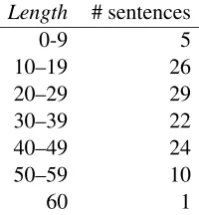
We tested the performance of our heuristics for alignment on a Chinese-English newswire corpus. Probabilities for the ITG model were trained using Expectation Maximization on a corpus of 18,773 sentence pairs with a total of 276,113 Chinese words and 315,415 English words. For EM train-ing, we limited the data to sentences of no more than 25 words in either language. Here we present timing results for finding the Viterbi alignment of longer sentences using this fixed translation model with different heuristics. We compute alignments on a total of 117 test sentences, which are broken down by length as shown in Table 1.
Length # sentences
0-9 5
10–19 26
20–29 29
30–39 22
40–49 24
50–59 10
[image:6.595.368.468.265.373.2]60 1
Table 1: Length of longer sentence in each pair from test data.
method time speedup
full 815s – uniform 547s 1.4 ibm1encn 269s 3.0 ibm1sym 205s 3.9
Table 2: Total time for each alignment method.
Results are presented both in terms of time and the number of arcs added to the chart before the optimal parse is found. Full refers to
exhaus-tive parsing, that is, building a complete chart with all n4 arcs. Uniform refers to a best-first
parsing strategy that expands the arcs with the highest inside probability at each step, but does not incorporate an estimate of the outside proba-bility. Ibm1encn denotes our heuristic based on
IBM model 1, applied to translations from English to Chinese, while ibm1sym applies the Model 1
[image:6.595.351.483.423.491.2]0 2e+06 4e+06 6e+06 8e+06 1e+07 1.2e+07 1.4e+07
0 5 10 15 20
# hyperedges
input sentence length BI-UNIFORM
BI-HOOK-UNIFORM BI-HOOK-A* BI-HOOK-A*-BEAM
13.7 13.8 13.9 14 14.1 14.2 14.3 14.4 14.5
0 100 200 300 400 500 600 700
bleu
average number of arcs (unit is 1k) BI-HOOK-A*+BEAM
[image:7.595.80.520.75.224.2]BI-CYK-BEAM
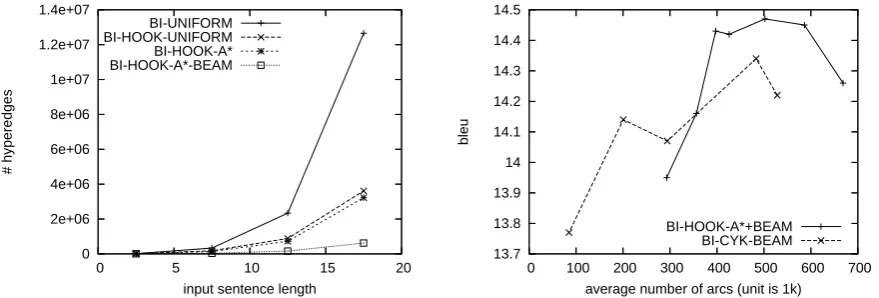
Figure 5: On the left, we compare decoding speed for uniform outside estimate best-first decoding with and without the hook trick, as well as results using our heuristic (labeled A*) and with beam pruning (which no longer produces optimal results). On the right, we show the relationship between computation time and BLEU scores as the pruning threshold is varied for both A* search and bottom-up CYK parsing.
dynamic programming.
We did our ITG decoding experiments on the LDC 2002 MT evaluation data set for translation of Chinese newswire sentences into English. The evaluation data set has 10 human translation refer-ences for each sentence. There are a total of 371 Chinese sentences of no more than 20 words in the data set. These sentences are the test set for our different versions of ITG decoders using both a bigram language model and a trigram language model. We evaluate the translation results by com-paring them against the reference translations us-ing the BLEU metric. The word-for-word transla-tion probabilities are from the translatransla-tion model of IBM Model 4 trained on a 160-million-word English-Chinese parallel corpus using GIZA++. The language model is trained on a 30-million-word English corpus. The rule probabilities for ITG are from the same training as in the alignment experiments described above.
We compared the BLEU scores of the A* de-coder and the ITG dede-coder that uses beam ratio pruning at each stage of bottom-up parsing. In the case of bigram-integrated decoding, for each input word, the best 2 translations are put into the bag of output words. In the case of trigram-integrated de-coding, top 5 candidate words are chosen. The A* decoder is guaranteed to find the Viterbi transla-tion that maximizes the product ofn-grams
prob-abilities, translation probabilities (including inser-tions and deleinser-tions) and inversion rule probabili-ties by choosing the right words and the right word order subject to the ITG constraint.
Figure 5 (left) demonstrates the speedup
ob-Decoder Combinations BLEU
BI-UNIFORM 8.02M 14.26 BI-HOOK-A* 2.10M 14.26 BI-HOOK-A*-BEAM 0.40M 14.43 BI-CYK-BEAM 0.20M 14.14 Table 3: Decoder speed and BLEU scores for bi-gram decoding.
Decoder Cbns BLEU
TRI-A*-BEAM(10−3) 213.4M 17.83 TRI-A*-BEAM(10−2) 20.7M 17.09
TRI-CYK-BEAM(10−3) 21.2M 16.86
Table 4: Results for trigram decoding.
tained through the hook trick, the heuristic, and pruning, all based on A* search. Table 3 shows the improvement of BLEU score after applying the A* algorithm to find the optimal translation under the model. Figure 5 (right) investigates the relation-ship between the search effort and BLEU score for A* and bottom-up CYK parsing, both with prun-ing. Pruning for A* works in such a way that we never explore a low probability hypothesis falling out of a certain beam ratio of the best hypothesis within the bucket of X[i, j,∗,∗], where ∗means any word. Table 4 shows results for trigram-integrated decoding. However, due to time con-straint, we have not explored time/performance tradeoff as we did for bigram decoding.
computation steps.
6 Conclusion
A* search for Viterbi alignment selection under ITG is efficient using IBM Model 1 as an outside estimate. The experimental results indicate that despite being a more relaxed word-for-word align-ment model than ITG, IBM Model 1 can serve as an efficient and reliable approximation of ITG in terms of Viterbi alignment probability. This is more true when we apply Model 1 to both trans-lation directions and take the minimum of both. We have also tried to incorporate estimates of bi-nary rule probabilities to make the outside esti-mate even sharper. However, the further improve-ment was marginal.
We are able to find the ITG Viterbi translation using our A* decoding algorithm with an outside estimate that combines outside bigrams and trans-lation probabilities for outside words. The hook trick gave us a significant further speedup; we be-lieve this to be the first demonstrated practical ap-plication of this technique.
Interestingly, the BLEU score for the opti-mal translations under the probabilistic model is lower than we achieve with our best bigram-based system using pruning. However, this sys-tem makes use of the A* heuristic, and our speed/performance curve shows that the heuris-tic allows us to achieve higher BLEU scores with the same amount of computation. In the case of trigram integrated decoding, there is 1 point of BLEU score improvement by moving from a typ-ical CYK plus beam search decoder to a decoder using A* plus beam search.
However, without knowing what words will ap-pear in the output language, a very sharp outside estimate to further bring down the number of com-binations is difficult to achieve.
The brighter side of the move towards optimal decoding is that the A* search strategy leads us to the region of the search space that is close to the optimal result, where we can more easily find good translations.
Acknowledgments This work was supported
by NSF ITR 09325646 and NSF ITR IIS-0428020.
References
Peter F. Brown, Stephen A. Della Pietra, Vincent J. Della Pietra, and Robert L. Mercer. 1993. The mathematics of statistical machine translation:
Pa-rameter estimation. Computational Linguistics,
19(2):263–311.
Eugene Charniak, Sharon Goldwater, and Mark John-son. 1998. Edge-based best-first chart parsing. In
Proceedings of the Sixth Workshop on Very Large Corpora.
Michael John Collins. 1999. Head-driven Statistical
Models for Natural Language Parsing. Ph.D. thesis,
University of Pennsylvania, Philadelphia.
Jason Eisner and Giorgio Satta. 1999. Efficient pars-ing for bilexical context-free grammars and head
au-tomaton grammars. In 37th Annual Meeting of the
Association for Computational Linguistics.
Liang Huang, Hao Zhang, and Daniel Gildea. 2005. Machine translation as lexicalized parsing with
hooks. InInternational Workshop on Parsing
Tech-nologies (IWPT05), Vancouver, BC.
Dan Klein and Christopher D. Manning. 2003. A* parsing: Fast exact viterbi parse selection. In Pro-ceedings of the 2003 Meeting of the North American chapter of the Association for Computational Lin-guistics (NAACL-03).
Franz Josef Och, Nicola Ueffing, and Herman Ney. 2001. An efficient a* search algorithm for
statis-tical machine translation. In Proceedings of the
ACL Workshop on Data-Driven Machine Transla-tion, pages 55–62, Toulouse, France.
Ye-Yi Wang and Alex Waibel. 1997. Decoding algo-rithm in statistical machine translation. In35th An-nual Meeting of the Association for Computational Linguistics.
Dekai Wu. 1996. A polynomial-time algorithm for sta-tistical machine translation. In34th Annual Meeting of the Association for Computational Linguistics.
Dekai Wu. 1997. Stochastic inversion transduction grammars and bilingual parsing of parallel corpora.
Computational Linguistics, 23(3):377–403.
Richard Zens and Hermann Ney. 2003. A compara-tive study on reordering constraints in statistical ma-chine translation. InProceedings of the 40th Annual Meeting of the Association for Computational Lin-guistics, Sapporo, Japan.
Hao Zhang and Daniel Gildea. 2005. Stochastic lex-icalized inversion transduction grammar for
align-ment. In Proceedings of the 43rd Annual
![Figure 2: The region within the dashed lines is the translation hypothesis X[ i , j , u , v ]](https://thumb-us.123doks.com/thumbv2/123dok_us/1377243.671461/4.595.126.472.65.206/figure-region-dashed-lines-translation-hypothesis-x-i.webp)