Modelling the Lexicon in
Unsupervised Part of Speech Induction
Greg Dubbin
Department of Computer Science University of Oxford
United Kingdom
Phil Blunsom
Department of Computer Science University of Oxford
United Kingdom
Abstract
Automatically inducing the syntactic part-of-speech categories for words in text is a fundamental task in Computational Linguistics. While the performance of unsupervised tagging models has been slowly improving, current state-of-the-art systems make the obviously incorrect as-sumption that all tokens of a given word type must share a single part-of-speech tag. This one-tag-per-type heuristic coun-ters the tendency of Hidden Markov Model based taggers to over generate tags for a given word type. However, it is clearly incompatible with basic syntactic theory. In this paper we extend a state-of-the-art Pitman-Yor Hidden Markov Model tagger with an explicit model of the lexi-con. In doing so we are able to incorpo-rate a soft bias towards inducing few tags per type. We develop a particle filter for drawing samples from the posterior of our model and present empirical results that show that our model is competitive with and faster than the state-of-the-art without making any unrealistic restrictions.
1 Introduction
Research on the unsupervised induction of part-of-speech (PoS) tags has the potential to im-prove both our understanding of the plausibil-ity of theories of first language acquisition, and Natural Language Processing applications such as Speech Recognition and Machine Transla-tion. While there has been much prior work on this task (Brown et al., 1992; Clark, 2003; Christodoulopoulos et al., 2010; Toutanova and
Johnson, 2008; Goldwater and Griffiths, 2007; Blunsom and Cohn, 2011), a common thread in many of these works is that models based on a Hidden Markov Model (HMM) graphical struc-ture suffer from a tendency to assign too many different tags to the tokens of a given word type. Models which restrict word types to only occur with a single tag show a significant increase in performance, even though this restriction is clearly at odds with the gold standard labeling (Brown et al., 1992; Clark, 2003; Blunsom and Cohn, 2011). While the empirically observed expectation for the number of tags per word type is close to one, there are many exceptions, e.g. words that occur as both nouns and verbs (opening,increase,relatedetc.).
In this paper we extend the Pitman-Yor HMM tagger (Blunsom and Cohn, 2011) to explicitly in-clude a model of the lexicon that encodes from which tags a word type may be generated. For each word type we draw an ambiguity class which is the set of tags that it may occur with, captur-ing the fact that words are often ambiguous be-tween certain tags (e.g. Noun and Verb), while rarely between others (e.g.DeterminerandVerb). We extend the type based Sequential Monte Carlo (SMC) inference algorithm of Dubbin and Blun-som (2012) to incorporate our model of the lexi-con, removing the need for the heuristic inference technique of Blunsom and Cohn (2011).
We start in Section 3 by introducing the origi-nal PYP-HMM model and our extended model of the lexicon. Section 4 introduces a Particle Gibbs sampler for this model, a basic SMC method that generates samples from the model’s posterior. We evaluate these algorithms in Section 5, analyzing their behavior in comparisons to previously pro-posed state-of-the-art approaches.
2 Background
From the early work in the 1990’s, much of the focus on unsupervised PoS induction has been on hidden Markov Models (HMM) (Brown et al., 1992; Kupiec, 1992; Merialdo, 1993). The HMM has proven to be a powerful model of PoS tag as-signment. Successful approaches generally build upon the HMM model by expanding its context and smoothing the sparse data. Constraints such as tag dictionaries simplify inference by restricting the number of tags to explore for each word (Gold-water and Griffiths, 2007). Ganchev et al. (2010) used posterior regularization to ensure that word types have a sparse posterior distribution over tags. A similar approach constrains inference to only explore tag assignments such that all tokens of the same word type are assigned the same tag. These constraints reduce tag assignment ambiguity while also providing a bias towards the natural spar-sity of tag distributions in language (Clark, 2003). However they do not provide a model based solu-tion to tag ambiguity.
Recent work encodes similar sparsity infor-mation with non-parametric priors, relying on Bayesian inference to achieve strong results with-out any tag dictionaries or constraints (Goldwater and Griffiths, 2007; Johnson, 2007; Gao and John-son, 2008). Liang et al. (2010) propose a type-based approach to this Bayesian inference similar to Brown et al. (1992), suggesting that there are strong dependencies between tokens of the same word-type. Lee et al. (2010) demonstrate strong results with a similar model and the introduction of a one-tag-per-type constraint on inference.
Blunsom and Cohn (2011) extend the Bayesian inference approach with a hierarchical non-parametric prior that expands the HMM con-text to trigrams. However, the hierarchical non-parametric model adds too many long-range de-pendencies for the type-based inference proposed earlier. The model produces state-of-the art re-sults with a one-tag-per-type constraint, but even with this constraint the tag assignments must be roughly inferred from an approximation of the ex-pectations.
Ambiguity classes representing the set of tags each word-type can take aid inference by mak-ing the sparsity between tags and words explicit. Toutanova and Johnson (2008) showed that mod-elling ambiguity classes can lead to positive re-sults with a small tag-dictionary extracted from the
data. By including ambiguity classes in the model, this approach is able to infer ambiguity classes of unknown words.
Many improvements in part-of-speech induc-tion over the last few years have come from the use of semi-supervised approaches in the form of projecting PoS constraints across languages with parallel corpora (Das and Petrov, 2011) or extract-ing them from the wiktionary (Li et al., 2012). These semi-supervised methods ultimately rely on a strong unsupervised model of PoS as their base. Thus, further improvements in unsupervised mod-els, especially in modelling tag constrains, should lead to improvements in semi-supervised part-of-speech induction.
We find that modelling the lexicon in part-of-speech inference can lead to more efficient algo-rithms that match the state-of-the-art unsupervised performance. We also note that the lexicon model relies heavily on morphological information, and suffers without it on languages with flexible word ordering. These results promise further improve-ments with more advanced lexicon models.
3 The Pitman-Yor Lexicon Hidden Markov Model
This article proposes enhancing the standard Hid-den Markov Model (HMM) by explicitly incorpo-rating a model of the lexicon that consists of word types and their associated tag ambiguity classes. The ambiguity class of a word type is the set of possible lexical categories to which tokens of that type can be assigned. In this work we aim to learn the ambiguity classes unsupervised rather than have them specified in a tag dictionary.
The Lexicon HMM (Lex-HMM) extends the Pitman-Yor HMM (PYP-HMM) described by Blunsom and Cohn (2011). When the ambiguity class of all of the word types in the lexicon is the complete tagset, the two models are the same.
3.1 PYP-HMM
The base of the model applies a hierarchical Pitman-Yor process (PYP) prior to a trigram hid-den Markov model to jointly model the distribu-tion of a sequence of latent word tags, t, and word tokens, w. The joint probability defined by the transition,Pθ(tl|tn−1, tn−2), and emission, Pθ(wn|tn), distributions of a trigram HMM is
Pθ(t,w) = N+1Y
n=1
where N = |t| = |w| and the special tag $
is added to denote the sentence boundaries. The model defines a generative process in which the tags are selected from a transition distribution, tl|tl−1, tl−2, T, determined by the two previous
tags in their history, and the word tokens are se-lected from the emission distribution,wl|tl, E, of
the latest tag.
tn|tn−1, tn−2, T ∼Ttn−1,tn−2
wn|tn, E ∼Etn
The PYP-HMM draws the above multinomial dis-tributions from a hierarchical Pitman-Yor Process prior. The Pitman-Yor prior defines a smooth back off probability from more complex to less com-plex transition and emission distributions. In the PYP-HMM trigram model, the transition distri-butions form a hierarchy with trigram transition distributions drawn from a PYP with the bigram transitions as their base distribution, and the bi-gram transitions similarly backing off to the uni-gram transitions. The hierarchical prior can be in-tuitively understood to smooth the trigram transi-tion distributransi-tions with bigram and unigram distri-butions in a similar manner to an ngram language model (Teh, 2006). This back-off structure greatly reduces sparsity in the trigram distributions and is achieved by chaining together the PYPs through their base distributions:
Tij|aT, bT, Bi ∼PYP(aT, bT, Bi)
Bi|aB, bB, U ∼PYP(aB, bB, U)
U|aU, bU ∼PYP(aU, bU,Uniform). Ei|aE, bE, C ∼PYP(aE, bE, Ci),
whereTij,Bi, andU are trigram, bigram, and
un-igram transition distributions respectively, andCi
is either a uniform distribution (PYP-HMM) or a bigram character language model distribution to model word morphology (PYP-HMM+LM).
Sampling from the posterior of the hierarchi-cal PYP is hierarchi-calculated with a variant of the Chi-nese Restaurant Process (CRP) called the ChiChi-nese Restaurant Franchise (CRF) (Teh, 2006; Goldwa-ter et al., 2006). In the CRP analogy, each latent variable (tag) in a sequence is represented by a customer entering a restaurant and sitting at one of an infinite number of tables. A customer chooses to sit at a table in a restaurant according to the
probability
P(zn=k|z1:n−1) =
( c−
k−a
n−1+b 1≤k≤K− K−a+b
n−1+b k=K−+ 1
(1) where zn is the index of the table chosen by the
nth customer to the restaurant,z1:n−1 is the
seat-ing arrangement of the previousn−1customers to enter,c−k is the count of the customers at table k, andK−is the total number of tables chosen by the previousn−1customers. All customers at a table share the same dish, representing the value assigned to the latent variables. When customers sit at an empty table, a new dish is assigned to that table according to the base distribution of the PYP. To expand the CRP analogy to the CRF for hierar-chical PYPs, when a customer sits at a new table, a new customer enters the restaurant of the PYP of the base distribution.
Blunsom and Cohn (2011) explored two Gibbs sampling methods for inference with the PYP-HMM model. The first individually samples tag assignments for each token. The second employs a tactic shown to be effective by earlier works by constraining inference to only one tag per word type (PYP-1HMM). However marginalizing over all possible table assignments for more than a sin-gle tag is intractable. Blunsom and Cohn (2011) approximates the PYP-1HMM tag posteriors for a particular sample according to heuristic fractional table counts. This approximation is shown to be particularly inaccurate for values ofaclose to one.
3.2 The Lexicon HMM
We define the lexicon to be the set of all word types (W) and a function (L) which maps each word type (Wi ∈ W) to an element in the power
set of possible tagsT,
L:W → P(T).
The Lexicon HMM (Lex-HMM) generates the lexicon with all of the word types and their ambi-guity classes before generating the standard HMM parameters. The set of tags associated with each word type is referred to as its ambiguity class si⊆T. The ambiguity classes are generated from
a multinomial distribution with a sparse, Pitman-Yor Process prior,
si|S ∼S
U Bj Tij
Ej
w1 t1
w2 t2
w3 t3
...
Wi si
[image:4.595.72.279.63.238.2]S
Figure 1: Lex-HMM Structure: The graphical structure of the Lex-HMM model. In addition to the trigram transition (Tij) and emission (Ej), the
model includes an ambiguity class (si) for each
word type (Wi) drawn from a distributionS with
a PYP prior.
where S is the multinomial distribution over all possible ambiguity classes. The base distribution of the PYP, G, chooses the size of the ambiguity class according to a geometric distribution (nor-malized so that the size of the class is at most the number of tags|T|). Gassigns uniform probabil-ity to all classes of the same size. A plate diagram for this model is shown in Figure 1.
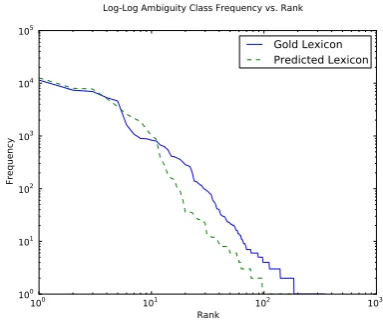
This model represents the observation that there are relatively few distinct ambiguity classes over all of the word types in a corpus. For example, the full Penn-Treebank Wall Street Journal (WSJ) cor-pus with 45 possible tags and 49,206 word types has only 343 ambiguity classes. Figure 2 shows that ambiguity classes in the WSJ have a power-law distribution. Furthermore, these classes are generally small; the average ambiguity class in the WSJ corpus has 2.94 tags. The PYP prior favors power-law distributions and the modified geomet-ric base distribution favors smaller class sizes.
Once the lexicon is generated, the standard HMM parameters can be generated as described in section 3.1. The base emission probabilitiesC are constrained to fit the generated lexicon. The standard Lex-HMM model emission probabilities for tagti are uniform over all word types withti
in their ambiguity class. The character language model presents a challenge because it is non-trivial to renormalise over words withtiin their
ambigu-ity class. In this case word types withouttiin their
100 101 102 103
Rank 100
101
102
103
104
105
Frequency
[image:4.595.315.507.64.224.2]Gold Lexicon Predicted Lexicon Log-Log Ambiguity Class Frequency vs. Rank
Figure 2: Ambiguity Class Distribution: Log-log plot of ambiguity class frequency over rank for the Penn-Treebank WSJ Gold Standard lexicon highlighting a Zipfian distribution and the ambigu-ity of classes extracted from the predicted tags.
ambiguity class are assigned an emission probabil-ity of0and the model is left deficient.
Neither of the samplers proposed by Blunsom and Cohn (2011) and briefly described in section 3.1 are well suited to inference with the lexicon. Local Gibbs sampling of individual token-tag as-signments would be very unlikely to explore a range of confusion classes, while the type based approximate sample relies on a one-tag-per-type restriction. Thus in the next section we extend the Particle Filtering solution presented in Dubbin and Blunsom (2012) to the problem of simultaneous resampling the ambiguity class as well as the tags for all tokens of a given type. This sampler pro-vides both a more attractive inference algorithm for the original PYP-HMM and one adaptable to our Lex-HMM.
4 Inference
To perform inference with both the lexicon and the tag assignments, we block sample the ambi-guity class assignment as well as all tag assign-ments for tokens of the same word type. It would be intractable to exactly calculate the probabili-ties to sample these blocks. Particle filters are an example of a Sequential Monte Carlo technique which generates unbiased samples from a distribu-tion without summing over the intractable number of possibilities.
parti-cle, is generated incrementally. For each partiparti-cle, the particle filter first samples an ambiguity class, and then samples each tag assignment in sequence based only on the previous samples in the parti-cle. The value of the next variable in a sequence is sampled from a proposal distribution based only on the earlier values in the sequence. Each particle is assigned an importance weight such that a par-ticle sampled proportional to its weight represents an unbiased sample of the true distribution.
Each particle represents a specific sampling of an ambiguity class, tag sequence, tW,p1:n, and the count deltas,zW,p1:n. The termtW,p1:n denotes the se-quence ofntags generated for word-typeW and stored as part of particle p ∈ [1, P]. The count deltas store the differences in the seating arrange-ment neccessary to calculate the posterior proba-bilities according to the Chinese restaurant fran-chise described in section 3.1. The table counts from each particle are the only data necessary to calculate the probabilities described in equation (1).
The ambiguity class for a particle is proposed by uniformly sampling one tag from the tagset to add to or remove from the previous iteration’s am-biguity class with the additional possibility of us-ing the same ambiguity class. The particle weights are then set to
P(sW,p|S−W)
Q
t∈sW,p(et+ 1)#(Et)
Q
t∈T−sW,p(et)#(Et)
whereP(sW,p|S−W)is the probability of the
am-biguity class proposed for particlepfor word type W given the ambiguity classes for the rest of the vocabulary,etis the number of word types witht
in their ambiguity class, and#(Et)is the number
of tables in the CRP for the emission distribution of tag t. The last two terms of the equation cor-rect for the difference in the base probabilities of the words that have already been sampled with a different lexicon.
At each token occurrencen, the next tag assign-ment, tW,pn for each particle p ∈ [1, P] is
deter-mined by the seating decisions znW,p, which are
made according the proposal distribution: qW,p
n (zW,pn |zW,p1:n−1,z−W)∝
P(zW,p
n |c−2, c−1,zW,p1:n−1,z−W)
×P(c+1n |c−n1, znW,p,zW,p1:n−1,z−W)
×P(c+2n |znW,p, c+1n ,zW,p1:n−1,z−W)
×P(wWn |zW,pn , zW,p1:n−1, z−W).
In this case,c±k
n represents a tag in the context of
site tW
n offset by k, while zW,p1:n−1 and z−W
rep-resent the table counts from the seating decisions previously chosen by particlepand the values at all of the sites where a word token of type W does not appear, respectively. This proposal dis-tribution ignores changes to the seating arrange-ment between the three transitions involving the site n. The specific tag assignement, tW, pn, is
completely determined by the seating decisions sampled according to this proposal distribution. Once all of the particles have been sampled, one of them is sampled with probability proportional to its weight. This final sample is a sample from the target distribution.
As the Particle Filter is embedded in a Gibbs sampler which cycles over all word types this al-gorithm is an instance of Particle Gibbs. Andrieu et al. (2010) shows that to ensure the samples gen-erated by SMC for a Gibbs sampler have the tar-get distribution as the invariant density, the par-ticle filter must be modified to perform a condi-tional SMC update. This means that the particle filter guarantees that one of the final particles is as-signed the same values as the previous Gibbs iter-ation. Therefore, a special0thparticle is
automati-cally assigned the value from the prior iteration of the Gibbs sampler at each siten, though the pro-posal probabilityqW
n (tW,0n |tW,p1:n−1,zW,p1:n−1)still has
to be calculated to update the weightωW,pn
prop-erly. This ensures that the sampler has a chance of reverting to the prior iteration’s sequence.
5 Experiments and Results
We provide an empirical evaluation of our pro-posed Lex-HMM in terms of the accuracy of the taggings learned according to the most pop-ular metric, and the distributions over ambiguity classes. Our experimental evaluation considers the impact of our improved Particle Gibbs inference algorithm both for the original PYP-HMM and when used for inference in our extended model.
Sampler M-1 Accuracy Time (h)
Meta-Model (CGS10) 76.1 —
MEMM (BBDK10) 75.5 ∼40*
Lex-HMM 71.1 7.9
Type PYP-HMM 70.1 401.2
Local PYP-HMM 70.2 8.6
PYP-1HMM 75.6 20.6
Lex-HMM+LM 77.5 16.9
Type PYP-HMM+LM 73.5 446.0
PYP-1HMM+LM 77.5 34.9
Table 1: M-1 Accuracy on the WSJ Corpus:
Comparison of the accuracy of each of the sam-plers with and without the language model emis-sion prior on the English WSJ Corpus. The second column reports run time in hours where available*. Note the Lex-HMM+LM model matches the PYP-1HMM+LM approximation despite finishing in half the time. The abbreviations in parentheses indicate that the results were reported in CGS10 (Christodoulopoulos et al., 2010) and BBDK10 (Berg-Kirkpatrick et al., 2010) *CGS10 reports that the MEMM model takes approximately 40 hours on 16 cores.
accuracy in representing ambiguity classes is an important aspect of its performance. The model focuses inference on the most likely tag choices, represented by ambiguity classes.
5.1 Unsupervised Part-of-Speech Tagging
The most popular evaluation for unsupervised part-of-speech taggers is to induce a tagging for a corpus and compare the induced tags to those annotated by a linguist. As the induced tags are simply integer labels, we must employ a map-ping between these and the more meaningful syn-tactic categories of the gold standard. We re-port results using the many-to-one (M-1) met-ric considered most intuitive by the evaluation of Christodoulopoulos et al. (2010). M-1 measures the accuracy of the model after mapping each pre-dicted class to its most frequent corresponding tag. While Christodoulopoulos et al. (2010) found V-measure to be more stable over the number of parts-of-speech, this effect doesn’t appear when the number of tags is constant, as in our case. For experiments on English, we report results on the entire Penn. Treebank (Marcus et al., 1993). For other languages we use the corpora made avail-able for the CoNLL-X Shared Task (Buchholz and
Marsi, 2006). All Lex-HMM results are reported with 10 particles as no significant improvement was found with 50 particles.
Table 1 compares the M-1 accuracies of both the PYP-HMM and the Lex-HMM models on the Penn. Treebank Wall Street Journal corpus. Blun-som and Cohn (2011) found that the Local PYP-HMM+LM sampler is unable to mix, achieving accuracy below 50%, therefore it has been left out of this analysis. The Lex-HMM+LM model achieves the same accuracy as the state-of-the-art PYP-1HMM+LM approximation. The Lex-HMM+LM’s focus on only the most likely tags for each word type allows it to finish training in half the time as the PYP-1HMM+LM approximation without any artificial restrictions on the number of tags per type. This contrasts with other approaches that eliminate the constraint at a much greater cost, e.g. the Type PYP-HMM, the MEMM, and the Meta-Model1
The left side of table 2 compares the M-1 accu-racies of the Lex-HMM model to the PYP-HMM model. These models both ignore word morphol-ogy and rely on word order. The 1HMM approxi-mation achieves the highest average accuracy. The Lex-HMM model matches or surpasses the type-based PYP-HMM approach in six languages while running much faster due to the particle filter con-sidering a smaller set of parts-of-speech for each particle. However, in the absence of morpho-logical information, the Lex-HMM model has a similar average accuracy to the local and type-based PYP-HMM samplers. The especially low performance on Hungarian, a language with free word ordering and strong morphology, suggests that the Lex-HMM model struggles to find ambi-guity classes without morphology. The Lex-HMM model has a higher average accuracy than the type-based or local PYP-HMM samplers when Hungar-ian is ignored.
The right side of table 2 compares the M-1 ac-curacies of the Lex-HMM+LM model to the PYP-HMM+LM. The language model leads to consis-tently improved performance for each of the sam-plers excepting the token sampler, which is un-able to mix properly with the additional complex-ity. The accuracies achieved by the 1HMM+LM
Language Lex-HMM PYP-HMM Local 1HMM Lex-HMM+LM PYP-HMM+LM 1HMM+LM
WSJ 71.1 70.1 70.2 75.6 77.5 73.5 77.5
Arabic 57.2 57.6 56.2 61.9 62.1 62.7 62.0
Bulgarian 67.2 67.8 67.6 71.4 72.7 72.1 76.2
Czech 61.3 61.6 64.5 65.4 68.2 67.4 67.9
Danish 68.6 70.3 69.1 70.6 74.7 73.1 74.6
Dutch 70.3 71.6 64.1 73.2 71.7 71.8 72.9
Hungarian 57.9 61.8 64.8 69.6 64.4 69.9 73.2
Portuguese 69.5 71.1 68.1 72.0 76.3 73.9 77.1
Spanish 73.2 69.1 68.5 74.7 80.0 75.2 78.8
Swedish 66.3 63.5 67.6 67.2 70.4 67.6 68.6
Average 66.3(67.2) 66.5(67.0) 66.1(66.2) 70.2(70.3) 71.8(72.6) 70.7(70.8) 72.9(72.9) Table 2: M-1 Accuracy of Lex-HMM and PYP-HMM models: Comparison of M-1 accuracy for the lexicon based model (Lex-HMM) and the PYP-HMM model on several languages. The Lex-HMM and PYP-HMM columns indicate the results of word type based particle filtering with 10 and 100 particles, respectively, while the Local and 1HMM columns use the token based sampler and the 1HMM approxi-mation described by Blunsom and Cohn (2011). The token based sampler was run for 500 iterations and the other samplers for 200. The percentages in brakets represent the average accuracy over all languages except for Hungarian.
sampler represent the previous state-of-the-art. These results show that the Lex-HMM+LM model achieves state-of-the-art M-1 accuracies on sev-eral datasets, including the English WSJ. The Lex-HMM+LM model performs nearly as well as, and often better than, the 1HMM+LM sampler without any restrictions on tag assignments.
The drastic improvement in the performance of the Lex-HMM model reinforces our hypothe-sis that morphology is critical to the inference of ambiguity classes. Without the language model representing word morphology, the distinction be-tween ambiguity classes is too ambiguous. This leads the sampler to infer an excess of poor am-biguity classes. For example, the tag assignments from the Lex-PYP model on the WSJ dataset con-sist of 660 distinct ambiguity classes, while the Lex-PYP+LM tag assignments only have 182 dis-tinct ambiguity classes.
Note that while the HMM and Lex-HMM+LM samplers do not have any restrictions on inference, they do not sacrifice time. The ad-ditional samples generated by the particle filter are mitigated by limiting the number of tags each particle must consider. In practice, this results in the Lex-HMM samplers with 10 particles running in half time as the 1HMM samplers. The Lex-HMM+LM sampler with 10 particles took 16.9 hours, while the 1HMM+LM sampler required 34.9 hours. Furthermore, the run time evaluation does not take advantage of the inherent distributed nature of particle filters. Each of the particles can be sampled completely independentally from the
others, making it trivial to run each on a seperate core.
5.2 Lexicon Analysis
While section 5.1 demonstrates that the Lex-HMM+LM sampler performs similarly to the more restricted 1HMM+LM, we also seek to eval-uate the accuracy of the lexicon model itself. We compare the ambiguity classes extracted from the gold standard and predicted tag assignments of the WSJ corpus. We also explore the relationship be-tween the actual and sampled ambiguity classes.
The solid curve in figure 2 shows the distribu-tion of the number of word types assigned to each ambiguity set extracted from the gold standard tag assignments from the Penn Treebank Wall Street Journal corpus. The straight line strongly indi-cates that ambiguity classes follow a Zipfian dis-tribution. Figure 2 also graphs the distribution of the ambiguity classes extracted from the best tag-assignment prediction from the model. The pre-dicted graph has a similar shape to the gold stan-dard but represents half as many distinct ambigu-ity classes - 182 versus 343.
Rank Gold Rank Tags Top Word Types
1 1 NNP Mr., Corp.(1), Inc.(.99), Co.(1), Exchange(.99)
2 2 NN %(1),company, stock(.99), -RRB-(0), years(0)
3 3 JJ new,other, first(.9), most(0), major(1)
4 5 NNS companies, prices(1), quarter(0), week(0),investors
5 4 CD $(0), million(1),billion,31, #(0)
15 303 NN, CD yen(.47,0), dollar(1,0), 150(0,1), 29(0,1), 33(0,1)
16 17 VB, NN plan(.03, .9), offer(.2, .74), issues(0,0), increase(.34, .66), end(.18, .81)
17 115 DT, NNP As(0,0), One(0, .01), First(0, .82), Big(0, .91), On(0, .01)
18 11 NN, JJ market(.99,0), U.S.(0,0), bank(1,0), cash(.98,0), high(.06, .9)
[image:8.595.72.535.59.187.2]20 22 VBN, JJ estimated (.58, .15), lost (.43, .03), failed (.35, .04), related (.74, .23), re-duced(.57, .12)
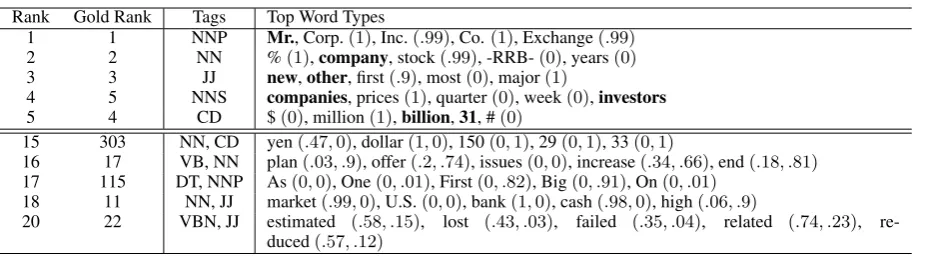
Table 3: Selection of Predicted Ambiguity Classes: Common ambiguity classes from the predicted part-of-speech assignments from the WSJ data set, and the five most common word types associated with each ambiguity class. The sets are ranked according to the number of word types associated to them. Words in bold are matched to exactly the same ambiguity set in the gold standard. The lower five ambiguity classes are the most common with more than one part-of-speech. Numbers in parentheses represent the proportion of tokens of that type assigned to each tag in the gold standard for that ambiguity class.
a class representing almost all of the words’ occur-rences in the gold standard, e.g., ‘Corp.’ is an NNP in 1514 out of 1521 occurrences. Some words are assigned to classes with similar parts of speech,
e.g.{NNS}rather than{NN}for week.
The lower half of table 3 shows the most fre-quent ambiguity classes with more than a sin-gle tag. The words assigned to the {NN,CD},
{DT,NNP}, and {NN,JJ} classes are not
them-selves ambiguous. Rather words that are unam-biguously one of the two tags are often assigned to an ambiguity class with both. The most com-mon types in the{NN, CD}set are unambiguously either NN or CD. In many cases the words are merged into broader ambiguity classes because the Lex-HMM+LM uses the language model to model the morphology of words over individual parts-of-speech, rather than entire ambiguity classes. Therefore, a word-type is likely to be assigned a given ambiguity class as long as at least one part-of-speech in that ambiguity class is associ-ated with morphologically similar words. These results suggest modifying the Lex-HMM+LM to model word morphology over ambiguity classes rather than parts-of-speech.
The{VB,NN}and{VBN,JJ}are representative
of true ambiguity classes. Occurrences of words in these classes are likely to be either of the possible parts-of-speech. These results show that the Lex-HMM is modelling ambiguity classes as intended.
6 Conclusion
This paper described an extension to the PYP-HMM part-of-speech model that incorporates a sparse prior on the lexicon and an SMC based in-ference algorithm. These contributions provide a more plausible model of part-of-speech induction which models the true ambiguity of tag to type as-signments without the loss of performance of ear-lier HMM models. Our empirical evaluation indi-cates that this model is able to meet or exceed the performance of the previous state-of-the-art across a range of language families.
In addition to the promising empirical results, our analysis indicates that the model learns ambi-guity classes that are often quite similar to those in the gold standard. We believe that further im-provements in both the structure of the lexicon prior and the inference algorithm will lead to addi-tional performance gains. For example, the model could be improved by better modelling the rela-tionship between a word’s morphology and its am-biguity class. We intend to apply our model to recent semi-supervised approaches which induce partial tag dictionaries from parallel language data (Das and Petrov, 2011) or the Wiktionary (Li et al., 2012). We hypothesize that the additional data should improve the modelled lexicon and conse-quently improve tag assignments.
References
Christophe Andrieu, Arnaud Doucet, and Roman Holenstein. 2010. Particle markov chain monte carlo methods. Journal Of The Royal Statistical So-ciety Series B, 72(3):269–342.
Taylor Berg-Kirkpatrick, Alexandre Bouchard-Cˆot´e, John DeNero, and Dan Klein. 2010. Painless
un-supervised learning with features. In Human
Lan-guage Technologies: The 2010 Annual Conference of the North American Chapter of the Association for Computational Linguistics, pages 582–590, Los Angeles, California, June. Association for Compu-tational Linguistics.
Phil Blunsom and Trevor Cohn. 2011. A hierarchi-cal Pitman-Yor process hmm for unsupervised part of speech induction. InProceedings of the 49th An-nual Meeting of the Association for Computational Linguistics: Human Language Technologies, pages 865–874, Portland, Oregon, USA, June. Association for Computational Linguistics.
Peter F. Brown, Peter V. deSouza, Robert L. Mer-cer, Vincent J. Della Pietra, and Jenifer C. Lai. 1992. Class-based n-gram models of natural
lan-guage. Comput. Linguist., 18:467–479, December.
Sabine Buchholz and Erwin Marsi. 2006. Conll-x shared task on multilingual dependency parsing. In
Proceedings of the Tenth Conference on Computa-tional Natural Language Learning, CoNLL-X ’06, pages 149–164, Morristown, NJ, USA. Association for Computational Linguistics.
Christos Christodoulopoulos, Sharon Goldwater, and Mark Steedman. 2010. Two decades of unsu-pervised POS induction: How far have we come? In Proceedings of the 2010 Conference on Empiri-cal Methods in Natural Language Processing, pages 575–584, Cambridge, MA, October. Association for Computational Linguistics.
Alexander Clark. 2003. Combining distributional and morphological information for part of speech
induc-tion. In Proceedings of the tenth Annual Meeting
of the European Association for Computational Lin-guistics (EACL), pages 59–66.
Dipanjan Das and Slav Petrov. 2011. Unsupervised part-of-speech tagging with bilingual graph-based
projections. In Proceedings of the 49th Annual
Meeting of the Association for Computational Lin-guistics: Human Language Technologies - Volume
1, HLT ’11, pages 600–609, Stroudsburg, PA, USA.
Association for Computational Linguistics.
Gregory Dubbin and Phil Blunsom. 2012. Unsuper-vised bayesian part of speech inference with particle gibbs. In Peter A. Flach, Tijl De Bie, and Nello
Cris-tianini, editors, ECML/PKDD (1), volume 7523 of
Lecture Notes in Computer Science, pages 760–773. Springer.
Kuzman Ganchev, Jo˜ao Grac¸a, Jennifer Gillenwater, and Ben Taskar. 2010. Posterior regularization for
structured latent variable models. Journal of
Ma-chine Learning Research, 99:2001–2049, August.
Jianfeng Gao and Mark Johnson. 2008. A compar-ison of bayesian estimators for unsupervised
hid-den markov model pos taggers. InProceedings of
the Conference on Empirical Methods in Natural Language Processing, EMNLP ’08, pages 344–352, Morristown, NJ, USA. Association for Computa-tional Linguistics.
Sharon Goldwater and Tom Griffiths. 2007. A fully bayesian approach to unsupervised part-of-speech
tagging. In Proc. of the 45th Annual Meeting of
the ACL (ACL-2007), pages 744–751, Prague, Czech Republic, June.
Sharon Goldwater, Tom Griffiths, and Mark John-son. 2006. Interpolating between types and tokens by estimating power-law generators. In Y. Weiss, B. Sch¨olkopf, and J. Platt, editors,Advances in Neu-ral Information Processing Systems 18, pages 459– 466. MIT Press, Cambridge, MA.
Mark Johnson. 2007. Why doesnt EM find good
HMM POS-taggers? In Proc. of the 2007
Con-ference on Empirical Methods in Natural Language Processing (EMNLP-2007), pages 296–305, Prague, Czech Republic.
Julian Kupiec. 1992. Robust part-of-speech tagging
using a hidden Markov model. Computer Speech
and Language, 6:225–242.
Yoong Keok Lee, Aria Haghighi, and Regina Barzilay. 2010. Simple type-level unsupervised pos tagging. InProceedings of the 2010 Conference on Empirical Methods in Natural Language Processing, EMNLP ’10, pages 853–861, Morristown, NJ, USA. Associ-ation for ComputAssoci-ational Linguistics.
Shen Li, Jo˜ao V. Grac¸a, and Ben Taskar. 2012. Wiki-ly
supervised part-of-speech tagging. InProceedings
of the 2012 Joint Conference on Empirical Methods in Natural Language Processing and Computational Natural Language Learning, EMNLP-CoNLL ’12, pages 1389–1398, Stroudsburg, PA, USA. Associa-tion for ComputaAssocia-tional Linguistics.
P. Liang, M. I. Jordan, and D. Klein. 2010.
Type-based MCMC. InNorth American Association for
Computational Linguistics (NAACL).
Mitchell P. Marcus, Mary Ann Marcinkiewicz, and Beatrice Santorini. 1993. Building a large
anno-tated corpus of English: the Penn treebank.
Compu-tational Linguistics, 19(2):313–330.
Bernard Merialdo. 1993. Tagging english text with
a probabilistic model. Computational Linguistics,
Yee Whye Teh. 2006. A hierarchical bayesian lan-guage model based on Pitman-Yor processes. In
Proceedings of the 21st International Conference on Computational Linguistics and the 44th annual meeting of the Association for Computational Lin-guistics, ACL-44, pages 985–992, Morristown, NJ, USA. Association for Computational Linguistics. Kristina Toutanova and Mark Johnson. 2008. A