101
Chains-of-Reasoning at TextGraphs 2019 Shared Task: Reasoning over
Chains of Facts for Explainable Multi-hop Inference
Ameya Godbole1∗, Rajarshi Das1∗,
Manzil Zaheer2,Shehzaad Dhuliawala3,Andrew McCallum1
1University of Massachusetts, Amherst, 2Google Research,3Microsoft Research, Montreal
{agodbole, rajarshi, mccallum}@cs.umass.edu [email protected], [email protected]
Abstract
This paper describes our submission to the
shared task1 on “Multi-hop Inference
Expla-nation Regeneration” in TextGraphs workshop
at EMNLP 2019 (Jansen and Ustalov,2019).
Our system identifies chains of facts relevant to explain an answer to an elementary science examination question. To counter the prob-lem of ‘spurious chains’ leading to ‘semantic drifts’, we train a ranker that uses contextual-ized representation of facts to score its rele-vance for explaining an answer to a question.
Our system2was rankedfirstw.r.t the mean
av-erage precision (MAP) metric outperforming
the second best system by14.95points.
1 Introduction
Machine reading comprehension (MRC), the abil-ity of computing systems to read and understand text, has been a long-standing goal of natural lan-guage understanding. Question answering (QA) provides a natural way of testing a models capa-bility to comprehend text — by probing it with queries about information present in the text. Re-search in MRC has seen rapid progress in recent years, with systems matching or out-performing human performance in many QA datasets (Chen et al.,2016;Devlin et al.,2018;Yang et al.,2019;
Liu et al.,2019). However, a series of recent work has demonstrated the brittleness of these systems showing that they perform shallow pattern match-ing (Jia and Liang, 2017; Kaushik and Lipton,
2018;Chen and Durrett,2019).
QA models that can provide explanations be-hind its answers can give us better insights into this brittleness. More importantly, it has also been shown that providing explanations for an an-swer also increases how much a user trusts the
1https://github.com/umanlp/tg2019task
2https://github.com/ameyagodbole/multihop_
inference_explanation_regeneration
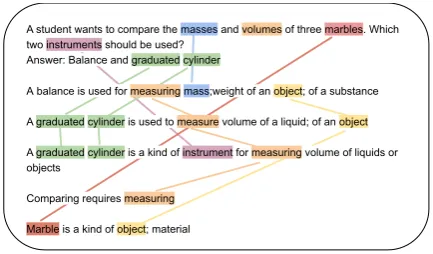
A balance is used for measuring mass;weight of an object; of a substance
A graduated cylinder is used to measure volume of a liquid; of an object
A graduated cylinder is a kind of instrument for measuring volume of liquids or objects
Comparing requires measuring
Marble is a kind of object; material
A student wants to compare the masses and volumes of three marbles. Which two instruments should be used?
[image:1.595.309.526.221.348.2]Answer: Balance and graduated cylinder
Figure 1: A subgraph of facts from the WorldTree
cor-pus thatexplainsthe answer to the question.
model (Herlocker et al., 2000; Dzindolet et al.,
2003;Ribeiro et al.,2016). Therefore, as more of these models are deployed into real-world appli-cations, providing explanations should be a neces-sary component of every QA system.
In this paper, we describe the system that we submitted to the shared task on “Multi-hop In-ference Explanation Regeneration”. Our model scores chains of facts (sentences) relevant to ex-plain an answer to an elementary science exam question. Given the question and its answer, we use a standard information retrieval (IR) system to retrieve a set of starting facts from the given corpus. We adopt the “explanation graphs” rep-resentation proposed by Jansen et al. (2018), in which sentences can be viewed as nodes in a graph and two nodes are connected if they have a lexical overlap between them. Therefore, finding the ex-planation for a question can be viewed as finding the ‘relevant subgraph’ within the bigger graph of facts and the explanation corresponds to the nodes (facts) comprising the subgraph. For example, fig-ure1shows a subgraph of facts explaining the an-swer to the given question.
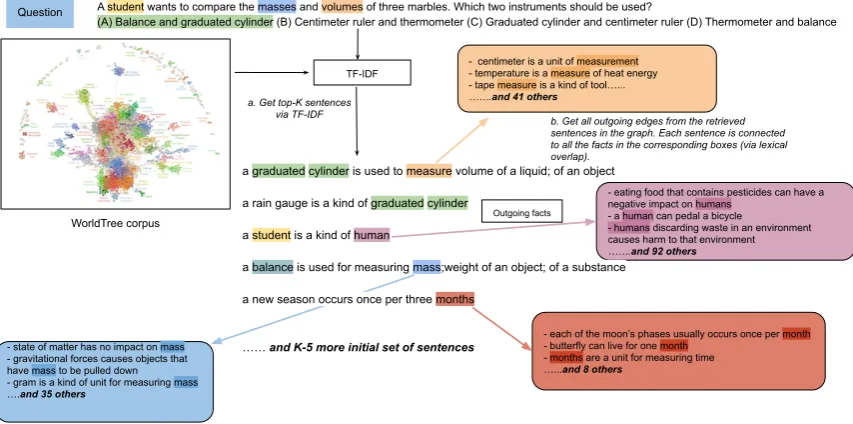
A student wants to compare the masses and volumes of three marbles. Which two instruments should be used?
(A) Balance and graduated cylinder (B) Centimeter ruler and thermometer (C) Graduated cylinder and centimeter ruler (D) Thermometer and balance Question
WorldTree corpus
TF-IDF
- centimeter is a unit of measurement - temperature is a measure of heat energy - tape measure is a kind of tool…...
…….and 41 others
- eating food that contains pesticides can have a negative impact on humans
- a human can pedal a bicycle
- humans discarding waste in an environment causes harm to that environment
…….and 92 others
- state of matter has no impact on mass - gravitational forces causes objects that have mass to be pulled down - gram is a kind of unit for measuring mass ….and 35 others
- each of the moon’s phases usually occurs once per month - butterfly can live for one month
- months are a unit for measuring time …...and 8 others
a. Get top-K sentences via TF-IDF
b. Get all outgoing edges from the retrieved sentences in the graph. Each sentence is connected to all the facts in the corresponding boxes (via lexical overlap).
a graduated cylinder is used to measure volume of a liquid; of an object
a rain gauge is a kind of graduated cylinder
a student is a kind of human
a balance is used for measuring mass;weight of an object; of a substance
a new season occurs once per three months
…… and K-5 more initial set of sentences
[image:2.595.89.516.77.289.2]Outgoing facts
Figure 2: Overview of our approach. Given a question and its answer, we find a set of initial relevant facts via a simple TF-IDF retriever. Next, from each of this relevant fact, we look at other outgoing facts (shown in the colored boxes). Note that, there are a lot of outgoing facts and most of them are spurious w.r.t the given question. Using the annotations provided, we train a supervised ranker to identify the relevant chains needed to explain an answer.
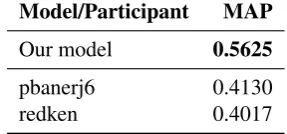
combining the top-ranked chains to reconstruct the explanation subgraph. Starting with the initial set of nodes (facts) returned by the IR system, we look at all the facts that can be hopped from them. How-ever as can be seen from figure 2, most of these chains of facts are not relevant for answering the question and are hence ‘spurious’ in nature. For example, combining the two facts (that are con-nected via lexical overlap) “a graduated cylinder is used to measure volume of a liquid” and “cen-timeter is a unit of measurement” does not provide a valid explanation for the question. Models, at-tempting to do reasoning over such spurious chain of facts often fall into the phenomenon of ‘se-mantic drift’ (Fried et al.,2015). To counter such spurious chains, we use the annotations provided in the WorldTree corpus (Jansen et al., 2018) to train a re-ranker that scores whether a pair of facts is relevant to answer a question. Our re-ranker encodes a pair of facts with the question and obtains question-aware contextualized representa-tion from a pre-trained BERT(Devlin et al.,2018) language model. We also find that an even sim-pler model that scores each facts independently (instead of a chain) is also very competitive and a combination of both the models performs the best. Overall our simple technique achieves a score of 56.25% MAP score outperforming the second best entry by 14.95 points.
2 Task
Given a question and the correct answer, the task is to find a set of sentences that explain the an-swer to the question. The task can easily be trans-formed into a ranking setup where the goal is to rank the relevant facts over all other facts present in the corpus. The evaluation metric used for the task is the widely used and robust mean average precision (MAP) metric.
Data: The data in the shared task comes from the WorldTree corpus that contains elementary sci-ence questions from the ARC corpus (Clark et al.,
2018). A key feature of the WorldTree corpus is that it contains detailed annotation stating whether a fact is a part of the explanation for each ques-tion. Following our prior graphical representation, these sentences form an ‘explanation subgraph’. Although, we do not use this, but the corpus also contains annotations about whether a fact is ‘cen-tral’, or provides ‘grounding’ or serves as a ‘lexi-cal glue’ for explaining the answer to the question.
3 Model
Our model consists of two major components — (a) a simple IR system that retrieves the initial set of evidence facts from the corpus and serves as a starting point for further exploration and (b) a BERTbased ranker that scores a pair of facts w.r.t
cur-rent system, the IR component is a simple tf-idf based retriever that takes in the concatenation of question and the correct answer string and returns the top-kranked facts in the corpus. Although we find that this simple retriever is effective, our de-sign is agnostic to the choice of the retriever and can be replaced with any sophisticated IR system. The retrieved facts will often miss key facts that are required for explaining an answer. This could be because there is no lexical overlap be-tween the fact and the question, or because the rel-evant facts are just ranked low. For example, as shown in figure2, two important explanatory facts were missed by the initial IR system (“Computing requires measuring” (‘central’) and “Marble is a kind of object; material” (‘grounding’)). However, we note that if we also consider the outgoing facts from all the retrieved sentences, then the recall of the system increases significantly. For exam-ple, on considering all the 1-hop neighbors from the top 25 initial facts retrieved by tf-idf, 94.48% of ground truth facts were covered for a question, on average3. This motivated us to consider reason-ing over a chain of facts together. Reasonreason-ing over chains of facts has also been shown to be an effec-tive technique for reasoning over knowledge bases (Lao et al., 2011; Neelakantan et al., 2015; Das et al.,2017,2018, inter-alia).
In our graphical representation, edges are as a result of lexical overlap between sentences. In making edges between facts, we ignore the stop words and “filler” words that were added in the an-notation process. Despite this the resulting graph is very dense, and hence, each node is associated with many neighbors and not all of the facts are important for answering the question. These kind of spurious chain of facts is responsible for leading to wrong inference and often goes out of context w.r.t the question leading to semantic drifts (Fried et al., 2015). Analogous problems due to spuri-ous facts can be seen in learning semantic parser from denotations (Guu et al., 2017) and in rein-forcement learning (Sutton,1984;Agarwal et al.,
2019). The density of the graph also makes it in-tractable to use more than 1-hop chains and a bet-ter (sparser) graph representation will be neces-sary to make full use of the path ranker.
To counter the problem of spurious chains, we use the annotations present in the WorldTree cor-pus. Specifically, a chain of facts is a positive
train-3For 75.66% of questions,allthe ground truth facts were
present in the set of 1-hop neighbors of top 25 tf-idf facts.
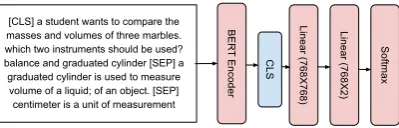
[CLS] a student wants to compare the masses and volumes of three marbles. which two instruments should be used? balance and graduated cylinder [SEP] a graduated cylinder is used to measure volume of a liquid; of an object. [SEP] centimeter is a unit of measurement
BER
T
Encoder CLS
Linear (768X768) Linear (768X2)
[image:3.595.320.520.72.136.2]Softmax
Figure 3: Architecture of the fact encoder. The ques-tion, answer and the chain of facts are concatenated
to-gether and fed to a BERTencoder to form query-aware
contextualized representation. The representation
cor-responding to the [CLS] token is then fed to another
feed-forward network.
ing example, ifallthe facts present in the chain are relevant to the question. For example, the chain (“A balance is used for measuring mass, weight of an object”, “Marble is kind of an object”) is a positive training example, since both the individ-ual facts are relevant for the question in figure1. However, the chain (“A balance is used for mea-suring mass, weight of an object”, “A graduated cylinder is a object”) is considered as a spurious chain for the same question.
To encode the chain of facts, we use the power of contextualized representation from a pre-trained BERT language model (Devlin et al.,
2018). As shown in figure3, we form the query-dependent representation of a chain of facts by concatenating the question, correct answer and the facts in the chain. After encoding with a BERT
model, we use the representation corresponding to the [CLS] token as the intermediate representation which is then fed to a 2-layer feed-forward net-work to output a score. We use a simple binary cross entropy loss to train the network.
facts, we were able to exhaustively evaluate it. As we will show in the next section, this model is ex-tremely competitive.
4 Experiments
For all experiments, the BERT encoder is
initial-ized with the pre-trained BERT-BASE-UNCASED
model available in the Python package PYTORCH
-TRANSFORMERS4. For training, learning rate was
initialized to 3e−5, batch size of 60 and maximum sequence length of 90 (for batching). During eval-uation, we increased the sequence length to 140. The entire model was fine-tuned for 1 epoch. We used Adam optimizer (Kingma and Ba,2014) with linear learning rate decay. For generating the paths during training, the top 25 facts obtained by tf-idf based ranker were used. We used the implementa-tion of TfidfVectorizer present in SCIKIT-LEARN
(Pedregosa et al.,2011). For all our experiments, we consider chains up to length 2.
For evaluation, we report results using top 25 and top 50 tf-idf ranked facts. Using 50 starting facts improves the coverage of our method5 but the this results in about 10,000+ chains per ques-tion making it difficult to scale. We concatenate the correct answer choice with the question. We did this because we observed that the score of tf-idf based ranker is best when given only the cor-rect choice. This makes intuitive sense since the ranker is distracted by the wrong choices and in most examples, the remaining choices are not nec-essary to answer the question. Our approach does not guarantee ranking of all possible facts present in the corpus. To obtain a ranking of all facts, we appended the facts that were missed in the order that they appear in the tf-idf ranking.
4.1 Baselines
We report the tf-idf based ranking scores as base-lines. We experimented with three variants based on which answer choices were present in the query. We report the score of the ‘no choices’ vari-ant because in a realistic setting, the correct an-swer will not be present at test time.
We consider a variant of our model that ranks individual facts directly rather than paths (BERT
Re-ranker in the Table1). This is the model pro-posed in (Nogueira and Cho,2019) but instead of
4https://github.com/huggingface/
pytorch-transformers
5For 88% (75.66%) of questions,allthe ground truth facts
were present in the set of 1-hop neighbors from top 50 (top 25) tf-idf facts.
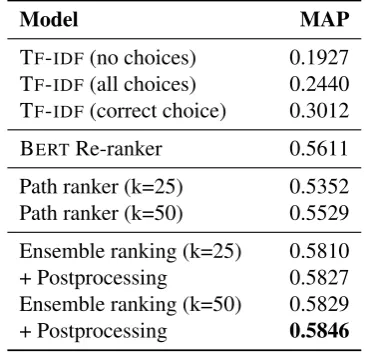
Model MAP
TF-IDF(no choices) 0.1927
TF-IDF(all choices) 0.2440
TF-IDF(correct choice) 0.3012
BERTRe-ranker 0.5611
Path ranker (k=25) 0.5352
Path ranker (k=50) 0.5529
Ensemble ranking (k=25) 0.5810
+ Postprocessing 0.5827
Ensemble ranking (k=50) 0.5829
[image:4.595.324.507.63.239.2]+ Postprocessing 0.5846
Table 1: MAP score on the development set. Perfor-mance of our model (Path ranker) and ensemble are re-ported for two variants; using top-25 and top-50 tf-idf retrieved facts as starting points
re-ranking a subset of facts, we use it to rank all the facts. The Re-ranker was initialized and trained in the same way as our model. We found that a model fine-tuned for 3 epochs worked best. This is an extremely competitive model and outperforms our Path-ranker model. As noted before, this is not a scalable approach and can not be applied to a large corpus of facts.
We also perform a type of ensemble ranking. For every question, the ranking of Path ranker is used until the probability output of the model drops below 0.5. At this point, we append the rank-ing of the BERT Re-ranker. The intuition behind this scheme is that we consider the ranking of the Path ranker only when it is confident (prob≥0.5) and then fall back to the BERTre-ranker. Empiri-cally, as seen in table1, this heuristic is very effec-tive. In addition, we perform a post processing step to move duplicate facts to the end of the ranking6. This post-processing also gave a slight improve-ment7.
4.2 Performance on the hidden test set
Our submission during the test phase of the shared task corresponds to a constrained version of the final model. Also, the initial set of facts are The test set performance is reported in Table2.
4.3 Error Analysis
We perform extensive error analysis (in Appendix I) on the 23 questions in the development set
6There are few duplicate facts present in the dataset (with
unique fact-ids)
7In the appendix, we refer to ranking generated by the
Model/Participant MAP
Our model 0.5625
pbanerj6 0.4130
[image:5.595.108.252.67.134.2]redken 0.4017
Table 2: MAP score on the hidden test set.
where our model performed poorly (MAP≤0.25). We find that 2 of the 23 errors resulted due to the pre-processing step of removing the wrong choices. These questions required reasoning by eliminating answer candidates. In 5 of the 23 er-rors, (in our opinion) our model brings up alterna-tive sentences (to the top) that provide sufficient explanation. In all other cases, when the model outputs a poor ranking, it usually outputs seman-tically similar facts but these facts are not neces-sary/helpful for completing the reasoning.
We would like to emphasize question 23 in Ap-pendix I which proves the need for scoring chains rather than individual facts (“The snowshoe hare sheds its fur twice a year. In the summer, the fur of the hare is brown. In the winter, the fur is white. Which of these statements best explains the advan-tage of shedding fur? (A) Shedding fur keeps the hare clean. (B) Shedding fur helps the hare move quickly. (C) Shedding fur keeps the hares home warm. (D) Shedding fur helps the hare blend into its habitat”). In this question, understanding that brown fur is in fact an adaptation to hide from predators and not meant for warmth is dependent on making a link that the hare lives in forests which have brown bark. Although our model per-forms better than tf-idf on this question, since the reasoning chain is longer than one hop, the perfor-mance is poor overall.
In appendix II, we also note examples where hopping over multiple facts is necessary. BERT
-re-ranker scores relevant facts low when they have low lexical overlap with the question. However, our model uses chain of connected facts to iden-tify that there are relevant to the question.
5 Conclusion
We describe our entry to the shared task on ‘Multi-hop Inference Explanation Regeneration’. We present a system that reasons over chains of facts to reconstruct a subgraph of facts that ex-plains an answer to the question. Our system is the winning entry to the shared task outperforming the second best system by14.95points in MAP score.
Acknowledgements
This work is funded in part by the Center for Data Science and the Center for Intelligent In-formation Retrieval, and in part by the National Science Foundation under Grant No. IIS-1514053 and in part by the International Business Ma-chines Corporation Cognitive Horizons Network agreement number W1668553 and in part by the Chan Zuckerberg Initiative under the project Sci-entific Knowledge Base Construction. Any opin-ions, findings and conclusions or recommenda-tions expressed in this material are those of the authors and do not necessarily reflect those of the sponsor.
References
Rishabh Agarwal, Chen Liang, Dale Schuurmans, and Mohammad Norouzi. 2019. Learning to generalize
from sparse and underspecified rewards. InICML.
Danqi Chen, Jason Bolton, and Christopher D
Man-ning. 2016. A thorough examination of the
cnn/daily mail reading comprehension task. InACL.
Jifan Chen and Greg Durrett. 2019. Understanding
dataset design choices for multi-hop reasoning. In
NAACL.
Peter Clark, Isaac Cowhey, Oren Etzioni, Tushar Khot, Ashish Sabharwal, Carissa Schoenick, and Oyvind Tafjord. 2018. Think you have solved question
an-swering? try arc, the ai2 reasoning challenge. arXiv
preprint arXiv:1803.05457.
Rajarshi Das, Shehzaad Dhuliawala, Manzil Zaheer, Luke Vilnis, Ishan Durugkar, Akshay Krishna-murthy, Alex Smola, and Andrew McCallum. 2018. Go for a walk and arrive at the answer: Reasoning over paths in knowledge bases using reinforcement
learning. InICLR.
Rajarshi Das, Arvind Neelakantan, David Belanger, and Andrew McCallum. 2017. Chains of reasoning over entities, relations, and text using recurrent
neu-ral networks. InEACL.
Jacob Devlin, Ming-Wei Chang, Kenton Lee, and Kristina Toutanova. 2018. Bert: Pre-training of deep bidirectional transformers for language
understand-ing. InNAACL.
Mary T Dzindolet, Scott A Peterson, Regina A Pom-ranky, Linda G Pierce, and Hall P Beck. 2003. The
role of trust in automation reliance. International
journal of human-computer studies.
Daniel Fried, Peter Jansen, Gustave Hahn-Powell,
Mi-hai Surdeanu, and Peter Clark. 2015.
Higher-order lexical semantic models for non-factoid
Kelvin Guu, Panupong Pasupat, Evan Zheran Liu,
and Percy Liang. 2017. From language to
pro-grams: Bridging reinforcement learning and
maxi-mum marginal likelihood. InACL.
Jonathan L Herlocker, Joseph A Konstan, and John Riedl. 2000. Explaining collaborative filtering
rec-ommendations. InCSCW.
Peter Jansen and Dmitry Ustalov. 2019. TextGraphs 2019 Shared Task on Multi-Hop Inference for
Ex-planation Regeneration. InTextGraphs-13, EMNLP.
Peter A Jansen, Elizabeth Wainwright, Steven Mar-morstein, and Clayton T Morrison. 2018. Worldtree: A corpus of explanation graphs for elementary sci-ence questions supporting multi-hop infersci-ence. In
LREC.
Robin Jia and Percy Liang. 2017. Adversarial exam-ples for evaluating reading comprehension systems. InEMNLP.
Divyansh Kaushik and Zachary C Lipton. 2018. How much reading does reading comprehension require? a critical investigation of popular benchmarks. In
EMNLP.
Diederik P Kingma and Jimmy Ba. 2014. Adam: A
method for stochastic optimization. arXiv preprint
arXiv:1412.6980.
Ni Lao, Tom Mitchell, and William Cohen. 2011. Ran-dom walk inference and learning in a large scale
knowledge base. InEMNLP.
Yinhan Liu, Myle Ott, Naman Goyal, Jingfei Du, Man-dar Joshi, Danqi Chen, Omer Levy, Mike Lewis, Luke Zettlemoyer, and Veselin Stoyanov. 2019. Roberta: A robustly optimized bert pretraining
ap-proach. arXiv preprint arXiv:1907.11692.
Arvind Neelakantan, Benjamin Roth, and Andrew Mc-Callum. 2015. Compositional vector space models
for knowledge base completion. InACL.
Rodrigo Nogueira and Kyunghyun Cho. 2019.
Pas-sage re-ranking with bert. arXiv preprint
arXiv:1901.04085.
F. Pedregosa, G. Varoquaux, A. Gramfort, V. Michel, B. Thirion, O. Grisel, M. Blondel, P. Prettenhofer, R. Weiss, V. Dubourg, J. Vanderplas, A. Passos, D. Cournapeau, M. Brucher, M. Perrot, and E.
Duch-esnay. 2011. Scikit-learn: Machine learning in
Python. Journal of Machine Learning Research,
12:2825–2830.
Marco Tulio Ribeiro, Sameer Singh, and Carlos Guestrin. 2016. Why should i trust you?: Explaining
the predictions of any classifier. InKDD.
Richard Stuart Sutton. 1984. Temporal Credit
Assign-ment in ReinforceAssign-ment Learning. Ph.D. thesis, Uni-versity of Massachusetts Amherst. AAI8410337.
Zhilin Yang, Zihang Dai, Yiming Yang, Jaime Car-bonell, Ruslan Salakhutdinov, and Quoc V Le. 2019. Xlnet: Generalized autoregressive
pretrain-ing for language understandpretrain-ing. arXiv preprint
6 Appendix I: Model error analysis (AP≤0.25)
This section contains examples from the development set where the final model performs poorly. 1 mercury sc 401652
Question:Before large trees could grow on Earth, what had to happen first? (A) Rocks were eroded to form soil. (B) Molten rock warmed Earth’s interior. (C) Earth’s gravity accumulated to modern levels. (D) Volcanoes exploded to form mountaintop lakes.
Correct Answer:A
Ground truth facts:
Text Role TF-IDF Reranker Path Ranker Mix
soil is formed by rocks eroding as CENTRAL 23 19 2 19
a plant requires soil for survival; to grow CENTRAL 3 64 6 61
a tree is a kind of plant GROUNDING 1501 10 32 10
MAP 0.1407 0.0840 0.3090 0.0840
Analysis:
• TF-IDF does better because the first relevant fact is ranked higher. However, the low TFIDF fact is ranked much lower than in the learned models
• Reranker output consists of facts related to soil erosion, which although have similar context, dont answer the question
• Path ranker by itself has a much better MAP but due to low confidence, its ranking is disregarded in the mixture result. The top results are lexical glue sentences connected to the questions and mostly related to erosion again
2 mercury sc 400058
Question: The small stone plant has leaves that look like pebbles or stones. This characteristic helps the plant (A) attract insects for pollination. (B) produce a large number of seeds. (C) absorb water and nutrients. (D) avoid being eaten by animals.
Correct Answer:D
Ground truth facts:
Text Role TF-IDF Reranker Path Ranker Mix
looking like is similar to camouflaging as LEXGLUE 135 32 552 30
camouflage is a kind of adaptation for hiding in an environment
CENTRAL 4026 233 4358 229
helping something has a positive impact on that something
LEXGLUE 317 1 257 2
an adaptation; an ability has a positive impact on an animal’s; living thing’s survival; health; ability to reproduce
CENTRAL 1279 88 24 86
camouflage is a kind of protection against preda-tors; from predapreda-tors; against consumers
CENTRAL 4027 67 4375 65
consumers eat other organisms CENTRAL 3866 1043 235 1032
a plant is a kind of organism GROUNDING 23 57 2 55
In the food chain process an animal has the role of consumer which eats producers;other animals for food
CENTRAL 205 145 148 142
avoiding predators; escaping predators; avoiding consumers is a kind of protection
CENTRAL 4100 276 4137 272
an adaptation is a kind of characteristic GROUNDING 110 115 1723 112
An example of camouflage is when an organism looks like its environment
CENTRAL 214 173 47 170
rock means stone LEXGLUE 7 87 18 85
a pebble is a kind of small rock GROUNDING 208 33 560 31
an ecosystem contains nonliving things CENTRAL 2622 590 3412 581
rock is a kind of nonliving thing GROUNDING 4870 538 135 531
MAP 0.0283 0.1193 0.0676 0.0876
Analysis:
– Establish rock is non-living: pebble is a kind of small rock; rock means stone; rock is a kind of nonliving thing; nonliving, non-living, die is the opposite of living, alive, live
– Establish consumer eat living things: consumers eat other organisms; an organism is a living thing; a plant is a kind of organism
– Establish that the plant is trying to camouflage: looking like is similar to camouflaging as; camouflage is a kind of protection against predators; from predators; against consumers
• Final ranking gathers facts related to adaptation and food chains near the top
3 mcas 2011 5 17673
Question:Jose has two bar magnets. He pushes the ends of the two magnets together and then he lets go. The magnets move quickly apart. Which of the following statements best explains why this happens? (A) The north poles of the two magnets are facing each other. (B) One magnet is a north pole and one magnet is a south pole. (C) The ends of magnets repel each other but the centers attract. (D) One magnet is storing energy and one magnet is releasing energy.
Correct Answer:A
Ground truth facts:
Text Role TF-IDF Reranker Path Ranker Mix
a magnet contains a north pole; south pole CENTRAL 1118 4 14 6
if a pole is facing a pole of the same direction then those two poles will repel each other
CENTRAL 5 41 10 41
repel means move away LEXGLUE 971 1740 56 1719
apart means away LEXGLUE 137 11 79 11
north is a kind of direction GROUNDING 117 84 28 84
MAP 0.0495 0.1111 0.0969 0.0944
Analysis:
• The mixed results ranks facts related to magnetism and separated object as top choices. They are similar in content but not necessary to answer the question
4 mercury sc 411306
Question:Some different types of plants have characteristics in common. Which characteristic do most plants share? (A) the size of their roots (B) the shape of their leaves (C) the color of their flowers (D) the structure of their cells
Correct Answer:D
Ground truth facts:
Text Role TF-IDF Reranker Path Ranker Mix
a plant is made of plant cells CENTRAL 2554 8 15 8
a plant cell is box-like in shape CENTRAL 172 41 29 40
structure is similar to shape LEXGLUE 53 31 136 30
shape is a kind of characteristic CENTRAL 51 29 64 28
MAP 0.0191 0.0971 0.0530 0.0991
Analysis:
• None of the valid ground truth facts in top 25 TF-IDF ranking meaning that the path ranker has bad starting points
• The mixed results ranks facts related to cells, structure and characteristics as top choices. They have similar context but are not necessary to answer the question
5 vasol 2011 5 3
Question:To make an electromagnet, a conductor should be coiled around - (A) a glass tube (B) an iron nail (C) a roll of paper (D) a wooden stick
Correct Answer:B
Ground truth facts:
Text Role TF-IDF Reranker Path Ranker Mix
an electromagnet contains a wire; cylindrical fer-rous metal
ROLE 22 8 11 8
Analysis:
• The top 2 facts ranked by the model are “iron nails are made of iron” and “an electromagnet is formed by attaching an iron nail wrapped in a copper wire to a circuit”. These are sufficient to answer the question but not marked as ground truth.
6 mercury sc lbs10789
Question:All of the following can become fossils except (A) bones. (B) shells. (C) teeth. (D) rocks.
Correct Answer:D
Ground truth facts:
Text Role TF-IDF Reranker Path Ranker Mix
fossil means preserved remains of organisms CENTRAL 2671 1 3 1
skeletal system is made of bones NE 2429 1540 3418 1503
a skeletal system is a part of an animal NE 2256 1506 919 1469
an animal is a kind of organism CENTRAL 1221 43 39 41
a shell is a part of some animals NE 2133 4328 285 4249
a tooth is a kind of bone NE 2308 3819 3308 3742
rock is a kind of nonliving thing CENTRAL 2098 25 24 23
nonliving; non-living; die is the opposite of living; alive; live
LEXGLUE 1117 2242 130 2387
an organism is a living thing CENTRAL 3294 178 64 175
MAP 0.0021 0.1318 0.0698 0.1331
Analysis:
• This question is a case where having all the choices is necessary to gather relevant facts. This is a known weakness in the preprocessing step which only keeps the correct choices. Because the rankers only see the query “All of the following can become fossils except rocks” they cannot gather facts related to bones, teeth and shells. This is reflected by very poor TF-IDF ranks
• Top ranked facts in the final results relate to fossil formation and rock formation. Again, because of the same reason mentioned before, the ranker never sees the other choice terms
7 mdsa 2009 5 16
Question:Students visited the Morris W. Offit telescope located at the Maryland Space Grant Observa-tory in Baltimore. They learned about the stars, planets, and moon. The students recorded the information below. Star patterns stay the same, but their locations in the sky seem to change. The sun, planets, and moon appear to move in the sky. Proxima Centauri is the nearest star to our solar system. Polaris is a star that is part of a pattern of stars called the Little Dipper. Which statement best explains why the sun appears to move across the sky each day? (A) The sun revolves around Earth. (B) Earth rotates around the sun. (C) The sun revolves on its axis. (D) Earth rotates on its axis.
Correct Answer:D
Ground truth facts:
Text Role TF-IDF Reranker Path Ranker Mix
the Earth rotating on its axis causes the sun to appear to move across the sky during the day
CENTRAL 1 18 25 15
the sun rises in the east BACKGROUND 39 23 87 20
the sun sets in the west BACKGROUND 48 7 21 7
MAP 0.3713 0.1281 0.0540 0.1421
Analysis:
• Just one fact (”the Earth rotating on its axis causes the sun to appear to move across the sky during the day”) is sufficient to actually answer the question
8 mdsa 2010 5 18 Question: Wind is a natural resource that benefits the southeastern shore of the Chesapeake Bay. How could these winds best benefit humans? (A) The winds could blow oil spills into the bay. (B) The winds could be converted to fossil fuel. (C) The winds could blow air pollution toward land. (D) The winds could be converted to electrical energy.
Correct Answer:D
Ground truth facts:
Text Role TF-IDF Reranker Path Ranker Mix
a windmill converts wind energy into electricity CENTRAL 80 75 192 74
electricity means electrical energy LEXGLUE 32 3 7 3
electricity is used as an energy source by electrical devices
CENTRAL 125 33 5 33
electrical devices are used for industrial purposes; household purposes by humans
CENTRAL 372 142 79 140
to help; to benefit means to be of use LEXGLUE 2 10 15 10
MAP 0.1291 0.1425 0.1525 0.1428
Analysis:
• Model spuriously ranks “a human is a kind of animal” at 2 and “person is synonymous with human” at 3. All other top facts relate to energy, wind and shore. Again the model has captured context but not found facts that answer the question
9 mercury sc 400862
Question:A wire is wrapped around a metal nail and connected to a battery. If the battery is active, the nail will (A) vibrate. (B) create sound. (C) produce heat. (D) become magnetic.
Correct Answer:D
Ground truth facts:
Text Role TF-IDF Reranker Path Ranker Mix
an electromagnet is a kind of electric magnet GROUNDING 3328 18 26 19
a electromagnet is formed by attaching an iron nail wrapped in a copper wire to a circuit
CENTRAL 4 9 52 10
iron is a kind of metal GROUNDING 22 86 30 86
creating a simple circuit requires a wire; battery CENTRAL 7 30 35 30
if battery in an electromagnet is active then the nail in the electromagnet will become magnetic
CENTRAL 1 1 14 6
MAP 0.4224 0.3161 0.0917 0.1432
Analysis:
• Top ranked fact is “metal is sometimes magnetic”. The model pushes useful sentences away by ranking unnecessary synonymy sentences higher
10 vasol 2009 5 10
Question:A student is hiking through a forest taking pictures for science class. Which picture would most likely be used as an example of human impact on Earth? (A) A trail built by cutting down trees (B) A river eroding away the riverbank (C) A bird nest made of dead branches (D) A group of butterflies landing on flowers
Correct Answer:A
Ground truth facts:
Text Role TF-IDF Reranker Path Ranker Mix
cutting down trees has a negative impact on an ecosystem; organisms living in an ecosystem
CENTRAL 10 3 5 3
clearing a forest means humans cutting down the trees
CENTRAL 7 38 38 37
building usually requires cutting down trees BACKGROUND 11 27 9 27
the Earth contains many ecosystems CENTRAL 530 41 52 40
MAP 0.1558 0.1460 0.1445 0.1471
Analysis:
11 mcas 2002 5 6
Question:Hummingbirds can hover in the air and fly very quickly. This benefits the hummingbird in all of the following except (A) quickly escaping predators. (B) easily reaching flowers. (C) staying in one place to drink nectar. (D) keeping eggs warm.
Correct Answer:D
Ground truth facts:
Text Role TF-IDF Reranker Path Ranker Mix
some animals move quickly to escape predators NEG 160 2294 241 2275
flying is a kind of motion air GROUNDING 410 12 5 12
motion; movement means moving; to move LEXGLUE 4541 155 425 150
avoiding predators; escaping predators; avoiding consumers is a kind of protection
LEXGLUE 3423 3832 621 3770
protecting something means preventing harm to that something
LEXGLUE 4077 1033 1271 1025
harming something has a negative impact on; effect on that something
LEXGLUE 4325 390 4488 384
negative impact is the opposite of positive impact LEXGLUE 1125 76 2346 73
a positive impact is a benefit LEXGLUE 3862 2 3968 5
a hummingbird can reach flowers by hovering in the air
NEG 2 37 26 36
hummingbirds eat nectar CENTRAL 9 25 63 24
a flower is a source of nectar CENTRAL 2769 89 182 86
an animal needs to eat food for nutrients CENTRAL 3545 365 85 359
an animal; living thing requires nutrients for sur-vival
CENTRAL 3946 151 71 148
requiring is similar to needing help LEXGLUE 4740 24 4786 23
to help; to benefit means to be of use LEXGLUE 3281 9 3830 10
to hover means to stay in place in the air NEG 1 13 2 2
MAP 0.1503 0.1470 0.0847 0.1651
Analysis:
• Since this is a question requiring elimination of choices, the preprocessing step of removing the wrong answer choices harms the model. Subsequently all relevant facts corresponding to incorrect choices are pushed to the end
12 nceoga 2013 5 15
Question:Which body system sends electrical signals to all other body systems? (A) circulatory system (B) digestive system (C) muscular system (D) nervous system
Correct Answer:D
Ground truth facts:
Text Role TF-IDF Reranker Path Ranker Mix
the nervous system sends observations in the form of electrical signals to the rest of the body
CENTRAL 1 6 6 6
MAP 1.0000 0.1667 0.1667 0.1667
Analysis:
• The model output ranks “nervous system is an electrical; electric conductor”; “the nervous system is a kind of body system”; “the nervous system contains nerves”; “the nervous system is a part of the body of an animal”; “the nervous system is the vehicle for controlling the body”. This is surprising since it ignores the near-perfect lexical overlap between question and ground truth
13 mercury sc 401598
Question:Which action does a kitten learn from its mother? (A) how to grow (B) how to meow (C) how to hunt mice (D) how to nurse milk
Correct Answer:C
Ground truth facts:
Text Role TF-IDF Reranker Path Ranker Mix
hunting; scavenging is a kind of skill GROUNDING 3883 46 28 45
skills are learned characteristics CENTRAL 4507 11 41 12
hunting is a kind of action CENTRAL 8 5 3 3
Analysis:
• The model output contains a lot of synonymy-like facts but not facts about mice and hunting
14 mcas 2016 5 7 Question: Which of the following happens only during the adult stage of the life cycle of a frog? (A) A frog lays eggs. (B) A frog swims in water. (C) A frog begins to lose its tail. (D) A frog begins to develop lungs.
Correct Answer:A
Ground truth facts:
Text Role TF-IDF Reranker Path Ranker Mix
some adult animals lay eggs CENTRAL 28 4 4 4
a frog is a kind of animal GROUNDING 4 3 3 3
An example of reproduction is laying eggs CENTRAL 85 32 16 31
reproduction occurs during adulthood CENTRAL 267 182 84 179
adulthood is a stage in the life cycle process CENTRAL 12 246 97 242
MAP 0.1179 0.1938 0.2240 0.1946
Analysis:
• Top ranked facts are “an egg is a stage in the life cycle process of some animals”; “frogs lay eggs”; “a frog is a kind of animal”; “some adult animals lay eggs”
• Spurious sentences like “a female insect lays eggs during the adult stage of an insect’s life cycle” appear in the ranking
15 mercury sc 415366
Question:Trees need oxygen. Roots close to the surface of the ground take in the oxygen the tree needs. Which organisms help trees get oxygen? (A) woodpeckers making holes in the tree (B) earthworms making holes in the ground near the tree (C) mushrooms growing at the base of the tree (D) squirrels eating walnuts on the ground near the tree
Correct Answer:B
Ground truth facts:
Text Role TF-IDF Reranker Path Ranker Mix
earthworms create tunnels in soil CENTRAL 144 30 22 28
to create means to make LEXGLUE 1475 197 2444 193
a tunnel is a kind of hole LEXGLUE 3265 110 147 107
soil is a part of the ground outside LEXGLUE 34 278 170 274
tunnels in soil loosen that soil CENTRAL 1924 83 11 80
the looseness of soil increases the amount of oxy-gen in that soil
CENTRAL 22 297 5 292
plants absorb nutrients; water; oxygen from soil into themselves through their roots
CENTRAL 63 9 7 9
taking in something means receiving; absorbing; getting something
LEXGLUE 1956 587 33 581
a tree is a kind of plant GROUNDING 46 3 168 3
an earthworm is a kind of animal CENTRAL 2760 1 3319 1
an animal is a kind of organism GROUNDING 2354 21 3051 20
to make something easier means to help LEXGLUE 330 450 1715 444
getting something increases the amount of that something
LEXGLUE 1024 1040 51 1033
MAP 0.0247 0.2044 0.1058 0.2066
Analysis:
• Model ranks sentences related to roots, plants and earthworms near the top. It gathers sentences with low TF-IDF overlap but misses facts required to complete the reasoning process
16 mdsa 2007 5 39
plants along a lakeshore (D) directing runoff from cropland into a lake
Correct Answer:D
Ground truth facts:
Text Role TF-IDF Reranker Path Ranker Mix
water is a kind of natural resource GROUNDING 6 11 1 11
a lake is a kind of body of water GROUNDING 1448 370 7 364
runoff contains chemicals; fertilizer; pollutants; pesticides from cropland
CENTRAL 194 2 19 2
to impact means to affect LEXGLUE 4482 7 7 7
cropland is used for farming by humans BACKGROUND 744 35 93 35
pollution is when humans pollute the environ-ment with pollutants
CENTRAL 1590 47 525 46
pollution has a negative impact on the environ-ment; air quality
CENTRAL 1504 65 239 64
a body of water is a kind of environment GROUNDING 1186 18 22 18
MAP 0.0247 0.2101 0.2149 0.2107
Analysis:
• TF-IDF is distracted by the initial chunk of text in the question. This text does not add any value to the actual question
• Top 5 outputs of our model are “runoff is when cropland water enters; runs off into bodies of water”; “runoff contains chemicals; fertilizer; pollutants; pesticides from cropland”; “runoff is a kind of water”; “harming something has a negative impact on; effect on that something”; “waste has a negative impact on the environment”. This shows that our model has in fact ignored the distractors
17 mercury sc 400612
Question: The surface of Earth changes constantly from weathering and erosion. Compared to Earth, there is little weathering and erosion on the Moon because of (A) the lack of gravity on the Moon. (B) the thin atmosphere on the Moon. (C) the lack of air and water on the Moon. (D) the lack of living creatures on the Moon.
Correct Answer:C
Ground truth facts:
Text Role TF-IDF Reranker Path Ranker Mix
the moon does not contain air; water CENTRAL 36 4 17 5
if something does not contain something else then that something lacks that something else
LEXGLUE 4201 15 23 14
rocks; soil; materials interacting with wind; mov-ing water over long periods of time causes weath-ering
CENTRAL 192 51 94 50
wind means moving air LEXGLUE 811 173 64 170
soil erosion means soil loss through wind;water; animals
CENTRAL 153 23 23 22
lack is similar to low; little LEXGLUE 38 1 3 3
MAP 0.0214 0.3344 0.1164 0.2108
Analysis:
• TF-IDF is distracted by facts relating to the definition of weathering, and the relation between the Earth and the moon
• Our model actually ranks the top 2 facts as “the Moon has less water; air than Earth”; “weathering is a kind of erosion” which are both correct and useful for answering the question. It also ranks “soil erosion is when wind; moving water; gravity move soil from fields; environments” at rank 9. These would be sufficient facts to answer the question. This example shows an occurrence where the annotation/ranking process actually misses valid supporting facts
18 mcas 1998 4 8
Correct Answer:B Ground truth facts:
Text Role TF-IDF Reranker Path Ranker Mix
a swimming pool contains water CENTRAL 1 3 1 1
water is an electrical; electric energy; thermal; ther-mal energy conductor
CENTRAL 93 15 5 5
sending electricity through a conductor causes electricity; electric current to flow through that conductor
CENTRAL 102 313 1313 310
nervous system is an electrical; electric conductor CENTRAL 42 714 1482 708
if one electrical conductor contacts another elec-trical conductor then electricity will flow through both conductors
CENTRAL 1817 975 1247 969
the nervous system is a part of the body of an ani-mal
CENTRAL 2809 3828 1014 3777
if electricity flows through; is transferred through the body of an animal then that animal is electro-cuted
CENTRAL 1784 25 11 24
electrocution causes harm to an organism CENTRAL 519 26 45 25
an animal is a kind of organism GROUNDING 4833 59 20 57
harm means danger LEXGLUE 3695 12 10 13
electric devices require electrical energy to func-tion
CENTRAL 35 19 57 18
device means tool LEXGLUE 3709 115 225 113
MAP 0.1043 0.1322 0.2199 0.2127
Analysis:
• The fact that the nervous system conducts electricity is needed to show that the animal/human body will conduct electricity. The facts ranked low by our model are the ones related to the nervous system. Most likely the model implicitly assumes this since it has observed the fact that “if electricity flows through; is transferred through the body of an animal then that animal is electrocuted”
19 mercury sc 401294 Question:The shape of plants’ leaves that survive well in a rainy climate are most often (A) red and shiny. (B) wide and flat. (C) thick and waxy. (D) sharp and narrow. Correct
Answer:BGround truth facts:
Text Role TF-IDF Reranker Path Ranker Mix
as the size of a leaf increases , the amount of sun-light absorbed by that leaf will increase
CENTRAL 506 99 53 97
width is a property of size; shape and includes or-dered values of narrow; wide
CENTRAL 5 78 2 76
as flatness of a leaf increases , the amount of sun-light that leaf can absorb will increase
CENTRAL 954 11 17 12
flatness is a property of a surface; the shape of an object and includes ordered values of uneven; flat
CENTRAL 6 9 5 10
a leaf is a kind of object GROUNDING 2220 19 11 18
a surface is a part of an object GROUNDING 2240 520 31 516
a leaf absorbs sunlight to perform photosynthesis CENTRAL 4734 207 494 204
a leaf is a part of a green plant GROUNDING 3033 6 98 7
a plant requires photosynthesis to grow; survive CENTRAL 74 237 77 234
rainy means often raining LEXGLUE 3 10 4 11
as the amount of rain increases in an environment , available sunlight will decrease in that environment
CENTRAL 245 150 91 147
a climate is synonymous with an environment LEXGLUE 20 1 3 2
the decrease of something required by an organism has a negative impact on that organism’s survival
CENTRAL 953 482 352 478
a plant is a kind of organism GROUNDING 2125 15 201 15
large leaves are a kind of adaptation for absorbing sunlight
CENTRAL 36 47 242 46
larger means greater; higher; more in size LEXGLUE 2089 83 66 81
an adaptation; an ability has a positive impact on an animal’s; living thing’s survival; health; ability to reproduce
CENTRAL 4088 41 115 40
negative impact is the opposite of positive impact LEXGLUE 1598 115 3030 234
Analysis:
• This question has too many supporting facts and a smaller subset of these facts is sufficient to answer the question i.e. establish that flat and wide leaves absorb more sunlight, rainy climate means shortage of sunlight and hence flat and wide leaves is a useful characteristic.
• The ground truth facts ranked lowest by our model are “a surface is a part of an object“, “the decrease of something required by an organism has a negative impact on that organism’s survival” which we feel are extraneous. The top ranked facts relate to leaves and their shapes.
20 csz 2007 5 csz10148
Question:Above a continent, a warm air mass slowly passes over a cold air mass. As the warm air begins to cool, clouds form. What will most likely happen next? (A) Rain will fall. (B) Hurricanes will form. (C) Lightning will strike. (D) Hail will form.
Correct Answer:A
Ground truth facts:
Text Role TF-IDF Reranker Path Ranker Mix
a warm front is when warm air mass rises and passes over a cold air mass
CENTRAL 1 1 3 3
a warm front causes cloudy and rainy weather CENTRAL 214 143 9 142
cloudy means the presence of clouds in the sky BACKGROUND 242 26 130 26
clouds are formed by water vapor rising and con-densing
CENTRAL 361 10 7 11
water vapor cooling causes that water vapor to condense
CENTRAL 1413 317 28 316
precipitation is when rain;snow;hail fall from clouds to the Earth;ground
GROUNDING 33 3 4 4
MAP 0.1849 0.3624 0.3218 0.2190
Analysis:
• This is a case where mixing actually leading to worse performance than the individual models
• The fact “a warm front causes cloudy and rainy weather” is necessary to eliminate hail from con-sideration and this is missed by the model. The actual model outputs relate to cloud formation and precipitation but this one fact is ranked very low
21 mdsa 2011 5 6
Question:Planets in our solar system have different solar years. Which statement explains the cause of an Earth solar year? (A) Earth rotates around the sun. (B) Earth revolves around the sun. (C) The sun rotates around Earth. (D) The sun revolves around Earth.
Correct Answer:B
Ground truth facts:
Text Role TF-IDF Reranker Path Ranker Mix
a complete revolution of the Earth around the sun takes 1; one year; solar year; Earth year
CENTRAL 1 6 4 5
a revolution is when something revolves around something else
LEXGLUE 41 8 10 7
MAP 0.5244 0.2083 0.2250 0.2428
Analysis:
• The top results for our model are “the Earth revolves around the sun”; “Earth is a kind of planet”; ”revolving around something means orbiting that something”; “the solar system contains the moon”; “a complete revolution of the Earth around the sun takes 1; one year; solar year; Earth year”. These sufficiently answer the question.
• It should be noted that TF-IDF had a better score than the other models
22 timss 2007 4 pg90
(B) The warm water dissolved the most sugar. (C) The hot water dissolved the most sugar. (D) The cold water, warm water and hot water all dissolved the same amount of sugar.
Correct Answer:C
Ground truth facts:
Text Role TF-IDF Reranker Path Ranker Mix
greatest means largest; highest; most ROLE 136 63 1940 62
temperature; heat energy is a property of objects; weather and includes ordered values of cold; cool; warm; hot
CENTRAL 40 6 37 6
hot means high in heat energy; temperature LEXGLUE 125 10 52 10
as temperature increases , the ability of that liquid to dissolve solids will increase
CENTRAL 177 60 22 60
high is similar to increase LEXGLUE 4268 54 1174 54
water is a kind of liquid GROUNDING 21 2 2 2
sugar is a kind of solid GROUNDING 15 15 20 15
MAP 0.0487 0.2434 0.1356 0.2436
Analysis:
• The central fact “as temperature increases , the ability of that liquid to dissolve solids will increase” has very low TF-IDF overlap. The path ranker actually does a good job of bringing this fact and the 2 GROUNDING facts to the top 25. However, its output is disregarded due to the mixing threshold.
• The reranker model is distracted by the facts relating to temperature, heat and the process of dis-solving
23 mdsa 2011 5 20
Question:The snowshoe hare sheds its fur twice a year. In the summer, the fur of the hare is brown. In the winter, the fur is white. Which of these statements best explains the advantage of shedding fur? (A) Shedding fur keeps the hare clean. (B) Shedding fur helps the hare move quickly. (C) Shedding fur keeps the hare’s home warm. (D) Shedding fur helps the hare blend into its habitat.
Correct Answer:D
Ground truth facts:
Text Role TF-IDF Reranker Path Ranker Mix
shedding is when an animal loses hair;fur;skin CENTRAL 4 24 3 3
a hare is similar to a rabbit LEXGLUE 16 8 4 4
some rabbits live in forests CENTRAL 2761 278 103 276
a rabbit is a kind of animal GROUNDING 1566 10 7 12
a forest contains plants; trees GROUNDING 4040 288 4195 286
bark is a protective covering around the trunk of; branches of a tree
GROUNDING 1002 1336 732 1330
bark is usually brown in color GROUNDING 240 522 478 518
snow is white in color GROUNDING 239 15 14 16
An example of camouflage is when something changes color in order to have the same color as its environment
CENTRAL 210 21 53 22
coloration is a kind of adaptation for hid-ing;camouflage
CENTRAL 2806 96 257 95
coloration means a thing’s color LEXGLUE 4537 137 28 136
help means advantage LEXGLUE 236 9 1492 11
blending in is synonymous with hiding LEXGLUE 2207 1 2795 6
habitat is similar to environment LEXGLUE 586 19 1625 20
an environment means an area LEXGLUE 4491 31 4935 31
the color of an environment means the color of the things that environment contains
LEXGLUE 73 116 194 115
MAP 0.0352 0.2507 0.1279 0.2449
Analysis:
• Our model is able to get “a hare is similar to a rabbit” but misses the rest of the facts. This is not a limitation in the model itself but in the actual inference time computation (we only hop out one fact during evaluation).
7 Appendix II: Positive examples
This sections contains examples of questions where Path Ranker performs better than all other models. 1 timss 2011 4 pg90
Question:Water that has its salt removed before it can be used as drinking water is most likely to have come from (A) underground (B) a river (C) a lake (D) a sea
Correct Answer:D
Ground truth facts:
Text Role TF-IDF Reranker Path Ranker Mix
the ocean contains large amounts of salt water CENTRAL 23 5 2 2
sea means ocean LEXGLUE 4090 93 3 3
animals usually require removing salt from wa-ter for drinking
BACKGROUND 1 1 1 1
MAP 0.3626 0.4774 1.0000 1.0000
2 mercury sc 401244
Question: Which rock type is most useful in studying the history of living organisms? (A) basalt (B) marble (C) granite (D) limestone
Correct Answer:D
Ground truth facts:
Text Role TF-IDF Reranker Path Ranker Mix
limestone is a kind of sedimentary rock GROUNDING 81 298 1 1
nearly all fossils are found in sedimentary rock CENTRAL 150 306 12 297
fossils are formed when layers of sediment cover the remains of organisms over time
CENTRAL 156 107 131 103
sedimentary rocks are formed from sediment com-pacting; cementing together
CENTRAL 4357 1662 32 1647
history occurred a long time ago CENTRAL 22 5 3 3
a type is synonymous with a kind LEXGLUE 14 2 2 2
something from long ago can be used for studying history
CENTRAL 1 3 4 4
useful means good to use LEXGLUE 5 6 9 7
MAP 0.2431 0.3160 0.6669 0.6001
Analysis: Notice that the facts “nearly all fossils are found in sedimentary rock” and “sedimentary rocks are formed from sediment compacting; cementing together” only have the word rock in common with the question and correct answer. Yet the Path ranker ranks them higher than the other models. It reaches them via the paths [‘limestone is a kind of sedimentary rock’, ‘nearly all fossils are found in sedimentary rock’] and [‘limestone is a kind of sedimentary rock’, ‘sedimentary rocks are formed from sediment compacting; cementing together’]
3 mercury sc 415541
Question:Which of these objects will most likely float in water? (A) glass marble (B) steel ball (C) hard rubber ball (D) table tennis ball
Correct Answer:D
Ground truth facts:
Text Role TF-IDF Reranker Path Ranker Mix
a ball is a kind of object CENTRAL 1476 4 1 1
an tennis ball contains air CENTRAL 4 1 2 2
something that contains air is usually buoyant CENTRAL 4562 688 11 677
buoyant means able to float in a liquid or gas CENTRAL 11 8 19 8
water is a kind of liquid GROUNDING 55 31 94 29
MAP 0.0980 0.4023 0.5073 0.5041