Proceedings of the 2019 Conference on Empirical Methods in Natural Language Processing
5405
Data-Anonymous Encoding for Text-to-SQL Generation
Zhen Dong1∗, Shizhao Sun2, Hongzhi Liu1, Jian-Guang Lou2 and Dongmei Zhang2
1Peking University 2Microsoft Research
{zhendong,liuhz}@pku.edu.cn
{shizsu,jlou,dongmeiz}@microsoft.com
Abstract
On text-to-SQL generation, the input utterance usually contains lots of tokens that are related to column names or cells in the table, called
table-related tokens. These table-related to-kens are troublesome for the downstream neu-ral semantic parser because it brings com-plex semantics and hinders the sharing across the training examples. However, existing ap-proaches either ignore handling these tokens before the semantic parser or simply use de-terministic approaches based on string-match or word embedding similarity. In this work, we propose a more efficient approach to han-dle table-related tokens before the semantic parser. First, we formulate it as a sequen-tial tagging problem and propose a two-stage anonymization model to learn the semantic re-lationship between tables and input utterances. Then, we leverage the implicit supervision from SQL queries by policy gradient to guide the training. Experiments demonstrate that our approach consistently improves performances of different neural semantic parsers and signif-icantly outperforms deterministic approaches.
1 Introduction
Interacting with relational databases or tables through natural language is an important and chal-lenging problem (Androutsopoulos et al., 1995; Li and Jagadish, 2014;Pasupat and Liang,2015; Zhong et al., 2017;Yu et al., 2018c). To tackle this problem, the neural semantic parser has been widely studied (Dong and Lapata, 2016; Jia and Liang, 2016; Herzig and Berant, 2017; Dong and Lapata, 2018), which automatically maps the input natural language into the logical form (e.g., SQL query) following the typical encoder-decoder structure (Hochreiter and Schmidhuber, 1997;Bahdanau et al.,2015;Vinyals et al.,2015).
∗
This work was done when the author was visiting Mi-crosoft Research Asia.
Semantic parsing usually tackles two kinds of problems (Goldman et al.,2018;Herzig and Be-rant,2018), i.e., thelexical problemand the struc-tural problem. On text-to-SQL generation, the lex-ical problem refers to mapping tokens in input ut-terances to constants in SQL queries, e.g., the col-umn names or cells in SQL queries. The structural problem refers to mapping intentions conveyed by input utterances to operators in SQL queries, e.g., the aggregators or the existence of WHERE clause in SQL queries. Intuitively, the lexical problem can be formulated as a sequential tagging problem, calledanonymization, where each token in the in-put utterance will be tagged as being related to a column name, a cell or nothing. For ease of refer-ence, we call the tokens in input utterances related to column names or cellstable-related tokens, and the tagged utteranceanonymous utterance.
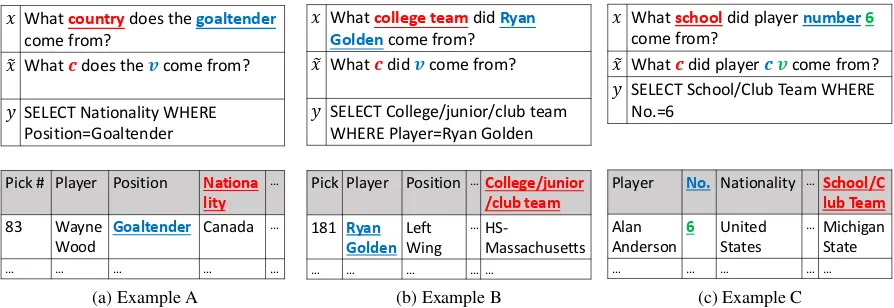
If the lexical problem can be reduced before the neural semantic parsing, the training difficulties will be greatly alleviated. The reason is two-fold. First, by anonymizing table-related tokens in the input utterance before the neural semantic parser, we can conceal the complex semantics of table-related tokens. Second, different input utterances, which have different table-related tokens but the same structure, can be reduced to the same anony-mous utterance before they are fed into the parser. This will result in sharing across training data and thus alleviate training difficulties (Goldman et al., 2018;Herzig and Berant,2018). For example, in Figure1aand1b, input utterances (denoted asx) seemingly ask different questions about country and college team, but they can be reduced to a sim-ilar anonymous utterance (denoted asx˜) by replac-ing the token related to the column name ascand the token related to the cell asv.
𝑥 What countrydoes the goaltender
come from?
𝑥 What 𝒄does the 𝒗come from?
𝑦 SELECT Nationality WHERE Position=Goaltender
Pick # Player Position Nationa lity
…
83 Wayne Wood
Goaltender Canada …
… … … … …
(a) Example A
𝑥 What college teamdid Ryan Goldencome from?
𝑥 What 𝒄did 𝒗come from?
𝑦 SELECT College/junior/club team WHERE Player=Ryan Golden
Pick Player Position …College/junior /club team
181 Ryan Golden
Left Wing
…
HS-Massachusetts
… … … … …
(b) Example B
𝑥 What schooldid player number6
come from?
𝑥 What 𝒄did player 𝒄𝒗come from?
𝑦 SELECT School/Club Team WHERE No.=6
Player No. Nationality …School/C lub Team
Alan Anderson
6 United States
…Michigan
State
… … … … …
[image:2.595.76.523.72.226.2](c) Example C
Figure 1: Examples for anonymizing table-related tokens on WikiSQL. For each subfigure, the upper box shows the utterance and the SQL query, while the lower box shows the table. In the upper box, xdenotes the input utterance,x˜denotes the anonymous utterance andydenotes the SQL query. In anonymous utterancex˜, we usec
andvto replace the tokens that are related to column names and cells respectively. In addition, we use the color to indicate the correspondence of column names or cells amongx,x˜and the table.
has been demonstrated to be helpful on other tasks (Goldman et al., 2018; Herzig and Berant, 2018). First, most approaches ignores reducing the lexical problem (Zhong et al.,2017;Xu et al., 2017; Dong and Lapata, 2018; Shi et al., 2018; Wang et al.,2018a;Hwang et al.,2019). Without conducting anonymization before the neural se-mantic parser, these approaches cannot receive the aforementioned benefit, although they may have modules to predict the presence of column names and cells inside the parser. Second, a few studies have tried the anonymization by deterministic ap-proaches, which compare the similarity based on string-match or word embedding between the in-put utterance and the table (Wang et al.,2018b;Yu et al.,2018a). These approaches cannot fully un-derstand the semantic relationship between input utterances and tables, and ignore the relationship with components of SQL queries. For example, in Figure1c, although the token ‘player’ is similar to the column name ‘Player’, it should not be tagged as a table-related token because the token ”player” is just a non-sense demonstrative pronoun and the column ’Player’ is not related to the SQL query.
To this end, we propose to use the learning-based approach to reduce the lexical problem, i.e., anonymize the table-related tokens. First, we pro-pose a two-stage anonymization model to learn the semantic relationship between input utterances and tables. Then, considering that there is no la-beled data for the anonymization, we propose to extract the set of column names and cells appear-ing in the SQL query and use this set as the
super-vision. Another benefit of leveraging such implicit supervision is that we can make the anonymization model consider the relationship with the compo-nents of the SQL query when it learns the semantic relationship, and thus avoid suffering the same dis-advantage as deterministic approaches. Further-more, to bridge the gap that our model is a sequen-tial tagging model while the supervision extracted from the SQL query is an unordered set, we lever-age the policy gradient (Williams, 1992) to train the model. Moreover, we train the anonymization model and the neural semantic parser as whole by a varational inference-like framework with the anonymous utterance as the hidden variable.
Experimental results demonstrate that our ap-proach can consistently improve performances of different neural semantic parsers and significantly outperform typical deterministic approach on the anonymization problem.
2 Related Work
etc. In this work, we focus on text-to-SQL genera-tion with the table as the source of the knowledge and with question-SQL query pairs as supervision.
Reducing Lexical Problem. On tasks other than text-to-SQL generation, some studies have tried to reduce lexical problem by anonymizing tokens that are related to the program constants. Goldman et al.(2018) lifts tokens in utterances to an abstract form by referring to fixed mappings on visual reasoning task. Herzig and Berant (2018) employs a rule-based method to transform content words in utterances to an abstract representation. Although these studies inspire us to consider re-ducing lexical problem on text-to-SQL generation, the rules they employed cannot be directly applied to text-to-SQL generation.
On text-to-SQL generation, a few studies tried to anonymize table-related tokens although they do not aim at reducing lexical problem. To bet-ter understand rare entities,Yu et al.(2018a) used string match to recognize column names. To learn a domain-transferable semantic parser,Wang et al. (2018b) detected column names by measuring the closeness of edit distance and word embedding. As discussed in Section1, these deterministic ap-proaches can not fully understand the semantic relationship between input utterances and tables, and ignore the relationship with components of SQL queries.
Entity Linking. Our approach can be regarded as an implementation of entity linking on the con-crete task, because general entity linking (Shen et al.,2015;Kolitsas et al.,2018) approaches fail to handle particular challenges in our scenario. On the one hand, there are lots of cases cannot be handled by the deterministic entity linking method which only relies on measuring the similarity; on the other hand, there is no labeled data for the learning-based entity linking method.
3 Problem Formulation
Denote the input utterance asx = x1. . . x|x|and
the corresponding SQL query asy = y1. . . y|y|.
We formulate the lexical problem as a sequen-tial tagging problem. Formally, for each token xt in the input utterance, we give it a tag x˜t ∈
{COL1, . . . ,COLK,CELL,UNK}, where COLk
represents that xt is related to the k-th column
name in the table, CELL represents thatxt is
re-lated to a cell in the table and UNK represents that
𝒙𝟏 𝒙𝒕 𝒙𝑻
𝒙𝟏 𝒙𝒕 𝒙𝑻
𝒈𝟏 𝒈𝒕 𝒈𝑻
Neural Semantic Parsing
𝒚𝟏 𝒚𝒕 𝒚𝑻
… …
… …
… …
… …
Anonymization Model
𝒑(𝒚|𝒙, 𝒙)
[image:3.595.312.525.65.199.2]𝒑(𝒙|𝒙)
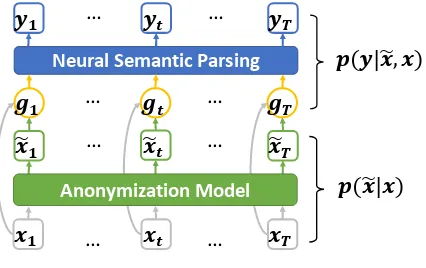
Figure 2: Framework.
xtis not related to the table. HereK is the
num-ber of column names in the table. Note that in-dexes of column names cannot be ignored in the algorithm to better leverage the implicit supervi-sion from SQL queries (see Section4.2) although it is ignored when giving examples in Figure1and Table4for ease of read. For ease of reference, we call this sequential tagging problem anonymiza-tion and the tagged sequence x˜ = ˜x1. . .x˜|x|
anonymous utterance.
The typical neural semantic parser aims to esti-matep(y|x). In our work, we decomposep(y|x) into two processes (as shown in Figure2), i.e.,
p(y|x) =X
˜ x
p(y|x,x)˜ p(˜x|x). (1)
Specifically, one process is to learn the anonymous utterancex˜given the input utterancexfor the pur-pose of reducing lexical problem, i.e.,
p(˜x|x) =Y
t
p(˜xt|x), (2)
while the other process is to learn the neural se-mantic parser with anonymous utterancex˜ as the additional input, i.e.,
p(y|x,x) =˜ Y
t
p(yt|y<t, x,x)˜ . (3)
In the following, we will discuss how to learn the anonymous utterance (Eqn (2)) and how to learn the neural semantic parser with anonymous utterance as additional input (Eqn (1)) in detail.
4 Approach
4.1 Anonymization Model
Input Encoder
𝑸𝟏 … 𝑸𝒕 … 𝑸𝑻 𝑪𝟏 … 𝑪𝒌 … 𝑪𝑲
Column Aggregation 𝑪𝒕𝑸
Channel Selection Column Binding
what … goaltender… ? [SEP] Pick# … Player…Nationality Input utterance Column names
[image:4.595.77.285.60.231.2]𝑬𝑺𝑬𝑷
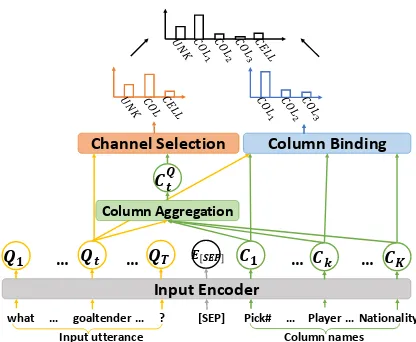
Figure 3: Illustration of the anonymization model when the table content is not available. We take thet-th token in the input utterance as the example.
the table. Second, we need to further recognize the concrete column/cell that the token is related to. Therefore, we design a model that uses two stages, i.e., channel selection stage and the column/cell bindingstage, to tackle these two subproblems re-spectively. The probability distributions produced by these two stages together determine the result,
p(˜xt|x) = (4)
X
at
pchannel(at|x)pbinding(˜xt|at, x),
where at ∈ {COL,CELL,UNK} is the
se-lected channel indicating that the token is related to column names, cells or nothing respectively, pchannel(·)is the probability produced by the chan-nel selection stage, andpbinding(·)is the probabil-ity produced by the column/cell binding stage.
For ease of reference, we call the two-stage model anonymization model, and illustrate it in Figure 3. In the following, we introduce details of its different components.
Input Encoder. We leverage BiLSTM or BERT (Devlin et al., 2018) to encode both the input utterance and the table. Due to the privacy problem, the table content is not allowed to be used on most text-to-SQL tasks (Zhong et al., 2017; Yu et al., 2018c). Therefore, we use the concatenation of the embedding of the tokens in the input utterance, the embedding of the separator and the embedding of the column names in the table as the input for BiLSTM or BERT. We denote the output of input encoder as {Q1, . . . , QT, E[SEP], C1, . . . , CK}, where
Qt, t ∈ {1, . . . , T}is the vector for the encoding
of the t-th token in the input utterance,E[SEP] is the vector for the encoding of the separator, and Ck, k∈ {1, . . . , K}is the vector for the encoding
of thek-th column name in the table. Note that we run a BiLSTM or BERT between column names instead of over each column name. The reason is thatYu et al.(2018a) have shown that although the order of column names does not matter, running a BiLSTM or BERT between colomn names can capture relationships between them, which will benefit the accuracy and the training time.
Channel Selection. We implement a linear gate with encodings of the input utterance and aggre-gated encodings of column names as input:
pchannel(at|x) =softmax
Wgate
h
Qt;CtQ i
,
(5)
whereWgatestands for learnable parameters, CtQ
is the aggregated encoding of column names, and [Qt;CtQ]is the concatenation ofQtandCtQ.
Specifically, to obtain the most relevant col-umn names for the t-th token in the input utter-ance, we leverage attention mechanism (Bahdanau et al.,2015) towards column names{C1, . . . , CK}
to compute the aggregated encoding of the column namesCtQ, i.e., CtQ = PK
k=1αktCk, whereαkt is
obtained throughukt = v1tanh (W1Qt+W2Ck)
andαkt = softmax ukt
, k ∈ {1, . . . , K}. Here, v1,W1andW2are learnable parameters.
Column/Cell Binding1. The probability distri-bution generated by this stage, i.e.,pbinding(·), can be categorized into three types, i.e., pCOL
binding(·), pCELL
binding(·) and pUNKbinding(·), corresponding to the three channels in the first stage respectively. Ob-viously,pUNKbinding(˜xt|at, x) = 1.
For column names, we produce a probabil-ity distribution over the K columns in the table through measuring the relevance between thet-th token and thek-th column name:
pCOLk
binding(˜xt|at, x) =softmax
ztk, (6)
zkt =v2tanh (W3Qt+W4Ck), k ∈ {1, . . . , K},
wherev2,W3andW4are learnable parameters.
1For the situation that the input utterance contains table
For cells, considering that table content is not available due to the privacy problem, we sim-ply predict a substring from the input utterance. Specifically, we follow the longest match principle to merge consecutive tokens in the input utterance, which are labeled as CELL by the channel selec-tion stage, to one cell. Therefore, the generated by column/cell binding stage is simply set as1, i.e., pCELLbinding(˜xt|at, x) = 1.
4.2 Implicit Supervision from SQL Queries
To train the anonymization model, the ground truth for the anonymous utterance is indispens-able. However, there is no such labeled data, and manually labeling the whole training data for each text-to-SQL task is unrealistic, especially when the amount of training data is tremendous.
To tackle this problem, we propose to extract the set of column names and cells appearing in the SQL query and use this set as the supervi-sion to guide the training of the anonymization model. Another benefit of such approach is that we can make our model consider the relationship with components of the SQL query, and thus avoid suffering the same trouble as deterministic ap-proaches. Concretely, for each SQL queryy, we denote the set of column names and cells appear-ing in it asSSQL, which consists of three parts, i.e., SSQL=Ssel col∪Sother col∪Scell:
1. Ssel col is the set of column names appearing in the SELECT clause;
2. Sother col is the set of column names appearing in other clauses;
3. Scell is the set of cells appearing in the whole SQL query.
4.3 Policy Gradient for Sequential Tagging
Maximizing Expected Reward. Ideally, if we have the ground truth, we can train the anonymiza-tion model by minimizing the gap (e.g., KL di-vergence) between the predicted probabilities and the ground truth. Unfortunately, it is infeasible be-cause the implicit supervision from SQL queries (i.e.,SSQL) takes a form of the unordered set while the anonymization model faces a sequential tag-ging task. To address this problem, we propose to encourage the set of column names and cells ap-pearing in the predicted anonymous utterance, de-noted asSpred, to be similar to that extracted from the SQL query, i.e.,SSQL. To this end, we define a reward of the predicted anonymous utterancer(˜x) as the similarity betweenSpredandSSQL, and then
train the anonymization model by maximizing ex-pected reward,
JER(θ) =
X
(x,˜x)∈D
Ex˜∼pθ(·|x)r(˜x), (7)
whereDrepresents the set of training pairs. However, directly computing expected reward requires traversing all the possible anonymous ut-terance x˜, which is unrealistic. Therefore, we leverage Monte Carlo estimate as the approxima-tion of the expected reward. Concretely, we sam-pleN anonymous utterances following probabil-ity distribution generated by the anonymization model, and then average the reward of the samples to estimate the expected reward,
JER(θ)≈
X
(x,˜x)∈D
N X
j=1
1 Nr(˜x
j), (8)
where x˜j denotes the j-th sample and x˜j ∼ pθ(·|x).
To maximize the above objective func-tion by gradient descent, we employ REIN-FORCE (Williams,1992) method, i.e,
∇θJER(θ)≈
X
(x,x˜)∈D
N X
j=1
1 Nr(˜x
j)∇
θlogpθ x˜j|x
.
(9)
Measurement of Reward. For ease of refer-ence, we decompose Spred into two parts, i.e., Spred = Spred col ∪Spred cell, where Spred col and Spred cellrepresent the set of column names and the set of cells appearing in the predicted anonymous utterance respectively.
The measurement of the reward r(˜x) is de-signed based on the similarity betweenSpred and SSQLby referring to the following principles:
1. The predicted anonymous utterance should contain the column names in the SELECT clause of the SQL query, i.e., Ssel col ⊂ Spred col. The anonymization model will be punished when it misses the column names inSsel col. This is mo-tivated by our preliminary analysis that almost ev-ery column name in the SELECT clause has the corresponding token in the input utterance.
SQL query may possible not have corresponding tokens in the input utterance. For example, in Figure 1a, the column name ‘Position’ does not have corresponding tokens in the input utterance. Therefore, it is unreasonable to strictly force col-umn names in the predicted anonymous utterance to be the same as that appearing in the SQL query. Instead, it is better to punish the anonymization model when it predicts column names outside the set of column names appearing in the SQL query.
3. The cell names in the predicted anony-mous utterance should be the same as that appear-ing in the SQL query, i.e., Spred cell = Scell. If there is any missing or extra cell inSpred cell, the anonymization model will be punished.
According to above principles, we design the re-wardr(˜x)as,
1. if Ssel col ⊆ Spred col, Spred cell = Scell and Spred col⊆Ssel col∪Sother colare all true,r(˜x) = 1; 2. if one ofSsel col*Spred col,Spred cell6=Scelland Spred col*Ssel col∪Sother colis true,r(˜x) =−1.
4.4 Training and Inference
To train the anonymization model and the parser as a whole, we regard the anonymous utterancex˜as the hidden variable for the neural semantic parser p(y|x). Then, maximizing the log likelihood of p(y|x) is equivalent to maximizing its Evidence Lower BOund (ELBO) (Kim et al.,2018), i.e.,
ELBO(ϕ, θ) =Eqθ(˜x|x)
logpϕ(y,x˜|x) qθ(˜x|x)
(10)
One popular strategy to maximizing ELBO is the coordinate ascent. Specifically, it itera-tively executes following two steps (Neal and Hinton, 1998): 1) variational E-step, which maximizes ELBO w.r.t. θ keeping ϕ fixed, i.e., θ? = arg minθKL(qθ(˜x|x)kpϕ(˜x|y, x));
and 2) variational M-step, which maximizes ELBO w.r.t. ϕ keeping θ fixed, i.e., ϕ? = arg maxϕEqθ(˜x|x)[logpϕ(y,x˜|x)].
In our scenario, ϕandθ refer to the learnable parameters in the neural semantic parser and the anonymization model respectively. For variational E-step, it usually finds the best variational ap-proximation to the true posterior (Neal and Hin-ton,1998). As discussed in Section4.2, the true posterior we can obtain is in the form of the un-ordered set. Thus, we actually minimize the the expected reward, i.e.,JER(θ), instead of the KL di-vergence (see Section4.3). For variational M-step,
to save training time, we simply sample one exam-ple greedily, which approximates to maximizing log likelihood ofpϕ(y,x˜|x), i.e.,JMLE(ϕ). More-over, since performing coordinate ascent on the entire dataset is too expensive, the variational E-step and M-E-step are usually performed over mini-batches (Hoffman et al.,2013). To further improve time efficiency, we optimize objectives of the vari-ational E-step and M-step simultaneously instead of alternatively. Thus, the actual objective is,
J(ϕ, θ) = (11)
X
(x,y)∈D
logpϕ(y|x, x)˜
| {z }
JMLE(ϕ)
+ X
(x,x˜)∈D
E˜x∼qθ(·|x)r(˜x)
| {z }
JER(θ)
,
whereJMLE(ϕ)is the log likelihood of the gener-ated SQL query given the input utterance and the anonymous utterance, andJER(θ) is the expected reward of the anonymous utterance given the input utterance (see Eqn (8) for details.)
Specifically, when optimizingJMLE(ϕ), we use the concatenation of the encoding of the input ut-terance (denoted as e(xt)) and the encoding of
the anonymous utterance (denoted ash(˜xt)) as the
input for the neural semantic parser, i.e., gt =
[e(xt);h(˜xt)],t∈ {1, . . . , T}(see Figure2). For
e(xt), it is determined by the parser itself. For
h(˜xt), it is concatenated by two parts: 1)
embed-ding of the channel name, i.e., COL, CELL and UNK, 2) embedding of indexkwhen the channel is COL, indicating that thet-th token is related to thek-th column name in the table.
At test time, the prediction for input utterance xis obtained byxˆ = arg maxx˜0p(˜x0|x)andyˆ = arg maxy0p(y0|x, x)ˆ .
5 Experiments
5.1 Experimental Setup
We conduct experiments on the WikiSQL (Zhong et al., 2017) and Spider (Yu et al., 2018c). Each example consists of a natural language question, a SQL query and a table. On WikiSQL, one ques-tion is only related to one table; while on Spider, one question is usually related to multiple tables.
Method Dev (%) Test (%)
ACCQM ACCEX ACCQM ACCEX
Seq2SQL (Zhong et al.,2017)1 53.5 62.1 51.6 60.4
Seq2SQL + DAE 60.0(+6.5) 67.5(+5.4) 58.0(+6.4) 66.1(+5.7)
SQLNet (Xu et al.,2017) 63.2 69.8 61.3 68.0
SQLNet + DAE 64.6(+1.4) 71.1(+1.3) 63.4(+2.1) 70.0(+2.0)
TypeSQL (Yu et al.,2018a) 68.0 74.5 66.7 73.5
TypeSQL + DAE 68.6(+0.6) 74.5 67.8(+1.1) 74.1(+0.6)
SQLova (Hwang et al.,2019)2 80.3 85.8 79.4 85.2
SQLova + DAE 81.3(+1.0) 86.4(+0.6) 80.5(+1.1) 86.1(+0.9)
−Supervision 81.0 86.1 80.0 85.4
−Co-training 80.6 86.0 79.8 85.3
1
For Seq2SQL, we useXu et al.(2017)’s version because it achieves better performance. 2
[image:7.595.79.518.274.341.2]For SQLova, we use BERT-Base as the input encoder due to limited computation resources.
Table 1: Performance improvement of the neural semantic parser on WikiSQL.
Method Easy (%) Medium (%) Hard (%) Extra Hard (%) All (%)
SyntaxSQLNet (Yu et al.,2018b) 38.4 15.0 16.1 3.5 18.9
SyntaxSQLNet + DAE 39.6(+1.2) 18.2(+3.2) 20.7(+4.6) 7.6(+4.1) 22.1(+3.2)
SyntaxSQLNetAug (Yu et al.,2018b) 44.4 23.0 23.0 2.9 24.9
SyntaxSQLNetAug + DAE 44.8(+0.4) 27.0(+4.0) 24.1(+1.1) 5.9(+3.0) 27.4(+2.5)
Table 2: Performance improvement of the neural semantic parser on Spider with different hardness levels.
#Total #Distinctx #Distinctx˜
Dev 8421 8387 5488
Test 15878 15828 9680
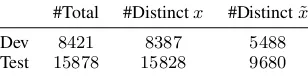
Table 3: The number of distinct input utterances and distinct anonymous utterances on WikiSQL.
use the manually labeled training data (which is 10% of the whole training data) to initiate our anonymization model and then optimize the en-tire framework on the whole training data. All the other hyperparameters, e.g., the learning rate, hy-perparameters in ADAM optimizer, the number of training epochs, etc., are tuned on the dev set2.
5.2 Performance of Neural Semantic Parsing
First, we show that reducing the lexical problem through the anonymization model can improve the performance of neural semantic parser.
To this end, we add the anonymization model to typical neural semantic parsers as presented in Section4. We use ‘[A]+DAE’ to denote the neu-ral semantic parser with the anonymization model, whereAstands for the original name of the con-crete parser andDAEis the abbreviated name of our approach, i.e., data-anonymous encoding.
2For Spider, we tune hyperparameters on training set and
test the model on dev set.
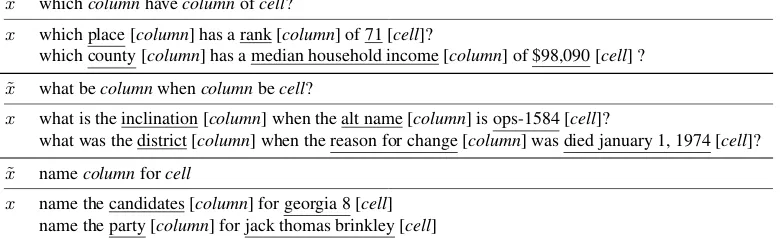
On WikiSQL, the performance is evaluated by query-match accuracy (ACCQM) and execu-tion accuracy (ACCEX), which measure accura-cies of canonical representation and execution re-sult matches between the predicted SQL and the ground truth respectively (Yu et al., 2018a). Ta-ble 1 shows the results. First, we can observe that query match accuracy on test data can be im-proved by 6.4% at most and 1.1% at least. Fur-thermore, for TypeSQL, query match accuracy can be further improved by1.1%although it has used string-match based approach to anonymize table-related tokens. Moreover, we perform ablation studies by 1) removing the supervision for the anonymization model (denoted as ‘-Supervision’ in Table1), and 2) simply using the output of the trained anonymization model as the input for the parser without training them as a whole (denoted as ‘-Co-training’ in Table1). We can observe that the performance improvement is limited without supervision and co-training, indicating that both of them are indispensable.
[image:7.595.103.257.385.423.2]per-˜
x whichcolumnhavecolumnofcell?
x which place [column] has a rank [column] of 71 [cell]?
which county [column] has a median household income [column] of $98,090 [cell] ?
˜
x what becolumnwhencolumnbecell?
x what is the inclination [column] when the alt name [column] is ops-1584 [cell]?
what was the district [column] when the reason for change [column] was died january 1, 1974 [cell]?
˜
x namecolumnforcell
[image:8.595.106.496.69.188.2]x name the candidates [column] for georgia 8 [cell] name the party [column] for jack thomas brinkley [cell]
Table 4: Top frequent anonymous utterances on dev set of WikiSQL. The tokens with underlines are table-related tokens. We use ‘[column]’ and ‘[cell]’ to differentiate whether the token is related to a column name or a cell.
Method Dev (%) Test (%)
ACCSC ACCOC ACCCE ACCSC ACCOC ACCCE
TypeSQL (Yu et al.,2018a) 75.9 92.9 − 76.0 92.9 −
AnnotatedSeq2Seq (Wang et al.,2018b) 88.8 64.6 − 88.8 63.6 −
[image:8.595.111.487.237.305.2]DAE 92.6 93.6 86.7 92.0 93.7 86.2
Table 5: Performances of different anonymization models on WikiSQL.
formances on medium, hard and extra hard SQL queries achieve more improvement than that on easy SQL queries, indicating that our approach is more helpful for solving complicated cases.
5.3 Performance of Reducing Input Utterances
To further demonstrate the effectiveness of reduc-ing the lexical problem, we show that different in-put utterance can be reduced to the same anony-mous utterance. To this end, we process input ut-terances and anonymous utut-terances by 1) convert-ing the characters to the lowercase, 2) lemmatizconvert-ing the tokens and 3) removing the articles.
Table 3 shows that by anonymizing table-related tokens, the number of distinct utterances is reduced from8387to5488on dev set and from
15828 to9680on test set. Furthermore, Table 4
shows three anonymous utterances that are most frequent on dev set and examples of correspond-ing input utterances. All of these indicate that although input utterances can hardly be identical, they often share the same anonymous utterance.
5.4 Performance of Anonymization Methods
In addition, we compare performances of differ-ent anonymization methods, including 1) Type-SQL, which uses exact string match to detect col-umn names, 2) AnnotatedSeq2Seq, which detects column names by setting a threshold for the edit
distance and the cosine similarity of word embed-ding, and 3) DAE, our learning-based approach3.
Anonymization methods are evaluated by fol-lowing metrics: 1) whether the column names in SELECT clause is included in the
pre-diction (ACCSC = PZ
i=1I(Sisel col⊆Spred coli )
Z ); 2)
whether there is wrongly predicted column names
(ACCOC = PZ
i=1I(Sipred col⊆S i sel col∪S
i other col)
Z ); and 3)
whether all the cells in the SQL query are correctly
predicted (ACCCE = PZ
i=1I(Spred celli =S i cell)
Z ). Here,
Z is the amount of test data,I(·)is the indicator
function, and superscriptiis the index of data. Table 5 shows that DAE significantly outper-forms TypeSQL and AnnotatedSeq2Seq on all the evaluation metrics. First, for ACCSC, DAE out-performs TypeSQL and AnotatedSeq2Seq by16% and3.5%on test data; for ACCOC, DAE outper-forms TypeSQL and AnnotatedSeq2Seq by0.8% and28%on test data. Moreover, DAE can achieve around86%for ACCCE, while other methods fail to recognize cells when the table content is not available due to the privacy problem.
6 Conclusion
In this work, we propose a learning-based ap-proach to reduce the lexical problem before the
3For experiments in this subsection, to make our
neural semantic parser on text-to-SQL generation. Specifically, we propose a two-stage anonymiza-tion model and leverage implicit supervision from SQL queries by policy gradient to guide its train-ing. In the future, we plan to improve the perfor-mance of the anonymization model by exploring more efficient expected reward. In addition, we also plan to extend our approach to the tasks with question-denotation pairs as supervision.
References
Ion Androutsopoulos, Graeme D Ritchie, and Peter Thanisch. 1995. Natural language interfaces to databases–an introduction. Natural language engi-neering, 1(1):29–81.
Dzmitry Bahdanau, Kyunghyun Cho, and Yoshua Ben-gio. 2015. Neural machine translation by jointly learning to align and translate. In Proceedings of the 3rd International Conference on Learning Rep-resentations.
Jacob Devlin, Ming-Wei Chang, Kenton Lee, and Kristina Toutanova. 2018. Bert: Pre-training of deep bidirectional transformers for language understand-ing. arXiv preprint arXiv:1810.04805.
Li Dong and Mirella Lapata. 2016. Language to logi-cal form with neural attention. InProceedings of the 54th Annual Meeting of the Association for Compu-tational Linguistics, pages 33–43.
Li Dong and Mirella Lapata. 2018. Coarse-to-fine de-coding for neural semantic parsing. InProceedings of the 56th Annual Meeting of the Association for Computational Linguistics, pages 731–742.
Omer Goldman, Veronica Latcinnik, Ehud Nave, Amir Globerson, and Jonathan Berant. 2018. Weakly su-pervised semantic parsing with abstract examples. In Proceedings of the 56th Annual Meeting of the Association for Computational Linguistics, pages 1809–1819.
Jonathan Herzig and Jonathan Berant. 2017. Neural semantic parsing over multiple knowledge-bases. In
Proceedings of the 55th Annual Meeting of the As-sociation for Computational Linguistics, pages 623– 628.
Jonathan Herzig and Jonathan Berant. 2018. Decou-pling structure and lexicon for zero-shot semantic parsing. InProceedings of the 2018 Conference on Empirical Methods in Natural Language Process-ing, pages 1619–1629.
Sepp Hochreiter and J¨urgen Schmidhuber. 1997. Long short-term memory. Neural computation, 9(8):1735–1780.
Matthew D Hoffman, David M Blei, Chong Wang, and John Paisley. 2013. Stochastic variational infer-ence. The Journal of Machine Learning Research, 14(1):1303–1347.
Wonseok Hwang, Jinyeung Yim, Seunghyun Park, and Minjoon Seo. 2019. A comprehensive exploration on wikisql with table-aware word contextualization.
arXiv preprint arXiv:1902.01069.
Robin Jia and Percy Liang. 2016. Data recombination for neural semantic parsing. InProceedings of the 54th Annual Meeting of the Association for Compu-tational Linguistics, pages 12–22.
Yoon Kim, Sam Wiseman, and Alexander M Rush. 2018. A tutorial on deep latent variable models of natural language. arXiv preprint arXiv:1812.06834.
Nikolaos Kolitsas, Octavian-Eugen Ganea, and Thomas Hofmann. 2018. End-to-end neural entity linking. InProceedings of the 22nd Conference on Computational Natural Language Learning, pages 519–529.
Fei Li and HV Jagadish. 2014. Constructing an in-teractive natural language interface for relational databases. Proceedings of the VLDB Endowment, 8(1):73–84.
Radford M Neal and Geoffrey E Hinton. 1998. A view of the em algorithm that justifies incremental, sparse, and other variants. InLearning in graphical models, pages 355–368. Springer.
Yusuke Oda, Hiroyuki Fudaba, Graham Neubig, Hideaki Hata, Sakriani Sakti, Tomoki Toda, and Satoshi Nakamura. 2015. Learning to generate pseudo-code from source code using statistical ma-chine translation. In30th IEEE/ACM International Conference on Automated Software Engineering, pages 574–584.
Panupong Pasupat and Percy Liang. 2015. Composi-tional semantic parsing on semi-structured tables. In
Proceedings of the 53rd Annual Meeting of the Asso-ciation for Computational Linguistics, pages 1470– 1480.
Adam Paszke, Sam Gross, Soumith Chintala, Gre-gory Chanan, Edward Yang, Zachary DeVito, Zem-ing Lin, Alban Desmaison, Luca Antiga, and Adam Lerer. 2017. Automatic differentiation in pytorch.
NIPS Workshop.
Jeffrey Pennington, Richard Socher, and Christopher Manning. 2014. Glove: Global vectors for word representation. InProceedings of the 2014 confer-ence on empirical methods in natural language pro-cessing, pages 1532–1543.
Tianze Shi, Kedar Tatwawadi, Kaushik Chakrabarti, Yi Mao, Oleksandr Polozov, and Weizhu Chen. 2018. Incsql: Training incremental text-to-sql parsers with non-deterministic oracles. arXiv preprint arXiv:1809.05054.
Alane Suhr, Mike Lewis, James Yeh, and Yoav Artzi. 2017. A corpus of natural language for visual rea-soning. In Proceedings of the 55th Annual Meet-ing of the Association for Computational LMeet-inguis- Linguis-tics, pages 217–223.
Oriol Vinyals, Meire Fortunato, and Navdeep Jaitly. 2015. Pointer networks. InAdvances in Neural In-formation Processing Systems, pages 2692–2700.
Chenglong Wang, Kedar Tatwawadi, Marc Brockschmidt, Po-Sen Huang, Yi Mao, Olek-sandr Polozov, and Rishabh Singh. 2018a. Robust text-to-sql generation with execution-guided decoding.arXiv preprint arXiv:1807.03100.
Wenlu Wang, Yingtao Tian, Hongyu Xiong, Haixun Wang, and Wei-Shinn Ku. 2018b. A transfer-learnable natural language interface for databases.
arXiv preprint arXiv:1809.02649.
Ronald J Williams. 1992. Simple statistical gradient-following algorithms for connectionist reinforce-ment learning. Machine learning, 8(3-4):229–256.
Xiaojun Xu, Chang Liu, and Dawn Song. 2017. Sqlnet: Generating structured queries from natural language without reinforcement learning. arXiv preprint arXiv:1711.04436.
Tao Yu, Zifan Li, Zilin Zhang, Rui Zhang, and Dragomir Radev. 2018a. Typesql: Knowledge-based type-aware neural text-to-sql generation. In
Proceedings of the 2018 Conference of the North American Chapter of the Association for Computa-tional Linguistics, volume 2, pages 588–594.
Tao Yu, Michihiro Yasunaga, Kai Yang, Rui Zhang, Dongxu Wang, Zifan Li, and Dragomir Radev. 2018b. Syntaxsqlnet: Syntax tree networks for com-plex and cross-domain text-to-sql task. In Proceed-ings of the 2018 Conference on Empirical Methods in Natural Language Processing, pages 1653–1663.
Tao Yu, Rui Zhang, Kai Yang, Michihiro Yasunaga, Dongxu Wang, Zifan Li, James Ma, Irene Li, Qingning Yao, Shanelle Roman, Zilin Zhang, and Dragomir Radev. 2018c. Spider: A large-scale human-labeled dataset for complex and cross-domain semantic parsing and text-to-sql task. In
Proceedings of the 2018 Conference on Empirical Methods in Natural Language Processing, pages 3911–3921.
Luke S. Zettlemoyer and Michael Collins. 2005. Learning to map sentences to logical form: Struc-tured classification with probabilistic categorial grammars. InProceedings of the Twenty-First Con-ference on Uncertainty in Artificial Intelligence, pages 658–666.
Victor Zhong, Caiming Xiong, and Richard Socher. 2017. Seq2sql: Generating structured queries from natural language using reinforcement learning.