Proceedings of the 2019 EMNLP and the 9th IJCNLP (System Demonstrations), pages 229–234 229
TEASPN: Framework and Protocol
for Integrated Writing Assistance Environments
Masato Hagiwara1 Takumi Ito2,3 Tatsuki Kuribayashi2,3 Jun Suzuki2,4 Kentaro Inui2,4
1Octanove Labs LLC 2Tohoku University 3Langsmith Inc. 4RIKEN AIP
{t-ito, kuribayashi, jun.suzuki, inui}@ecei.tohoku.ac.jp
Abstract
Language technologies play a key role in as-sisting people with their writing. Although there has been steady progress in e.g., gram-matical error correction (GEC), human writ-ers are yet to benefit from this progress due to the high development cost of integrating with writing software. We propose TEASPN1, a protocol and an open-source framework for achieving integrated writing assistance envi-ronments. The protocol standardizes the way writing software communicates with servers that implement such technologies, allowing developers and researchers to integrate the lat-est developments in natural language process-ing (NLP) with low cost. As a result, users can enjoy the integrated experience in their fa-vorite writing software. The results from ex-periments with human participants show that users use a wide range of technologies and rate their writing experience favorably, allow-ing them to write more fluent text.
1 Introduction
Language technologies have been playing an im-portant role in assisting people in writing natu-ral language texts, such as essays, emails,
busi-ness documents, and academic papers. There
has been considerable progress on writing assis-tance technologies (or WATsin short) in the past few decades in fields such as NLP and computer-aided language learning (CALL). For example, in one of such areas, grammatical error correction
(GEC) (Leacock et al., 2010), new models and
systems are developed and published month after month, breaking the previous evaluation records and advancing state of the art. The recent develop-ment in neural language models enabled the
com-1See https://www.teaspn.org/demo for the
screencast and https://www.teaspn.org/for more general info about TEASPN.
Backend
Research Models Writing Software
Writing Software
Research Models
Editor Web frontendWord Processor
OSS Spell Checker
Commercial Products
Commercial API
BEF
ORE
AFTER TEASPN
OSS Spell Checker Editor Word Editor Editor
Processor Web frontend
Suggestion Model Search GEC Model
[image:1.595.341.486.226.437.2]Suggestion Model Search GEC Model
Figure 1: Writing software before and after TEASPN.
pletion of a prompt with long, realistic looking yet coherent passages (Radford et al.,2019).
However, real-world users such as writers who can and should benefit the most from WATs are yet to reap the fruits from these research efforts. Aside from a small number of commercial products,
notably Grammarly2 and Smart Compose (Chen
et al.,2019), and research systems such as WriteA-head (Yen et al., 2015;Chang and Chang, 2015)
and CroVeWA (Soyer et al., 2015), we see few
examples of user-facing applications and exper-iments that make use of recent development in WATs. Many models are confined in research im-plementations that are not easily accessible to end users and the larger society. WATs, however, are not truly useful until they are integrated into user-facing writing applications such as editors and word processors (collectively calledwriting soft-warein this paper) and interact with end users in a dynamic and intuitive manner. This “great
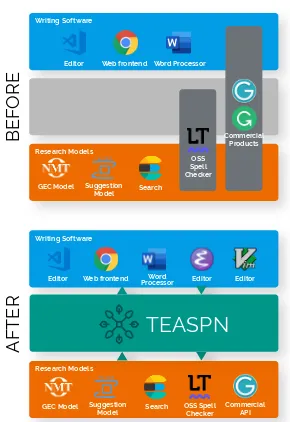
di-vide” (see Figure 1 BEFORE) between
tions and academia is not unique in the domain of writing assistance, but a widespread phenomenon across many fields in machine learning and NLP, as pointed out byWagstaff(2012).
One cause of this “great divide” is the high de-velopment cost for integrating and bridging both sides. Since there is a wide range of WATs, it is impractical, if not impossible, for developers of writing software to support all types of such tech-nologies that come in different packages in dif-ferent programming languages. Similarly, since there is a large selection of writing software, WAT researchers and developers cannot afford to offer their solutions in such a way that most writing software packages can benefit from them. If there
are N types of writing software and M types of
WATs, there can beN×Mcombinations between
the two sides. As a result, writers often need to rely on many different writing software solutions and switch between many different applications and websites (search engines, grammar checkers, dictionaries and thesauri, etc.) in order to com-plete their tasks.
In this paper, we propose TEASPN (Text Edit-ing Assistance Smartness Protocol for Natural Language; pronounced “teaspoon”), a protocol and a framework for achieving integrated writ-ing assistance environments, as a solution to this
“great divide” problem (Figure 1 AFTER).
In-spired by and built upon Language Server Protocol (LSP)3, a similar protocol for integrating software development environments, TEASPN provides an open protocol that standardizes the way writing software and WATs communicate with each other. We also released the TEASPN SDK (software de-velopment kit) as an open source library, which eases the cost of making WATs compatible with TEASPN. As a result, by using TEASPN,
• Developers of writing software can easily in-tegrate state-of-the-art WATs into their edi-tors and word processors just by following the protocol.
• Developers and researchers of WATs can
support major writing software applications without worrying about the development cost, just by using the TEASPN SDK. • Writers can benefit from integrated writing
experience provided by their favorite writing software and WATs.
3https://microsoft.github.io/
language-server-protocol/
Finally, we implemented a demo TEASPN server that integrates WATs using latest develop-ments in NLP (e.g., a neural language model and seq2seq-based paraphrasing) and ran experiments with real human writers to verify the framework’s effectiveness. The experimental results demon-strated that our integrated writing assistance sys-tem developed with TEASPN provides better writ-ing experience for human writers.
2 Related Work
Writing assistance Use of language
technolo-gies for assisting writing in a second language (L2) has been extensively explored, especially for non-native English speakers. One of the most ac-tive research areas is GEC (Leacock et al.,2010), where several new models are published every year and commercial systems such as Grammarly
are actively developed. Other research-based
systems include WriteAhead (Yen et al., 2015;
Chang and Chang, 2015), an interactive writ-ing environment that provides users with gram-matical patterns mined from large corpora, and CroVeWA (Soyer et al.,2015), a crosslingual
sen-tence search system for L2 writers. FLOW (Chen
et al., 2012) is another writing assistance system that allows users to type in their first languages (L1) and suggests words and phrases in L2. Run-ning syntactic analysis and visualizing sentence structures have also been explored for L2 reading assistance (Faltin,2003;Srdanovi´c,2011).
In addition to L2 learners, the use of technolo-gies for assisting human translators has also been a focus of research. TransType (Langlais et al.,
2000) is a translation assistance system that sug-gests completions for the text to the human transla-tor in an interactive manner. In SemEval 2014,van Gompel et al.(2014) presented an L2 writing as-sistance task where systems find the proper trans-lation of a word given a context in L2. Other writ-ing assistance systems (not necessarily L2 learn-ers) include assisting users with composing an email by auto-completion (Chen et al.,2019) and reply suggestion (Kannan et al.,2016).
LSP The N ×M problem mentioned in
Sec-tion 1 is not unique to writing assistance. In
software development, there can be N
differ-ent types of integrated developmdiffer-ent environmdiffer-ents
(IDEs) andM different programming languages,
making the integration cost proportionally
proposing an open protocol that standardizes the way IDEs communicate with servers that offer language smartness technologies such as syntax checking and completion. As of today, LSP is widely adopted and supported by more than 70 servers and 20 development environments.
Since there is a large overlap between author-ing in programmauthor-ing and natural languages, we built TEASPN as a “fork” of LSP. There are a few features that we need to design and implement specifically for writing assistance, namely, syntax highlighting and external resource search, which makes TEASPN incompatible with LSP. However, we re-purposed many LSP data models and fea-tures for TEASPN. Being able to leverage exist-ing resources for LSP gives TEASPN a great head start for a wide adoption.
Protocols for NLP Language Grid (Ishida,
2006) is a platform where language providers
(e.g., translation systems) and linguistic resources (e.g., dictionaries) are connected via semantic Web technologies to provide language services
to communities. The NLP Interchange
For-mat (NIF) (Hellmann et al., 2012) is a standard that aims to achieve interoperability between dif-ferent NLP tools and resources by defining an RDL/OWL-based format. Although these projects have seen some real-world success, their adoption is quite limited as of this writing, compared to the aforementioned LSP, which powers at least a cou-ple of millions of developers worldwide both for
Visual Studio Code (VS code)4 and Atom5. We
believe the key to the wide adoption of any pro-tocol is the focus on the right scope, practicality, and ease of development, which are the guiding principles for TEASPN.
3 TEASPN
3.1 Overview
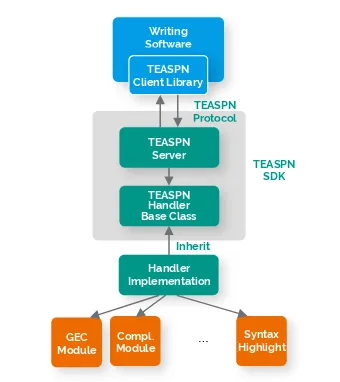
TEASPN adopts a client-server architecture (Fig-ure 2), where a client (writing software such as an editor or a word processor) communicates with a server that provides WATs. The client and the server communicate over the TEASPN protocol, an HTTP-like protocol which uses JSON-RPC (re-mote procedure call)6to encode the message body.
4
https://code.visualstudio.com/blogs/ 2017/11/16/connect
5
https://blog.atom.io/2016/03/28/ atom-reaches-1m-users.html
6http://www.jsonrpc.org/
Writing Software
TEASPN Server
TEASPN Protocol
TEASPN SDK
Inherit TEASPN Client Library
TEASPN Handler Base Class
Handler Implementation
GEC
[image:3.595.329.499.67.258.2]Module ModuleCompl. … HighlightSyntax
Figure 2: Architecture of TEASPN.
Requests can be sent in both directions, which are often triggered by some events (such as user input) and can be responded with additional data (such as results of GEC). TEASPN clients and servers can be written in any programming language as long as they conform to the protocol.
3.2 Features
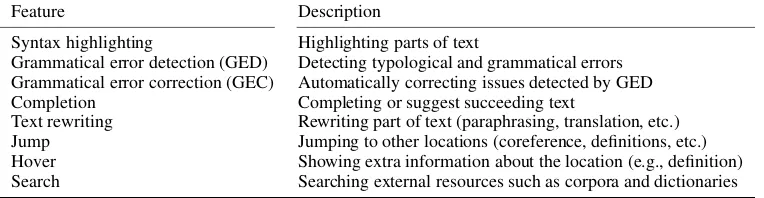
By integrating a large selection of WATs in a sin-gle platform, TEASPN makes them available to writers at their fingertips and is expected to im-prove writing effectiveness. Table1shows the list of WATs that are supported by TEASPN. Notice that the list includes a wide range of WATs that have been extensively investigated the literature (e.g., GEC and search) as well as the ones that are less explored (e.g., syntax highlighting and jump). Although we were able to build many WAT fea-tures upon existing ones from LSP, there were two features that we needed to design from scratch specifically for TEASPN—syntax highlighting and search. While syntax highlighting is usually han-dled on the client side for programming languages using shallow lexical analysis, syntactic analyses of natural language can be too costly and complex to be handled solely by the client. Therefore, we defined a new type of request and related type dec-larations so that it can be handled by the server.
The second feature, search, enables writers to
search external linguistic resources. While the
Feature Description
Syntax highlighting Highlighting parts of text
Grammatical error detection (GED) Detecting typological and grammatical errors Grammatical error correction (GEC) Automatically correcting issues detected by GED Completion Completing or suggest succeeding text
[image:4.595.110.492.65.164.2]Text rewriting Rewriting part of text (paraphrasing, translation, etc.) Jump Jumping to other locations (coreference, definitions, etc.) Hover Showing extra information about the location (e.g., definition) Search Searching external resources such as corpora and dictionaries
Table 1: WATs supported by TEASPN.
3.3 Developers of Writing Software
By adopting TEASPN, developers of writing soft-ware can easily integrate WATs into their editors and word processors. The fact that a large number of IDEs and editors already support LSP helps to a great extent. For example, in the sample TEASPN
client implementation7 we provide for VS Code,
we needed to modify less than 200 lines of Type-Script code to make it compatible with the TEA-SPN protocol while leveraging the existing library for LSP. We were also able to implement
prelimi-nary TEASPN clients for Atom and Sublime text8
with little modification to existing code.
3.4 Developers of WATs
Developers and researchers of WATs can make their technologies available to major writing soft-ware just by using TEASPN without writing any client code. To facilitate the development pro-cess, we released the TEASPN SDK, which in-cludes a library and a sample TEASPN server im-plementation in Python, one of the most popular programming languages for developing language
technologies as of late. The library takes care
of low-level communication and text synchroniza-tion with the client, letting WAT developers just inherit the TEASPN handler base class and fo-cus on implementing the missing core NLP logic.
As an example, Figure3 shows a simplified code
snippet for implementing completion. Notice the brevity of the code. We also provide a simple yet working TEASPN server implementation in the SDK for reference to accelerate the development.
4 Experiments and Implementation
4.1 Experiments
In this section, we develop a demo TEASPN sys-tem and investigate its effectiveness through
ex-7
https://github.com/teaspn/teaspn-sdk
8https://www.sublimetext.com/
@overrides
def get_completion_list(
self, position: Position) -> CompletionList: """Handle autocomplete."""
offset = self._position_to_offset(position) context = self._text[:offset]
items = []
# ... add completion items ...
return CompletionList(isIncomplete=True, items=items)
Figure 3: Code snippet for computing completion
periments with end-users (writers) in order to an-swer the following research question:
Does the integrated writing assistance environ-ment developed with TEASPN provide better writ-ing experience and help write better texts?
To explore the effectiveness of integrated writ-ing assistance environment, we compared the
fol-lowing two conditions. In the INTEGRATED
condition, participants used an editor (VS Code) equipped with TEASPN, where many WATs were available, while in theBASELINEcondition, they used the same editor with no WATs activated, while being allowed to use any other writing tools outside the editor (e.g., Grammarly and Web dic-tionaries). The BASELINE condition was set up to simulate the real situation that writers face, where writing assisting technologies are imple-mented separately outside the editor.
The participants of our experiments consist of twelve college students or researchers in NLP with a diverse L1 distribution: Bengali: 1, Chinese: 1, Croatian: 1, German: 1, Hindi: 1, Japanese: 6, Spanish: 1. They were directed to go through two writing sessions, one for each condition men-tioned above, during which they wrote English text within five sentences in response to two dif-ferent prompts: (i)write about an activity you
en-joy, such as a hobby, and (ii) write about your
Figure 4: Screenshot of our demo system.
the authors of this paper showed the participants all the features of the demo system for a demon-stration purpose. After the writing sessions, they were asked questions regarding their writing expe-rience. Because the focus of this experiment is to evaluate the integrated writing assistance environ-ment, participants are instructed not to consider the performance of individual WATs.
4.2 Implementation of the Demo System
We implemented a demo system using the TEA-SPN framework which has all of the features shown in Table1. See Figure4for the screenshot. For syntax highlighting, we used the depen-dency parser SpaCy9. Head tokens with specific dependency relation10 were highlighted in differ-ent colors. As for the GEC and GED features, we used the open-source GEC tool LanguageTool
3.211. We implemented two types of
comple-tion features: one which suggests the likely next phrases given the context using a neural language model (Radford et al., 2019) and the other one which suggests a set of words consistent with the characters being typed. We built a seq2seq
para-phrase model trained on PARANMT-50M (
Wiet-ing and Gimpel, 2018) for the text rewriting fea-ture, which allows the writer to select a part of the text and chooses among paraphrases. As for the jump feature, we used a coreference resolution model12to jump from a selected expression to its antecedent. The hover feature shows the definition of a hovered word using WordNet13. Finally, we implemented a full-text search feature using the open multilingual sentence dataset Tatoeba14 and used Elasticsearch 7.1.115for indexing and search.
9https://spacy.io/ 10
ROOT,nsubj,nsubjpass, anddobjin the CLEAR style tag set.
11https://github.com/languagetool-org/
languagetool/releases/tag/v3.2
12https://github.com/huggingface/
neuralcoref
13https://wordnet.princeton.edu/ 14
https://tatoeba.org/eng/
15https://www.elastic.co
0% 20% 40% 60% 80% 100%
0 4 8 12
INTEGRATED About the same BASELINE
Q1. Which condition provides a better writing experience?
Q2. Is there a difference in quality between the two texts? If yes, in which condition was the better text written?
Q3. Which of the features did you use?
Synta x high
light GED
/ GEC
Phras e comp
letion
Word comp
letion Text r
ewritin g
Jump (coref
erence )
Hove r (dict
ionary )
Searc h (exa
mple)
% Participants
#
P
a
rt
ici
p
a
n
ts
[image:5.595.315.508.63.230.2]% Participants
Figure 5: Response summary of the questionnaire.
Condition Perplexity # Chars. (mean±std) BASELINE 37.8 379±116
[image:5.595.310.519.267.309.2]INTEGRATED 26.4 335±91
Table 2: Statistics of the written texts.
5 Results and Analysis
After the writing sessions, the participants re-sponded to a questionnaire including the following questions:Q1: Which environment provides a
bet-ter writing experience?,Q2: Is there a difference
in quality between the two texts? If yes, in which
environment was the better text written?, andQ3:
Which of the following features did you use?
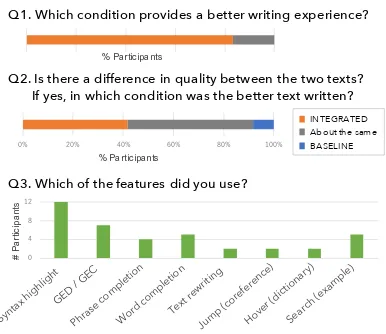
Figure 5 summarizes the responses from the
participants. Ten out of twelve (83.3%) partici-pants rated their experience favorably (Q1), and 40% believed they were able to write better texts in the INTEGRATED condition (Q2), demonstrating the effectiveness of the integrated writing assis-tance environment with TEASPN. The responses for Q3 show that an average participant used 3.2
WAT features in the INTEGRATED condition16.
This suggests that the writers can benefit from an integrated environment with various WATs acti-vated.
We ran further analyses on the texts written by the participants during the writing sessions. Ta-ble 2 shows some statistics of the written texts
in the two experimental conditions. Perplexity
was calculated using the pretrained GPT-2 model (small, 117M parameters) (Radford et al.,2019). The texts written in the INTEGRATED condi-tion had lower perplexity, suggesting that the in-tegrated writing environment helped them write
16Note that we assume that every participant used syntax
more fluent and/or typical English text. This re-sult backs up the subjective responses from the participants indicating they were able to produce better texts in the INTEGRATED condition than the other. We also note that the texts written in the INTEGRATED condition were relatively shorter. This could be due to the fact that the participants were still spending some of their time observing and figuring out the behavior of the assisting fea-tures and spending slightly less time actually writ-ing. We believe this trend will disappear or even reverse itself as they get more used to the inte-grated writing experience and the quality of the inidividual WATs improve.
6 Conclusion and Future Work
We proposed TEASPN, a framework and a proto-col which standardizes the way writing software communicates with writing assistance technolo-gies, to achieve integrated writing assistance en-vironments. In addition, we released the TEASPN SDK as an open source library, which eases the cost of making WATs compatible with TEASPN. We developed a demo system which implements various assistance technologies based on latest NLP developments and ran experiments with
hu-man participants. The result demonstrated that
they rated their integrated writing experience fa-vorably, potentially helping them write more flu-ent and better text.
In future work, by making this a larger com-munity effort, we wish to broaden the support lineup for writing software while developing vari-ous writing assistance features with TEASPN, fur-ther closing the gap between the latest develop-ments in NLP and real-world human users.
References
Jim Chang and Jason Chang. 2015. WriteAhead2: Mining lexical grammar patterns for assisted writ-ing. In Proceedings of the NAACL 2015 System Demonstrations, pages 106–110.
Mei-Hua Chen, Shih-Ting Huang, Hung-Ting Hsieh, Ting-Hui Kao, and Jason S. Chang. 2012. FLOW: A first-language-oriented writing assistant system. In
Proceedings of ACL 2012 System Demonstrations, pages 157–162.
Mia Xu Chen, Benjamin N Lee, Gagan Bansal, Yuan Cao, Shuyuan Zhang, Justin Lu, Jackie Tsay, Yi-nan Wang, Andrew M. Dai, Zhifeng Chen, Timothy Sohn, and Yonghui Wu. 2019. Gmail smart com-pose: Real-time assisted writing.
Anne Vandeventer Faltin. 2003. Natural language pro-cessing tools for computer assisted language learn-ing.Linguistik Online, 17(5):137–153.
Maarten van Gompel, Iris Hendrickx, Antal van den Bosch, Els Lefever, and V´eronique Hoste. 2014. Se-mEval 2014 task 5 - L2 writing assistant. In Pro-ceedings of SemEval 2014, pages 36–44.
Sebastian Hellmann, Jens Lehmann, and Soren Auer. 2012. NIF: An ontology-based and linked-data-aware NLP interchange format. Technical report, Working Draft.
Toru Ishida. 2006. Language Grid: An infrastruc-ture for intercultural collaboration. In IEEE/IPSJ Symposium on Applications and the Internet (SAINT 2006), pages 96–100.
Anjuli Kannan, Karol Kurach, Sujith Ravi, Tobias Kaufmann, Andrew Tomkins, Balint Miklos, Gre-gory S. Corrado, L´aszl´o Luk´acs, Marina Ganea, Pe-ter Young, and Vivek Ramavajjala. 2016. Smart re-ply: Automated response suggestion for email. In
Proceedings of KDD 2016.
Philippe Langlais, George Foster, and Guy Lapalme. 2000.TransType: a computer-aided translation typ-ing system. InANLP-NAACL 2000 Workshop: Em-bedded Machine Translation Systems.
Claudia Leacock, Martin Chodorow, Michael Gamon, and Joel Tetreault. 2010. Automated Grammatical Error Detection for Language Learners. Morgan & Claypool.
Alec Radford, Jeffrey Wu, Rewon Child, David Luan, Dario Amodei, and Ilya Sutskever. 2019. Language models are unsupervised multitask learners. Techni-cal report, OpenAI.
Hubert Soyer, Goran Topi´c, Pontus Stenetorp, and Akiko Aizawa. 2015. CroVeWA: Crosslingual vector-based writing assistance. In Proceedings of NAACL 2015 System Demonstrations, pages 91–95, Denver, Colorado.
Irena Srdanovi´c. 2011. Evaluating e-resources for Japanese language learning. InProceedings of eLex 2011, pages 260–267.
Kiri Wagstaff. 2012. Machine learning that matters. In
Proceedings of the Twenty-Ninth International Con-ference on Machine Learning (ICML), pages 529– 536.
John Wieting and Kevin Gimpel. 2018. ParaNMT-50M: Pushing the limits of paraphrastic sentence embeddings with millions of machine translations. InProceedings of ACL 2018, pages 451–462.
Tzu-Hsi Yen, Jian-Cheng Wu, Jim Chang, Joanne Bois-son, and Jason Chang. 2015. WriteAhead: Mining grammar patterns in corpora for assisted writing. In