Abstract—One of the main parameters to Control of a flexible
system is vibration frequency. This parameter often is unknown in the flexible system, for this reason estimating of vibration frequency affects considerable influences on control system performance. In this paper a new model reference adaptive method based on MIT rule is proposed and simulated on a flexible system and compared with recursive least square method. Results of simulation show satisfied responses especially in speed of convergence.
Keywords: model reference, flexible system, vibration frequency estimation, adaptive method
1 INTRODUCTION
Flexible behavior of large space structures often influences on their control systems. One of these flexible structures is launch vehicle (LV) which with current developments its design has led to bigger values of thrust-to-weight and length-to-diameter ratios required for long range flights. Moreover, for reduced cost of handling and launching operation, it is desired to reduce the launch vehicle structures weight. Obviously, these different requirements lead to a high flexibility (LV), for which, dynamic response and vibrational characteristics are of vital importance [1].The complete assessment of elastic vibrational effects on the dynamic behavior of LV requires the coupled rigid-elastic equations of motion [2-4].
In flexible launch vehicles (FLV), inertial navigation system (INS) measures the attitude and angular velocities of the deflected body as well as the rigid body motion, and feeds these signals back to the control loop. This degrades the control system stability and in the worst case makes it unstable. Moreover, because the interaction of control forces on elastic deformations could cause undesired excitations leading to resonance, control these flexible behaviors has been considered and extended recently [5].
One of the better approaches to protecting the vibrational bias from feeding back to the control system is to adopt a notch filter. This approach uses the notch filtered signals of
A. A. jafari is with the University of Applied Science and Technology, Tehran Iran (e-mail: [email protected]).
A. M. Khoshnood is the student of Ph.D in K.N.Toosy University of Technology, Tehran Iran, (corresponding author, e-mail:
J. Roshanian is with the K.N.Toosy University of Technology, Tehran Iran, (e-mail: [email protected])
the INS as feedback element for the control system and thus takes the rigid-body motion of the rocket only inside the control loop. Englehart and Krause [6] have proposed an analog notch filter with least square algorithm to reduce the bending vibrational effects on a FLV. Choi and Bang have also designed an adaptive control approach to the attitude control of a flexible system. They used root mean square method to estimate the bending frequency considering the first bending vibration mode. This approach has extended for second bending vibration frequency for FLV [7,8]. For going up the robustness of estimation Ra [9] has proposed a robust adaptive notch filter for a flexible system.
In this paper, MIT rule which is one of the model reference approaches is used to estimate the bending frequency of FLV. There are many methods to design control system for the rigid body dynamic of a LV. However, MIT rule method designed for model reference control has no noticeable affect on the rigid body controller. Therefore, the rigid body model with control system can be a model reference for control system of FLV. On the other hand, using the rigid body model as a model reference for flexible model is the main contribution of this paper. In addition, the stability margin of MIT rule method is measurable. For illustrating the performance of this new method rather than the recursive least square (RLS), this two approach are compared in a part of paper. Proposed control system is implemented on linear model of a FLV and satisfied responses are obtained.
The paper is organized as follows: Section 2 presents details of dynamic of flexible system. In section 3 designing a model reference for FLV is investigated. The new model reference adaptive method for estimating the bending vibration frequency and its results are given in sections 4 and 5. Conclusion of this work is presented in section 6.
2 Basic equation 2.1 Rigid body dynamic
The equations of motion for rigid body dynamic of LV are given in Eq.(1). From this equation transfer function between pitch, and pitch canard deflections can be extracted. This transfer function is represented in Eq.(2). As the LV is symmetric, only the bending vibration in the pitch canard will be considered.
2.2 Bending vibration dynamics
The gyroscope in the LV attitude control loop measures not only the rigid body motion but also the bending vibration mode due to the flexible body effect which can be expressed
Model Reference Adaptive Method
for Estimating the Bending Vibration Frequency
of a Flexible System
Ali Asghar jafari, Abdol Majid Khoshnood, and Jafar Roshanian
mathematically as Eq. (3). ) ( . ) 4 1 ( ) . 2 1 ( ) ( ) 1 4 1 ( ) ) ( 2 1 ( 4 2 2 0 2 0 4 2 0 0 0 0 y mq y z ac y s zq s s x z s I dx de q C SD U I C x S U I q U m de q SDC m U m T C C S U m (1)
Where represents angle of attack, q is angular velocity of LV,
m
s,
I
y,
,
U
0,
S
,
T
are mass, moment of inertia, density, magnitude of velocity, reference surface, and thrust, respectively. In this equation Cij,i,di are aerodynamicmomentum and force coefficients and canard deflections in the pitch direction and thrust coefficient, respectively.
)) ( ) ( ( ) ( 2
2 s a f s af gh
de bc as q (2)
Where a,b,c,d,e,f,g,h are derived from parameters of Eq. (1). ) , ( 2 2 2 2 2 2 t x f x w EI x t w A (3)
Where relates the mass of LV, w the LV deflection due
to bending moment, E the Young's modulus, I the area moment of inertia about neutral axis, F the external force of bending vibration. The equation of Euler-Bernoulli beam by using assumed mode method leads to equation as follows [7]:
z j j j j j j j j j
j M K f
Q g g
g
2
2 (4)
Where g is angular velocity of elastic deflection,M and j j
Q are the generalized mass and force of jth bending mode,
respectively, j is the natural frequency of jth bending
mode, j the damping ratio of jth bending mode, K and j j
f are the proportional constant and the external force per
unit canard deflection, respectively. From the rigid body dynamic in Eq. (2) and the bending vibration dynamic in Eq. (4), pitch canard deflection and pitch angle measured by gyroscope, can be expressed as the follow transfer function:
2 2 2 2 2 )) ( ) ( ( ) ( i i i i i i s f K gh af s f a s de bc as (5)
3 Designing a model reference for flexible system Designing a control system for rigid body dynamic in this approach leads to design a controller by using gain scheduling method. In the gain scheduling design approach, a non linear controller is constructed by continually interpolating, in some manner, between the members of family of linear controllers. Each linear controller is typically, associated with specific equilibrium operating point of the system. To design the parameter of family of linear controllers, which in this approach PID controller is utilized, extraction the operating points of rigid body LV in some steps of flight time and adjust the parameters of PID controller is essential:
2 0 2 2 2 2 1
( e d T e
T e k e d t i c
(6)Where is the pitch angle and e is the error of control 2 system, respectively.
For designing a model reference for estimating the bending vibration frequency it can use from this close loop control system which is the rigid model of flexible system. On the other hand, by this choosing the behaviour of flexible system convect to its rigid behaviour. This method leads to obtain the error between rigid and flexible model which is applied to estimate the vibrational characteristics.
4 Model reference Adaptive method
Because the bending vibration frequency in FLVs varies as the propellant burns, bending vibration frequency is an unknown parameter in a FLV. To estimate the bending frequency, MIT rule is utilized.
Rao and Kung [10] have used a notch filter to recover the sine wave from noisy sine wave and [8] has simplified this filter for a flexible system. Transfer function of this filter is:
2 1 0 2 1 0 ) 1 ( 1 2 1 ) ( ) ( ) ( Z Z K Z Z K z D z N z H (7)
Where K and 0 are center frequency of filter and a constant parameter, respectively. In Fig .1, the block diagram of proposed adaptive algorithm is given. The basic equations of MR are as follows [11]:
e e dt d J dt d e J y y e m 2 2 1 )
(
(8)
Where y and y are the outputs of reference model and real m
model, e and the error and adjustable parameter, respectively.
) ( ) ( 1 )
( u n
z D n
x (9)
Then, output of the filter y(n) is expressed as: )
2 ( ) 1 ( 2 ) ( )
(n xn K0xn xn
y (10)
If Eq. (4) is substituted to Eq. (2) for all steps in discrete form:
) )( (
0 0
K e y y t
K
m
[image:3.612.309.513.47.218.2] (11)
Fig. 1. Block diagram of model reference adaptive estimator. For comparing this new method with other estimation approaches in this section performance of model reference method is investigated considering RLS method which is one of the best methods of estimation.
The basic equations of RLS has become in [11] as follows:
) 1 ( )] ( ) ( [ ) (
)] ( ) 1 ( ) ( )[ ( ) 1 ( ) (
)] 1 ( ˆ ) ( ) ( )[ ( ) 1 ( ˆ ) ( ˆ
1
n P n n K I n P
n n P n I n n P n K
n z n n y n K n z n z
T T
T
(12)
Where zˆ(n) is estimated parameters matrix, K(n) is correcting gain and p(n),(n), are recursive parameters and regression model of out put, respectively. Transfer function of flexible dynamic in Eq. (4) can be expressed in discrete form as:
2 1 2
2 1 )
(
b z b z
a z a z
G b
(10)
Where b is the additional angle measured by INS, owing to the bending vibration. This parameter can be expressed as a regression model. Substitution Eq. (10) in Eq. (9) leads to estimate the parameters of pitch channel transfer function and from the value of this parameters the bending vibration frequency is estimated [12]. Block diagram of this method is given in Fig. 2.
5 Results
The proposed adaptive system is implemented on the linear model of FLV in pitch channel. Vibrationnal affects only
Fig. 2. Block diagram of filtered RLS estimator.
appear in stage one, because of high length to diameter ratio in this phase. Note that the first bending vibration mode is only considered in adaptive filter design. Because the other bending vibration modes include high frequency and low magnitude in this FLV and their frequency range are out of the other natural frequency of system application, their effects are very negligible.
In simulation the initial value of
K
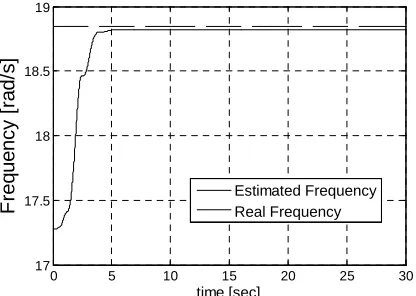
0 (in Eq. (7)) is set as the notch frequency is equaled to the approximate value of first bending vibration one. Moreover, in two intervals of flight time, the bending frequency estimation is considered. Fig. 3,4 show the bending frequency estimation. Error of estimation is illustrated in Fig. 5. Convergence and accuracy of estimation are shown in these figures.Result of comparing model reference method and RLS method is shown in Fig. 6. It is inferred from regarding to Fig. 6 that the speed of estimation in model reference method is very better than the RLS method. In general, the speed of estimating is very vital in aerospace control systems design.
In Addition, the algorithm of RLS method almost needs a high volume for processing, but the new adaptive method adjusts only one single parameter and is designed base on MIT rule, therefore, it is simpler and faster than the other approaches.
0 5 10 15 20 25 30
17 17.5 18 18.5 19
time [sec]
F
re
q
u
e
n
c
y
[
ra
d
/s
]
[image:3.612.75.278.163.335.2]Estimated Frequency Real Frequency
Fig. 3. Test of adaptive algorithm for first interval of flight time.
Rigid and flexible
dynamic system
Rigid body Filtering RLS
algorithm for estimating the
bending frequency c
Frequency Estimated
Flexible body dynamic
Model
Reference
Adaptive Algorithm c
[image:3.612.316.524.557.705.2]0 5 10 15 20 25 30 17.5
18 18.5 19 19.5 20 20.5 21 21.5 22
time [sec]
F
re
q
u
e
n
c
y
[
ra
d
/s
]
Estimated Frequency Real Frequency
Fig. 4. Test of adaptive algorithm for second interval of flight time.
0 5 10 15 20 25 30
-0.5 0 0.5 1 1.5 2 2.5
3x 10
-3
time [sec]
E
rr
o
r
o
f
e
s
ti
m
a
ti
o
n
[
ra
d
/s
]
Fig. 5. Error of estimation in model reference adaptive method.
Fig. 6. Comparison two model reference and RLS methods for estimating the vibration frequency.
The stability of model reference method is limited [13] but in RLS method convergence of system is often ensured. Consequently, only in stable margin the model reference method is preferred. For this reason, it is essential to protect the parameters of system in stable margin.
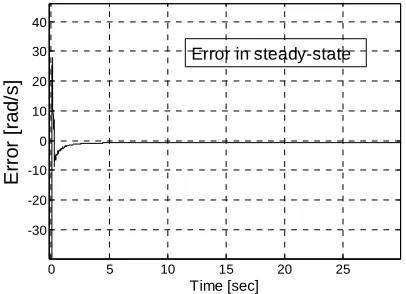
[image:4.612.73.282.58.205.2] [image:4.612.326.529.146.293.2]The error of estimation by using RLS method is shown in Fig. 7.
Another advantage of the new method refers to input signals of algorithm. Note to the block diagram of two model reference and RLS methods in Fig. 1,2. The new method executes the estimation only with output of system, but, in RLS method input of system is also required.
0 5 10 15 20 25
-30 -20 -10 0 10 20 30 40
Time [sec]
E
rr
o
r
[r
a
d
/s
]
Error in steady-state
Fig. 7. Error of estimation by using RLS method. 6 Conclusion
A new model reference method for estimating the bending frequency of a flexible system is proposed and simulated in this paper. For examining this approach it is implemented on a flexible launch vehicle in pitch channel and after simulation the equation, satisfied responses rather than another practical method are obtained.
This new method only makes use of output signal of flexible system instead of other approaches such as RLS method and also designed base on MIT rule which is one of the gradient simple approaches. The simplicity of MIT rule method causes to decrease the volume of processing leading to increase the speed of estimation. Moreover, because this method adjusts only one single parameter it is simpler and faster than the other approaches.
Comparison two model reference and RLS approaches leads to several results as follows: considering the speed of convergence and estimation, the model reference performs very better than the RLS method. Note that in flexible system such as FLV the speed of convergence is more important rather than the accuracy of estimation. With regard to accuracy of estimation, model reference also executes betters than the RLS method.
Model reference is designed base on MIT rule so, its stability margin is limited, but, the range of its parameters for protecting the system in stable margin is obtainable. However, this method should be used only in stable condition to perform conveniently.
References
[1] Pourtakdoust, S.H. & Assadian, N. (2004), Investigation of thrust effect on the vibration characteristics of flexible guided missile, Journal of sound&vibration, 272, p.p.287-299.
5 10 15 20 25 30
17.5 18 18.5 19 19.5 20 20.5 21 21.5 22
time [sec] RLS Method
[image:4.612.71.282.458.629.2][2] Platus. D.M. (1989), Aeroelastic stability of slender, spinning missiles, journal of guidance control and dynamics 15 (1), 404-413.
[3] Euler, J.A., and Khadem, S.E., (1990), Dynamic stability of flexible spinning missiles, Part I: Derivation of equations of motion using the complex plane approach, Proceedings of
the Atmospheric Flight Mechanic Conference, AIAA-90-2852- CP, p.p. 396-403.
[4] Khadem, S.E., and Euler, J.A, (1992), Dynamic stability of flexible spinning missiles, Part 11: Vibration and stability analysis of a damped controlled free-free Bernoulli-Euler beam, as a model for flexible missiles, AIAA, 33rd
Structures,Structural Dynamics, and Material Conference,
p.p. 1236-1244
[5] Oh, C. S & Bang, H. &.Park, C.S, Attitude control of a flexible launch vehicle using an adaptive notch filter: Ground experiment, Control engineering practice, Article in
press, 2007.
[6] Englehart, M.J. & Krause, J.M. (1992), An Adaptive Control Concept for Flexible Launch Vehicles, AIAA
Journal, No. 4622, p.p. 1505-1512.
[7] Choi, H.D. & Bang, H. (2000), An adaptive control approach to the attitude control of a flexible rocket, Control
engineering practice, 8, p.p. 1003-1010.
[8] Choi H D. and Kim j. Adaptive notch filter design for bending vibration of a sounding rocker, I MechE, Part G, Vol 215, p.p 13-23 2001.
[9] Ra, W.S. (2005), Practical adaptive notch filter for missile bending mode rejection, Electronics Letters, Vol. 41, No. 5. [10] Rao, D.V. & Kung, S.Y. (1984), Adaptive notch filter for the retrieval of sinusoids in noise, IEEE Transaction of
acoustics speech, signal processing, 32, p.p. 791-802.
[11] Astrom, K.J. & Wittenmark, B. (1989) Adaptive control, 2nd ed, Addison-Wesley.
[12] Roshanian Jafar, Khaki-Sedigh Ali, Khoshnood Abdol majid, , Simulation of Bending Vibration Effects on Attitude Control of a Flexible Launch Vehicle , Proceedings of the IASTED Asian Conference Modeling and Simulation, Beijing, China, Oct 2007.