A Joint Model for Quotation Attribution and Coreference Resolution
Mariana S. C. Almeida∗† Miguel B. Almeida∗† Andr´e F. T. Martins∗† ∗Priberam Labs, Alameda D. Afonso Henriques, 41, 2o, 1000-123 Lisboa, Portugal †Instituto de Telecomunicac¸˜oes, Instituto Superior T´ecnico, 1049-001 Lisboa, Portugal
{mla,mba,atm}@priberam.pt
Abstract
We address the problem of automatically attributing quotations to speakers, which has great relevance in text mining and me-dia monitoring applications. While cur-rent systems report high accuracies for this task, they either work at mention-level (getting credit for detecting uninfor-mative mentions such as pronouns), or as-sume the coreferent mentions have been detected beforehand; the inaccuracies in this preprocessing step may lead to error propagation. In this paper, we introduce a joint model for entity-level quotation attri-bution and coreference resolution, exploit-ing correlations between the two tasks. We design an evaluation metric for attribu-tion that captures all speakers’ menattribu-tions. We present results showing that both tasks benefit from being treated jointly.
1 Introduction
Quotations are a crucial part of news stories, giv-ing the perspectives of the participants in the nar-rated event, and making the news sound objective. The ability of extracting and organizing these quo-tations is highly relevant for text mining applica-tions, as it may aid journalists in fact-checking, help users browse news threads, and reduce human intervention in media monitoring. This involves assigning the correct speaker to each quote—a problem calledquotation attribution(§2).
There is significant literature devoted to this task, both for narrative genres (Mamede and Chaleira, 2004; Elson and McKeown, 2010) and newswire domains (Pouliquen et al., 2007; Sar-mento et al., 2009; Schneider et al., 2010). While the earliest works focused on devising lexical and syntactic rules and hand-crafting grammars, there has been a recent shift toward machine learning approaches (Fernandes et al., 2011; O’Keefe et al., 2012; Pareti et al., 2013), with latest works re-porting high accuracies for speaker identification
in newswire (in the range 80–95% for direct and mixed quotes, according to O’Keefe et al. (2012)). Despite these encouraging results, quotation min-ing systems are not yet fully satisfactory, even when only direct quotes are considered. Part of the problem, as we next describe, has to do with inaccuracies incoreference resolution(§3).
The “easiest” instances of quotation attribution problems arise when the speaker and the quote are semantically connected, e.g., through a reported speech verb likesaid. However, in newswire text, the subject of this verb is commonly a pronoun or another uninformative anaphoric mention. While the speaker thus determined may well be correct— being in most cases consistent with human annota-tion choices (Pareti, 2012)—from a practical per-spective, it will be of little use without a corefer-ence system that correctly resolves the anaphora. Since the current state of the art in coreference res-olution is far from perfect, errors at this stage tend to propagate to the quote attribution system.
Consider the following examples for illustration (taken from the WSJ-1057 and WSJ-0089 docu-ments in the Penn Treebank), where we have an-notated with subscripts some of the mentions: (a) Rivals carp at “the principle of [Pilson]M1,”
as [NBC’s Arthur Watson]M2 once put it –
“[he]M3’s always expounding that rights are
too high, then [he]M4’s going crazy.” But [the
49-year-old Mr. Pilson]M5 is hardly a man to
ignore the numbers.
(b) [English novelist Dorothy L. Sayers]M1
de-scribed [ringing]M2 as a“passion that finds its
satisfaction in [mathematical completeness]M3
and [mechanical perfection]M4.” [Ringers]M5,
[she]M6 added, are“filled with the solemn
intox-ication that comes of intricate ritual faultlessly performed.”
In example (a), the pronoun coreference system used by O’Keefe et al. (2012) erroneously clus-ters together mentions M2, M3 and M4 (instead of the correct clustering{M1, M3, M4}). Since it is unlikely that the speaker is co-referent to a
person pronounheinside the quote, a pipeline sys-tem would likely attribute (incorrectly) this quote to Pilson. In example (b), there are two quotes with the same speaker entity (as indicated by the cueshe added). This gives evidence thatM1 and M6 should be coreferent. A pipeline approach would not be able to exploit these correlations.
We argue that this type of mistakes, among others, can be prevented by a system that per-forms quote attribution and coreference resolution
jointly (§4). Our joint model is inspired by re-cent work in coreference resolution that indepen-dently ranks the possible mention’s antecedents, forming a latent coreference tree structure (Denis and Baldridge, 2008; Fernandes et al., 2012; Dur-rett et al., 2013; DurDur-rett and Klein, 2013). We con-sider a generalization of these structures which we call aquotation-coreference tree. To effectively couple the two tasks, we need to go beyond simple arc-factored models and consider paths in the tree. We formulate the resulting problem as a logic pro-gram, which we tackle using a dual decomposition strategy (§5). We provide an empirical compari-son between our method and baselines for each of the tasks and a pipeline system, defining suitable metrics for entity-level quotation attribution (§6).
2 Quotation Attribution
The task of quotation attribution can be formally defined as follows. Given a document containing a sequence of quotations, hq1, . . . , qLi, and a set of candidate speakers,{s1, . . . , sM}, the goal is to a assign a speaker to every quote.
Previous work has handled direct and mixed quotations (Sarmento et al., 2009; O’Keefe et al., 2012), easily extractable with regular expressions for detecting quotation marks, as well as indirect quotations (Pareti et al., 2013), which are more in-volved and require syntactic or semantic patterns. In this work, we resort to direct and mixed quo-tations. Pareti (2012) defines quotation attribu-tions in terms of theircontent span(the quotation text itself), theircue(a lexical anchor of the attri-bution relation, such as a reported speech verb), and the source span (the author of the quote). The same reference introduced the PARC dataset, which we use in our experiments (§6) and which is based on the annotation of a database of attribu-tion relaattribu-tions from the Penn Discourse Treebank (Prasad et al., 2008). Several machine learning algorithms have been applied to this task, either
framing the problem as classification (an indepen-dent decision for each quote), or sequence label-ing (uslabel-ing greedy methods or linear-chain condi-tional random fields); see O’Keefe et al. (2012) for a comparison among these different methods.
In this paper, we distinguish between mention-level quotation attribution, in which the candi-date speakers are individual mentions, and entity-level quotation attribution, in which they are en-tity clusters comprised of one or more mentions. With this distinction, we attempt to clarify how prior work has addressed this task, and design suit-able baselines and evaluation metrics. For exam-ple, O’Keefe et al. (2012) applies a coreference resolver before quotation attribution, whereas de La Clergerie et al. (2011) does itafterwards, as a post-processing stage. An important issue when evaluating quotation attribution systems is to pre-vent them from getting credit for detecting unin-formative speakers such as pronouns; we will get back to this topic in§6.2.
3 Coreference Resolution
In coreference resolution, we are given a set of mentions M := {m1, . . . , mK}, and the goal is to cluster them into discourse entities, E := {e1, . . . , eJ}, where eachej ⊆ M andej 6= ∅. We follow Haghighi and Klein (2007) and distin-guish between proper, nominal, and pronominal mentions. Each requires different types of infor-mation to be resolved. Thus, the task involves de-termining anaphoricity, resolving pronouns, and identifying semantic compatibility among men-tions. To resolve these references, one typically exploits contextual and grammatical clues, as well as semantic information and world knowledge, to understand whether mentions refer to people, places, organizations, and so on. The importance of coreference resolution has led to it being the subject of recent CoNLL shared tasks (Pradhan et al., 2011; Pradhan et al., 2012).
Rahman and Ng, 2011) and seek the set of enti-ties that optimize the sum of scores; this can also be promoted in a decentralized manner (Durrett et al., 2013). Pairwise models (Bengtson and Roth, 2008; Finkel et al., 2008; Versley et al., 2008), on the other hand, define scores for each pair of men-tions to be coreferent, and define the clusters as the transitive closure of these pairwise relations. A disadvantage of these two methods is that they lead to intractable decoding problems, so approx-imate methods must be used. For comprehensive overviews, see Stoyanov et al. (2009), Ng (2010), Pradhan et al. (2011) and Pradhan et al. (2012).
Our joint approach (to be fully described in
§4) draws inspiration from recent work that shifts from entity clusters tocoreference trees (Fernan-des et al., 2012; Durrett and Klein, 2013). These models define scores for each mention to link to its antecedent or to an artifical root symbol $(in which case it is not anaphoric). The computation of the best tree can be done exactly with spanning tree algorithms, or by independently choosing the best antecedent (or the root) for each mention, if only left-to-right arcs are allowed. The same idea underlies the antecedent ranking approach of De-nis and Baldridge (2008). Once the coreference tree is computed, the set of entity clustersEis ob-tained by associating each entity set to a branch of the tree coming out from the root. This is illus-trated in Figure 1 (left).
4 Joint Quotations and Coreferences
In this work, we propose that quotation attribu-tion and coreference resoluattribu-tion are solved jointly by treating both mentions and quotations as nodes in a generalized structure called a quotation-coreference tree(Figure 1, right). The joint sys-tem’s decoding process consists in creating such a tree, from which a clustering of the nodes can be immediatelly obtained. The clustering is inter-preted as follows:
• All mention nodes in the cluster are coreferent, thus they describe one single entity (just like in a standard coreference tree).
• Quotation nodes that appear together with those mentions in a cluster will be assigned that entity as the speaker.
For example, in Figure 1 (right), the en-tity Dorothy L. Sayers (formed by mentions
{M1, M6}) is assigned as the speaker of quota-tionsQ1 andQ2. We forbid arcs between quotes and from a quote to a mention, effectively con-straining the quotes to be leavesin the tree, with mentions as parents.1 We force a tree with only
left-to-right arcs, by choosing a total ordering of the nodes that places all the quotations in the right-most positions (which implies that any arc con-necting a mention to a quotation will point to the right). The quotation-coreference tree is obtained as the best spanning tree that maximizes a score function, to be described next.
4.1 Basic Model
Our basic model is a feature-based linear model which assigns a score to each candidate arc linking two mentions (mention-mention arcs), or linking a mention to a quote (mention-quotation arcs). Our basic system is called QUOTEBEFORECOREFfor reasons we will detail in section 4.2.
4.1.1 Coreference features
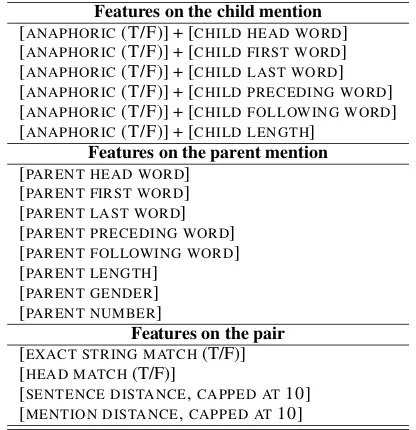
For the mention-mention arcs, we use the same coreference features as theSURFACEmodel of the Berkeley Coreference Resolution System (Durrett and Klein, 2013), plus features for gender and number obtained through the dataset of Bergsma and Lin (2006). This is a very simple lexical-driven model which achieves state-of-the-art re-sults. The features are shown in Table 1.
4.1.2 Quotation features
For the quote attribution features, we use features inspired by O’Keefe et al. (2012), shown in Ta-ble 2. The same set of features works for speakers that are individual mentions (in the model just de-scribed), and for speakers that are clusters of men-tions (used in§6 for the baseline QUOTEAFTER -COREF). These features include various distances between the mention and the quote, the indication of the speaker being inside the quote span, and var-ious contextual features.
4.2 Final Model
Figure 1:Left: A typical coreference tree for the text snippet in§1, example (b), with mentionsM1 and M6 clustered together and M2 andM3 left as singletons. Right: A quotation-coreference tree for the same example. Mention nodes are depictedas green circles, and quotation nodesin shaded blue. The dashed rectangle represents a branch of the tree, containing the entity cluster associated with the speaker
Dorothy L. Sayers, as well as the quotes she authored.
Features on the child mention [ANAPHORIC(T/F)] + [CHILD HEAD WORD] [ANAPHORIC(T/F)] + [CHILD FIRST WORD] [ANAPHORIC(T/F)] + [CHILD LAST WORD] [ANAPHORIC(T/F)] + [CHILD PRECEDING WORD] [ANAPHORIC(T/F)] + [CHILD FOLLOWING WORD] [ANAPHORIC(T/F)] + [CHILD LENGTH]
Features on the parent mention [PARENT HEAD WORD]
[PARENT FIRST WORD] [PARENT LAST WORD] [PARENT PRECEDING WORD] [PARENT FOLLOWING WORD] [PARENT LENGTH]
[PARENT GENDER] [PARENT NUMBER]
Features on the pair [EXACT STRING MATCH(T/F)] [HEAD MATCH(T/F)]
[image:4.595.77.285.300.515.2][SENTENCE DISTANCE,CAPPED AT10] [MENTION DISTANCE,CAPPED AT10]
Table 1: Coreference features, associated to each candidate mention-mention arc in the tree. As in Durrett and Klein (2013), we also include con-junctions of each feature with the child and parent mention types (proper, nominal, or, if pronominal, the pronoun word).
quotation-coreference tree can be obtained by first assigning the highest scored mention to each quo-tation, and then building a standard coreference tree involving only the mention nodes. This cor-responds to the QUOTEBEFORECOREF baseline, to be used in§6.
To go beyond separate models, we introduce a final JOINT model, which includes additional scores that depend not just on arcs, but also on
paths in the tree. Concretely, we select certain
Features on the quote-speaker pair [WORD DISTANCE]
[SENTENCE DISTANCE] [#IN-BETWEEN QUOTES] [#IN-BETWEEN SPEAKERS]
[SPEAKER IN QUOTE, 1ST PERS.SG.PRONOUN(T/F)] [SPEAKER IN QUOTE, 1ST PERS.PL. PRONOUN(T/F)] [SPEAKER IN QUOTE,OTHER(T/F)]
Features on the speaker [PREVIOUS WORD IS QUOTE(T/F)] [PREVIOUS WORD IS SAME QUOTE(T/F)] [PREVIOUS WORD IS ANOTHER QUOTE(T/F)] [PREVIOUS WORD IS SPEAKER(T/F)] [PREVIOUS WORD IS PUNCTUATION(T/F)]
[PREVIOUS WORD IS REPORTED SPEECH VERB(T/F)] [PREVIOUS WORD IS VERB(T/F)]
[NEXT WORD IS QUOTE(T/F)] [NEXT WORD IS SAME QUOTE(T/F)] [NEXT WORD IS ANOTHER QUOTE(T/F)] [NEXT WORD IS SPEAKER(T/F)] [NEXT WORD IS PUNCTUATION(T/F)]
[NEXT WORD IS REPORTED SPEACH VERB(T/F)] [NEXT WORD IS VERB(T/F)]
Table 2: Quotation attribution features, associ-ated to each quote-speaker candidate. These features are used in the QUOTEONLY, QUOTE -BEFORECOREF, and JOINT systems (where the speaker is a mention) and in the QUOTEAFTER -COREFsystem (where the speaker is an entity).
[image:4.595.307.527.301.535.2]Mention-inside-quote features
[MENTION IS1ST PERSON,SING.PRONOUN(T/F)] [MENTION IS1ST PERSON,PLUR.PRONOUN(T/F)] [OTHER MENTION(T/F)]
Consecutive quote features [DISTANCE IN NUMBER OF WORDS] [DISTANCE IN NUMBER OF SENTENCES]
Table 3: Features used in the JOINT system for mention-quote pairs (only for mentions inside quotes) and for quote pairs (only for consecutive quotes). These features are associated to pairs in the same branch of the quotation-coreference tree.
span is within the quotation span ( mention-inside-quotation pairs), and pairs of quotations that ap-pear consecutively in the document ( consecutive-quotation pairs). The idea is that, if consecutive quotations appear on the same branch of the tree, they will have the same speaker (the entity class associated with that branch), even though they are not necessarily siblings. These two pairs are aligned with the motivating examples (a) and (b) shown in§1.
4.2.1 Mention-inside-quotation features
The top rows of Table 3 show the features we de-fined for mentions inside quotes. The features in-dicate whether the mention is first-person singular pronominal (I, me, my, myself), which provides strong evidence that it co-refers with the quotation author, whether it is first-person plural pronominal (we,us,our,ourselves), which provides a weaker evidence (but sometimes works for colective enti-ties that are organizations), and whether none of the above happens—in which case, the speaker is
unlikelyto be co-referent with the mention.
4.2.2 Consecutive quotation features
We show our consecutive quote features in the bot-tom rows of Table 3. We use only distance fea-tures, measuring both distance in sentences and in words, with binning. These simple features are enough to capture the trend of consecutive quotes that are close apart to have the same speaker.
5 Joint Decoding and Training
While decoding in the basic model is easy— as pointed out above, it can even be done by running a mention-level quotation attribu-tor and the coreference resolver independently (QUOTEBEFORECOREF)—exact decoding with the JOINT model is in general intractable, since
this model breaks the independence assumption between the arcs. However, given the relatively small amount of node pairs that have scores (only mentions inside quotations and consecutive quota-tions), we expect this “perturbation” to be small enough not to affect the quality of an approxi-mate decoder. The situation resembles other prob-lems in NLP, such as non-projective dependency parsing, which becomes intractable if higher order interactions between the arcs are considered, but can still be well approximated. Inspired by work in parsing (Martins et al., 2009) using linear re-laxations with multi-commodity flow models, we propose a similar strategy by defining auxiliary variables and coupling them in a logic program.
5.1 Logic Formulation
We next derive the logic program for joint decod-ing of coreferences and quotations. The input is a set of nodes (including an artificial node), a set of candidate arcs with scores, and a set of node pairs with scores. To make the exposition lighter, we index nodes by integers (starting by the root node
0) and we do not distinguish between mention and quotation nodes. Only arcs from left to right are allowed. The variables in our logic program are:
• Arc variables ai→j, which take the value 1 if there is an arc fromitoj, and0otherwise.
• Pair variables pi,j, which indicate that nodes i andjare in the same branch of the tree.
• Path variables πj→∗k, indicating if there is a
path fromjtok.
• Common ancestor variablesψi→∗j,k, indicating
that nodeiis a common ancestor of nodesjand kin the tree.
Consistency among these variables is ensured by the following set of constraints:
• Each node except the root has exactly one par-ent:
j−1
X
i=0
ai→j = 1, ∀j6= 0 (1)
• There is a path from each node to itself:
πi→∗i= 1, ∀i (2)
fromjtok:
πi→∗k=
_
i<j≤k
(ai→j∧πj→∗k), ∀i, k (3)
• Nodeiis a common ancestor ofkand`iff there is a path fromitokand fromito`:
ψi→∗k,`=πi→∗k∧πi→∗`, ∀i, k, ` (4)
• Nodes k and ` are in the same branch if they have a common ancestor which is not the root:
pk,`=
_
i6=0
ψi→∗k,`, ∀k, l. (5)
The objective to optimize is linear in the arc and pair variables (hence the problem can be repre-sented as an integer linear program by turning the logical constraints into linear inequalities).
5.2 Dual Decomposition
To decode, we employ the alternating direc-tions dual decomposition algorithm (AD3), which solves a relaxation of the ILP above. AD3 has been used successfully in various NLP tasks, such as dependency parsing (Martins et al., 2011; Mar-tins et al., 2013), semantic role labeling (Das et al., 2012), and compressive summarization (Almeida and Martins, 2013). At test time, if the solution is not integer, we apply a simple rounding procedure to obtain an actual tree: for each node j, obtain the antecedent (or root) i with the highest ai→j, solving ties arbitrarily.
5.3 Learning the Model
We train the joint model with the max-loss variant of the MIRA algorithm (Crammer et al., 2006), adapted to latent variables (we simply obtain the best tree consistent with the gold clustering at each step of MIRA, before doing cost-augmented de-coding). The resulting algorithm is very similar to the latent perceptron algorithm in Fernandes et al. (2011), but it uses the aggressive stepsize of MIRA. We set the same costs for coreference mistakes as Durrett and Klein (2013), and a unit cost for missing the correct speaker of a quota-tion. For speeding up decoding, we first train a ba-sic pruner for the coreference system (using only the features described in§4.1.1), limiting the num-ber of candidate antecedents to 10, and discarding scores whose difference with respect to the best antecedent is below a threshold. We also freeze
the best coreference trees consistent with the gold clustering using the pruner model, to eliminate the need of latent variables in the second stage.
6 Experiments
6.1 Dataset
We used the 597 documents of the Wall Street Journal (WSJ) corpus that were disclosed for the CoNLL-2011 coreference shared task (Pradhan et al., 2011) as a dataset for coreference resolu-tion. This dataset includes train, development and test partitions, annotated with coreference infor-mation, as well as gold and automatically gener-ated syntactic and semantic information.
The CoNLL-2011 corpus does not contain an-notations of quotation attribution. For that rea-son, we used the WSJ quotation annotations in the PARC dataset (Pareti, 2012). We used the same version of the corpus as O’Keefe et al. (2012), but with different splits, to match the dataset parti-tions in the coreference resolution data. This attri-bution corpus contains 279 documents of the 597 CoNLL-2011 files, having a total of 1199 anno-tated quotes. As in that work, we only consid-ered directed speech quotes and the direct part of mixed quotes (quotes with both direct and undi-rected speech).
6.2 Metrics for quotation attribution
Previous evaluations of quotation attribution sys-tems were designed atmention level, and are thus assessed by comparing the predicted speaker men-tion span with the gold one. This metric assesses the amount of speaker mentions that were cor-rectly identified. For compatibility with previous assessments, we report this score, which we call
Exact Match (EM): this is the percentage of pre-dicted speakers with the same span as the gold one. However, for several quotations (about 30% in the PARC corpus) this information is of little value, since the gold mention is a pronoun, which
per sedoes not give any useful information about the actual speaker entity. Considering this fact, we propose two other metrics that capture infor-mation at theentity level, reflecting the amount of information a system is able to extract about the speakers:
choose arepresentative speakerfrom that clus-ter. We define this representative speaker as the proper mention which is the closest to the quote (if available); if the cluster does not con-tain proper mentions, we use the closest nom-inal mention; if only pronomnom-inal mentions are available, we use the original annotated speaker. The final measure is the percentage of predicted speakers that match the string of the correspond-ing representative speakers.
• Entity Cluster F1 (ECF1). Considering that a system outputs a set of mentions coreferent to the predicted speakers, we compute theF1score between the predicted set and the gold corefer-ence cluster of the correct speaker.
The entity level metrics are not only useful for assessing the quality of an quotation attribution system—they also reflect the quality of the un-derlying coreference system used to cluster the re-lated mentions.
6.3 Attribution baselines
To analyze the task of entity-level quotation attri-bution, we implemented three baseline systems.
• QUOTEONLY: A quotation attribution system trained on the representative speaker, instead of the gold speaker. For fairness, this baseline was trained with an extra feature indicating the type of the mention (nominal, pronominal or proper).
• QUOTEAFTERCOREF: An attribution system directly applied to the output of a predicted coreference chain. This baseline uses a coref-erence pre-processing, as applied in O’Keefe et al. (2012).
• QUOTEBEFORECOREF: An attribution system trained on the gold speaker, and post-combined with the output of a coreference system. This system should be able to provide a set of infor-mative mentions about a quote, post-resolving the problem of the pronominal speakers. This kind of post-coreference approach was used by de La Clergerie et al. (2011).
6.4 Coreference Resolution
We use the coreference results of our basic QUOTEBEFORECOREF system as a baseline for coreference resolution. Since this system effec-tively solves the two problems separately, this can be considered our implementation of theSURFACE system of Durrett and Klein (2013) . As reported
in Table 4, the perfromance of our baseline is comparable with the one of theSURFACE system of Durrett and Klein (2013), which is denoted as SURFACE-DK-2013.2
Table 4 also show the CoNLL metrics obtained for the proposed system of joint coreference reso-lution and quotation attribution. Our joint system outperformed the baseline with statistical signifi-cance (withp <0.05and according to a bootstrap resampling test (Koehn, 2004)) for all metrics ex-pect for the CEAFEF1measure, whose value was only slighty improved. These results confirm that the coreference resolution task benefits for being tackled jointly with quotation attribution.
6.5 Quotation attribution
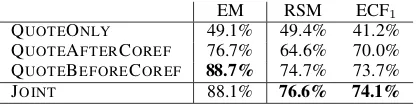
We implemented and trained the three attribution systems that were described in§6.3 and the system for joint coreference and author attribution that is detailed in§4. For each system, Table 5 shows the mention-based and entity-based metrics that were described in§6.2.
Training a quotation attribution system using representative speakers instead of the gold speak-ers (QUOTEONLY) leads to rather disappointing results. As expected, we conclude that assigning the semantically related speaker is considerably easier than selecting another mention that is coref-erent with the correct speaker.
Using (predicted) coreference information, both QUOTEAFTERCOREF and QUOTEBE -FORECOREF systems considerably increase our entity-based metrics. This was also expected, since the coreference chain allows these baselines to output a set of related mentions. We observed that, using the coreference resolution clusters as the attribution entity (QUOTEAFTERCOREF) in-fluences the results negatively when compared to a more basic system that runs coreference on top of attribution result of the QUOTEONLY system (QUOTEBEFORECOREF). These results indicate that the quotation attribution task performs better by looking at the speaker mention that connects more strongly with the quotation, instead of trying to match the whole cluster.
MUCF1 BCUBF1 CEAFEF1 Avg. SURFACE-DK-2013 58.87 62.74 45.46 55.7 SURFACE-OURS[QUOTEBEFORECOREF] 57.89 62.50 45.48 55.3
[image:8.595.131.469.63.105.2]JOINT 58.78 63.79 45.50 56.0
Table 4: Coreference obtained with the CoNLL scorer (version 5) in the test partition of the WJS cor-pus, for theSURFACE system of Durrett and Klein (2013), our baseline implementation of the that sys-tem (SURFACE-OURS), and our JOINTapproach. All systems were trained in the WSJ portion of the Ontonotes.
EM RSM ECF1
QUOTEONLY 49.1% 49.4% 41.2% QUOTEAFTERCOREF 76.7% 64.6% 70.0% QUOTEBEFORECOREF 88.7% 74.7% 73.7%
JOINT 88.1% 76.6% 74.1%
Table 5: Attribution results obtained, in the test set, for the three baseline systems and our joint system.
model are slightly above the best baseline sys-tem QUOTEBEFORECOREF, yielding the best per-formance on the entity-level quotation attribution task. The differences, however, were not found statistically significant, probably due to the small number of quotes (159) in the test set.
The average decoding runtime of the JOINT model is 1.6 sec. per document, against 0.2 sec. for the pipeline system. This slowdown is ex-pectable given the fact that the pipeline system only needs to make independent decisions, while the joint version needs to solve a harder combina-torial problem. Yet, this runtime is within the or-der of magnitude of the time necessary to prepro-cess the documents (which includes tagging and parsing the sentences).
6.6 Error Analysis
To understand the type of errors that are prevented with the JOINTsystem, consider the following ex-ample (from document WSJ-2428):
• [Robert Dow, a partner and portfolio manager at Lord, Abbett & Co.]M1, which manages $4
billion of high-yield bonds, says [he]M2 doesn’t
“think there is any fundamental economic ra-tionale (for the junk bond rout). It was [herd instinct]M3.” [He]M4 adds: “The junk market
has witnessed some trouble and now some peo-ple think that if the equity market gets creamed that means the economy will be terrible and that’s bad for junk.”
The basic QUOTEBEFORECOREF system wrongly clusters togetherM3 andM4 as
corefer-ent, and wrongly assignsM3as the representative speaker. On the other hand, the JOINT system correctly clustersM1, M2 andM4 as coreferent. This is due to the presence of the consecutive quote features which aid in understanding that both quotes have the same speaker, and the mention-inside-quote features which preventherd instinct, which is inside a quote, from being coreferent withHe, which is very likely the author of the quotes due to the verbadds.
7 Conclusions
We presented a framework for joint coreference resolution and quotation attribution. We repre-sented the problem as finding an optimal spanning tree in a graph including both quotation nodes and mention nodes. To couple the two tasks, we intro-duce variables that look at paths in the tree, indi-cating if pairs of nodes are in the same branch, and we formulate decoding as a logic program. Each branch from the root can then be interpreted as a cluster containing all coreferent mentions of an en-tity and all quotes from that enen-tity.
In addition, we designed an evaluation metric suitable for entity-level quotation attribution that takes into account informative speakers. Experi-mental results show mutual improvements in the coreference resolution and quotation attribution tasks.
Future work will include extensions to tackle in-direct quotations, possibly exploring connections to semantic role labeling.
Acknowledgements
[image:8.595.78.286.184.237.2]References
M. B. Almeida and A. F. T. Martins. 2013. Fast and ro-bust compressive summarization with dual decom-position and multi-task learning. InProc. of the An-nual Meeting of the Association for Computational Linguistics.
Eric Bengtson and Dan Roth. 2008. Understanding the value of features for coreference resolution. In Pro-ceedings of the Conference on Empirical Methods in Natural Language Processing, pages 294–303. As-sociation for Computational Linguistics.
Shane Bergsma and Dekang Lin. 2006. Bootstrapping path-based pronoun resolution. In Proceedings of the 21st International Conference on Computational Linguistics and the 44th annual meeting of the Asso-ciation for Computational Linguistics, pages 33–40. Association for Computational Linguistics.
K. Crammer, O. Dekel, J. Keshet, S. Shalev-Shwartz, and Y. Singer. 2006. Online Passive-Aggressive Al-gorithms. Journal of Machine Learning Research, 7:551–585.
Aron Culotta, Michael Wick, Robert Hall, and An-drew McCallum. 2007. First-order probabilistic models for coreference resolution. InHuman Lan-guage Technology Conference of the North Ameri-can Chapter of the Association for Computational Linguistics (HLT/NAACL), pages 81–88.
D. Das, A. F. T. Martins, and N. A. Smith. 2012. An Exact Dual Decomposition Algorithm for Shallow Semantic Parsing with Constraints. InProc. of First Joint Conference on Lexical and Computational Se-mantics (*SEM).
´Eric de La Clergerie, Benoˆıt Sagot, Rosa Stern, Pas-cal Denis, Ga¨elle Recourc´e, and Victor Mignot. 2011. Extracting and visualizing quotations from news wires. InHuman Language Technology. Chal-lenges for Computer Science and Linguistics, pages 522–532. Springer.
Pascal Denis and Jason Baldridge. 2008. Specialized models and ranking for coreference resolution. In
Proceedings of the Conference on Empirical Meth-ods in Natural Language Processing, pages 660– 669. Association for Computational Linguistics.
Greg Durrett and Dan Klein. 2013. Easy victories and uphill battles in coreference resolution. In Proceed-ings of the 2013 Conference on Empirical Methods in Natural Language Processing.
Greg Durrett, David Hall, and Dan Klein. 2013. Decentralized entity-level modeling for coreference resolution. InProc. of Annual Meeting of the Asso-ciation for Computational Linguistics.
David K Elson and Kathleen McKeown. 2010. Auto-matic attribution of quoted speech in literary narra-tive. InAAAI.
William Paulo Ducca Fernandes, Eduardo Motta, and Ruy Luiz Milidi´u. 2011. Quotation extraction for portuguese. In Proceedings of the 8th Brazilian Symposium in Information and Human Language Technology (STIL 2011), Cuiab´a, pages 204–208. Eraldo Rezende Fernandes, C´ıcero Nogueira dos
San-tos, and Ruy Luiz Milidi´u. 2012. Latent structure perceptron with feature induction for unrestricted coreference resolution. In Joint Conference on EMNLP and CoNLL-Shared Task, pages 41–48. As-sociation for Computational Linguistics.
J.R. Finkel, A. Kleeman, and C.D. Manning. 2008. Ef-ficient, feature-based, conditional random field pars-ing. Proc. of Annual Meeting on Association for Computational Linguistics, pages 959–967.
Aria Haghighi and Dan Klein. 2007. Unsupervised coreference resolution in a nonparametric bayesian model. InAnnual meeting-Association for Compu-tational Linguistics, volume 45, page 848.
Aria Haghighi and Dan Klein. 2010. Coreference resolution in a modular, entity-centered model. In
Human Language Technologies: The 2010 Annual Conference of the North American Chapter of the Association for Computational Linguistics, pages 385–393. Association for Computational Linguis-tics.
P. Koehn. 2004. Statistical signicance tests for ma-chine translation evaluation. InProc. of the Annual Meeting of the Association for Computational Lin-guistics.
Heeyoung Lee, Yves Peirsman, Angel Chang, Nathanael Chambers, Mihai Surdeanu, and Dan Ju-rafsky. 2011. Stanford’s multi-pass sieve coref-erence resolution system at the conll-2011 shared task. InProceedings of the Fifteenth Conference on Computational Natural Language Learning: Shared Task, pages 28–34. Association for Computational Linguistics.
Nuno Mamede and Pedro Chaleira. 2004. Char-acter identification in children stories. In Ad-vances in Natural Language Processing, pages 82– 90. Springer.
A. F. T. Martins, N. A. Smith, and E. P. Xing. 2009. Concise Integer Linear Programming Formulations for Dependency Parsing. InProc. of Annual Meet-ing of the Association for Computational LMeet-inguis- Linguis-tics.
A. F. T. Martins, N. A. Smith, P. M. Q. Aguiar, and M. A. T. Figueiredo. 2011. Dual Decomposition with Many Overlapping Components. In Proc. of Empirical Methods for Natural Language Process-ing.
Vincent Ng and Claire Cardie. 2002. Improving ma-chine learning approaches to coreference resolution. InProceedings of the 40th Annual Meeting on Asso-ciation for Computational Linguistics, pages 104– 111. Association for Computational Linguistics. V. Ng. 2010. Supervised noun phrase coreference
re-search: The first fifteen years. In Proc. of the An-nual Meeting of the Association for Computational Linguistics.
Tim O’Keefe, Silvia Pareti, James R Curran, Irena Ko-prinska, and Matthew Honnibal. 2012. A sequence labelling approach to quote attribution. In Pro-ceedings of the 2012 Joint Conference on Empirical Methods in Natural Language Processing and Com-putational Natural Language Learning, pages 790– 799. Association for Computational Linguistics. Silvia Pareti, Tim O’Keefe, Ioannis Konstas, James R.
Curran, and Irena Koprinska. 2013. Automatically detecting and attributing indirect quotations. In Pro-ceedings of the 2013 Conference on Empirical Meth-ods in Natural Language Processing.
Silvia Pareti. 2012. A database of attribution relations. InLREC, pages 3213–3217.
Bruno Pouliquen, Ralf Steinberger, and Clive Best. 2007. Automatic detection of quotations in multi-lingual news. InProceedings of Recent Advances in Natural Language Processing, pages 487–492. Sameer Pradhan, Lance Ramshaw, Mitchell Marcus,
Martha Palmer, Ralph Weischedel, and Nianwen Xue. 2011. Conll-2011 shared task: Modeling un-restricted coreference in ontonotes. InProceedings of the Fifteenth Conference on Computational Nat-ural Language Learning: Shared Task, pages 1–27. Association for Computational Linguistics.
Sameer Pradhan, Alessandro Moschitti, Nianwen Xue, Olga Uryupina, and Yuchen Zhang. 2012. Conll-2012 shared task: Modeling multilingual unre-stricted coreference in ontonotes. In Proceedings of the Joint Conference on EMNLP and CoNLL: Shared Task, pages 1–40.
Rashmi Prasad, Nikhil Dinesh, Alan Lee, Eleni Milt-sakaki, Livio Robaldo, Aravind K Joshi, and Bon-nie L Webber. 2008. The penn discourse treebank 2.0. InLREC. Citeseer.
Altaf Rahman and Vincent Ng. 2011. Narrowing the modeling gap: A cluster-ranking approach to coref-erence resolution. Journal of Artificial Intelligence Research, 40(1):469–521.
Luis Sarmento, Sergio Nunes, and E Oliveira. 2009. Automatic extraction of quotes and topics from news feeds. In 4th Doctoral Symposium on Informatics Engineering.
Nathan Schneider, Rebecca Hwa, Philip Gianfortoni, Dipanjan Das, Michael Heilman, Alan W Black,
Frederick L Crabbe, and Noah A Smith. 2010. Vi-sualizing topical quotations over time to understand news discourse. Technical report, Technical Report CMU-LTI-01-103, CMU.
Wee Meng Soon, Hwee Tou Ng, and Daniel Chung Yong Lim. 2001. A machine learning ap-proach to coreference resolution of noun phrases.
Computational linguistics, 27(4):521–544.
Veselin Stoyanov, Nathan Gilbert, Claire Cardie, and Ellen Riloff. 2009. Conundrums in noun phrase coreference resolution: Making sense of the state-of-the-art. InProceedings of the Joint Conference of the 47th Annual Meeting of the ACL and the 4th International Joint Conference on Natural Lan-guage Processing of the AFNLP: Volume 2-Volume 2, pages 656–664. Association for Computational Linguistics.