Abstract—Interactive TV (iTV) is a progress with friendly interaction for people. In particular, remote controller is always been designed for TV machine not TV programs or people. This is a serious restriction for the development of iTV service. However, many researches are usually based on “one audience” and one iTV service. It is fewer to consider multiuser interaction in a local environment. In fact, the situated interaction with family should be mentioned. A framework “VRDCiTV” grounded on distributed computing is proposed in this study, which effectively utilizes external displays (TV or projector) and provides audiences to execute “varied remote operation” with their handheld devices in an iTV system, without any locating process. Furthermore, the development of iTV services could not be limited with “one remote controller”.
Index Terms—Interactive TV, Varied Remote Control, Distributed Computing, Multiuser Interaction.
I. INTRODUCTION
In the home information system, TV is one of the most common entertainment devices. People habitually use the remote controller combined with TV machine but provided by different manufacturers. The remote controller is an input device with a fixed appearance after manufactured, but provides only invariable functions. However, this is a serious restriction in the interactive TV (iTV) field, previous researches proposed some methods to integrate other devices or technologies to substitute for the traditional remote controller, such as paper or Tablet PC [1], [2]. In addition, a part of the researches are based on different types of input technologies been tested in an independent room. The scholars setup some devices and use detective devices to locate light point or recognize human gestures for remote control [3], [4]. For the most of people, these researches had provided different solutions but more devices, with the result that are less convenient to be applied in a general home environment.
Nintendo Wii is a more popular TV game system because it gives consideration to the “family”, not one person only. In fact, the situational interaction with family should be
Manuscript received November 21, 2008.
S.C. Wang is with the Chaoyang University of Technology, Taiwan, ROC (email: [email protected]).
T.C. Chung is with the Chaoyang University of Technology, Taiwan, ROC (email: [email protected]).
K.Q. Yan is with the Chaoyang University of Technology, Taiwan, ROC (corresponding author to provide phone: 886423323000; fax: 88623742369; email: [email protected]).
mentioned, especially in a home information system. However, the traditional remote controller still possesses the characteristics:
1. One TV machine is controlled by one TV remote controller.
2. Only one audience can use the TV remote controller at the same time.
The TV remote controller is designed for TV machine to change channels and regulate other functions, such as adjustment of sound volume. People have been used to use it in an “alone” situation because it is always “one to one” relation with the TV machine.
Personal Digital Assistants (PDAs) and smart phones are more prevalent of handheld devices. The reports released by Gartner Inc. indicated that the sale of handheld devices has always been growing [5], [6]. InStat also considers smartphones are the fastest growing and lead to the most profit for wireless operators, manufacturers, and applications developers [7]. These show that an increasing number of people have begun to rely on the mobile devices. With the advancement of hardware manufacturing techniques, most of the handheld devices in present days are built in with the input devices, computation capability, video/audio output, and connectivity to the Internet. People can regard PDAs as a miniature of a personal computer, due to their compactness, portability, and the connectivity to the Internet (via GPRS, WiFi, 3G, and WiMAX, etc.), the related applications and services have been observed gradually.
Handheld devices have some hardware limits (such as CPU, display, etc), but its portability and mobility has made it an indispensable user device in pervasive computing. Thus, how to satisfy people’s demand for mobility and to reduce the limitation of input devices and further achieve the coordination among users, devices, and connections for accurate operations is worth studying. Hence, this study proposes a framework with the “virtual room” concept and provides people to use handheld devices to interact with iTV services and family, especially in an easy and convenient way.
The rest of this paper is organized as follows: Section 2 provides discussions of the literature related to this study. Section 3 introduced the framework of this research. Section 4 centers on experiments. Concluding remarks are drawn in Section 5.
Variable Remote Download Control Function for
iTV Services
II. PREVIOUSWORK
According to Petri Lankoski, and Inger Ekman, one important issue in producing content for digital television is what kind of content viewers want and how they want to interact with the content. They considered iTV program should provide interesting game like interaction and integrate a game with a traditional television series so that the game has effect on series [8]. Rudinei Goularte et al. proposed the method to annotation the multimedia content for iTV services. The scholars used an underlying model for structured multimedia descriptions and annotations, and allowed the establishment of spatial, temporal, and inking relationships [9].
These researches highlighted the importance of interaction for iTV program and developed related methods, but disregard that the interaction must be achieved with hardware, not only software design and audiences. After all, the input device is necessary for a complete system. For this reason, this study considers that the interaction design of iTV content must comprise hardware and software design A. Variable Remote Controller
Every input device has a fixed appearance after manufactured, and the appearance is usually unchangeable. This is an important limit due to the current manufacturing technology, and it is difficult to change the appearance of input devices on demand. Because people use traditional remote controller frequently, they are already used to complete input operations with “button push”, no matter what kind of input is required by the system software. The limit has a larger effect on the iTV services for the following reasons:
1. TV remote controller is a kind of handheld devices and it is portable.
2. The appearance of TV remote controller cannot be changed freely.
3. People have accepted habitually “one remote controller to one TV”.
[image:2.595.55.286.527.636.2](a) (b)
Fig. 1. Two kind of variable remote controllers (a) Touchscreen Remotes SRC3000 and SRC9310
(b) MiTV on the TV and Tablet PC [2].
The products shown in Fig. 1(a) are named “Touchscreen Remotes.” They are manufactured by Sunwave Technology Corp., and the products focus on allembracing different functions of several controllers. Sunwave Technology Corp. uses userfriendly touch screen panel to replace the physical buttons on the traditional remote controllers. People can control up to eight devices, including VCRs, DVDs, TVs, and satellite dishes. This is an effective method for
decreasing the number of controllers in a home information system.
Touchscreen Remotes possess the function for program upgraded, but all functions of remote control are still designed for different hardware devices, not TV programs. This is the original limit for the design of iTV program content. Besides, the local connection also limits the multiuser using because it is a “one to one” connection.
Jehan et al. considered the bad interface design and terrible interaction function that the industry is currently on its way to make, so they proposed MiTV application for iTV services [2]. They had already implemented MiTV application using their distributed computing architecture that integrates TV machine and Tablet PC. On the Tablet PC, MiTV application provides convenient interfaces for people to interact with the TV shows (Fig. 1(b)), and the interfaces are changed in coordination with the TV programs.
MiTV application possesses the characteristics of variable interfaces for people input. It communicates with the TV tuner, cable, or satellite box locally. The input interfaces shown on Tablet PC are friendly and artistic. However, Tablet PC is usually bigger than handheld device in the dimensions and less mobile. This study considers that are against the habit of people using TV remote controllers with “handheld”.
B. Multiuser framework
In addition to iTV program design, scholars also proposed the frameworks for iTV services. The TV programs are usually delivered in broadcasting, and the interactions within them are provided by the server services. Different architectures of iTV services are sometimes necessary for more interactions. Borko Furht et al. presented the framework of iTV services and that was based on the TV settop box (STB). It is a kind of local connections between STB and other devices, such as game controller, VCR, and TV [10]. This is a more common method to communicate iTV services and other devices in this localconnect way because people are habitual that. In fact, that is still limited in different manufacturing technology or provider.
As for another multiuser framework in largescale area, such as “Inhabited Television”, the research is founded on a shared “virtual world” [11]. Steve Benford et al. designed the framework to allow online audiences can participate in television shows within shared virtual worlds. People can use the service in a connective environment. The largescale framework can cover more people, but the framework seems to need more largesized client device for each audience, such as PC.
Multiuser framework should be a largescale service and give consideration to people’s mobility. Therefore, iTV services based on STB are localized, limited in different specifications of STB from different manufacturers and the connective capability of remote controller. Because of abovementioned reasons, the composite motive of this study is to integrate largescale mobility and convenient remote control in a multiuser environment.
coordination with display devices. Ferscha and Vogl proposed the “WebWall” framework founded on Wall computing and let people to operate services on the display by the text messages from handheld device [12].
In the WebWall framework, users keys in some text as “request” and then delivers them to the servers by handheld device. The server services will transform these requests into XML represent and deliver them to the show client hosts for display. In other words, users can use own handheld device to interact with the applications shown in the face of themselves. This architecture combines hardware devices, software, and distributed communications to satisfy people in remote control.
However, the interface of input function on handheld device is a textbased data processing in WebWall. People must key in formatted text to operate remote control. Although WebWall can provide control functions to users but it is less friendly, because users must understand the formats of text and different commands in advance. In addition, to complete a remote control in WebWall must key down more times than traditional remote controller. The characteristics of remote controllers are preserved in WebWall, but the convenience of people input is insufficient.
In conclusion, this study considers that a friendly TV remote controller of iTV services must be:
1. Variable: change the fixed input interface of hardware device.
2. Connectible: integrate local using convenient in the largescale environment.
3. Mobile: satisfy the freedom when people use the remote controller.
4. Innovative: harmony with iTV program not TV machine.
5. Convenient: easy to apply in a general home environment.
III. THEVRDCITV FRAMEWORK
This study proposes a framework named “VRDCiTV” (Variable Remote Download Control) based on the Internet distributed computing. The characteristics of previous researches are integrated in VRDCiTV framework, and this framework can provide the friendlier interfaces of iTV remote controller for interaction, especially in mobility and operating.
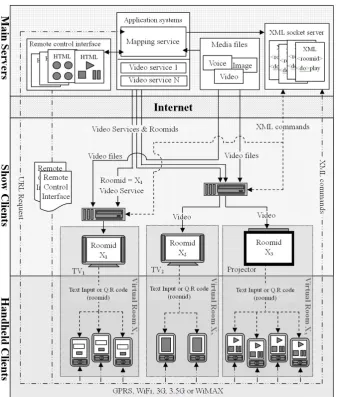
[image:3.595.129.467.365.763.2]The VRDCiTV framework architecture is shown in Fig. 2. This study separates the VRDCiTV framework architecture into three entities by the purposes of various devices, includes Main Servers, Show Clients, and Handheld Clients.
§ Main Servers: The servers are composed of Application Systems, XML Socket Server, and two modules (remote control interface files and media files). This entity is the kernel of VRDCiTV framework and masters the coordination between Show Clients and Handheld Clients.
§ Show Clients: From the displays of Show Clients, the audiences can see any video provided by video services of VRDCiTV. Moreover, Show Clients accept incoming XMLcommands and execute them immediately when the audiences operate relative remote control.
§ Handheld Clients: The audiences can push the virtual buttons on the remote control interface shown on their own handheld devices (such as PDA or Smart phone), after the interfaces have been downloaded from Main Servers. Each Handheld Client can connect with the relative Show Client indirectly by text input or Q.R code.
There are three entities are grounded on distributed computing to work in coordination with each other. At the start, the Show Client downloads a video service of VRDCiTV from Application Systems of Main Servers, and then starts the video service to display on a TV or monitor. At the same time, the Show Client will get a uniroomid from Main Servers. Moreover, it downloads the initial video and waits to play. The uniroomid is encoded to the Q.R code and shown directly on the menu of video service in the Show Client. Audiences can see it and then input the uniroomid to the Start Page of Handheld Client on their handheld devices, or take the Q.R code by the camera of own handheld device and decode it. After that, the handheld device sends a request composed relative uniroomid to Mapping Service of Main Servers via wireless connection.
After mapping, Application Systems returns the relative remote controller interfaces to each handheld device, and broadcasts the XMLcommand “ready” to the Show Client by XML Socket Server. An XMLcommand is composed of a command and the sender’s uniroomid. For the Show Client, that means the corresponding Handheld Clients have been set up. Then the audiences can operate the remote control interfaces shown on the corresponding Handheld Clients as traditional remote control. These Handheld Clients will send relative XMLcommand to XML Socket Server when someone presses any virtual button.
XML Socket Server broadcasts the XMLcommands and Show Client systems will receive the XMLcommands according to the uniroomid, and then the Show Client will execute the XMLcommand to display on a TV or monitor. When the interaction implied in the video is acted, the Show Client sends another XMLcommand to each relative Handheld Client. Those Handheld Clients will change the interfaces immediately after they received the relative XMLcommand.
Each video has relative remote control interfaces in the VRDCiTV framework. These remote control interfaces can be designed for special input or video content, especially be created by the same author of video. In the distributed computing architecture, the remote control interfaces can also be update at once and that is the more convenient for people to interact with video.
IV. EXPERIMENT ANDRESULTS
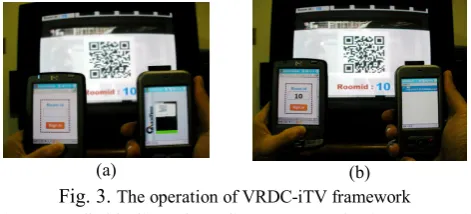
This experiment used Microsoft ASP scripting to develop the Main Servers systems. XML Socket Server was Palabre XML Socket Python Server and that is a freeware [13]. Adobe Flash technology and HTML were used to develop the remote control interfaces. The Show Client system was developed by Adobe Flash technology and the host system was Windows XP professional. The Main Servers system was powered by an IBM e360 with Microsoft Windows Server 2003. In addition, two handheld devices with different level of computing capability were used as the multiuser Handheld Client devices and a Toshiba 37” TV was the display of Show Client. The aforementioned technologies and hardware/software systems were adopted in hope of creating a simulated scenario closer to practical applications. In order to assure each handheld device is able to download the related remote control interfaces corresponding to the video on the display of Show Client, this experiment used virtual tag “Q.R code” as the connection guide and integrated the freeware “QuickMark” provided by SimpleAct Inc. to decode the Q.R code that is shown in Fig. 3. With the builtin camera, the handheld device could decode the corresponding URL implied in the Q.R code to reduce the audience’s hand input. In the experiment, information implied in the virtual tag includes:
1. The correct URL of mapping service. 2. The uniroomid of the Show Client.
As shown in Fig. 3(a), left handheld device first open the Start Page to wait for uniroomid inputted and right handheld device took the Q.R. code with camera. After audiences complete to input the uniroomid (Fig. 3(b)), each Handheld Client would connect to the video service indirectly via another XMLcommand with the same uniroomid that is shown in Fig. 4(a).
(a) (b)
Fig. 3. The operation of VRDCiTV framework
(a) In a Handheld Client, the audiences prepared to input a roomid by the handheld devices.
(b) The audiences had input the roomid to the Start Pages.
[image:4.595.309.545.487.594.2](a) (b)
Fig. 4. The operation of VRDCiTV framework
(a) The handheld devices accepted the first remote control interface from the Main Servers.
After the connection with some Handheld Client was established, the Application Systems would return an XMLcommand “ready” with relative uniroomid to the Show Client via XML Socket Server. The Show Client accepted the XMLcommand with the same uniroomid and then took off the menu to ready status (Fig. 4(a)). When the video service was ready to play, audiences could push any “virtual button” on the panel of handheld devices, and the corresponding XMLcommand of “virtual button” pushed would be delivered to Show Client via XML Socket Server. The video service in Show Client then parsed the XMLcommand and executed it. As shown in Fig. 4(b), the left audience pushed the “Play” virtual button, and then the Show Client played the video that they saw.
In specially, VRDCiTV framework provides the function of remote control interfaces changed according to the video content. As Jehan et al. proposed the MiTV application for the interaction of iTV [2], this study also consider that is necessary for iTV video content to interactive with people. As shown in Fig. 5(a), in VRDCiTV framework, the remote control interfaces of handheld devices could be changed in accordance with the video content that displayed in the Show Client. That is to say, the designers of iTV programs can add interactive functions in programs with fewer limitations of remote controller, in VRDCiTV framework.
As shown in Fig. 5(a), the video program showed the question menu of interactive point and each Handheld Client changed the remote control interfaces immediately. After the audiences pushed the virtual buttons that they wanted, the menu would show the first right input controller on the menu, as shown in Fig. 5(b).
[image:5.595.303.551.392.516.2](a) (b)
Fig. 5. The interfaces on handheld devices had changed according to the video program
(a) The audiences pushed the buttons that they want (b) TV showed the first right answer was no.1 Handheld Client.
The traditional remote controller works only for TV machine, not iTV services. Most people habitually use it in an “alone context”, since it has a “one to one” relation with TV machine and only one audience can use it at the same time. In VRDCiTV framework, audiences can use the handheld devices to interact with iTV program together. This is a more interesting mode for family. According to the previous studies, the interaction of iTV program had better depends on special input device, such as Tablet PC [2]. Nevertheless, that does not suit the “handheld” property for people.
Traditional remote controller has a fixed appearance after manufactured. Its interface of input is inflexible. However, the virtual interfaces in Handheld Clients are built with software technology, downloaded from Main Servers immediately, and the functions of button pushed can be
change freely. In addition, the virtual remote control interfaces of VRDCiTV framework can be customized with iTV program. This is the most different from the TV remote controller software for the mobile device [14]. This study considers the Handheld Client of VRDCiTV is more suitable for iTV services.
Finally, audiences usually use traditional remote controller to control TV machine via IrDA or Bluetooth, such as the products of Sunwave Technology Corp or FReCon [15]. That is a localconnection mode. VRDCiTV framework is grounded on distributed computing and communicates via the Internet. People can use own handheld device as a Handheld Client freely in the connectible area of VRDCiTV framework, dynamically and immediately built a virtual room to enjoy the iTV services with other people.
V. CONCLUSIONS
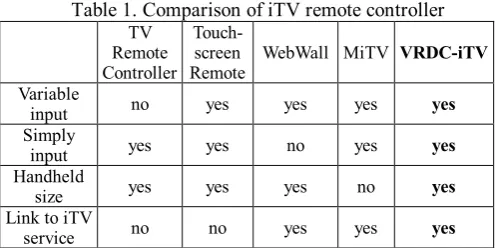
iTV is a very interesting development for people, so it should not be limited. Previous researches provided different methods to decrease the restrictions of iTV services. However, TV remote controller is an important device and people always use it, so its change must conform to the fixed pattern of people, include size, appearance, and operation. This study considers that is more friendly to people. Proved by experiment, VRDCiTV framework can be executed in iTV services and combine the advantages of previous researches, as shown in Table 1.
Table 1. Comparison of iTV remote controller TV
Remote Controller
Touch screen Remote
WebWall MiTV VRDCiTV
Variable
input no yes yes yes yes Simply
input yes yes no yes yes Handheld
size yes yes yes no yes
Link to iTV
service no no yes yes yes
VRDCiTV framework is a special method to integrate different devices for iTV services based on distributed computing, and that is different from the most distributed computing systems to work in coordination for total performance of processing. VRDCiTV framework is mainly aimed at the multiuser interaction in a family, and it extends the functions of different devices to provide more conveniences to people, via system software. Moreover, the mobility of people is also the emphasis in VRDCiTV framework. Different from the traditional localconnection mode, people can use their own handheld devices in any virtual room of VRDCiTV.
REFERENCES
[1]. B. Aseel, B. Erik, L. Anders and B. Magnus, “Paper remote: An augmented television guide and remote control,”Universal Access in the Information Society, vol. 4, no 4, May 2006, pp. 300327.
[2]. B. Jehan, D. Jérome, E. Joanes, J. Luc, L. Matthew, L.Martin and S. Maklouf, “MiTV: Rethinking interactive TV,” Proceedings of the Seventh International Conference on Virtual Systems and Multimedia, 2001, pp. 365369.
[image:5.595.50.289.434.544.2]50, no. 2, May 2004, pp. 413419.
[4]. Z. Janez, P. Jernej and F. Jurij. T., “Visionbased humancomputer interface using hand gestures,” International Workshop on Image Analysis for Multimedia Interactive Services, June 2007, pp. 4141. [5]. Gartner Says Research in Motion Led Worldwide PDA Industry to 7
Percent Growth in First Quarter of 2006. Available: http://www. gartner.com/press_ releases/asset_151801_11.html. [6]. Quarterly Statistics: PDA and Smartphone Shipment Forecast. Available:
http://www.gartner.com/ DisplayDocument?ref=g_search&id=493176& subref =browse.
[7]. Smartphones 2007: The ARPU Generation Machine, Available: http://www.instat.com/Abstract.asp?ID=300&SKU=IN0703823WH [8]. P. Lankoski, and I. Ekman, “Integrating a multiuser game with dramatic
narrative for interactive television,” Proceedings of the 1st European Conference on Interactive Television, 2003, pp.24.
[9]. G. Rudinei, G. C. Renan, A. CamachoGuerrero José, S. Carlos, R. Valter Inácio Jr., and C. Maria da Graça Pimentel: “Interactive multimedia annotations: enriching and extending content,” Proceedings of the 2004 ACM symposium on Document engineering, 2004, pp.8486. [10]. B. Furht, D. Kalra, F. L. Kitson, A. A. Rodriguez, and W. E. Wall,
“Design issues for interactive television systems,” IEEE Computer, vol. 28, no. 5, May 1995, pp.2539.
[11]. B. Steve, G. Chris, C. Mike, W. Graham, R. Tim, M. Jason, W. John,” Inhabited Television: broadcasting interaction from within collaborative virtual environments,” ACM Transactions on ComputerHuman Interaction, vol. 7, no. 4, December 2000, pp.510547.
[12]. F, Alois and V, Simon, “Pervasive Web access via public communication walls,” Lecture Notes in Computer Science, vol. 2414, January 2002, pp.8497.
![Fig. 1. Two kind of variable remote controllers (a) Touchscreen Remotes SRC3000 and SRC9310 (b) MiTV on the TV and Tablet PC [2].](https://thumb-us.123doks.com/thumbv2/123dok_us/1318268.662197/2.595.55.286.527.636/variable-remote-controllers-touch-screen-remotes-mitv-tablet.webp)