Multilingual Back-and-Forth Conversion between
Content and Function Head for Easy Dependency Parsing
Ryosuke Kohita Hiroshi Noji
Graduate School of Information Science Nara Institute of Science and Technology 8916-5 Takayama, Ikoma, Nara 630-0192, Japan
{kohita.ryosuke.kj9, noji, matsu}@is.naist.jp
Yuji Matsumoto
Abstract
Universal Dependencies (UD) is becom-ing a standard annotation scheme cross-linguistically, but it is argued that this scheme centering on content words is harder to parse than the conventional one centering on function words. To improve the parsability of UD, we propose a back-and-forth conversion algorithm, in which we preprocess the training treebank to in-crease parsability, and reconvert the parser outputs to follow the UD scheme as a post-process. We show that this technique con-sistently improves LAS across languages even with a state-of-the-art parser, in par-ticular on core dependency arcs such as nominal modifier. We also provide an in-depth analysis to understand why our method increases parsability.1
1 Introduction
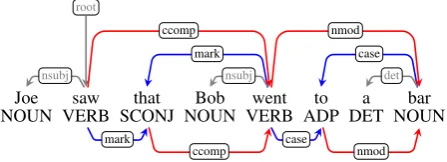
As shown in Figure 1 there are several variations in annotations of dependencies. A famous exam-ple is a head choice in a prepositional phrase (e.g,
to a bar), which diverges in the two trees. Though various annotation schemes have been proposed so far (Hajic et al., 2001; Johansson and Nugues, 2007; de Marneffe and Manning, 2008; McDon-ald et al., 2013), recently the Universal Dependen-cies (UD) (de Marneffe et al., 2014) gains much popularity and is becoming the annotation stan-dard across languages. The upper tree in Figure 1 is annotated in UD.
Practically, however, UD may not be the opti-mal choice. In UD a content word consistently dominates a function word, but past work points out that this makes some parser decisions more 1Our conversion script is available at https://github.com/kohilin/MultiBFConv
Joe saw that Bob went to a bar
NOUN VERB SCONJ NOUN VERB ADP DET NOUN nsubj
root
mark
nsubj
ccomp
case
det
nmod
mark
[image:1.595.312.536.223.304.2]ccomp case nmod
Figure 1: Dependency trees with content head (above) and function head (below).
difficult than the conventional style centering on function words, e.g., the tree in the lower part of Figure 1 (Schwartz et al., 2012; Ivanova et al., 2013).
To overcome this issue, in this paper, we show the effectiveness of a back-and-forth conver-sion approach where we train a model and parse sentences in an anontation format with higher parsability, and then reconvert the parser output into the UD scheme. Figure 1 shows an example of our conversion. We use the function head trees (below) as an intermediate representation.
This is not the first attempt to improve depen-dency parsing accuracy with tree conversions. The positive result is reported in Nilsson et al. (2006) using the Prague Dependency Treebank. For the conversion of content and function head in UD, however, the effect is still inconclusive. Using En-glish UD data, Silveira and Manning (2015) report the negative result, which they argue is due to error propagation at backward conversions, in particu-lar in copula constructions that often incur drastic changes of the structure. Rosa (2015) report the advantage of funcion head in the adposition con-struction, but the data is HamleDT (Zeman et al., 2012) rather than UD and the conversion target is conversely too restrictive.
Our main contribution is to show that the back-and-forth conversion can bring consistent accu-racy improvements across languages in UD, by
POS Label Example
ADP casedep ... a post(ja)Taro niaboutha...fault ... mark ... opinionsonhow it ... SCONJ mark I thinkthat...
[image:2.595.309.527.77.261.2]ADV mark ... feetwhenyou ... PART casemark Elena... Sharon’smotor cycle ...tomake ...
Table 1: The set of conversion targets. (ja) is an example in Japanese.
limiting the conversion targets to simpler ones around function words while covering many lin-guistic phenomena. Another limitation in previous work is the parsers: MSTParser or MaltParser is often used, but they are not state-of-the-art today. We complement this by showing the effectiveness of our approach even with a modern parser with rich features. We also provide an in-dpeth analy-sis to explore when and why our conversion brings higher parsability than the orignal UD.
2 Conversion method
Let us define notations first. For thei-th word wi in a sentence, pi denotes its POS tag,hi the head index,lithe dependency label, andlefti(righti) the list of indexes of left (right) children forwi. For instance in the upper tree in Figure 1,w5 =went,
p5= VERB,h5= 2,l5= ccomp, andleft5= [3, 4].
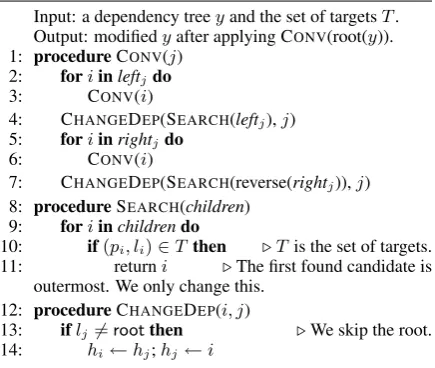
Forward Conversion The forward algorithm receives the original UD tree and converts it to a function head tree by modifying hi. Figure 1 is an example, and Algorithm 1 is the pseudo-code; root(y) returns the root word index of treey.
The algorithm traverses the tree in a top-down fashion and modifies the deepest node first. The modifications such as changing themarkarc from
went to that in Figure 1 occur when it detects a word wi (that, in this case), for which the pair (pi, li) exists in the set of conversion targets, which is listed in Table 1 and is denoted byT in Algo-rithm 1. Letwj be the head of the detected word
wi. Then, we reattach the arcs so thatwi’s head becomes wj’s head and wj’s new head becomes
wi. Note that we modify heads (hi) only and keep labels (li). We skip the children of the root word (line 13); otherwise, an arc withrootlabel will ap-pear at an intermediate node. We operate only on the outermost child when multiple candidates are found (line 11).
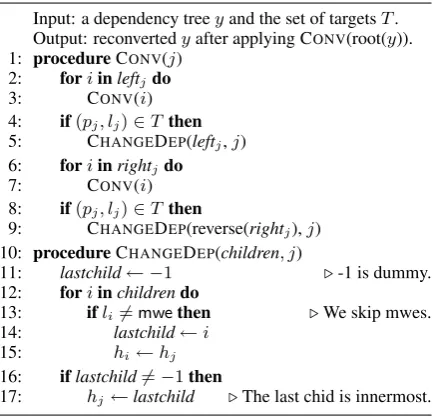
Backward Conversion In contrast, the back-ward algorithm receives a function head tree and
Algorithm 1Forward conversion
Input: a dependency treeyand the set of targetsT. Output: modifiedyafter applying CONV(root(y)).
1: procedureCONV(j)
2: foriinleftjdo
3: CONV(i)
4: CHANGEDEP(SEARCH(leftj),j)
5: foriinrightjdo
6: CONV(i)
7: CHANGEDEP(SEARCH(reverse(rightj)),j)
8: procedureSEARCH(children) 9: foriinchildrendo
10: if(pi, li)∈Tthen . Tis the set of targets.
11: returni .The first found candidate is outermost. We only change this.
12: procedureCHANGEDEP(i, j)
13: iflj6=rootthen .We skip the root. 14: hi←hj;hj←i
reconverts it to a UD-style tree. Algorithm 2 is the pseudo-code.
There are two main differences between the for-ward and backfor-ward algorithms. The first is the relative position of a target node (one of Table 1) among the operated nodes; in the forward algo-rithm they are the target node, its parent (head), and its grandparent, while in the backward algo-rithm they are the target node, its head, and its children. The second is how we reattach the nodes at the CHANGEDEPoperation, in particular when
the target node has multiple children. While the forward algorithm modifies only two arcs at once, the backward algorithm may modify more than two arcs considering possible parse errors at pre-diction. Specifically, when we find a target node having multiple children, we change the head of all these children to the head of the target (exclud-ing those with the mwe label)2. We choose the
intermost child as the new head of the target word (line 17).
Algorithm 2Backward conversion
Input: a dependency treeyand the set of targetsT. Output: reconvertedyafter applying CONV(root(y)).
1: procedureCONV(j)
2: foriinleftjdo
3: CONV(i)
4: if(pj, lj)∈Tthen
5: CHANGEDEP(leftj,j)
6: foriinrightjdo
7: CONV(i)
8: if(pj, lj)∈Tthen
9: CHANGEDEP(reverse(rightj),j)
10: procedureCHANGEDEP(children, j)
11: lastchild← −1 .-1 is dummy. 12: foriinchildrendo
13: ifli6=mwethen .We skip mwes. 14: lastchild←i
15: hi←hj
16: iflastchild6=−1then
17: hj←lastchild .The last chid is innermost.
erage. We argue this is not a serious restriction since UD already contains moderate amount of non-projective arcs and the parser should be able to handle them. In practice, this complication does not lead to performance degradation; when we em-ploy non-projective parsers, the scores increase re-gardless of the increased non-projectivity.
3 Experiment
3.1 Experimental Setting
For each treebank and parser, we train two differ-ent models: one with the original trees (UD) and
another with the converted trees (CONV).
Recon-vertingCONV’s output into the UD scheme by the
backward algorithm, we can evaluate the outputs of both models against the same UD test set.
For parsers, we use two non-projective parsers: second-order MSTParser (MST) (McDonald et al.,
2005)3and RBGParser (RBG) (Lei et al., 2014)4
with the default settings, which utilizes the third-order features and is much stronger .
We choose 19 langueges from UD ver.1.3 con-sidering the sizes and typological variations.5 The
ratio of converted tokens is 6.3% on average (2.3%-15.6%). The failed backward conversions rarely occur at most 0.01% (0.002% on average) in the training data. We use gold POS tags, and exclude punctuations from evaluation.
3https://sourceforge.net/projects/mstparser/ 4https://github.com/taolei87/RBGParser
5We exclude Arabic and French since they caused prob-lems in training withRBGin a preliminary study.
3.2 Result
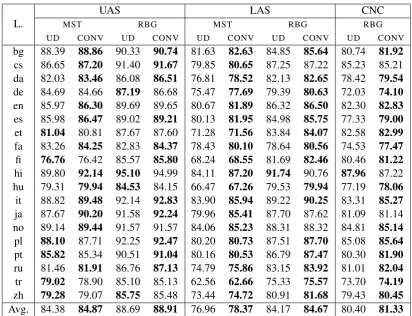
Attachment scores Table 2 shows the main sult and we can see that the improvements are re-markable in the labeled attachment score (LAS): For MST, the scores increase more than 1.0 point
in many languages (11 out of 19), and for RBG,
though the changes are smaller, more than 0.5 points improvements are still observed in 10 lan-guages. The differences in the unlabelled attach-ment score (UAS) are modest, implying that our conversion contributes in particular to find correct arclabelsrather than head words themselves. On the other hand, LAS of Hindi decreases withRBG.
One possible explanation for this is that the score of original UD is sufficiently high (91.74) and our conversion may impede parsability in such cases.
These overall improvements are not observed in past work (Silveira and Manning, 2015). One rea-son of our success seems that we restrict our con-version to simpler constructions and operations. We do not modify copula and auxiliary construc-tions, which involve more complex changes, am-plifying error propagation in backward conver-sion. Our conversion also suffers from such prop-agation (see below) but in a lesser extent, suggst-ing that it may achieve a good balance between parsability and simplicity.
As the whole trends of the two parsers are simi-lar, we mainly foucs onRBGin the analysis below.
What kinds of errors are reduced by our con-version? To inspect this, we compare F1-scores of each arc label. Table 3 summarizes the results for the frequent labels, and interestingly we can see that the improvements are observed for more semantically crucial, core relations such as dobj
(+0.81),nmod(+2.34), andnsubj(+2.01).6 This
is not surprising as these relations are involved in most of our conversion. See Figure 1, on which in the original tree, nmod arc connects two con-tent words (wentandbar) while in the converted tree, they are connected via a function word to. The result suggests that this latter structure is more parsable than the original one, possibly because directly connecting content words is harder due to the sparsity. We further investigate this hypothesis quantitatively later.
The F1-scores degrade in some functional lables, such asmark(-2.74) andcase(-0.85).
[image:3.595.74.291.76.284.2]L. MST UAS RBG MST LAS RBG CNCRBG
UD CONV UD CONV UD CONV UD CONV UD CONV
[image:4.595.92.505.59.375.2]bg 88.39 88.86 90.33 90.74 81.63 82.63 84.85 85.64 80.74 81.92 cs 86.65 87.20 91.40 91.67 79.85 80.65 87.25 87.22 85.23 85.21 da 82.03 83.46 86.08 86.51 76.81 78.52 82.13 82.65 78.42 79.54 de 84.69 84.66 87.19 86.68 75.47 77.69 79.39 80.63 72.03 74.10 en 85.97 86.30 89.69 89.65 80.67 81.89 86.32 86.50 82.30 82.83 es 85.98 86.47 89.02 89.21 80.13 81.95 84.98 85.75 77.33 79.00 et 81.04 80.81 87.67 87.60 71.28 71.56 83.84 84.07 82.58 82.99 fa 83.26 84.25 82.83 84.37 78.43 80.10 78.64 80.56 74.53 77.47 fi 76.76 76.42 85.57 85.80 68.24 68.55 81.69 82.46 80.46 81.22 hi 89.80 92.14 95.10 94.99 84.11 87.20 91.74 90.76 87.96 87.22 hu 79.31 79.94 84.53 84.15 66.47 67.26 79.53 79.94 77.19 78.06 it 88.82 89.48 92.14 92.83 83.90 85.94 89.22 90.25 83.31 85.27 ja 87.67 90.20 91.58 92.24 79.96 85.41 87.70 87.62 81.09 81.14 no 89.14 89.44 91.57 91.57 84.06 85.23 88.31 88.32 84.81 85.14 pl 88.10 87.71 92.25 92.47 80.20 80.73 87.51 87.70 85.08 85.64 pt 85.82 85.34 90.51 91.04 80.16 80.53 86.79 87.47 80.30 81.90 ru 81.46 81.91 86.76 87.13 74.79 75.86 83.15 83.92 81.01 82.04 tr 79.02 78.90 85.10 85.13 62.56 62.66 75.33 75.57 73.70 74.19 zh 79.28 79.07 85.75 85.48 73.44 74.72 80.91 81.68 79.43 80.45 Avg. 84.38 84.87 88.69 88.91 76.96 78.37 84.17 84.67 80.40 81.33
Table 2: Comparison of unlabelled (UAS) and labelled (LAS) attachment scores. See body for CNC. A bold score means that the difference is more than 0.1 points.
Type Label Ratio UD CONV
core
advmod 4.9% 79.24 79.15 amod 6.3% 92.41 92.46 conj 4.4% 66.56 68.07 dobj 5.7% 81.92 82.73 nmod 14.6% 76.52 78.86 nsubj 7.3% 80.19 82.20
func
[image:4.595.315.524.424.473.2]case 11.4% 95.54 94.69 cc 3.3% 79.47 80.00 det 6.6% 94.99 94.95 mark 2.9% 87.39 84.65
Table 3: F1-scores (UD and CONV) and the
av-erage ratio in the test set (Ratio) of the frequent labels.
specting the outputs, we find that this essentially arises in our backward conversion, which induces errors on these arcs even when they are correctly attached in the (CONV) parser output, if another
core label arc following them, such asnmod, at-taches wrong. Figure 2 describes the situation. In the initial parser output (above), the case arc toin is correct although it misattachesgroups as a child of in (the correct head is provides). By
... provides in a single glass all four essential groups
case
nmod
case nmod
Figure 2: A failed output ofCONVmodel (above),
which induces an additional error oncasewith the backward conversion (below).
the backward conversion, then, it induces a wrong
casearc fromgroupstoin, which hurts both pre-cision and recall. In summary, we can say that just predicting correct functional arcs (e.g.,case) is equally easy for both representations, but our method needs correct analysis onbothfunctional and core arcs, to recover the true functional arcs.
[image:4.595.81.283.432.584.2]which is recently proposed in Nivre (2016) for UD evaluation purpose and calculates LAS excluding functional arcs7. The last column in Table 2 shows
the results, where the improvements are clearer than LAS, +0.9 points on average. The results confirm the above observation that our method fa-cilitates to find core grammatical arcs at a slight sacrifice of functional arcs.
Head word vocabulary entropy Finally, we provide an analysis to answer the questionwhyour method improves the scores of core dependency arcs. As we mentioned above, this may be rel-evant to the ease of sparseness by placing func-tion words between two content words. We verify this intuition quantitatively in terms of the entropy reduction of head word vocabulary. Schwartz et al. (2012) hypothesize about such correlation be-tween entropy and parsability, although no qunati-tative verification has been carried out yet.
For each dependency hyl
w fromh tow with label l in the training data, we extract a pair
((p, l, w), h)wherepis the POS tag ofw. We then discard the pairs such that a tuple (p,l,w) appears less than five times, and calculate the entropy of head word,Hl(h)from the conditional probablity
P(h|p, l, w). We perform this both for the original UD and converted data, and calculate the differ-ence for each labelHlorig(h)−Hconv
l (h).
See Figure 3 above, where manynmods appear on the upper left side, meaning that the reduction of entropy contributes to the larger improvements cross-linguistically. Other points on this area in-cludedobjs of Japanese and Persian, both of which employ case constructions for expressing objects.
We also explore the correlation between LAS and the averaged reduction of entropy per a to-ken in each language. Figure 3 below shows a negative correlation, which means the reduc-tion of entropy as a whole by the conversion re-lates with the overall improvement. In particu-lar in MST, we find a strong negative correlation
(r = −.75;p < .01). RBG, on the other hand,
has a weaker, non-significant negative correlation (r =−.35;p=.14) when excluding Hindi, which seems an outlier. These correlations imply that the variation of entropy can be a metric of assessing an annotation framework, or a conversion method.
7Arcs with the following relations: aux, auxpass, case,
cc,cop,det,mark, andneg.
advmodamod case cc conj det dobj mark nmod nsubj
advmodamodcasecc conj det dobj mark nmod nsubj advmod amod case cc conj det dobj mark nmod nsubj advmod amod case cc conj det dobj mark nmod nsubj advmodamod case cc conj det dobj mark nmod nsubj advmod amod case cc conj det dobj mark nmod nsubj advmodamod case cc conj det dobj mark nmod nsubj advmod amod case cc conj det dobj mark nmod nsubj
advmodamod case cc conjdet dobj mark nmodnsubj advmod amod case cc conj det dobj mark nmod nsubj case cc conj det dobj mark nmod nsubj advmodamod case cc conj det dobj mark nmod nsubj advmod amod case cc conj det dobj mark nmod nsubj advmod amod casecc conjdobjdet mark nmod nsubj advmod amod case cc conj det dobj mark nmod nsubj advmod amod case cc conj det dobj mark nmod nsubj
advmodamod case cc conj det dobj mark nmod nsubj advmod amod case cc conj det dobj mark nmodnsubj advmod amod case cc conjdet dobj mark nmod nsubj −0.10 −0.05 0.00 0.05 0.10
−1.5 −1.0 −0.5 0.0
The reduction of entropy
The impro
v
ement of F1−score
Lang bg cs da de en es et fa fi hi hu it ja no pl pt ru tr zh MST RBG 0.00 0.02 0.04
−0.4 −0.3 −0.2 −0.1 0.0 −0.4 −0.3 −0.2 −0.1 0.0
The reduction of entropy
The impro
vement of LAS
[image:5.595.308.517.59.346.2]Lang bg cs da de en es et fa fi hi hu it ja no pl pt ru tr zh
Figure 3: The reduction of entropy and the im-provement of F1-score (above) and LAS (below)
4 Conclusion and Future Work
Acknowledgements
This work was in part supported by JSPS KAK-ENHI Grant Number 16H06981.
References
Daniel Andor, Chris Alberti, David Weiss, Aliaksei Severyn, Alessandro Presta, Kuzman Ganchev, Slav Petrov, and Michael Collins. 2016. Globally nor-malized transition-based neural networks. In Pro-ceedings of the 54th Annual Meeting of the Associa-tion for ComputaAssocia-tional Linguistics (Volume 1: Long Papers), pages 2442–2452, Berlin, Germany, Au-gust. Association for Computational Linguistics.
Marie-Catherine de Marneffe and Christopher D Man-ning. 2008. The stanford typed dependencies representation. In COLING Workshop on Cross-framework and Cross-domain parser evaluation, pages 1–8.
Marie-Catherine de Marneffe, Timothy Dozat, Na-talia Silveira, Katri Haverinen, Filip Ginter, Joakim Nivre, and Christopher D. Manning. 2014. Univer-sal stanford dependencies: A cross-linguistic typol-ogy. In Nicoletta Calzolari, Khalid Choukri, Thierry Declerck, Hrafn Loftsson, Bente Maegaard, Joseph Mariani, Asuncion Moreno, Jan Odijk, and Stelios Piperidis, editors,Proceedings of the Ninth Interna-tional Conference on Language Resources and Eval-uation (LREC’14), pages 4585–4592, Reykjavik, Iceland, May. European Language Resources Asso-ciation (ELRA). ACL Anthology Identifier: L14-1045.
Chris Dyer, Miguel Ballesteros, Wang Ling, Austin Matthews, and Noah A. Smith. 2015. Transition-based dependency parsing with stack long short-term memory. In Proceedings of the 53rd Annual Meeting of the Association for Computational Lin-guistics and the 7th International Joint Conference on Natural Language Processing (Volume 1: Long Papers), pages 334–343, Beijing, China, July. Asso-ciation for Computational Linguistics.
Jan Hajic, Barbora Vidov´a-Hladk´a, and Petr Pajas. 2001. The prague dependency treebank: Annotation structure and support. In Proceedings of the IRCS Workshop on Linguistic Databases, pages 105–114.
Angelina Ivanova, Stephan Oepen, and Lilja Øvrelid. 2013. Survey on parsing three dependency repre-sentations for english. In51st Annual Meeting of the Association for Computational Linguistics Proceed-ings of the Student Research Workshop, pages 31– 37, Sofia, Bulgaria, August. Association for Com-putational Linguistics.
Richard Johansson and Pierre Nugues. 2007. Ex-tended constituent-to-dependency conversion for en-glish. InProceedings of the 16th Nordic Conference of Computational Linguistics, pages 105–112.
Tao Lei, Yu Xin, Yuan Zhang, Regina Barzilay, and Tommi Jaakkola. 2014. Low-rank tensors for scor-ing dependency structures. In Proceedings of the 52nd Annual Meeting of the Association for Compu-tational Linguistics (Volume 1: Long Papers), pages 1381–1391, Baltimore, Maryland, June. Association for Computational Linguistics.
Ryan McDonald, Fernando Pereira, Kiril Ribarov, and Jan Hajic. 2005. Non-projective dependency pars-ing uspars-ing spannpars-ing tree algorithms. In Proceed-ings of Human Language Technology Conference and Conference on Empirical Methods in Natural Language Processing, pages 523–530, Vancouver, British Columbia, Canada, October. Association for Computational Linguistics.
Ryan McDonald, Joakim Nivre, Yvonne Quirmbach-Brundage, Yoav Goldberg, Dipanjan Das, Kuz-man Ganchev, Keith Hall, Slav Petrov, Hao Zhang, Oscar T¨ackstr¨om, Claudia Bedini, N´uria Bertomeu Castell´o, and Jungmee Lee. 2013. Uni-versal dependency annotation for multilingual pars-ing. InProceedings of the 51st Annual Meeting of the Association for Computational Linguistics (Vol-ume 2: Short Papers), pages 92–97, Sofia, Bulgaria, August. Association for Computational Linguistics. Jens Nilsson, Joakim Nivre, and Johan Hall. 2006. Graph transformations in data-driven dependency parsing. In Proceedings of the 21st International Conference on Computational Linguistics and 44th Annual Meeting of the Association for Computa-tional Linguistics, pages 257–264, Sydney, Aus-tralia, July. Association for Computational Linguis-tics.
Joakim Nivre. 2016. Universal depndency evaluation. Inhttp://stp.lingfil.uu.se/ nivre/docs/udeval-cl.pdf. Rudolf Rosa. 2015. Multi-source cross-lingual
delexi-calized parser transfer: Prague or stanford? In Pro-ceedings of the Third International Conference on Dependency Linguistics, pages 281–290.
Roy Schwartz, Omri Abend, and Ari Rappoport. 2012. Learnability-based syntactic annotation design. In
Proceedings of COLING 2012, pages 2405–2422, Mumbai, India, December. The COLING 2012 Or-ganizing Committee.
Natalia Silveira and Christopher Manning. 2015. Does universal dependencies need a parsing representa-tion? an investigation of english. InProceedings of the Third International Conference on Dependency Linguistics, pages 310–319.