150
Team SWEEPer: Joint Sentence Extraction and Fact Checking with
Pointer Networks
Christopher Hidey∗ Department of Computer Science
Columbia University New York, NY 10027
Mona Diab Amazon AI Lab
Abstract
Many tasks such as question answering and reading comprehension rely on information extracted from unreliable sources. These systems would thus benefit from knowing whether a statement from an unreliable source is correct. We present experiments on the FEVER (Fact Extraction and VERification) task, a shared task that involves selecting sen-tences from Wikipedia and predicting whether a claim is supported by those sentences, re-futed, or there is not enough information. Fact checking is a task that benefits from not only asserting or disputing the veracity of a claim but also finding evidence for that position. As these tasks are dependent on each other, an ideal model would consider the veracity of the claim when finding evidence and also find only the evidence that is relevant. We thus jointly model sentence extraction and verification on the FEVER shared task. Among all partici-pants, we ranked 5th on the blind test set (prior to any additional human evaluation of the evi-dence).
1 Introduction
Verifying claims using textual sources is a diffi-cult problem, requiring natural language inference as well as information retrieval if the sources are not provided. The FEVER task (Thorne et al.,
2018) provides a large annotated resource for ex-traction of sentences from Wikipedia and verifica-tion of the extracted evidence against a claim. A system that extracts and verifies statements in this framework must consist of three components: 1) Retrieving Wikipedia articles. 2) Identifying the sentences from Wikipedia that support or refute the claim. 3) Predicting supporting, refuting, or not enough info.
We combine these components into two stages: 1) identifying relevant documents (Wikipedia
ar-∗
Work completed while at Amazon AI Lab
ticles) for a claim and 2) jointly extracting sen-tences from the top-ranked articles and predict-ing a relation for whether the claim is supported, refuted, or if there is not enough information in Wikipedia. We first identify relevant docu-ments by ranking Wikipedia articles according to a model using lexical and syntactic features. Then, we derive contextual sentence representations for the claim paired with each evidence sentence in the extracted documents. We use the ESIM mod-ule (Chen et al.,2017b) to create embeddings for each claim/evidence pair and use a pointer net-work (Vinyals et al., 2015) to recurrently extract only relevant evidence sentences while predicting the relation using the entire set of evidence sen-tences. Finally, given these components, which are pre-trained using multi-task learning (Le et al.,
2016), we tune the parameters of the entailment component given the extracted sentences.
Our experiments reveal that jointly training the model provides a significant boost in perfor-mance, suggesting that the contextual representa-tions learn information about which sentences are most important for relation prediction as well as information about the type of relationship the evi-dence has to the claim.
2 Document Retrieval
con-tradicting information. Examining the supporting and refuting claims in isolation, we find that doc-ument retrieval atk= 5is 59% and 49% respec-tively and sentence selection atl = 5is 49% and 39%. For example, the false claim ”Murda Beatz was born on February 21, 1994.” (his birth date is February 11) also retrieves documents for people born on February 21. In the question answering scenario, an example question might be ”Which rap artist was born on February 11, 1994 in Fort Erie, Ontario?” which allows an IR system to re-turn documents using the disambiguating n-grams about his location and place of birth.
This motivates the decision to focus on noun phrases. Many of the claims contain the correct topic of the Wikipedia article in the subject posi-tion of both the claim and either the first or sec-ond sentence. When the topic is not in the first sentence, it is often because the title is ambiguous and the first sentence is a redirect. For example, for the article “Savages (2012 film)” the first two sentences are “For the 2007 film, see The Savages. Savages is a 2012 American crime thriller film di-rected by Oliver Stone.”
We thus parse Wikipedia and all the claims us-ing CoreNLP (Manning et al., 2014) and train a classifier with the following lexical and syntactic features from the claim and the first two sentences in the Wikipedia article:
• TF/IDF from DrQA for full article
• Overlap between the subject/object/modifier in the claim with the subject/object/modifier in the first and second sentence of Wikipedia. The topic of the article is often the subject of the sentence in Wikipedia, but it is occasion-ally a disambiguating modifier such as “also known as”. The topic of the claim is often in the subject position as well. We also add overlap between named entities (in case the parsing fails) and upper case words (in case the parsing and NER fails). For each of sub-ject/object/modifier/upper/entity, for both up-per and lower case, we consider the coverage of the claim from the first two Wikipedia sen-tences, for25∗2∗2 = 100features.
• Average/max/minimum of GloVe ( Penning-ton et al.,2014) embeddings in the claim and the first and second sentence of Wikipedia. This feature captures the type of sentence. If it is a person, it may have words like ’born’,
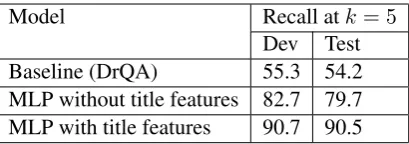
Model Recall atk= 5
[image:2.595.309.514.61.133.2]Dev Test Baseline (DrQA) 55.3 54.2 MLP without title features 82.7 79.7 MLP with title features 90.7 90.5
Figure 1: Document Retrieval Results
’known as’, etc. and if it is a disambiguation sentence it should have words like ’refers’ or ’see’ or ’confused’. It also allows for the han-dling of cases where the sentence tokeniza-tion splits the first sentence.
• Features based on the title: whether the title is completely contained in the claim and the overlap between the claim and the title (with and without metadata information in paren-theses), for both upper and lower case.
2.1 Experiments
We train a Multi-Layer Perceptron (MLP) using Pytorch (Paszke et al.,2017) on the top 1000 doc-uments extracted using DrQA, which obtains a re-call of 95.3%, with early stopping on the paper development set. We used the Adam optimizer (Kingma and Ba, 2015) with a learning rate of 0.001 and hyper-parameters of β1 = 0.9, β2 =
0.999, and = 10−8. We used pre-trained 300-dimensional GloVe embeddings. We clip gradi-ents at 2 and use a batch size of 32.
2.2 Results
Document recall atk = 5articles is presented in Figure1. We present results on the paper devel-opment and test sets as the evidence for the shared task blind test set was unavailable as of this writ-ing. The model with lexical and syntactic features obtains around 25 points absolute improvement over the DrQA baseline and the title features when added provide an additional 8 points improvement on the development set and 10.8 points on test.
3 Joint Sentence Extraction and Relation Prediction
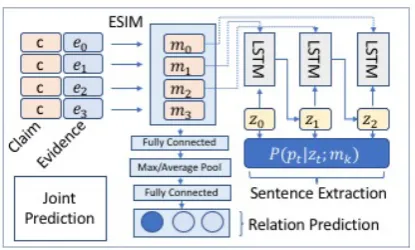
Figure 2: The contextual claim and evidence sentence representations obtained with ESIM.
First, given the topkextracted documents from our retrieval component, we select the topl sen-tences using a weighted combination of Jaccard similarity and cosine similarity of average word embeddings. Hyper-parameters were tuned so that the model would have minimal difference in re-call from the document retrieval stage but still fit in memory on a Tesla V100 with 16GB of mem-ory. We selectedk = 5andl = 50, with Jaccard similarity weighted at 0.3 and GloVe embeddings weighted at 0.7. We found that recall on the devel-opment set was 90.3.
We then store contextual representations of the claim and each evidence sentence in a memory network and use a pointer network to extract the top 5 sentences sequentially. Simultaneously, we use the entire memory of up tolsentences to pre-dict the relation: supports, refutes, or not enough info.
3.1 Sentence Representation
For each sentence in the evidence, we create con-textual representations using the ESIM module (Chen et al.,2017b), which first encodes the claim and the evidence sentence using an LSTM, attends to the claim and evidence, composes them using an additional LSTM layer, and finally applies max and average pooling over time (sentence length) to obtain a paired sentence representation for the claim and evidence. This representation is de-picted in Figure2. For more details, please refer to (Chen et al.,2017b).
The representation for a claim cand extracted evidence sentenceepforcis then:
mp =ESIM(c, ep) (1)
3.2 Sentence Extraction
[image:3.595.72.299.75.160.2]Next, to select the top 5 evidence sentences, we use a pointer network (Vinyals et al.,2015;Chen and Bansal,2018) over the evidence for claimcto
Figure 3: Our multi-task learning architecture with contextual ESIM representations used for evidence sentence extraction via a pointer network and relation prediction with max/average pooling and dense layers.
extract sentences recurrently. The extraction prob-ability1for sentenceepat timet <5is then:
utp =
(
veT tanh(W[mp;ht,q]), ifpt6=ps∀s < t.
−inf, otherwise.
(2)
P(pt|p0· · ·pt−1) =softmax(ut) (3)
with ht,q computed using the output of q hops over the evidence (Vinyals et al.,2016;Sukhbaatar et al.,2015):
αt,o =softmax(vhTtanh(Wg1mp+Wg2ht,o−1))
(4)
ht,o =X j
αt,oWg1mj (5)
At each timestept, we update the hidden stateztof the pointer network LSTM. Initially,ht,0 is set to zt. We train and validate the pointer network using the extracted toplsentences. For all training ex-amples, we randomly replace evidence sentences with gold evidence if no gold evidence is found.
3.3 Relation Prediction
In order to predict the support, refute, or not enough info relation, we use a single-layer MLP to obtain an abstract representation of the sentence representation used for extraction, then apply av-erage and max pooling over the contextual rep-resentations of the claim and evidence sentences to obtain a single representationm for the entire memory. Finally, we use a 2-layer MLP to predict this relation givenm. The entire joint architecture is presented in Figure3.
3.4 Optimization
We train the model to minimize the negative log likelihood of the extracted evidence sequence2and the cross-entropy loss (L(θrel)) of the relation pre-diction. The pointer network is trained as in a sequence-to-sequence model:
L(θptr) =−1/T
X
t=0..T
logPθptr(pt|p0:t−1) (6)
and the overall loss is then:
L(θ) =λL(θptr) +L(θrel) (7)
Since the evidence selection and relation pre-diction are scored independently for the FEVER task, we select the parameters using early stopping such that one set of parameters performs the best in terms of evidence recall on the validation set and another performs the best for accuracy.
Although the models are trained jointly to select evidence sentences that help predict the relation to the claim, we may obtain additional improvement by tuning the parameters given the output of the sentence extraction step. In order to do so, we first select the top 5 sentences from the sentence extrac-tor and predict the relation using only those sen-tences rather than the entire memory as before. In this scenario, we pre-train the model using multi-task learning and tune the parameters for relation prediction while keeping the sentence extraction parameters fixed (and using separate representa-tions for ESIM). We also experimented with a reinforcement learning approach to tune the sen-tence extractor as in (Chen and Bansal,2018) but found no additional improvement.
3.5 Experiments
We use Pytorch for our experiments. For the multi-task learning and tuning, we use the Ada-grad optimizer with learning rates of 0.01 and 0.001 and gradients clipped to 5 and 2, respec-tively. For both experiments, we used a batch size of 16. We used the paper development set for early stopping. We initialized the word embeddings with 300-dimensional GloVe vectors and fixed them during training, using a 200-dimensional projection. Out-of-vocabulary words were initial-ized randomly during both training and evaluation.
2The evidence as given has no meaningful order but we
use the support/refute sequence as provided in the dataset as it may contain annotator bias in terms of importance.
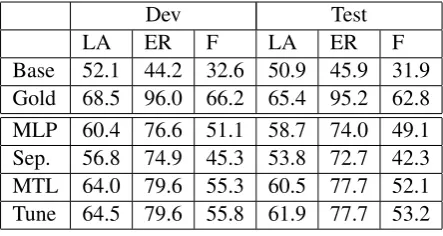
Dev Test
LA ER F LA ER F
[image:4.595.307.529.62.180.2]Base 52.1 44.2 32.6 50.9 45.9 31.9 Gold 68.5 96.0 66.2 65.4 95.2 62.8 MLP 60.4 76.6 51.1 58.7 74.0 49.1 Sep. 56.8 74.9 45.3 53.8 72.7 42.3 MTL 64.0 79.6 55.3 60.5 77.7 52.1 Tune 64.5 79.6 55.8 61.9 77.7 53.2
Figure 4: Paper Development and Test Results (LA: Label Accuracy, ER: Evidence Recall, F: FEVER Score)
The second dimension of all other parameter ma-trices was 200. For the pointer network, we used a beam size of 5 andq= 3hops.λwas set to 1.
4 Results
LA EF1 F Paper 62.2 31.6 53.5 Blind 59.7 29.7 49.9 Best 68.2 52.9 64.2
Figure 5: Blind Test Results (LA: Label Accuracy,
EF1: Evidence F1,F: FEVER Score)
examples where the model can both identify the correct sentences and label. Finally, we notice that improvements to document retrieval would also improve our model. The gap between Gold andTuneis around 20 points for evidence recall. When using gold Wikipedia articles (1-2 docu-ments), the number of sentences available (around 20 on average) is less than those selected for our model (l = 50), which makes evidence retrieval easier as the memory is smaller. As our models for document retrieval are fairly simple, it is likely that a more complex model could obtain better performance with fewer documents.
Results on the shared task blind test set (prior to any additional human evaluation of the evidence) are presented in Figure 5. For comparison, we show the results on the paper development and test sets (Paper) when submitted for the shared task as well as the results of the top system on the leaderboard (Best). On the blind test set (Blind), overall performance drops by 2-3 points for every metric compared to the paper set. As our analy-sis in Section 4.1 shows, the performance drops significantly when 2 or more evidence sentences are required. Thus, the performance decrease on the blind test set may be caused by an increase in the number of examples that require additional ev-idence, although as of this writing the evidence for the test set has not yet been released.
4.1 Analysis
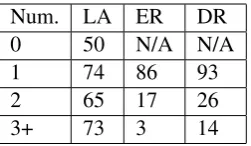
We present an analysis of the performance of the best model (Tune) when the model requires mul-tiple pieces of evidence. We present results in Fig-ure 6for no evidence (for the “not enough info” case) and 1, 2, and 3 or more sentences for label accuracy, evidence recall, and document recall at k = 5. When no evidence is required the model only obtains 50% accuracy. We found that this in-creases to 54% accuracy for theMTL model but the accuracy on the other 2 classes decreases. This suggests that using a larger memory improves per-formance when there is not enough information
Num. LA ER DR
0 50 N/A N/A
1 74 86 93
2 65 17 26
3+ 73 3 14
Figure 6: Paper Development Results by Number of Evidence Sentences Required (Num.: Sentences Re-quired, LA: Label Accuracy, ER: Evidence Recall,
DR: Document Recall)
to make a prediction. Intuitively, reading all rel-evant Wikipedia articles in their entirety would be necessary for a human to determine this as well. When only 1 sentence is required the model per-forms well. However, the performance drops sig-nificantly on recall when 2 or more sentences are required. This is largely due to the performance of the document retrieval component, which seems to perform poorly when the evidence retrieval re-quires 2 different Wikipedia articles. When ex-actly 2 sentences are required, the pointer network retrieves around 60% of the evidence if the re-trieved documents are correct. When 3 or more sentences are required, both components perform poorly, suggesting there is significant room for im-provement in this case (although there are very few examples requiring this amount of evidence).
5 Conclusion
We presented the results of our system for the FEVER shared task. We described our document retrieval system using lexical and syntactic fea-tures. We also described our joint sentence ex-traction and relation prediction system with multi-task learning. The results of our model suggest that the largest gains in performance are likely to come from improvements to detection of the “not enough info” class and retrieval of Wikipedia arti-cles (especially when more than one is required).
[image:5.595.115.250.61.122.2]References
Shraey Bhatia, Jey Han Lau, and Timothy Baldwin. 2016. Automatic labelling of topics with neural embeddings. In Proceedings of COLING 2016, the 26th International Conference on Computational Linguistics: Technical Papers, pages 953–963. The COLING 2016 Organizing Committee.
Danqi Chen, Adam Fisch, Jason Weston, and Antoine Bordes. 2017a. Reading wikipedia to answer open-domain questions. InProceedings of the 55th An-nual Meeting of the Association for Computational Linguistics (Volume 1: Long Papers), pages 1870– 1879. Association for Computational Linguistics.
Qian Chen, Xiaodan Zhu, Zhen-Hua Ling, Si Wei, Hui Jiang, and Diana Inkpen. 2017b. Enhanced lstm for natural language inference. In Proceedings of the 55th Annual Meeting of the Association for Compu-tational Linguistics (Volume 1: Long Papers), pages 1657–1668. Association for Computational Linguis-tics.
Yen-Chun Chen and Mohit Bansal. 2018. Fast abstrac-tive summarization with reinforce-selected sentence rewriting. InProceedings of the 56th Annual Meet-ing of the Association for Computational LMeet-inguistics (Volume 1: Long Papers), pages 675–686. Associa-tion for ComputaAssocia-tional Linguistics.
Diederik Kingma and Jimmy Ba. 2015. Adam: A method for stochastic optimization. InInternational Conference on Learning Represen- tations (ICLR).
Quoc Le, Ilya Sutskever, Oriol Vinyals, and Lukasz Kaise. 2016. Multi-task sequence to sequence learning. In International Conference on Learning Represen- tations (ICLR).
Christopher D. Manning, Mihai Surdeanu, John Bauer, Jenny Finkel, Steven J. Bethard, and David Mc-Closky. 2014. The Stanford CoreNLP natural lan-guage processing toolkit. InAssociation for Compu-tational Linguistics (ACL) System Demonstrations, pages 55–60.
Ramesh Nallapati, Feifei Zhai, and Bowen Zhou. 2017. Summarunner: A recurrent neural network based se-quence model for extractive summarization of doc-uments. In Proceedings of the Thirty-First AAAI Conference on Artificial Intelligence, February 4-9, 2017, San Francisco, California, USA., pages 3075– 3081.
Adam Paszke, Sam Gross, Soumith Chintala, Gre-gory Chanan, Edward Yang, Zachary DeVito, Zem-ing Lin, Alban Desmaison, Luca Antiga, and Adam Lerer. 2017. Automatic differentiation in pytorch.
Jeffrey Pennington, Richard Socher, and Christo-pher D. Manning. 2014. Glove: Global vectors for word representation. InEmpirical Methods in Nat-ural Language Processing (EMNLP), pages 1532– 1543.
Sainbayar Sukhbaatar, Arthur Szlam, Jason Weston, and Rob Fergus. 2015. End-to-end memory net-works. In C. Cortes, N. D. Lawrence, D. D. Lee, M. Sugiyama, and R. Garnett, editors,Advances in Neural Information Processing Systems 28, pages 2440–2448. Curran Associates, Inc.
James Thorne, Andreas Vlachos, Christos Christodoulopoulos, and Arpit Mittal. 2018. Fever: a large-scale dataset for fact extraction and verification. In Proceedings of the 2018 Conference of the North American Chapter of the Association for Computational Linguistics: Human Language Technologies, Volume 1 (Long Papers), pages 809–819. Association for Computational Linguistics.
Oriol Vinyals, Samy Bengio, and Manjunath Kudlur. 2016. Order matters: Sequence to sequence for sets. InInternational Conference on Learning Represen-tations (ICLR).