Modeling Online Discourse with Coupled Distributed Topics
Akshay Srivatsan† Zachary Wojtowicz‡ Taylor Berg-Kirkpatrick†
†Language Technologies Institute, Carnegie Mellon University,{asrivats,tberg}@cs.cmu.edu ‡Social and Decision Sciences, Carnegie Mellon University,[email protected]
Abstract
In this paper, we propose a deep, globally nor-malized topic model that incorporates struc-tural relationships connecting documents in so-cially generated corpora, such as online fo-rums. Our model(1) captures discursive in-teractions along observed reply links in addi-tion to tradiaddi-tional topic informaaddi-tion, and (2)
incorporates latent distributed representations arranged in a deep architecture, which enables a GPU-based mean-field inference procedure that scales efficiently to large data. We ap-ply our model to a new social media dataset consisting of13M comments mined from the popular internet forum Reddit, a domain that poses significant challenges to models that do not account for relationships connecting user comments. We evaluate against existing meth-ods across multiple metrics including perplex-ity and metadata prediction, and qualitatively analyze the learned interaction patterns.
1 Introduction
Topic models have become one of the most com-mon unsupervised methods for uncovering latent semantic information in natural language data, and have found a wide variety of applications across the sciences. However, many common models -such as Latent Dirichlet Allocation (Ng and Jordan,
2003) - make an explicit exchangeability assump-tion that treats documents as independent samples from a generative prior, thereby ignoring important aspects of text corpora which are generated by non-ergodic, interconnected social systems. While the direct application of such models to datasets such as transcripts of The French Revolution (Barron et al.,2017) and discussions on Twitter (Zhao et al.,
2011) have yielded sensible topics and exciting in-sights, their exclusion of document-to-document interactions imposes limitations on the scope of their applicability and the analyses they support.
For instance, on many social media platforms, com-ments are short (the average Reddit comment is10
words long), making them difficult to treat as full documents, yet they do cohere as a collection, sug-gesting that contextual relationships should be con-sidered. Moreover, analysis of social data is often principally concerned with understanding relation-ships between documents (such as question-asking and -answering), so a model able to capture such features is of direct scientific relevance.
To address these issues, we propose a design that models representations of comments jointly along observed reply links. Specifically, we attach a vec-tor of latent binary variables to each comment in a collection of social data, which in turn connect to each other according to the observed reply-link structure of the dataset. The inferred representa-tions can provide information about the rhetorical moves and linguistic elements that characterize an evolving discourse. An added benefit is that while previous work such as Sequential LDA (Du et al.,
2012) has focused on modeling a linear progres-sion, the model we present applies to a more gen-eral class of acyclic graphs such as tree-structured comment threads ubiquitous on the web.
ℎ1
�1
ℎ2 ℎ3
ℎ4
ℎ
�
log−bilinearfactor unobserved topics
observed word counts
�2 �3
�4
ℎ0 Thread-Level
Representation Comment-Level Representations
�3
�4
He took 300,000 photos so it’s a 1
in 300,00 shot!
Getting that lightning strike is a 1 in a trillionshot…
FYI this won The
�2 National Geographic photo contest lastyear…
<URL> For 14 years, Sergio
�1 Tapiro took 300,000+ photos
“of which only 100 aregood”…
Thread
Comment Reply Link
[image:2.595.78.369.62.282.2]�
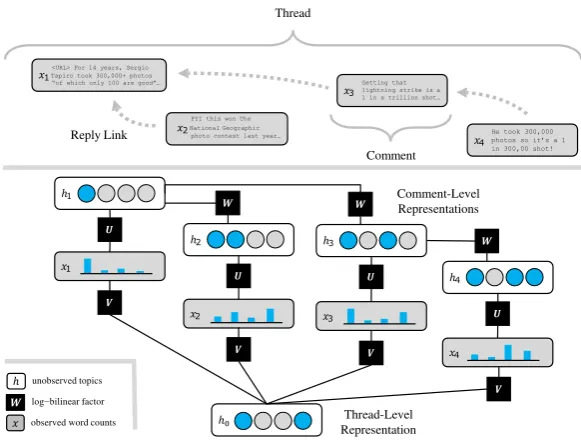
Figure 1: DDTM factor graph for an example thread. Each comment is modeled as an ob-served bag-of-wordsxwith top-ics represented by a latent bi-nary vectorh. Log-bilinear fac-tors connect the latent and ob-served variables of each com-ment, and the latent variables of parent-child comment pairs along observed reply links. Bi-ases are omitted for clarity.
features admits a mean-field inference procedure which takes the form of a series of dense matrix multiplications followed by nonlinearities, which is particularly amenable to GPU computation and lets us scale efficiently to large data.
Our model outperforms LDA and RS baselines on perplexity and downstream tasks including meta-data prediction and document retrieval when evalu-ated on a new dataset mined from Reddit. We also qualitatively analyze the learned topics and discuss the social phenomena uncovered.
2 Model
We now present an overview of our model. Specifi-cally, it will take the probabilistic form of an undi-rected graphical model whose architecture mirrors the tree structure of the threads in our data.
2.1 Motivating Dataset
We evaluate on a corpus mined from Reddit, an internet forum which ranks as the fourth most traf-ficked site in the US (Alexa,2018) and sees mil-lions of daily comments (Reddit,2015). Discourse on Reddit follows a branching pattern, shown in Figure1. The largest unit of discourse is a thread, beginning with a link to external content or a natu-ral language prompt, posted to a relevant subreddit based on its subject matter. Users comment in re-sponse to the original post (OP), or to any other comment. The result is a structure which splits at many points into more specific or tangential discussions that while locally coherent may dif-fer substantially from each other. The data reflect features of the underlying memory and network
structure of the generating process; comments are serially correlated and highly cross-referential. We treat individual comments as “documents” under the standard topic modeling paradigm, but use ob-served reply structure to induce a tree of documents for every thread.
2.2 Description of Discursive Distributed
Topic Model
speak-ing and mannerisms that do not directly indicate specific subjects of conversation. The joint proba-bility is defined in terms of an energy function that scores latent embeddings and observed word counts across the tree of comments within a thread using log-bilinear potentials, and is globally normalized over all word count and embedding combinations.
2.3 Probability Model
More formally, consider a thread containing N comments each of sizeDnwith a vocabulary of
sizeK. As depicted in Figure1, each comment is viewed as a bag-of-words, densely connected via a log-bilinear potential to a latent embedding of sizeF. Let each comment be represented as as an integer vectorxn ∈ ZK wherexnk is number
of times wordkwas observed in commentn, and lethn={0,1}F be the topic embedding for each
comment, and leth0 ={0,1}F be the embedding
for the entire thread. To model topic transitions, we score the embeddings of parent-child pairs with a separate coupling potential as shown in Figure1
(comments with no parents or children receive ad-ditional start/stop biases respectively). Let replies be represented with sets R, PN, andCN where
(n, m)∈Randn∈Pmandm∈Cnif comment
mis a reply to commentn. DDTM assigns prob-ability to a specific configuration ofx, hwith an energy function scored by the emission (πe) and
coupling (πc) potentials.
E(x, h;θ) =
N X
n=1
πe(h, x, n)
| {z }
Emission Potentials
+ X
(n,m)∈R
πc(h, n, m)
| {z }
Coupling Potentials
πe(h, x, n) =h⊺nU xn+x⊺na+Dnh⊺nb
+h⊺
0V xn+Dnh⊺0c
πc(h, n, m) =h⊺nW hm
(1)
Note that the bias on embeddings is scaled by the number of words in the comment, which controls for their highly variable length. The joint probabil-ity is computed by exponentiating the energy and dividing by a normalizing constant.
p(x, h;θ) = exp(E(x, h;θ))
Z(θ)
Z(θ) =X
x′,h′
exp(E(x′, h′;θ)) (2)
This architecture encourages the model to learn discursive maneuvers via the coupling potentials while separating within-thread variance and across-thread variance through the comment-level and thread-level embeddings respectively. The cou-pling of latent variables makes factored inference impossible, meaning that even the exact computa-tion of the particomputa-tion funccomputa-tion is no longer tractable. This necessitates approximating the gradients for learning which we will now address.
3 Learning and Inference
Inference in this model class in intractable, so as has been done in previous work on topic modeling (Ng and Jordan,2003) we rely on variational meth-ods to approximate the gradients needed during training as well as the posteriors over the topic bit vectors. Specifically, we will need the gradients of the normalizer and the sum of the energy function over the hidden variables
E(x;θ) = logX
h
exp(E(x, h;θ)) (3)
which we refer to as themarginal energy. Follow-ing the approach described for undirected models byEisner(2011), we approximate these quantities and their gradients with respect to the model pa-rametersθas we will now describe (thread-level embeddings are omitted in this section for clarity).
3.1 Normalizer Approximation
We aim to train our model to maximize the marginal likelihood of the observed comment word counts, conditioned on the reply links. To do this we must compute the gradient of the normalizer Z(θ). However, this quantity is computationally intractable, as it contains a summation over all exponential choices for every word in the thread. Therefore, we must approximate Z(θ). Observe that under Jensen’s Inequality, we can form the following lower bound on the normalizer using an approximate joint distributionq(Z).
logZ(θ) = logX
x,h
exp(E(x, h;θ))
≥Eq(Z)[E(x, h;θ)]−Eq(Z)[logq(Z)(x, h;φ, γ)]
(4)
We now define q(Z) as depicted in Figure 2
ℎ�
� �, ℎ; �, �
ℎ�
��
�
� �
�, ℎ; �
��, ��, ��, ��,
��
��
ℎ�
� ℎ; �
��, ��, ��, ��,
Joint Probability Variational Approx. to Joint Variational Approx. to Post.
Figure 2: Factor graph of full joint compared to mean-field approximations to joint and posterior.
φnf ∈ [0,1], independent Bernoulli parameters
representing the probability ofhnf being equal to
1, andγnk replicated softmaxes representing the
probability of a word inxntaking the valuek. Note
that all words inxnare modeled as samples from
this single distribution. The approximation then factors as follows:
q(Z)(x, h;φ, γ) =q(Z)(x;γ)·q(Z)(h;φ)
q(Z)(x;γ) =
N Y
n=1 K Y
k=1
(γnk)xnk
q(Z)(h;φ) =
N Y
n=1 F Y
f=1
(φnf)hnf(1−φnf)(1−hnf)
(5)
We optimize the parameters ofq(Z)to maximize its variational lower bound, via iterative mean-field updates, which allow us to perform coordinate as-cent over the parameters ofq(Z). Maximizing the lower bound with respect to particularφnf andγnk
while holding all other parameters frozen, yields the following mean-field update equations (biases omitted for clarity):
φn·=σ U γn+ X
m∈Cn
W φm+φ⊺PnW !
γn·=σ(φ⊺nU)
(6)
We iterate over the parameters of q(Z) in an “upward-downward” manner; first updatingφfor all comments with no children, then all comments whose children have been updated, and so on up to the root of the thread. Then we perform the same updates in reverse order. After updating allφ, we then updateγ simultaneously (the components of γ are independent conditioned on φ). We iterate these upward-downward passes until convergence.
3.2 Marginal Energy Approximation
We can now approximate the normalizer, but still need the marginal data likelihood in order to take gradient steps on it and train our model. In order to recover the marginal likelihood, we must next approximate the marginal energyE(x;θ)as it too is intractable. This is due to the coupling potentials, which make the topics across comments dependent even when conditioned on the word counts. To do this, we form an additional variational approxima-tion (see Figure2) to the marginal energy, which we optimize similarly.
E(x;θ) = logX
h
exp(E(x, h;θ))
≥Eq(E)[E(x, h;θ)]−Eq(E)[logq(E)(h;ψ)]
(7)
Since q(E)(h;ψ) need only model the hidden unitsh, we can parameterize it in the same man-ner as q(Z)(h;φ). Note that while these distribu-tions factor similarly, they do not share parame-ters, although we find that in practice, initializing φ←ψimproves our approximation. We optimize the lower bound onE(x;θ)via a similar coordi-nate ascent strategy, where the mean-field updates take the following form (biases omitted for clarity):
ψn·=σ U hn+ X
m∈Cn
W ψm+ψPn⊺ W !
(8)
We can useq(E)to perform inference at test time in our model, as its parametersψ directly corre-spond to the expected values of the hidden topic embeddings under our approximation.
3.3 Learning via Gradient Ascent
We train the parameters of our true modelp(x, h;θ)
ap-proximations on a single datum (i.e. thread) to com-pute the approximate gradient of its log-likelihood, and take a single gradient step on the model param-eters (repeating on all training instances until con-vergence). That gradient is given by the difference in feature expectations under the approximations (entropy terms from the lower bounds are dropped as they do not depend onθ).
∇logp(x;θ)≈Eq(E)(h;ψ)[∇E(x, h;θ)]
−Eq(Z)(x′,h;ψ)
∇E(x′, h;θ) (9)
In summary, we use two separate mean-field approximations to compute lower bounds on the marginal energy E(x, h;θ), and its normalizer Z(θ), which lets us approximate the marginal like-lihoodp(x;θ). Note that as our estimate on the marginal likelihood is the difference between two lower bounds, it is not a lower bound itself, al-though in practice it works well for training.
3.4 Scalability and GPU Implementation
Given the magnitude of our dataset, it is essen-tial to be able to train efficiently at scale. Many commonly used topic models such as LDA (Ng and Jordan,2003) have difficulty scaling, partic-ularly if trained via MCMC methods. Improve-ments have been shown from online training ( Hoff-man et al.,2010), but extending such techniques to model comment-to-comment connections and leverage GPU compute is nontrivial.
In contrast, our proposed model and mean-field procedure can be scaled efficiently to large data because they are amenable to GPU implementation. Specifically, the described inference procedure can be viewed as the output of a neural network. This is because DDTM is globally normalized with edges parameterized as log-bilinear weights, which re-sults in the mean-field updates taking the form of matrix operations followed by nonlinearities. Therefore, a single iteration of mean-field is equiv-alent to a forward pass through a recursive neu-ral network, whose architecture is defined by the tree structure of the thread. Multiple iterations are equivalent to feeding the output of the network back into itself in a recurrent manner, and optimiz-ing for T iterations is achieved by unrolling the network overT timesteps. This property makes DDTM highly amenable to efficient training on a GPU, and allowed us to scale experiments to a dataset of over13M total Reddit comments.
4 Experimental Setup
4.1 Data
We mined a corpus of Reddit threads pulled through the platform’s API. Focusing on the twenty most popular subreddits (gifs, today-ilearned, CFB, funny, aww, AskReddit, Black-PeopleTwitter, videos, pics, politics, The_Donald, soccer, leagueoflegends, nba, nfl, worldnews, movies, mildlyinteresting, news, gaming) over a one month period yielded200,000threads consist-ing of13,276,455comments total. The data was preprocessed by removing special characters, re-placing URLs with a domain-specific token, stem-ming English words using a Snowball English Stemmer (Porter,2001), removing stopwords, and truncating the vocabulary to only include the top
10,000most common words. OPs are modeled as a comment at the root of each thread to which all top-level comments respond. This dataset will be made available for public use after publication.
4.2 Baselines and Comparisons
We compare to baselines of Replicated Softmax (RS) (Salakhutdinov and Hinton,2009) and Latent Dirichlet Allocation (LDA) (Ng and Jordan,2003). RS is a distributed topic model similar to our own, albeit without any coupling potentials. LDA is a lo-cally normalized topic model which defines topics as non-overlapping distributions over words. To en-sure that DDTM does not gain an unfair advantage purely by having a larger embedding space, we divide the dimensions equally between comment-and thread-level. Unless specified64 bits/topics were used. We experiment with RS and LDA treat-ing either comments or full threads as documents.
4.3 Training and Initialization
SGD was performed using the Adam opti-mizer (Kingma and Ba,2015). When running in-ference, we found convergence was reached in an average of 2 iterations of updates. Using a sin-gle NVIDIA Titan X (Pascal) card, we were able to train our model to convergence on the training set of10M comments in less than30hours. It is worth noting that we found DDTM to be fairly sen-sitive to initialization. We found best results from Gaussian noise, with comment-level emissions at variance of0.01, thread-level emissions at0.0001, and transitions at0. We initialized all biases to0
Perplexity(nats)
Bits 32 64 96 128
RS (thr) 2240 2234 2233 2257 RS (cmt) 1675 1894 2245 2518
DDTM (-cpl) 2027 1704 1766 1953
[image:6.595.70.280.61.165.2]DDTM 1624 1590 1719 713
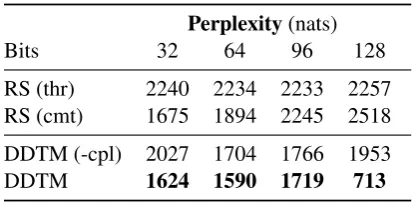
Table 1: Perplexity of DDTM with and without coupling potentials (-cpl) vs. baselines trained at comment (cmt) or thread (thr) level across vari-ous numbers of topics and bits. For reference, a unigram model achieves2644.
5 Results
5.1 Evaluating Perplexity
We compare models by perplexity on a held-out test set, a standard evaluation for generative and latent variables models.
Setup: Due to the use of mean-field
approxima-tions for both the marginal energy and normalizer we lose any guarantees regarding the accuracy of our likelihood estimate (both approximations are lower bounds, and therefore their difference is nei-ther a strict lower bound nor guaranteed to be unbi-ased). To evaluate perplexity in a more principled way, we use Annealed Importance Sampling (AIS) to estimate the ratio between our model’s normal-izer and the tractable normalnormal-izer of a base model from which we can draw true independent samples as described bySalakhutdinov and Murray(2008). Note that since the marginal energy is intractable in our model, unlike a standard RBM, we must sample the joint - and not the marginal - intermedi-ate distributions. This yields an unbiased estimintermedi-ate of the normalizer. The marginal energy must still be approximated via a lower bound, but given that AIS is unbiased and empirically low in variance, we can treat the overall estimate as a lower bound on likelihood for evaluation. Using2000 interme-diate distributions, and averaging over20runs, we evaluated per-word perplexity over a set of50 un-seen threads. Results are shown in Table1.
Results:DDTM achieves the lowest perplexity at
all dimensionalities. Note our ablation with the coupling potentials removed (-cpl), increases per-plexity noticeably, indicating that modeling replies helps beyond simply modeling threads and com-ments jointly, particularly at larger embeddings. For reference, a unigram model achieves 2644.
Task Upvote Regr. Deletion Pred.
(MSE) (% acc.)
LDA (thr) 1.952 68.35
LDA (cmt) 2.047 59.26
RS (thr) 2.024 69.92
RS (cmt) 2.007 66.45
DDTM 1.933 70.39
Table 2: Performance of DDTM vs. Replicated Softmax (RS) and Latent Dirichlet Allocation (LDA) at predicting upvotes and child deletion.
We find that LDA’s approximate perplexity is even worse, likely due to slackness in its lower bound.
5.2 Upvote Regression
To measure how well embeddings capture comment-level characteristics, we feed them into a linear regression model that predicts the number of upvotes the comment received. Upvotes provide a loose human-annotated measure of likability. We expect that context matters in determining how well received a comment is; the same comment posted in response to different parents may receive a very different number of upvotes. Hence, we expect comment-level embeddings to be more informa-tive for this task when connected via our model’s coupling potentials.
Setup: We trained a standard linear regressor for
each model. The regressor was trained using or-dinary least squares on the entire training set of comments using the model’s computed topic em-beddings as input, and the number of upvotes on the comment as the output to predict. As a pre-processing step, we took the log of the absolute number of votes before training. We compared models by mean squared error (MSE) on our test set. Results are shown in Table2.
Results:DDTM achieves lowest MSE. To assess
Figure 3: Precision vs. recall for document retrieval based on subreddit comparing various models for
1000randomly selected held-out query comments.
5.3 Deletion Prediction
Comments that are excessively provocative or in violation of site rules are often deleted, either by the author or a moderator. We can measure whether DDTM captures discursive interactions that lead to such intervention by training a logistic classifier that predicts whether any of a given comment’s children have been deleted.
Setup:For each model, a logistic regression classi-fier was trained stochastically with the Adam opti-mizer on the entire training set of comments using the model’s computed topic embeddings as input, and a binary label for whether the comment had any deleted children as the output to predict. We com-pared models by accuracy on our test set. Results are shown in Table2.
Results: DDTM gets the highest accuracy.
In-terestingly, thread-level models do better than comment-level ones, which suggests that certain topics or even subreddits may correlate with com-ments being deleted. This makes sense given that subreddits vary in severity of moderation. DDTM’s performance also demonstrates that mod-eling comment-to-comment interaction patterns is helpful in predicting when a comment will spawn a deleted future response, which strongly matches our intuition.
5.4 Document Retrieval
[image:7.595.344.484.64.195.2]Finally, while DDTM is not designed to better cap-ture topical struccap-ture, we evaluate the extent to which it can still capture this information by per-forming document retrieval, a standard evaluation, for which we treat the subreddit to which a thread
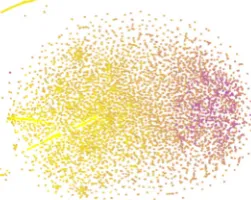
Figure 4: t-SNE visualization of a random sample of DDTM thread-level embeddings colored by sub-reddit (not observed in training)
Figure 5: t-SNE visualization of a random sample of DDTM comment-level embeddings colored by log of comment length (darker is longer).
was posted as a label for relevance. Note that every comment within the same thread belongs to the same subreddit, which gives thread-level models an inherent advantage at this task. We include this task purely for the purpose of demonstrating that by capturing discursive patterns, DDTM does not lose the ability to model thread-level topics as well.
Setup:Given a query comment from our held-out
test set, we rank the training set by the Dice simi-larity of the hidden embeddings computed by the model. We consider a retrieved comment relevant to the query if they both originate from the same subreddit, which loosely categorizes the seman-tic content. Tuning the number of documents we return allows us to form precision recall curves, which we show in Figure3.
Results:DDTM outperforms both comment-level
[image:7.595.355.481.271.371.2]Bit # Associated Word Stems by Emission Weight (Higher Score→Lower Score)
Comment-Level
Bit 1 faq tldrs pms 165 til keyword questions feedback chat pm
2 irl riamverysmart legend omfg riski aboard favr madman skillset tunnel 3 lotta brah ouch spici oof bummer buildup viewership hd uncanni
4 funniest mah tfw teleport fav hoo plz bah whyd dumbest
5 handsom hipster texan hottest whore norwegian shittier scandinavian jealousi douch
Thread-Level
Bit 1 btc gameplay tutori cyclist dev currenc kitti bitcoin rpg crypto
2 url_youtu url_leagueoflegends url_businessinsider url_twitter url_redd url_snopes 3 comey pede macron pg13 maga globalist ucf committe cuck distributor
[image:8.595.81.486.65.210.2]4 maduro venezuelan ballot puerto catalonia rican quak skateboard venezuela quebec 5 nra scotus opioid cheney nevada metallica marijuana vermont colorado xanax
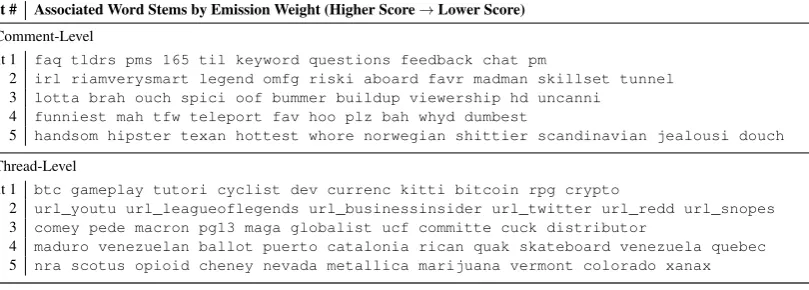
Table 3: Words with the highest emission weight for various comment-level and thread-level bits.
to do so. The gap between comment-level RS and LDA is also consistent with LDA’s known issues dealing with sparse data (Sridhar,2015), and lends credence to our theory that distributed topic repre-sentations are better suited to such domains.
6 Qualitative Analysis of Topics
We now offer qualitative analysis of the topic em-beddings learned by our model. Note that since we use distributed embeddings, our bits are more akin to filters than complete distributions over words, and we typically observe as many as half of them active for a single comment. In a sense, we have an exponential number of topics, whose parame-terization simply factors over the bits. Therefore, it can be difficult to interpret them as one would interpret topics learned by a model such as LDA. Furthermore, we find that in practice this effect is correlated with the topic embedding size; the more bits our model has, the less sparse and con-sequently less individually meaningful the bits be-come. Therefore for this analysis, we specifically focus on DDTM trained with 64 bits total.
6.1 Bits in Isolation
Directly inspecting the emission parameters, re-veals that the comment-level and thread-level halves of our embeddings capture substantially different aspects of the data (shown in Table 3) akin to vertical, within-thread, and horizontal, across-thread sources of variance respectively. The comment-level topic bits tend to reflect styles of speaking, lingo, and memes that are not unique to a particular subject of discourse or even subreddit. For example, comment-level Bit 2 captures many words typical of taunting Reddit comments; reply-ing with “/r/iamverysmart” (a subreddit dedicated
to mocking people who make grandiose claims about their intellect) is a common way of jokingly implying that the author of the parent comment takes themselves too seriously — and thus corre-sponds to a certain kind of rhetorical move. Further, it is grouped with other words that indicate related rhetorical moves; calling a user “risky” or a “mad-man” is a common means of suggesting that they are engaging in a pointless act of rebellion. They also cluster at the coarsest level by length (see Fig-ure5) which we find to correlate with writing style. By contrast, the thread-level bits are more in-dicative of specific topics of discussion, and unsur-prisingly they cluster by subreddit (see Figure4). For example, thread-level Bit 3 captures lexicon used almost exclusively by alt-right Donald Trump supporters as well as the names of various politi-cal figures. Bit 4 highlights words related to civil unrest in Spanish speaking parts of the world.
6.2 Bits in Combination
While these distributions over words (particularly for comment-level bits) can seem vague, when mul-tiple bits are active, their effects compound to pro-duce much more specific topics. One can think of the bits as defining soft filters over the space of words, that when stacked together carve out pat-terns not apparent in any of them individually. We now analyze a few sample topic embeddings. To do this, we perform inference as described on a held-out thread, and pass the comment-level topic embedding for a single sampled comment through our emission matrix and inspect the words with the highest corresponding weight (shown in Table4). In generative terminology, these can be thought of as reconstructions of comments.
Sample # Associated Word Stems by Emission Weight (Higher Score→Lower Score)
Comment-Level
Sample 1 grade grader math age 5th 9th 10th till mayb 7th
2 repost damn dope bamboozl shitload imagin cutest sad legendari awhil 3 heh dawg hmm spooki buddi aye m8 aww fam woah
4 hug merci bless tfw prayer pleas dear bear banana satan 5 chuckl cutest funniest yall bummer oooh mustv coolest ok oop
6 cutest heard coolest funniest havent seen ive craziest stupidest weirdest 7 reev keanu christoph murphi walken vincent chris til wick roger
8 moron douchebag stupid dipshit snitch jackass dickhead idioci hypocrit riddanc 9 technic actual realiz happen escal werent citat practic memo cba
10 reddit shill question background user subreddit answer relev discord guild
Table 4: Words with the highest emission weight for sample held-out comment reconstructions.
Sample 6 displays supportive and interested reac-tionary language, which one might expect to see used in response to a post or comment linking to media or describing something intriguing. This is of note given that one of the primary aims of includ-ing couplinclud-ing potentials was to encourage DDTM to learn “topics” that correspond to responses and interactive behavior, something existing methods are largely not designed for. By contrast, Sample 9 captures a variety of hostile language and insults, which unlike those discussed previously do not de-note membership in a particular online community. As patterns of toxic and hateful behavior on Red-dit are more well-studied (Chandrasekharan et al.,
2017), it could be useful to have a tool to analyze precipitous contexts and parent comments, some-thing which we hope systems based on coupling of comment embeddings have the capacity to pro-vide. Sample 10 is of particular interest as it con-sists largely of Reddit terminology. Conversations about the meta of the site can manifest for example in users accusing each other of being “shills” (i.e. accounts paid to astroturf on behalf of external in-terests) or requesting/responding to “guilding”, a feature which lets users purchase premium access for each other often in response to a particularly well made comment.
7 Related Work
Many topic models such as LDA (Ng and Jordan,
2003) treat documents as independent mixtures, yet this approach fails to model how comments inter-act with one another throughout a larger discourse if such connections exist in the data. Other work has considered modeling hierarchy in topics ( Grif-fiths et al.,2004). These models form hierarchical representations of topics themselves, but still treat documents as independent. While this approach can succeed in learning topics of various
granulari-ties, it does not explicitly track how topics interact in the context of a nested conversation.
Some approaches such as Pairwise-Link-LDA and Link-PSLA-LDA (Nallapati et al., 2008) at-tempt to model interactions among documents in an arbitrary graph, albeit with important drawbacks. The former models every possible pairwise link between comments, and the latter models links as a bipartite graph, limiting its ability to scale to large tree-structured threads. Similar work on Topic-Link LDA (Liu et al., 2009) models link probabilities conditioned on both topic similar-ity and an authorship model, yet this approach is poorly suited to high volume, semi-anonymous on-line domains. Other studies have leveraged reply-structures on Reddit in the context of predicting persuasion (Hidey and McKeown), but DDTM dif-fers in its generative, unsupervised approach.
DDTM’s emission potentials are similar to those of Replicated Softmax (Salakhutdinov and Hinton,
2009), an undirected model based on a Restricted Boltzmann Machine. Unlike LDA-style models, RS does not assign a topic to each word, but instead builds a distributed representation. In this setting, a single word can be likely under two different topics, both of which are present, and lend probability mass to that word. LDA-style models by contrast would require the topics to compete for the word.
8 Conclusion
References
Alexa. 2018. Reddit.com traffic, demographics and competitors. https://www.alexa.com/
siteinfo/reddit.com. Accessed:
2018-02-22.
Alexander TJ Barron, Jenny Huang, Rebecca L Spang, and Simon DeDeo. 2017. Individuals, institutions, and innovation in the debates of the french revolu-tion. arXiv preprint arXiv:1710.06867.
Eshwar Chandrasekharan, Umashanthi Pavalanathan, Anirudh Srinivasan, Adam Glynn, Jacob Eisenstein, and Eric Gilbert. 2017. You can’t stay here: The efficacy of reddit’s 2015 ban examined through hate speech. Proceedings of the ACM on Human-Computer Interaction, 1(CSCW):31.
Lan Du, Wray Buntine, Huidong Jin, and Changyou Chen. 2012. Sequential latent dirichlet allocation. Knowledge and information systems, 31(3):475– 503.
Jason Eisner. 2011. High-level explanation of varia-tional inference. https://www.cs.jhu.edu/
~jason/tutorials/variational.html.
Accessed: 2018-02-22.
Thomas L Griffiths, Michael I Jordan, Joshua B Tenen-baum, and David M Blei. 2004. Hierarchical topic models and the nested chinese restaurant process. In Advances in neural information processing systems, pages 17–24.
Christopher Hidey and Kathleen McKeown. Persua-sive influence detection: The role of argument se-quencing. InAssociation for the Advancement of Ar-tificial Intelligence.
M. Hoffman, D. Blei, and F. Bach. 2010. Online learn-ing for latent dirichlet allocation. Neural Informa-tion Processing Systems.
Diederik P. Kingma and Jimmy Ba. 2015. Adam: A method for stochastic optimization. 3rd Interna-tional Conference for Learning Representations.
Yan Liu, Alexandru Niculescu-Mizil, and Wojciech Gryc. 2009. Topic-link lda: joint models of topic and author community. In proceedings of the 26th annual international conference on machine learn-ing, pages 665–672. ACM.
Ramesh M Nallapati, Amr Ahmed, Eric P Xing, and William W Cohen. 2008. Joint latent topic models for text and citations. In Proceedings of the 14th ACM SIGKDD international conference on Knowl-edge discovery and data mining, pages 542–550. ACM.
D. Blei A. Ng and M. Jordan. 2003. Latent dirichlet allocation. Journal of Machine Learning Research, 3:993–1022.
Martin Porter. 2001. Snowball: A language for stem-ming algorithms. http://snowball. tartarus.org/texts. Accessed: 2018-02-22.
Reddit. 2015. Reddit in 2015. https: //redditblog.com/2015/12/31/
reddit-in-2015/. Accessed: 2018-02-22.
Ruslan Salakhutdinov and Geoffrey Hinton. 2009. Replicated softmax: An undirected topic model. Ad-vances in Neural Information Processing Systems, 22:1607–1614.
Ruslan Salakhutdinov and Iain Murray. 2008. On the quantitative analysis of deep belief networks. Pro-ceedings of the 25th International Conference on Machine Learning.
Vivek Kumar Rangarajan Sridhar. 2015. Unsupervised topic modeling for short texts using distributed repre-sentations of words. InProceedings of the 1st Work-shop on Vector Space Modeling for Natural Lan-guage Processing, pages 192–200.