Exploring Supervised LDA Models for Assigning Attributes to
Adjective-Noun Phrases
Matthias Hartung and Anette Frank
Computational Linguistics Department Heidelberg University
{hartung,frank}@cl.uni-heidelberg.de
Abstract
This paper introduces an attribute selection task as a way to characterize the inherent mea-ning of property-denoting adjectives in adjec-tive-noun phrases, such as e.g. hot in hot
sum-mer denoting the attribute TEMPERATURE,
rather than TASTE. We formulate this task
in a vector space model that represents adjec-tives and nouns as vectors in a semantic space defined over possible attributes. The vectors incorporate latent semantic information ob-tained from two variants of LDA topic mod-els. Our LDA models outperform previous ap-proaches on a small set of 10 attributes with considerable gains on sparse representations, which highlights the strong smoothing power of LDA models. For the first time, we extend the attribute selection task to a new data set with more than 200 classes. We observe that large-scale attribute selection is a hard prob-lem, but a subset of attributes performs ro-bustly on the large scale as well. Again, the LDA models outperform the VSM baseline.
1 Introduction
Corpus-based statistical modeling of semantics is gaining increased attention in computational linguis-tics. This field of research includes distributional vector space models (VSMs), i.e., models that rep-resent the semantics of words or phrases as vectors over high-dimensional cooccurrence data (Turney and Pantel, 2010; Baroni and Lenci, 2010, i.a.), as well as latent variable models (LVMs) which aggre-gate distributional observations in ’hidden’, or latent variables, thereby reducing the dimensionality of the
data. An example of the latter are topic models (Blei et al., 2003), which have recently been applied to modeling selectional preferences of verbs (Ritter et al., 2010; ´O S´eaghdha, 2010), or word sense disam-biguation (Li et al., 2010).
A topic that is increasingly studied in distribu-tional semantics is the semantics of adjectives, both in isolation (Almuhareb, 2006) and in compositional adjective-noun phrases (Hartung and Frank, 2010; Guevara, 2010; Baroni and Zamparelli, 2010).
In this paper, we propose a new approach to a problem we denote as attribute selection: The task is to predict the hidden attribute meaning expressed by a property-denoting adjective in composition with a noun. The adjective hot, e.g., may denote
at-tributes such as TEMPERATURE, TASTE or
EMO-TIONALITY. These adjective meanings can be com-bined with nouns such as tea, soup or debate, which can be characterized in terms of attributes as well. The goal of the task is to determine the hidden at-tribute meaning predicated over the noun in a given adjective-noun phrase, as illustrated in (1).
(1) a. a hotvalue summerconcept
b. TEMPERATURE(summer) = hot
It is by way of the composition of adjective and noun that specific attributes are selected from the ad-jective’s space of possible attribute meanings, and typically lead to a disambiguation of the adjective and possibly the noun. Hartung and Frank (2010) were the first to model this insight in a VSM by rep-resenting the meaning of adjectives and nouns in se-mantic vectors defined over attributes. The meaning of adjective-noun phrases is computed by means of
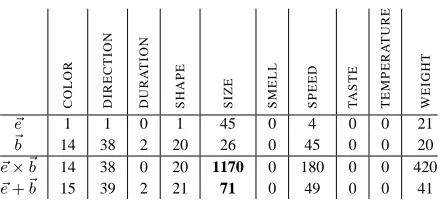
C O L O R D IR E C T IO N D U R A T IO N S H A P E S IZ E S M E L L S P E E D T A S T E T E M P E R A T U R E W E IG H T
~e 1 1 0 1 45 0 4 0 0 21
~b 14 38 2 20 26 0 45 0 0 20
~
e×~b 14 38 0 20 1170 0 180 0 0 420
~
[image:2.612.76.296.54.155.2]e+~b 15 39 2 21 71 0 49 0 0 41
Figure 1: Vectors for enormous (~e) and ball (~b)
vector composition, such that the ‘hidden’ attribute meaning of the phrase can be ‘selected’ as a promi-nent compopromi-nent from the composed vector. This is illustrated in Fig. 1 for the adjective enormous (~e) in combination with the noun ball (~b), with alter-native composition operations: vector multiplication (×) and addition (+).1 Both yieldSIZEas the most prominent component in the composed vector.
In the present paper we offer a new approach to this formalization of the compositional meaning of adjectives and nouns that owes to both distributional VSMs and LVMs. Through this combination, we attempt to improve on earlier work in Almuhareb (2006) and Hartung and Frank (2010), which are both embedded in a purely distributional setting.
Specifically, we use Latent Dirichlet Allocation (LDA; Blei et al. (2003)) to train an attribute model that captures semantic information encoded in ad-jectives and nouns independently of one another. Following Hartung and Frank (2010), this model is embedded into a VSM that employs vector com-position to combine the meaning of adjectives and nouns. We present two variants of LDA that differ in the way attributes are associated with the induced LDA topics: Controled LDA (C-LDA) and Labeled LDA (L-LDA; Ramage et al. (2009)). Both will be presented in detail in Section 3.
Our aims in this paper are two-fold: (i) We inves-tigate LDA as a modeling framework in the attribute selection task, as its use of topics as latent variables may alleviate inherent sparsity problems faced by prior work using pattern-based (Almuhareb, 2006) or vector space models (Hartung and Frank, 2010). (ii) While these prior approaches were restricted to a confined set of 10 attributes, we will we apply our
1
The figure is adopted from the distributional setting of Har-tung and Frank (2010), with component values defined by pat-tern frequency counts for the chosen attribute nouns.
models on a much larger space of attributes, to probe their capacity on a more realistic data set.
The remainder of this paper is divided as fol-lows. Section 2 reviews related work on distribu-tional models of adjective semantics, and introduces the two frameworks in which we ground our ap-proach: LVMs and VSMs. In Section 3 we introduce two LDA models for attribute selection: C-LDA and L-LDA. Section 4 describes the settings for two ex-periments: In the first experiment, we perform at-tribute selection confined to a space of 10 atat-tributes to compare against prior work. In the second setting we perform attribute selection on a large scale, using 206 attributes. Section 5 presents and discusses the results. Section 6 concludes.
2 Related Work
Distributional models of adjective semantics.
Almuhareb (2006) aims at capturing the relationship between adjectives and attributes based on lexico-syntactic patterns, such as the ATTR of the * is ADJ. Apart from inherent sparsity issues, his approach does not account for the compositional nature of the problem, as the contextual information contributed by a noun is neglected: For instance, his model is unable to predict that hot is unlikely to denoteTASTE in the context of summer, other than in hot meal.
Compositionality of adjective-noun phrases and how it can be adequately modeled in VSMs is the main concern in Baroni and Zamparelli (2010) and Guevara (2010), who are in search of the best composition operator for combining adjective
with noun meanings. While these works adhere
to a purely latent representation of meaning, Har-tung and Frank (2010) include attributes as sym-bolic ‘hidden’ meanings of adjectives, nouns and adjective-noun phrases in a distributional VSM.
Finally, a large body of work dealing with com-positionality in distributional frameworks is not con-fined to the special case of adjective-noun composi-tion (Mitchell and Lapata (2008), Rudolph and Gies-brecht (2010), i.a.). All these approaches regard composition as a process combining vectors (or ma-trices, resp.) to yield a new, contextualized vector representation within the same semantic space.
for document collections. Each document is repre-sented as a mixture over latent topics, where each topic is a probability distribution over words (Blei et al., 2003). These topics can be used as dense fea-tures for, e.g., document clustering. Depending on the number of topics, which has to be pre-specified, the dimensionality of the document representation can be considerably reduced in comparison to sim-ple bag-of-words models. The remainder of this pa-per will assume some familiarity with LDA and the LDA terminology as introduced in Blei et al. (2003). Recent work investigates ways of accommodating supervision with LDA, e.g. supervised topic models (Blei and McAuliffe, 2007), Labeled LDA (L-LDA) (Ramage et al., 2009) or DiscLDA (Lacoste-Julien et al., 2008). We will discuss L-LDA in Section 3.
Distributional VSMs and TMs. The idea to inte-grate topic models and VSMs goes back to Mitchell and Lapata (2009) who build a distributional model with dimensions set to topics over bag-of-words fea-tures. In their setting, LDA merely serves the pur-pose of dimensionality reduction, whereas our par-ticular motivation is to use topics as probabilistic indicators for the prediction of attributes as seman-tic target categories in adjective-noun composition. Mitchell and Lapata (2010) compare VSMs defined over bags of context words vs. latent topics in a sim-ilarity judgement task. Their results indicate that a multiplicative setting works best for vector compo-sition in word-based models, while vector addition is better suited for topic vectors.
3 Topic Models for Attribute Selection
3.1 Using LDA for modeling lexical semantics
Recently, LDA has been used for problems in lexical semantics, where the primary goal is not document modeling but the induction of semantic knowledge from high-dimensional co-occurrence data. Ritter et al. (2010) and ´O S´eaghdha (2010) model selectional restrictions of verbs by inducing topic distributions that characterize ’mixtures of topics’ observed in verb argument positions. As a basis for LDA mod-eling, they collect pseudo-documents, i.e. bags of words that co-occur in syntactic argument positions. We apply a similar idea to the attribute selection problem: we collect pseudo-documents that char-acterize attributes by adjectives and nouns that
co-occur with the attribute nouns in local contextual re-lations. The topic distributions obtained from fitting an LDA model to the collection of these pseudo-documents can then be injected into semantic vector representations for adjectives and nouns.
In its original statement, LDA is a fully unsuper-vised process (apart from the desired number of top-ics which has to be specified in advance) that es-timates topic distributions over documents θd and topic-word distributions φt with topics represented as latent variables. Estimating these parameters on a document collection yields topic proportionsP(t|d)
and topic distributions P(w|t) that can be used to compute a smooth distribution P(w|d) as in (2), where t denotes a latent topic, w a word and d a document in the corpus.
P(w|d) =X
t
P(w|t)P(t|d) (2)
Being designed for exploratory rather than dis-criminative analysis, LDA does not intend condi-tioning of words or topics on external categories. That is, the resulting topics cannot be related to pre-viously defined target categories. For attribute se-lection, the LDA-inferred topics need to be linked to semantic attributes. Therefore, we apply two ex-tensions of standard LDA that are capable of taking supervised category information into account, either implicitly or directly, by including an additional ob-servable variable into the generative process.
3.2 Controled LDA
The generative story behind C-LDA is equivalent to standard LDA. However, the collection of pseudo-documents used as input to C-LDA is structured in a controled way such that each document conveys semantic information that specifically characterizes the individual categories of interest (attributes, in our case). In line with the distributional hypothesis (Harris, 1968), we consider the pseudo-documents constructed in this way as distributional fingerprints of the meaning of the corresponding attribute.
The contents of the pseudo-documents are se-lected along syntactic dependency paths linking each attribute noun to meaningful context words (ad-jectives and nouns).2 A corpus consisting of the two sentences in (3), e.g., yields a pseudo-document for the attribute nounSPEEDcontaining car and fast.
(3) What is the speed of this car? The machine runs at a very fast speed.
Though we are ultimately interested in triples of attributes, adjectives and nouns that define the com-positional semantics of adjective-noun phrases (cf. (1)), C-LDA is only exposed to binary tuples be-tween attributes and adjectives or nouns,
respec-tively. This is in line with Hartung and Frank
(2010), who obtained substantial performance im-provements by splitting the ternary relation into two binary relations.
Presenting LDA with pseudo-documents that cha-racterize individual target attributes imports super-vision into the LDA process in two respects: the estimated topic proportions P(t|d) will be highly attribute-specific, and similarly so for the topic dis-tributions P(w|t). This makes the model more ex-pressive for the ultimate labeling task. Moreover, since C-LDA collects pseudo-documents focused on individual target attributes, we are able to link exter-nal categories to the generative process by heuristi-cally labeling pseudo-documents with their respec-tive attribute as target category. Thus, we approx-imate P(w|a), the probability of a word given an attribute, byP(w|d)as obtained from LDA:
2The dependency paths, together with the set of attribute
nouns of interest, have to be manually specified. See the sup-plementary material for the full list of dependency paths used.
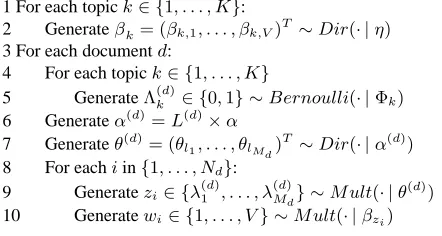
1 For each topick∈ {1, . . . , K}:
2 Generateβk= (βk,1, . . . , βk,V)T ∼Dir(· |η) 3 For each documentd:
4 For each topick∈ {1, . . . , K}
5 GenerateΛ(kd)∈ {0,1} ∼Bernoulli(· |Φk) 6 Generateα(d)=L(d)×α
7 Generateθ(d)= (θ
l1, . . . , θlMd)
T
∼Dir(· |α(d))
8 For eachiin{1, . . . , Nd}: 9 Generatezi∈ {λ(1d), . . . , λ
(d)
Md} ∼M ult(· |θ (d))
[image:4.612.312.533.60.178.2]10 Generatewi∈ {1, . . . , V} ∼M ult(· |βzi)
Figure 2: L-LDA generative process (Ramage et al. 2009)
P(w|a)≈P(w|d) =X
t
P(w|t)P(t|d) (4)
3.3 Labeled LDA
L-LDA (Ramage et al., 2009) extends standard LDA to include supervision for specific target categories, yet in a different way: (i) The generative process includes a second observed variable, i.e. each doc-ument is explicitly labeled with a target category. A document may be labeled with an arbitrary num-ber of categories; unlabeled documents are also
pos-sible. However, L-LDA permits only binary
as-signments of categories to documents; probabilistic weights over categories are not intended. (ii) Con-trary to LDA, where the number of topics has to be specified in advance, L-LDA sets this parameter to the number of unique target categories. Moreover, the model is constrained such that documents may be assigned only those topics that correspond to their observable category label(s). That is, latent topics t in the standard formulation of LDA (2) are con-strained to correspond to explicit labelsa.
More specifically, L-LDA extends the generative process of LDA by constraining the topic distribu-tions over documentsθ(d) to only those topics that correspond to the document’s set of labelsΛ(d). This is done by projecting the parameter vector of the Dirichlet topic priorα to a lower-dimensional vec-torα(d) whose topic dimensions correspond to the document labels.
This extension is integrated in steps 5 and 6 of Fig. 2: First, in step 5, the document’s labels Λ(d)
L(d)
|λ(d)|×K, such thatL
(d)
ij = 1 ifλ
(d)
i = j, and 0 oth-erwise. This matrix is used in step 6 to project the Dirichlet topic prior αto a lower-dimensional vec-torα(d), whose topic dimensions correspond to the document labels. Topic proportions are then, in step 7, generated for this reduced parameter space.
In our instantiation of L-LDA, we collect pseudo-documents for attributes exactly as for C-LDA. Doc-uments are labeled with exactly one category, the at-tribute noun. Note that, even though the relationship between documents and topics is fixed, the one be-tween topics and words is not. Any word occurring in more than one document will be assigned a non-zero probability for each corresponding topic.
Thus, with regard to attribute modeling, C-LDA and L-LDA build an interesting pair of opposites: The L-LDA model assumes that attributes are se-mantically primitive in the sense that they cannot be decomposed into smaller topical units, whereas words may be associated with several attributes at the same time. C-LDA, at the other end of the spec-trum, licenses semantic variability on both the at-tribute and the word level. Particularly, a word might be associated with some of the topics underlying an attribute, but not with all of them, and an attribute can be characterized by multiple topics.
3.4 Vector Space Framework
For integrating the information obtained from C-LDA or L-C-LDA into a distributional VSM, we
fol-low Hartung and Frank (2010): Adjectives and
nouns are modeled as independent semantic vectors along their relationship to attributes; the most promi-nent attribute(s) that represent the hidden meaning of adjective-noun phrases are selected from their composition (cf. Fig. 1).
The dimensions of the VSM are set to the pre-selected attributes. Semantic vectors are computed for all adjectives and nouns occurring at least five times in the pseudo-documents. Vector component values vhw,ai are derived from the C-LDA and L-LDA models in different ways: with C-L-LDA we obtainP(w|a)by approximation from P(w|d) (cf. equation (4)), while in L-LDA we obtainP(w|a) di-rectly from the induced topic-word distribution φt, through labeled topicst=a(cf. equation (2)).
Vector composition is defined as vector
multipli-cation (×) or vector addition (+).
For attribute selection on the composed vector, we use two methods we found to perform best in Har-tung and Frank (2010): Entropy Selection (ESel) and Most Prominent Component (MPC). ESel mea-sures entropy over the vector components to identify components that encode a high amount of informa-tion. It selects all attributes that lead to an increase of entropy when suppressed from the vector represen-tation. If no informative components can be detected in a vector due to a very broad, flat distribution of the probability mass (cf.~bin Fig. 1), ESel yields an empty list. MPC always chooses exactly one vector component, i.e. the one with the highest value.
4 Experimental Settings
Attribute selection over small and large semantic spaces. We evaluate the performance of the VSMs based on C-LDA and L-LDA in two experimental settings, contrasting the problem of attribute selec-tion on semantic spaces of radically different dimen-sionality, using sets of 10 vs. 206 attributes.
Evaluation measures. We evaluate against two gold standards consisting of adjective-noun phrases (or adjective-noun pairs) and their associated at-tribute meanings. We report precision, recall and f1-score. Where appropriate, we test differences in
the performance of various model configurations for statistical significance in a randomized permutation test (Yeh, 2000), using thesigftool (Pad´o, 2006).
Baselines. We compare our models against two
baselines, PATTVSM and DEPVSM. PATTSVM is
reconstructed from Hartung and Frank (2010). It is grounded in a selection of lexical patterns that iden-tify the target elements (adjectives and nouns) for the vector basis elements (i.e., the attribute nouns) in a local context window. The component values are defined using raw frequency counts over the ex-tracted patterns. DEPVSM is similar to PATTVSM; however, it relies on dependency paths that connect the target elements and attributes in local contexts. The paths are identical to the ones used for con-structing pseudo-documents in C-LDA and L-LDA. As in PATTVSM, the vector components are set to raw frequencies over extracted paths.
the Stanford Topic Modeling Toolbox3 for L-LDA. In both cases, we run 1000 iterations of Gibbs sam-pling, using default values for all hyperparameters.
Data set for attribute selection over 10 attributes.
The first experiment is conducted on the data set used in Hartung and Frank (2010). It consists of 100 adjective-noun pairs manually annotated for
ten attributes: COLOR, DIRECTION, DURATION,
SHAPE, SIZE, SMELL, SPEED, TASTE, TEMPER-ATURE, WEIGHT. To enable comparison, the di-mensions of our models are set to exactly these at-tributes.
Data set for attribute selection over a large se-mantic space (206 attributes). In the second ex-periment, we max out the attribute selection task to a much larger set of attributes in order to an-alyze the difficulty of the task on more represen-tative data. We automatically construct a data set of adjective-noun phrases labeled with appropriate attributes from WordNet 3.0 (Fellbaum, 1998), re-lying on the assumption that examples given in glosses correspond to the respective word sense of the adjective. We first extract all adjectives that are linked to at least one attribute synset by the
attributerelation. Next, we run the glosses of these adjectives (3592 in number) through TreeTag-ger (Schmid, 1994) to find examples of adjectives modifying nouns in attributive constructions. The resulting adjective-noun phrases are labeled with the attribute label linked to the given adjective sense.
This method yields 7901 labeled adjective-noun phrases. They are divided into development and test data according to a sampling procedure that respects the following criteria: (i) Both sets must contain all attributes with an equal number of phrases for each attribute; (ii) phrases with both elements con-tained in CoreWordNet4 are preferred, while others are only considered if necessary to satisfy the first criterion. This procedure yields 496/345 phrases in the development/test set, distributed over 206 at-tributes5.
3http://nlp.stanford.edu/software/tmt/.
4A subset of WordNet restricted to the 5000 most
fre-quently used word senses. Available from: http:// wordnetcode.princeton.edu/standoff-files/ core-wordnet.txt
5If an attribute provides only one example, this was added
to the development set. Therefore, the test set only comprises
Training data. The pseudo-documents are collec-ted from dependency paths obtained from section 2 of the parsed pukWaC corpus (Baroni et al., 2009).
5 Discussion of Results
5.1 Experiment 1
In Experiment 1, we evaluate the performance of C-LDA and L-LDA on the attribute selection task over 10 attributes against the pattern-based and dependency-based models PATTVSM and DE-PVSM as competitive baselines. Besides a com-parison to standard VSMs, we are especially in-terested in the relative performance of the LDA models. Given that C-LDA and L-LDA estimate attribute-specific topic distributions in the structured pseudo-documents under different assumptions re-garding the correspondence of attributes and topics (cf. Sec. 3.2 and 3.3), we expect the two LDA vari-ants to differ in their capability to capture the topic distributions in the labeled pseudo-documents.
5.1.1 Attribute Selection for 10 Attributes
Tables 1 and 2 summarize the results for at-tribute selection over 10 atat-tributes against the la-beled adjective-noun pairs in the test set, using ESel and MPC as selection functions on vectors com-posed by multiplication (Table 1) and addition (Ta-ble 2). The results reported for C-LDA correspond to the best performing model (with number of top-ics set to 42, as this setting yields the best and most constant results over both composition operators).
C-LDA shows highest f-scores and recall over all settings, and highest precision with vector addition.6 In line with Mitchell and Lapata (2010) (cf. Sec. 2), we obtain the best overall results with vector addi-tion (ESel: P: 0.55, R: 0.66, F: 0.61; MPC: P: 0.59, R: 0.71, F: 0.64). The difference between C-LDA and L-LDA is small but significant for vector mul-tiplication; for vector addition, it is not significant.
Compared to the LDA models, the VSM baselines
206 attributes, while all models were trained on 262 attributes obtained from WordNet in the first extraction step.
6
ESel MPC
P R F P R F
C-LDA 0.58 0.65 0.61L,P 0.57 0.64 0.60
L-LDA 0.68 0.54 0.60D 0.55 0.61 0.58D
[image:7.612.315.532.59.217.2]DepVSM 0.48 0.58 0.53P 0.57 0.60 0.58 PattVSM 0.63 0.46 0.54 0.60 0.58 0.59
Table 1: Attribute selection over 10 attributes (×)
ESel MPC
P R F P R F
C-LDA 0.55 0.66 0.61D,P 0.59 0.71 0.64 L-LDA 0.53 0.57 0.55D,P 0.50 0.45 0.47D,P DepVSM 0.38 0.65 0.48P 0.57 0.60 0.58
[image:7.612.87.287.59.126.2]PattVSM 0.71 0.35 0.47 0.47 0.56 0.51
Table 2: Attribute selection over 10 attributes (+)
are competitive, but tend to perform lower. This ef-fect is statistically significant for ESel with vector multiplication: each of the LDA models statistically significantly outperforms one of the VSM models, DEPVSM and PATTVSM. With ESel and vector addition, both LDA models outperform both VSM models statistically significantly. The LDAESel,+
models outperform the PATTVSMESel,+ model of
Hartung and Frank (2010) by a high margin in
f-score: +0.14 for C-LDA; +0.08 for L-LDA.
Compared to the stronger multiplicative settings PATTVSMESel,× and PATTVSMM P C,× this still
represents a plus of +0.07 and +0.02 in f-score, re-spectively. We further observe a clear improvement of the LDA models over the VSM models in terms of recall (+0.20, C-LDAESel,+ vs. PATTVSMESel,×),
at the expense of some loss in precision (-0.08, C-LDAESel,+vs. PATTVSMESel,×). This clearly
con-firms a stronger generalization power of LDA com-pared to VSM models.
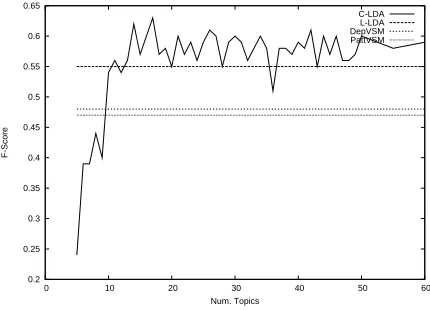
With regard to selection functions, we observe that MPC tends to perform better for the VSM mod-els, while ESel is more suitable in the LDA models. Figures 3 and 4 display the overall performance curve ranging over different topic numbers for C-LDAESel,+ and C-LDAESel,× – compared to the
remaining models that are not dependent on topic size. For topic numbers smaller than the attribute set size, C-LDA underperforms, for obvious reasons. Increasing ranges of topic numbers to 60 does not show a linear effect on performance. Parameter set-tings with performance drops below the VSM base-lines are rare, which holds particularly for vector
0.2 0.25 0.3 0.35 0.4 0.45 0.5 0.55 0.6 0.65
0 10 20 30 40 50 60
F-Score
Num. Topics
C-LDA L-LDA DepVSM PattVSM
Figure 3: Performance of C-LDAESel,× for different
topic numbers, compared against all other models
0.2 0.25 0.3 0.35 0.4 0.45 0.5 0.55 0.6 0.65
0 10 20 30 40 50 60
F-Score
Num. Topics
C-LDA L-LDA DepVSM PattVSM
Figure 4: Performance of C-LDAESel,+ for different
topic numbers, compared against all other models
dition at topic ranges larger than 10. With vector addition, C-LDA outperforms L-LDA in almost all configurations, yet at an overall lower performance level of L-LDA (0.55 with addition vs. 0.6 with mul-tiplication). Note that in the multiplicative setting, C-LDA reaches the performance of L-LDA only in its best configurations, while with vector addition it obtains high performance that exceeds L-LDA’s top f-score of 0.6 for topic ranges between 10 and 20.
Based on these observations, vector addition seems to offer the more robust setting for C-LDA, the model that is less strict with regard to topic-attribute correspondences. Vector multiplication, on the other hand, is more suitable for L-LDA and its stricter association of topics with class labels.
5.1.2 Smoothing Power of LDA Models
[image:7.612.317.532.260.415.2]ESel MPC
P R F P R F
[image:8.612.337.515.57.116.2]C-LDA 0.39 0.31 0.35 0.37 0.27 0.32 L-LDA 0.30 0.18 0.23 0.20 0.18 0.19 DepVSM 0.20 0.10 0.13 0.37 0.26 0.30 PattVSM 0.00 0.00 0.00 0.00 0.00 0.00
Table 3: Performance figures on sparse vectors (×)
ESel MPC
P R F P R F
[image:8.612.84.282.57.231.2]C-LDA 0.43 0.33 0.38 0.44 0.28 0.34 L-LDA 0.34 0.16 0.22 0.37 0.18 0.24 DepVSM 0.16 0.17 0.17 0.36 0.21 0.27 PattVSM 0.13 0.04 0.06 0.17 0.25 0.20
Table 4: Performance figures on sparse vectors (+)
to pattern-based or purely distributional approaches. While this is broadly confirmed in the above results by global gains in recall, we conduct a special evalu-ation focused on those pairs in the test set that suffer from sparse data. We selected all adjective and noun vectors that did not yield any positive component values in the PATTVSM model. The 22 adjective-noun pairs in the test set affected by these ’zero vec-tors’ were evaluated using the remaining models.
The results in Tables 3 and 4 yield a very clear pic-ture: C-LDA obtains highest precision, recall and f-score across all settings, followed by L-LDA and DEPVSMESel, while their ranks are reversed when using MPC. Again, MPC works better for the VSM models, ESel for the LDA models. Vector addition performs best for C-LDA with f-scores of 0.38 and 0.34 – outperforming the pattern-based results on sparse vectors by orders of magnitude.
5.2 Experiment 2
Experiment 2 is designed to max out the space of attributes to be modeled, to assess the capacity of both LDA models and the DEPVSM baseline model in the attribute selection task on a large attribute space.7 In contrast to Experiment 1, with its con-fined semantic space of 10 target attributes, this rep-resents a huge undertaking.
5.2.1 Large-scale Attribute Selection
Table 5 (column all) displays the performance of all models on attribute selection over a range of 206
7
We did not apply PATTVSM to this large-scale experiment, as only poor performance can be expected.
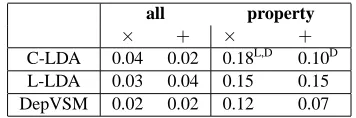
all property
× + × +
C-LDA 0.04 0.02 0.18L,D 0.10D
L-LDA 0.03 0.04 0.15 0.15
[image:8.612.90.282.57.126.2]DepVSM 0.02 0.02 0.12 0.07
Table 5: Performance figures (in f-score) of C-LDAESel
on 206 (all) and 73 property attributes (property)
all property
P R F P R F
WIDTH 0.67 1.00 0.80 1.00 0.50 0.67
WEIGHT 0.80 0.57 0.67 0.50 0.57 0.53
MAGNETISM 0.50 1.00 0.67
SPEED 0.50 0.50 0.50 1.00 0.50 0.67
TEXTURE 0.33 1.00 0.50 0.33 1.00 0.50
DURATION 0.50 0.50 0.50 1.00 1.00 1.00
TEMPERATURE 0.30 0.75 0.43 0.43 0.75 0.55
AGE 0.33 0.50 0.40
THICKNESS 1.00 0.25 0.40 0.50 0.13 0.20
DEGREE 1.00 0.20 0.33
LENGTH 0.17 1.00 0.29 0.50 1.00 0.67
DEPTH 1.00 0.14 0.25 1.00 0.86 0.92
ACTION 0.17 0.50 0.25
LIGHT 0.33 0.17 0.22 0.20 0.17 0.18
POSITION 0.14 0.25 0.18 0.20 0.25 0.22
SHARPNESS 1.00 1.00 1.00
SERIOUSNESS 0.50 1.00 0.67
COLOR 0.13 0.25 0.17 0.29 0.50 0.36
LOYALTY 1.00 1.00 1.00
average 0.49 0.54 0.51 0.63 0.63 0.63
Table 6: Attribute selection on 206 attributes (all) and 73 property attributes (property); performance figures of C-LDAESel,×for best attributes (F>0)
dimensions, contrasting vector addition and multi-plication. The number of topics was set to 400. As the overall performance is close to 0 for both com-position methods, no parameter setting can be iden-tified as particularly suited for this large-scale at-tribute selection task. The differences between the three models are very small and not significant8.
5.2.2 Focused Evaluation and Data Analysis
To gain a deeper insight into the modeling capac-ity of the LDA models for this large-scale selection task, Table 6 (column all) presents a partial evalua-tion of attributes that could be assigned to adjective-noun pairs with an f-score>0 by C-LDAESel,×.
Despite the disappointing overall performance of
8
[image:8.612.87.283.154.226.2] [image:8.612.322.529.157.411.2]prediction correct thin layer THICKNESS THICKNESS
heavy load WEIGHT WEIGHT
shallow water DEPTH DEPTH
short holiday DURATION DURATION
attractive force MAGNETISM MAGNETISM
short hair LENGTH LENGTH
serious book DIFFICULTY MIND
blue line COLOR UNION
weak president POSITION POWER
fluid society REPUTE CHANGEABLENESS
short flight DISTANCE DURATION
rough bark TEXTURE EVENNESS
[image:9.612.80.291.57.213.2]faint heart CONSTANCY COWARDICE
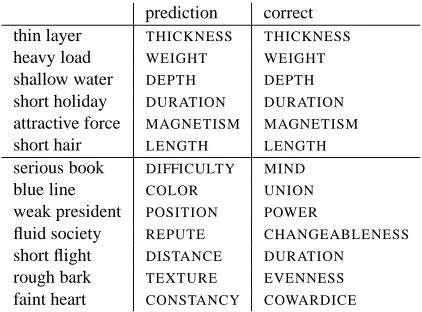
Table 7: Sample of correct and false predictions of C-LDAESel,×in Experiment 2
the LDA models on this large attribute space, it is remarkable that C-LDA is able to induce distinctive topic distributions for a number of attributes with up to 0.51 f-score with balanced precision and recall, a moderate drop of only -0.10 relative to the corre-sponding model induced over 10 attributes.
Raising the attribute selection task from 10 to 206 attributes poses a true challenge to our models, by the sheer size and diversity of the semantic space considered. Table 7 gives an insight into the nature of the data and the difficulty of the task, by listing correct and false preditions of C-LDA for a small sample of adjective-noun pairs. Possible explana-tions for false predicexplana-tions are manifold, among them near misses (e.g. serious book, weak president, short flight, rough bark), idiomatic expressions (e.g. faint heart, blue line) or questionable labels provided by WordNet (e.g. serious book).
As seen above, C-LDA achieves relatively high performance figures on selected attributes (cf. Table 6, col. all). In order to identify what makes these attributes different from others that resist success-ful modeling, we investigated three factors: (i) the amount of training data available for each attribute, (ii) the ambiguity rate per attribute, and (iii) their ontological subtype.
(i) Measuring the dependence between training data size and f-score per attribute shows that a large amount of training data is generally helpful, but not the decisive factor (Pearson’sr = 0.19,p <0.01).
(ii) The ambiguity rate ARattr per attribute attr is computed by averaging over all test pairsT Pattr labeled withattr, counting the total number of
at-tributesattr′ that are associated with each adjective in pairshadj, ni ∈T Pattr in WordNet:
ARattr =
P
attr′Phadj,ni∈T Pattr|hadj, attr′iW N| |T Pattr|
Correlating this figure with the performance per at-tribute in terms of f-score yields only a small pos-itive correlation (Pearson’s r = 0.23, p < 0.01). In fact, the qualitative analysis in Table 7 shows that C-LDA is capable of assigning meaningful attributes to adjective-noun phrases not only in easy, but also ambiguous cases (cf. shallow water, where DEPTH is the only attribute provided for shallow in Word-Net vs. short holiday, short hair or short flight).
(iii) Although the 206 attributes used in Exp. 2 are rather diverse, including concepts such as HEIGHT, KINDNESS or INDIVIDUALITY, we observe a high number of attributes from Exp. 1 that are success-fully modeled in Exp. 2 (5 out of 10, cf. column
all in Table 6). Given that they are categorized into
the property class in WordNet9, we presume that the varying performance across attributes might be in-fluenced by their ontological subtype. This hypoth-esis is validated in a replication of Exp. 2, with train-ing data limited to the 73 attributes pertaintrain-ing to the property subtype in WordNet. The test set was re-stricted accordingly, resulting in 112 pairs that are linked to a property attribute.
The overall performance of the models in this ex-periment is shown in Table 5 (column property): With vector multiplication, the best-performing op-eration across all models, all models benefit consid-erably (+0.10 or more). C-LDA shows the largest improvement, significantly outperforming both L-LDA and DEPVSM. With vector addition, the per-formance gains are slightly lower in general. In this setting, L-LDA shows higher f-score than C-LDA, though this difference is not statistically sig-nificant. Still, C-LDA significantly outranges DE-PVSM. Note that we can not show a significant dif-ference between C-LDAESel,× and L-LDAESel,+,
so the comparison between these models remains in-conclusive here. Note further that the affinity of C-LDA with vector addition and L-C-LDA with vector multiplication, respectively, is inverted in the large-scale experiment (cf. Table 5).
9
WordNet separates attributes into properties, qualities and
While these overall results are far from satisfac-tory, they still clearly indicate that the LDA models work effectively for at least a subset of attributes, and outperform the VSM baseline.
Again, a more detailed analysis is given in Ta-ble 6 (column property), showing the performance of the best individual property attributes (F >0) in the restricted experiment. Average performance of the best property attributes withF >0, individually, amounts toF=0.6310. In comparison to the unres-tricted setting (cf. column all), nearly all property attributes benefit from model training on selective
data. Exceptions areWIDTH,WEIGHT,THICKNESS,
AGE, DEGREE and LIGHT. Thus, apparently, some of the adjectives associated with non-property at-tributes in the full set provide some discriminative power that is helpful to distinguish property types.
In a qualitative analysis of the 133 non-property attributes filtered out in this experiment, we find that the WordNet-SUMO mapping (Niles, 2003) does not provide differentiating definitions for about 60% of these attributes, linking them instead to a single subjective assessment attribute. This suggests that in many cases the distinctions drawn by WordNet are too subtle even for humans to reproduce.
6 Conclusion
This paper explored the use of LDA topic models in a semantic labeling task that predicts attributes as ’hidden’ meanings in the compositional seman-tics of adjective-noun phrases. LDA topic models are expected to alleviate sparsity problems of dis-tributional VSMs as encountered in prior work, by incorporating latent semantic information about at-tribute nouns. We investigated two variants of LDA that employ different degrees of supervision for as-sociating topics with attributes.
Our contributions are as follows. We proposed two LDA models for the attribute selection task that import supervision for a target category parameter in different ways: L-LDA (Ramage et al., 2009) embeds the target categories into the LDA process, by defining a 1:1 correspondence of topics and tar-get categories. C-LDA, by contrast, does not af-fect the LDA generative process. Here, we
heuris-10
In comparison, L-LDAESel,×yields an average f-score of 0.47 for attributes withF >0 in the property setting.
tically equate pseudo-documents with target cate-gories, to approximate category-specific word-topic distributions. By adhering to standard LDA, C-LDA accommodates a greater variety in the distributions of topics to attribute-specific documents and words, as compared to L-LDA. Combining standard LDA topic modeling with a means of interpreting the in-duced topics relative to a set of external categories, C-LDA offers greater flexibility and expressiveness. Our experimental results show that modeling at-tributes as latent or explicit topics with C-LDA and L-LDA, respectively, outperforms the purely distri-butional baseline model DEPVSM and PATTVSM of prior work. Targeted evaluation on sparse data points confirms that LDA models help to overcome inherent sparsity effects of VSMs. C-LDA and L-LDA are close in performance in Experiment 1. C-LDA outperforms L-C-LDA only with optimal topic parameter settings.
Finally, we probed the modeling capacity of LDA and VSM models on a vast space of 206 attributes. This task proved to be extremely difficult. However, we obtain respectable results on a subset of attributes denoting properties, where C-LDA performs best in quantitative performance measures. It yields high-est f-scores in full and partial evaluation – both with the full-size attribute model, and when training and testing is restricted to property attributes. The differ-ences are small, but statistically significant between the LDA models and the VSM baseline in a setting restricted to property attributes.
Data analysis indicates that our models perform more robustly on concrete attributes in contrast to abstract attribute types that lack clear categorization. This suggests that our approach to attribute selec-tion is most appropriate for detecting attributes that reflect clear ontological distinctions.
References
Abdulrahman Almuhareb. 2006. Attributes in Lexical
Acquisition. Ph.D. Dissertation, Department of
Com-puter Science, University of Essex.
Marco Baroni and Alessandro Lenci. 2010.
Distri-butional Memory. A General Framework for Corpus-based Semantics. Computational Linguistics, 36:673– 721.
Marco Baroni and Roberto Zamparelli. 2010. Nouns
are vectors, adjectives are matrices: Representing
adjective-noun constructions in semantic space. In
Proceedings of the 2010 Conference on Empiri-cal Methods in Natural Language Processing, East
Stroudsburg, PA, pages 1183–1193.
M. Baroni, S. Bernardini, A. Ferraresi, and E. Zanchetta. 2009. The WaCky Wide Web: A Collection of Very Large Linguistically Processed Web-Crawled Corpora.
Language Resources and Evaluation, 43:209–226.
D. Blei and J. McAuliffe. 2007. Supervised topic mod-els. Neural Information Processing Systems, 21. David M. Blei, Andrew Ng, and Michael Jordan. 2003.
Latent dirichlet allocation. JMLR, 3:993–1022. Christiane Fellbaum, editor. 1998. WordNet: An
Elec-tronic Lexical Database. MIT Press, Cambridge, Mass.
Emiliano Guevara. 2010. A regression model of
adjective-noun compositionality in distributional
se-mantics. In Proceedings of the 2010 Workshop on
GEometrical Models of Natural Language Semantics,
Stroudsburg, PA. Association for Computational Lin-guistics.
Zellig Harris. 1968. Mathematical Structures of
Lan-guage. Wiley.
Matthias Hartung and Anette Frank. 2010. A Structured Vector Space Model for Hidden Attribute Meaning in Adjective-Noun Phrases. In Proceedings of the 23rd
International Conference on Computational Linguis-tics (COLING), Beijing, China, August.
Matthias Hartung and Anette Frank. 2011. Assessing in-terpretable, attribute-related meaning representations for adjective-noun phrases in a similarity prediction task. In Proceedings of GEometrical Models of
Nat-ural Language Semantics (GEMS-2011), Edinburgh,
UK.
Simon Lacoste-Julien, Fei Sha, and Michael I. Jordan. 2008. DiscLDA: Discriminative Learning for Dimen-sionality Reduction and Classification. In NIPS, vol-ume 22.
Linlin Li, Benjamin Roth, and Caroline Sporleder. 2010. Topic models for word sense disambiguation and token-based idiom detection. In Proceedings of the
48th Annual Meeting of the Association for Computa-tional Linguistics, ACL ’10, pages 1138–1147,
Upp-sala, Sweden.
Andrew Kachites McCallum. 2002.
MAL-LET: A machine learning for language toolkit. http://mallet.cs.umass.edu.
Jeff Mitchell and Mirella Lapata. 2008. Vector-based Models of Semantic Composition. In Proceedings of
ACL-08: HLT, pages 236–244, Columbus, Ohio, June.
Jeff Mitchell and Mirella Lapata. 2009. Language Mod-els Based on Semantic Composition. In Proceedings
of the 2009 Conference on Empirical Methods in Nat-ural Language Processing, Singapore, August 2009,
pages 430–439, Singapore, August.
Jeff Mitchell and Mirella Lapata. 2010. Composition in distributional models of semantics. Cognitive Science, 34:1388–1429.
Ian Niles. 2003. Mapping WordNet to the SUMO Ontol-ogy. In Proceedings of the IEEE International
Knowl-edge Engineering conference, pages 23–26, June.
Diarmuid ´O S´eaghdha. 2010. Latent variable models
of selectional preference. In Proceedings of the 48th
Annual Meeting of the Association for Computational Linguistics, pages 435–444, Uppsala, Sweden, July.
Association for Computational Linguistics.
Sebastian Pad ´o, 2006. User’s guide to sigf:
Signifi-cance testing by approximate randomisation.
D. Prescher, S. Riezler, and M. Rooth. 2000. Using a probabilistic class-based lexicon for lexical ambiguity resolution. In Proceedings of the 18th COLING, pages 649–655.
Daniel Ramage, David Hall, Ramesh Nallapati, and
Christopher D. Manning. 2009. Labeled LDA: A
supervised topic model for credit attribution in multi-labeled corpora. In Proceedings of the 2009
Confer-ence on Empirical Methods in Natural Language Pro-cessing, Singapore, August 2009, pages 248–256.
Alan Ritter, Mausam, and Oren Etzioni. 2010. A La-tent Dirichlet Allocation Method for Selectional
Pref-erences. In Proceedings of the 48th Annual
Meet-ing of the Association for Computational LMeet-inguistics,
pages 424–434, Uppsala, Sweden, July. Association for Computational Linguistics.
Sebastian Rudolph and Eugenie Giesbrecht. 2010. Com-positional matrix-space models of language. In
Pro-ceedings of the 48th Annual Meeting of the Association for Computational Linguistics, pages 907–916.
Asso-ciation for Computational Linguistics, July.
Helmut Schmid. 1994. Probabilistic part-of-speech
tagging using decision trees. In Proceedings of the
International Conference on New Methods in Lan-guage Processing (NeMLaP). Manchester, U.K., 14– 16 September 1994.
Peter D. Turney and Patrick Pantel. 2010. From Fre-quency to Meaning: Vector space models of semantics.
Journal of Artificial Intelligence Research, 37:141–
Alexander Yeh. 2000. More accurate tests for the sta-tistical significance of result differences. In
Proceed-ings of the Fourth Conference on Computational Lan-guage Learning (CoNLL-2000) and the Second Learn-ing Language in Logic Workshop, Lisbon, Portugal,