Efficient Left-to-Right Hierarchical Phrase-based Translation with
Improved Reordering
Maryam Siahbani, Baskaran Sankaran, Anoop Sarkar Simon Fraser University
Burnaby BC. CANADA
{msiahban,baskaran,anoop}@cs.sfu.ca
Abstract
Left-to-right (LR) decoding (Watanabe et al., 2006b) is a promising decoding algorithm for hierarchical phrase-based translation (Hiero). It generates the target sentence by extending the hypotheses only on the right edge. LR de-coding has complexityO(n2b)for input ofn words and beam sizeb, compared toO(n3)for the CKY algorithm. It requires a single lan-guage model (LM) history for each target pothesis rather than two LM histories per hy-pothesis as in CKY. In this paper we present an augmented LR decoding algorithm that builds on the original algorithm in (Watanabe et al., 2006b). Unlike that algorithm, using experi-ments over multiple language pairs we show two new results: our LR decoding algorithm provides demonstrably more efficient decod-ing than CKY Hiero, four times faster; and by introducing new distortion and reordering fea-tures for LR decoding, it maintains the same translation quality (as in BLEU scores) ob-tained phrase-based and CKY Hiero with the same translation model.
1 Introduction
Hiero (Chiang, 2007) models translation using a lex-icalized synchronous context-free grammar (SCFG) extracted from word aligned bitexts. Typically, CKY-style decoding is used for Hiero with time complexity O(n3) for source input with n words. Scoring the target language output using a lan-guage model within CKY-style decoding requires two histories per hypothesis, one on the left edge of each span and one on the right, due to the fact that the target side is not generated in left to right order, but rather built bottom-up from sub-spans. This leads to complex problems in efficient lan-guage model integration and requires state reduc-tion techniques (Heafield et al., 2011; Heafield et al., 2013). The size of a Hiero SCFG grammar is typically larger than phrase-based models extracted
from the same data creating challenges in rule ex-traction and decoding time especially for larger datasets (Sankaran et al., 2012).
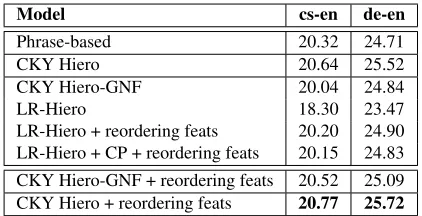
In contrast, the LR-decoding algorithm could avoid these shortcomings such as faster time com-plexity, reduction in the grammar size and the sim-plified left-to-right language model scoring. It means LR decoding has the potential to replace CKY decoding for Hiero. Despite these attractive properties, we show that the original LR-Hiero de-coding proposed by (Watanabe et al., 2006b) does not perform to the same level of the standard CKY Hiero with cube pruning (see Table 3). In addition, the current LR decoding algorithm does not obtain BLEU scores comparable to phrase-based or CKY-based Hiero models for different language pairs (see Table 4). In this paper we propose modifications to the LR decoding algorithm that addresses these limi-tations and provides, for the first time, a true alterna-tive to the standard CKY Hiero algorithm that uses left-to-right decoding.
We introduce a new extended version of the LR decoding algorithm presented in (Watanabe et al., 2006b) which is demonstrably more efficient than the CKY Hiero algorithm. We measure the effi-ciency of the LR Hiero decoder in a way that is independent of the choice of system and program-ming language by measuring the number of lan-guage model queries. Although more efficient, the new LR decoding algorithm suffered from lower BLEU scores compared to CKY Hiero. Our anal-ysis of left to right decoding showed that it has more potential for search errors due to early pruning of good hypotheses. This is unlike bottom-up decoding (CKY) which keeps best hypotheses for each span. To address this issue, we introduce two novel fea-tures into the Hiero SMT model that deal with re-ordering and distortion. Our experiments show that LR decoding with these features using prefix
calized target side rules equals the scores obtained by CKY decoding with prefix lexicalized target side rules and phrase-based translation system. It per-forms four times fewer language model queries on average, compare to CKY Hiero decoding with un-restricted Hiero rules: 6466.7 LM queries for CKY Hiero (with cube pruning) compared to 1500.45 LM queries in LR Hiero (with cube pruning). While translation quality suffers by only about 0.67 in BLEU score on average, across two different lan-guage pairs.
2 Left-to-Right Decoding for Hiero
Hierarchical phrase-based SMT (Chiang, 2005; Chi-ang, 2007) uses a synchronous context free gram-mar (SCFG), where the rules are of the formX → hγ, αi, where X is a non-terminal, γ and α are strings of terminals and non-terminals.
Chiang (2007) places certain constraints on the extracted rules in order to simplify decoding. This includes limiting the maximum number of non-terminals (rule arity) to two and disallowing any rule with consecutive non-terminals on the foreign lan-guage side. It further limits the length of the initial phrase-pair as well as the number of terminals and non-terminals in the rule. For translating sentences longer than the maximum phrase-pair length, the de-coder relies on additional glue rules S → hX, Xi
andS → hSX, SXi that allows monotone
combi-nation of phrases. The glue rules are used when no rules could match or the span length is larger than the maximum phrase-pair length.
2.1 Rule Extraction for LR Decoding
Left-to-right Hiero (Watanabe et al., 2006b) gener-ates the target hypotheses left to right, but for syn-chronous context-free grammar (SCFG) as used in Hiero. The target-side rules are constrained to be prefix lexicalized. These constrained SCFG rules are defined as:
X → hγ,¯b βi (1)
where γ is a mixed string of terminals and non-terminals. ¯bis a terminal sequence prefixed to the possibly empty non-terminal sequence β. For the sake of simplicity, We refer to these type of rules as
their work
students X1
X2
X6
X4 X5
X3 have
not yet
done
.
schuler ihre arbeit noch nicht gemacht haben .
students have not yet done their work .
(b) (a)
gemacht
schuler X1
X2
X6
X5 X4
X3 haben
noch nicht
ihre arbeit
. 1
2
3 6
4 5
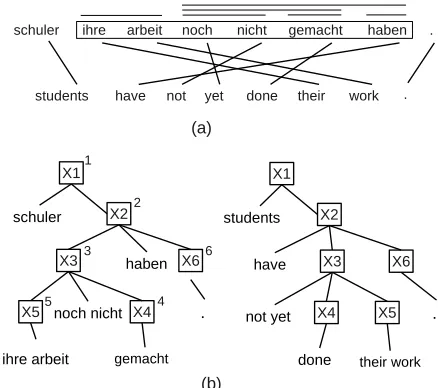
Figure 1: (a): A word-aligned German-English sentence pair. The bars above the source words indicate phrase-pairs having at least two words. (b): its corresponding left-to-right target derivation tree. Superscripts on the source non-terminals show the indices of the rules (see Fig 2) used in derivation.
GNF rules1in this paper.
Rule extraction is similar to Hiero, except any rules violating GNF form on the target side are excluded. Rule extraction considers each smaller source-target phrase pair within a larger phrase pair and replaces the spans with non-terminalX, yield-ing hierarchical rules. Figure 1(a) shows a word-aligned German-English sentence with a phrase
pair hihre arbeit noch nicht gemacht haben,
have not yet done their workithat will lead to a
SCFG rule. Given other smaller phrases (marked by bars above the source side), we extract a GNF rule2:
X →
hX1noch nicht X2haben, have not yet X2X1i (2)
In order to avoid data sparsity and for better gen-eralization, Watanabe et al. (2006b) adds fourglue
rules for each lexical rule hf,¯ ¯ei which are analo-gous to the glue rules defined in (Chiang, 2007) (see above) except that these glue rules for LR decoding
1
Griebach Normal Form (GNF), although the synchronous grammar is not in this normal form, rather only the target side is prefix lexicalized as if it were in GNF form.
2LR-Hiero rule extraction excludes non-GNF rules such as
[image:2.612.317.536.61.255.2]allow reordering as well.
X→ hfX¯ 1,eX¯ 1i X → hX1fX¯ 2,eX¯ 1X2i
X→ hX1f,¯eX¯ 1i X → hX1fX¯ 2,eX¯ 2X1i
(3)
It might appear that the restriction that target-side rules be GNF is a severe restriction on the cover-age of possible hypotheses compared to the full set of rules permitted by the Hiero extraction heuris-tic. However there is some evidence in the liter-ature that discontinuous spans on the source side in translation rules is a lot more useful than dis-continuous spans in the target side (which is disal-lowed in the GNF). For instance, (Galley and Man-ning, 2010) do an extensive study of discontinuous spans on source and target side and show that source side discontinuous spans are very useful but remov-ing discontinuous spans on the target side only low-ers the BLEU score by 0.2 points (using the Joshua SMT system on Chinese-English). Removing dis-continuous spans means that the target side rules have the form: uX, Xu, XuX, XXu, oruXX of which we disallow Xu, XuX, XXu. Zhang and Zong (2012) also conduct a study on discontinuous spans on source and target side of Hiero rules and conclude that source discontinuous spans are always more useful than discontinuities on the target side with experiments on four language pairs (zh-en, fr-en, de-en and es-en). As we shall also see in our experimental results (see Table 4) we can get close to the BLEU scores obtained using the full set of Hi-ero rules by using only target lexicalized rules in our LR decoder.
2.2 LR-Hiero Decoding
LR-Hiero decoding uses a top-down depth-first search, which strictly grows the hypotheses in target surface ordering. Search on the source side follows an Earley-style search (Earley, 1970), the dot jumps around on the source side of the rules based on the order of nonterminals on the target side. This search is integrated with beam search or cube pruning to efficiently find thek-best translations.
Several important details about the algorithm of LR-Hiero decoding are implicit and unexplained in (Watanabe et al., 2006b). In this section we scribe the LR-Hiero decoding algorithm in more de-tail than the original description in (Watanabe et al.,
Algorithm 1: LR-Hiero Decoding 1: Input sentence:f =f0f1. . . fn
2: F =FutureCost(f) (Precompute future cost for spans)
3: fori= 0, . . . , ndo
4: Si={} (Create empty stacks)
5: h0= (hsi,[[0, n]],∅,F[0,n]) (Initial hypothesis
4-tuple)
6: Addh0toS0 (Push initial hyp into first Stack)
7: fori= 0, . . . , n−1do 8: foreachhinSido
9: [u, v]= pop(hs) (Pop first uncovered span
from list)
10: R = GetSpanRules([u, v]) (Extract rules matching the entire span[u, v])
11: forr∈Rdo
12: h0=GrowHypothesis(h, r,[u, v],F) (New hypothesis)
13: Addh0toSl, wherel=|h0cov| (Add new
hyp to stack)
14: returnarg max(Sn)
15: GrowHypothesis(h, r,[u, v],F)
16: h0 = (h0t=∅, h0s=hs, h0cov =∅, h0c= 0)
17: rX ={Xj, Xk, . . .|jCkC. . .} (Get NTs in
surface order)
18: foreachXin reverse(rX)do
19: push(h0s, span(X)) (Push uncovered spans to LIFO list)
20: h0t=Concatenate(ht, rt)
21: h0cov =UpdateCoverage(hcov, rs)
22: h0c=ComputeCost(g(h0),F¬h0 cov)
23: returnh0
2006b). We explain our own modified algorithm for LR decoding with cube pruning in Section 2.3.
Algorithm 1 shows the pseudocode for LR de-coding. Decoding the example in Figure 1(b) is explained using a walk-through shown in Fig-ure 2. Each partial hypothesis h is a 4-tuple
(ht, hs, hcov, hc): consisting of a translation prefix ht, a (LIFO-ordered) list hs of uncovered spans,
source words coverage sethcov and the hypothesis
costhc. The initial hypothesis is a null string with
just a sentence-initial markerhsiand the lisths
con-taining a span of the whole sentence,[0, n]. The hy-potheses are stored in stacksS0, . . . , Sn, where each
stack corresponds to a coverage vector of same size, covering same number of source words (Koehn et al., 2003).
hy-X⟦schuler ihre arbeit noch nicht gemacht haben .⟧ schuler X1
1
⟦ihre arbeit noch nicht gemacht haben .⟧ schuler X1
2
⟦ihre arbeit noch nicht gemacht⟧ haben X2 2
⟦.⟧ schuler X13⟦ihre arbeit⟧ noch nicht X32⟦gemacht⟧ haben X22⟦.⟧
schuler X1 3
⟦ihre arbeit⟧ noch nicht gemacht haben X2 2
⟦.⟧ schuler ihre arbeit noch nicht gemacht haben X2
2
⟦.⟧ schuler ihre arbeit noch nicht gemacht haben . 1)X→〈schuler X1/students X1〉
2)X→〈X1heban X2/have X1X2〉 3)X→〈X1noch nicht X2/not yet X2X1〉 4)X→〈gemacht/done〉
5)X→〈ihre arbeit/their work〉
6)X→〈./.〉
[0,8] students[1,8] students have[1,6][7,8]
students have not yet[5,6][1,3][7,8] students have not yet done[1,3][7,8] students have not yet done their work[7,8] students have not yet done their work .
rules source side coverage hypothesis
G
G <s>
<s> <s> <s> <s> <s> <s>
</s>
Figure 2: Illustration of the LR-Hiero decoding process in Figure 1. (a) Rules pane show the rules used in the derivation (glue rules are marked byG) (b) Decoder state using Earley dot notation (superscripts show rule#) (c) Hypotheses pane showing translation prefix and ordered list of yet-to-be-covered spans.
pothesish0is added to the decoder stack S0(line 6 in Algoorithm 1). Hypotheses in each decoder stack are expanded iteratively, generating new hypotheses, which are added to the latter stacks corresponding to the number of source words covered. In each step it pops from the LIFO list hs, the span [u, v]of the
next hypothesishto be processed.
All rules that match the entire span[u, v]are then obtained efficiently via pattern matching (Lopez, 2007). GetSpanRulesaddresses possible ambigui-ties in matched rules to the given span [u, v]. For example, given a rule r, with source side rs :
hX1 the X2i and source phrase p : hok, the more
the betteri. There is ambiguity in matching r to
p. GetSpanRulesreturns a distinct matched rule for each possible matching.
The GrowHypothesis routine creates a new can-didate by expanding given hypothesish using rule
r and computes the complete hypothesis score in-cluding language model score. Since the target-side rules are in GNF, the translation prefix of the new hypothesis is obtained by simply concatenating the terminal prefixes ofhandrin same order (line 20).
UpdateCoverageupdates source word coverage set using the source side of r. The hs list is built by
pushing the non-terminal spans of rulerin a reverse order (lines 17 and 18). The reverse ordering main-tains the left-to-right generation of the target side.
In the walk-through in Figure 2, the derivation process starts by expanding the initial hypothesish0 (first item in the right pane of Fig 2) with the rule (rule #1 in left pane) to generate a new partial candi-date having a terminal prefix ofhsistudents(second item in right pane). The second item in the middle pane shows the current position of the parser em-ploying Earley’s dot notation, indicating that the first word has already been translated. Now the decoder
considers the second hypothesis and pops the span
[1,8]. It then matches the rule (#2) and pushes the spans [1,6]and[7,8]into the lisths in the reverse
order of their appearance in the target-side rule. At each step the new hypothesis is added to the decoder stackSldepending on the number of covered words
in the new hypothesis (line 13 in Algorithm 1). For pruning we use an estimate of the future cost3 of the spans uncovered by current hypothesis to-gether with the hypothesis cost. The future cost is precomputed (line 2 Algorithm 1) in a way simi-lar to the phrase-based models (Koehn et al., 2007) using only the terminal rules of the grammar. The ComputeCost method (line 22 in Algorithm 1) uses the usual log-linear model and scores a hypothesis based on its different feature scores g(h0) and the future cost of theyet to be covered spans (F¬h0
cov).
Time complexity of left to right Hiero decoding with beam search is O(n2b) in practice where n is the length of source sentence andbis the size of beam (Huang and Mi, 2010).
2.3 LR-Hiero Decoding with Cube Pruning
The Algorithm 1 presented earlier does an ex-haustive search as it generates all possible partial translations for a given stack that are reachable from the hypotheses in previous stacks. However only a few of these hypotheses are retained, while majority of them are pruned away. The cube pruning tech-nique (Chiang, 2007) avoids the wasteful generation of poor hypotheses that are likely to be pruned away by efficiently restricting the generation to only high scoring partial translations.
We modify the cube pruning for LR-decoding that takes into account the next uncovered span to
3Watanabe et al. (2006b) also use a similar future cost, even
Algorithm 2: LR-Hiero Decoding with Cube Pruning 1: Input sentence:f =f0f1. . . fn
2: F =FutureCost(f) (Precompute future cost for spans)
3: S0={} (Create empty initial stack)
4: h0= (hsi,[[0, n]],∅,F[0,n]) (Initial hypothesis
4-tuple)
5: Addh0toS0 (Push initial hyp into first Stack)
6: fori= 1, . . . , ndo
7: cubeList={} (MRLis max rule length)
8: forp=max(i−MRL,0), . . . , i−1do
9: {G}= Grouped(Sp) (Group based on the first
uncovered span)
10: forg∈ {G}do 11: [u, v]=gspan
12: R = GetSpanRules([u, v])
13: forRs∈Rdo
14: cube= [ghyps, Rs]
15: AddcubetocubeList
16: Si= Merge(cubeList,F) (Create stackSiand
add new hypotheses to it, see Figure 3)
17: returnarg max(Sn)
18: Merge(CubeList,F)
19: heapQ={}
20: foreach(H, R)incubeListdo 21: [u, v]= span of ruleR
22: h0= GrowHypothesis(h1, r1,[u, v],F) (from Algorithm 1)
23: push(heapQ,(h0c, h0,[H, R])
24: hypList={}
25: while|heapQ|>0and|hypList|< K do 26: (h0c, h0,[H, R])= pop(heapQ)
27: push(heapQ, GetNeighbours([H, R])
28: Addh0tohypList
29: returnhypList
be translated indicated by the Earley’s dot nota-tion. The Algorithm 2 shows the pseudocode for LR-decoding using cube pruning. The structure of stacks and hypotheses and computing the future cost is similar to Algorithm 1 (lines 1-5). To fill stack
Si, it iterates over previous stacks (line 8 in
Algo-rithm 2) 4. All hypotheses in each stack Sp
(cov-ering p words on the source-side) are first parti-tioned into a set of groups, {G}, based on their first uncovered span (line 9) 5. Each group g is a
4
As the length of rules are limited (at mostMRL), we can ignore stacks with index less thani−MRL
5The beam search decoder in Phrase-based system (Huang
and Chiang, 2007; Koehn et al., 2007; Sankaran et al., 2010)
2-tuple (gspan, ghyps), where ghyps is a list of
hy-potheses which share the same first uncovered span
gspan. Rules matching the span gspan are obtained
from routineGetSpanRules, which are then grouped based on unique source side rules (i.e. eachRs
con-tains rules that share the same source sidesbut have different target sides). Eachghyps and possibleRs6
create a cube which is added tocubeList.
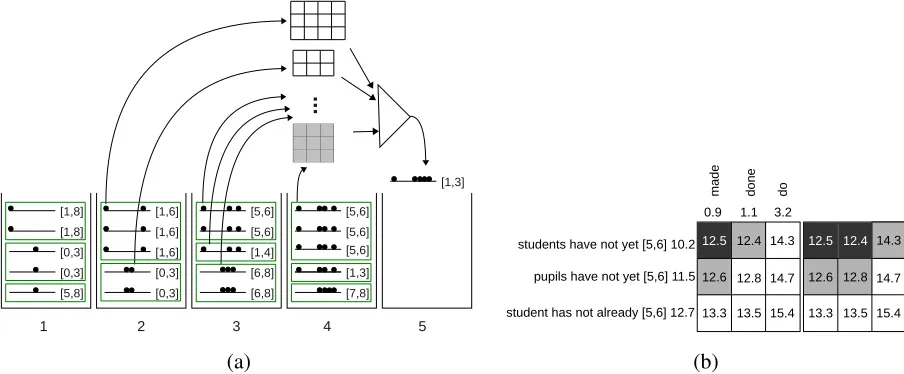
In LR-Hiero, each hypothesis is developed with only one uncovered span, therefore each cube al-ways has just two dimensions: (1) hypotheses with the same number of covered words and similar first uncovered span, (2) rules sharing the same source side. In Figure 3(a), each group of hypotheses,
ghyps, is shown in a green box (in stacks), and each
rectangle on the top is a cube. Figure 3 is using the example in Figure 2.
The Merge routine is the core function of cube pruning which generates the best hypotheses from all cubes (Chiang, 2007). For each possible cube,
(H, R), the best hypothesis is generated by calling
GrowHypothesis(h1, r1,span,F) where h1 and
r1 are the best hypothesis and rule inH andR re-spectively (line 22). Figure 3 (b) shows a more de-tailed view of a cube (shaded cube in Figure 3(a)). Rows are hypotheses and columns are rules which are sorted based on their scores.
The first best hypotheses, h0, along with their score, h0c and corresponding cube, (H, R) are placed in a priority queue, heapQ(triangle in Fig-ure 3). Iteratively the best hypothesis is popped from the queue (line 26) and its neighbours in the cube are added to the priority queue (using
GetNeighbours([H, Q])). It continues to generate
all K best hypotheses. Using cube pruning tech-nique, each stack is filled with K best hypotheses without generating all possible hypotheses in each cube.
groups the hypotheses in a given stack based on their coverage vector. But this idea does not work in LRHiero decoding in which the expansion of each hypothesis is restricted to its first uncovered span. We have also tried another way of grouping hypotheses: group by all uncovered spans,hs. Our experiments
did not show any significant difference between the final results (BLEU score), therefore we decided to stick to the simpler idea: using first uncovered span for grouping.
6Note that, just rules whose number of terminals in their
...
1 2 3 4 5
[1,8] [1,8] [0,3] [0,3] [5,8]
[1,6] [1,6] [1,6] [0,3] [0,3]
[5,6] [5,6] [1,4] [6,8] [6,8]
[5,6] [5,6] [5,6]
[1,3] [7,8]
[1,3]
12.4
13.3 12.8 12.6
12.5 14.3
14.7
15.4 13.5
3.2 1.1 0.9
students have not yet [5,6] 10.2
student has not already [5,6] 12.7 pupils have not yet [5,6] 11.5
m
ad
e
do
ne
do
13.3 12.8 12.6
12.5 14.3
14.7
15.4 13.5
12.4
[image:6.612.80.532.60.247.2](a) (b)
Figure 3: Example of generating hypotheses in cube pruning using Figure 2: (a) Hypotheses in previous stacks are grouped based on their first uncovered span, and build cubes (grids on top). Cubes are in different sizes because of different number of rules and group sizes. Cubes are fed to a priority queue (triangle) and new hypotheses are iteratively popped from the queue and added to the current stack,S5. (b) Generating hypotheses from a cube. The top side of the grid denotes the target side of rules sharing the same source side (Rs) along with their scores. Left side of
the grid shows the hypotheses in a same group, their first uncovered span and their scores. Hypothesis generated from row1and column1is added to the queue at first. Once it is popped from the queue, its neighbours (in the grid) are subsequently added to the queue.
Figure 3 (b) shows the derivation of the two best hypotheses from the cube. The best hypothesis of this cube which is likely created from the best hy-pothesis and rule (left top most entry) is popped at first step. Then, GetNeighbours calls GrowHy-pothesisto generate next potential best hypotheses of this cube (neighbours of the popped entry which are shaded in Figure 3(b)). These hypotheses are added to the priority queue. In the next iteration, the best hypothesis is popped from all candidates in the queue and algorithm continues.
3 Features
We use the following standard SMT features for the log-linear model of LR-Hiero: relative-frequency translation probabilities p(f|e) and p(e|f), lexical translation probabilities pl(f|e) andpl(e|f), a
lan-guage model probability, word count and phrase count. In addition we also use the glue rule count and the two reordering penalty features employed by Watanabe et al. (2006b; 2006a). These features compute theheightandwidth (span size of the en-tire subtree) of all subtrees which arebacktracedin the derivation of a hypothesis. A non-terminal Xi
is pushed into the LIFO list of a partial hypothesis;
it’sbacktrace refers to the set of NTs that must be popped beforeXi.
In Figure 1(b), X2 has two subtrees X3 andX6, whereX3should be processed beforeX6. The sub-tree rooted atX3in Figure 1(b) has a height of 2 and span[1,6]having a width of 5. Similarly,X4should be backtraced beforeX5and has height and width of 1. Backtracing applies only for rules having at least two non-terminals. Thus the total height and width penalty for this derivation are 3 and 6 respectively.
However, the height and width features do not distinguish between a rule that reorders the non-terminals in source and target from one that pre-serves the ordering. Rules#2and#3 in Figure 2 are treated equally although they have different or-derings. The decoder is thus agnostic to this dif-ference and would not be able to exploit this ef-fectively to control reordering and instead would rely on the partial LM score. This issue is exac-erbated for glue rules, where the decoder has to choose from different possibilities without any way to favour one over the others. Instead of the rule
#2, the decoder could use its reordered version
hX1 haben X2, have X2 X1i leading to a poor
The features we introduce can be used to learn if the model should favour monotone translations at the cost of re-orderings or vice versa and hence can easily adapt to different language pairs. Further, our experiments (see Section 4) suggest that the features
handware not sufficient by themselves to model re-ordering for language pairs exhibiting very different syntactic structure.
3.1 Distortion Features
Our distortion features are inspired by their name-sake in phrase-based system, with some modifica-tions to adapt the idea for the discontiguous phrases in LR-Hiero grammar.
r:hf1X1f2X2f3, tX2X1i I= [`, f1, f2, f3, X2, X1,a]
f2 f3
X1
f1 X2
(a)
r:〈X1noch nicht X2/not yet X2X1〉
I=[(1,1),(3,5),(5,6),(1,3),(6,6)]
.1ihre2arbeit3noch4nicht5gemacht6 (b)
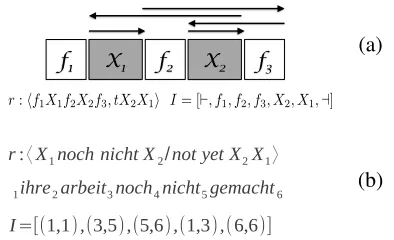
Figure 4: (a) Distortion feature computation using a rule
r. (b) Example of distortion computation for applyingr3 on phrasehihre arbeit noch nicht gemacht habeni. sub-scripts between words show the indices which are used to buildI. Distortion would be:d= 2 + 0 + 5 + 3.
Consider a rule r = hγ,¯b βi, with the source term γ being a mixed string of terminals and non-terminals. Representing the non-terminal spans and each sequence of terminals inγas distinctitems, our distortion feature counts the total length ofjumps be-tween the items during Earley parsing.
Figure 4 (a) explains the computation of our dis-tortion feature for an example rule r. Let I =
[I0, . . . , Ik] be the items denoting the terminal
se-quences and non-terminal spans withI0 andIk
be-ing dummy items (`andain Fig) marking the left and right indices of the ruler in input sentencef. Other items are arranged by their realization order on the target-side with the terminal sequences pre-ceding non-terminal spans. The items for the exam-ple rule are shown in Figure 4 (a). The distortion
feature is computed as follows:
d(r) = k X
j=1
|IjL−IjR−1| (4)
where superscripts refer to position of left (L) and right (R) edge of each item in the source sentence
f. These are then aggregated across the rules of a derivationD as: d = P
r∈Dd(r). For each item Ij, we count the jump from the end of previous item
to the beginning of the current. In Figure 4 (a) the jumps are indicated by the arrows above the rule. Figure 4 (b) shows an example of distortion com-putation for r3 and phrase hihre arbeit noch nicht gemacht habenifrom Figure 2.
Since the glue rules are likely to be used in the top levels (possibly with large distortion) of the deriva-tion, we would want the decoder to learn the distor-tion for regular and glue rules separately. We thus use two distortion features for the two rule types and we call themdpanddg.
These features do not directlymodel the source-target reordering, but only capture the source-side jumps. Furthermore they apply for both monotone and reordering rules. We now introduce a new fea-ture for exclusively modelling the reordering.
3.2 Reordering Feature
This feature simply counts the number ofreordering rules, where the non-terminals in source and target sides are reordered. Thusrhi = rule(D,hi), where rule(D,hi)is the number of reordering rules in D. Similar to width and height, this feature is applied for rule having at least two non-terminals. This fea-ture is applied to regular and glue rules.
4 Experiments
We conduct different types of experiments to evalu-ate LR-Hiero decoding developed by cube pruning and integrating new features into LR-Hiero system for two language pairs: German-English (de-en) and Czech-English (cs-en).Table 1 shows the dataset de-tails.
4.1 System Setup
[image:7.612.88.285.282.402.2]Corpus Train/Dev/Test
cs-en Europarl(v7), CzEng(v0.9);
News commentary
7.95M/3000/3003
de-en Europarl(v7); News
commentary
[image:8.612.312.553.57.142.2]1.5M/2000/2000
Table 1: Corpus statistics in number of sentences
Model cs-en de-en
Phrase-based 233.0 77.2 Hiero 1,961.6 858.5 LR-Hiero 230.5 101.3
Table 2: Model sizes (millions of rules). We do not count glue rules for LR-Hiero which are created at runtime as needed.
• Hiero: we used Kriya, our open-source im-plementation of Hiero in Python, which per-forms comparably to other open-source Hiero systems (Sankaran et al., 2012). Kriya can obtain statistically significantly equal BLEU scores when compared with Moses (Koehn et al., 2007) for several language pairs (Razmara et al., 2012; Callison-Burch et al., 2012).
• Hiero-GNF:where we use Hiero decoder with the restricted LR-Hiero grammar (GNF rules).
• LR-Hiero: our implementation of LR-Hiero (Watanabe et al., 2006b) in Python.
• phrase-based:Moses (Koehn et al., 2007)
• LR-Hiero+CP:LR-Hiero decoding with cube pruning.
We use a 5-gram LM trained on the Gigaword cor-pus and use KenLM (Heafield, 2011) for LM scor-ing durscor-ing decodscor-ing. We tune weights by minimiz-ing BLEU loss on the dev set through MERT (Och, 2003) and report BLEU scores on the test set. We use comparable pop limits in each of the decoders: 1000 for Moses and LR-Hiero and 500 with cube pruning for CKY Hiero and LR-Hiero+CP. Other extraction and decoder settings such as maximum phrase length, etc. were identical across settings so that the results are comparable.
Table 2 shows how the LR-Hiero grammar is much smaller than CKY-based Hiero.
Model cs-en de-en
[image:8.612.80.294.57.117.2]#queries / time(ms) #queries / time(ms) Hiero 5,679.7 / 16.12 7,231.62 / 20.33 Hiero-GNF 4,952.5 / 14.71 5,858.74 / 18.23 LR-Hiero (1000) 46,333.21 / 163.6 83,518.63 / 328.11 LR-Hiero (500) 24,141.03 / 97.61 42,783.12 / 192.23 LR-Hiero+CP 1,303.2 / 4.2 1,697.7 / 5.67
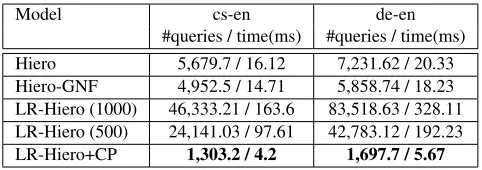
Table 3: Comparing average number and time of lan-guage model queries.
4.2 Time Efficiency Comparison
To evaluate the performance of LR-Hiero decod-ing with cube prundecod-ing (LR-Hiero+CP), we compare it with three baselines: (i) CKY Hiero, (ii) CKY Hiero-GNF, and (iii) LR-Hiero (without cube prun-ing) with two different beam size 500 and 1000. When it comes to instrument timing results, there are lots of system level details that we wish to abstract away from, and focus only on the number of “edges” processed by the decoder. In comparison of parsing algorithms, the common practice is to measure the number of edges processed by different algorithms for the same reason (Moore and Dowding, 1991). By analogy to parsing algorithm comparisons, we compare the different decoding algorithms with re-spect to the number of calls made to the language model (LM) since that directly corresponds to the number of hypotheses considered by the decoder. A decoder is more time efficient if it can consider fewer translation hypotheses while maintaining the same BLEU score. All of the baselines use the same wrapper to query the language model, and we have instrumented the wrapper to count the statistics we need and thus we can say this is a fair comparison. For this experiment we use a sample set of 50 sen-tences taken from the test sets.
Table 3 shows the results in terms of average num-ber of language model queries and times in millisec-onds.
4.3 Reordering Features
Model cs-en de-en
Phrase-based 20.32 24.71
CKY Hiero 20.64 25.52
CKY Hiero-GNF 20.04 24.84
LR-Hiero 18.30 23.47
[image:9.612.80.291.56.164.2]LR-Hiero + reordering feats 20.20 24.90 LR-Hiero + CP + reordering feats 20.15 24.83 CKY Hiero-GNF + reordering feats 20.52 25.09 CKY Hiero + reordering feats 20.77 25.72
Table 4: BLEU scores. The rows are grouped such that each group use the same model. The last row in part 2 of table shows LR-Hiero+CP using our new features in ad-dition to the baseline Watanabe features (line LR-Hiero baseline). The last part shows CKY Hiero using new re-ordering features. The rere-ordering features used aredp, dg
andrhi. Hiero+CP has a beam size of 500 while
LR-Hiero has a beam size of 1000, c.f. with the LM calls shown in Table 3.
worse than both phrase-based and CKY-Hiero base-lines by up to 2.3 BLEU points.
All the reported results are obtained from a single optimizer run. However we observed insignificant changes in different tuning runs in our experiments. We find a gain of about 1 BLEU point when we add a single distortion feature d and a further gain of 0.3 BLEU (not shown due to lack of space) when we split the distortion feature for the two rule types (dp and dg). The last line in part two of Table 4
shows a consistent gain of 1.6 BLEU over the LR-Hiero baseline for both language pairs. It shows that LR-Hiero maintains the BLEU scores obtained by “phrase-based” and “CKY Hiero-GNF”.
We performed statistical significance tests us-ing two different tools: Moses bootstrap resam-pling and MultEval (Clark et al., 2011). The dif-ference between “LR-Hiero+CP+reordering feat” and three baselines: “phrase-based”, “CKY Hiero-GNF”, “LR-Hiero+reordering feat” are not statis-tically significant even for p-value of 0.1 for both tools.
To investigate the impact of proposed reordering features with other decoder or models. We add these features to both Hiero and Hiero-GNF7. The last part of Table 4 shows the performance CKY decoder
7Feature r
hi is defined for SCFG rules and cannot be
adopted to phrase-based translation systems; and Moses uses distortion feature therefore we omit Moses from this experi-ment.
with different models (full Hiero and GNF) with the new reordering features in terms of BLEU score. The results show that these features are helpful in both models. Although, they do not make a big dif-ference in Hiero with full model, they can alleviate the lack of non-GNF rules in Hiero-GNF.
Nguyen and Vogel (2013) integrate traditional phrase-based features: distortion and lexicalized re-ordering into Hiero as well. They show that such features can be useful to boost the translation quality of CKY Hiero with the full rule set. Nguyen and Vo-gel (2013) compute the distortion feature in a differ-ent way, only applicable to CKY. The distortion for each cell is computed after the translation for non-terminal sub-spans is complete. In LR-decoding, we compute distortion for rules even though we are yet to translate some of the sub-spans. Thus our ap-proach computes the distortion incrementally for the untranslated sub-spans which are later added. Un-like (Nguyen and Vogel, 2013), our distortion fea-ture can be applied to both LR and CKY-decoding (Table 4). We have also introduced another reorder-ing feature (Section 3.2) not proposed previously.
5 Conclusion and Future Work
We provided a detailed description of left-to-right Hiero decoding, many details of which were only implicit in (Watanabe et al., 2006b). We presented an augmented LR decoding algorithm that builds on the original algorithm in (Watanabe et al., 2006b) but unlike that algorithm, using experiments over multiple language pairs we showed two new results: (i) Our LR decoding algorithm provides demonstra-bly more efficient decoding than CKY Hiero and the original LR decoding algorithm in (Watanabe et al., 2006b). And, (ii) by introducing new distortion and reordering features for LR decoding we show that it maintains the BLEU scores obtained by phrase-based and CKY Hiero-GNF.
CKY Hiero uses standard Hiero-style translation rules capturing better reordering model than prefix lexicalized target-side translation rules used in LR-Hiero. Our LR-decoding algorithm is 4 times faster in terms of LM calls while translation quality suffers by about0.67in BLEU score on average.
of future cost in decoding algorithm which is an es-sential part in decoding. We have shown in this pa-per that left-to-right (LR) decoding can be consid-ered as a potential faster alternative to CKY decod-ing for Hiero-style machine translation systems.
In future work, we plan to apply lexicalized re-ordering models to LR-Hiero. It has been shown to be useful for Hiero in some languages therefore it is promising to improve translation quality in LR-Hiero which suffers from lack of modeling power of non-GNF target side rules. We also plan to ex-tend the glue rules in LR-Hiero to provide a bet-ter reordering model. We believe such an exten-sion would be very effective in reducing search er-rors and capturing better reordering models in lan-guage pairs involving complex reordering require-ments like Chinese-English.
Acknowledgments
This research was partially supported by an NSERC, Canada (RGPIN: 264905) grant and a Google Fac-ulty Award to the third author. The authors wish to thank Taro Watanabe and Marzieh Razavi for their valuable discussions and suggestions, and the anonymous reviewers for their helpful comments.
References
Chris Callison-Burch, Philipp Koehn, Christof Monz, Matt Post, Radu Soricut, and Lucia Specia. 2012. Findings of the 2012 workshop on statistical machine translation. In Proceedings of the Seventh Work-shop on Statistical Machine Translation, pages 10– 51, Montr´eal, Canada, June. Association for Compu-tational Linguistics.
David Chiang. 2005. A hierarchical phrase-based model for statistical machine translation. InIn ACL, pages 263–270.
David Chiang. 2007. Hierarchical phrase-based transla-tion. Computational Linguistics, 33.
Jonathan H. Clark, Chris Dyer, Alon Lavie, and Noah A. Smith. 2011. Better hypothesis testing for statisti-cal machine translation: controlling for optimizer in-stability. InProceedings of the 49th Annual Meeting of the Association for Computational Linguistics: Hu-man Language Technologies: short papers - Volume 2, HLT ’11, pages 176–181, Stroudsburg, PA, USA. Association for Computational Linguistics.
Jay Earley. 1970. An efficient context-free parsing algo-rithm. Commun. ACM, 13(2):94–102, February.
Michel Galley and Christopher D. Manning. 2010. Ac-curate non-hierarchical phrase-based translation. In Human Language Technologies: The 2010 Annual Conference of the North American Chapter of the As-sociation for Computational Linguistics, pages 966– 974, Los Angeles, California, June. Association for Computational Linguistics.
Kenneth Heafield, Hieu Hoang, Philipp Koehn, Tetsuo Kiso, and Marcello Federico. 2011. Left language model state for syntactic machine translation. In Pro-ceedings of the International Workshop on Spoken Language Translation, pages 183–190, San Francisco, California, USA, 12.
Kenneth Heafield, Philipp Koehn, and Alon Lavie. 2013. Grouping language model boundary words to speed K-Best extraction from hypergraphs. InProceedings of the 2013 Conference of the North American Chapter of the Association for Computational Linguistics: Hu-man Language Technologies, Atlanta, Georgia, USA, 6.
Kenneth Heafield. 2011. KenLM: Faster and smaller language model queries. InIn Proc. of the Sixth Work-shop on Statistical Machine Translation.
Liang Huang and David Chiang. 2007. Forest rescoring: Faster decoding with integrated language models. In In ACL 07.
Liang Huang and Haitao Mi. 2010. Efficient incremental decoding for tree-to-string translation. InProceedings of the 2010 Conference on Empirical Methods in Natu-ral Language Processing, pages 273–283, Cambridge, MA, October. Association for Computational Linguis-tics.
Philipp Koehn, Franz Josef Och, and Daniel Marcu. 2003. Statistical phrase-based translation. In Proc. of NAACL.
Philipp Koehn, Hieu Hoang, Alexandra Birch, Chris Callison-Burch, Marcello Federico, Nicola Bertoldi, Brooke Cowan, Wade Shen, Christine Moran, Richard Zens, Chris Dyer, Ondˇrej Bojar, Alexandra Con-stantin, and Evan Herbst. 2007. Moses: open source toolkit for statistical machine translation. In Proceed-ings of the 45th Annual Meeting of the ACL on Inter-active Poster and Demonstration Sessions, ACL ’07, pages 177–180, Stroudsburg, PA, USA. Association for Computational Linguistics.
Adam Lopez. 2007. Hierarchical phrase-based trans-lation with suffix arrays. In EMNLP-CoNLL, pages 976–985.
Robert C. Moore and John Dowding. 1991. Efficient bottom-up parsing. InHLT. Morgan Kaufmann. Thuylinh Nguyen and Stephan Vogel. 2013.
Franz Josef Och. 2003. Minimum error rate training in statistical machine translation. In Proceedings of the 41st Annual Meeting on Association for Compu-tational Linguistics - Volume 1, ACL ’03, pages 160– 167, Stroudsburg, PA, USA. Association for Compu-tational Linguistics.
Majid Razmara, Baskaran Sankaran, Ann Clifton, and Anoop Sarkar. 2012. Kriya - the sfu system for trans-lation task at wmt-12. InProceedings of the Seventh Workshop on Statistical Machine Translation, WMT ’12, pages 356–361, Stroudsburg, PA, USA. Associa-tion for ComputaAssocia-tional Linguistics.
Baskaran Sankaran, Ajeet Grewal, and Anoop Sarkar. 2010. Incremental decoding for phrase-based statis-tical machine translation. InProceedings of the Joint Fifth Workshop on Statistical Machine Translation and MetricsMATR, WMT ’10, pages 216–223, Strouds-burg, PA, USA. Association for Computational Lin-guistics.
Baskaran Sankaran, Majid Razmara, and Anoop Sarkar. 2012. Kriya - an end-to-end hierarchical phrase-based mt system. The Prague Bulletin of Mathematical Lin-guistics (PBML), (97):83–98, apr.
Taro Watanabe, Jun Suzuki, Hajime Tsukada, and Hideki Isozaki. 2006a. NTT statistical machine translation for iwslt 2006. InProceedings of IWSLT 2006, pages 95–102.
Taro Watanabe, Hajime Tsukada, and Hideki Isozaki. 2006b. Left-to-right target generation for hierarchical phrase-based translation. InProc. of ACL.