http://wrap.warwick.ac.uk
Original citation:
ATLAS collaboration (Including: Farrington, Sinead and Jones, G. (Graham)). (2013)
Search for pair-produced massive coloured scalars in four-jet final states with the ATLAS
detector in proton-proton collisions at √s = 7 TeV. European Physical Journal C, Volume
73 (Issue 1). pp. 1-20. ISSN 1434-6044
Permanent WRAP url:
http://wrap.warwick.ac.uk/56460
Copyright and reuse:
The Warwick Research Archive Portal (WRAP) makes this work of researchers of the
University of Warwick available open access under the following conditions.
This article is made available under the Creative Commons Attribution 3.0 Unported (CC
BY 3.0) license and may be reused according to the conditions of the license. For more
details see:
http://creativecommons.org/licenses/by/3.0/
A note on versions:
The version presented in WRAP is the published version, or, version of record, and may
be cited as it appears here.
DOI 10.1140/epjc/s10052-012-2263-z
Letter
Search for pair-produced massive coloured scalars in four-jet final
states with the ATLAS detector in proton–proton collisions
at
√
s
=
7 TeV
The ATLAS Collaboration
CERN, 1211 Geneva 23, Switzerland
Received: 17 October 2012 / Revised: 11 December 2012 / Published online: 15 January 2013
© CERN for the benefit of the ATLAS collaboration 2013. This article is published with open access at Springerlink.com
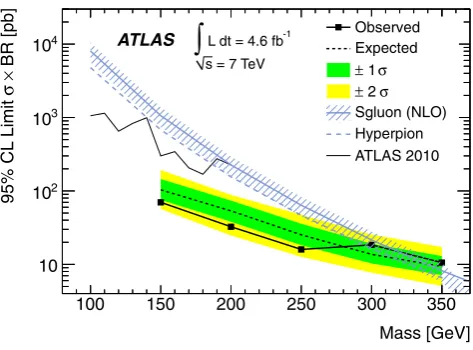
Abstract A search for pair-produced massive coloured scalar particles decaying to a four-jet final state is performed by the ATLAS experiment at the LHC in proton–proton collisions at √s=7 TeV. The analysed data sample cor-responds to an integrated luminosity of 4.6 fb−1. No devi-ation from the Standard Model is observed in the invariant mass spectrum of the two-jet pairs. A limit on the scalar gluon pair production cross section of 70 pb (10 pb) is ob-tained at the 95 % confidence level for a scalar gluon mass of 150 GeV (350 GeV). Interpreting these results as mass limits on scalar gluons, masses ranging from 150 GeV to 287 GeV are excluded at the 95 % confidence level.
Massive coloured scalar particles that decay into gluons are predicted in several extensions of the Standard Model (SM). The most prominent examples are the scalar part-ners of a Dirac gluino called scalar gluons (‘sgluons’) in extended supersymmetric models like theN=1/N=2 hy-brid model [1,2] or the R-symmetric MSSM [3,4]. These particles are also present in compositeness models [5–9] where they are called hyperpions. While single production of sgluons is possible, the production cross section depends strongly on the masses of the supersymmetric particles and, in typical supersymmetric scenarios, is of the same order as the pair production cross section. On the contrary the pair production cross section does not, at leading order, depend on supersymmetric parameters except for the sgluon mass. Since the sgluon has positive R-parity [10] and since the sgluon coupling to quark–antiquark pairs is suppressed by the quark mass, light sgluons, i.e. sgluons with masses of the order of 100 GeV, are expected to decay to two gluons with a branching ratio close to one [2,4]. Pair production of sgluons each decaying to two gluons, leading to a four-jet
e-mail:[email protected]
final state, is therefore used as a benchmark process. AT-LAS has previously searched for signatures of these parti-cles in the dataset of 34 pb−1recorded in 2010 [11], exclud-ing at the 95 % confidence level (CL) sgluons with masses of 100 GeV to 180 GeV, with the exception of a mass win-dow of 5 GeV around 140 GeV. The search described in this paper, using data recorded in 2011, explores the mass region from 150 GeV up to about 300 GeV.
The strategy of the analysis is to first reconstruct the two sgluon candidates. The relative mass difference and theR between the two jets associated to a reconstructed sgluon are used to select well reconstructed sgluons with a small mass difference, whereR=(φ)2+(η)2withφandη being the difference in azimuth and pseudorapidity of the two jets. The distribution of the reconstructed average mass of the two sgluon candidates is then analysed for evidence of a signal with a fit to the background plus a signal template of variable strength. The background for this search is the SM multijet background, due to its large cross section.
ATLAS is a multipurpose detector [12,13] with nearly 4π coverage in solid angle. The inner detector, consist-ing of silicon pixel and microstrip detectors as well as a transition radiation tracker, is immersed in a 2 T axial magnetic field. In the pseudorapidity1 region |η| <3.2, high-granularity lead/liquid-argon (LAr) electromagnetic (EM) sampling calorimeters are used. An iron/scintillator-tile calorimeter provides hadronic coverage for |η|<1.7. The end-cap and forward regions, spanning 1.5<|η|<4.9, are instrumented with LAr calorimeters for both EM and hadronic measurements. The calorimeters are surrounded
1ATLAS uses a right-handed coordinate system with its origin at the
nominal interaction point (IP) in the centre of the detector and thez -axis along the beam pipe. Thex-axis points from the IP to the centre of the LHC ring, and they-axis points upward. Cylindrical coordinates
by a muon spectrometer which consists of three large super-conducting toroids, a system of precision tracking chambers, and fast detectors for triggering. ATLAS uses a three-level trigger system. The first-level trigger is implemented in cus-tom hardware, the other two trigger levels are implemented in software running on commercially available PC farms.
A data-driven method is used for the background estima-tion. The method is developed and validated on SM multijet Monte Carlo (MC) samples. The samples are also used to determine a systematic error on the background determina-tion. To incorporate detector effects, these events are passed through a detailed simulation of the ATLAS detector [14] based on GEANT4 [15]. ALPGEN[16] SM multijet samples are generated with the MLM matching scheme [17] and in-terfaced to HERWIG[18] for the parton shower and fragmen-tation processes and to JIMMY[19] for the simulation of the underlying event. The ALPGENsamples are generated with the CTEQ6L1 parton distribution functions (PDFs) [20] (un-derlying event tune AUET2-CTEQ6L1 [21]). PYTHIA[22] SM multijet samples are generated with the LO∗ MRST PDFs [23] (underlying event tune AUET2B LO∗∗[21]). The sgluon pair production differential cross section [2] is im-plemented as an external process interfaced to PYTHIA. The decay of the sgluons as well as fragmentation and hadro-nisation are performed by PYTHIA. For the normalisation of the signal a next-to-leading-order (NLO) cross section is used [24].
Signal samples of 40k to 120k events each were gener-ated with sgluon masses of 150, 200, 250, 300 and 350 GeV and passed through the fast simulation of the ATLAS detec-tor. Additionally the fast simulation was verified by passing some samples through the detailed simulation which leads to results with good agreement.
Jets are reconstructed using the anti-kt jet clustering
al-gorithm [25] with a radius parameter of 0.4. The inputs to the jet algorithm are three-dimensional clusters [26] formed from energy deposits in the calorimeters. The jets are cal-ibrated using transverse momentum (pT) andη-dependent correction factors based on MC simulations and validated by test beam and collision data studies [27]. Quality criteria are applied to reject jets produced by non-collision back-grounds [28]. Such jets are typically produced by hardware problems in the calorimeters, LHC beam-gas interactions or cosmic-ray induced showers. The jet energy resolution for a jet with apTof 80 GeV is about 11 % [29].
[image:3.595.307.542.49.266.2]The analysis uses collision data collected in the year 2011 at a centre-of-mass energy of√s=7 TeV and correspond-ing to an integrated luminosity of 4.6 fb−1. The data were recorded with a multijet trigger requiring at least four jets. Reflecting the threshold of the third level trigger of 45 GeV, the trigger efficiency does not depend strongly on thepTof the four highest-pT jets for pT>80 GeV. To ensure full trigger efficiency for the analysis, the four highest-pTjets in
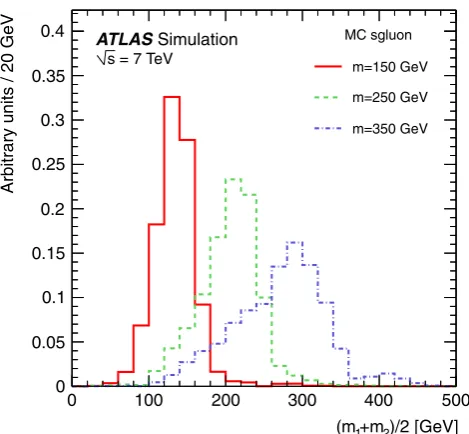
Fig. 1 The reconstructed average mass distribution after all analysis
cuts for the signal samples withmsgluon=150, 250 and 350 GeV. The
curves are normalised to unit area
a selected event are required to be separated from each other by R >0.6. The resulting trigger efficiency of at least 99 % obtained with simulated events was verified in data with the use of a single-electron trigger. The average num-ber of proton–proton interactions in the same event (pile-up) has increased to about 12 events over the course of the run. Simulated minimum-bias events are overlayed onto the sim-ulated samples of the hard-scattering processes. The result-ing events are reweighted to reproduce the luminosity profile of the data. The requirement on thepTof the jets makes the analysis robust with respect to the increase of pile-up.
The reconstructed average mass is(m1+m2)/2. The scat-tering angle is defined as the angle between the direction of motion of the reconstructed sgluons in the rest frame of the four highest-pTjets and the boost direction between the lab frame and the rest frame of the four highest-pT jets. The magnitude of the cosine of the scattering angle|cos(θ∗)|is required to be less than 0.5. In fact the SM multijet back-ground is peaked in the forward region, reflectingt-channel gluon exchange, while the signal is produced centrally due to the (mainly)s-channel production and scalar nature of the sgluon. Finally, to further improve the rejection of the SM multijet background, the relative difference between the two reconstructed masses|m1−m2|/(m1+m2)is required to be less than 0.15. The requirement on the relative mass dif-ference selects well reconstructed events increasing the bulk of the signal distribution with respect to the tails. Loosening the requirement, i.e., accepting events with larger mass dif-ferences, leads to an increase of signal events but also an in-crease of background events. The selection that inin-creases the number of events in the control regions without decreasing the sensitivity is chosen. As the requirement on the 4thjet is mass dependent, a selection efficiency of 0.6 % is achieved for all simulated samples of the different sgluon masses.
The reconstructed average mass distribution after all cuts is shown for sgluon signals with varying masses in Fig.1. The natural width of the sgluon in this mass range is neg-ligible and the width of the observable is entirely domi-nated by the instrumental mass resolution. As the mass of the sgluon increases, the requirement on the transverse mo-mentum of the jets becomes relatively less stringent. An in-crease of 100 GeV in the sgluon mass leads to an inin-crease of only 30 GeV in the requirement on the jet transverse mo-menta. As a consequence the radiative tails to lower masses are more evident for higher masses in the figure, as they are less sculpted by thepTcut.
After applying preselection and jet pairing, the primary variables used in the analysis are compared to the ALPGEN and PYTHIA multijet simulation. Backgrounds other than SM multijet events are estimated to be smaller than 1 % of the total background sample and are thus neglected. Since the analysis requires at least four jets, ALPGENis expected to give a better description than PYTHIA, which generates the third and fourth jets via a parton shower.
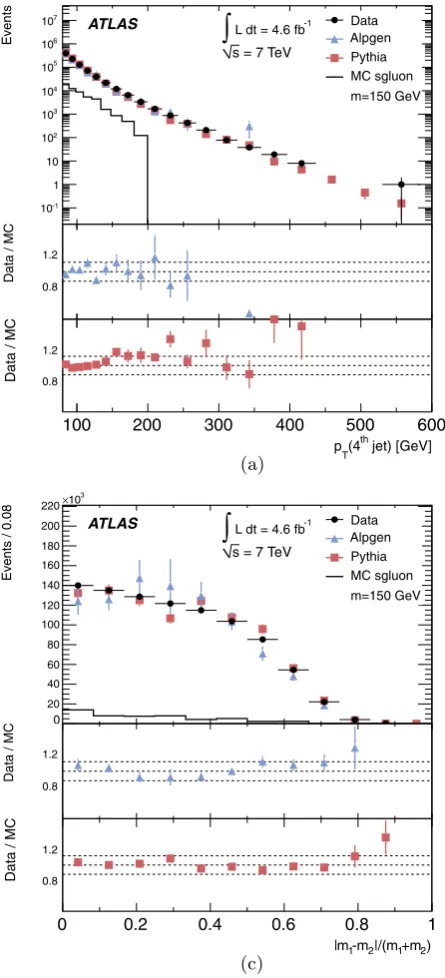
The MC samples are normalised to the data after the pre-selection described above. The normalisation factor of 1.25 obtained for ALPGENis compatible with the one (1.26) ob-tained in Ref. [11]. For PYTHIAthe normalisation factor is 0.75, close to the value of 0.65 [30] obtained with the 2010 data using a different tune (AMBT1). After this normalisa-tion, for the transverse momentum of the 4thjet (Fig.2(a)), the separation of the two jets of the sgluon candidate with the highest transverse momentum (Fig. 2(b)), the relative mass difference (Fig.2(c)) and the cosine of the scattering
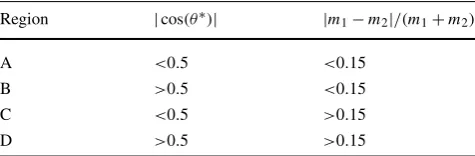
Table 1 Definition of the four regions for the background
determina-tion. Region A is the signal region
Region |cos(θ∗)| |m1−m2|/(m1+m2)
A <0.5 <0.15
B >0.5 <0.15
C <0.5 >0.15
D >0.5 >0.15
angle (Fig. 2(d)), the agreement between the data and the MC simulations is, in general, at the 20 % level. To reduce the dependence on simulation, the background is estimated from data, taking advantage of the kinematic properties of the sgluon signal. Only the systematic error on the method is taken from the Monte Carlo studies.
The main discriminating variable for the analysis is the reconstructed average mass. To determine the background normalisation as well as the shape of the background in the signal region, an ABCD method is used. The data sample is divided into one signal region (A) and three background-dominated regions (B, C and D). The variables used to de-fine the four regions are|cos(θ∗)| and|m1−m2|/(m1+ m2). The regions defined in Table1 are chosen as a com-promise between the statistical significance of the signal in region A and the statistical uncertainty in the regions B, C and D which feeds into the uncertainty on the background prediction.
The correlation between the two variables is less than 0.1 % in the four regions in the data and less than 1 % in the PYTHIA samples, so the normalisation of the background in the region A is derived from the ratio of events in the control samples usingNA =NB·NC/ND. A closure test is performed with the PYTHIAand ALPGENMC samples and shows that NA reproduces the actual number of events in region A,NA, within 2 %. The difference is assigned as a systematic uncertainty on the background prediction.
Table2 summarises the results obtained in data, for the five sgluon mass hypotheses and corresponding signal re-gions, A, together with the corresponding background pre-dictions. Good agreement is observed. The assumption of the ABCD method that the shapes of the reconstructed aver-age mass distributions in regions A and B are the same was verified on the Monte Carlo samples. The last column gives thep-value obtained from a Kolmogorov–Smirnov test be-tween the shapes of the reconstructed average mass distri-butions for data in regions A and B. Satisfactoryp-values are found in this test on the data, which considers statistical uncertainties only.
[image:4.595.306.544.76.154.2]Fig. 2 The kinematic variables of the analysis are shown after
ap-plying the preselection and pairing the four highest-pTjets: (a) is the
transverse momentum of the fourth highest-pTjet; (b) is theR
be-tween the two jets of the reconstructed sgluon candidate with the high-est transverse momentum jet; (c) is the relative mass difference; (d) is the cosine of the scattering angle in the four-jet centre-of-mass frame.
The black histogram is the signal for a sgluon mass of 150 GeV nor-malised to the NLO cross section. Data (dots) are compared to the ALPGEN (triangles) and PYTHIA(rectangles) SM multijet samples where the MC samples are normalised to the data. The ratio data/MC is also shown separately for ALPGENand PYTHIAwith its statistical uncertainty
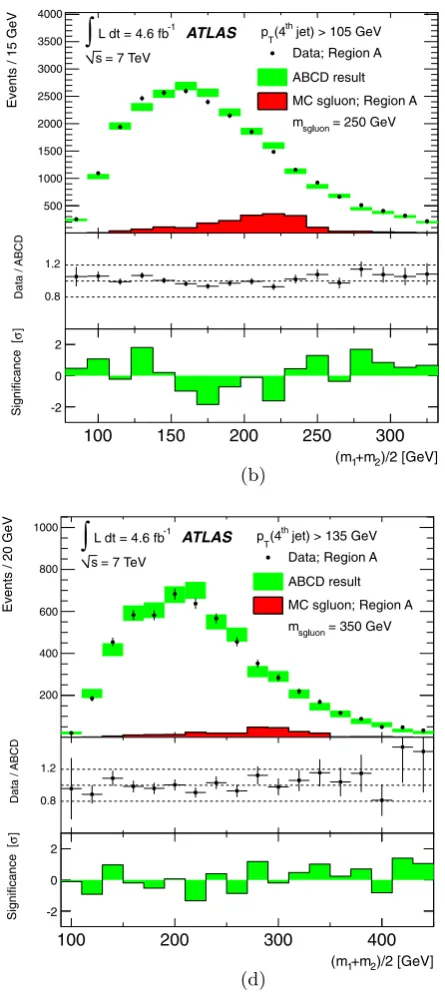
background to data as well as the significance, in standard deviations, of the difference between the data and the pre-diction are shown as a function of the reconstructed average mass. The significance takes into account only statistical un-certainties.
pa-Fig. 3 The comparison of the data in the signal region with the
back-ground prediction is shown for: (a)msgluon=150 GeV, (b)msgluon=
250 GeV, (c)msgluon=300 GeV and (d)msgluon=350 GeV. The
points are the data in the signal region (region A). The plain histogram (red) is the expected signal in region A normalised to the NLO cross
section. The prediction of background in region A based upon the data in region B normalised using the ABCD method is shown as the rect-angles which include the statistical uncertainty. The data/background ratio and the statistical significance of its difference from one, in stan-dard deviations, are also shown in the lower panels
rameters. Systematic uncertainties affecting the simulated sgluon signal shapes are incorporated in the fit by varying signal templates, taking into account the migration of events between the regions.
The systematic uncertainties on the acceptance, and the correlation assumed for each uncertainty source between
[image:6.595.321.544.51.548.2]Table 2 Comparison of the data in the signal region with the
back-ground prediction. The first column is the sgluon mass hypothesis, the second column is the corresponding minimumpTrequirement on the
four jets, followed by the number of observed data events in the sig-nal region A (third column) and the number of predicted events using
the ABCD method (fourth column), where the first uncertainty given is statistical and the second systematic. The last column gives thep -value obtained from a Kolmogorov–Smirnov test between the shapes of the reconstructed average mass distributions in regions A and B. Only statistical uncertainties are considered in this test
Sgluon mass [GeV] pmin
T [GeV] Data ABCD prediction Shapep-value(A,B)
150 80 102162 101100±800±2000 0.22
200 90 55194 54500±600±1100 0.10
250 105 23404 22500±340±500 0.28
300 120 11082 10640±230±210 0.24
[image:7.595.51.546.292.409.2]350 135 5571 5330±180±110 0.70
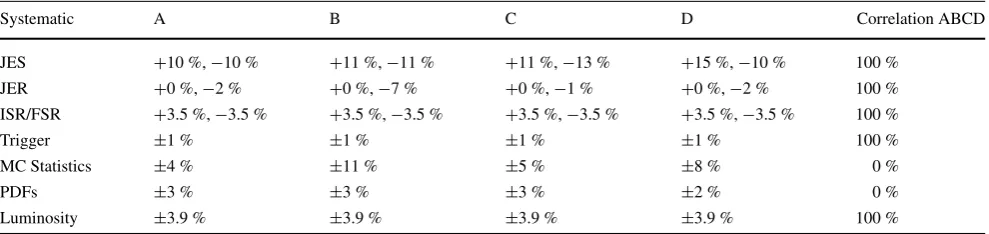
Table 3 The systematic uncertainties on the signal due to the jet
en-ergy scale (JES), jet enen-ergy resolution (JER), initial and final state ra-diation (ISR/FSR), the trigger efficiency (Trigger), the Monte Carlo signal statistics (MC Statistics), the choice of parton distribution func-tions (PDFs) and the integrated luminosity (Luminosity). The relative uncertainty of the signal acceptance is given for the four regions and for
a sgluon mass of 300 GeV. The JES uncertainty is treated as asymmet-ric, corresponding to upward and downward fluctuations of the JES. For the JER uncertainty, only an upward fluctuation of the JER is con-sidered, i.e. only a degradation of the JER, with respect to the nominal MC JER. The last column shows the expected correlation among the four regions
Systematic A B C D Correlation ABCD
JES +10 %,−10 % +11 %,−11 % +11 %,−13 % +15 %,−10 % 100 %
JER +0 %,−2 % +0 %,−7 % +0 %,−1 % +0 %,−2 % 100 %
ISR/FSR +3.5 %,−3.5 % +3.5 %,−3.5 % +3.5 %,−3.5 % +3.5 %,−3.5 % 100 %
Trigger ±1 % ±1 % ±1 % ±1 % 100 %
MC Statistics ±4 % ±11 % ±5 % ±8 % 0 %
PDFs ±3 % ±3 % ±3 % ±2 % 0 %
Luminosity ±3.9 % ±3.9 % ±3.9 % ±3.9 % 100 %
added. The variation of the PYTHIAparameters controlling initial state and final state radiation in a range consistent with experimental data [32] produces only a small effect on the reconstructed average mass distribution. Therefore, this sys-tematic uncertainty is taken into account for the signal ac-ceptance. An uncertainty of 1 % is assigned to the trigger efficiency for sgluon signals. The uncertainty on the signal acceptance due to the signal MC statistical uncertainty is uncorrelated among the four regions. The acceptance uncer-tainty due to the PDFs is estimated using the independent CT10 [20] error sets. The uncertainty on the luminosity is taken to be 3.9 % [33,34].
To probe for the presence of a signal, a fit with a freely varying signal strength parameter is performed for each mass hypothesis. No significant deviation from zero is found, and limits on sgluon production are derived.
The profile likelihood ratio q˜μ [35] is used as test
statistic, and exclusions are determined using the CLs
ap-proach [36]. Exclusion limits are computed using samples of pseudo-experiments generated taking into account all un-certainties and also contamination of the control regions by signal events. The normalisation and shape of the event dis-tribution in region B are used, whereas for regions C and
D only the normalisation is used. MC templates are used to generate the shape of the signal in each pseudo-experiment. In each pseudo-experiment the statistical and systematic un-certainties are randomised, using Poisson and Gaussian dis-tributions.
Fig. 4 Expected and observed 95 % CL upper bounds on the product
of the scalar pair production cross section and the branching ratio to gluons as a function of the scalar mass using the profile likelihood ratio as the test statistic. The predictions of the sgluon and hyperpion pair production cross section are also shown as well as the observed limit from a previous ATLAS search [11]. The sgluon cross section is at NLO [24]
with the NLO cross section minus one standard deviation of the theory uncertainty.
The dashed line is the prediction for the hyperpion cross section of a compositeness model, obtained by rescaling the sgluon cross section according to the ratios from Ref. [7]. Since the ratios were calculated at leading order, this line should only be considered as an approximate indication of the excluded mass region.
In summary, using 4.6 fb−1 of √s =7 TeV proton– proton collision data, collected by the ATLAS detector, four-jet events have been analysed to search for the pair produc-tion of a new scalar particle decaying into two gluons. The data in the signal region are in good agreement with the data-driven background estimation. No evidence for new phe-nomena is found. Cross section times branching ratio limits as a function of the mass of the scalar particle are derived. Interpreting the section limit with the NLO cross-section calculation, sgluons with masses from 150 GeV to 287 GeV are excluded at 95 % CL using the data recorded in 2011 while the range 150 GeV to 306 GeV is expected to be excluded in the absence of a signal. Combining the ex-clusions obtained with the analyses of 2010 and 2011 data, sgluons with masses from 100 GeV to 287 GeV are excluded at the 95 % CL.
Acknowledgements We thank CERN for the very successful oper-ation of the LHC, as well as the support staff from our institutions without whom ATLAS could not be operated efficiently.
We acknowledge the support of ANPCyT, Argentina; YerPhI, Ar-menia; ARC, Australia; BMWF and FWF, Austria; ANAS, Azerbai-jan; SSTC, Belarus; CNPq and FAPESP, Brazil; NSERC, NRC and CFI, Canada; CERN; CONICYT, Chile; CAS, MOST and NSFC, China; COLCIENCIAS, Colombia; MSMT CR, MPO CR and VSC
CR, Czech Republic; DNRF, DNSRC and Lundbeck Foundation, Den-mark; EPLANET and ERC, European Union; IN2P3-CNRS, CEA-DSM/IRFU, France; GNSF, Georgia; BMBF, DFG, HGF, MPG and AvH Foundation, Germany; GSRT, Greece; ISF, MINERVA, GIF, DIP and Benoziyo Center, Israel; INFN, Italy; MEXT and JSPS, Japan; CNRST, Morocco; FOM and NWO, Netherlands; BRF and RCN, Norway; MNiSW, Poland; GRICES and FCT, Portugal; MERYS (MECTS), Romania; MES of Russia and ROSATOM, Russian Federa-tion; JINR; MSTD, Serbia; MSSR, Slovakia; ARRS and MVZT, Slove-nia; DST/NRF, South Africa; MICINN, Spain; SRC and Wallenberg Foundation, Sweden; SER, SNSF and Cantons of Bern and Geneva, Switzerland; NSC, Taiwan; TAEK, Turkey; STFC, the Royal Society and Leverhulme Trust, United Kingdom; DOE and NSF, United States of America.
The crucial computing support from all WLCG partners is ac-knowledged gratefully, in particular from CERN and the ATLAS Tier-1 facilities at TRIUMF (Canada), NDGF (Denmark, Norway, Sweden), CC-IN2P3 (France), KIT/GridKA (Germany), INFN-CNAF (Italy), NL-T1 (Netherlands), PIC (Spain), ASGC (Taiwan), RAL (UK) and BNL (USA) and in the Tier-2 facilities worldwide.
Open Access This article is distributed under the terms of the Cre-ative Commons Attribution License which permits any use, distribu-tion, and reproduction in any medium, provided the original author(s) and the source are credited.
References
1. P. Fayet, Nucl. Phys. B 113, 135 (1976)
2. S.Y. Choi, M. Drees, J. Kalinowski, J.M. Kim, E. Popenda, P.M. Zerwas, Phys. Lett. B 672, 246 (2009). .arXiv:0812.3586 [hep-ph]
3. G.D. Kribs, E. Poppitz, N. Weiner, Phys. Rev. D 78, 055010 (2008).arXiv:0712.2039[hep-ph]
4. T. Plehn, T.M.P. Tait, J. Phys. G 36, 075001 (2009). arXiv: 0810.3919[hep-ph]
5. C. Kilic, T. Okui, R. Sundrum, J. High Energy Phys. 0807, 038 (2008).arXiv:0802.2568[hep-ph]
6. C. Kilic, S. Schumann, M. Son, J. High Energy Phys. 0904, 128 (2009).arXiv:0810.5542[hep-ph]
7. S. Schumann, A. Renaud, D. Zerwas, J. High Energy Phys. 1109, 074 (2011).arXiv:1108.2957[hep-ph]
8. C. Kilic, T. Okui, R. Sundrum, J. High Energy Phys. 1002, 018 (2010).arXiv:0906.0577[hep-ph]
9. Y. Bai, J. Shelton, J. High Energy Phys. 1207, 067 (2012). arXiv:1107.3563[hep-ph]
10. G.R. Farrar, P. Fayet, Phys. Lett. B 76, 575 (1978)
11. ATLAS Collaboration, Eur. Phys. J. C 71, 1828 (2011).arXiv: 1110.2693[hep-ex]
12. ATLAS Collaboration, J. Instrum. 3, S08003 (2008)
13. ATLAS Collaboration, CERN-OPEN-2008-020.arXiv:0901.0512 [hep-ex]
14. ATLAS Collaboration, Eur. Phys. J. C 70, 823 (2010). arXiv: 1005.4568[physics.ins-det]
15. S. Agostinelli et al. (GEANT4 Collaboration), Nucl. Instrum. Methods A 506, 250 (2003)
16. M.L. Mangano, M. Moretti, F. Piccinini, R. Pittau, A.D. Polosa, J. High Energy Phys. 0307, 001 (2003).arXiv:hep-ph/0206293 17. S. Hoeche, F. Krauss, N. Lavesson, L. Lonnblad, M. Mangano,
A. Schalicke, S. Schumann,arXiv:hep-ph/0602031
18. G. Corcella, I.G. Knowles, G. Marchesini, S. Moretti, K. Oda-giri, P. Richardson, M.H. Seymour, B.R. Webber, arXiv: hep-ph/0210213
20. H.-L. Lai, M. Guzzi, J. Huston, Z. Li, P.M. Nadolsky, J. Pumplin, C.-P. Yuan, Phys. Rev. D 82, 074024 (2010).arXiv:1007.2241 [hep-ph]
21. ATLAS Collaboration, ATL-PHYS-PUB-2011-009. http:// cdsweb.cern.ch/record/1363300
22. T. Sjostrand, S. Mrenna, P.Z. Skands, J. High Energy Phys. 0605, 026 (2006).hep-ph/0603175
23. A. Sherstnev, R.S. Thorne, Eur. Phys. J. C 55, 553 (2008). arXiv:0711.2473[hep-ph]
24. D. Goncalves-Netto, D. Lopez-Val, K. Mawatari, T. Plehn, I. Wig-more,arXiv:1203.6358[hep-ph]
25. M. Cacciari, G.P. Salam, G. Soyez, J. High Energy Phys. 0804, 063 (2008).arXiv:0802.1189[hep-ph]
26. W. Lampl, S. Laplace, D. Lelas, P. Loch, H. Ma, S. Menke, S. Ra-jagopalan, D. Rousseau et al. ATL-LARG-PUB-2008-002 27. ATLAS Collaboration, submitted to Eur. Phys. J. C. arXiv:
1203.1302[hep-ex]
28. ATLAS Collaboration, ATLAS-CONF-2012-020.http://cdsweb. cern.ch/record/1430034
29. ATLAS Collaboration, submitted to Eur. Phys. J. C. arXiv: 1210.6210[hep-ex]
30. ATLAS Collaboration, Eur. Phys. J. C 71, 1763 (2011).arXiv: 1107.2092[hep-ex]
31. ATLAS Collaboration, submitted to Eur. Phys. J. C, arXiv: 1112.6426[hep-ex]
32. ATLAS Collaboration, Eur. Phys. J. C 72, 1926 (2012).arXiv: 1201.2808[hep-ex]
33. ATLAS Collaboration, ATLAS-CONF-2011-116. http:// cdsweb.cern.ch/record/1376384
34. ATLAS Collaboration, Eur. Phys. J. C 71, 1630 (2011).arXiv: 1101.2185[hep-ex]
35. G. Cowan, K. Cranmer, E. Gross, O. Vitells, Eur. Phys. J. C 71, 1554 (2011).arXiv:1007.1727[physics.data-an]
36. A.L. Read, J. Phys. G 28, 2693 (2002)
The ATLAS Collaboration
M.C. Vetterli142,d, I. Vichou165, T. Vickey145b,ah, O.E. Vickey Boeriu145b, G.H.A. Viehhauser118, S. Viel168, M. Villa20a,20b, M. Villaplana Perez167, E. Vilucchi47, M.G. Vincter29, E. Vinek30, V.B. Vinogradov64, M. Virchaux136,*, J. Virzi15, O. Vitells172, M. Viti42, I. Vivarelli48, F. Vives Vaque3, S. Vlachos10, D. Vladoiu98, M. Vlasak127, A. Vogel21, P. Vokac127, G. Volpi47, M. Volpi86, G. Volpini89a, H. von der Schmitt99, H. von Radziewski48, E. von Toerne21, V. Vorobel126, V. Vor-werk12, M. Vos167, R. Voss30, T.T. Voss175, J.H. Vossebeld73, N. Vranjes136, M. Vranjes Milosavljevic105, V. Vrba125, M. Vreeswijk105, T. Vu Anh48, R. Vuillermet30, I. Vukotic31, W. Wagner175, P. Wagner120, H. Wahlen175, S. Wahrmund44, J. Wakabayashi101, S. Walch87, J. Walder71, R. Walker98, W. Walkowiak141, R. Wall176, P. Waller73, B. Walsh176, C. Wang45, H. Wang173, H. Wang33b,ai, J. Wang151, J. Wang55, R. Wang103, S.M. Wang151, T. Wang21, A. Warburton85, C.P. Ward28, D.R. Wardrope77, M. Warsinsky48, A. Washbrook46, C. Wasicki42, I. Watanabe66, P.M. Watkins18, A.T. Watson18, I.J. Wat-son150, M.F. Watson18, G. Watts138, S. Watts82, A.T. Waugh150, B.M. Waugh77, M.S. Weber17, P. Weber54, J.S. Webster31, A.R. Weidberg118, P. Weigell99, J. Weingarten54, C. Weiser48, P.S. Wells30, T. Wenaus25, D. Wendland16, Z. Weng151,t, T. Wengler30, S. Wenig30, N. Wermes21, M. Werner48, P. Werner30, M. Werth163, M. Wessels58a, J. Wetter161, C. Weydert55, K. Whalen29, A. White8, M.J. White86, S. White122a,122b, S.R. Whitehead118, D. Whiteson163, D. Whittington60, F. Wicek115, D. Wicke175, F.J. Wickens129, W. Wiedenmann173, M. Wielers129, P. Wienemann21, C. Wiglesworth75, L.A.M. Wiik-Fuchs21, P.A. Wijeratne77, A. Wildauer99, M.A. Wildt42,q, I. Wilhelm126, H.G. Wilkens30, J.Z. Will98, E. Williams35, H.H. Williams120, W. Willis35, S. Willocq84, J.A. Wilson18, M.G. Wilson143, A. Wilson87, I. Wingerter-Seez5, S. Winkel-mann48, F. Winklmeier30, M. Wittgen143, S.J. Wollstadt81, M.W. Wolter39, H. Wolters124a,g, W.C. Wong41, G. Wooden87, B.K. Wosiek39, J. Wotschack30, M.J. Woudstra82, K.W. Wozniak39, K. Wraight53, M. Wright53, B. Wrona73, S.L. Wu173, X. Wu49, Y. Wu33b,aj, E. Wulf35, B.M. Wynne46, S. Xella36, M. Xiao136, S. Xie48, C. Xu33b,x, D. Xu139, B. Yabs-ley150, S. Yacoob145a,ak, M. Yamada65, H. Yamaguchi155, A. Yamamoto65, K. Yamamoto63, S. Yamamoto155, T. Yama-mura155, T. Yamanaka155, T. Yamazaki155, Y. Yamazaki66, Z. Yan22, H. Yang87, U.K. Yang82, Y. Yang109, Z. Yang146a,146b, S. Yanush91, L. Yao33a, Y. Yao15, Y. Yasu65, G.V. Ybeles Smit130, J. Ye40, S. Ye25, M. Yilmaz4c, R. Yoosoofmiya123, K. Yorita171, R. Yoshida6, K. Yoshihara155, C. Young143, C.J. Young118, S. Youssef22, D. Yu25, J. Yu8, J. Yu112, L. Yuan66, A. Yurkewicz106, B. Zabinski39, R. Zaidan62, A.M. Zaitsev128, Z. Zajacova30, L. Zanello132a,132b, D. Zanzi99, A. Zaytsev25, C. Zeitnitz175, M. Zeman125, A. Zemla39, C. Zendler21, O. Zenin128, T. Ženiš144a, Z. Zinonos122a,122b, S. Zenz15, D. Zer-was115, G. Zevi della Porta57, D. Zhang33b,ai, H. Zhang88, J. Zhang6, X. Zhang33d, Z. Zhang115, L. Zhao108, Z. Zhao33b, A. Zhemchugov64, J. Zhong118, B. Zhou87, N. Zhou163, Y. Zhou151, C.G. Zhu33d, H. Zhu42, J. Zhu87, Y. Zhu33b, X. Zhuang98, V. Zhuravlov99, A. Zibell98, D. Zieminska60, N.I. Zimin64, R. Zimmermann21, S. Zimmermann21, S. Zimmermann48, M. Zi-olkowski141, R. Zitoun5, L. Živkovi´c35, V.V. Zmouchko128,*, G. Zobernig173, A. Zoccoli20a,20b, M. zur Nedden16, V. Zut-shi106, L. Zwalinski30
1School of Chemistry and Physics, University of Adelaide, Adelaide, Australia
2Physics Department, SUNY Albany, Albany NY, United States of America
3Department of Physics, University of Alberta, Edmonton AB, Canada
4(a)Department of Physics, Ankara University, Ankara;(b)Department of Physics, Dumlupinar University, Kutahya;
(c)Department of Physics, Gazi University, Ankara;(d)Division of Physics, TOBB University of Economics and
Technology, Ankara;(e)Turkish Atomic Energy Authority, Ankara, Turkey 5LAPP, CNRS/IN2P3 and Université de Savoie, Annecy-le-Vieux, France
6High Energy Physics Division, Argonne National Laboratory, Argonne IL, United States of America
7Department of Physics, University of Arizona, Tucson AZ, United States of America
8Department of Physics, The University of Texas at Arlington, Arlington TX, United States of America
9Physics Department, University of Athens, Athens, Greece
10Physics Department, National Technical University of Athens, Zografou, Greece
11Institute of Physics, Azerbaijan Academy of Sciences, Baku, Azerbaijan
12Institut de Física d’Altes Energies and Departament de Física de la Universitat Autònoma de Barcelona and ICREA,
Barcelona, Spain
13(a)Institute of Physics, University of Belgrade, Belgrade;(b)Vinca Institute of Nuclear Sciences, University of Belgrade,
Belgrade, Serbia
14Department for Physics and Technology, University of Bergen, Bergen, Norway
15Physics Division, Lawrence Berkeley National Laboratory and University of California, Berkeley CA, United States of
America
16Department of Physics, Humboldt University, Berlin, Germany
17Albert Einstein Center for Fundamental Physics and Laboratory for High Energy Physics, University of Bern, Bern,
18School of Physics and Astronomy, University of Birmingham, Birmingham, United Kingdom
19(a)Department of Physics, Bogazici University, Istanbul;(b)Division of Physics, Dogus University, Istanbul;
(c)Department of Physics Engineering, Gaziantep University, Gaziantep;(d)Department of Physics, Istanbul Technical
University, Istanbul, Turkey
20(a)INFN Sezione di Bologna;(b)Dipartimento di Fisica, Università di Bologna, Bologna, Italy
21Physikalisches Institut, University of Bonn, Bonn, Germany
22Department of Physics, Boston University, Boston MA, United States of America
23Department of Physics, Brandeis University, Waltham MA, United States of America
24(a)Universidade Federal do Rio De Janeiro COPPE/EE/IF, Rio de Janeiro;(b)Federal University of Juiz de Fora (UFJF),
Juiz de Fora;(c)Federal University of Sao Joao del Rei (UFSJ), Sao Joao del Rei;(d)Instituto de Fisica, Universidade de Sao Paulo, Sao Paulo, Brazil
25Physics Department, Brookhaven National Laboratory, Upton NY, United States of America
26(a)National Institute of Physics and Nuclear Engineering, Bucharest;(b)University Politehnica Bucharest, Bucharest;(c)
West University in Timisoara, Timisoara, Romania
27Departamento de Física, Universidad de Buenos Aires, Buenos Aires, Argentina
28Cavendish Laboratory, University of Cambridge, Cambridge, United Kingdom
29Department of Physics, Carleton University, Ottawa ON, Canada
30CERN, Geneva, Switzerland
31Enrico Fermi Institute, University of Chicago, Chicago IL, United States of America
32(a)Departamento de Física, Pontificia Universidad Católica de Chile, Santiago;(b)Departamento de Física, Universidad
Técnica Federico Santa María, Valparaíso, Chile
33(a)Institute of High Energy Physics, Chinese Academy of Sciences, Beijing;(b)Department of Modern Physics,
University of Science and Technology of China, Anhui;(c)Department of Physics, Nanjing University, Jiangsu; (d)School of Physics, Shandong University, Shandong, China
34Laboratoire de Physique Corpusculaire, Clermont Université and Université Blaise Pascal and CNRS/IN2P3,
Clermont-Ferrand, France
35Nevis Laboratory, Columbia University, Irvington NY, United States of America
36Niels Bohr Institute, University of Copenhagen, Kobenhavn, Denmark
37(a)INFN Gruppo Collegato di Cosenza;(b)Dipartimento di Fisica, Università della Calabria, Arcavata di Rende, Italy
38AGH University of Science and Technology, Faculty of Physics and Applied Computer Science, Krakow, Poland
39The Henryk Niewodniczanski Institute of Nuclear Physics, Polish Academy of Sciences, Krakow, Poland
40Physics Department, Southern Methodist University, Dallas TX, United States of America
41Physics Department, University of Texas at Dallas, Richardson TX, United States of America
42DESY, Hamburg and Zeuthen, Germany
43Institut für Experimentelle Physik IV, Technische Universität Dortmund, Dortmund, Germany
44Institut für Kern- und Teilchenphysik, Technical University Dresden, Dresden, Germany
45Department of Physics, Duke University, Durham NC, United States of America
46SUPA - School of Physics and Astronomy, University of Edinburgh, Edinburgh, United Kingdom
47INFN Laboratori Nazionali di Frascati, Frascati, Italy
48Fakultät für Mathematik und Physik, Albert-Ludwigs-Universität, Freiburg, Germany
49Section de Physique, Université de Genève, Geneva, Switzerland
50(a)INFN Sezione di Genova;(b)Dipartimento di Fisica, Università di Genova, Genova, Italy
51(a)E. Andronikashvili Institute of Physics, Iv. Javakhishvili Tbilisi State University, Tbilisi;(b)High Energy Physics
Institute, Tbilisi State University, Tbilisi, Georgia
52II Physikalisches Institut, Justus-Liebig-Universität Giessen, Giessen, Germany
53SUPA - School of Physics and Astronomy, University of Glasgow, Glasgow, United Kingdom
54II Physikalisches Institut, Georg-August-Universität, Göttingen, Germany
55Laboratoire de Physique Subatomique et de Cosmologie, Université Joseph Fourier and CNRS/IN2P3 and Institut
National Polytechnique de Grenoble, Grenoble, France
56Department of Physics, Hampton University, Hampton VA, United States of America
57Laboratory for Particle Physics and Cosmology, Harvard University, Cambridge MA, United States of America
58(a)Kirchhoff-Institut für Physik, Ruprecht-Karls-Universität Heidelberg, Heidelberg;(b)Physikalisches Institut,
59Faculty of Applied Information Science, Hiroshima Institute of Technology, Hiroshima, Japan
60Department of Physics, Indiana University, Bloomington IN, United States of America
61Institut für Astro- und Teilchenphysik, Leopold-Franzens-Universität, Innsbruck, Austria
62University of Iowa, Iowa City IA, United States of America
63Department of Physics and Astronomy, Iowa State University, Ames IA, United States of America
64Joint Institute for Nuclear Research, JINR Dubna, Dubna, Russia
65KEK, High Energy Accelerator Research Organization, Tsukuba, Japan
66Graduate School of Science, Kobe University, Kobe, Japan
67Faculty of Science, Kyoto University, Kyoto, Japan
68Kyoto University of Education, Kyoto, Japan
69Department of Physics, Kyushu University, Fukuoka, Japan
70Instituto de Física La Plata, Universidad Nacional de La Plata and CONICET, La Plata, Argentina
71Physics Department, Lancaster University, Lancaster, United Kingdom
72(a)INFN Sezione di Lecce;(b)Dipartimento di Matematica e Fisica, Università del Salento, Lecce, Italy
73Oliver Lodge Laboratory, University of Liverpool, Liverpool, United Kingdom
74Department of Physics, Jožef Stefan Institute and University of Ljubljana, Ljubljana, Slovenia
75School of Physics and Astronomy, Queen Mary University of London, London, United Kingdom
76Department of Physics, Royal Holloway University of London, Surrey, United Kingdom
77Department of Physics and Astronomy, University College London, London, United Kingdom
78Laboratoire de Physique Nucléaire et de Hautes Energies, UPMC and Université Paris-Diderot and CNRS/IN2P3, Paris,
France
79Fysiska institutionen, Lunds universitet, Lund, Sweden
80Departamento de Fisica Teorica C-15, Universidad Autonoma de Madrid, Madrid, Spain
81Institut für Physik, Universität Mainz, Mainz, Germany
82School of Physics and Astronomy, University of Manchester, Manchester, United Kingdom
83CPPM, Aix-Marseille Université and CNRS/IN2P3, Marseille, France
84Department of Physics, University of Massachusetts, Amherst MA, United States of America
85Department of Physics, McGill University, Montreal QC, Canada
86School of Physics, University of Melbourne, Victoria, Australia
87Department of Physics, The University of Michigan, Ann Arbor MI, United States of America
88Department of Physics and Astronomy, Michigan State University, East Lansing MI, United States of America
89(a)INFN Sezione di Milano;(b)Dipartimento di Fisica, Università di Milano, Milano, Italy
90B.I. Stepanov Institute of Physics, National Academy of Sciences of Belarus, Minsk, Republic of Belarus
91National Scientific and Educational Centre for Particle and High Energy Physics, Minsk, Republic of Belarus
92Department of Physics, Massachusetts Institute of Technology, Cambridge MA, United States of America
93Group of Particle Physics, University of Montreal, Montreal QC, Canada
94P.N. Lebedev Institute of Physics, Academy of Sciences, Moscow, Russia
95Institute for Theoretical and Experimental Physics (ITEP), Moscow, Russia
96Moscow Engineering and Physics Institute (MEPhI), Moscow, Russia
97Skobeltsyn Institute of Nuclear Physics, Lomonosov Moscow State University, Moscow, Russia
98Fakultät für Physik, Ludwig-Maximilians-Universität München, München, Germany
99Max-Planck-Institut für Physik (Werner-Heisenberg-Institut), München, Germany
100Nagasaki Institute of Applied Science, Nagasaki, Japan
101Graduate School of Science and Kobayashi-Maskawa Institute, Nagoya University, Nagoya, Japan
102(a)INFN Sezione di Napoli;(b)Dipartimento di Scienze Fisiche, Università di Napoli, Napoli, Italy
103Department of Physics and Astronomy, University of New Mexico, Albuquerque NM, United States of America
104Institute for Mathematics, Astrophysics and Particle Physics, Radboud University Nijmegen/Nikhef, Nijmegen,
Netherlands
105Nikhef National Institute for Subatomic Physics and University of Amsterdam, Amsterdam, Netherlands
106Department of Physics, Northern Illinois University, DeKalb IL, United States of America
107Budker Institute of Nuclear Physics, SB RAS, Novosibirsk, Russia
108Department of Physics, New York University, New York NY, United States of America
110Faculty of Science, Okayama University, Okayama, Japan
111Homer L. Dodge Department of Physics and Astronomy, University of Oklahoma, Norman OK, United States of
America
112Department of Physics, Oklahoma State University, Stillwater OK, United States of America
113Palacký University, RCPTM, Olomouc, Czech Republic
114Center for High Energy Physics, University of Oregon, Eugene OR, United States of America
115LAL, Université Paris-Sud and CNRS/IN2P3, Orsay, France
116Graduate School of Science, Osaka University, Osaka, Japan
117Department of Physics, University of Oslo, Oslo, Norway
118Department of Physics, Oxford University, Oxford, United Kingdom
119(a)INFN Sezione di Pavia;(b)Dipartimento di Fisica, Università di Pavia, Pavia, Italy
120Department of Physics, University of Pennsylvania, Philadelphia PA, United States of America
121Petersburg Nuclear Physics Institute, Gatchina, Russia
122(a)INFN Sezione di Pisa;(b)Dipartimento di Fisica E. Fermi, Università di Pisa, Pisa, Italy
123Department of Physics and Astronomy, University of Pittsburgh, Pittsburgh PA, United States of America
124(a)Laboratorio de Instrumentacao e Fisica Experimental de Particulas - LIP, Lisboa, Portugal;(b)Departamento de Fisica
Teorica y del Cosmos and CAFPE, Universidad de Granada, Granada, Spain
125Institute of Physics, Academy of Sciences of the Czech Republic, Praha, Czech Republic
126Faculty of Mathematics and Physics, Charles University in Prague, Praha, Czech Republic
127Czech Technical University in Prague, Praha, Czech Republic
128State Research Center Institute for High Energy Physics, Protvino, Russia
129Particle Physics Department, Rutherford Appleton Laboratory, Didcot, United Kingdom
130Physics Department, University of Regina, Regina SK, Canada
131Ritsumeikan University, Kusatsu, Shiga, Japan
132(a)INFN Sezione di Roma I;(b)Dipartimento di Fisica, Università La Sapienza, Roma, Italy
133(a)INFN Sezione di Roma Tor Vergata;(b)Dipartimento di Fisica, Università di Roma Tor Vergata, Roma, Italy
134(a)INFN Sezione di Roma Tre;(b)Dipartimento di Fisica, Università Roma Tre, Roma, Italy
135(a)Faculté des Sciences Ain Chock, Réseau Universitaire de Physique des Hautes Energies - Université Hassan II,
Casablanca;(b)Centre National de l’Energie des Sciences Techniques Nucleaires, Rabat;(c)Faculté des Sciences Semlalia, Université Cadi Ayyad, LPHEA-Marrakech;(d)Faculté des Sciences, Université Mohamed Premier and LPTPM, Oujda;(e)Faculté des sciences, Université Mohammed V-Agdal, Rabat, Morocco
136DSM/IRFU (Institut de Recherches sur les Lois Fondamentales de l’Univers), CEA Saclay (Commissariat a l’Energie
Atomique), Gif-sur-Yvette, France
137Santa Cruz Institute for Particle Physics, University of California Santa Cruz, Santa Cruz CA, United States of America
138Department of Physics, University of Washington, Seattle WA, United States of America
139Department of Physics and Astronomy, University of Sheffield, Sheffield, United Kingdom
140Department of Physics, Shinshu University, Nagano, Japan
141Fachbereich Physik, Universität Siegen, Siegen, Germany
142Department of Physics, Simon Fraser University, Burnaby BC, Canada
143SLAC National Accelerator Laboratory, Stanford CA, United States of America
144(a)Faculty of Mathematics, Physics & Informatics, Comenius University, Bratislava;(b)Department of Subnuclear
Physics, Institute of Experimental Physics of the Slovak Academy of Sciences, Kosice, Slovak Republic 145(a)Department of Physics, University of Johannesburg, Johannesburg;(b)School of Physics, University of the
Witwatersrand, Johannesburg, South Africa
146(a)Department of Physics, Stockholm University;(b)The Oskar Klein Centre, Stockholm, Sweden
147Physics Department, Royal Institute of Technology, Stockholm, Sweden
148Departments of Physics & Astronomy and Chemistry, Stony Brook University, Stony Brook NY, United States of
America
149Department of Physics and Astronomy, University of Sussex, Brighton, United Kingdom
150School of Physics, University of Sydney, Sydney, Australia
151Institute of Physics, Academia Sinica, Taipei, Taiwan
152Department of Physics, Technion: Israel Institute of Technology, Haifa, Israel
154Department of Physics, Aristotle University of Thessaloniki, Thessaloniki, Greece
155International Center for Elementary Particle Physics and Department of Physics, The University of Tokyo, Tokyo, Japan
156Graduate School of Science and Technology, Tokyo Metropolitan University, Tokyo, Japan
157Department of Physics, Tokyo Institute of Technology, Tokyo, Japan
158Department of Physics, University of Toronto, Toronto ON, Canada
159(a)TRIUMF, Vancouver BC;(b)Department of Physics and Astronomy, York University, Toronto ON, Canada
160Faculty of Pure and Applied Sciences, University of Tsukuba, Tsukuba, Japan
161Department of Physics and Astronomy, Tufts University, Medford MA, United States of America
162Centro de Investigaciones, Universidad Antonio Narino, Bogota, Colombia
163Department of Physics and Astronomy, University of California Irvine, Irvine CA, United States of America
164(a)INFN Gruppo Collegato di Udine, Udine;(b)ICTP, Trieste;(c)Dipartimento di Chimica, Fisica e Ambiente,
Università di Udine, Udine, Italy
165Department of Physics, University of Illinois, Urbana IL, United States of America
166Department of Physics and Astronomy, University of Uppsala, Uppsala, Sweden
167Instituto de Física Corpuscular (IFIC) and Departamento de Física Atómica, Molecular y Nuclear and Departamento de
Ingeniería Electrónica and Instituto de Microelectrónica de Barcelona (IMB-CNM), University of Valencia and CSIC, Valencia, Spain
168Department of Physics, University of British Columbia, Vancouver BC, Canada
169Department of Physics and Astronomy, University of Victoria, Victoria BC, Canada
170Department of Physics, University of Warwick, Coventry, United Kingdom
171Waseda University, Tokyo, Japan
172Department of Particle Physics, The Weizmann Institute of Science, Rehovot, Israel
173Department of Physics, University of Wisconsin, Madison WI, United States of America
174Fakultät für Physik und Astronomie, Julius-Maximilians-Universität, Würzburg, Germany
175Fachbereich C Physik, Bergische Universität Wuppertal, Wuppertal, Germany
176Department of Physics, Yale University, New Haven CT, United States of America
177Yerevan Physics Institute, Yerevan, Armenia
178Centre de Calcul de l’Institut National de Physique Nucléaire et de Physique des Particules (IN2P3), Villeurbanne,
France
aAlso at Laboratorio de Instrumentacao e Fisica Experimental de Particulas - LIP, Lisboa, Portugal
bAlso at Faculdade de Ciencias and CFNUL, Universidade de Lisboa, Lisboa, Portugal
cAlso at Particle Physics Department, Rutherford Appleton Laboratory, Didcot, United Kingdom
dAlso at TRIUMF, Vancouver BC, Canada
eAlso at Department of Physics, California State University, Fresno CA, United States of America
fAlso at Novosibirsk State University, Novosibirsk, Russia
gAlso at Department of Physics, University of Coimbra, Coimbra, Portugal
hAlso at Department of Physics, UASLP, San Luis Potosi, Mexico
iAlso at Università di Napoli Parthenope, Napoli, Italy
jAlso at Institute of Particle Physics (IPP), Canada
kAlso at Department of Physics, Middle East Technical University, Ankara, Turkey
lAlso at Louisiana Tech University, Ruston LA, United States of America
mAlso at Dep Fisica and CEFITEC of Faculdade de Ciencias e Tecnologia, Universidade Nova de Lisboa, Caparica,
Portugal
nAlso at Department of Physics and Astronomy, University College London, London, United Kingdom
oAlso at Department of Physics, University of Cape Town, Cape Town, South Africa
pAlso at Institute of Physics, Azerbaijan Academy of Sciences, Baku, Azerbaijan
qAlso at Institut für Experimentalphysik, Universität Hamburg, Hamburg, Germany
rAlso at Manhattan College, New York NY, United States of America
sAlso at CPPM, Aix-Marseille Université and CNRS/IN2P3, Marseille, France
tAlso at School of Physics and Engineering, Sun Yat-sen University, Guanzhou, China
uAlso at Academia Sinica Grid Computing, Institute of Physics, Academia Sinica, Taipei, Taiwan
vAlso at School of Physics, Shandong University, Shandong, China
xAlso at DSM/IRFU (Institut de Recherches sur les Lois Fondamentales de l’Univers), CEA Saclay (Commissariat a
l’Energie Atomique), Gif-sur-Yvette, France
yAlso at Section de Physique, Université de Genève, Geneva, Switzerland
zAlso at Departamento de Fisica, Universidade de Minho, Braga, Portugal
aaAlso at Department of Physics and Astronomy, University of South Carolina, Columbia SC, United States of America
abAlso at Institute for Particle and Nuclear Physics, Wigner Research Centre for Physics, Budapest, Hungary
acAlso at California Institute of Technology, Pasadena CA, United States of America
adAlso at Institute of Physics, Jagiellonian University, Krakow, Poland
aeAlso at LAL, Université Paris-Sud and CNRS/IN2P3, Orsay, France
afAlso at Nevis Laboratory, Columbia University, Irvington NY, United States of America
agAlso at Department of Physics and Astronomy, University of Sheffield, Sheffield, United Kingdom
ahAlso at Department of Physics, Oxford University, Oxford, United Kingdom
aiAlso at Institute of Physics, Academia Sinica, Taipei, Taiwan
ajAlso at Department of Physics, The University of Michigan, Ann Arbor MI, United States of America
akAlso at Discipline of Physics, University of KwaZulu-Natal, Durban, South Africa