Original citation:
Chen, Ziqi and Leng, Chenlei. (2015) Dynamic covariance models. Journal of the American Statistical Association.http://dx.doi.org/10.1080/01621459.2015.1077712
Permanent WRAP url:
http://wrap.warwick.ac.uk/72728
Copyright and reuse:
The Warwick Research Archive Portal (WRAP) makes this work of researchers of the University of Warwick available open access under the following conditions. Copyright © and all moral rights to the version of the paper presented here belong to the individual author(s) and/or other copyright owners. To the extent reasonable and practicable the material made available in WRAP has been checked for eligibility before being made available.
Copies of full items can be used for personal research or study, educational, or not-for-profit purposes without prior permission or charge. Provided that the authors, title and full bibliographic details are credited, a hyperlink and/or URL is given for the original metadata page and the content is not changed in any way.
Publisher statement:
"This is an Accepted Manuscript of an article published by Taylor & Francis Group in Journal of the American Statistical Association on 7/08/2015, available online:
http://www.tandfonline.com/10.1080/01621459.2015.1077712
.A note on versions:
The version presented here may differ from the published version or, version of record, if you wish to cite this item you are advised to consult the publisher’s version. Please see the ‘permanent WRAP url’ above for details on accessing the published version and note that access may require a subscription.
Dynamic Covariance Models
∗
Ziqi Chen
†and Chenlei Leng
‡Abstract
An important problem in contemporary statistics is to understand the relationship
among a large number of variables based on a dataset, usually with p, the number of
the variables, much larger thann, the sample size. Recent efforts have focused on modeling
static covariance matrices where pairwise covariances are considered invariant. In many
real systems, however, these pairwise relations often change. To characterize the changing
correlations in a high dimensional system, we study a class of dynamic covariance models
(DCMs) assumed to be sparse, and investigate for the first time a unified theory for
un-derstanding their non-asymptotic error rates and model selection properties. In particular,
in the challenging high dimension regime, we highlight a new uniform consistency theory
in which the sample size can be seen as n4/5 when the bandwidth parameter is chosen as
h∝n−1/5for accounting for the dynamics. We show that this result holds uniformly over a
range of the variable used for modeling the dynamics. The convergence rate bears the mark
of the familiar bias-variance trade-off in the kernel smoothing literature. We illustrate the
results with simulations and the analysis of a neuroimaging dataset.
Key Words: Covariance model; Dynamic covariance; Functional connectivity; High
Dimen-sionality; Marginal independence; Rate of convergence; Sparsity; Uniform consistency.
∗We thank the Joint Editor, an Associate Editor and two reviewers for their constructive comments. We also
acknowledge the Neuro Bureau and the ADHD-200 consortium for making the fMRI dataset used in this paper freely available.
†Chen is with School of Mathematics and Statistics, Central South University (Email: [email protected]).
Chen’s research is supported in part by National Nature Science Foundation of China(no. 11401593), Specialized Research Fund for the Doctoral Program of Higher Education of China (no. 20130162120086), China Postdoctoral Science Foundation (no. 2013M531796), and China Postdoctoral Science Foundation (no. 2014T70778).
‡Corresponding author. Leng is with Department of Statistics, University of Warwick (Email:
1
Introduction
A common feature of contemporary data sets is their complexity in terms of dimensionality.
To understand the relationship between the large number of variables in a complex dataset, a
number of approaches are proposed to study a covariance matrix, or its inverse, sometimes with
additional structures, built on the premise that many variables are either marginally independent
or conditionally independent (Yuan and Lin, 2006; Bickel and Levina, 2008a,b; Rothman et al.,
2009; Yuan, 2010; Cai and Liu, 2011; Cai et al., 2011; Chandrasekara et al., 2012; Xue et al.,
2012; Cui et al., 2015).
The existing literature on estimating a sparse covariance matrix (or a sparse precision matrix)
in high dimensions has an implicit assumption that this matrix is static, treating its entries as
constant. Under this assumption, many methods were proposed to estimate the static covariance
matrix consistently. Bickel and Levina (2008a) considered the problem of estimating this matrix
by banding the sample covariance matrix, if a natural ordering of the variables or a notion of
distance between the variables exists. Bickel and Levina (2008b), Rothman et al. (2009), Cai and
Liu (2011) proposed to threshold a sample covariance matrix when an ordering of the variables
is not available. Xue et al. (2012) developed a positive definitel1-penalized covariance estimator.
Yuan and Lin (2006) proposed a penalized likelihood based method for estimating sparse inverse
covariance matrices. Yuan (2010) and Cai et al. (2011) estimated the static precision matrix
under a sparsity assumption via linear programming. Guo et al. (2011) and Danaher et al.
(2014) studied the estimation of multiple graphical models when several datasets are available.
The aforementioned papers all treat the matrix of interest as static. Thus, the resulting
covariance matrix remains a constant matrix throughout the entire course of data collection. In
reality, however, the assumption that the covariance matrix is constant may not be true. To
illustrate this point, we considered the fMRI data collected by New York University Child Study
Center. This particular experiment we considered has 172 scans from one subject, each recording
the BOLD signals of 351 regions of interests (ROIs) in the brain. The detail of this dataset is
discussed in Section 4.2. If we simply divide the dataset into two equal parts, with the first
86 scans in population one and the remaining 86 scans in population two, a formal test of the
2012). This result implies that it may be more appropriate to use different covariance matrices for
the scans at different time. Indeed, it is reasonable to expect that in a complex data situation, the
covariance matrix often behaves dynamically in response to the changes in the underlying data
collection process. This phenomenon is severely overlooked when the dimensionality is high.
Other important examples where the underlying processes are fundamentally varying include
genomics, computational social sciences, and financial time series (Kolar et al., 2010).
The main purpose of this paper is to develop a general class of dynamic covariance
mod-els (DCMs) for capturing the dynamic information in large covariance matrices. In particular,
we make use of kernel smoothing (Wand and Jones, 1995; Fan and Gijbels, 1996) for
estimat-ing the covariance matrix locally, and apply entrywise thresholdestimat-ing afterwards to this locally
estimated matrix for achieving consistency uniformly over the variable used for capturing
dy-namics. The proposed method is simple, intuitive, easy to compute, and as demonstrated by the
non-asymptotic analysis, possesses excellent theoretical properties. To the best of our
knowl-edge, this is the first piece of work that demonstrates the power of nowadays classical kernel
smoothing in estimating large covariance matrices. Yin et al. (2010) studied this model for fixed
dimensional problems without considering sparsity. In high dimensional cases, Ahmed and Xing
(2009) and Kolar et al. (2010) considered time-varying networks by presenting pointwise
con-vergence and model selection results. Zhou et al. (2010) estimated the time-varying graphical
models. These papers established theoretical results at each time point. However, it is not clear
whether the results provided in these papers hold simultaneously over the entire time period
under consideration. This concern greatly hinders the use of dynamic information for modeling
high dimensional systems. In contrast, we show that the convergence rate of the estimated
ma-trices via the proposed approach holds uniformly over a compact set of the dynamic variable of
interest. A detailed analysis reveals the familiar bias-variance trade-off commonly seen in kernel
smoothing (Fan and Gijbels, 1996; Yu and Jones, 2004). In particular, by choosing a bandwidth
parameter as h ∝ n−1/5, the effective sample size becomes of order n4/5 which is used for
esti-mating a covariance matrix locally. Although this result matches that when the dimension is
fixed, we allow the dimensionality pto be exponentially high compared to the sample sizen and
the conclusion holds uniformly. This is the first rigorous uniform consistency result combining
The rest of the article is organized as follows. In Section 2, we elaborate the proposed DCMs
that require simply local smoothing and thresholding. A unified theory demonstrating that
DCMs work for high dimensionality uniformly is presented in Section 3. In this section, we also
discuss a simple ad-hoc method to obtain a positive definite estimate in case that thresholding
gives a non-positive definite matrix. We present finite-sample performance of the DCMs by
exten-sive simulation studies and an analysis of the fMRI data in Section 4. Section 5 gives concluding
remarks. All the proofs are relegated to the Appendix and the Supplementary Materials.
2
The Model and Methodology
LetY = (Y1,· · · , Yp)T be ap-dimensional random vector andU = (U1,· · · , Ul)T be the associated
index random vector. In many cases, a natural choice of U is time for modeling temporal
dynamics. We write the conditional mean and the conditional covariance of Y given U as
m(U) = (m1(U),· · · , mp(U))T and Σ(U), respectively, where Σjk(U) = Cov(Yj, Yk|U). That
is, we allow both the conditional mean and the conditional covariance matrix to vary with U.
When U denotes time, our model essentially states that both the mean and the covariance
of the response vector are time dependent processes. Previous approaches for analyzing large
dimensional data often assumem(U) = mand Σ(U) = Σ, where both m and Σ are independent
of U. Suppose that {Yi, Ui} with Yi = (Yi1,· · · , Yip)T is a random sample from the population
{Y, U}, for i = 1,· · · , n with n p. We are interested in the estimation of the conditional
covariance matrix Σ(u). In this paper, we focus on univariate dynamical variables where l = 1.
The result can be easily extended to multivariate cases with l >1 as long as l is fixed.
To motivate the estimates, recall that for fixed p, the usual consistent estimates of the static
mean and covariancemand Σ can be written as ˆm=n−1Pn
i=1Yiand ˆΣ =n−1
Pn
i=1YiYiT−mˆmˆT,
respectively. The basic idea of kernel smoothing is to replace the weight 1/nfor each observation
in these two expressions by a weight that depends on the distance of the observation to the target
point. By having larger weights for the observations closer to the target U, we estimate m(U)
m(U) at U =uas
ˆ
m(u) = n
n
X
i=1
Kh(Ui−u)Yi
onXn
i=1
Kh(Ui−u)
o−1
, (1)
where Kh(·) = K(·/h)/hfor a kernel functionK(·) and h is a bandwidth parameter (Wand and
Jones, 1995; Fan and Gijbels, 1996). Similarly, a kernel estimate of E(Y1jY1Tk|U =u) is simply
nXn
i=1
Kh(Ui−u)YijYikT
onXn
i=1
Kh(Ui−u)
o−1
,
which is consistent at each u under appropriate conditions (Wand and Jones, 1995; Fan and
Gijbels, 1996). Putting these pieces together, we have the following empirical sample conditional
covariance matrix
ˆ
Σ(u) :=n
n
X
i=1
Kh(Ui−u)YiYiT
onXn
i=1
Kh(Ui−u)
o−1
−n
n
X
i=1
Kh(Ui−u)Yi
onXn
i=1
Kh(Ui−u)YiT
onXn
i=1
Kh(Ui−u)
o−2
. (2)
Based on a normality assumption, Yin et al. (2010) derived a slightly different covariance
esti-mator as
ˆ Σ1(u) =
hXn
i=1
Kh(Ui−u){Yi−mˆ(Ui)}{Yi−mˆ(Ui)}T
inXn
i=1
Kh(Ui−u)
o−1
.
Both ˆΣ(u) and ˆΣ1(u) are consistent for estimating Σ(u) when p is fixed and n goes to infinity.
However, in high-dimensional settings where the dimension p can vastly outnumber the sample
sizen, both ˆΣ(u) and ˆΣ1(u) become singular, and neither can be used to estimate the inverse of a
covariance matrix. With the increasing availability of large data, it is of great demand to develop
new methods to estimate the dynamic covariance matrix with desirable theoretical properties.
Bickel and Levina (2008b) proposed to use hard thresholding on individual entries of the
sample covariance matrix. They showed that as long as logp/n →0, the thresholded estimator
is consistent in the operator norm uniformly over the class of matrices satisfying their notion of
thresh-olding, Lasso (Tibshirani, 1996), adaptive Lasso (Zou, 2006), and SCAD (Fan and Li, 2001) as
special cases, Rothman et al. (2009) proposed the generalized thresholding operator. Denoted
as a function sλ :R →R, this operator satisfies the following three conditions for all z ∈R: (i)
|sλ(z)| ≤ |z|; (ii) sλ(z) = 0 for z ≤λ; (iii) |sλ(z)−z| ≤ λ. In particular, for hard thresholding,
sλ(z) = zI(|z| ≥λ); for soft thresholding, sλ(z) = sign(z)(|z| −λ)+ with (z)+ = z if z > 0 and
(z)+ = 0 if z ≤0; for adaptive lasso, sλ(z) = sign(z)(|z| −λ2/|z|)+; and for SCAD, sλ(z) is the
same as the soft thresholding if|z| ≤2λ, and equals {2.7z−sign(z)3.7λ}/1.7 for|z| ∈[2λ,3.7λ],
and z if |z|>3.7λ. We follow this notion of generalized shrinkage to construct our estimator as
sλ(u)( ˆΣ(u)) =
h
sλ(u)( ˆΣjk(u))
i
p×p,
where λ(u) is a dynamic thresholding parameter depending on U. We collectively name our
covariance estimates as Dynamic Covariance Models (DCMs) to emphasize the dependence of
the conditional mean and the conditional covariance matrix on the dynamic index variable U.
We remark that we allow the thresholding parameter λ to depend on the dynamic variable U.
Thus, the proposed DCMs can be made fully adaptive to the sparsity levels at different U.
3
Theory
Throughout this paper, we implicitly assume p n. We first present the exponential-tail
condition (Bickel and Levina, 2008b) for deriving our asymptotic result. Namely, fori= 1,· · · , n
and j = 1,· · · , p, it is assumed that
EetYij2 ≤K
1 <∞, for 0 <|t|< t0, (3)
where t0 is a positive constant. We establish the convergence of our proposed estimator in the
matrix operator norm (spectral norm) defined as ||A||2 = λ
max(AAT) for a matrix A = (aij)∈
Rp×r. The following conditions are mild and routinely made in the kernel smoothing literature
(Fan and Gijbels, 1996; Pagan and Ullah, 1999; Einmahl and Mason, 2005; Fan and Huang,
2005). These conditions may not be the weakest possible conditions for establishing the results
Regularity Conditions:
(a) We assume that U1,· · · , Un are independent and identically distributed from a pdf f(·) with
compact support Ω. In addition,f is twice continuously differentiable and is bounded away from
0 on its support.
(b) The kernel functionK(·) is a symmetric density function about 0 and has bounded variation.
Moreover, supuK(u)< M3 <∞for a constant M3.
(c) The bandwidth satisfies h→0 and nh→ ∞ asn → ∞.
(d) All the components of the mean function m(u) and all the entries of Σ(u) have continuous
second order derivatives. Moreover, supuE(Y4
ij|Ui = u) < M4 < ∞, for i = 1,· · ·, n; j = 1,· · · , p,where M4 is a constant.
The following result shows that the proposed estimator converges to the true dynamic
covari-ance matrix uniformly overu∈Ω, which holds uniformly over the set of the covariance matrices
defined as
U(q, c0(p), M2; Ω) =
n
{Σ(u), u∈Ω} |sup
u∈Ω
σii(u)< M2 <∞,sup
u∈Ω
(
p
X
j=1
|σij(u)|q)≤c0(p), ∀i
o
,
where Ω is a compact subset of R and 0≤q <1. When q= 0,
U(0, c0(p), M2; Ω) =
n
{Σ(u), u∈Ω} |sup
u∈Ω
σii(u)< M2 <∞,sup
u∈Ω
(
p
X
j=1
I{σij(u)6= 0})≤c0(p), ∀i
o
.
The dynamic covariance matrices Σ(u) in U(q, c0(p), M2; Ω) are assumed to satisfy the densest
sparse condition over u ∈ Ω, i.e., supu∈Ω(Pp
j=1|σij(u)|q) ≤ c0(p). Loosely speaking, for q = 0, the densest Σ(u) over u ∈ Ω has at most c0(p) nonzero entries on each row. This condition is
necessary, because otherwise, with a limited sample size, one can not estimate a dense covariance
matrix well. Clearly, the family of covariance matrices over u ∈ Ω defined in U(q, c0(p), M2; Ω)
generalizes the notion of static covariance matrices in Bickel and Levina (2008b). We remark
that the results presented in this paper apply to any compact subset Ω1 ⊂ Ω where {Σ(u), u∈
apply our method to sub-regions of Ω where this condition holds. We have the following strong
uniform results for the consistency of the proposed DCMs.
Theorem 1. [Uniform consistency in estimation] Under Conditions (a)–(d), suppose that the
exponential-tail condition in (3) holds and that sλ is a generalized shrinkage operator. Uniformly
on U(q, c0(p), M2; Ω), if λn(u) =M(u)(
q
logp
nh +h
2√logp), logp
nh →0 and h
4logp→0, we have
sup
u∈Ω
||sλn(u)( ˆΣ(u))−Σ(u)||=Op
c0(p)(
r
logp nh +h
2p
logp)1−q,
where M(u) depending on u∈Ω is large enough and supu∈ΩM(u)<∞.
The proof of Theorem 1 can be found in the Appendix. The uniform convergence rate in
Theorem 1 has the familiar bias-variance trade-off in the kernel smoothing literature (Wand and
Jones, 1995; Fan and Gijbels, 1996), suggesting that the bandwidth should be selected carefully in
order to balance bias and variance for optimally estimating the dynamic covariance matrices. In
particular, forq= 0, the bias is bounded uniformly byO(c0(p)h2√logp) and the variance is of the
order Op(c0(p)
q
logp
nh ) uniformly. The existence of p here demonstrates clearly the dependence
of these two quantities on the dimensionality, the bandwidth and the sample size. From this
theorem, we immediately know that the optimal convergence rate is achieved when h ∝ n−1/5,
consistent with the bandwidth choice in the traditional kernel smoothing (Wand and Jones,
1995; Fan and Gijbels, 1996). When the optimal bandwidth parameterh∝n−1/5 is adopted, the
uniform convergence rate in Theorem 1 is Op(c0(p)(logn4/p5)
(1−q)/2). Thus, if c0(p) is bounded, we
can allow the dimension to be of order o(exp(n4/5)) to have a meaningful convergent estimator.
Intuitively, our result is also consistent with that of Bickel and Levina (2008b) and Rothman et
al. (2009) for estimating a static sparse covariance matrix. A key difference is that the effective
sample size for estimating each Σ(u) can be seen as nh ∝ n4/5 with a bandwidth parameter
h∝n−1/5 for accounting for the dynamics. Most importantly, our result holds uniformly over a
range of the variable used for modeling dynamics. It is noted that the uniform convergence rate
depends explicitly on how sparse the truth is through c0(p), and that the fundamental result
underlying this theorem is Lemma 7. This is the first uniform result combining the strength of
kernel smoothing and covariance matrix estimation in the challenging high dimensional regime.
estimators are also optimal in the sense of Cai et al. (2010) and Cai and Zhou (2012) if c0(p) is
bounded from above by a constant. This is discussed in detail in the Supplementary Materials.
Our results generalize the results in these two papers to the situation where the entries in the
covariance matrix vary with covariates.
Remark 1. The conditions on the kernel function are mild, and Theorem 1 holds for a wide
range of kernel functions. The kernel function used only affects the convergence rate of the
estimators up to multiplicative constants and thus has no impact on the rate of convergence.
See, for example, Fan and Gijbels (1996) for a detailed analysis when the dimensionality is fixed.
Under appropriate conditions, shrinkage estimates of a large static covariance matrix are
consistent in identifying the sparsity pattern (Lam and Fan, 2009; Rothman et al., 2009). The
sparsity property of our proposed thresholding estimator of a dynamic covariance matrix also
holds in a stronger sense that the proposed DCMs are able to identify the zero entries uniformly
over U on a compact set Ω.
Theorem 2. [Uniform consistency in estimating the sparsity pattern] Under Conditions (a)–
(d), suppose that the exponential-tail condition in (3) holds, that sλ is a generalized shrinkage
operator, and that supu∈Ωσii(u) < M2 < ∞ for all i. If λn(u) = M(u)(
q
logp
nh +h
2√logp)
with M(u) depending on u ∈ Ω large enough and satisfying supu∈ΩM(u) < ∞, lognhp → 0, and
h4logp→0, we have
sλn(u)(ˆσjk(u)) = 0 for σjk(u) = 0, ∀(j, k),
with probability tending to 1 uniformly in u∈ Ω. If we assume further that, for each u ∈Ω, all
nonzero elements of Σ(u) satisfy |σjk(u)|> τn(u) where nhinfu∈Ω(logτn(pu)−λn(u))2 →0, we have that
sign{sλn(u)(ˆσjk(u))·σjk(u)}= 1 for σjk(u)6= 0,∀(j, k),
with probability tending to 1 uniformly in u∈Ω.
Theorem 2 states that with probability going to one, the proposed DCMs can distinguish the
zero and nonzero entries in Σ(u). The conditions |σjk(u)| > τn(u) and nhinf logp
the case with the thresholding approach for estimating large covariance matrices, one drawback
of our proposed approach is that the resulting estimator is not necessarily positive-definite. See
Rothman (2012) and Xue et al. (2012) for some examples. To overcome this difficulty, we
apply the following ad-hoc step. Let −ˆa(u) be the smallest eigenvalue of sλn(u)( ˆΣ(u)) when
ˆ
a(u)≥0. Letcn=O
c0(p)(
q
logp
nh +h
2√logp)1−qbe a positive number. To guarantee positive
definiteness, we add ˆa(u) +cn to the diagonals of sλn(u)( ˆΣ(u)); that is, we define a corrected
estimator as
ˆ
ΣC(u) = sλn(u)( ˆΣ(u)) +{ˆa(u) +cn}Ip×p,
whereIp×pis thep×pidentity matrix. The smallest eigenvalue of ˆΣC(u) is nowcn>0. Therefore,
ˆ
ΣC(u) is positive definite. Ifsλn(u)( ˆΣ(u)) is already positive definite, no such correction is needed.
Taking together, to guarantee positive definiteness, we define a modified estimator of Σ(u) as
ˆ
ΣM(u) = ˆΣC(u)I[λmin{sλn(u)( ˆΣ(u))} ≤0] +sλn(u)( ˆΣ(u))I[λmin{sλn(u)( ˆΣ(u))}>0].
For any u∈Ω such that λmin{sλn(u)( ˆΣ(u))} ≤0, it holds that
ˆ
a(u)≤ | −ˆa(u)−λmin(Σ(u))| ≤ ||sλn(u)( ˆΣ(u))−Σ(u)||.
Thus, we obtain immediately
||ΣˆC(u)−Σ(u)|| ≤ ||sλn(u)( ˆΣ(u))−Σ(u)||+ ˆa(u) +cn≤2 sup
u
||sλn(u)( ˆΣ(u))−Σ(u)||+cn.
We see that under the conditions in Theorem 1,
sup
u∈Ω
||ΣˆM(u)−Σ(u)||=Op
c0(p)(
r
logp nh +h
2p
logp)1−q
.
That is, the modified estimator of Σ(u) is guaranteed to be positive definite, with the same
convergence rate as that of the original thresholding estimator sλn( ˆΣ(u)). Since the modified
estimating procedure does not change the sparsity pattern of the thresholding estimator when n
is large enough, Theorem 2 still holds for ˆΣM(u).
Xue et al. (2012), we can also show the convergence rate of the proposed estimator under a
polynomial-tail condition. To this end, assume that for some γ > 0 and c1 > 0, p =c1nγ, and
for some τ >0,
sup
u∈Ω
E(|Yij|5+5γ+τ |Ui =u)≤K2 <∞, for i= 1,· · · , n;j = 1,· · · , p. (4)
Let h = c2n−1/5 for a positive constant c2. Under the moment condition (4) and Conditions
(a)–(d), ifλn(u) =M(u)
q
logp
n4/5, we have that, uniformly onU(q, c0(p), M2; Ω),
sup
u∈Ω
||sλn(u)( ˆΣ(u))−Σ(u)||=Op
c0(p)( logp
n4/5)
(1−q)/2, (5)
where M(u) depending on u ∈ Ω is large enough and supu∈ΩM(u) < ∞. The proof of (5) is
found in the Appendix.
Define
U(q, c0(p), M2, ; Ω) =
n
{Σ(u), u∈Ω} | {Σ(u), u∈Ω} ∈ U(q, c0(p), M2; Ω),
inf
u {λmin(Σ(u))} ≥ >0
o
,
which is a set consisting of only positive definite dynamic covariances inU(q, c0(p), M2; Ω). From
Theorem 1, we can derive that the inverse of the covariance matrix estimator converges to the
true inverse with convergence rate Op(c0(p)(
q
logp
nh +h
2√logp)1−q) uniformly in u ∈ Ω. The
detailed proof of Proposition 3 appears in the Appendix.
Proposition 3. [Uniform consistency of the inverse of the estimated dynamic matrix] Under
Conditions (a)–(d), suppose that the exponential-tail condition in (3) holds and that sλ is a
generalized shrinkage operator. If λn(u) =M(u)(
q
logp
nh +h
2√logp), logp
nh →0, h
4logp→0 and
c0(p)(
q
logp
nh +h
2√logp)1−q →0, we have that uniformly in U(q, c
0(p), M2, ; Ω),
sup
u∈Ω
||[sλn(u)( ˆΣ(u))]
−1 −Σ−1(u)||=O
p
c0(p)(
r
logp nh +h
2p
logp)1−q,
Bandwidth selection and the choice of the threshold
The performance of the proposed DCMs depends critically on the choices of two tuning
parameters: the bandwidth parameter h for kernel smoothing and the dynamic thresholding
parameter λ(u). We propose a simple two-step procedure for choosing them in a sequential
manner. Namely, we first determine a data driven choice of the bandwidth parameter, followed
by selecting λ(u) at each pointu.
Since the degree of smoothing is controlled by the bandwidth parameterh, a good bandwidth
should reflect the smoothness of the true nonparametric functions m(u) and Σ(u). Importantly,
in order to minimize the estimating error, the bandwidth parameter should be selected carefully
to balance the bias and the variance of the estimate as in Theorem 1. In our implementation,
we choose one bandwidth for ˆm(·) in (1) and another bandwidth for ˆΣ(·) in (2). For choosing
the bandwidth in estimating the mean function m(·), we use the leave-one-out cross-validation
approach in Fan and Gijbels (1996) and denote the chosen bandwidth as h1. Next we discuss
the bandwidth choice for estimating ˆΣ(u) defined in (2). When the dimension p is large and
the sample size n is small, ˆΣ(u) is not positive definite. Therefore, the usual log-likelihood-type
leave-one-out cross-validation (Yin et al., 2010) fails to work. Instead, we propose a subset-y
-variables cross-validation procedure to overcome the effect of high dimensionality. Specifically,
we choose k (k < n) y-variables randomly from (y1,· · · , yp)T (i.e., Ys = (yj1,· · · , yjk)
T) and
repeat thisN times. Denote var(Ys|U) = Σs(U) and define
CV(h) = 1
N
N
X
s=1
n1
n
n
X
i=1
h
{Yis−mˆs(Ui)}TΣˆ−s(1−i)(Ui){Yis−mˆs(Ui)}+ log(|Σˆs(−i)(Ui)|)
io
,
where ˆΣs(−i)(·) is estimated by leaving out the i-th observation according to (2) using responses
Yswith the bandwidthh, and ˆms(u) = {
Pn
i=1Kh1(Ui−u)Yis}{
Pn
i=1Kh1(Ui−u)}
−1. The optimal
bandwidth for estimating the dynamic covariance matrices is the value that minimizes CV(h).
We observed empirically that this choice gives good performance in the numerical study.
Now we consider how to choose λ(u). For high-dimensional static covariance matrix
estima-tion, Bickel and Levina (2008b) proposed to select the threshold by minimizing the Frobenius
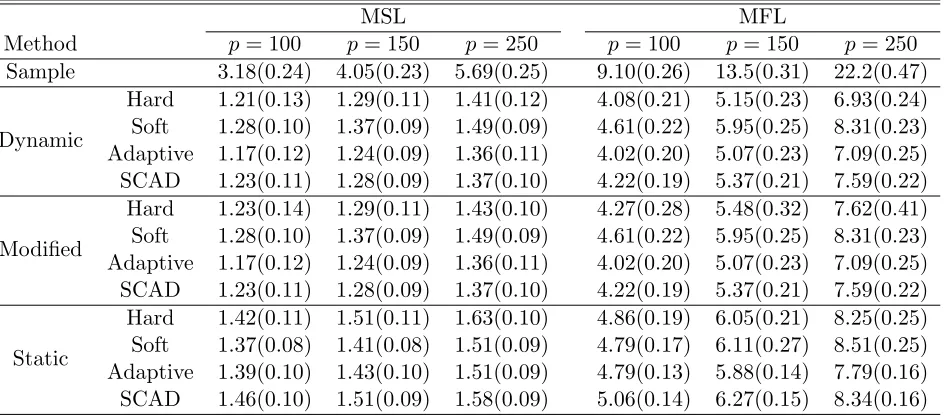
Table 1: Average (standard error) MSLs and MFLs for Model 1
MSL MFL
Method p= 100 p= 150 p= 250 p= 100 p= 150 p= 250
Sample 3.18(0.24) 4.05(0.23) 5.69(0.25) 9.10(0.26) 13.5(0.31) 22.2(0.47)
Dynamic
Hard 1.21(0.13) 1.29(0.11) 1.41(0.12) 4.08(0.21) 5.15(0.23) 6.93(0.24) Soft 1.28(0.10) 1.37(0.09) 1.49(0.09) 4.61(0.22) 5.95(0.25) 8.31(0.23) Adaptive 1.17(0.12) 1.24(0.09) 1.36(0.11) 4.02(0.20) 5.07(0.23) 7.09(0.25) SCAD 1.23(0.11) 1.28(0.09) 1.37(0.10) 4.22(0.19) 5.37(0.21) 7.59(0.22)
Modified
Hard 1.23(0.14) 1.29(0.11) 1.43(0.10) 4.27(0.28) 5.48(0.32) 7.62(0.41) Soft 1.28(0.10) 1.37(0.09) 1.49(0.09) 4.61(0.22) 5.95(0.25) 8.31(0.23) Adaptive 1.17(0.12) 1.24(0.09) 1.36(0.11) 4.02(0.20) 5.07(0.23) 7.09(0.25) SCAD 1.23(0.11) 1.28(0.09) 1.37(0.10) 4.22(0.19) 5.37(0.21) 7.59(0.22)
Static
Hard 1.42(0.11) 1.51(0.11) 1.63(0.10) 4.86(0.19) 6.05(0.21) 8.25(0.25) Soft 1.37(0.08) 1.41(0.08) 1.51(0.09) 4.79(0.17) 6.11(0.27) 8.51(0.25) Adaptive 1.39(0.10) 1.43(0.10) 1.51(0.09) 4.79(0.13) 5.88(0.14) 7.79(0.16) SCAD 1.46(0.10) 1.51(0.09) 1.58(0.09) 5.06(0.14) 6.27(0.15) 8.34(0.16)
computed from an independent data. We adopt this idea. Specifically, we divide the original
sample into two samples at random of size n1 andn2, wheren1 =n(1−log1n) and n2 = lognn, and
repeat this N1 times. Let ˆΣ1,s(u) and ˆΣ2,s(u) be the empirical dynamic covariance estimators
according to (2) based on n1 and n2 observations respectively with the bandwidth selected by
the subset-y-variables cross validation. Given u, we select the thresholding parameter ˆλ(u) by
minimizing
R(λ, u) := 1
N1
N1
X
s=1
||sλ( ˆΣ1,s(u))−Σˆ2,s(u)||2F,
where ||M||2
F = tr(M MT) is the squared Frobenius norm of a matrix.
4
Numerical Studies
In this section we investigate the finite sample performance of the proposed procedure with Monte
Carlo simulation studies. We compare our method to the static covariance matrix estimates
in Rothman et al. (2009) when generalized thresholding, including hard, soft, adaptive lasso,
and SCAD thresholding, is considered. We also include the modified estimator ˆΣM(u) that
guarantees positive definiteness and the empirical sample dynamic covariance matrix in (2) for
comparison purposes. Throughout the numerical demonstration, the Gaussian kernel function
K(a) = √1
2π exp(−a
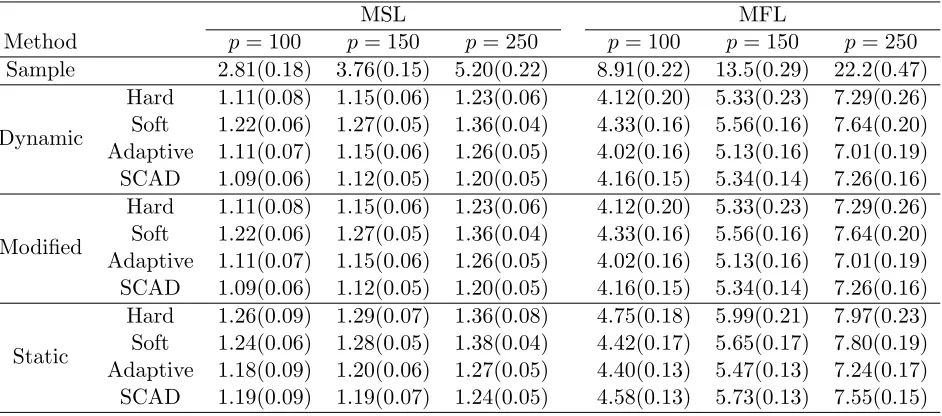
Table 2: Average (standard error) MSLs and MFLs for Model 2
MSL MFL
Method p= 100 p= 150 p= 250 p= 100 p= 150 p= 250
Sample 2.81(0.18) 3.76(0.15) 5.20(0.22) 8.91(0.22) 13.5(0.29) 22.2(0.47)
Dynamic
Hard 1.11(0.08) 1.15(0.06) 1.23(0.06) 4.12(0.20) 5.33(0.23) 7.29(0.26) Soft 1.22(0.06) 1.27(0.05) 1.36(0.04) 4.33(0.16) 5.56(0.16) 7.64(0.20) Adaptive 1.11(0.07) 1.15(0.06) 1.26(0.05) 4.02(0.16) 5.13(0.16) 7.01(0.19) SCAD 1.09(0.06) 1.12(0.05) 1.20(0.05) 4.16(0.15) 5.34(0.14) 7.26(0.16)
Modified
Hard 1.11(0.08) 1.15(0.06) 1.23(0.06) 4.12(0.20) 5.33(0.23) 7.29(0.26) Soft 1.22(0.06) 1.27(0.05) 1.36(0.04) 4.33(0.16) 5.56(0.16) 7.64(0.20) Adaptive 1.11(0.07) 1.15(0.06) 1.26(0.05) 4.02(0.16) 5.13(0.16) 7.01(0.19) SCAD 1.09(0.06) 1.12(0.05) 1.20(0.05) 4.16(0.15) 5.34(0.14) 7.26(0.16)
Static
Hard 1.26(0.09) 1.29(0.07) 1.36(0.08) 4.75(0.18) 5.99(0.21) 7.97(0.23) Soft 1.24(0.06) 1.28(0.05) 1.38(0.04) 4.42(0.17) 5.65(0.17) 7.80(0.19) Adaptive 1.18(0.09) 1.20(0.06) 1.27(0.05) 4.40(0.13) 5.47(0.13) 7.24(0.17) SCAD 1.19(0.09) 1.19(0.07) 1.24(0.05) 4.58(0.13) 5.73(0.13) 7.55(0.15)
4.1
Simulation studies
Study 1.
We consider two dynamic covariance matrices in this study to investigate the accuracy of our
proposed estimating approach in terms of the spectral loss and the Frobenius loss of a matrix.
Model 1: (Dynamic banded covariance matrices). Let Σ(u) ={σij(u)}1≤i,j≤p,whereσij(u) =
exp(u/2)[{φ(u) + 0.1}I(|i−j|= 1) +φ(u)I(|i−j|= 2) +I(i=j)] and φ(u) is the density of the
standard normal distribution.
Model 2: (Dynamic AR(1) covariance model). Let Σ(u) = {σij(u)}1≤i,j≤p, where σij(u) =
exp(u/2)φ(u)|i−j|.
Model 2 is not sparse, although many of the entries in Σ(u) are close to zero for large p. This
model is used to assess the accuracy of the sparse DCMs for approximating non-sparse matrices.
For each covariance model, we generate 50 datasets, each consisting of n = 150
observa-tions. We sample Ui, i = 1,· · · , n, independently from the uniform distribution with support
[−1,1]. The response variable is generated according to Yi ∼ N(0,Σ(Ui)), i = 1,· · · , n, for
p = 100,150, or 250, respectively. The k and N in the subset-y-variables cross-validation
are set to be [p/12] and p, respectively, with [p/12] denoting the largest integer no greater
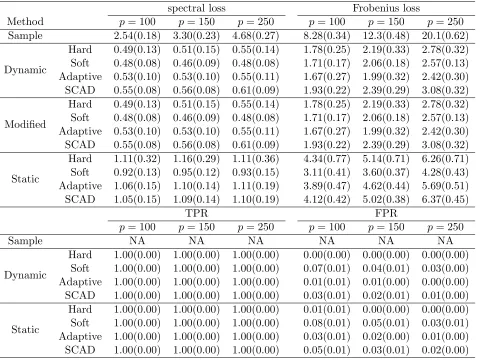
Table 3: Average (standard error) spectral loss, Frobenius loss, TPR and FPR when U =−0.75 for Model 3 in Study 2
spectral loss Frobenius loss
Method p= 100 p= 150 p= 250 p= 100 p= 150 p= 250
Sample 2.54(0.18) 3.30(0.23) 4.68(0.27) 8.28(0.34) 12.3(0.48) 20.1(0.62)
Dynamic
Hard 0.49(0.13) 0.51(0.15) 0.55(0.14) 1.78(0.25) 2.19(0.33) 2.78(0.32) Soft 0.48(0.08) 0.46(0.09) 0.48(0.08) 1.71(0.17) 2.06(0.18) 2.57(0.13) Adaptive 0.53(0.10) 0.53(0.10) 0.55(0.11) 1.67(0.27) 1.99(0.32) 2.42(0.30) SCAD 0.55(0.08) 0.56(0.08) 0.61(0.09) 1.93(0.22) 2.39(0.29) 3.08(0.32)
Modified
Hard 0.49(0.13) 0.51(0.15) 0.55(0.14) 1.78(0.25) 2.19(0.33) 2.78(0.32) Soft 0.48(0.08) 0.46(0.09) 0.48(0.08) 1.71(0.17) 2.06(0.18) 2.57(0.13) Adaptive 0.53(0.10) 0.53(0.10) 0.55(0.11) 1.67(0.27) 1.99(0.32) 2.42(0.30) SCAD 0.55(0.08) 0.56(0.08) 0.61(0.09) 1.93(0.22) 2.39(0.29) 3.08(0.32)
Static
Hard 1.11(0.32) 1.16(0.29) 1.11(0.36) 4.34(0.77) 5.14(0.71) 6.26(0.71) Soft 0.92(0.13) 0.95(0.12) 0.93(0.15) 3.11(0.41) 3.60(0.37) 4.28(0.43) Adaptive 1.06(0.15) 1.10(0.14) 1.11(0.19) 3.89(0.47) 4.62(0.44) 5.69(0.51) SCAD 1.05(0.15) 1.09(0.14) 1.10(0.19) 4.12(0.42) 5.02(0.38) 6.37(0.45)
TPR FPR
p= 100 p= 150 p= 250 p= 100 p= 150 p= 250
Sample NA NA NA NA NA NA
Dynamic
Hard 1.00(0.00) 1.00(0.00) 1.00(0.00) 0.00(0.00) 0.00(0.00) 0.00(0.00) Soft 1.00(0.00) 1.00(0.00) 1.00(0.00) 0.07(0.01) 0.04(0.01) 0.03(0.00) Adaptive 1.00(0.00) 1.00(0.00) 1.00(0.00) 0.01(0.01) 0.01(0.00) 0.00(0.00) SCAD 1.00(0.00) 1.00(0.00) 1.00(0.00) 0.03(0.01) 0.02(0.01) 0.01(0.00)
Static
Hard 1.00(0.00) 1.00(0.00) 1.00(0.00) 0.01(0.01) 0.00(0.00) 0.00(0.00) Soft 1.00(0.00) 1.00(0.00) 1.00(0.00) 0.08(0.01) 0.05(0.01) 0.03(0.01) Adaptive 1.00(0.00) 1.00(0.00) 1.00(0.00) 0.03(0.01) 0.02(0.00) 0.01(0.00) SCAD 1.00(0.00) 1.00(0.00) 1.00(0.00) 0.05(0.01) 0.03(0.01) 0.02(0.00)
spectral and Frobenius losses as the criteria to compare the estimators produced by various
approaches. Specifically, for each dataset, we estimate the DCMs at the following 20 points
ui ∈ A={−0.95,−0.85,· · · ,−0.05,0.05,0.15,· · · ,0.85,0.95}. Then for each method, we
calcu-late the medians of 20 spectral and Frobenius losses, defined as
Median Spectral Loss = median{5S(ui), i= 1,· · ·,20},
Median Frobenius Loss = median{5F(ui), i= 1,· · ·,20},
where 5S(u) = max1≤j≤p|λj{Σ(ˆ u)−Σ(u)}| and 5F(u) =
q
trace[{Σ(ˆ u)−Σ(u)}2] are spectral
loss and Frobenius loss, respectively. For brevity, the two losses, Median Spectral Loss and
Median Frobenius Loss, are referred to as MSL and MFL, respectively.
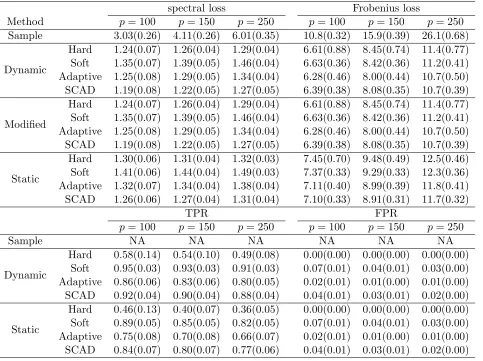
Table 4: Average (standard error) spectral loss, Frobenius loss, TPR and FPR when U = 0.25 for Model 3 in Study 2
spectral loss Frobenius loss
Method p= 100 p= 150 p= 250 p= 100 p= 150 p= 250
Sample 3.03(0.26) 4.11(0.26) 6.01(0.35) 10.8(0.32) 15.9(0.39) 26.1(0.68)
Dynamic
Hard 1.24(0.07) 1.26(0.04) 1.29(0.04) 6.61(0.88) 8.45(0.74) 11.4(0.77) Soft 1.35(0.07) 1.39(0.05) 1.46(0.04) 6.63(0.36) 8.42(0.36) 11.2(0.41) Adaptive 1.25(0.08) 1.29(0.05) 1.34(0.04) 6.28(0.46) 8.00(0.44) 10.7(0.50) SCAD 1.19(0.08) 1.22(0.05) 1.27(0.05) 6.39(0.38) 8.08(0.35) 10.7(0.39)
Modified
Hard 1.24(0.07) 1.26(0.04) 1.29(0.04) 6.61(0.88) 8.45(0.74) 11.4(0.77) Soft 1.35(0.07) 1.39(0.05) 1.46(0.04) 6.63(0.36) 8.42(0.36) 11.2(0.41) Adaptive 1.25(0.08) 1.29(0.05) 1.34(0.04) 6.28(0.46) 8.00(0.44) 10.7(0.50) SCAD 1.19(0.08) 1.22(0.05) 1.27(0.05) 6.39(0.38) 8.08(0.35) 10.7(0.39)
Static
Hard 1.30(0.06) 1.31(0.04) 1.32(0.03) 7.45(0.70) 9.48(0.49) 12.5(0.46) Soft 1.41(0.06) 1.44(0.04) 1.49(0.03) 7.37(0.33) 9.29(0.33) 12.3(0.36) Adaptive 1.32(0.07) 1.34(0.04) 1.38(0.04) 7.11(0.40) 8.99(0.39) 11.8(0.41) SCAD 1.26(0.06) 1.27(0.04) 1.31(0.04) 7.10(0.33) 8.91(0.31) 11.7(0.32)
TPR FPR
p= 100 p= 150 p= 250 p= 100 p= 150 p= 250
Sample NA NA NA NA NA NA
Dynamic
Hard 0.58(0.14) 0.54(0.10) 0.49(0.08) 0.00(0.00) 0.00(0.00) 0.00(0.00) Soft 0.95(0.03) 0.93(0.03) 0.91(0.03) 0.07(0.01) 0.04(0.01) 0.03(0.00) Adaptive 0.86(0.06) 0.83(0.06) 0.80(0.05) 0.02(0.01) 0.01(0.00) 0.01(0.00) SCAD 0.92(0.04) 0.90(0.04) 0.88(0.04) 0.04(0.01) 0.03(0.01) 0.02(0.00)
Static
Hard 0.46(0.13) 0.40(0.07) 0.36(0.05) 0.00(0.00) 0.00(0.00) 0.00(0.00) Soft 0.89(0.05) 0.85(0.05) 0.82(0.05) 0.07(0.01) 0.04(0.01) 0.03(0.00) Adaptive 0.75(0.08) 0.70(0.08) 0.66(0.07) 0.02(0.01) 0.01(0.00) 0.01(0.00) SCAD 0.84(0.07) 0.80(0.07) 0.77(0.06) 0.04(0.01) 0.03(0.01) 0.02(0.00)
estimators of the dynamic covariance matrices in Model 1 and Model 2, respectively. Here,
Sample represents the sample conditional covariance estimate in (2). Several conclusions can be
drawn from Table 1 and Table 2. First, there is a drastic improvement in accuracy by using
thresholded estimators over the kernel smoothed conditional covariance matrix in (2), and this
improvement increases with dimensionp. Second, as is expected, our proposed estimating method
produces more accurate estimators than the static covariance estimation approach independent
of the thresholding rule used. Third, the modified estimators perform similarly as the unmodified
dynamic estimates. However, we observe that the unmodified estimate is not positive definite
sometimes. For example, whenn = 100 in Model 2, we observe that about 0.6% of the estimated
Study 2.
In this study, we consider a dynamic covariance model whose sparsity pattern varies as a function
of the covariateU. The purpose of this study is to assess the ability of our proposed method for
recovering the varying sparsity, evaluated via the true positive rate (TPR) and the false positive
rate (FPR), defined as
T P R(u) = #{(i, j) :sλn(u)(ˆσij(u))6= 0 and σij(u)6= 0}
#{(i, j) :σij(u)6= 0}
,
F P R(u) = #{(i, j) :sλn(u)(ˆσij(u))6= 0 and σij(u) = 0} #{(i, j) :σij(u) = 0}
,
respectively (Rothman et al., 2009). For each given point u, we also evaluate the estimation
accuracy of various approaches in terms of the spectral loss and the Frobenius loss.
Model 3: (Varying-sparsity covariance model) Let Σ(u) = {σij(u)}1≤i,j≤p, where
σij(u) = exp(u/2)
h
0.5 exp{− (u−0.25)
2
0.752−(u−0.25)2}I(−0.5≤u≤1)I(|i−j|= 1)
+0.4 exp{− (u−0.65)
2
0.352−(u−0.65)2}I(0.3≤u≤1)I(|i−j|= 2) +I(i=j)
i
.
For this model, we assess the estimated covariance matrices at three points{−0.75,0.25,0.65}.
Note that from the data generating process, the sparsity of this dynamic covariance model varies
with the value of U, and that the covariance matrices at −0.75, 0.25 and 0.65 are diagonal,
tridiagonal and five-diagonal respectively.
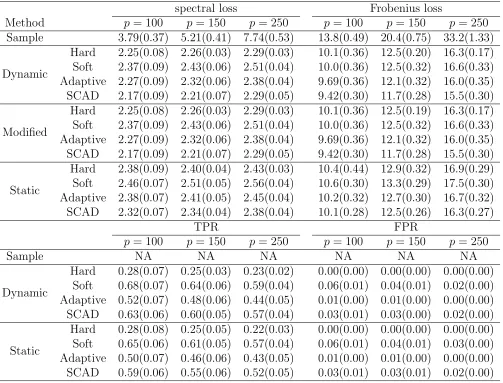
The data is generated following the procedure in Study 1. We report the spectral losses,
Frobenius losses, TPRs and FPRs in Table 3, Table 4 and Table 5 at point −0.75, 0.25 and
0.65, respectively. In these tables, “NA” means “not applicable”. Since the modified dynamic
covariance estimator does not change the sparsity, we do not report the performance of this
method for sparsity identification. The following conclusions can be drawn from the three tables.
First, the accuracy statement in terms of the spectral loss and Frobenius loss made in Study
1 continues to hold in this study. Second, for each thresholding rule, our proposed dynamic
Table 5: Average (standard error) spectral loss, Frobenius loss, TPR and FPR when U = 0.65 for Model 3 in Study 2
spectral loss Frobenius loss
Method p= 100 p= 150 p= 250 p= 100 p= 150 p= 250
Sample 3.79(0.37) 5.21(0.41) 7.74(0.53) 13.8(0.49) 20.4(0.75) 33.2(1.33)
Dynamic
Hard 2.25(0.08) 2.26(0.03) 2.29(0.03) 10.1(0.36) 12.5(0.20) 16.3(0.17) Soft 2.37(0.09) 2.43(0.06) 2.51(0.04) 10.0(0.36) 12.5(0.32) 16.6(0.33) Adaptive 2.27(0.09) 2.32(0.06) 2.38(0.04) 9.69(0.36) 12.1(0.32) 16.0(0.35) SCAD 2.17(0.09) 2.21(0.07) 2.29(0.05) 9.42(0.30) 11.7(0.28) 15.5(0.30)
Modified
Hard 2.25(0.08) 2.26(0.03) 2.29(0.03) 10.1(0.36) 12.5(0.19) 16.3(0.17) Soft 2.37(0.09) 2.43(0.06) 2.51(0.04) 10.0(0.36) 12.5(0.32) 16.6(0.33) Adaptive 2.27(0.09) 2.32(0.06) 2.38(0.04) 9.69(0.36) 12.1(0.32) 16.0(0.35) SCAD 2.17(0.09) 2.21(0.07) 2.29(0.05) 9.42(0.30) 11.7(0.28) 15.5(0.30)
Static
Hard 2.38(0.09) 2.40(0.04) 2.43(0.03) 10.4(0.44) 12.9(0.32) 16.9(0.29) Soft 2.46(0.07) 2.51(0.05) 2.56(0.04) 10.6(0.30) 13.3(0.29) 17.5(0.30) Adaptive 2.38(0.07) 2.41(0.05) 2.45(0.04) 10.2(0.32) 12.7(0.30) 16.7(0.32) SCAD 2.32(0.07) 2.34(0.04) 2.38(0.04) 10.1(0.28) 12.5(0.26) 16.3(0.27)
TPR FPR
p= 100 p= 150 p= 250 p= 100 p= 150 p= 250
Sample NA NA NA NA NA NA
Dynamic
Hard 0.28(0.07) 0.25(0.03) 0.23(0.02) 0.00(0.00) 0.00(0.00) 0.00(0.00) Soft 0.68(0.07) 0.64(0.06) 0.59(0.04) 0.06(0.01) 0.04(0.01) 0.02(0.00) Adaptive 0.52(0.07) 0.48(0.06) 0.44(0.05) 0.01(0.00) 0.01(0.00) 0.00(0.00) SCAD 0.63(0.06) 0.60(0.05) 0.57(0.04) 0.03(0.01) 0.03(0.00) 0.02(0.00)
Static
SCAD thresholding rules seems to have higher TPRs than using the hard and the adaptive
thresholding rules.
Study 3.
In this study, we demonstrate the effectiveness of our proposed method for estimating a dynamic
covariance model whose positions of the nonzero elements varied as a function of the covariate
U.
Model 4: (Varying-nonzero-position covariance model) The dynamic covariance model is
similar to the random graph model in Zhou et al. (2010). Specifically, we examine 9 time points
{−1,−0.75,−0.5,−0.25,0,0.25,0.5,0.75,1}. LetR(u) be the correlation matrix at pointu. We
randomly choose p entries {rij : i = 2,· · · , p;j < i} of R(−1) such that each of these p
ele-ments was a random variable generated from the uniform distribution with support [0.1,0.3].
The other correlations in R(−1) are all set to zero. For each of the other 8 time points
{−0.75,−0.5,−0.25,0,0.25,0.5,0.75,1}, we change p/10 existing nonzero correlations to zero
and add p/10 new nonzero correlations. For each of the p/10 new entries having nonzero
cor-relations, we choose a target correlation, and the correlation on the entry is gradually changed
to ensure smoothness. Similarly, for each of the p/10 entries to be set as zero, the correlation
decays to zero gradually. Thus, there exist p+p/10 nonzero correlations and there existp/5
cor-relations that varied smoothly. The covariance matrix is then set as exp(u/2)R(u). We generate
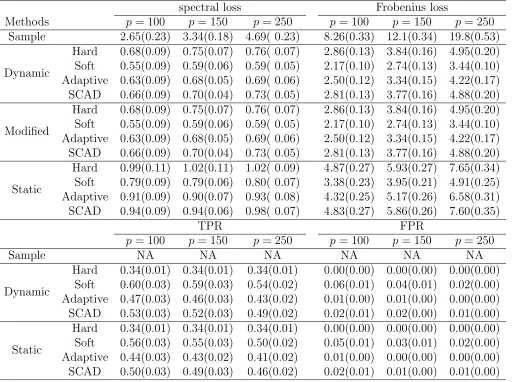
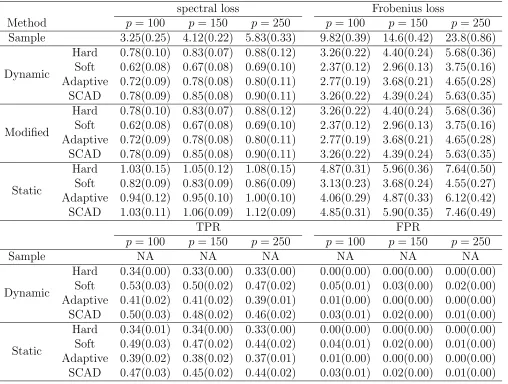
data following the procedure in Study 1 with n = 100 or n = 150. The results for estimating
the covariance matrix at point U =−1 (Zhou et al., 2010) are reported in Table 6 for n = 150
and Table 7 for n = 100. We find that the proposed method performs better than the sample
estimates and the static estimates in terms of the spectral loss, Frobenius loss and TPR.
Finally, we investigate the performance of the proposed bandwidth selection procedure using
the model in this study. For a given bandwidth parameter h, our proposed estimator of Σ(u)
is denoted as sλn(u)( ˆΣ(u;h)). The oracle that knows the true dynamic covariance matrix Σ(u)
prefers to select the bandwidth parameterh(i.e.,horacle) that minimizesPni=1||sλn(Ui)( ˆΣ(Ui;h))−
Σ(Ui)||F, where || · ||F is the Frobenius loss. The bandwidth parameter selected by our
Table 6: Average (standard error) spectral loss, Frobenius loss, TPR and FPR whenU =−1 for Model 4 in Study 3 with n= 150
spectral loss Frobenius loss
Methods p= 100 p= 150 p= 250 p= 100 p= 150 p= 250
Sample 2.65(0.23) 3.34(0.18) 4.69( 0.23) 8.26(0.33) 12.1(0.34) 19.8(0.53)
Dynamic
Hard 0.68(0.09) 0.75(0.07) 0.76( 0.07) 2.86(0.13) 3.84(0.16) 4.95(0.20) Soft 0.55(0.09) 0.59(0.06) 0.59( 0.05) 2.17(0.10) 2.74(0.13) 3.44(0.10) Adaptive 0.63(0.09) 0.68(0.05) 0.69( 0.06) 2.50(0.12) 3.34(0.15) 4.22(0.17) SCAD 0.66(0.09) 0.70(0.04) 0.73( 0.05) 2.81(0.13) 3.77(0.16) 4.88(0.20)
Modified
Hard 0.68(0.09) 0.75(0.07) 0.76( 0.07) 2.86(0.13) 3.84(0.16) 4.95(0.20) Soft 0.55(0.09) 0.59(0.06) 0.59( 0.05) 2.17(0.10) 2.74(0.13) 3.44(0.10) Adaptive 0.63(0.09) 0.68(0.05) 0.69( 0.06) 2.50(0.12) 3.34(0.15) 4.22(0.17) SCAD 0.66(0.09) 0.70(0.04) 0.73( 0.05) 2.81(0.13) 3.77(0.16) 4.88(0.20)
Static
Hard 0.99(0.11) 1.02(0.11) 1.02( 0.09) 4.87(0.27) 5.93(0.27) 7.65(0.34) Soft 0.79(0.09) 0.79(0.06) 0.80( 0.07) 3.38(0.23) 3.95(0.21) 4.91(0.25) Adaptive 0.91(0.09) 0.90(0.07) 0.93( 0.08) 4.32(0.25) 5.17(0.26) 6.58(0.31) SCAD 0.94(0.09) 0.94(0.06) 0.98( 0.07) 4.83(0.27) 5.86(0.26) 7.60(0.35)
TPR FPR
p= 100 p= 150 p= 250 p= 100 p= 150 p= 250
Sample NA NA NA NA NA NA
Dynamic
Hard 0.34(0.01) 0.34(0.01) 0.34(0.01) 0.00(0.00) 0.00(0.00) 0.00(0.00) Soft 0.60(0.03) 0.59(0.03) 0.54(0.02) 0.06(0.01) 0.04(0.01) 0.02(0.00) Adaptive 0.47(0.03) 0.46(0.03) 0.43(0.02) 0.01(0.00) 0.01(0.00) 0.00(0.00) SCAD 0.53(0.03) 0.52(0.03) 0.49(0.02) 0.02(0.01) 0.02(0.00) 0.01(0.00)
Static
Table 7: Average (standard error) spectral loss, Frobenius loss, TPR and FPR whenU =−1 for Model 4 in Study 3 with n= 100
spectral loss Frobenius loss
Method p= 100 p= 150 p= 250 p= 100 p= 150 p= 250
Sample 3.25(0.25) 4.12(0.22) 5.83(0.33) 9.82(0.39) 14.6(0.42) 23.8(0.86)
Dynamic
Hard 0.78(0.10) 0.83(0.07) 0.88(0.12) 3.26(0.22) 4.40(0.24) 5.68(0.36) Soft 0.62(0.08) 0.67(0.08) 0.69(0.10) 2.37(0.12) 2.96(0.13) 3.75(0.16) Adaptive 0.72(0.09) 0.78(0.08) 0.80(0.11) 2.77(0.19) 3.68(0.21) 4.65(0.28) SCAD 0.78(0.09) 0.85(0.08) 0.90(0.11) 3.26(0.22) 4.39(0.24) 5.63(0.35)
Modified
Hard 0.78(0.10) 0.83(0.07) 0.88(0.12) 3.26(0.22) 4.40(0.24) 5.68(0.36) Soft 0.62(0.08) 0.67(0.08) 0.69(0.10) 2.37(0.12) 2.96(0.13) 3.75(0.16) Adaptive 0.72(0.09) 0.78(0.08) 0.80(0.11) 2.77(0.19) 3.68(0.21) 4.65(0.28) SCAD 0.78(0.09) 0.85(0.08) 0.90(0.11) 3.26(0.22) 4.39(0.24) 5.63(0.35)
Static
Hard 1.03(0.15) 1.05(0.12) 1.08(0.15) 4.87(0.31) 5.96(0.36) 7.64(0.50) Soft 0.82(0.09) 0.83(0.09) 0.86(0.09) 3.13(0.23) 3.68(0.24) 4.55(0.27) Adaptive 0.94(0.12) 0.95(0.10) 1.00(0.10) 4.06(0.29) 4.87(0.33) 6.12(0.42) SCAD 1.03(0.11) 1.06(0.09) 1.12(0.09) 4.85(0.31) 5.90(0.35) 7.46(0.49)
TPR FPR
p= 100 p= 150 p= 250 p= 100 p= 150 p= 250
Sample NA NA NA NA NA NA
Dynamic
Hard 0.34(0.00) 0.33(0.00) 0.33(0.00) 0.00(0.00) 0.00(0.00) 0.00(0.00) Soft 0.53(0.03) 0.50(0.02) 0.47(0.02) 0.05(0.01) 0.03(0.00) 0.02(0.00) Adaptive 0.41(0.02) 0.41(0.02) 0.39(0.01) 0.01(0.00) 0.00(0.00) 0.00(0.00) SCAD 0.50(0.03) 0.48(0.02) 0.46(0.02) 0.03(0.01) 0.02(0.00) 0.01(0.00)
Static
Hard 0.34(0.01) 0.34(0.00) 0.33(0.00) 0.00(0.00) 0.00(0.00) 0.00(0.00) Soft 0.49(0.03) 0.47(0.02) 0.44(0.02) 0.04(0.01) 0.02(0.00) 0.01(0.00) Adaptive 0.39(0.02) 0.38(0.02) 0.37(0.01) 0.01(0.00) 0.00(0.00) 0.00(0.00) SCAD 0.47(0.03) 0.45(0.02) 0.44(0.02) 0.03(0.01) 0.02(0.00) 0.01(0.00)
horacle|/horacle as the criterion to measure the performance of hCV. Setting p= 100, we explore
the performance based on 50 simulations forn = 100,150 and 200, respectively. The medians of
50 absolute relative errors for sample sizes 100,150 and 200 are 0.12,0.06 and 0.01, respectively.
The percentages of absolute relative errors less than 20% for sample sizes 100, 150 and 200 are
0.82, 0.96, 0.98, respectively. It is concluded that the estimated bandwidth converges fast to its
oracle counterpart when the sample size grows.
4.2
Real data analysis
As an illustration, we apply the dynamic covariance method to the resting state fMRI data
obtained from the attention deficit hyperactivity disorder (ADHD) study conducted by New York
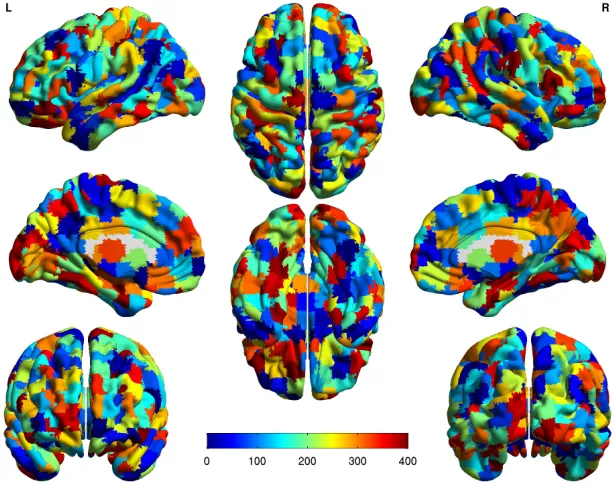
Figure 1: The ROIs from the CC400 functional parcellation atlases.
disorders and can continue through adulthood. Symptoms of ADHD include difficulty staying
focused and paying attention, difficulty controlling behavior, and over-activity. An ADHD patient
tends to have high variability in brain activities over time. Because fMRI measures brain activity
by detecting associated changes in blood flow through low frequency BOLD signal in the brain
(Biswal et al., 1995), it is believed that the temporally varying information in fMRI data may
provide insight into the fundamental workings of brain networks (Calhoun et al., 2014; Lindquist
et al., 2014). Thus, it is of great interest to study the dynamic changes of association among
different regions of interest (ROIs) of the brain for an ADHD patient at the resting state. For
this dataset, we examine the so-called CC400 ROI atlases with 351 ROIs derived by functionally
parcellating the resting state data as discussed in Craddock et al. (2012). An illustration of these
ROIs is found in Figure 1.
The experiment included 222 children and adolescents. We focus on Individual 0010001. The
BOLD signals of p = 351 ROIs of the brain were recorded over n = 172 scans equally spaced
in time. We treat the time as the index variables U after normalizing the 172 scanning time
points onto [0,1]. The main aim is to assess how the correlations of BOLD signals change with
the scanning time, as changing correlations can illustrate the existence of distinctive temporal
0.0 0.2 0.4 0.6 0.8 1.0
−0.5
0.0
0.5
Time
Correlation
[image:24.612.160.431.64.331.2]Cor(1,2) Cor(1,7) Cor(1,12) Cor(3,4) Cor(14,30)
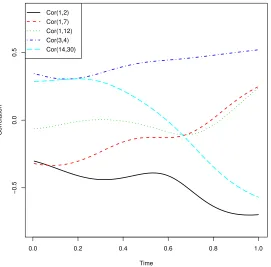
Figure 2: Selected entries of the correlation matrix as functions of time using (2) for the ADHD data. Cor(k, l) represents the (k, l)-th element of the correlation matrix.
covariance estimating method and compare it to the static method in Rothman et al. (2009).
We first obtain the sample covariance estimate as defined in (2), and plot selected entries of
this matrix in Figure 2. We can see that the correlations of BOLD signals for different pairs of
ROIs vary with time. For example, the entries (1,7) and (14,30) as functions of the time change
signs, one from negative to positive and one from positive to negative. Entries (1,2) and (3,4)
seem to remain negative and positive respectively over the entire time, while entry (1,12) is very
close to zero before becoming positive. As discussed in the Introduction, a test of the equality
of the two covariance matrices, one for the first 86 scans and the other for the last 86 scans, is
rejected. These motivate the use of the proposed dynamic covariance method. For the dynamic
sparse estimates, we only report the results using the soft thresholding rule, since simulation
studies indicate that this thresholding rule performs satisfactorily in recovering the true sparsity
of the covariance matrices. We examine the estimated dynamic covariance matrices at the 50-th,
90-th and 130-th scans.
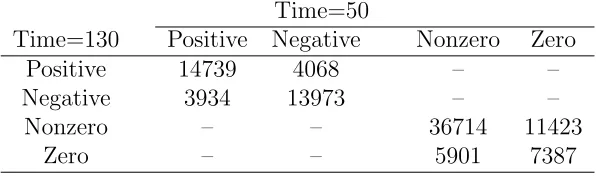
Table 8: Qualitative summary of the estimated correlations at time 50 and 130 Time=50
Time=130 Positive Negative Nonzero Zero
Positive 14739 4068 – –
Negative 3934 13973 – –
Nonzero – – 36714 11423
Zero – – 5901 7387
in Figure 3 (a), (b) and (c) for time 50, 90 and 130 respectively. We can see a clear varying
pattern in panel (a)–(c), as compared to the static covariance matrix estimate in panel (e).
To appreciate the dynamic characteristics of the BOLD signals, in panel (d), we use K-means
clustering to cluster the 351 time series, one from each ROI, with K = 10, and plot these ten
centroids. We can see different correlation patterns for the BOLD signals during different time
periods, indicating the need for dynamically capturing the time varying phenomenon.
We comment on the dynamic nature of the three estimated matrices. The matrices at time
50, 90 and 130 have 42615, 46778 and 48137 non-zero correlations, respectively. That is, the
covariance matrix at time = 130 is denser than those at time = 50 and 90. This tells that the
sparsity of the covariance varies with time. Moreover, the positions of the nonzero (or zero)
correlations change with time. For example, as Table 8 shows, there are 7387 and 36714 entries
(correlations) of the estimated covariance matrices at time = 50 and 130 to be simultaneously
zero and nonzero, respectively. However, there are 5901 entries (correlations) that are nonzero in
the estimated covariance matrix at time = 50 but are zero in the estimated matrix at time = 130.
There are 11423 entries (correlations) that are zero in the estimated matrix at time = 50 but
are zero in the estimated matrix at time = 130. Furthermore, the signs of the correlations are
time varying. As Table 8 shows, the numbers of the entries (correlations) of the two estimated
covariance matrices being simultaneously positive and negative are 14739 and 13973, respectively.
Meanwhile, there are 4068 entries (correlations) that are negative in the estimated covariance
matrix at time = 50 but are positive in the estimated matrix at time = 130. And there are 3934
entries (correlations) that are positive in the estimated covariance matrix at time = 50 but are
negative in the estimated matrix at time = 130. We found that, at time = 50, 2 ROIs have
more than 325 associations with other ROIs, and that 8 ROIs have fewer than 10 associations
0 10 20 30
0 10 20 30
−1.0 −0.5 0.0 0.5 1.0
Correlation
(a)
0 10 20 30
0 10 20 30
−1.0 −0.5 0.0 0.5 1.0
Correlation
(b)
0 10 20 30
0 10 20 30
−1.0 −0.5 0.0 0.5 1.0
Correlation
(c)
0.0 0.2 0.4 0.6 0.8 1.0
−1.0
0.0
1.0
Time
BOLD Signal
(a) t=50/172 (b) t=90/172 (c) t=130/172
(d)
0 10 20 30
0 10 20 30
−1.0 −0.5 0.0 0.5 1.0
Correlation
[image:26.612.57.559.89.629.2](e)
becomes 11, and the number of the ROIs having fewer than 10 associations is 3, indicating that
there are more active ROIs at this time. However, the static covariance estimating method can
not show these dynamics.
As brain activities are often measured through low frequency BOLD signals in the brain,
our model indicates that the correlations of different areas of the brain varied over time, which
coincides with the high variability of brain function for an ADHD patient and makes sense for
the purpose of locating the ADHD pathology.
5
Discussion
We study for the first time a novel uniform theory of the dynamic covariance model that combines
the strength of kernel smoothing and modelling sparsity in high dimensional covariances. Our
numerical results show that our proposed method can capture dynamic behaviors of these varying
matrices and outperforms its competitors. We are currently studying similar uniform theory for
high dimensional regression and classification where dynamics are incorporated.
We identify several directions for future study. First, the kernel smoothing employed in this
paper uses local constant fitting. It is interesting to study local linear models that is known
to reduce bias (Fan and Gijbels, 1996). A first step was taken by Chen and Leng (2015) when
the dimensionality is fixed, but more research is warranted. Second, it is of great interest to
develop more adaptive thresholding rules such as those in Cai and Liu (2011). A difficulty in
extending our method in that direction is that the sample dynamic covariance matrix in (2) is
biased entrywise, unlike the sample static covariance matrix in Cai and Liu (2011). Third, it is of
great interest to study a new notion of rank-based estimation of a large dimensional covariance
matrix in a dynamic setting (Liu et al., 2012; Xue and Zou, 2012) that is more robust to the
distributional assumption of the variables. Fourth, it is possible to study dynamic estimation
of the inverse of a covariance matrix that elucidates conditional independence structures among
the variables (Yuan and Lin, 2007). These topics are beyond the scope of the current paper and
Appendix
Lemma 4. Under Conditions (a)–(d), suppose that (3) is satisfied and supu∈Ωσii(u)< M2 <∞
for all i. If x >0 and x→0 as n → ∞, we have, for 1≤i≤n, 1≤j ≤p and 1≤k ≤p,
EexK(Ui
−u
h )YijYik <∞
for each u∈Ω.
Proof. When n is large enough, we have
EexYijYik = 1 +xEY
ijYik+
x2 2 EY
2
ijY
2
ik+
x3 3!EY
3
ijY
3
ik+· · ·
≤ 1 +xEYij2+ x 2
2EY 4
ij +
x3 3!EY
6
ij +· · ·
+1 +xEYik2 +x 2
2 EY 4
ik+
x3
3!EY 6
ik+· · ·
= EexYij2 +EexYik2 <∞.
By simple calculation, it is seen Ee|xYijYik| <∞. Due to the boundedness of the kernel function
K(·), we obtain Ee|xK(Uih−u)YijYik|<∞.The result follows.
Define Wijk(u, h) :=K{(Ui−u)/h}YijYik−EK{(Ui−u)/h}YijYik, for 1≤i≤n, 1≤j ≤p
and 1≤k ≤p. By Lemma 4, we easily have the following lemma.
Lemma 5. Under Conditions (a)–(d), if (3) holds and supu∈Ωσii(u)< M2 <∞ for all i, then,
if x > 0 and x→ 0 as n → ∞, there exists a positive constant gi =O(var(Wijk(u, h)) =O(h),
which does not depend on u, such that
Eexp{xWijk(u, h)} ≤exp{gix2}
for each u∈Ω.
The exponential convergence rate for|1
n
Pn
i=1Kh(Ui−u)YijYik−EKh(Ui−u)YijYik|is impor-tant for deriving our theorems. First, we obtain its point-wise convergence rate in the following
Lemma 6. Under Conditions (a)–(d), suppose that (3) holds and supu∈Ωσii(u)< M2 <∞ for
all i. If λn →0, there exists a constant C >0, which does not depend on u, such that
P 1 n n X i=1
Kh(Ui−u)YijYik−EKh(Ui−u)YijYik
≥λn
≤2 exp{−Cnhλ2n}
for each u∈Ω.
Proof. Define G := Pn
i=1gi = O(nh). By Lemma 5, for x > 0 and x → 0 as n → ∞, we have
P
n
X
i=1
Wijk(u, h)≥λn
≤ exp{−xλn}Eexp{x n
X
i=1
Wijk(u, h)}
= exp{−xλn}ΠniEexp{xWijk(u, h)}
≤ exp{−λnx+Gx2}. (6)
Note that (6) is maximized when x=λn/2G→ 0 and that the maximizer is exp{−
λ2
n
4G}. Thus,
there exists a positive constant C such that
Pn1 n
n
X
i=1
Kh(Ui−u)YijYik−EKh(Ui−u)YijYik
o
≥λn
≤exp{−Cnhλ2n}.
Similarly, we obtain
Pn1 n
n
X
i=1
Kh(Ui −u)YijYik−EKh(Ui−u)YijYik
o
≤ −λn
≤exp{−Cnhλ2n}.
Combining the above two equations, the result is established.
We discuss the uniform exponential convergence rate for|1
n
Pn
i=1Kh(Ui−u)YijYik−E(YijYik|U =
u)f(u)|, which plays an important role in deriving our theorems.
Lemma 7. Under Conditions (a)–(d), suppose that (3) holds, supu|K0(u)| < M5 < ∞ and
supu∈Ωσii(u) < M2 < ∞ for all i. For sufficient large M
0
, if λn = M
0
(
q
logp
nh +h
2√logp),
logp
nh →0 and h
4logp→0, there exist C
1 >0 and C2 >0 such that
Psup
u∈Ω
1 n n X i=1
Kh(Ui −u)YijYik−E(YijYik|U =u)f(u)
≥λn
Proof. Without loss of generality, we let Ω = [a, b]. Decompose [a, b] =∪qn
l=1[un,l−rn, un,l+rn],
which contains qn intervals of length 2rn. That is 2qnrn =b−a. Then,
sup
u∈[a,b]
1 n n X i=1
Kh(Ui−u)YijYik−EKh(Ui−u)YijYik
≤ max 1≤l≤qn
1 n n X i=1
Kh{Ui−un,l}YijYik−EKh{Ui−un,l}YijYik
+ max 1≤l≤qn
sup
u∈[un,l−rn,un,l+rn]
1 n n X i=1
Kh(Ui−u)YijYik−
1
n
n
X
i=1
Kh{Ui−un,l}YijYik
− {EKh(Ui−u)YijYik−EKh(Ui−un,l)YijYik}
.
Let rn =h4, then qn = b2−ha4. Let λn =M 0
(
q
logp
nh +h
2√logp), where M0
is sufficiently large,
logp
nh → 0 and h
4logp → 0. Define B
1 = {ω : max1≤l≤qnsupu∈[un,l−rn,un,l+rn]|
1
n
Pn
i=1Kh(Ui −
u)YijYik − n1
Pn
i=1Kh(Ui −un,l)YijYik − {EKh(Ui−u)YijYik −EKh(Ui −un,l)YijYik}| < λn/3}
and B2 =B1C. By Taylor’s expansion, we have
sup
u∈[un,l−rn,un,l+rn]
1 n n X i=1
Kh(Ui−u)YijYik−
1
n
n
X
i=1
Kh(Ui−un,l)YijYik
− {EKh(Ui−u)YijYik−EKh(Ui−un,l)YijYik}
≤h4 sup
u∈[un,l−rn,un,l+rn]
1 nh2 n X i=1 n
K0(Ui−un,l+Ri(un,l−u)
h )YijYik
−EK0(Ui−un,l+Ri(un,l−u)
h )YijYik
o
, (7)
where 0 < Ri < 1 is a random scalar depending on Ui, for i = 1,· · · , n. Since supu|K
0
(u)| <
M5 <∞, (7) is bounded by
h2M 5
n
n
X
i=1
(Yij2 +Yik2) +h2M5(EYij2+EYik2). (8)
A (for all l) such that
P sup
u∈[un,l−rn,un,l+rn]
1 n n X i=1
Kh(Ui −u)YijYik−
1
n
n
X
i=1
Kh(Ui−un,l)YijYik
− {EKh(Ui−u)YijYik−EKh(Ui−un,l)YijYik}
≥λn/3
≤2 exp{−An h4 λ
2
n}.
Thus, we obtain immediately
P(B2) = P
max 1≤l≤qn
sup
u∈[un,l−rn,un,l+rn]
1 n n X i=1
Kh(Ui−u)YijYik−
1
n
n
X
i=1
Kh(Ui−un,l)YijYik
− {EKh(Ui−u)YijYik−EKh(Ui−un,l)YijYik}
≥λn/3
= qn max
1≤l≤qn
P sup
u∈[un,l−rn,un,l+rn]
1 n n X i=1
Kh(Ui−u)YijYik−
1
n
n
X
i=1
Kh(Ui −un,l)YijYik
− {EKh(Ui−u)YijYik−EKh(Ui−un,l)YijYik}
≥λn/3
≤ 2qnexp{−
An h4 λ
2
n}. (9)
Note
P
sup
u∈[a,b]
1 n n X i=1
Kh(Ui−u)YijYik−EKh(Ui−u)YijYik
≥λn
≤Pn sup
u∈[a,b]
1 n n X i=1
Kh(Ui−u)YijYik−EKh(Ui−u)YijYik
≥λn
o
∩ B1
+Pn sup
u∈[a,b]
1 n n X i=1
Kh(Ui−u)YijYik−EKh(Ui−u)YijYik
≥λn
o
∩ B2
:=J1+J2.
We know that J1 is bounded (using Lemma 6) as
P max 1≤l≤qn
1 n n X i=1
Kh{Ui−un,l}YijYik−EKh{Ui−un,l}YijYik
≥(λn−λn/3)
≤qn max
1≤l≤qn
P 1 n n X i=1
Kh{Ui −un,l}YijYik−EKh{Ui −un,l}YijYik
≥λn/2
and that J2 is bounded by (9). Therefore, for large enoughn,
P sup
u∈[a,b]
1 n n X i=1
Kh(Ui−u)YijYik−EKh(Ui−u)YijYik
≥λn
≤4qnexp{−Cnhλ2n/4} ≤
2(b−a)
h4 exp{−Cnhλ 2
n/4}.
It is well known that (Pagan and Ullah, 1999; Fan and Huang, 2005)
sup
u∈[a,b]
EKh(Ui−u)YijYik−E(YijYik|U =u)f(u)
=O(h
2).
Since
sup
u∈[a,b]
1 n n X i=1
Kh(Ui−u)YijYik−E(YijYik|U =u)f(u)
≤ sup
u∈[a,b]
1 n n X i=1
Kh(Ui−u)YijYik−EKh(Ui−u)YijYik
+ sup
u∈[a,b]
EKh(Ui−u)YijYik−E(YijYik|U =u)f(u)
and λn h2, we have immediately
P sup
u∈[a,b]
1 n n X i=1
Kh(Ui−u)YijYik−E(YijYik|U =u)f(u)
≥λn
≤P sup
u∈[a,b]
1 n n X i=1
Kh(Ui−u)YijYik−EKh(Ui−u)YijYik
≥λn/2
≤ 2(b−a)
h4 exp{−Cnhλ 2
n/16}.
Letting C1 =C/16 and C2 = 2(b−a), we obtain the conclusion.
Remark 3. We now outline the main steps of our proofs. Along the way, we highlight the
main theoretical innovations and comment that existing results in the literature may not apply
to the high-dimensional problems we are interested in studying. In the first step, we obtain the
exponential convergence rate of|1
n
Pn
i=1Kh(Ui−u)YijYik−EKh(Ui−u)YijYik|in Lemma 6 for each
u on a discrete grid. After decomposing Ω, we transform the uniform exponential convergence
6. The exponential uniform convergence result of the kernel estimators in Lemma 7, essential
for establishing the main conclusions of the paper, plays an important role in deriving the rates
of convergence in Theorem 1 and Proposition 3 as well as the result in Theorem 2, when one
deals with problems with the dimensionality exponentially high in relation to the sample size.
In contrast, Einmahl and Mason (2005) used the exponential inequality of Talagrand (1994) to
construct the uniform exponential convergence rate. According to their arguments, the right
hand side of (7) should be much larger than h−4exp{−C1nhλ2n}. This indicates that the result
implied by the theorems in Einmahl and Mason (2005) is not enough for deriving the uniform
convergence results in our paper and thus does not apply to the challenging high-dimensional
setup.
Remark 4. To facilitate the proof of Lemma 7, we assume supu|K0(u)|< M5 <∞. However,
this does not mean that some commonly used kernel functions (e.g., the boxcar kernel) can not
be used. We now examine the boxcar kernel specifically. WriteK(u) = 12I(|u| ≤1) and note
sup
u∈[un,l−rn,un,l+rn]
1 n n X i=1
Kh(Ui−u)YijYik−
1
n
n
X
i=1
Kh(Ui−un,l)YijYik
− {EKh(Ui−u)YijYik−EKh(Ui−un,l)YijYik}
≤ 1
2u∈[un,lsup−rn,un,l]
1 n n X i=1 1
hI{Ui ∈[u+h, un,l+h]}YijYik−E
1
hI{Ui ∈[u+h, un,l+h]}YijYik
+1
2u∈[un,lsup−rn,un,l]
1 n n X i=1 1
hI{Ui ∈[u−h, un,l−h]}YijYik−E
1
hI{Ui ∈[u−h, un,l−h]}YijYik
+1
2u∈[un,lsup,un,l+rn]
1 n n X i=1 1
hI{Ui ∈[un,l+h, u+h]}YijYik−E
1
hI{Ui ∈[un,l+h, u+h]}YijYik
+1
2u∈[un,lsup,un,l+rn]
1 n n X i=1 1
hI{Ui ∈[un,l−h, u−h]}YijYik−E
1
hI{Ui ∈[un,l−h, u−h]}YijYik
:= A1+A2 +A3+A4. (10)
We have
A1 ≤
1 n n X i=1 1
hI{Ui ∈[un,l+h−rn, un,l+h]}(Y
2
ij +Y
2
ik)
+|E{1
hI{Ui ∈[un,l+h−rn, un,l+h]}(Y
2
ij +Y
2
ik)