© Medwell Journals, 2020
Comparison of Voice Analysis Programs for Fundamental Frequency
Measurement in Elderly Voice Signals Through Gender Analysis
Min Ju Seo and JiYeoun Lee
Department of Biomedical Engineering, Jungwon University, Donbu-ri #5,
Goesan-eup, Goesan-gun, 367-805 Chungcheongbuk-do, South Korea
Abstract: Changes in the vocal folds due to aging may change the pitch of the voice. An elderly signal can be automatically distinguished from a normal signal through various analyses. With most smart biomedical devices, elderly voices have been neglected due to optimization that does not take the elderly into account. The objective of this study was to use a symmetric higher-order differential energy function to analyze the elderly signal and extract the fundamental frequency. This study suggests a symmetric higher-order differential energy function based on gender analysis. The elderly voices of 40 Korean subjects (20 females and 20 males) ranging in age from 70-80 years were used. Symmetrical instantaneous frequency estimators with orders 5 and 4 were selected for female and male voices, respectively in this study through gender analysis. The experiments were compared to the F0 extracted by various methods such as manual extraction, WaveSurfer, TF32, Praat and an instantaneous frequency estimator based on before-and-after gender analysis. The F0 value obtained through the instantaneous frequency estimator after gender analysis is the most similar to the results from manual extraction, exhibiting an accuracy of 80%. The results will help to provide ease of access for the elderly by means of speech. Future investigations will incorporate multiple analytical methods to implement more reliable detectors for automated medical diagnostic systems.
Key words: Elderly voice, symmetric higher-order differential energy function, fundamental frequency, instantaneous frequency estimator, diagnostic, disorder voice
INTRODUCTION
Speech signal processing is a field of researching algorithms that computers automatically understand and process natural language uttered by human. It is necessary to understand the contents and emotions of words, recognize meaning and exchange natural conversations (Lee, 2017). According to the statistics of the National Statistical Office, Korea has already entered an aged society and expects to increase to 15.1% by 2020 (Cho et al., 2018).
The aging of the body brings morphological changes in the tissues of the vocal cords and larynx structure that are directly relevant to voice. Therefore, elderly voices have to be understood in conjunction with the acoustic properties of the sound as the larynx changes due to aging. In other words, anatomical and physiological changes in the larynx and vocal cords may change the pitch of the voice which is measured by the fundamental frequency (F0) (Kahane, 1981). In conclusion, elderly voice is distinguished from that of such groups as young adults and middle-aged persons.
Computerized smart devices with speech interface are actively produced for medical welfare systems (Lee, 2014). However, as is the case for most medical devices, elderly voices have been excluded from the speech
recognition and synthesis systems due to an interface that does not take the elderly into account (Kim and Kim, 2001). A speech interface that supports a medical device currently uses an optimized method based on the average speech patterns of young adults, the middle-aged and the elderly. If the deviation of the pattern from the standard is too great, it may result in a phenomenon that degrades the performance of voice synthesis and recognition (Kim and Kim, 2001; Song, 2012; Lee and Kwon, 2014). Therefore, in order to respond to the changes of aged society, the voice signal analysis technique of the elderly should be utilized in the clinic for the purpose of interpreting the voice in the multidimensional aspect and providing appropriate intervention plan. Analysis of the elderly voice can be the beginning of gender innovation.
uniformized threshold and the threshold value for each acoustic index is applied with the same number of sex samples according to each age group. Since, the acoustic index are also based on fundamental frequency, a highly reliable pitch detection algorithm is necessary to measure voicing irregularities in elderly signals (Lee et al., 2010; Lee, 2012). Perturbation analysis has been found to be sensitive to pitch variations in analysis tools such as Multi-Dimensional Voice Profile (MDVP), CSpeech and TF32.
Some papers have utilized Higher-Order Statistics (HOS) for pitch estimation. Many studies have applied HOS to disordered voices, since, Alonso et al. (2001) published on the automatic detection of voice pathologies by HOS-based parameters (Lee et al., 2008a, b; Lee and Hahn, 2010; Lee et al., 2011; Lee, 2012). Furthermore, the combination of HOS analysis and the Linear Predictive Coding (LPC) residual may help to effectively construct important information to distinguish the signal types of disordered voices (Lee and Hahn, 2010; Lee et al., 2011; Lee and Choi, 2012).
In this study, we analyze the speech of the elderly by means of gender analysis. Gender analysis provides a basis for robust evaluation of the differences between women and men and removes the possibility of analysis based on incorrect assumptions and stereotypes. An instantaneous frequency estimator using symmetric higher-order differential energy function is presented in this study for the analysis of elderly voices and a comparison of the various programs of fundamental frequency extraction such as TF32, WaveSurfer, Praat, and manual techniques (Iem, 2010, 2011). This approach will enhance the speech recognition performance of existing smart medical systems for the elderly. It is also expected to help provide a means of easy access for the elderly and people with disabilities who were excluded from rapid socialization with speech.
Gender analysis methods: Gendered innovations aim to pursue excellence in the research and development of science and technology by integrating sex and gender analysis. Gendered innovations activities were initiated by Dr. Londa Schiebinger of Stanford University and the concept, methods and case studies are presented in detail on the following website: http://genderedinnovations. stanford.edu.
Sex and gender can influence all stages of research or development processes, ranging from strategic considerations for establishing priorities and building theory to the more routine tasks of formulating questions, designing methodologies and interpreting data as shown in referenced website.
Gender innovation is an approach to applying gender analysis in science and engineering. As the need for “innovation that reflects gender” is raised, Stanford University and the European Commission (EC), led by experts in gender, basic science, engineering, health and
medicine, policy and technology development have developed a systematic analysis method that considers gender and sex. Gender innovation methods and case studies were developed through seven international workshops from 2010-2013. The twelve methods for gender and sex analysis in each research field are as follows: rethinking research priorities and outcomes, rethinking concepts and theories, formulating research questions, analyzing sex, analyzing gender, analyzing how sex and gender interact, analyzing factors intersecting with sex and gender, engineering innovation processes, designing health and biomedical research, participatory research and design, rethinking standards and reference models and rethinking language and visual representations. We should consider the above research processes in each step to analyze sex and gender.
In this study, we reported the sex of research subjects and the differences that exist within groups of females and males as sex analysis. We also conducted research on the elderly voice in response to gender needs as gender analysis. Therefore, the experiments were conducted by setting the elderly voice as the target, not using voice from all ages. Finally, we considered standards and reference models to decrease gender and sex bias.
MATERIALS AND METHODS
Elderly voice database: Elderly voice samples were collected in the Speech information Technology and Industry Promotion Center (SiTEC). The database includes the elderly voices of 40 Korean subjects (20 females and 20 males), ranging in age from 70-80 years. Two sentences and ten words were used in this study. The voice samples were sampled at 16 kHz. Detailed database information is shown in Table 1.
Extraction method of fundamental frequency: A symmetric higher-order differential energy function is utilized to extract fundamental frequency. The instantaneous frequency is a single frequency value at a certain instance in time. That is it is a time varying frequency as a function of time. The definition of classical instantaneous frequency can be reviewed in (Iem, 2010, 2011).
For the discrete signal x [n] = Acos (Ωn+θ), the higher order differential energy function is defined as follows:
(1)
k x n = x n x n+k-2 -x n-1 x n+k-1
Where:
x [n] : Discrete signal at time n k : The order of the energy operator
Table 1: Elderly voice database
Sex Age No. Korean sentences
Female 70-79 5 Who then came forward to her desk (geuttae nuga geunyeoui chaegsang ap-eulo dagawassda) 5 Then a stranger approached and asked (geuttae wen nachseon salam-i dagawa mul-eossda)
10 Blue house (cheong-wadae), vaccinia (udukeoni), kolitical retirement (jeong-gyeeuntoeleul), by-election
(bogwolseongeo), out of sight (siyaleul), iron ax (soedokkileul), benefit (hyetaeg-eul), hugging (kkeul-eoango), premium (boheomlyo), factitious (in-wijeog-in)
Male 70-78 5 Same
5 Same 10 Same (2)
k k k kx n + x n-k+2
, odd k 2
x n =
2
x n- +1 , even k
k
Instantaneous frequency using a symmetric higher-order differential energy function can be derived as follows:
(3)
-1 2k-1
2k-1
x n 1
n = cos ( )
k-1 2 x n
This equation manages the time misalignment of the generalized instantaneous frequency. To obtain the frequency prediction performance with order of the instantaneous frequency estimator an AM-PM signal is used as a test signal. The signal is defined as follows:
(4)
n
1+ cos cos
100 x n =
n+20 sin , n = 1,2, ,400n
5 100
,
0.05i, 0.05j , i, j = 1,2,3,
,10The κ and λ control an amount of AM and PM, respectively. They increase the values from 5-50% in a stepwise fashion by increments of 5%. Then, instantaneous frequency of the signal is defined as follows:
(5)
n = + cos n5 5 100
The frequency estimation error of the instantaneous frequency is defined as follows:
(6)
10 10 400 ij
iji =1 j=1 n =1 ij
ˆ
n - n
1 Error % =
40000 n
Where:
Ωij [n] : The real values of instantaneous frequency
: Estimated values of instantaneous frequency in
ij
ˆ n
[image:3.612.316.540.209.259.2]specific (i, j)
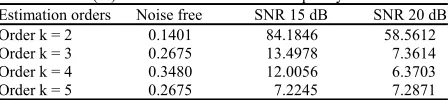
Table 2: Error (%) of various instantaneous frequency estimators Estimation orders Noise free SNR 15 dB SNR 20 dB
Order k = 2 0.1401 84.1846 58.5612
Order k = 3 0.2675 13.4978 7.3614
Order k = 4 0.3480 12.0056 6.3703
Order k = 5 0.2675 7.2245 7.2871
RESULTS AND DISCUSSION
Order decision of instantaneous frequency estimator:
Table 2 shows the performance of various instantaneous frequency estimators. In the noise free case, the symmetric higher-order differential energy operator based on the instantaneous frequency estimator with order k = 2 shows the best result. Other orders also produce acceptable results. In noisy situations, such as SNR 15 and 20 dB, the symmetric higher-order differential energy operators based on the instantaneous frequency estimator with order k = 5 and k = 4 yielded the best results. When the order is 4, acceptable results (7.2245 and 7.2871%) are shown in two noise environments. Then, the second order estimator shows the worst results.
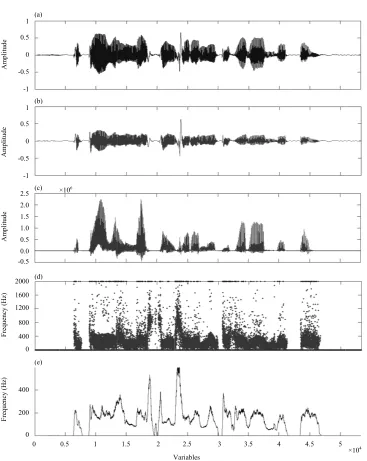
Fundamental frequency estimator: Figure 1 shows the structure of the fundamental frequency estimator. Elderly signals such as Fig. 2a are first processed with a low pass filter with a cutoff frequency of 250 Hz. Then, the 250 Hz lowpass filtered signal is shown as in Fig. 2b. The phonated sentence is “ Then a stranger approached and asked (geuttae wen nachseon salam-i dagawa mul-eossda)” in Korean. Symmetrical instantaneous frequency estimators with orders 5 and 4 are selected for female and male voices, respectively as shown in Table 2. The higher-order differential energy function used to estimate an instantaneous frequency is utilized as a characteristic parameter to classify unvoiced and voiced sections. The fundamental frequency can be found through the moving average filter with estimated instantaneous frequency values for the obtained voiced sections.
Low-pass f ilter
Symmetric higher-order
differential energy function
Voiced/ unvoiced classif ication
Instantaneous frequency estimator Elderly
signal
Extraction of fundamental frequency Moving average
[image:4.612.112.506.97.139.2]f ilter
Fig. 1: Structure of a fundamental frequency estimator
Fig. 2: Higher order differential energy functions extracted from elderly female voice (a) Original waveform of elderly female voice, (b) 250 Hz lowpass filtered waveform, (c) Differential a energy operator, (d) Instantaneous frequency, (e) Extracted fundamental frequency
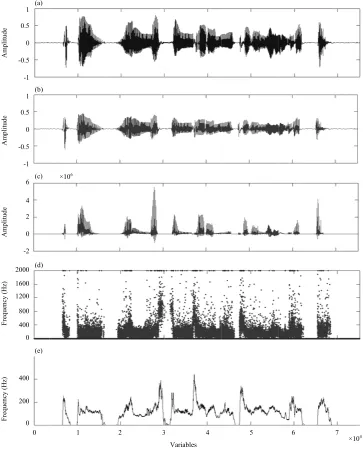
of Fig. 2e, a moving average filter with a length of 200 is utilized. The same procedures are used for the elderly male waveform in Fig. 3.
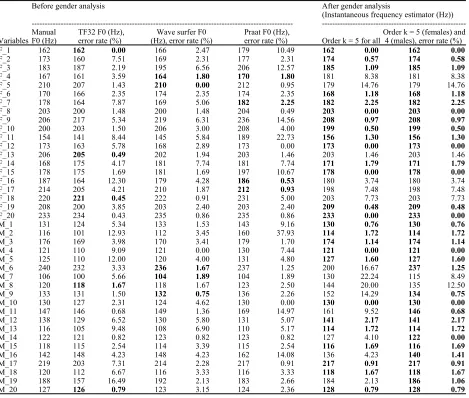
Table 3 shows the results of various fundamental frequency extractions. From F_1-F_5 and from M_1-M_5, the subjects pronounced the sentence as
Al
it
d
Al
it
d
Al
it
d
F(
H
)
F(
H
)
1
0.5
0
-0.5
-1
1
0.5
0
-0.5
-1
2.5 2.0 1.5 1.0 0.5 0.0 -0.5
2000 1600 1200
800
400 0
400
200
0 0
×
A
mp
li
tu
de
A
mp
li
tu
de
A
mp
li
tu
de
F
re
qu
en
cy
(H
z)
F
re
qu
en
cy
(H
z)
(a)
(b)
(c)
(d)
(e)
0.5 1
×106
1.5 2 V
2.5 3 Variables
[image:4.612.119.486.168.629.2]Fig. 3: Higher order differential energy functions extracted from elderly male voice (a) Original waveform of elderly male voice, (b) 250 Hz lowpass filtered waveform, (c) Differential energy operator, (d) Instantaneous frequency, (e) Extracted fundamental frequency
“Who then came forward to her desk (geuttae nuga geunyeoui chaegsang ap-eulo dagawassda.)” in Korean. From F_6-F_10 and from M_6-M_10, the subjects pronounced the sentence as “Then a stranger approached and asked (geuttae wen nachseon salam-i dagawa mul-eossda)” in Korean. From F_11-F_20 and from M_11-M_20, the subjects pronounced the words as “Blue house (cheong-wadae), vaccinia (udukeoni), political retirement (jeong-gyeeuntoeleul), by-election (bogwolseongeo), out of sight (siyaleul), iron ax
(soedokkileul), benefit (hyetaeg-eul), hugging (kkeul-eoango), premium (boheomlyo), factitious (in-wijeog-in)” in order.
The first column represents F0 which was manually extracted by our researchers. The second and third columns indicate F0 that were extracted by TF32, WaveSurfer and Praat. Finally, F0 was extracted with the instantaneous frequency estimator with order 5 for female and male signals. It is the last stage before gender analysis that does not consider characteristics of
1
0.5
0
-0.5
-1
1
0.5
0
-0.5
-1
6
4
2
0
-2
2000
1600 1200
800 400 0
400
200
0 0
Am
pl
it
ude
Am
pl
it
ude
Am
pl
it
ude
Freq
ue
nc
y (H
z)
Freq
ue
nc
y (H
z)
(a)
(b)
(c)
(d)
(e)
1
×106
2 33 4 Variables
Table 3: Comparisons of various extraction methods
Before gender analysis After gender analysis
(Instantaneous frequency estimator (Hz)) --- ---Manual TF32 F0 (Hz), Wave surfer F0 Praat F0 (Hz), Order k = 5 (females) and Variables F0 (Hz) error rate (%) (Hz), error rate (%) error rate (%) Order k = 5 for all 4 (males), error rate (%)
F_1 162 162 0.00 166 2.47 179 10.49 162 0.00 162 0.00
F_2 173 160 7.51 169 2.31 177 2.31 174 0.57 174 0.58
F_3 183 187 2.19 195 6.56 206 12.57 185 1.09 185 1.09
F_4 167 161 3.59 164 1.80 170 1.80 181 8.38 181 8.38
F_5 210 207 1.43 210 0.00 212 0.95 179 14.76 179 14.76
F_6 170 166 2.35 174 2.35 174 2.35 168 1.18 168 1.18
F_7 178 164 7.87 169 5.06 182 2.25 182 2.25 182 2.25
F_8 203 200 1.48 200 1.48 204 0.49 203 0.00 203 0.00
F_9 206 217 5.34 219 6.31 236 14.56 208 0.97 208 0.97
F_10 200 203 1.50 206 3.00 208 4.00 199 0.50 199 0.50
F_11 154 141 8.44 145 5.84 189 22.73 156 1.30 156 1.30
F_12 173 163 5.78 168 2.89 173 0.00 173 0.00 173 0.00
F_13 206 205 0.49 202 1.94 203 1.46 203 1.46 203 1.46
F_14 168 175 4.17 181 7.74 181 7.74 171 1.79 171 1.79
F_15 178 175 1.69 181 1.69 197 10.67 178 0.00 178 0.00
F_16 187 164 12.30 179 4.28 186 0.53 180 3.74 180 3.74
F_17 214 205 4.21 210 1.87 212 0.93 198 7.48 198 7.48
F_18 220 221 0.45 222 0.91 231 5.00 203 7.73 203 7.73
F_19 208 200 3.85 203 2.40 203 2.40 209 0.48 209 0.48
F_20 233 234 0.43 235 0.86 235 0.86 233 0.00 233 0.00
M_1 131 124 5.34 133 1.53 143 9.16 130 0.76 130 0.76
M_2 116 101 12.93 112 3.45 160 37.93 114 1.72 114 1.72
M_3 176 169 3.98 170 3.41 179 1.70 174 1.14 174 1.14
M_4 121 110 9.09 121 0.00 130 7.44 121 0.00 121 0.00
M_5 125 110 12.00 120 4.00 131 4.80 127 1.60 127 1.60
M_6 240 232 3.33 236 1.67 237 1.25 200 16.67 237 1.25
M_7 106 100 5.66 104 1.89 104 1.89 130 22.24 115 8.49
M_8 120 118 1.67 118 1.67 123 2.50 144 20.00 135 12.50
M_9 133 131 1.50 132 0.75 136 2.26 152 14.29 134 0.75
M_10 130 127 2.31 124 4.62 130 0.00 130 0.00 130 0.00
M_11 147 146 0.68 149 1.36 169 14.97 161 9.52 146 0.68
M_12 138 129 6.52 130 5.80 131 5.07 141 2.17 141 2.17
M_13 116 105 9.48 108 6.90 110 5.17 114 1.72 114 1.72
M_14 122 121 0.82 123 0.82 123 0.82 127 4.10 122 0.00
M_15 118 115 2.54 114 3.39 115 2.54 116 1.69 116 1.69
M_16 142 148 4.23 148 4.23 162 14.08 136 4.23 140 1.41
M_17 219 203 7.31 214 2.28 217 0.91 217 0.91 217 0.91
M_18 120 112 6.67 116 3.33 116 3.33 118 1.67 118 1.67
M_19 188 157 16.49 192 2.13 183 2.66 184 2.13 186 1.06
M_20 127 126 0.79 123 3.15 124 2.36 128 0.79 128 0.79
females and males. After gender analysis, F0 are extracted with the instantaneous frequency estimator with order 5 and 4 for female and male signals, respectively. F0 of female elderly and male elderly was average 190 and 142 Hz. The average F0 value of adult males is about 100-130 Hz and the average F0 value of adult females is about 190-230 Hz. F0 of the older females tend to decrease and F0 of the older males tend to be higher.
The values of the instantaneous frequency estimator before-and-after gender analysis were 75 and 80%, respectively. The accuracies of WaveSurfer, TF32 and Praat were 12.5, 12.5 and 10%, respectively. In addition, comparing the manual and various extraction methods with the F0 error rate (%), the F0 value of the instantaneous frequency estimator after gender analysis was closest to that of manual extraction with an accuracy of 80%. The gray cells represent extracted F0 values closest to the manually extracted F0 values. As shown in Table 3, the best accuracy is obtained with F0 extracted
through the instantaneous frequency estimator with order k = 5 and 4 for females and males, respectively, after gender analysis.
CONCLUSION
Speech interfaces that are used in smart medical devices currently uses an optimized method based on the average speech patterns of young and middle-aged adults and the elderly. If the speech pattern has even a slightly larger deviation from the standard model, it may result in a phenomenon that degrades the performance of voice synthesis and recognition. Elderly voices have been neglected from the speech recognition and synthesis system of most smart medical devices due to speech interfaces that do not take the elderly into account.
sex of research subjects and the differences that exist within groups of females and males as sex analysis. We also conducted research on the elderly voice in response to gender needs as gender analysis. Therefore, the experiments were conducted by setting the elderly voice as the target, not using a voice created from the average speech patterns of all ages. Finally, we confirmed the standards and reference models to decrease gender and sex bias.
The elderly voices of 40 Korean subjects (20 females and 20 males) ranging in age from 70-80 years were used. The symmetrical instantaneous frequency estimators with order 5 and 4 were selected for female and male voices, respectively in this study through gender analysis. The higher-order differential energy function to estimate an instantaneous frequency is utilized as characteristic parameter to classify unvoiced and voiced section. The fundamental frequency can be found through moving average filter with the values of an instantaneous frequency estimated in the obtained voiced section. Performance was estimated as a comparison of F0 extracted by various methods, such as manual techniques, WaveSurfer, TF32, Praat and an instantaneous frequency estimator based on before-and-after gender analysis. The F0 values through the instantaneous frequency estimator after gender analysis are the most similar to the manual extraction results with an accuracy of 80% being observed.
Our research will enhance the speech recognition and synthesis performance of existing smart medical systems for the elderly. This study is also expected to help provide a means of easy access to such enhancements as speech for the elderly and people with disabilities who are excluded from rapid socialization.
ACKNOWLEDGEMENTS
This research was supported by the National Research Foundation of Korea (NRF) grant funded by the Korea government (MEST) (No. 2017R1A2B4011373).
REFERENCES
Alonso, J.B., J.D. Leon, I. Alonso and M.A. Ferrer, 2001. Automatic detection of pathologies in the voice by HOS based parameters. EURASIP. J. Appl. Signal Process., 4: 275-284.
Cho, B.C., S. Cheon, K.N. Kim and H.S. Yuk, 2018. A policy study for the voice recognition technology based on elderly health care. J. Digital Convergence, 16: 9-17.
Iem, B.G., 2010. An instantaneous frequency estimator based on the symmetric higher order differential energy operator. IEICE. Trans. Fundam. Electron. Commun. Comput. Sci., 93: 227-232.
Iem, B.G., 2011. Estimation of fundamental frequency using an instantaneous frequency based on the symmetric higher order differential energy operator. Trans. Korean Inst. Electr. Eng., 60: 2374-2379.
Kahane, J.C., 1981. Anatomic and Physiologic Changes in the Aging Peripheral Speech Mechanism. In: Aging, Communication Processes and Disorders, Beasley, D.S. and G.A. Davis (Eds.). Grune and Stratton, New York, USA., ISBN:9780808912811, pp: 21-45.
Kim, H.T., S.H. Cho, S.M. Youn, D.I. Sun and M.S. Kim, 2000. The changes and characteristics of acoustic parameters with aging in Korean. Korean J. Otorhinolaryngology Head Neck Surg., 43: 69-74.
Kim, I.C. and D.Y. Kim, 2001. A study on the features for building Korean digit recognition system based on multilayer perceptron. J. Korea Ind. Inf. Syst. Res., 6: 389-391.
Kim, S.H. and D.H. Ko, 2008. Fundamental frequencies in Korean elderly speakers. Speech Sci., 15: 95-102.
Lee, J. and S.H. Choi, 2012. Perturbation analysis using a moving window for disordered voices. Intl. J. Eng. Sci. Innovative Technol., 3: 1-10.
Lee, J., 2014. KHIDI brief. Korea Health Ind. Dev. Inst., 140: 1-2.
Lee, J., S. Jeong, M. Hahn, A.J. Sprecher and J.J. Jiang, 2011. An efficient approach using HOS-based parameters in the LPC residual domain to classify breathy and rough voices. Biomed. Signal Process. Control, 6: 186-196.
Lee, J.Y. and M. Hahn, 2010. Automatic assessment of pathological voice quality using higher-order statistics in the LPC residual domain. EURASIP. J. Adv. Signal Process., 2009: 1-8.
Lee, J.Y., 2012. A two-stage approach using Gaussian mixture models and higher-order statistics for a classification of normal and pathological voices. EURASIP. J. Adv. Signal Process., 2012: 1-8.
Lee, J.Y., S. Jeong and M. Hahn, 2008a. Pathological voice detection using efficient combination of heterogeneous features. IEICE. Trans. Inf. Syst., 91: 367-370.
Lee, J.Y., S. Jeong, H.S. Choi and M. Hahn, 2008b. Objective pathological voice quality assessment based on HOS features. IEICE. Trans. Inf. Syst., 91: 2888-2891.
Lee, K.N., 2017. Voice language processing technology, how far have you come. National Korean Lang. Inst. N. Lang. Life, 27: 99-116.
Lee, S.J. and S.I. Kwon, 2014. Elderly speech analysis for improving elderly speech recognition. J. Korean Inst. Inf. Sci. Eng., 32: 16-20.
Sataloff, R.T., D.C. Rogen, M. Hawkshaw and J.R. Spiegel, 1997. The three ages of voice: The aging adult voice. J. Voice, 11: 156-160.