University of Warwick institutional repository: http://go.warwick.ac.uk/wrap
A Thesis Submitted for the Degree of PhD at the University of Warwick
http://go.warwick.ac.uk/wrap/58403
This thesis is made available online and is protected by original copyright. Please scroll down to view the document itself.
Making
Sense
of
Mathematics:
Supportive
and
Problematic
Conceptions
with
special
reference
to
Trigonometry
Kin Eng CHIN
A thesis submitted for the degree of
Doctor
of
Philosophy
University
of
Warwick
ii
Contents
Chapter1: ThesisOverview 1
1.1 Introduction. 1
1.2 Structure of the thesis. 5
Chapter2: LiteratureReview 9
2.1 Introduction. 9
2.2 Theories related to mathematical thinking . 10
2.2.1 Compression of operations. 13
2.2.2 Compression of objects through categorization. 18
2.2.3 Distillation of the theories. 19
2.3 Research in trigonometry. 22
2.4 Construction of knowledge and understanding. 25
2.5 Conceptions of mathematics. 28
2.6 Subject matter knowledge of mathematics. 29
2.7 Emotions associated to mathematical thinking. 31
2.8 Emergence of research questions from the literature
review. 33
2.9 Summary. 34
Chapter3: TheoreticalFramework 36
3.1 Introduction. 36
3.2 Ways of making sense of mathematics. 37
3.3 Extensional blend in trigonometry. 44
3.3.1 Triangle trigonometry. 44
3.3.2 Circle trigonometry. 45
3.3.3 Analytic trigonometry. 47
3.4 Supportive and problematic conceptions in changing
contexts in trigonometry. 50
3.5 Knowing and grasping. 55
iii
3.6 Summary. 57
Chapter4: ResearchDesignandMethods 59
4.1 Introduction. 59
4.2 Research questions. 60
4.3 The sample. 64
4.4 Methods of data collection. 65
4.4.1 Questionnaire. 65
4.4.2 Follow‐up interview. 68
4.4.3 Concept map. 69
4.5 The quasi‐judicial method of analysis. 71
4.6 Ethical considerations 73
4.7 Conclusion. 74
Chapter5: PreliminaryInvestigations 75
5.1 Introduction. 75
5.2 The pilot study. 76
5.3 Outcome of the pilot study 77
5.3.1 Respondent A . 78
5.3.2 Respondent B . 83
5.3.3 Respondent C . 88
5.4 The special case study. 93
5.4.1 Outcome of the special case study. 93
5.5 Interpretive dilemmas in the data analysis process. 106
5.6 Relating empirical evidence to theoretical framework. 107
Chapter6: TheStoriesofFiveStudentTeachers 112
6.1 Introduction. 112
6.2 The story of student teacher ST1. 113
6.2.1 Summary of ST1. 131
6.3 The story of student teacher ST2. 135
iv
6.4 The story of student teacher ST3. 163
6.4.1 Summary of ST3. 163
6.5 The story of student teacher ST4. 165
6.5.1 Summary of ST4. 183
6.6 The story of student teacher ST5. 185
6.6.1 Summary of ST5. 199
6.7 Summary of the chapter. 201
Chapter7: StudentTeachers’ConceptMaps 202
7.1 Introduction. 202
7.2 Concept maps of ST1 . 203
7.3 Concept maps of ST2 . 207
7.4 Concept maps of ST3. 209
7.5 Concept maps of ST4 . 211
7.6 Concept maps of ST5 . 213
7.7 Summary. 214
Chapter8: MasteryofSubjectMatterKnowledge&Levelof
Confidence 216
8.1 Introduction. 216
8.2 Perceptions on the importance of mastery of subject
matter knowledge. 217
8.2.1 Items considered unimportant by a few student
teachers. 221
8.2.2 Summary of mastery of subject matter
knowledge. 223
8.3 Level of confidence. 224
8.3.1 Level of confidence in responding to the
mathematics item. 224
v Chapter9: StudentTeachers’AwarenessofLearning
DifficultiesinTrigonometry 235
9.1 Introduction. 235
9.2 Awareness of learning difficulties in trigonometry. 235
9.3 Student teachers’ perceptions of their own
learning difficulties. 235
9.3.1 Student teacher ST1. 235
9.3.2 Student teacher ST2. 237
9.3.3 Student teacher ST3. 238
9.3.4 Student teacher ST4. 239
9.3.5 Student teacher ST5. 240
9.4 Awareness of student’s difficulties in learning
trigonometry. 241
9.4.1 Student teacher ST1. 241
9.4.2 Student teacher ST2. 241
9.4.3 Student teacher ST3. 242
9.4.4 Student teacher ST4. 242
9.4.5 Student teacher ST5. 243
9.5 Summary. 244
Chapter10: SummaryandPlansforFutureDirections 247
10.1 Introduction. 247
10.2 Main ideas and theoretical framework. 247
10.3 Summary of the study. 248
10.4 Methodological considerations. 252
10.5 Suggestions for further research. 253
vi Sampleofquestionnaireforthisstudy 258
TranscriptofST1’sfollow‐upinterview 261
TranscriptofST2’sfollow‐upinterview 276
TranscriptofST3’sfollow‐upinterview 287
TranscriptofST4’sfollow‐upinterview 297
TranscriptofST5’sfollow‐upinterview 320
Bibliography 337
vii
List
of
Figures
2.1 Emotions associated with goals and anti‐goals
(Tall, 2013). 31
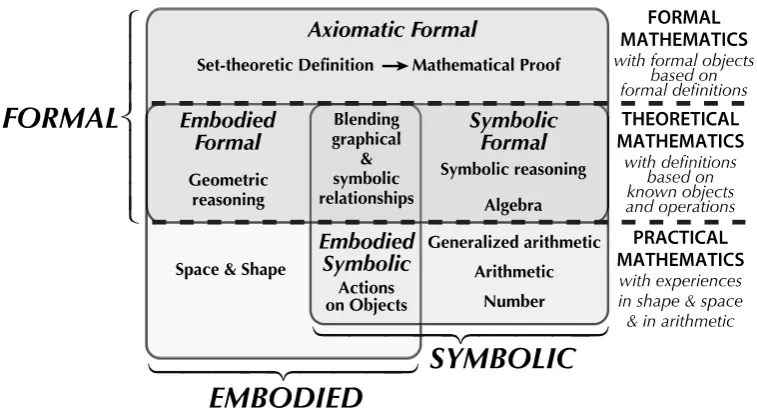
3.1 Practical, theoretical and formal mathematics
(Tall, 2013). 40
3.2 Length and angle in Euclidean geometry. 45
3.3 A right angled triangle in the unit circle. 46
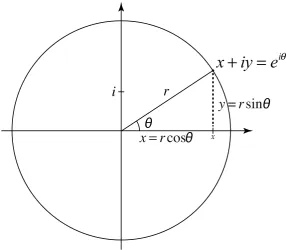
3.4 A complex number in Cartesian and Polar coordinates. 50
3.5 Geometric representation of Euler formula. 50
3.6 Proof of the formula for sin( )in triangle
trigonometry. 53
5.1 Sketch of interviewee SC. 95
6.1 Sketch of sine graph by ST1. 115
6.2 Sketch of radians by ST1. 118
6.3 Sketch of tangent curve by ST1. 127
6.4 Sketch of tan 90in triangle trigonometry by ST1. 128
6.5 Sketch of a gradient line by ST3. 158
6.6 Sketch of tan 90in triangle trigonometry by ST4. 179
6.7 Sketch of complex numbers by ST5 . 197
7.1 First concept map constructed by ST1. 203
7.2 Second concept map constructed by ST1. 205
7.3 First concept map constructed by ST2. 207
7.4 Second concept map constructed by ST2. 208
7.5 First concept map constructed by ST3. 209
7.6 Elements added to the first concept map by ST3 as
his second concept map. 210
7.7 First concept map constructed by ST4. 211
7.8 Elements added to the first concept map by ST4 as
viii 7.9 First and second concept map constructed by ST5. 213
8.1 Mean values of mastery of SMK tested by the mathematics
items. 219
8.2 Mean values of level of confidence in responding to the
mathematics items. 225
ix
List
of
Tables
2.1 Links between the proposed theoretical framework
to other theories. 21
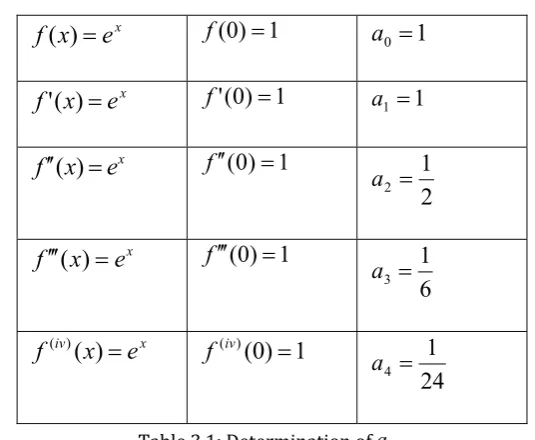
3.1 Determination of an. 49
8.1 Responses for mastery of subject matter knowledge. 218
8.2 Level of confidence in responding to the mathematics
items. 225
x
Acknowledgements
During the writing of this thesis, I have received valuable support from different people. I wish to thank Emeritus Professor Dr David Tall, who has given me the fullest support and strength throughout my PhD study. He is an excellent supervisor and an exemplary model of how to supervise doctoral students. Not only that, he treats me like his family member.
I am also extremely grateful to David Lynham and Hannah Rooney, who have invested a lot of time in helping me to transcribe the interviews. I would like to thank Dr Michael Hammond who acted as my co‐supervisor and has given me the necessary support to complete this study.
Tragically my wife, Pei Yee Lai who died in spring 2012 and thus she never saw the result of this study. Her love and support to me will be remembered forever. This study is dedicated to her.
xi
Declaration
xii
Abstract
This thesis is concerned with how a group of student teachers make sense of trigonometry. There are three main ideas in this study. This first idea is about the theoretical framework which focusses on the growth of mathematical thinking based on human perception, operation and reason. This framework evolves from the work of Piaget, Bruner, Skemp, Dienes, Van Hiele and others. Although the study focusses on trigonometry, the theory constructed is applicable to a wide range of mathematics topics.
The second idea is about three distinct contexts of trigonometry namely triangle trigonometry, circle trigonometry and analytic trigonometry. Triangle trigonometry is based on right angled triangles with positive sides and angles bigger than 0and less than 90. Circle trigonometry involves dynamic angles of any size and sign with trigonometric ratios involving signed numbers and the properties of trigonometric functions represented as graphs. Analytic trigonometry involves trigonometric functions expressed as power series and the use of complex numbers to relate exponential and trigonometric functions.
1 Chapter1
ThesisOverview
1.1Introduction.
As a university lecturer who has taught several years of mathematics
courses for prospective teachers, I became very interested in exploring how
humans make sense of mathematics in ways that can essentially improve
teacher education. Apart from this, I also have two years of teaching
experience as a secondary school mathematics teacher before joining the
university as a lecturer. As a consequence, I noticed that most secondary
students have difficulties in understanding trigonometry. Additionally, I still
remember my experience as a secondary school student who had struggled
to make sense of school trigonometry. With this background, I started the
journey of this study. I initiated my investigation by reading journals and
books which were related to the theories in mathematical thinking.
The rationale of choosing trigonometry as a research topic arose because it
involved the blending of two domains of mathematics involving visual and
symbolic aspects in geometry and algebra. Moreover I found that there were
very few research studies conducted in trigonometry, therefore a study in
this area should be beneficial for mathematics education. Through extensive
reading and relating my personal experience in learning school
trigonometry I conjectured that there were certain common difficulties in
learning school trigonometry across learners such as the transition from the
triangle trigonometry to the unit circle. Then I designed the first version of a
2 Having collected the data I sought to read further research papers to
formulate a theoretical framework to make sense of the responses. The
discussions with my supervisor, Professor David Tall enabled us to clarify
issues in his work on three worlds of mathematics, which was subsequently
published as Tall (2013), and to modify the theory to base the ideas on the
blending of geometry and algebra and the more general ideas of blending
perception, operation and reason, which has its origins in the ideas of
Richard Skemp (1979) where he speaks of perception, action and reflection.
This study is concerned with how a group of student teachers make sense of
trigonometry which they will eventually teach at different levels to pupils in
school at different stages of development. The theoretical framework
focusses on the growth of mathematical thinking based on human
perception, operation and reason. This has its foundations in a wide range of
empirical and theoretical research. In particular human perception is
related to the notion of embodiment as suggested by Lakoff & Nunez (2000)
meanwhile operation is related to the process‐object encapsulation theories
as proposed by Dubinsky & McDonald (2001), Sfard (1991), Gray & Tall
(1994). Reason is closely related to the increasing sophistication in
embodiment and symbolism such as the increasing sophistication in
geometry of Van Hiele (1986) and in arithmetic and algorithm based on the
rules of arithmetic, and the theories of advanced mathematical thinking in
Tall (1991).
In this thesis there are three main ideas. The first focuses on how
3 particular, in terms of perception, operation and reason (Chin & Tall, 2012).
Although the study focusses on trigonometry, the theory constructed is part
of a broader theory of cognitive and affective development of mathematical
concepts (Tall, 2013).
The second idea is about three distinct contexts in making sense of
trigonometry. The review of literature and the outcome of the pilot study
(discussed in chapters 2 and 4) suggest that there are two distinct contexts
for trigonometry in school and further developments in undergraduate
study. These three distinct contexts of trigonometry are introduced as
triangle trigonometry, circletrigonometry and analytic trigonometry in this
study. Triangle trigonometry is based on right angled triangles with positive
sides and angles bigger than 0and less than 90. Circle trigonometry involves dynamic angles of any size and sign with trigonometric ratios
involving signed numbers and the properties of trigonometric functions
represented as graphs. Analytic trigonometry involves trigonometric
functions expressed as power series and the use of complex numbers to
relate exponential and trigonometric functions.
The third idea concerns supportiveandproblematic conceptions in making
sense of trigonometry. This involves the effect of previous experience in
new contexts. This idea was first introduced in Tall (2004) as a ‘met‐before’.
In this case, ‘met‐before’ can be regarded as a mental construct that an
individual uses at a given time based on experiences they have met before.
Met‐befores can be supportive in a new situation and encourage
4 instance the conception of triangle in Euclidean geometry may impede the
generalization of triangle in the Cartesian plane because the sides and
angles, which previously had specific properties as unsigned quantities, can
now be any size, positive or negative. In this thesis we will find that
conceptions in general may involve a mixture of supportive and problematic
conceptions. A supportive conception that leads to successful mathematical
thinking may also involve subtle problematic aspects. On the other hand,
problematic aspects may become so dominant as to cause increasing
disaffection. In general, supportive conceptions will give the learner a sense
of confidence whereas problematic conceptions may act as a challenge to
some or lead to a sense of anxiety for others. This will result in a spectrum of
performance in the whole population from those who take pleasure in
success at one extreme or experience mathematical anxiety and likely
failure at the other.
As the students develop their knowledge, supportive conceptions may occur
in different ways. A student may ‘know’ how to perform an algorithm or
how to use a particular concept, without ‘grasping’ the meaning of the idea
in a manner which enables them to make sense of more sophisticated ideas.
For instance, a pupil may ‘know’ that one uses degrees in triangle
trigonometry and radians in circle trigonometry, without grasping why this
is necessary (for example, that the derivative of sinkx is kcoskx when x is
measured in radians and so radian measure is required in the calculus
5 More importantly, ‘grasping’ a concept may allow the thinker to imagine it
as a single entity, so that it can be more easily manipulated in the mind. This
also enables the thinker to think about the concept in different ways. For
instance, in switching from triangle trigonometry to circle trigonometry, the
notion of sinx changes from handling the complexities of ratio and
proportion, to ‘see’ the sine of an angle in radians as the (signed) length of
the y‐coordinate of a point on a unit circle, to offer a conceptual extension of
the idea of trigonometric ratios from circle geometry to functional
representations of trigonometric functions as graphs.
The analysis of the changing meanings of the ideas in trigonometry will be
investigated using carefully designed questionnaires with follow‐up
interviews with selected students that focus on the essential changes from
one form of trigonometry to another including:
(i) Problematic aspects in learning successive levels of trigonometry;
(ii) The relative importance of the mathematical items in the
questionnaire and perceived by the students;
(iii) The level of confidence in responding to the given mathematical
items.
1.2Structureofthethesis.
The relevant literature is reviewed in chapter 2. Since the main focus of the
study is about developing a framework to see how humans make sense of
trigonometry, this considers the extensive literature about theories of
6 the literature review of the past research in trigonometry, in particular the
difficulties in learning trigonometry at all levels of education. The last
section of chapter 2 considers the emotional affects association of
mathematical thinking and wider issues in teacher education.
Chapter 3 discusses the constructs and the theoretical framework of this
study in greater detail. It considers the nature of making sense of
mathematics through human perception, operation and reason and relates
this to the changing meanings in triangle, circle and analytic geometry. This
is formulated in terms of supportive and problematic conceptions and the
deeper ideas of not just knowing mathematical ideas but also grasping them
within a coherent knowledge schema.
Chapter 4 discusses the details of the research design and methods that are
used in this study. Research questions will be presented in this chapter and
the rationale of adopting certain methods will be explained. The
demography of the sample and the selection of sample will be reported. The
issues of reliability, validity and limitations of the study will be explained in
detail.
Chapter 5 reports the outcome of the pilot study with teacher‐training
students and a special case study of a highly gifted sixth‐form pupil which
together reveal a broad spectrum of data. This chapter begins with a
description of how the pilot study is conducted, in particular, it describes
the items used in the questionnaire and also the gathered responses. The
data analysis of the pilot study is presented in the later part of this chapter.
7 relevant literature review to the preliminary data is discussed in this
chapter.
Chapter 6 discusses the main data analysis collected from the
questionnaires and from follow up interviews with five selected student
teachers. The data collected from the questionnaires and the follow up
interviews are reported and analyzed by using the theoretical framework
explained in chapter 5.
Chapter 7 presents the analysis of concept maps constructed by the student
teachers before and after the follow‐up interviews. Concept map is used as a
tool to tap into the knowledge structure of the student teachers. The process
of construction of this concept map was recorded in order to trace the
sequence of development.
Chapter 8 discusses the analysis of student teachers’ perceptions on the
importance of mastery of subject matter knowledge tested by the
mathematics items in the questionnaire. Then the analysis of the student
teachers’ level of confidence in responding to the mathematics items of the
questionnaire is presented. The data for these two constructs were
collected through the questionnaire and the follow‐up interviews.
Chapter 9 reports the learning difficulties as perceived by the student
teachers. The first section is concerned with the student teachers’ learning
difficulties in trigonometry. The second section is about the perceived
learning difficulties of students. Data is collected through the follow‐up
8 The final chapter of this thesis, chapter 10, presents the summary and plans
for future directions. This chapter also reiterates the three main ideas in this
thesis in order to emphasize the importance of the proposed ideas. The
issues of methodology are discussed in order to be aware with the
limitations of the study. As a consequence of this study, suggestions for a
9 CHAPTER2
LiteratureReview
2.1Introduction.
This study is concerned with how student teachers make sense of
trigonometry. The development of making sense through perception,
operation and reason is partly based on the review of literature. In this case,
various theories of mathematical thinking are presented in order to show
how this framework evolves from previous work.
Student teachers learn trigonometry in school and university. This process
of learning involves the changes of meaning between different contexts. In
this study, three distinct contexts of trigonometry are proposed as triangle
trigonometry, circle trigonometry and analytic trigonometry. The study
performed by Michelle Challenger (2009) clearly shows that secondary
school students have serious difficulties in coping with the changes of
meaning in different context of school trigonometry. In this case, it would be
interesting to investigate whether student teachers have difficulties in
making sense of school trigonometry or not after learning university
trigonometry. Some research done in trigonometry is presented in order to
see what can be extended from previous work.
The transition in different contexts of trigonometry involves supportive and
problematic conceptions. The notion of supportive and problematic
conceptions can be regarded as a useful and powerful way of looking at the
10 recognizing these difficulties as misconceptions, it might be more insightful
to see these as pre‐conceptions. In this study, the nature of these pre‐
conceptions is formulated as supportive or problematic conceptions in a
new context so that the linkage between different contexts can be seen as a
coherent whole. In the later stages of the sense‐making process, some
student teachers grasp the whole concept while most of the student
teachers only manage to know the essential skills and strategies to cope
with the changing of contexts.
The review of literature related to mathematical conceptions and
mathematical understanding is presented in this chapter which is divided
into four sections. The theories of mathematical thinking are reviewed in the
first section relevant to the formulation of making sense through perception,
operation and reason in this study. Most of the literature in this section is
from the work of cognitive scientists. It will show how the theoretical
framework in this study is evolved. The second section is about the
literature review of research in trigonometry, in particular the difficulties in
learning trigonometry. The third section presents the literature review of
mathematical conceptions and mathematical understanding. The last
section is a short review of subject matter knowledge and emotions
associated to mathematical thinking.
2.2Theoriesrelatedtomathematicalthinking.
Jean Piaget formulated a cognitive theory to explain the mechanisms and
processes by which a child developed into an adult through successive
11 where a child develops the relationship between physical actions to
perceived results of those actions. In the pre‐operational stage, a child
develops language and mental imagery from his/her own viewpoint. In a
later stage of development which is known as the concreteoperationalstage,
a child develops a stable conception of a physical object and understands
that although the appearance of something changes, the thing itself does not.
Lastly in the formal operational stage, a child develops the capacity to
perform logical reasoning and is able to think in an abstract way without
any dependence to physical objects. It should be noticed that Piaget’s theory
focusses on readiness and biological maturation of a learner in the learning
process.
Jerome Bruner (1966), classified three modes of human representation
namely enactive,iconicand symbolic.Enactiverepresentation is action‐based
information and can be represented using gestures whereas iconic
representation is image‐based information and can be represented using
pictures and diagrams. Symbolicrepresentation develops last and this kind
of information is stored and represented in the form of mathematical
symbols and language.
Skemp (1979) referred to a development through perception, action and
reflection at two levels, delta‐one which involves perception (input) through
the senses and action (output) operating on the external world, with
internal reflection that leads to a higher order delta‐two system which also
12 Pamela Liebeck (1984) proposed a theory of learning mathematics for
children. The process of learning involves a sequence of abstraction which
she called: E (Experience) – L (language) – P (Pictures) – S (Symbols). In this
case, E refers to experience with physical objects, L refers to spoken
language that describes that experience, P refers to pictures that represent
the experience and S refers to written symbols that generalize the
experience. E‐L‐P‐S shares some similarities with Bruner’s three modes of
knowledge representation. E corresponds to enactivemode, P corresponds
to iconicmode, L and S correspond to symbolicmode of Bruner’s theory.
Efraim Fischbein (1987) considered the development of mathematics
through three approaches namely intuitive, algorithmic and formal. An
intuitive cognition is a kind of cognition that is accepted directly without the
need for justification because it is self‐evident for an individual. For instance,
the whole is bigger than its parts is self‐evident. Algorithmic aspect refers to
solving techniques and standard strategies whereas the formalaspect refers
to axioms, definitions theorems and proofs.
Tall (2004, 2013) developed the ideas of perception, action and reflection to
categorize two distinct approaches to mathematics in school and a third
formalist approach at university level. He spoke of three worlds of
mathematics to categorize the three distinct types of mathematical thinking.
The first is based on the world of conceptual embodiment building from
human perceptions and actions through increasingly sophisticated practical
activity and thought experiment to imagine perfect mental entities or
13 meanings in the real world that become increasingly sophisticated in
thought. The second is based on the world of operationalsymbolismbuilding
from physical actions, such as counting or measuring being symbolized as
manipulable mental concepts of arithmetic and algebra. The world of
symbolism gives us the power of computation and the ability to reason
about the properties of numbers and algebra. The third is based on the
world of axiomaticformalism which involves formal set‐theoretic definitions
and mathematical proof.
It should be noted that the three worlds of mathematics might blend in a
sophisticated way so that new entities exist such as the number line which is
a blending of the world of conceptual embodiment and the world of
operational symbolism. In this case, the real number system blends a line
(which arises from the world of conceptual embodiment) with numbers
(which arises from the world of operational symbolism) so that new
characteristics exist such as the numbers on the right hand side will be
bigger than the numbers on the left hand side on a number line. In this case,
humans need to use a blending of perception and operation in order to make
sense of number line. Later in formal mathematics, they may describe the
properties of the operations and formulate the definition of a complete
ordered field.
2.2.1Compressionofoperations.
The previous section shows some theories in mathematical thinking in a
14 mathematical concepts are learnt and understood from one level to another
level.
Piaget (1972) introduced the notions of empirical abstraction and pseudo‐
empirical abstraction. Empirical abstraction focuses on objects and their
properties whereas pseudo‐empirical abstraction focuses on actions on
objects and the properties of the actions. In a later stage, reflective
abstractionoccurs through mental actions on mental concepts in which the
mental operations themselves become new objects of thought (Piaget, 1972,
p.70). Tall (2013) proposed a fourth type of abstraction as platonic
abstraction where properties of objects are conceptualized as mental objects.
Mitchelmore and White (1995) suggested the two faces of abstraction as a
continuum between abstract‐apart and abstract‐general ideas. In short,
abstract‐general idea means the existence of links which enable learner both
to recognize the idea in different contexts and to call up a variety of contexts
in which the abstract idea is found. Abstract‐apart idea indicates the
mathematical idea is separated and apart from any context. They proposed
this continuum is to explain students’ difficulties in learning mathematics as
they shift from familiar situations to more formal mathematical contexts.
Thurston (1990) spoke of similar ideas by using the term compression to
describe how human develop thinkable concept.
15 quickly and completely when you need it, and use it as just one step in some other mental process. The insight that goes with this compression is one of the real joys of mathematics. (Thurston, 1990, p. 847)
Compression is needed in the learning of mathematics because it can free
the cognitive space of a learner so that the learner will not be required to
focus on certain details all the time. For instance, the learning of numbers is
started from the operation of counting. When the learner has compressed
this operation of counting into the number concept then he can use the
numbers freely for different operations (such as multiplication and division
etc) without the need to do the counting all the time.
The terms procedural knowledge and conceptual knowledge are widely
used in mathematics education research (Hiebert & Lefevre, 1986; Hiebert
& Carpenter, 1992). Procedural knowledge can be regarded as knowledge of
performing step by step procedure. When the procedural knowledge is
compressed into thinkable concepts then the linking of different thinkable
concepts can be performed to build a powerful knowledge structure.
Meaning is generated when relationships between units of knowledge are
recognized or developed whereas conceptual knowledge by the definition in
Hiebert (1986) must be learned meaningfully. Procedures may or may not
be learned meaningfully. Hiebert (1986) proposed that procedures that are
learned meaningfully are procedures that are linked with conceptual
knowledge. On the other hand, rote learning produces knowledge that is
without relationship and this knowledge is tied closely to specific context,
16 Cottrill et al (1996) proposed a theory to describe the sequence of learning
mathematics as actions, processes, objects and schemas with acronym as
APOS theory. Action is regarded as physical or mental transformation of
objects that is initially seen as external to the individual. In this stage, the
subject has least control over the action and every subsequent step is
triggered by the results of the previous step. Conscious control can be
established when an individual reflects on the actions then the actions are
internalized as processes. In this stage, the individual is able to describe and
reflect on all the steps in the transformation without necessarily performing
them. Later on the individual might encapsulate the processes as thinkable
objects so that transformations can be acted on them. These thinkable
objects will be situated in a growing schema of ideas and the schema can be
encapsulated as an object in further development.
Sfard (1991) spoke of operational mathematics which focusses on processes
alternating with structural mathematics which focusses on objects and their
properties. She identifies a constant three‐step pattern in the transitions
from operational to structural conceptions. These three steps of concept
development are known as interiorization, condensation and reification. In
the first stage there must be processes acted on objects then interiorization
occurs when the individual is acquainted with the processes which
eventually give rise to a new concept. The condensation stage signifies the
ability of an individual to think of a given process in terms of input/output
17 which solidifies process into object and this allows an individual to think
about it in a structural way.
Gray & Tall (1994) proposed the term procept to talk about symbol as
process and concept. According to Tall (2005), there are five levels of
development for operational procedures to be compressed into a thinkable
concept. The first level is known as the pre‐procedure level which indicates
that no operational procedure is developed for a problem. The second level
is known as the procedure where a specific procedure is developed to solve
a routine problem. A Multi‐procedure level is achieved when an individual
has developed more than one procedure to solve a routine problem and this
allows the individual to select a more efficient procedure. Process is a level
where an individual sees the process as an input/output operation and
various procedures are seen to be equivalent. The procept level is achieved
when an individual can think of a symbol as process or concept in a flexible
way and this gives power to the individual to operate different procedures
and to think about the related concepts. All these are related to Davis’s ideas
(1984) who formulated the transition between process and object as three
stages namely visually moderated sequence (VMS), integrated sequence and
a noun. The visually moderated sequence stage indicates each step prompts
the next whereas the integrated sequence stage indicates that different
sequences are seen as a whole and can be broken into sub‐sequences.
Finally the integrated sequence is encapsulated as a noun so that an
18 Tall (2013) identifies three major methods for compression which are
categorization, encapsulation and definition. In general, categorization is
based on the recognizable properties of objects, encapsulationis based on
repeating actions which are symbolized as mental objects, and definition
uses language to formulate concepts as a basis for proof and mathematical
reasoning. Over the years, Tall (2013) further developed and refined the
notion of compression into embodiedcompressionand symboliccompression.
By focusing on the effect of operation on already known objects (which are
called ‘base objects’), embodied compression occurs. On the other hand,
symbolic compression focuses on symbols and being able to perform the
operation so that the symbols can be conceived as processes or concepts in a
flexible way.
2.2.2Compressionofobjectsthroughcategorization.
Van Hiele (1959) formulated a theory which consists of five levels to
describe the learning of geometry. The first level is known as visualization
which indicates that a child is able to classify geometry shapes based on
holistic appearance. At this level, visual prototypes are developed in
children minds. The second level is known as analysis and the objects of
thought are classes of shapes therefore a child at this level will be able to
analyze the properties of a shape. For instance, the child might say, “A
triangle is a figure with three sides and three angles.” The third level is
known as abstraction which indicates the objects of thought are geometric
properties. At this level, a child can relate different set of properties and see
19 might say, “All squares are rectangles but not all rectangles are squares.”,
this is because the child understand the properties of square and rectangle
and sees a square is just a specific example of rectangle.
Level four is known as deduction where the object of thought is deductive
reasoning (Euclidean proof). At this level, Euclidean geometry is used to
deduce other properties based on a figure with certain property and the
understanding of geometric ideas is limited to the objects in Euclidean plane.
For instance, the idea of congruent triangle arises through the laying one
triangle over the other triangle. The final level which is level 5 is known as
rigor. At this level, students understand that definitions are arbitrary and
need not to refer to any real world concrete object so that the students can
study non‐Euclidean geometries.
Over the years, different researchers have renamed these levels for their
research contexts. Hoffer (1981) renamed these 5 levels as recognition,
analysis, ordering, deduction and rigor. Meanwhile Clements & Battista
(1992) renamed these as recognition, descriptive/analytic,
abstract/relational, Euclidean deduction and rigor. Tall (2013) renamed
these as recognition, description, definition, Euclidean proof and rigor.
2.2.3Distillationofthetheories.
Section 2.2 describes general theories of mathematical thinking covering all
the domains of mathematics. However, they do not put much emphasis in
explaining the different stages of compression in mathematics. Meanwhile
20 mathematical concepts are compressed from one level to another level, in
particular the compression of operation to concept. On the other hand, the
theories in section 2.2.2 focus on the explanation of different stages of
compression through sensory input.
There is no perfect theory in this world. Different theories have different
emphases to serve different purposes. For instance, Jean Piaget’s stage
theory focuses on the readiness of humans for learning based on their
biological development from sensori‐motor beginnings through concrete
operational and formal operational stages of development. Meanwhile, Van
Hiele (1959) proposed a theory to explain the learning of geometry. Bruner
(1966) focuses on different kinds of representation of information from
enactive through iconic and symbolic. Skemp (1979) focuses on the humans’
innate ability to make sense of mathematics through perception, action and
reflection and whether the student’s understanding is instrumental (in
terms of rote learning) or relational (Skemp, 1976). Efraim Fischbein (1987)
focuses on three approaches to mathematics: intuitive, algorithmic and
formal. Tall (2004) focuses on three distinct developments of mathematical
thinking by proposing three worlds of mathematics, one focusing on the
perception, recognition and construction of objects and their properties, one
focusing on operations that are compressed into manipulable symbols, and
the increasing sophistication through reasoning that leads to the highest
level of axiomatic formal mathematics in university and in mathematical
21 Part of the theoretical framework in this study was formulated by blending
these theories together in a coherent way in order to explain how humans
make sense of mathematics. This gave rise to the three modes of making
sense through perception,operationand reason, where operations are seen
generally as actions that are performed with a specific purpose e.g. for
construction in geometry or through symbolic operations in arithmetic and
algebra. The aspects of operations in embodiment and symbolism are
blended together in the study of trigonometry. In the following table, we
consider the roles of perception, action (which becomes more sophisticated
as operation) and reason.
Author Proposed framework Emphasis
Bruner (1966) Iconic (Perception) Enactive (Action) Symbolic (Reason) Representation of information Skemp (1979) Perception (Perception)
Action (Action)
Reflection (Reason)
Humans’ ability to make sense
Liebeck (1984) Experience (Perception/ Action) Language (Reason)
Picture (Perception)
Symbol (Operation) Sequence of abstraction Fischbein (1987) Intuitive (Perception) Algorithmic (Operation)
Formal (Reason)
Approaches to mathematics Tall (2004) Embodiment (Perception) Symbolism (Operation)
Formalism (Reason)
Three distinct types of thinking in
maths Cottrill et al
(1996)
APOS
(ActionProcessObjectSchema)
Sequence of compression of operation into a concept Sfard (1991) Operational (Operation)
Structural (Perception)
Two different types of mathematics Van Hiele
(1959)
Successive levels in geometry
involving perceptions, geometric operations and reason
Explain the hierarchy of
learning geometry Gray & Tall
(1994)
Procept
(operationsbecomementalobjectsrepresentedassymbols withpropertiesthataresubjecttoreason)
Symbol as process and
22 Based on Table 2.1, it can be noticed that the proposed theoretical
framework in this study corresponds to other theories up to certain extent.
The words in italics indicate the proposed mode which corresponds to
different parts of other theories. However, while these modes may focus on
on perception,operationor reason,usually they involve a blend of all three.
For instance, the three worlds of Tall (2004) all involve perception,
operation and reason while the main emphasis in conceptual embodiment is
on perception of objects and their resulting properties found by operation
and reason, operational symbolism is based on operations and their
properties represented symbolically and axiomatic formal theory is based
on verbal definition and reason, often suggested by perceptions and
operations.
2.3Researchintrigonometry.
There are not many research studies in the learning of trigonometry. A few
have suggested new teaching instructions as supplements for the
conventional teaching methods of trigonometry (Searl, 1998; Barnes, 1999;
Miller, 2001). These suggestions are potentially useful to improve students’
understanding of trigonometry but they are not based on any mathematics
learning theories. A study performed by Michelle Challenger (2009) on a
group of 16‐18 year old students found that students have certain
confusions in learning trigonometry. Some of the students’ comments are
given as follow:
23 ‘‘I used to understand it when it was just triangles but now I don’t know where to start.’’
‘‘What is sine exactly? I thought I knew but now it is so confusing.’’
It is evident that secondary school students have difficulties in making sense
of trigonometry. What about student teachers? Do they have the same
difficulties in making sense of trigonometry after studying a mathematics
degree in university? Weber (2005) conducted a study to examine the
understanding of college students on trigonometry. He designed an
experimental instruction which followed a learning trajectory based on the
notion of procept proposed by Gray & Tall (1994).
The outcome of the study indicated that the students in the experimental
group possess deeper understanding than the students of the control group
who were taught by using conventional lecture‐based classes. The main
aims of Weber’s study (2005) was to explore how students reason about
trigonometric functions and how they justify the properties of trigonometric
functions after being taught with two different approaches. In this case, the
questions set for the pre‐test, post‐test and interviews focus on students’
conceptual understanding. Below are some questions from the tests and
interviews:
“What is the range of sin x? Why?”
“Approximate a. sin 340b.cos340. Explain your work.” “Why doessin2 cos2 1?”
“What does the sentence, sin 40 0.635mean to you?”
“What can you tell me aboutsin170 ? Will this number be
24 Generally, the results of the pre‐test were poor. All justifications provided by
the students were either based on rote learning such as “it’s just a
mathematical law” or mnemonic devices. In the post‐test, all the students of
the experimental group had improved greatly.
Two limitations of students’ understandings are reported in this study. The
first limitation is related to the role of geometric figures in reasoning about
the concept of functions. For instance, some students couldn’t approximate
sin for a given
only and asked for more information such as a labeledtriangle so that they can answer the task. The second limitation is about the
level of control felt by the students when operating with the sine function.
According to Breidenbach et al. (1992), an operation performed by an
individual can be categorized as either internal or external to him/her. If the
perceived operation is internal then the individual will see it as a means to
accomplish a mathematical goal and this implies he/she possesses deeper
understanding than those who perform meaningless operations (perceived
as external operations) which are triggered by external cues. Weber’s
(2005) study also shows that those students who are successful in the post‐
test have a tendency to reason about trigonometric functions by using the
unit circle.
Blackett and Tall (1991) found that students of experimental group who
were taught by using interactive computer graphics to relate the visual
model (triangle figures) to numerical data has helped them to gain greater
25 computers were used to show the changes of triangle for every 10 as the ratio of the side opposite to the hypotenuse of the corresponding triangle is
tabulated. The purpose of doing this was to embody the dynamic
relationship between visual and numerical data and this can hardly be done
by using conventional teaching methods.
Hart (1981) shows that ratio is an extremely difficult concept for children to
understand. This is related to the learning of triangle trigonometry which
defined sine as the ratio of the side opposite a given angle (in a right angled
triangle) to the hypotenuse. Ratio and proportion are complicated because
they involve the comparison of 4 pieces of information and the relationships
between them. When ratio is compressed to equivalent fractions then a
single unified concept arises, which is the sine of an angle that is a number
that can vary as the angle varies (Tall, 2013).
2.4Constructionofknowledgeandunderstanding.
Constructivism is a worldview stating that knowledge is constructed
through an active constructive process by a learner. A more traditional
approach occurs when knowledge is transmitted from teacher to learner.
Over recent years, there has been much support for the constructivist
paradigm and also the recognition that there is a need to blend aspects of
both approaches in a more connectionist style where the teacher as mentor
guides the learner to grasping more subtle aspects of the mathematical ideas
(Askew et al, 1997). Examining knowledge from the constructivist
viewpoint, knowledge is a personal construction which is essentially
26 different individuals possess different nature of knowledge. The
epistemological issue in mathematics knowledge is complex. The argument
whether mathematics knowledge is discovered or invented is still ongoing
(Tall, 2011). A mathematician, Sir Christopher Zeeman stated that he
invented some aspects of mathematics in order to be able to formulate and
study a certain problem and then other aspects are discovered as the
consequence of its context (Arnot, 2005). This practical viewpoint has
highlighted the unavoidable point that individuals need to develop their
own mathematics understanding for themselves.
The term ‘understanding’ is a commonly used term in the process of
teaching and learning. However, the meaning of understanding is rather
subjective. Different person interpret understanding differently. It seems
like there is no agreed meaning for the term understanding.
To understand something means to assimilate it into an
appropriate schema. (Skemp, 1971, p,46)
Skemp (1979), described schema as a structure of connected concepts. This
mental model which is made up of a number of interconnected concepts, is a
conceptual structure.
A conceptual structure is called a schema. Among the new functions which a schema has, beyond the separate properties of its individual concepts, are the following: it integrates existing knowledge, it acts as a tool for future learning, and it makes
possible understanding.
27 It should be noted that the function of a schema is essentially different from
the functions of those individual concepts which make up this conceptual
structure. Different individuals might understand something by assimilating
it into their own personal schemas, thus this explains the subjective nature
of understanding. Besides, assimilation into an inappropriate schema might
also give a learner a subjective feeling of understanding.
According to Kotarbinski (1961) (in Sierpinska, 1994), the word ‘to
understand’ is often claimed to be highly ambiguous. Kotarbinski pointed
out that ‘understanding’ can be thought of as an actual or a potential mental
experience. Some authors state that ‘understanding’ is synonymous to
‘understanding why’. Piaget speaks of understanding a practical action
(Sierpinska, 1994). In this case, to understand an action means to
understand why it works or why it does not work. Skemp (1976) used the
term ‘relational understanding’ to indicate a kind of understanding that
involves knowing what to do and why. Another kind of understanding
proposed by Skemp (1976) is instrumental understanding which can be
described as ‘rules without reasons’.
Learning relational mathematics consists of building up a conceptual structure (schema) from which its possessor can (in principle) produce an unlimited number of plans for getting from any starting point within his schema to any finishing point.
(Skemp, 1976, p.25)
National Council of Teachers of Mathematics (NCTM) states the focus of high
28 Sense making may be considered as developing understanding of a situation, context, or concept by connecting it with the existing knowledge or previous experience. (NCTM, n. d.)
This is coherent to the notion of understanding as proposed by Skemp
(1987). The focus of NCTM has highlighted the mechanisms and importance
of sense‐making in mathematics.
2.5Conceptionsofmathematics.
Sophisticated mathematical thinking builds on personal conceptions in
particular mathematical concepts. This view is consistent with the view of
constructivism which proposed that knowledge is constructed by the
learner perhaps with guidance by a mentor, rather than only being
transmitted. Tall & Vinner (1991) expressed the distinction between
concept image and concept definition which is widely used in the research
of mathematics education nowadays. In this context, the concept image is
described as the total cognitive structure associated with the concept which
might include mental images, processes, representations and properties.
The concept definition is referred as a form of words used to specify the
concept. Sfard proposed a similar idea by referring it as conception.
The whole cluster of internal representations and associations evoked by the concept – the concept’s counterpart in the internal, subjective “universe of human knowing”. (Sfard, 1991, Vol 22, p3)
The subjective nature of personal mathematical conceptions leads us to
realize that the divergence in the performance of mathematics across
learners is partly due to this. The more able learners will make sense of new
29 sophisticated knowledge structure. The less able learners tend to learn new
ideas more as discontinuous sets of facts. The question is how do we
humans acquire mathematical conceptions? Personal experience leads us to
have certain conceptions on certain things, in particular mathematics. Lima
& Tall (2008) introduced the term met‐before to indicate the effect of
previous experience in a new situation that affects our current thinking.
Met‐before highlights the importance of previous experience in shaping
mathematical conception. There might be supportive met‐befores and
problematic met‐befores incorporated in conceptions. A supportive met‐
before is considered as a kind of experience which supports the
development of coherent knowledge structure in a new situation. A
problematic met‐before impedes generalization in new situation. It should
be noted that supportive or problematic met‐befores can be incorporated
into new conceptions, for instance, the met‐before of ‘take‐away always
gives less’ in natural number is regarded as a supportive met‐before when
working in positive integers. On the other hand, this met‐before will become
problematic when working in the context of negative integers.
2.6Subjectmatterknowledgeofmathematics.
Subject Matter Knowledge is the ‘amount and organization of the knowledge
perse in the mind of the teacher’ (Shulman, 1986, p.9). A systematic review
of mathematics teacher’s subject matter knowledge by Baturo and Nason in
1996, led the authors to redefine the term ‘subject matter knowledge’. It is
not just about substantive knowledge but it should include other important
30 discourse of mathematics; (ii) knowledge about mathematics in culture and
society; (iii) teachers’ dispositions towards the subject. In this context,
substantive knowledge is not limited to getting the correct answer but also
has a sense of the mathematical meanings underlying the concepts and
processes. It should be a collection of interconnected concepts and
procedures. Knowledge about the nature and discourse of mathematics
refers to (i) what counts as an ‘answer’, justification is part of the answer;
(ii) how the truth or reasonableness of an answer is established; (iii)
creative activities such as examining patterns, formulating and testing
generalizations and constructing proofs; (iv) what can be derived logically
versus what could be defined as mathematics convention. Knowledge about
mathematics in culture and society refers to an understanding how
mathematical ideas are used in our society.
A background review done by Rowland (2007) indicated that novice
secondary school teachers use various coping strategies, such as relying
heavily on a textbook when they lack content knowledge. At the same time,
the teacher’s style of instruction is also affected in order to avoid discussion
and student questions. Ball (1990) discovered that prospective teachers’
university experiences and understanding were commonly instrumental
and not conceptual. A few researchers have shown the inadequacy of
content knowledge of mathematics teachers (e.g. Martin & Harel, 1989; Ma,
1999; Rowland et al, 2001; Goulding & Sulgate, 2001; Rowland & Tsang,
31 Research done by Rowland and Tsang (2005) on SMK of Hong Kong primary
school mathematics teachers has showed that the SMK of the respondents
was quite shallow. 138 respondents were involved in this survey. A test was
used as one of the instruments to collect data regarding the SMK of the
participants. In this survey, an interesting finding indicated that teachers’
perception of the SMK that is important in teaching was different from what
they thought they would be able to solve. In reality, the respondents
performed poorly with the test items that they considered important.
Another unexpected finding from this survey was the relationship between
the respondents’ test score and the years of teaching experience. The
Pearson correlation coefficient found was ‐0.256 (significant at
0.01(two tailed)). This indicates that respondents who have more years of
teaching experience tend to have a lower test score.
2.7Emotionsassociatedtomathematicalthinking.
Skemp (1979) proposed a theory which linked emotions to mathematics.
According to this theory, human emotions to mathematics are related to the
[image:44.595.145.475.583.658.2]goal state and anti‐goal state (see Figure 2.1).
Figure 2.1: Emotions associated with goals and anti‐goals (Tall, 2013).
The nature of goal state and anti‐goal state can be categorized as short term
32 necessary procedures to solve a routine problem without knowing why the
procedures work so that the learner can pass a test. Meanwhile, a long term
goal might be a wish to achieve relational understandings in mathematics.
On the other hand, a short term anti‐goal might be a wish to avoid failing a
particular mathematics test or a longer‐term desire to avoid mathematics
after secondary school education.
Based on figure 2.1, there are eight categories of emotions. The first four
types of emotions are pleasure, unpleasure, fear and relief which signal the
changes towards or away from a state. In this case, the state can be either a
goal state or an anti‐goal state. Meanwhile the other four types of emotions
are confidence, frustration, security and anxiety which signal the knowledge
of ability or inability to change into a stage. An individual will have the
pleasure of doing something if the individual is moving towards the goal
state. Confidence is a positive emotion which emerges when an individual
believes that he/she can achieve the goal.
For the anti‐goal state, an individual will have a sense of security if the
individual believes that he/she can avoid this state. On the other hand, an
individual will have a sense of anxiety if the individual believes that he/she
can’t avoid this anti‐goal state. Moving towards the anti‐goal state will give
us a sense of fear, while moving away gives us relief. All these are related to
the notion of supportive and problematic conceptions in this study. A
supportive conception gives an individual a sense of confidence in
answering mathematical task because the individual believes that this
33 problematic conception gives an individual a sense of anxiety in answering
mathematical task because the individual believes that this conception will
lead him/her to the anti‐goal state.
Some supportive conceptions might contain problematic aspects. In this
case, an individual with this conception might have confidence in using this
conception to answer a mathematical task and suppress the problematic
aspects because the individual believes that it will lead him/her to the goal
state. It should be noted that different individuals handle these problematic
aspects differently. Some individuals might keep on using this conception
without bothering or thinking about the problematic aspects. Other
individuals might believe that these problematic aspects might be resolved
as they learn higher level mathematics.
2.8Emergenceofresearchquestionsfromtheliteraturereview.
The literature review in section 2.3 has shown that most students have
confusions in making sense of trigonometry in school and college. Hence it is
definitely worthwhile to see how student teachers who have studied more
advanced concepts in trigonometry at university think about the forms of
trigonometry that they may teach in school. For this reason, I started this
study by exploring the concept image of university students concerning the
concept of sine and expanded this theme to focus on various difficulties that
the student may experience in dealing with trigonometry.
A broad review of theories related to mathematical thinking was presented
34 have different emphases and different ways of looking at how humans make
sense of mathematics. The literature review of section 2.5 focused on
conceptions of mathematics that led me to rethink and characterize the
nature of personal conceptions in mathematics and their long‐term
development. In order to explore the personal conceptions of a learner, I
included a few mathematics items that cover the domains of school
trigonometry and university trigonometry. By doing this, I will be able to
gain relevant data on how a learner attempts to cope with the changes of
contexts in trigonometry.
Past studies have shown the inadequacy of teachers’ subject knowledge and
their relationships to other constructs such as the perceived importance of
subject knowledge. A study by Rowland & Tsang (2005) has shown that
there was a decay of subject knowledge in teachers that increased over their
years of teaching experience. I found this very interesting because it
conflicted with my expectation. In order to explore further this theme
therefore I included it as one of the research themes in this study. Emotion
is associated to mathematical thinking, therefore it is definitely sensible to
explore how the process of sense‐making affects the emotion of a learner in
order to build a bigger picture for this study.
2.9Summary.
In this chapter, relevant reviews of literature are presented. This study
concerns with how student teachers make sense of mathematics. The
development of making sense of mathematics through perception, operation
35 which are presented in section 2.2. There are three distinct contexts in
making sense of trigonometry which can be traced from the past research
done in this field. In this case, the review of research done in trigonometry is
presented in section 2.3.
The process of sense‐making in mathematics involves the building of
coherent links between different contexts. In this case, learners build on the
supportive or problematic conceptions to make sense of a new context. Due
to this point, the reviews of knowledge construction and mathematical
conceptions were presented in section 2.4 and 2.5 respectively. Humans
have different emotions associated to supportive or problematic
conceptions. In relation to this aspect, the review of emotions associated to
mathematical thinking was presented in section 2.7. This study also
explores the perception of student teachers regarding the importance of
subject matter knowledge tested by the research instruments, therefore it is
sensible to include the review of literature in subject matter knowledge