0
Lonne Dijkhuis
M.Sc. Thesis, January 2019
Communication Sciences – Corporate communication
First supervisor: Dr. Suzanne Janssen Second supervisor: MSc Ester van Laar
Faculty of Behavioral Management and Social
Sciences (BMS)
Communication Sciences – Corporate communication
The differences between humans and mobile
devices as border crossers which let employees
switch between work-and private life.
An explorative survey study investigating the influence on work pressure,
social pressure, autonomy, availability and multitasking and their
Abstract
Background: In recent years, the concept of work-life balance has been investigated by a lot of researchers. It is a complex concept and with the upswing of different mobile devices, has led to blurring borders between work- and private life. Employees and organizations have a lack of knowledge about what the rapid changes of mobile devices will cause and how it can influence the work-life balance of employees. An imbalanced work- and private life has not only negative effects on an organization but also on the employee itself. It is therefore important to gain more knowledge about this topic and how mobile devices could influence work-life balance differently than humans could do.
Objective: The objective of this research was to investigate the influence of humans on the one hand and mobile devices on the other hand on work-life balance. The Border Theory is hereby used as a theoretical foundation. The Border Theory shows how humans can function as border crossers. This study gives insight into how and if not only humans, but also mobile devices functioning as border crossers to let employees switch between their work- and private life.
Method: An online survey has been conducted with a total of 234 respondents of different organizations. The independent variables were work pressure, social pressure, autonomy, availability and multitasking. All variables are studied in the context where humans and mobile devices function as border crossers. Two scenarios are used to study the variables; one in which humans functioned as border crossers and one in which mobile devices functioned as border crossers.
Results: Both scenario’s had the same explained variance of around 34%. Only work pressure
was found to be significant on work-life balance in both scenario’s. Work pressure appeared to be the strongest predictor of perceived work-life balance, in both the scenario in which humans functioned as border crosser and the scenario in which mobile devices functioned as border crosser. Employees experienced a higher work pressure and less work-life balance when they used mobile devices in comparison to the scenario where humans functioned as border crossers.
Table of content
1. Introduction ...3
2. Theoretical framework ...5
2.1 Work-life balance ...5
2.2 Border Theory ...6
2.3. Permeability: work pressure and availability ...8
2.4. Flexibility: autonomy and social pressure ...9
2.5. Blending: multitasking ...11
3. Method ...14
3.1 Research Design ...14
3.2 Sample and participants ...14
3.3 Measures ...15
3.4 Procedure for the participants ...20
3.5 Data analysis procedure ...20
4. Results ...21
4.1 Descriptive results ...21
4.2 Correlations ...22
4.3 Test of hypotheses ...24
5. Discussion ...28
5.1 Theoretical implications ...28
5.2 Practical implications ...31
5.3 Limitations ...31
5.4 Conclusion ...33
References ...34
1. Introduction
How, where and at what time people work, has changed more than ever in the last decades. More employees are given the opportunity to organize their work flexible. As a result, they are sometimes forced, or feel forced, to be available for work related activities even outside working time (Baane, Houtkamp & Knotter, 2010; Ten Brummelhuis, ten Bakker, Hetland & keulemans, 2012). Mobile devices make it easy for employees to finish work at home and work overtime (Chandola, Britton, Brunner, Hemingway, Malik, Kumari, Badrick, Kivimaki & Marmot, 2008). Working at home has become more popular. To illustrate; 2017 had an increasement of more than 300.000 homeworkers compared to 2016 (CBS, 2018). Flexible working designs are very popular in organizations, nowadays more than 75% of all the companies are implementing flexible working designs (Over Het Nieuwe Werken, 2018).
After two decades of research it can be concluded that most employees have a problem in balancing their work and private life (Carlson, Macmar & Williams, 2000; Sarker, Xiao, Sarker & Ahuja, 2012; Katz & Kahn, 1978). Research has shown that nine out of ten employees experience an imbalance between their working and private life (Bertera, 1990). Especially parents or caretakers state that their life is not well balanced. Despite not every employee experiences an imbalance in their work- and private life at the moment, it can lead to a conflict eventually (Higgins & Duxburry, 1994). Therefore, it is important to gain more knowledge on this topic as time goes by and the use of technology and the technology itself is evolving.
Kreiner, Hollensbe & Sheep (2009) state that a work-life imbalance is caused by incompatible expectations and challenges from both work- and family domains. Finishing work at home can affect the work-life balance, because the borders between work- and private life are fading (Ten Brummelhuis, 2012). Employees need to have time to disconnect and recover from work when they are at home. Without the appropriate recovery time, they are more likely to get health- and/or personal problems like a burn-out, feeling depressed or having issues at home (Fritz & Sonnentag, 2006). Not only are employees who are having these problems expensive for organizations, it is also causing discomfort for the employee like struggling with mental- and physical problems (Bertera, 1990). Mental problems of employees costs employers in The Netherlands each year around 2,4 milliard euro (Wester, 2017). The combination of the increasing use of mobile devices to work at home and the possibility for employees to work makes it important for organizations and individuals to know how the use of mobile devices can affect their work-life balance.
of Mazmanian is published in 2013, but the data she is using is collected in 2003. In 2003 the first mobile devices with 3G internet access were released, the real evolution of the use of mobile devices and their functionalities just started (Tweakers, 2002). Also, the first laptop with wireless internet access was released in 2003 and this means that first then people were not restricted anymore when it came to having internet access (Portablegear, 2010). The data of Mazmanian (2013) is therefore rather old, because 2003 was just the beginning of the whole evolution of mobile devices in their functionalities and the use of it when it came to working flexible. To confirm the relationships between flexible working designs and mobile devices ter Hoeven and van Zoonen (2015) are encouraging further research. The technical revolution of the past ten years is enormous and therefore it is important to keep monitoring the impact of mobile devices, since the devices have changed a lot in their functionalities and use (Andrews, Ellis, Shaw & Piwek, 2015).
Clark (2000) has developed and researched the Border Theory were human actions were seen as triggers (border crossers) for employees to cross the border between work- and private life. Clark did not include mobile devices as border crossers. The Border Theory is used as a theoretical foundation to see if there are differences between humans and mobile devices as border crossers. The variables used in this research have shown to have an influence on work-life balance and fit within the Border Theory. The variables are: work pressure, social pressure, autonomy, availability and multitasking. These variables are all able to influence the experienced work-life balance of employees according to multiple studies (Carson & Kacmar, 1996; Bergman & Gardiner, 2007; Meijman & Mulder, 1998; Zecic & Bakker, 2011; Mazmanian, 2013; Biggs, Philipson, Leach & Money, 2006).
2. Theoretical framework
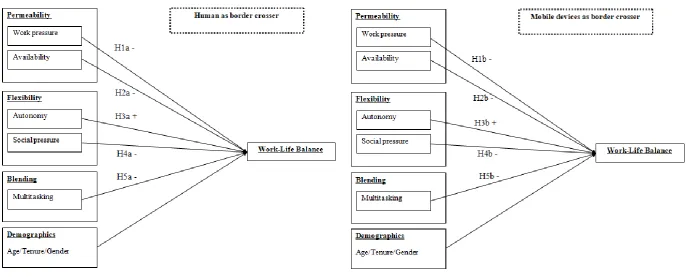
This theoretical framework will take a closer look how humans and mobile devices can function as triggers (border crossers) to make employees switch between their work-and private life. The two conceptual models with on the one hand humans as border crossers and on the other hand mobile devices as border crossers to switch between work- and private life will be compared to each other to investigate if there is a difference (Figure 2).
2.1 Work-life balance
Traditionally, work- and private life was held separate. Back in the days, the role of breadwinner and the role of homemaker were approached as independent systems (Parsons & Bales, 1995). In the seventies, Katz and Kahn (1978) assumed that events at home could affect events at work and vice versa. Work-life balance is hereby defined as a subjective feeling of being able to separate multiple life roles and being able to balance them to meet the demands of an individual in their private and work environment (Jacobs & Gerson, 1998; Fritz & Sonnentag, 2006). People can have different life roles within the two domains, family (private) and work: A person’s role as an employee may include different behaviors in comparison with the behaviors of a person in their private life. If there are no problems in separating the different life roles, the person would feel in control. When there is no control and a person finds it hard to separate these roles, they experience a role-conflict (Carlson, Macmar & Williams, 2000). According to Kreiner et al. (2009), a work-life role-conflict is characterized by high expectations towards employees in their work and family domains and not being able to meet them. Meeting these expectations within the domains and therefore finding a good work-life balance can be difficult for employees.
The upswing of different mobile devices has also led to blurring borders whereas the separation between work- and private life became even more difficult (Derks & Tims, 2013). Nowadays employees tend to work more often when, how and wherever they want (Over Het Nieuwe Werken, 2018). The use of mobile devices makes it easier for employees to switch into their work-role when not at work. Mobile devices are defined as devices which can be used at different places to complete unfinished work or to be able to work at home (Sarker, Xiao, Sarker & Ahuja, 2012). Mobile devices are defined as devices such as laptops, smartphones and iPads, which can be used at different places to complete unfinished work or to be able to work at home.
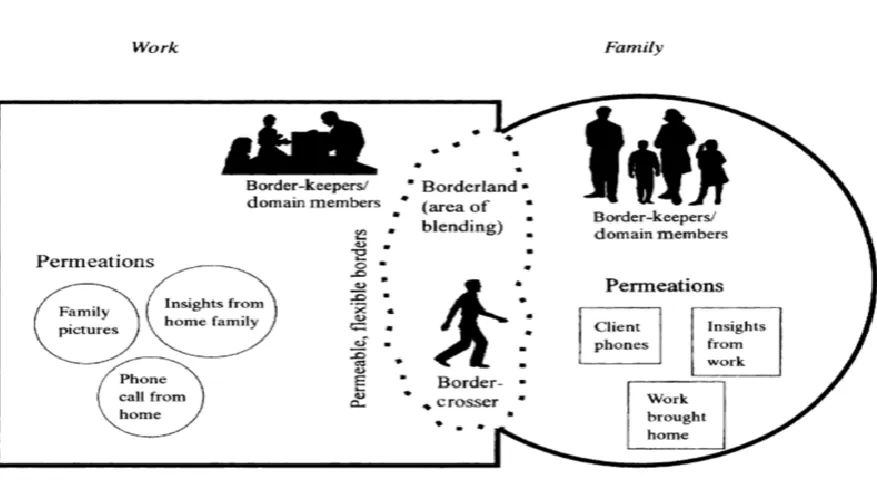
work-Clark (2000) will be used as a theoretical foundation in this research and is developed to describe the role of humans and mobile devices as border crossers between work- and private life. The Border Theory argues that not emotions, but the influence of other humans is shaping the world of work and family. The three main borders used in this theory are, permeability, flexibility and blending (Clark, 2000). This study will address if not only humans but also mobile devices can function as border crossers.
2.2 Border Theory
The Border Theory shows how humans function as border crossers between work- and private life. The Border Theory is the result of combining and adapting other theories on this topic, like the Spillover Theory and Compensatory Theory.
When working life and private life is seen as a spectrum with respectively working domain/life and private domain/life at the ends, one can draw a vertical line somewhere on this spectrum as the border between working life and private life. Even though the exact location of the border varies from person to person, the border can shift towards one of the ends as the result of emotions and actions. This is called the Spillover Theory.
The compensation Theory focuses on how employees are trying to compensate for lost time or the need for more time within their working- or private domain/life (Staines, 1980). For example: when employees are having a non-productive day at work, they would try to compensate this by finishing some work at home. Also, when employees are unhappy in their family life, they will try to seek satisfaction in their work to compensate.
working domain again. The borders are having three main forms namely, permeability, flexibility and blending (Clark, 2000).
This theory is only including humans as border crossers, even though mobile devices can also function as triggers for employees to cross a border. Thereby this research is also monitoring the influence of mobile devices as border crossers and will compare it to when humans function as border crossers. This means that not only humans, but also mobile devices can cause an employee into switching domains. Research has shown that variables such as work pressure, social pressure, autonomy, availability and multitasking influence work-life balance. These variables are included and linked to the three main forms within the Border Theory which will be explained in the next paragraphs.
[image:8.595.88.527.382.622.2]RQ: To what extent are mobile devices as border crossers influencing the work-life balance of employees and how does it differ from the influence of humans as border crossers on the work-life balance of employees?
2.3. Permeability: work pressure and availability
The first of the three domains is permeability; this is the degree to which elements from other domains are able to enter another domain (Carson & Kacmar, 1996). This means that humans can enter the working sphere of an employee. An example of humans as border crossers is when an employee is working at home and someone of the family is entering the office and asks a question related to the family domain. When the employee answers this question they have crossed the border between their work and family domain by getting triggered by a family member.
The extent of mobile devices and their role in entering the private sphere of an employee can also be scaled under permeability. In the former example, the appearance of a human is the trigger to switch from one domain to another. With the use of mobile devices, the switch between the domains can be triggered even without the physical appearance of a human (of the other domain). To illustrate, in the above mentioned example, the person interrupting your working domain can also send a text on their mobile phone without entering the home office. When answering this question, the switch between the two domains is easily made. Despite the fact that the mobile device is controlled by a human, in this case, the presence of the mobile device makes it possible to cross the border between the two domains. In this case, the mobile device is the border crosser. Several factors can be scaled under permeability.
Work pressure can be defined as the strain when the job demands are high and decision latitude (job control) questions are low (Chandola et al., 2008). When the job demands are high, employees may be forced by co-workers or their bosses to work outside working time. Work pressure can lead to stress when not at work (Meijman & Mulder, 1998). This pressure can come from humans when they are present like their boss asking them to do work when at work, but their boss can also enter their private life by using a mobile device to reach out to the employee. Therefore not only humans but also mobile devices can function as a border crosser when it comes to work pressure.
Availability is also a factor that can have an influence on the work-life balance of employees. In the research of Bergman and Gardiner (2007), work-life balance in combination with availability is studied. Availability is defined by the extent to which someone is accessible to answer questions or receive input from persons related to a specific domain (work/family domain) (Sayer, 2000).
different domains. Being connected through mobile devices is challenging employees in terms of how work is and should be.
When humans or mobile devices is causing that someone is switching roles between the work and private life to meet the demands from each domain, it can cause a role-conflict and/or lack of recovery. A lack of recovery means that an employee is not fully recovered from work when starting a new day and it will affect his or her health (Chandola et al., 2008). The employee will then start the subsequent workday in a suboptimal condition and will have to invest extra effort to perform adequately at work (Meijman & Mulder, 1998). To recover properly it is important that someone does not need to switch roles too much because it can affect his or her work-life balance (Sonnentag & Geurts, 2009). In relation to work-life balance, work pressure is leading to a negative effect on the work-life balance of employees. Where more work pressure leads to more stress and less balance. Availability is leading to less recovery for employees and is therefore expected to have a negative effect on the work-life balance of employees.
H1a: Experienced work pressure, caused by humans as border crossers, has a negative relationship with work-life balance.
H1b: Experienced work pressure, caused by mobile devices as border crossers, has a negative relationship with work-life balance.
H2a: The pressure of being available, caused by humans as border crossers, has a negative relationship with work-life balance.
H2b: The pressure of being available, caused by mobile devices as border crossers, has a negative relationship with work-life balance.
2.4. Flexibility: autonomy and social pressure
person decide to answer the call of their smartphone, or is the smartphone forcing them in a way (Mazmanian, 2013). Besides autonomy, also social pressure is described in this section. Social pressure can be defined as a feeling that employees can experience when they can work flexibly to meet the demands of the other domain Martin, Solomon, Golden & Ciapponi, 1998).
Autonomy offers advantages, the employees can have more control over the tasks when and where they want to perform them (Abbott, 1981). This gives them the feeling of being taken seriously and having the responsibility over their work. Also, disadvantages are found in several studies regarding more autonomy for employees. In this case, employees experience the restriction on their freedom and experience the autonomy that they have as pressure from the management. The reaction to this occurrence is that employees are feeling trapped in the work they need to complete and are feeling frustrated (Barley & Kunda, 2004). In this case, the human border crosser can be a friend. For example, when an employee decides to work at home, but their friend comes over unexpectedly for a cup of coffee. In the study of Mazmanian (2013) the respondents were studied on their feeling of autonomy when they could be connected to work all day and night by their mobile devices. She found that employees were experiencing to be more in control and had a sense of more competence when they were connected. Even though being in control and therefore being able to work all day is disrupting the work-life balance. Autonomy ensures employees can decide for themselves if they want to use their mobile devices outside working time for work-related activities, or not (Mazmanian, 2013). This means that according to her, mobile devices can have an influence on whether you are going to read that important report on your Ipad when you are at home and can, therefore, be a border crosser.
When there is a lot of social pressure and autonomy, this can have an influence on your work-life balance (Mazmanian, 2013). People tend to get stressed if there is a lot of pressure from other people (Martin et al., 1998). A misbalance in the work- and private life of people is causing role-conflicts. For example, someone stays in the role of an employee too long and cannot get enough time in the role of a friend. Employees are given more autonomy by being able to work anywhere and anytime on the one hand. The norm can, therefore, be shifted even more and the following hypotheses can be used in this research where more autonomy leads to more work-life balance because the employee is able to decide for themselves if they want to be in their working-role or in their family-role. Social pressure is on the other hand expected to have a negative effect on work-life balance.
H3a: Experienced autonomy caused by humans as border crossers, has a positive relationship with work-life balance.
H3b: Experienced autonomy caused by mobile devices as border crossers, has a positive relationship with work-life balance.
H4a: Experienced social pressure caused by humans as border crossers, has a negative relationship with work-life balance.
H4b: Experienced Social pressure caused by mobile devices as border crossers, has a negative relationship with work-life balance.
2.5. Blending: multitasking
If the area around the border is not only for one domain, blending is occurring. In this situation work and family is combined in one domain (Clark, 2000). This means that the two domains are not seen as two separate spheres, but can be overlapping and be mixed together. An example is when you work at home in the morning and while you are feeding your child, you are on the phone with a client. According to Clark (2000), blending occurs when a person is using their personal experience in their work or the other way around. Previous research shows that blending becomes a conflict when the two domains are very different. It leads to integration and wholeness when the two domains are similar and switching is easily done (Carlson, Macmar & Williams, 2000).
negative effects on work-life balance then positive effects. It can increase the amount of stress, loss of focus and declining performance (Wallis & Steptoe, 2006). Wallis and Steptoe showed that people have difficulties doing two things at the same time when these activities were not automatic processes (like breathing). It is possible to multitask when the tasks are not too complicated and can be done in a short amount of time (Parama, 2003). Examples of these tasks are texting, sending short e-mails and answering a quick call.
When you are multi-tasking you can be your own human border crosser. You decide which task you are doing at the same time. This can be work-related tasks or private related tasks, but you can also combine them. In this case, you are practicing for a presentation and you are also cooking dinner at home. Multitasking can not only be done by you, but also mobile devices can have an influence on an employee and their ability to multi-task. Parama (2003) found that employees, through mobile devices, can take more tasks to earn more money and work faster. They are thereby favouring a multi-tasking work environment (Parma, 2003). Mobile devices can be used to perform multiple tasks at the same time. For example, you can answer an e-mail and watch a Netflix movie at the same time.
In terms of work-life balance and the role-conflicts that may occur, multi-tasking can be a source of problems according to literature. As said earlier it can increase the amount of stress, loss of focus and declining performance (Wallis & Steptoe, 2006). Stress can cause role-conflicts and the loss of focus can cause that people cannot get in the right role at a certain time (Kreiner et al., 2009). This means for the hypotheses that for this research we expect that multi-tasking has a negative effect on work-life balance when humans are functioning as border crossers and when mobile devices are the border crossers.
H5a: The degree of multi-tasking caused by humans as border crossers has a negative relationship with work-life balance.
3. Method
3.1 Research Design
The data from this research is collected through a quantitative cross-sectional correlation survey. Surveys are often used to get information directly from people about what they believe, know and think (van den Berg & van der Kolk, 2014). The main benefit of using a survey is that it is well suited to investigate the explained variance and the coherency between the variables. Another benefit of using this type of data gathering is that the participants are able to fill in the survey easily at their own pace and time. A quantitative research can be executed faster than qualitative research. All the participants were working and were able to find suitable moment so they could fill in the survey when it suited their schedule.
3.2 Sample and participants
For this research, only participants who were working flexible or had the possibility to work flexible were asked to fill in the questionnaire. Working flexible meant that employees were able to work not only at the office, but also at home. The respondents which were recruited by calling several organizations, were all clients of an organization which sells them different IT solutions to work flexible. These clients were accessible for this research, because the organisation which sells these IT solutions was the employer of the researcher of this study (N=178). There was no distinction made in which clients were approached to participate in this research. Also, people were approached personally through the network of the researcher (N=56). They were asked if they are able to work flexible and if they were to do so, they were asked to fill in the questionnaire.
All respondents were selected on the base of their possibilities to work flexibly. It was a demand that the respondent could work at home or somewhere else rather than only at work. This research is not conducted in a specific branch. The survey was not age restricted, but since the demand was that the respondent was able to work flexible, no underage respondents were included.
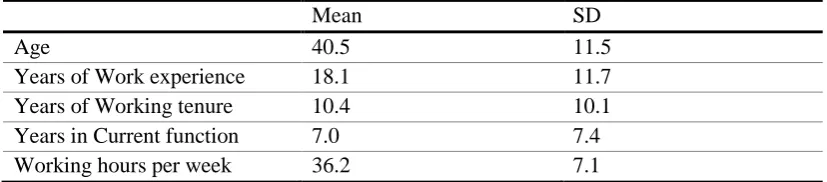
Table 1 shows the demographics of the respondents that have participated in this research. Most of the participants were having reasonable working experience (M = 18.1; SD = 11.7). Most respondents worked around 7 years in the function that they are in right now (M = 7.0; SD = 7.4) and were working for the same employer for about 10 years (M = 10.4; SD = 10.1). The respondents in this research were mostly working around 36 hours per week (M = 36.2; SD = 7.1). Table 2 shows the how the education level of the respondents is divided, most respondents are having a bachelor degree (N=108) or a master degree (N=80).
Table 1.
Descriptives demographics (N=234)
Mean SD
Age 40.5 11.5
Years of Work experience 18.1 11.7
Years of Working tenure 10.4 10.1
Years in Current function 7.0 7.4
[image:16.595.82.498.433.528.2]Working hours per week 36.2 7.1
Table 2.
Frequencies of education level (N=234)
Frequency
VMBO 5
HAVO 8
VWO 4
MBO 29
HBO 108
University 80
3.3 Measures
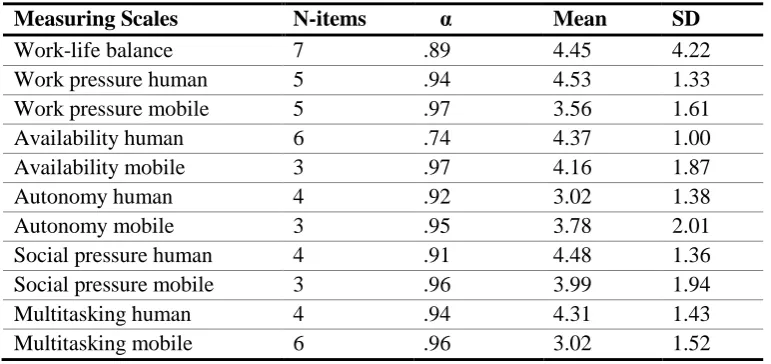
The first scenario which included humans as border crossers focuses on how other people can influence the behaviour of employees to make them switch between work-and private life. The second scenario included mobile devices as border crossers to see if for example, the sound of an incoming message could make employees switch between work-and private life. An overview of the scales, number of items per scale and the reliability can be seen in Table 3. The questionnaire can be seen in Appendix 1 of this study.
Work-life balance
Work-life balance is the dependent variable and is a subjective feeling that work- and family/personal demands are not in balance or are in balance (Jacobs & Gerson, 1998). The 7 items that are used are asked on a seven-point-likert-scale and are inspired on the research of Pierik (2011). The items from this research are copied, but the scenario is changed by the use of the scenarios. Examples of the items are: “My private life suffers from my work” and “My work makes my private life difficult”. The items that are used established an acceptable Cronbach’s alpha of .89.
Next, is the description of the independent variables. The dependent variable is predicted through these independent variables.
Work pressure: humans as border crossers
Work pressure can be seen as the strain when the job demands questions are high and decision latitude (job control) questions are low (Chandola et al., 2008). Five items were used to measure this scale. The items which are used are copied from the research of Chandola et al. (2008) and are placed in the scenarios of this study. This scale measured the amount of work pressure the participants were experiencing with only the influence of other like family member or friends. First, the situation where the participant is being distracted from work by their family and/or friends is stated. After this situation, the items are displayed. Items that are used for the scale work pressure where humans function as border crossers are: “I experience a lot of work pressure” and “I experience a lack of time”. In this research, the scale work pressure with humans as border crossers had an acceptable Cronbach’s alpha of .94.
Work pressure: mobile devices as border crossers
mobile devices as border crossers are: “I have the feeling that I have to work fast” and “I have the feeling that I have to meet a lot of demands”. In this research, the scale work pressure had an acceptable Cronbach’s alpha of .97.
Availability: humans as border crossers
The availability can be defined as being available to be accessible for others. This can be accessible in time, space and responses (Sayer, 2000). The six items used for availability with humans as border crossers are inspired by the research of van Ispelen (2004) the first part of the item is the same: “I have the feeling that I always have to be available”. Only the last part of the item is changed to fit the item into this research: “for my colleagues in my free time”. For example, this scale is including the following items: “I have the feeling that I always have to be available for my colleagues in my free time” and “I feel obligated to change my working schedule when a colleague asks for it”. The scale availability had a Cronbach’s alpha of .74 was established.
Availability: mobile devices as border crossers
In the situation were mobile devices are used as border crossers the respondents first saw a stated situation and after this the three items which belonged to this scale. The items for availability and the situation that was displayed before the items is inspired by the research of van Zutphen (2015) and adjusted to the context of this research. The following situation is displayed to the respondents: “How do you experience it when you are getting notifications on your mobile, laptop or iPad of your family or friends and you are not able to look immediately.”. Next, the items are used to measure the availability of employees in this context. Two examples of these items are: “I feel stressed in this situation” and “I feel restless in this situation”. In this research, the scale availability had an acceptable Cronbach’s alpha of .97.
Autonomy: humans as border crossers
Autonomy: mobile devices as border crossers
To measure autonomy with mobile devices as border crossers the research of van Ispelen (2004) is used. The three items are slightly adjusted to suit them within the context of this research. When mobile devices are used as border crossers, examples of statements which are used are: “My mobile device determines when I am looking at a message” and “My mobile device determines if I reply on a message”. In this research, the scale autonomy was measured to have an acceptable Cronbach’s alpha of .95.
Social pressure: humans as border crossers
Social pressure means that employees are feeling more pressure to conform to the expectations of the workplace community (Martin et al., 1998). The four items used to measure this scale are adopted from the research of van Zutphen (2015). First, the following situation was displayed: How do you feel or what do you experience when your supervisor or colleague asks you if you want to arrange some things for him or her outside working time. Examples of the items used for this scale are: “I feel insecure in this situation” and “I am worried about the opinion of others in this situation”. The scale social pressure had an acceptable Cronbach’s alpha of .91.
Social pressure: mobile devices as border crossers
To measure the scale social pressure whit mobile devices as border crossers, the research of van Zutphen (2015) is adopted to formulate the items. The following situation was displayed before the items were displayed: “How do you feel or what do you experience when you receive an e-mail or message from your work and you are not able to reply immediately”. “I feel obligated to reply directly to not disappoint someone else” and “I am scared that others will blame it on me when I do not reply their messages directly” are examples of items that are used within this scale. This research established a Cronbach’s alpha of .94.
Multi-tasking: humans as border crossers
can combine tasks like this”. The scale multi-tasking established an acceptable Cronbach’s alpha of .94.
Multi-tasking: mobile devices as border crossers
The scale multitasking with mobile devices as border crossers the statements are adopted from the research of Stephens, Cho and Ballard (2012). Examples of items which are used are: “I think that mobile devices make it more attractive to combine tasks” and “I think that I am more productive when combining tasks”. The items were asked after the context was explained. The respondents were asked to imagine themselves to combine two tasks like watching a movie and answering e-mails or messages from work. This scale had a Cronbach’s alpha of .96.
Demographics
[image:20.595.83.469.491.673.2]To see how the sample was divided within this research, some demographics were included at the start of the survey. These demographics were used to see how the respondents could be divided into groups to see any secondary effects and to see if there are any interesting outcomes that are worth to include in future research. Demographics which are measured are gender, age, education level, work experience, work tenure, work experience within their current function and the working hours per week.
Table 3.
Scale descriptives independent- and dependent variables (N=234)
Measuring Scales N-items α Mean SD
Work-life balance 7 .89 4.45 4.22
Work pressure human 5 .94 4.53 1.33
Work pressure mobile 5 .97 3.56 1.61
Availability human 6 .74 4.37 1.00
Availability mobile 3 .97 4.16 1.87
Autonomy human 4 .92 3.02 1.38
Autonomy mobile 3 .95 3.78 2.01
Social pressure human 4 .91 4.48 1.36
Social pressure mobile 3 .96 3.99 1.94
Multitasking human 4 .94 4.31 1.43
Multitasking mobile 6 .96 3.02 1.52
3.4 Procedure for the participants
The survey started with a general explanation where the respondent only could read that the survey was looking at how the boundaries have been changed between work and private life. After the introduction, the respondents were asked to tell if they were able to work flexibly within their job. If the answer was no, the questionnaire stopped. This extra filter has been added to make the results more reliable and to make sure that only employees who could work flexible were participating in this research. Several respondents were filtered out of the questionnaire via this question, despite the fact that they were asked only to fill in the questionnaire if they are able to work flexibly.
Next, the respondents were asked to fill in their demographics. The items belonging to the dependent variable, work-life balance, were displayed after the demographics. Then the statements of the independent variables were displayed. These statements were organized by the three border forms (Permeability, Flexibility, and Blending) and the variables which were scaled under each form. First, the statements where humans function as border crossers were asked and then the statements where mobile devices function as border crossers were asked. The completion of the survey took about 10 minutes.
3.5 Data analysis procedure
4. Results
In this part of the research, the results will be discussed. These results include the regression analyses to see if the hypotheses can be accepted or rejected with a significant outcome. The comparison was made between the context were humans function as border crossers and mobile devices function as border crossers.
4.1 Descriptive results
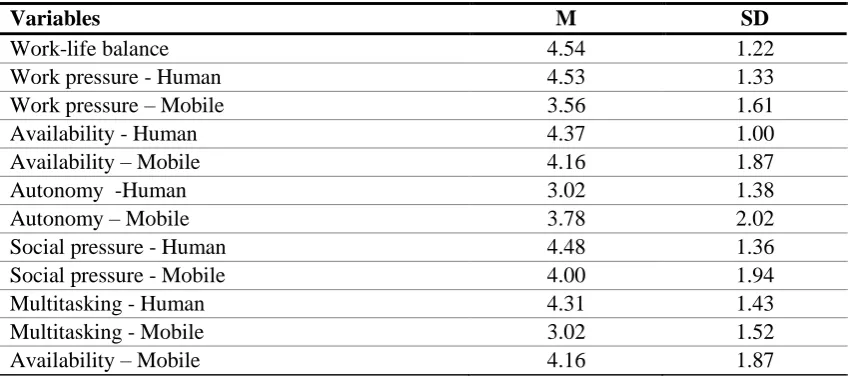
[image:22.595.85.516.504.695.2]The variables which can be seen in table 4 are showing differences between the scores were humans or mobile devices are border crossers between work- and private life. The respondents are experiencing less work pressure when humans are causing them to switch between their work- and private life. This result can also be seen for availability, social pressure, and multitasking. This means that when mobile devices are causing them to switch between work- and private life the respondents are experiencing more work pressure; they also feel a bit more the need to be available for others. They are also experiencing more social pressure when mobile devices can be used to switch between work- and private life. The last variable which is showing some big differences in terms of mobile devices causing respondents to agree more on the statements is multitasking. This score shows that mobile devices make it more attractive and easy to multitask. When looking at autonomy the opposite end result can be seen.
Table 4.
Descriptive statistics of variables split by border crossers (N=234)
Variables M SD
Work-life balance 4.54 1.22
Work pressure - Human 4.53 1.33
Work pressure – Mobile 3.56 1.61
Availability - Human 4.37 1.00
Availability – Mobile 4.16 1.87
Autonomy -Human 3.02 1.38
Autonomy – Mobile 3.78 2.02
Social pressure - Human 4.48 1.36
Social pressure - Mobile 4.00 1.94
Multitasking - Human 4.31 1.43
Multitasking - Mobile 3.02 1.52
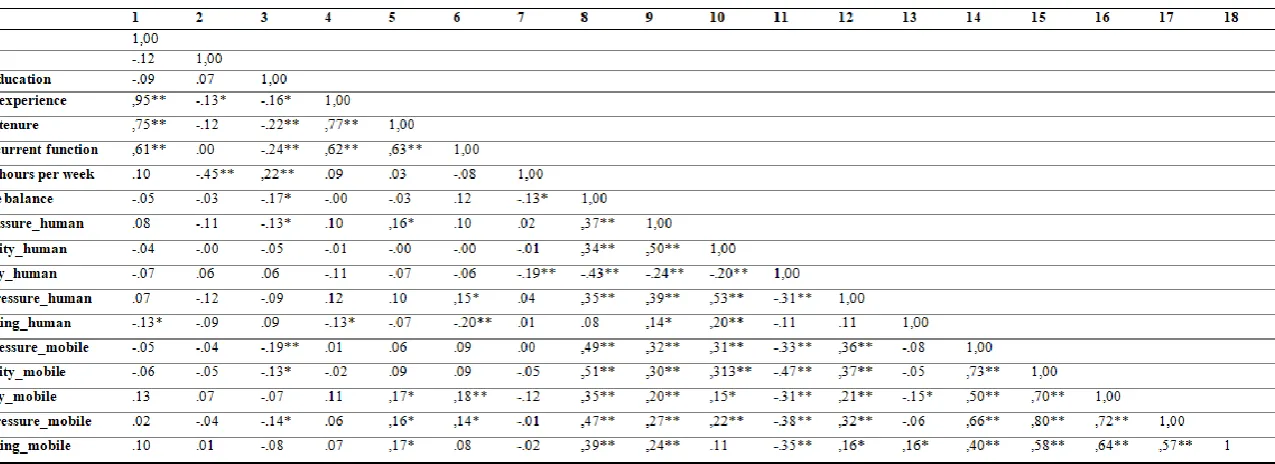
4.2 Correlations
Table 5.
Correlations
4.3 Test of hypotheses
Next, the regression analysis is executed to see if there can be any significance found between the variables. The outcome of the regression analysis can be found in Tables 6, 7 and 8. These tables show the different scores for the model when humans function as border crossers and when mobile devices function as border crossers.
Table 6 shows that only the demographics are having the lowest explained variance [R2 = .082, F = 2,87, p<.01]. The model with humans as border crossers has slightly the
highest explained variance [R2 = .340, F = 11,01, p<.00], but it does not differ that much from
the last model where mobile devices function as border crossers [R2 = .333, F = 10,17,
[image:25.595.84.513.400.473.2]p<.00],. The explained variance was increased when other variables are added and this is showing that not only demographics but also other variables are explaining a decent percentage of the behavior.
Table 6.
Outcome regression analysis: explained variances of the influence of humans and mobile devices as border crossers on the work-life balance
Adj. R2 F-value Sig.
Demographics .082 2.87 .01
Demographics + Humans as border crossers .340 11.01 .00 Demographics + Mobile devices as border
crossers
.333 10.17 .00
Work pressure: humans as border crossers
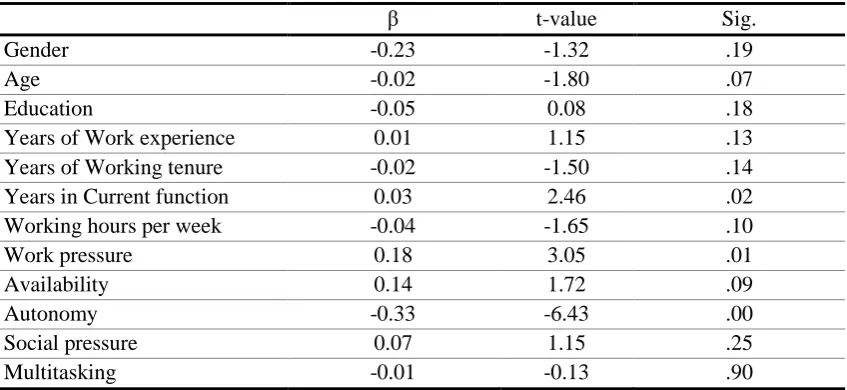
The variable work pressure showed a slight difference of outcomes between humans and mobile devices as border crossers. The regression analysis showed a positive significant influence of work pressure with work-life balance when humans were border crossers [β = .18, t = 3.05, p<.01].
Work pressure: mobile devices as border crossers
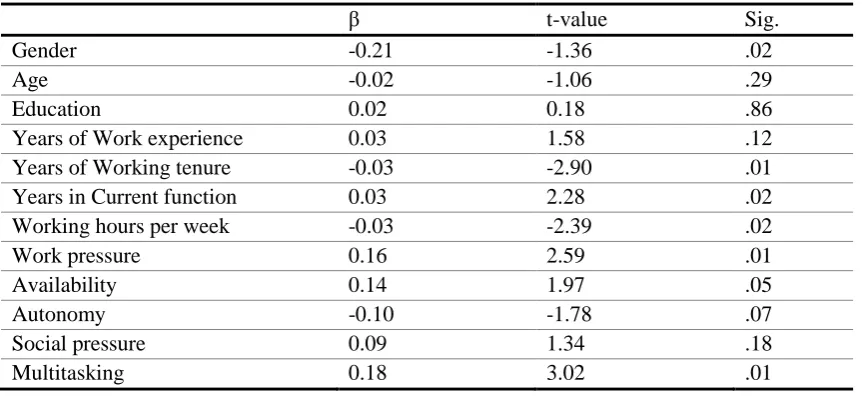
The situation where mobile devices functioned as border crossers showed a small difference in the positive significant influence [β = .16, t = 2.59, p<.01]. These results showed that the regression line for work pressure and the influence on work-life balance with humans as border crossers was slightly steeper than with mobile devices as border crossers.
Availability: humans as border crossers
Availability: mobile devices as border crossers
Only when mobile devices functioned as border crossers a statistically significant was found [β = .14, t = 1.97, p<.05].
Autonomy: humans as border crossers
The negative influence of autonomy on the work-life balance of employees was found statistically significant only in the case where humans are used as a trigger to cross the border between work- and private life [β =-.33, t = -6.43, p<.00].
Autonomy: mobile devices as border crossers
There was no significant influence of autonomy on work-life balance found when mobile devices were used to let employees cross the border between work- and private life [β = -.10, t = -1.78, n.s.].
Social pressure: humans as border crossers
Social pressure was found not to be statistically significant when humans functioned as border crossers [β = .07, t = 1.15, n.s.].
Social pressure: humans as border crossers
When mobile devices functioned as border crossers there was no statistically significant outcome [β = .09, t = 1.34, n.s.].
Multitasking: humans as border crossers
When humans were used to see what the influence of multitasking on work-life balance was, no significance was found [β = -.01, t = -.13, n.s.].
Multitasking: mobile devices as border crossers
Demographics
First, the demographics are tested by itself. This was not giving a high degree of explained variance. The demographics did show some interesting outcomes per model regarding gender, work tenure, working experience function and working hours per week. These results can possibly be used to give more insight on how employees are experiencing work-life balance when they have one or multiple of these demographic characteristics.
Gender was found to have a significant influence on work-life balance when mobile devices were used as border crossers. This influence is found to be negative which means that women were having a less experienced work-life balance than men when they used their phone as border crossers. In the other two models, gender is found not to be statistically significant in this research.
Also, work tenure was found to be having a negative influence on work-life balance which was statistically significant. This was only the case when mobile devices were used as border crossers. The outcome showed that the less years of working experience an employee had at his current employer, the less work-life balance he or she is experiencing.
The amount of work experience an employee has within their current function is having a significant positive influence when both humans and mobile devices functioned as border crossers. Hence, the more experience the employee has within their function the more he or she is experiencing a more imbalanced work-life balance.
[image:27.595.88.512.567.762.2]Employees who are working fewer hours per week are having a worse experienced work-life balance than employees who are working more hours per week. The regression analysis shows that they are significantly influenced by their working hours per week when they can switch between work- and private life via their mobile devices.
Table 7.
Outcomes regression analysis: demographics + humans as border crossers
β t-value Sig.
Gender -0.23 -1.32 .19
Age -0.02 -1.80 .07
Education -0.05 0.08 .18
Years of Work experience 0.01 1.15 .13
Years of Working tenure -0.02 -1.50 .14
Years in Current function 0.03 2.46 .02
Working hours per week -0.04 -1.65 .10
Work pressure 0.18 3.05 .01
Availability 0.14 1.72 .09
Autonomy -0.33 -6.43 .00
Social pressure 0.07 1.15 .25
Table 8.
Outcomes regression analysis: demographics + mobile devices as border crossers
β t-value Sig.
Gender -0.21 -1.36 .02
Age -0.02 -1.06 .29
Education 0.02 0.18 .86
Years of Work experience 0.03 1.58 .12
Years of Working tenure -0.03 -2.90 .01
Years in Current function 0.03 2.28 .02
Working hours per week -0.03 -2.39 .02
Work pressure 0.16 2.59 .01
Availability 0.14 1.97 .05
Autonomy -0.10 -1.78 .07
Social pressure 0.09 1.34 .18
5. Discussion
5.1 Theoretical implications
It is important to continue doing research on work-life balance and what may influence the feeling of a balanced or imbalanced work- and private life. Not only can employees who are experiencing an imbalance be expensive for organizations, it is also causing discomfort for the employee who maybe struggling with mental- and physical problems (Bertera, 1990). It is important for organizations and individuals to know what the use of mobile devices can cause, and how it can affect their work-life balance. The general question for this research was: “To what extent are mobile devices as border crossers influencing the work-life balance of employees and how does it differ from the influence of humans as border crossers on work-life balance of employees?”. This research had the aim to explore the differences between humans and mobile devices when they function as border crossers. The border theory is used as a theoretical foundation to explore these differences.
This study showed an explained variance of 34% when humans functioned as border crossers and 33% when mobile devices functioned as border crossers. The next step for research is to explore what other variables are relating to work-life balance. It may be interesting to see what kind of leaders are influencing the work-life balance of employees. The research of Syrek, Apostel and Anthony (2013) is researching the impact of transformational leadership on work-life balance. They found that there is a relationship between this leadership style and work-life balance, this means that this is also a variable that explains the behaviour of employees and how it relates to their work-life balance.
Based on survey questions and the corresponding performed statistical tests, it can be concluded that H1a, H1b, H2b, H3a and H5b can be accepted.
The main result of this research is that there is a difference between the influence of humans and mobile devices as border crossers on work-life balance. This motivates the statement of Chandola et al. (2008) they stated that mobile devices are increasing the possibility to work overtime and that this increases the work pressure. In this research this difference could only seen when looking at the variable work pressure. This variable showed significant relationship in both scenario’s and could therefore be compared to each other.
White, Hill, McGovern, Mils and Smeaton (2003) they found that work pressure is influenced by working hours and that less working hours leads to more work pressure, because employees cannot finish work on time. This leads to more working overtime and less work-life balance. This can also be seen in this research when looking at work pressure and working hours with mobile devices as border crossers. In this scenario, working hours is negative related to work-life balance. For organisations where employees do not work fulltime this can be something to be careful with. Are employees able to finish the amount of work within their working hours when working part-time? It is important for employees who are working part-time to be aware of the danger for their mental- and physical health of finishing work, because of the lack of hours that they have at work.
Autonomy showed significant results only when humans functioned as border crossers. It is therefore difficult to say something about the differences caused by the border crossers for this variable. The research of Barley and Kunda (2004) is showing the same significance. They saw that employees who are feeling less autonomy are feeling trapped by the management and are experiencing less work-life balance. Why is this result not showing for mobile devices? It may be caused by the research design where the respondents could not make the difference between human and mobile devices. Mazmanian (2013) did find a relation between autonomy and work-life balance when using mobile devices, so did Geurts & Demerouti (2003). For future research on this variable it is important to make a clear distinction what separates mobile devices from humans. Assuming that there is a relation between the two variables, there may be other aspects like demographics such as the amount of years in their current function. This research showed that this variable correlates with autonomy and work-life balance, and this can be explored in future research.
With employees multitasking more by using mobile devices, they are experiencing less work-life balance. Being able to work at home means that the recovery will be less and less work-life balance is experienced. As Fritz and Sonnentag (2006) were saying that employees need to recover from work in order to prevent health problems like a burn-out. Mobile devices make it easier to be connected to work all day. Jarvenpaa, Lang and Tuunainen (2005) are saying that the mobile devices can cause several paradoxes. Mobile devices empower and enslave users, simultaneously engage and disengage them. Also they blur the boundaries between work-and private life. Multitasking gives employees the opportunity to do things at the same time which can be work- and private life related. This causes the blurring boundaries and gives them challenges in keeping their work- and private life in balance.It is more difficult to combine tasks when not using mobile devices. In today’s world it is more common for employees to use mobile devices to multitask, this can be one of the reasons that multitasking is not showing significant results when humans functioned as border crossers. Further research may explore how many employees are using methods or tools to multitask other then mobile devices to see if this variable is still relevant.
Social pressure was not showing any significant relations in both cases and the two scenario’s. This is remarkable but can also be explained. The research of (Waycman, Bittman &, Brown, 2008) showed that also the actual content of calls, e-mails may play a role in the behaviour of people. This can be a reason why only work pressure is showing significance in both cases; all the other variables may be getting influenced by the content of a call, e-mail or a question from someone else. The priority of calls or questions can have an influence on how the employee is reacting to it and if they decide to switch domains for it. For future research it is wise to investigate what kind of content is triggering employees to switch between the work- and private life domains. Social pressure is still a variable that will have a relation with work-life balance. Mazmanian, Orlikowski and Yates (2005) reported that mobile email users were expected by others to respond as quickly as possible experienced pressure to meet these demands. The pressure to meet the demands of others could cause an imbalance in their work-life balance. There is research that confirmed the relation of social pressure with work-work-life balance. Assuming that this relation is still there, only this research did not showed these results. Possibly because of the lack of a wider exploration of this variable within this research.
underestimate. Nowadays people find themselves having complete control over when they decide to use their mobile devices for work- or private matters. A potentially interesting inquiry for future research would be to investigate the use of mobile devices with an organizational learning perspective. This is something that also Middleton (2007) is encouraging. This research shows that even though we may think that we have control about our work-life balance that we are still vulnerable to mobile devices to make them imbalance our work-life balance. It is a learning process that we are still in and will be in the future.
5.2 Practical implications
As mentioned before, it is important to keep making employees aware of the effects that mobile devices can have on their work-life balance. Also it is important to mention that humans are also impacting the work-life balance and that employees who may be insecure or are not able to say no to others are more able to experience health problems due to the fact that they are less able to balance their work- and private life when for example the work pressure gets high. It is for organisations therefore important to get to know their employees and that they can respond adequately to the behaviour that their employees are showing. Besides this, it is good for organizations to see if their employees can finish their work within the hours that they are given. Especially for part-times this is important, are they able to do all the work in limited hours? Does an organisation need to hire more employees, give their part-times the possibility to work more hours or do they need to lower the amount of work for one person? All important questions that organizations can try to figure out in order to maintain healthy employees and a healthy organization.
For employees it is important to be aware of the dangers of doing the work at home that they did not finish. Time to recover from work is important and when working overtime at home it may cause that boundaries are getting blurred and that they cannot handle the demands from both work- and private life. It may be helpful for employees to keep track of their hours and when noticing an increasing amount of working hours to discuss this with their supervisor.
5.3 Limitations
good results and the distinction could be made by the respondents. It is still possible that in the real sample the distinction between the scenarios was sometimes not fully understood.
The employees who have participated in this research are all from different organizations. To have a more clear view of the behaviour within a certain work field it may be helpful to include only employees from one specific work field and type of organization. To focus more on different demographics and separate them, even more, the sample will provide more specific information for certain organizations in different branches.
Thirdly, it is not possible to make any generalization for bigger population groups due to the representativeness of the sample. The outcomes of this research can be used to view a possible relation. This could give a reason to dive deeper into this topic and do a comparable research with a larger sample to see if it can be generalized over a specific population.
Furthermore, the survey questions were adapted from the researches of, Chandola et al. (2008), van Ispelen (2004), van Zutphen (2015) and Stephens, Cho and Ballard (2012). The questions have been translated from English to Dutch. This could have caused problems in the validity of the results. The weighing of on the one hand asking Dutch respondents to fill in an English questionnaire and thereby having to deal with the risk of them not fully understanding the questions. On the other hand, asking Dutch respondents to fill in the questionnaire with the questions translated by the researcher and trying to minimize miscommunication from the employee’s side. This research includes the last option because translation errors from my side are better identifiable than translation mistakes that respondents will make. Nevertheless, both options could affect the validity of the results even though the reliability scores of the items in this research were all very high and acceptable.
5.4 Conclusion
References
Abbott, A. (1981). Status and status strain in the professions. Journal of Sociology , 86(4),
p. 819-835
Andrews, S., Ellis, D. A., Shaw, H., & Piwek, L. (2015). Beyond self-report: Tools to compare estimated and real-world smartphone use. Journal PLOS one, 10(10).
Retrieved from: https://doi.org/10.1371/journal.pone.0139004
Baane, R., Houtkamp, P., & Knotter, M. (2010). A ravelling new ways of working. Assen, The Netherlands: Koninklijke Van Gorcum/Stichting, Management Studies.
Bergman, A., & Gardiner, J. (2007). Employee availability for work and family: Three Swedish case studies. Employee relations, 29(4), p. 400-414.
Barley, S. R., & Kunda, G. (2004). Beach time, bridge time, and billable hours: The temporal structure of technical contracting. Administrative Science Quarterly, 49, p. 1-38.
Bertera, R. L. (1990). The effects of workplace health promotion on absenteeism and employment costs in a large industrial population. Journal of Public Health, 90(9),
p. 1101-1105.
Biggs, S., Phillipson, P., Leach, R., & Money, A.M. (2006). The age-shift: observations on social policy, ageism and the dynamics of the adult lifecourse. Journal of Social Work Practice, 20(3), p. 239-250.
Derks, D., ten Brummelhuis, L. L., Zecic, D., & Bakker, A. B. (2011). Switching on and off. Does smartphone use obstruct the possibility to engage in recovery activities? Manuscript under review.
Carlson, D. S., Macmar, K. M., & Williams, L. J. (2000). Construction and initial validation of a multidimensional measure of work–family conflict. Journal of Vocational Behavior, 56, 249–276.
CBS (2018). Vooral vrouwen zijn meer gaan thuiswerken. Retrieved from: https://www.cbs.nl/nl-nl/nieuws/2018/12/vooral-vrouwen-zijn-meer-gaan-thuiswerken
Chandola, T., Britton, A., Brunner, E., Hemingway, H., Malik, M., Kumari, M., Badrick, E., Kivimaki, M., & Marmot, M. (2008). Work pressure and coronary heart disease: what are the mechanisms? European Heart Journal, 29(5), p. 640–648.
Clark, S.C. (2000). Work/family Border Theory: A new theory of work/family balance. SAGE journals, 53, p. 747-770.
Derks, D., & Tims, D. (2013). The impact of job crafting on job demands, job resources and well-being. Journal of occupational Health Psychology, 18(2), p. 230-240.
Fritz, C., & Sonnentag, S. (2006). Recovery, well-being, and performance-related outcomes: The role of workload and vacation experiences. Journal of Applied Psychology, 91,
p. 936–945.
Geurts, S. A. E.,& Demerouti, E. (2003). Work/non-work interface: A review of theories and findings. In M.J. Schabracq, J.A.M. Winnubst, & C.L. Cooper (Eds.),The handbook of work and health psychology, 20(1), p. 279–312.
Higgins, C., Duxbury, L., & Lee, C., (1994). Impact of life-cycle stage and gender on the ability to balance work and family responsibilities. Journal of family relations, 43(2),
p. 144-150.
ter Hoeven, C., & van Zoonen, W. (2015). Flexible work designs and employee well-being: e xamining the effects of resources and demands. Journal of New Technology, Work and Employment, 30(3), p. 237-255.
Jacobs, J., & Gerson, K. (1998). Overworked individuals or overworked families? Explaining trends in work, leisure and family time. Journal ofWork and occupations, 28(1), p. 40-63.
Jarvenpaa, S. L., Lang, K. R., & Tuunainen V. K. (2005). The ambivalent relationship between mobile technology and its users. New York: Springer, pp. 29-42.
Kreiner, G.E., Hollensbe, E.C., & Sheep, M.L. (2009). Balancing borders and bridges: Negotiating the work-home interface via boundary work tactics. Academy of management journal, 52(4), p. 704-730.
Lee, F.J., & Taatgen, N.A. (2002). Proceedings of the annual meeting of the cognitive Science society. Journal Proceedings of the Annual Meeting of the Cognitive Science Society, 24(24), p. 102-130.
Martin, A. D., Solomon, G. B., Golden, A. J. & Ciapponi, T. M. (1998). Coach expectations and differential feedback: Perceptual flexibility revisited. Journal of Sport Behavior, 21(3), p. 298-310.
Mazmanian, M. (2013). The autonomy paradox: The implications of mobile email devices for knowledge professionals. Organization Science, 24(5), p. 1337–1357.
Mazmanian, M., Orlikowski A. W. J., & Yates. J. (2005) Crackberries: The social implications of ubiquitous wireless e-mail. New York: Springer, pp. 337-344
Middleton, C. (2007). Illusions of balance and control in an always-on environment: A case study of BlackBerry users. Continuum: Journal of Media & Cultural Studies.
Geraadpleegd op http://www.tandf.co.uk/journal/titels/ 10304312.asp
Over het nieuwe werken (2016). Retrieved from: http://overhetnieuwewerken.nl/bijna- driekwart-van-bedrijven-brengt-hnw-in-de-praktijk/
Parsons, T., & Bales, R.F. (1995). Family: Socialization and Interaction Process. The sociology of Gender and the Family. 15, p. 233-254.
Portable gear (2010). Retrieved from: https://www.portablegear.nl/achtergrond/11518/ evolutie-van-de-laptop.htm
Sarker, S., Xiao, X., Sarker, S., Ahuja, M. (2012). Managing employees' use of mobile technologies to minimize work-life balance Impacts. M I S Quarterly
Executive, 11(4), p. 143-157.
Sayer, A. (2000). Realism and social science. Retrieved from: https://uk.sagepub.com/en- b/afr/realism-and-social-science/book207971.
Sonnentag, S., & Geurts, S. A. (2009). Methodological issues in recovery research. In S. Sonnentag, P.L. Perrewe, & D.C. Ganster (Eds.), Current perspectives on jobwork pressure recovery, p. 1–37.
Staines, G. (1980). Spillover versus compensation: A review of the literature on the relationship between work and nonwork . Human relations, 33(2), p. 111-129. Stephens, K.K., Cho, J.K., & Ballard, D.I. (2011). Simultaneity, sequentiality, and speed:
Organizational messages about multiple-task completion, Human communication research, 38, p. 23-47.
Syrek, C.J., Apostel, E., & Antoni. C.H. (2013). Stress in highly demanding IT jobs:
transformational leadership moderates the impact of time pressure on exhaustion and work–life balance. Journal of Occupational Health Psychology, 18(3), p. 252-261. Ten Brummelhuis, L. L. ten, Bakker, A. B., Hetland, J., & Keulemans, L. (2012). Do new
ways of working foster work engagement? Psicothema, 24(1), p. 113-120. Tweakers (2002). Retrieved from: https://tweakers.net/nieuws/23561/nokia-zet-eerste-3g-
telefoon-begin-2003-op-de-markt.html
van den Berg, S., & van der Kolk, H. (2014). Data collection and scale Development, London England: Sage.
Van Ispelen, R. T. (2004). Druk op de Kethel?': Een onderzoek naar werkdruk in de gemeente
Van Zupthen, P.J.M. (2015). Compulsief sociale mediagebruik. De rol van Fear of Missing Out, nomophobia en ervaren sociale druk. Retrieved from:
file:///C:/Users/Gebruiker/Downloads/Masterthesis_Maron_van_Zutphen_17juni2015 %20(1).pdf
Wajcan, J., Bittman, M., & Brown, J. (2008). Families without borders: Mobile phones, connectedness and work-home divisions. doi: 10.1177/0038038508091620
Wallis. C., & Steptoe. S. (2006). How to bring our schools out of the 20th century. Retrieved from The time magazine: https://bfarm.org/sites/default/files/Parents/Montessori %20Links/Time_How%20to%20Bring%20Our%20Schools%20Out%20of%20the%2 020th%20Century.pdf
Werken20 (2018). Retrieved from: http://www.werken20.nl/nieuws-over-nieuwe- werken/organisatie-bedrijf/26460/nederlander-mist-balans-werk-prive/
Wester, J. (2017). NRC checkt: ‘Kosten van burn-out bedragen 60.000 euro’. Retrieved from: https://www.nrc.nl/nieuws/2017/06/19/kosten-van-burn-out-bedragen-60000-euro-11172164-a1563696
Appendix 1, The questionnaire
Q1 Hallo, Allereerst bedankt dat u mee wilt doen aan dit onderzoek over werk- en privé balans. Ik voer dit onderzoek uit als afronding van mijn Master Communicatiewetenschap. Ik wil u graag vragen om deze enquête naar waarheid in te vullen. Er zijn geen goede of foute antwoorden en al uw antwoorden zullen volledig anoniem blijven en worden niet met derden gedeeld. Het invullen van deze enquête duurt ongeveer 5 tot 10 minuten. Wilt u de resultaten van dit onderzoek ontvangen? Mail dan naar [email protected] en ik zal deze naar u toesturen. Alvast bedankt voor uw deelname.
Lonne Dijkhuis
Q2 Voordat u de enquête verder invult, zou ik graag willen weten of u het afgelopen jaar binnen uw werk gebruikmaakt, of gebruik hebt gemaakt van de mogelijkheid om flexibel te werken. Dit houdt in dat u de mogelijkheid hebt om bijvoorbeeld thuis of in een openbare ruimte te werken.
o
Ja (1)o
Nee (2) (einde vragenlijst)Q2a Voor deze enquête is het van belang dat u gebruikmaakt, of gebruik hebt gemaakt van de mogelijkheid om flexibel te werken. Om u goed in te kunnen leven in de situaties is dit een vereiste om mee te kunnen doen aan deze enquête. U heeft aangegeven dat dit bij u niet het geval is. Om deze reden sluit hier de enquête.
Toch bedankt voor uw tijd.
Q3 Wat is uw leeftijd? (Geef uw antwoord in gehele jaren)
Q4 Wat is uw geslacht?
o
Man (1)o
Vrouw (2)Q5 Wat is uw hoogst afgeronde opleiding?
o
VMBO (1)o
HAVO (2)o
VWO (3)o
MBO (4)o
HBO (5)o
Universiteit (6)o
Anders namelijk, (7) ________________________________________________Q6 Hoeveel jaar werkervaring heeft u? (Geef uw antwoord in gehele jaren) ________________________________________________________________
Q7 Hoeveel jaar bent u werkzaam bij uw huidige werkgever? (Geef uw antwoord in gehele jaren)
________________________________________________________________
Q10 In de volgende stellingen wil ik u vragen om aan te geven in hoeverre bent u het eens of oneens bent met deze stellingen over uw werk- en privé balans.
Helemaal mee eens (1) Eens (2) Beetje mee eens (3) Neutraal (4) Beetje mee oneens (5) Oneens (6) Helemaal mee oneens (7)
Mijn privéleven lijdt
onder mijn werk. (1)
o
o
o
o
o
o
o
Mijn werk maakt mijn
privéleven moeilijk. (2)
o
o
o
o
o
o
o
Ik negeer privé behoeften door mijn werk. (3)
o
o
o
o
o
o
o
Ik zet mijn privéleven opzij voor mijn werk. (4)
o
o
o
o
o
o
o
Ik loop privé
activiteiten mis door mijn werk. (5)
o
o
o
o
o
o
o
Ik heb moeite om werk en privé te scheiden. (6)
o
o
o
o
o
o
o
Ik ben tevreden met de hoeveelheid vrije tijd voor privé activiteiten. (7)