warwick.ac.uk/lib-publications
Original citation:
Ma, He, Xu, Hongming, Wang, Jihong, Schnier, Thorsten, Neaves, Ben, Tan, Cheng and Wang,
Zhi. (2015) Model-based intelligence multi-objective globally optimization for HCCI engines.
IEEE Transactions on Vehicular Technology, 64 (9). pp. 4326-4331.
Permanent WRAP URL:
http://wrap.warwick.ac.uk/79180
Copyright and reuse:
The Warwick Research Archive Portal (WRAP) makes this work by researchers of the
University of Warwick available open access under the following conditions. Copyright ©
and all moral rights to the version of the paper presented here belong to the individual
author(s) and/or other copyright owners. To the extent reasonable and practicable the
material made available in WRAP has been checked for eligibility before being made
available.
Copies of full items can be used for personal research or study, educational, or not-for profit
purposes without prior permission or charge. Provided that the authors, title and full
bibliographic details are credited, a hyperlink and/or URL is given for the original metadata
page and the content is not changed in any way.
Publisher’s statement:
“© 2015 IEEE. Personal use of this material is permitted. Permission from IEEE must be
obtained for all other uses, in any current or future media, including reprinting
/republishing this material for advertising or promotional purposes, creating new collective
works, for resale or redistribution to servers or lists, or reuse of any copyrighted component
of this work in other works.”
A note on versions:
The version presented here may differ from the published version or, version of record, if
you wish to cite this item you are advised to consult the publisher’s version. Please see the
‘permanent WRAP url’ above for details on accessing the published version and note that
access may require a subscription.
Abstract—Modern engines feature a considerable number of
adjustable control parameters. With this increasing number of Degrees of Freedom (DoF) for engines, and the consequent considerable calibration effort required to optimize engine performance, traditional manual engine calibration or optimization methods are reaching their limits. An automated engine optimization approach is desired. In this paper, a self-learning evolutionary algorithm based multi-objective globally optimization approach for a Homogenous Charge Compression Ignition (HCCI) engine is developed. The performance of the HCCI engine optimizer is demonstrated by the co-simulation between an HCCI engine Simulink model and an Strength Pareto Evolutionary Algorithm 2 (SPEA2) based multi-objective optimizer developed in Java. The HCCI engine model is developed by integrating the physical gas exchange model, in-cylinder volume model and statistical combustion model. The model has been validated from 1500 rpm to 2250 rpm with different Indicated Mean Effective Pressure (IMEP). The model is able to simulate the performance of in-cylinder pressure, Indicated Specific Fuel Consumption (ISFC) and Indicated Specific Hydrocarbon (ISHC) emissions with acceptable accuracy in real-time within a wide engine operation window. The SPEA2 optimizer has been validated by the classic evaluation function SRN with constrains. The validation results show that the optimizer can find the Pareto Front of SRN efficiently. The introduced Intelligence optimization is an approach to optimize the engine ISFC and ISHC simultaneously by adjusting the engine actuators’ settings automatically through SPEA2. For this study, the HCCI engine actuators’ settings are Intake Valves Opening (IVO), Exhaust Valves Closing (EVC) and relative air to fuel ratio (𝛌). The co-simulation study and experimental validation results show that the intelligent multi-objective optimizer can find the optimal HCCI engine actuators’ settings with acceptable accuracy, and much lower time consumption than usual.
Index Terms—Model-based engine optimization, co-simulation, strength Pareto evolutionary algorithm 2.
I. INTRODUCTION
n order to improve the engine performance, more and more new technologies have been applied to modern engines, such as Variable Valve Timing (VVT), Gasoline Direct Injection (GDI), Exhaust Gas Recirculation (EGR), multiple injection, etc. As a result, the number of adjustable engine settings which can affect engine performance are becoming considerable. Moreover, due to the increasingly stringent emissions’
regulations and the fierce competition between automotive manufactures, the number of performance references (Particulate Matter (PM) emissions, unregulated emissions, fuel consumption, noise, comfortability etc.) for modern engines are increasing[1]. With the increasing complexity of engines, and the combinatorial explosion of the parameter space, the traditional engine calibration approach is thus becoming more complex, expensive and time consuming. Vehicle manufactures have to spend more money and time on the engine optimization process [2]. Most calibrated set-points are trade-offs made within the limited time of engine testing, rather than globally optimization, to allow acceptable engine performance over a wider variety of operating conditions. It is desired to have an automated and intelligent engine globally optimization approach to replace the traditional manual optimization approach [3-5].
As a promising method to reduce nitrogen oxides (NOx) emissions and fuel consumption, Homogenous Charge Compression Ignition (HCCI) is attracting increasing attention[6]. Owing to low temperature multi-points combustion and throttle-free operation, HCCI engines can provide ultra-low NOx emissions and up to 30% improved fuel consumption. However, the lean and low temperature combustion also causes higher Hydrocarbons (HC) emissions [7-9]. For this study, a developed HCCI engine model is considered as the objective to test the intelligent self-learning optimization approach. The HCCI engine model has been validated from 1500 rpm to 2500 rpm with different Indicated Mean Effective Pressure (IMEP) by experimental data.
Some academic researchers and commercial institutions of engine research have contributed their efforts on the related subjects [2-4, 10-14]. Vossoughi et al. developed two multi-objective engine optimizers for reducing Spark Ignition (SI) engines’ fuel consumption and emissions simultaneously in New European Driving Cycle (NEDC) [10]. One utilized the Distance-based Pareto Genetic Algorithm (DPGA), and the other one adopted Non-dominated Sorting Genetic Algorithm (NSGA) together with a supplementary algorithm named Entropy-based Multi-Objective Genetic Algorithm (EMOGA), i.e. NSGA-EMOGA. A neural-network engine model with an ADvanced VehIcle SimulatOR (ADVISOR) based vehicle model was applied as a virtual test bed. The inputs are requested engine speed and torque, and the adjustable objectives are λ and spark timing. The outputs are Brake Specific Fuel Consumption (BSFC), sum of emissions
Model-based Intelligence Multi-objective
Globally Optimization for HCCI Engines
He Ma, Hongming Xu, Jihong Wang, Senior Member, IEEE, Thorsten Schnier, Ben Neaves, Cheng
Tan, Zhi Wang
(HC+CO+NOx). It shows that the DPGA has a better performance to find the lowest emissions, and NSGA-EMOGA can provide better results on fuel consumption. However, each runs needed around 100 hours to complete and there are no validation results from real engine.
Kesgin developed a simple Genetic Algorithm (GA) optimizer for optimizing a natural gas engine’s efficiency and NOx emissions at the same time [12]. An Artificial Neural Network (ANN) engine model was used to predict the thermal efficiency and NOx emissions. The equivalence ratio, charge pressure, charge temperature, combustion duration, combustion start position and Mass Fraction Burned (MFB) shape factor are the adjustable engine settings. The results showed an increase in efficiency, and the amount of NOx emissions being kept under a constraint value. However, the time consumption of one GA optimization case and the validation results of optimization were not given. Moreover, the combustion duration and MFB shape factor are impossible to be directly controlled in real engine.
AVL’s CAMEO is a commercial tool for traditional Design of Experiments (DoEs) to help engine calibration engineers to optimize engine performance efficiently [15]. The engine parameters’ setting constrains can be found by tuning each parameter gradually, and the engine experimental data will be recorded at the same time. The automatic modelling module can automatically develop the mathematical engine model based on the obtained experimental data. Following this, the GA optimizer will start engine calibration work based on the developed engine model. The automatic Engine Control Unit (ECU) maps generator can generate ECU maps from the optimization results. It can be found that the optimization results rely strongly on the accuracy of the engine model accuracy. However, the mathematical engine model needs a large amount of experimental data to calibrate, and the simulation errors can be amplified by experimental uncertainties consequently.
In this paper, an intelligence multi-objective globally optimization approach is introduced and tested on a real-time based HCCI engine model. A Simulink based control oriented HCCI engine model is used as a virtual engine test bed, and the Strength Pareto Evolutionary Algorithm 2 (SPEA2) based optimizer is developed in Java. From the co-simulation study and experimental validation results, the presented engine optimization approach is able to find the optimal engine parameters set, i.e. Intake Valves Opening (IVO) timing, Exhaust Valves Closing (EVC) and relative air to fuel ratio (λ), for the best Indicated Specific Fuel Consumption (ISFC) and Indicated Specific Hydrocarbon (ISHC), with good accuracy. Although the high HC emissions always lead to high fuel consumption, the relationship between them is not strictly linear. Each optimization case only takes around 20 minutes of computation time.
II. CO-SIMULATION SYSTEM
A. HCCI Engine Model
The real-time HCCI engine model is developed by Simulink
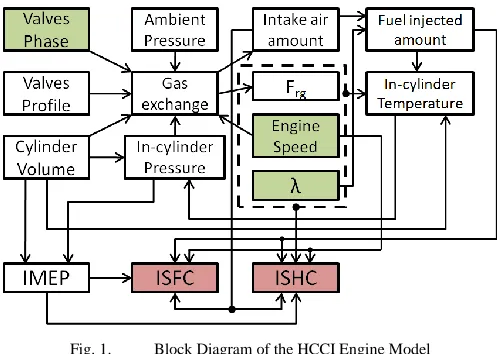
[image:3.612.314.564.181.358.2]with fixed simulation step. In order to develop the intelligent multi-objective optimization approach for the HCCI engine, IVO, EVC and λ are designated as variables in the model. The model is organized to have three major parts: 1) gas exchange model, 2) combustion and emissions model and 3) performance evaluation model. For the implementation of HCCI combustion in this study, the Negative Valve Overlap (NVO) strategy is used for trapping the residual gas, which provides heat of the residual gas to promote the HCCI combustion for the next engine cycle [16, 17].
Fig. 1. Block Diagram of the HCCI Engine Model
Fig. 1 gives the flow chart of the whole HCCI engine model structure, which indicates the relationships between different engine parameters or modules. The model inputs and outputs modules are highlighted with green and red respectively. For more information about the model development methodology and validation results, please see reference [18].
B. SPEA2 Optimizer
With a fast, reliable model of the engine in place, we can use an evolutionary search to find optimal operating points for any operating condition. A huge variety of algorithms based on evolutionary search (Evolutionary Algorithms, EA) have been developed. An in-depth discussion would be beyond the scope of this paper, in this section a rough overview of the elements of a typical EA, and a particular Multi-Objective EA (MOEA) will be presented.
form the population for the next iteration (generation) typically involves picking the better offspring and parents and discarding the worst performing parents, such that the population size remains constant.
Evolutionary algorithms are most useful in situations where no conventional optimization knowledge exists. Because they are population based, they are particularly well suited in applications with a trade-off between two or more fitness criteria. Multi-objective EA can produce a whole set of solutions (Pareto front), allowing the user to analyse the trade-off and pick the preferred solution. Most multi-objective EA are based on the notion of dominance: one solution is said to dominate another if it is as good or better in all fitness criteria, and better in at least one. Dominance establishes a partial ordering, where it is possible to establish a preference only for some pairs of individuals. A number of evolutionary algorithms have been designed based on this partial ordering, including the Non-sorting Genetic Algorithm (NSGA) [20] and the Strength Pareto Evolutionary Algorithm (SPEA, SPEA2)[21, 22].
In SPEA and its variations, the dominance ordering is converted into a single performance value that is then used for selection. To do this, it first computes a strength value for all parents and offspring: a count of all other individuals dominated by this individual. In a second step, the raw fitness of an individual is the sum of the strength values for all other individuals that dominate this individual. All non-dominated individuals have a fitness of 0, for all other individuals the fitness is higher (worse) the more they are dominated by other IV, and the stronger those other IV are.
In order to encourage the population to cover the entire surface of the Pareto front of solutions, the algorithm also contains a fitness sharing method. Here, the raw fitness is scaled by a measure of the density of individuals in a particular area of the search space. For the next generation, SPEA first tries to preserve all non-dominated individuals. If there are more non-dominated IV than the population (archive) size, a clustering algorithm selectively removes individuals. On the other hand, if the number of non-dominated IV is smaller than the archive size, dominated individuals are added depending on their scaled fitness. Parent selection in SPEA is simply a tournament selection, based on the scaled strength fitness.
In order to compensate the shortages of SPEA, SPEA was updated to SPEA2, which improved the domains of fitness assignment, individual density estimation and environmental selection [22].
The fitness assignment and environmental selection of SPEA2 are presented as follows:
Fitness assignment: in order to avoid the individuals who are dominated by external archive points, having the same fitness value, in SPEA2, the dominated solutions of every individual and the solutions which are dominated by every individual are considered. A strength value 𝑆(𝑖) is assigned for each individual of the population and external archive, which indicates the number of the solutions which are dominated by the individual. The equation to calculate the strength value is given as:
i j
t t j
x
x
A
P
x
j
i
S
(
)
,
,
(1)
The fitness value 𝑅(𝑖) of individual 𝑖 is equal to the sum of the strength values of all the individuals which dominates the individual 𝑖, i.e.
𝑅(𝑖) = ∑
𝑥𝑗∈𝑃𝑡+𝐴𝑡,𝑥𝑖≻𝑥𝑗𝑆(𝑗)
.
(2)
The density information is used to distinguish the individuals who have the same raw fitness. The kth nearest neighbor method is adopted to calculate the density value 𝐷(𝑖) of individual 𝑖, and which is given by:
𝐷(𝑖) =
1𝜎𝑖𝑘+2
,
(3)
where 𝜎𝑖𝑘 indicates the space distance between the
individual 𝑖 and the kth nearby individual, and k = √N + N . Finally, the fitness value F(𝑖) of individual 𝑖 is the sum of raw fitness value and the density value, i.e.:
𝐹(𝑖) = 𝑅(𝑖) + 𝐷(𝑖) .
(4)
C. Co-simulation Structure
The optimization approach is developed to optimize engine controllable parameters. For this paper, they are IVO, EVC and λ respectively. With respect to the EA, they represent these values by a three-element floating point vector, with each value restricted to the range of 0 to 1. These 'raw' values are scaled into the working ranges which has been specified in Table 2. Furthermore, IVO and EVC are discretized into all crank angle values. This is necessary as the model is implemented with a discrete time solver, with one-degree crank angle step. Since the representation is based on a floating point vector with a uniform range over all elements, we can use a simple Euclidean distance measure for the fitness sharing used in SPEA2. A simple one-point crossover with Cauchy mutation is applied.
In the tests reported in this paper, two fitness values are computed by the model for the HCCI engine: ISFC and ISHC. Not all combinations of parameters lead to stable operation of the engine. For conditions that lead to unstable engine operations the optimizer will exit early and return an indication that the output values are invalid.
The engine model is set up with a fixed, pre-defined speed, but variable IMEP outputs. In addition to the primary optimization objectives, the model produces an additional output value: the engine's IMEP at the operating point. With respect to the optimization to be useful in real-world situations, it needs to be able to target a specific IMEP range. The optimization therefore becomes a constraint optimization problem: minimize objectives ISFC and ISHC for HCCI mode subject to:
The SPEA2 algorithm has been modified to incorporate both constraints and individuals with invalid fitness values (engine misfire or unstable), such that:
1. An invalid individual never dominates another individual, and a valid individual with an output IMEP constraint violation will never dominate an individual that does not violate the IMEP constraint.
2. The archive is first filled with non-dominated individuals, then with dominated individuals without constraint violation, then with individuals with constraint violation. If spaces remain, they are filled out with invalid individuals.
3. In the tournaments used in parent selection, individuals not violating the IMEP constraint always win against those that do, and valid individuals always win against invalid individuals.
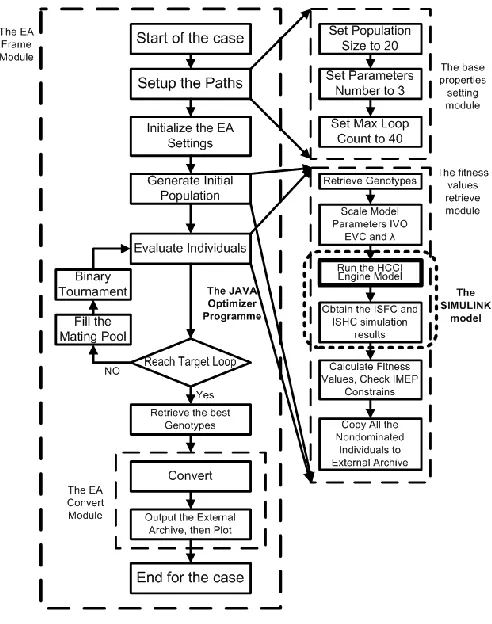
[image:5.612.316.560.243.322.2]The SPEA2 optimizer is implemented in Java, while the engine model is developed in SIMULINK. Thanks to the fact that Java is supported directly in Matlab, linking the two is possible. However, as Matlab functions cannot be called from Java (only the reverse is supported), a slightly more complex interaction is required. The EA loop remains in the Matlab domain, and it calls Java to perform the genetic operations and SPEA2 selection. The population is stored in the Java domain, and then Matlab reads the genotypes and writes back fitness values. Fig. 2 shows the flowchart for one engine multi-objective optimization case.
Fig. 2. Flowchart for One Engine Multi-objective Optimization Case
In Fig. 2, the “fitnesses” are the values of the target optimization objectives, for this study, they are ISFC and ISHC. The “genotypes” are the variables which are used for
scaling engine model parameters, i.e. individuals, they are IVO, EVC and λ. The genotype values are four decimal places between 0 and 1.
III. EXPERIMENTAL APPARATUS AND PROCEDURE
The experiments were performed on a Jaguar V6 SI/HCCI dual mode engine. The engine specifications are given in Table 1. Cam Profile Switching (CPS) system is applied to switch between SI and HCCI modes. This system allows on-line switching of valve lifts from 9 mm (SI mode) to 3 mm (HCCI mode). The Variable Valve Timing (VVT) system is able to change the cam timing for the inlet and exhaust cams within 60 crank angle degrees range.
TABLE 1
ENGINE SPECIFICATION SUMMARY
Engine type Jaguar V6 GDI Compression ratio 11.3 Displacement 3.0 Litres Max Valve Lift (SI/HCCI) 9/3 mm Engine speed 800~ 3500 rpm Valve Duration (SI/HCCI) 260/160 CAD
Bore 89mm Intake valve timing Variable
Stroke 79.5mm Exhaust valve timing Variable
Rod 138mm Intake temperature Variable
Fuel ULG95 Air/Fuel ratio Variable
[image:5.612.49.295.373.685.2]In order to assure stable and homogeneous condition, the fuel injection timing is located in TDC of recompression process. The gaseous emissions are quantified using a Horiba MEXA-7100DEGR emissions bench. Fuel consumption is obtained from an AVL 7131-06 fuel meter. The whole test bed is controlled by dSPACE system. The schematic of the engine test bed setup is shown in Fig. 3.
Fig. 3. Schematic of Jaguar V6 HCCI Engine Test Bed
[image:5.612.317.566.428.592.2]for EVC is only 5 CAD. In total, 3532, 90 combinations of engine parameters have been experimentally tested to derive
[image:6.612.103.511.72.259.2]the complete engine model.
Fig. 4. Schematic of Tested Valves Timing for HCCI Engine Model Development
The adjustable ranges of each variable engine parameters in HCCI model are given in Table 2.
TABLE 2
ADJUSTABLE RANGES OF EACH ENGINE PARAMETERS IN HCCIMODEL
Engine Speed EVC (bTDC) IVO (aTDC) 𝝀
Min 1500 rpm 75 CAD 60 CAD 1.0
Max 2500 rpm 95 CAD 80 CAD 1.2
Samples 1500,2000,2500 75,80,85,90,95 60,70,80 1.0,1.2
To combine all the different variables sample points, there are 90 groups of experimental data are obtained and used to calibrate the engine combustion and emissions model.
IV. THE VALIDATION RESULTS
The validation of HCCI engine model-based intelligent multi-objective optimization approach will be presented and discussed here. The validation includes SPEA2 code and the HCCI engine optimization. In order to demonstrate the high speed of the new engine optimization approach, the simulation speeds of the HCCI engine model and optimization for one engine case are presented. A computer with 1.6G Hz processor and 2GB RAM is used to run the simulation.
A. SPEA2 Optimizer Code Validation
Although the performance of SPEA2 has been developed and validated by E. Zitzler et al. in their research, it is essential to validate the self-developed code which is used in this research. The SRN Multi-objective Optimization Problem (MOP) is used to validate the developed SPEA2 optimizer code. It is a classic MOP to validate MOEA. As a Multiple-Input and Multiple-Output (MIMO) MOP, the SRN has two inputs (x, y) and two outputs (𝑓1 , 𝑓2) which are given by [23]:
20
,
20
&
0
10
3
,
225
,
.
.
1
9
,
min
1
2
2
,
min
2 2 2 1 2 2 2 2 1
y
x
y
x
y
x
e
y
x
y
x
e
t
s
y
x
y
x
f
y
x
y
x
f
SRN
(6)
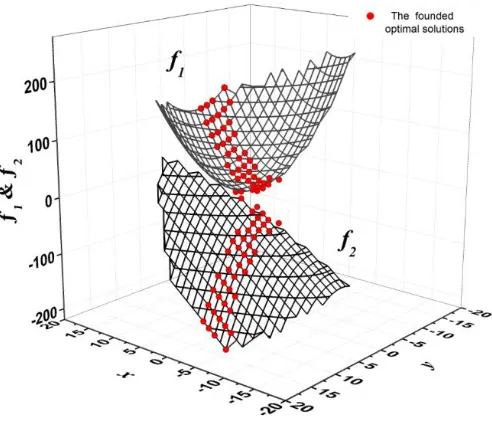
[image:6.612.332.565.298.399.2]For simplicity, the inputs (x, y) are considered as integers as well. The 3-D map surfaces of 𝑓1 and 𝑓2 without constraint conditions are presented in Fig. 5. The found optimal solutions of SRN MOP are shown in Fig. 6.
[image:6.612.324.571.463.671.2]Fig. 6. Found Optimal Solutions of SRN MOP
[image:7.612.51.300.384.593.2]In Fig. 6, the red points are the solutions which are found by the SPEA2 based Java code, which are equally good from the view of MOEA. The found Pareto Front of SRN MOP is shown in Fig. 7, which shows the solutions space and the optimal solutions.
Fig. 7. Founded Pareto Front of SRN MOP
From Fig. 7, it is recognized that the SPEA2 based MOEA is able to find the Pareto front of SRN MOP efficiently.
B. Engine Optimization Results and Validation
Since the engine model and SPEA2 based optimizer code have been validated, it is time to validate the optimization approach by comparing the experimental data and co-simulation results.
In order to test the approach within a wide range, the HCCI engine model-based intelligent multi-objective optimization
approach is validated for 8 HCCI cases with different engine speeds and IMEP. The conditions for these cases are given in Table 3 below.
TABLE 3
OPERATING CONDITIONS FOR EACH HCCICASE
Case No. 1 2 3 4 5 6 7 8
Engine Speed 1500 1750 2000 2250
Min IMEP (bar) 3.5 4.0 3.5 4.0 3.0 3.5 4.0 3.0 Max IMEP (bar) 4.0 4.5 4.0 4.5 3.5 4.0 4.5 3.5
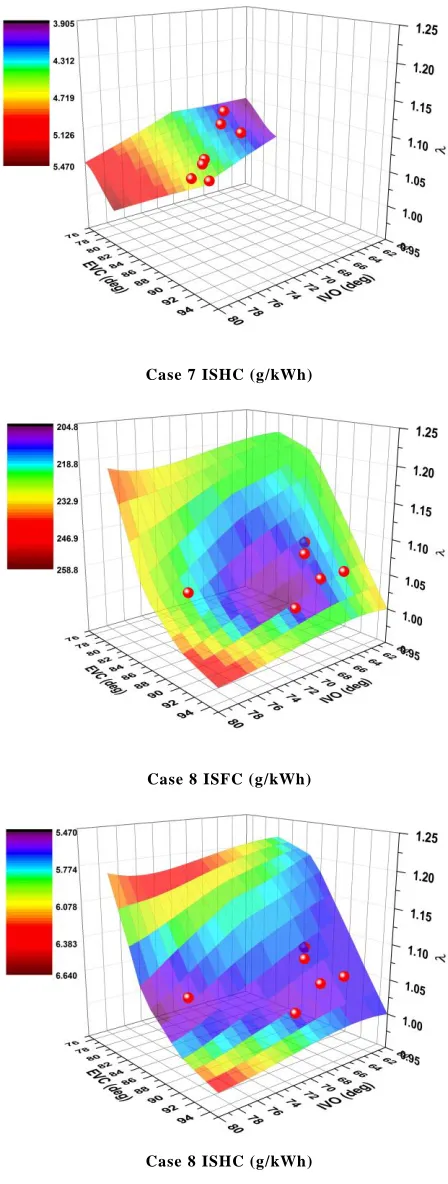
The optimizer needs to run 40 EA loops in order to find the optimal engine parameter settings. The validation results of the 8 different HCCI cases are shown in the 4-Dimensional Fig. 8. There are two figures for each case to display the validation results; one figure is coloured by the ISFC map and the other one is coloured by the ISHC map. The surface in each figure is the map of all the HCCI engine parameter settings (IVO, EVC and λ) which operates within the current engine speed and IMEP range. The 4th dimension of the figure is the different colour on the surface, which indicates a different ISFC or ISHC value. The corresponding values of ISFC and ISHC can be read from the colour scale bar beside the figures. The best performance region is in the dark area. The red points are the predicted optimal results (non-dominated solutions) which were found by the HCCI engine model-based intelligent multi-objective optimization approach. It is important to note that the ISFC and ISHC maps are derived from experimental data, with the HCCI engine operating with the specified engine parameter settings. The figures therefore provide an indication of the performance of the entire approach, and not just of the optimization step.
[image:7.612.333.557.452.608.2]Case 1 ISHC (g/kWh)
Case 2 ISFC (g/kWh)
Case 2 ISHC (g/kWh)
Case 3 ISFC (g/kWh)
Case 3 ISHC (g/kWh)
Case 4 ISHC (g/kWh)
Case 5 ISFC (g/kWh)
Case 5 ISHC (g/kWh)
Case 6 ISFC (g/kWh)
Case 6 ISHC (g/kWh)
Case 7 ISHC (g/kWh)
Case 8 ISFC (g/kWh)
[image:10.612.58.282.59.651.2]Case 8 ISHC (g/kWh)
Fig. 8. Validation Results of the 8 HCCI Cases
From the validation results in the figure above, it is observed that most of the red points are located in the purple or blue areas. This implies that the HCCI engine model-based intelligent multi-objective optimization approach is able to optimize the HCCI engine for obtaining the best engine
performance in terms of ISFC and ISHC simultaneously. These red points are equally good, from the EA based optimization point of view. For these points, some have better fuel consumption performance, some have better HC emissions performance and some are the compromise results between ISFC and ISHC. Engine designers need to determine which point is the best solution based on the particular design requirements. The most straightforward method is pick the point with the lowest fuel consumption with acceptable emissions level.
In some cases, the validation results are very good, where the red points are just located at the centre of purple zone, such as cases 1, 2, 3, 4 and 6. For example, in case 1, the red points are evenly distributed in the purple zones of ISFC and ISHC surfaces. However, some of the cases do not show such good results, e.g. for cases 7 and 8. For case 8, it looks like the optimizer cannot find the best solution for each target optimization objective and only found some compromised points in the blue areas. This is mainly due to the simulation errors of the HCCI engine model. Another possible reason is that 40 EA loops are not enough to optimize the engine for achieving the best performance for this case. This case has a relatively wider surface than others which implies that there are more potential parameter settings for this case.
[image:10.612.314.562.377.569.2]The comparisons between the initial experimental data and the optimized settings for case 1 and 2 are shown in Fig. 9.
Fig. 9. Comparisons between the Simulation and Experimental Data
Furthermore, the SPEA2 based multi-objective optimization process can be observed in Fig. 10. Case 1 is used as an example.
Fig. 10. SPEA2 Based Multi-Objective Optimization Process of Case 1
In Fig. 10, the small black points, medium red points and big red points represent 10, 20 and 40 loops of Pareto optimal results respectively. It is found that as the EA running loops increase, the optimal points will “climb” to the practical optimal zone gradually. For the cases with 10 loops, the Pareto optimal points (black) are located somewhere around the practical optimal zone, and some of them even appear in the green and yellow zones in the figure. However, after 20 loops, most of the Pareto optimal points (blue) are found in the blue zones. After 40 optimization loops, all the Pareto optimal points (red) are located in the practical optimal zones (purple). However, the time consumption of 40 loops is twice as long as that of 20 loops. Therefore, a compromise between optimization accuracy and time consumption is needed for any engine type or operating conditions. Additionally, it is found that some points are overlapped by the Pareto surface of different running loops. The reason is that these points’ fitness values are so good that the SPEA2 optimizer chose to keep them for even more loops.
C. Optimization Time Consumption
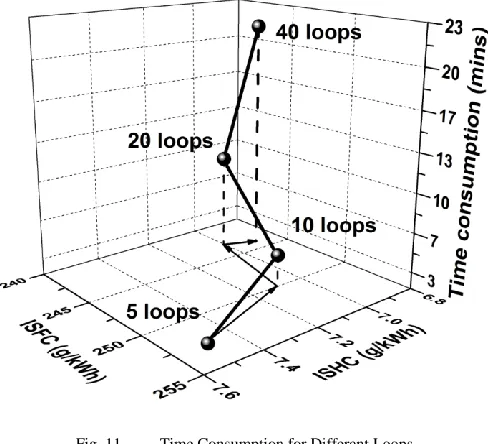
[image:11.612.317.561.128.350.2]The average time consumption of the HCCI engine model-based intelligent multi-objective optimization approach of case 1 is shown in Fig. 11, which has different EA running loops and the corresponding average engine performances improvements.
Fig. 11. Time Consumption for Different Loops
From this figure, it is found that a remarkable improvement is made when the EA running loops increase from 5 to 10. Although it is not as large as before, a considerable improvement is still achieved when the EA running loop number increases from 10 to 20. After 20 loops, the improvement is small. After that, further improvements from running more EA loops are limited. This implies that the improvement amplitude will decrease as the EA running loops increase. In general, no further improvement can be observed after 100 loops. As a compromise result between optimization standard and time consumption, the 40 EA running loops setting of HCCI cases is reasonable. It takes around 20 minutes to optimize one HCCI case.
V. CONCLUSIONS
In this Paper, a novel intelligence method of optimizing HCCI engine performance globally under given objectives has been developed. The performance of the HCCI engine optimizer is demonstrated by the co-simulation between an HCCI engine Simulink model and an Strength Pareto Evolutionary Algorithm 2 (SPEA2) based multi-objective optimizer developed in Java.
the HCCI engine for validation, which covers a very wide range of engine speed and IMEP. The HCCI engine optimizer only needs around 20 minutes to obtain the best engine performance points for one case.
For most of the cases, after 40 optimization loops, the Pareto optimal points are located in or very near the optimal zones. It means the optimizer is able to find the best performance points based on the limited experimental data, which suggests that the approach has great potential to help industries to reduce the engine calibration efforts, even for traditional gasoline and diesel engines.
ACKNOWLEDGMENT
The present work is part of a 3-year research project sponsored by the Engineering and Physical Sciences Research Council (EPSRC) under the grant EP/J00930X/1 and EP/J01043X/1. The authors would like to acknowledge the support from Jaguar Cars Ltd, Shell Global Solutions and various research assistants and technicians.
REFERENCE
[1] Gordon, T., M. Howell, and F. Brandao, Integrated control methodologies for road vehicles. Vehicle System Dynamics, 2003.
40(1-3): p. 157-190. Available from: <Go to ISI>://WOS:000184913400005.
[2] Rask, E. and M. Sellnau, Simulation-Based Engine Calibration: Tools, Techniques, and Applications. SAE Paper 2004-01-1264, 2004. [3] Atkinson, C. and G. Mott, Dynamic Model-Based Calibration
Optimization: An Introduction and Application. SAE Paper 2005-01-0026, 2005.
[4] Malikopoulos, A.A., D.N. Assanis, and P.Y. Papalambros, Optimal Engine Calibration for Individual Driving Styles. SAE Paper 2008-01-1367, 2008.
[5] Malikopoulos, A.A., D.N. Assanis, and P.Y. Papalambros, Real-Time Self-Learning Optimization of Diesel Engine Calibration. Journal of Engineering for Gas Turbines and Power, 2009. Vol. 131.
[6] Megaritis, A., D. Yap, and M.L. Wyszynski, Effect of inlet valve timing and water blending on bioethanol HCCI combustion using forced induction and residual gas trapping. Fuel, 2008. 87(6): p. 732-739. Available from: <Go to ISI>://WOS:000253894800016.
[7] Najt, P.M. and D.E. Foster, Compression ignited homogeneous charge combustion. SAE Paper 830264, 1983.
[8] Shaver, G.M., J.Christian, and G.P. Jain. Modeling for Control of HCCI Engines. in Proceedings of me American Control Conference 2003. 2003. CA, USA.
[9] Zhao, F., Homogeneous charge compression ignition (HCCI) engines : key research and development issues. Pt. 2003, Warrendale, PA: Society of Automotive Engineers. ix, 658 p.
[10] Vossoughi, G.R. and S. Rezazadeh. Optimization of the calibration for an internal combustion engine management system using multi-objective genetic algorithms. in 2005 Ieee Congress on Evolutionary Computation, Vols 1-3, Proceedings. 2-5 Sept. 2005.
[11] Hiroyasu, T., et al., Multi-Objective Optimization of Diesel Engine Emissions and Fuel Economy using Genetic Algorithms and Phenomenological Model. SAE Paper 2002-01-2778, 2002.
[12] Kesgin, U., Genetic algorithm and artificial neural network for engine optimisation of efficiency and NOx emission. Fuel, 2004. 83(7-8): p. 885-895. Available from: <Go to ISI>://WOS:000220387300014. [13] Wu, B., R.G. Prucka, and Z.S. Filipi, Cam-phasing Optimization Using
Artificial Neural Networks as Surrogate Models-Fuel Consumption SAE Paper 2006-01-1512, 2006.
[14] Obodeh, O. and C.I. Ajuwa, Calibration of Aging Diesel Engine with Artificial Neural Networks. European Journal of Scientific Research, 2008. Vol.24: p. 520-531.
[15] AVL. AVL CAMEO™. 2012; Available from: https://www.avl.com/cameo
[16] Xu, H.M., et al., Operating Characteristics of a Homogeneous Charge Compression Ignition Engine with Cam Profile Switching - Simulation Study. SAE Transactions Journal of Engines, 2003. Vol.112.
[17] Xie, H., et al., A Combustion Correlation for CAI Combustion and Its Application to CAI Engine Simulation. Journal of Combustion Science and Technology, 2004. Vol. 10 No. 6.
[18] Ma, H., CONTROL ORIENTED ENGINE MODELLING AND ENGINE MULTI-OBJECTIVE OPTIMAL FEEDBACK CONTROL. Ph.D Thesis, 2013. Available from: http://etheses.bham.ac.uk/4308/.
[19] Coello, C.C., G.B. Lamont, and D.A. Veldhuizen, Evolutionary Algorithms for Solving Multi-Objective Problems 2007 edition. 2007: Springer.
[20] Deb, K. and T. Goel, Controlled Elitist Non-dominated Sorting Genetic Algorithms for Better Convergence. Evolutionary Multi-Criterion Optimization Lecture Notes in Computer Science, 2001. 1993, 2001: p. 67-81.
[21] Zitzler, E. and L. Thiele, An evolutionary algorithm for multiobjective optimization: The strength pareto approach. 1998.
[22] Zitzler, E., M. Laumanns, and L. Thiele, SPEA2: Improving the strength Pareto evolutionary algorithm, in Tech. Rep .2001.
[23] Chankong, V. and Y.Y. Haimes, Multiobjective Decision Making Theory and Methodology. 1983: Dover Publications (February 4, 2008). 432 pages.
NOMENCLATURE
HCCI Homogeneous Charge Compression Ignition
DoF Degrees of Freedom
SPEA2 Strength Pareto Evolutionary Algorithm 2
rpm Revolutions per minute
IMEP Indicated Mean Effective Pressure
ISFC Indicated Specific Fuel Consumption
ISHC Indicated Specific Hydrocarbon
IVO Intake Valves Open
EVC Exhaust Valves Close
GDI EGR
Gasoline Direct Injection Exhaust Gas Recirculation
PM Particulate Matter
NEDC New European Driving Cycle
NOx Nitrogen Oxides
HC Hydrocarbons
SI Spark Ignition
DPGA Distance-based Pareto Genetic Algorithm
NSGA Non-dominated Sorting Genetic Algorithm
EMOGA Entropy-based Multi-Objective Genetic Algorithm
ADVISOR ADvanced VehIcle SimulatOR
BSFC Brake Specific Fuel Consumption
GA Genetic Algorithm
ANN Artificial Neural Network
MFB Mass Fraction Burned
DoE Design of Experiments
ECU Engine Control Unit
NVO Negative Valve Overlap
MOEA Multi-Objective Evolutionary Algorithms
CPS Cam Profile Switching
VVT Variable Valve Timing
CAD Crank Angle Degree
aTDC After Top Dead Centre
bTDC Before Top Dead Centre
TDC Top Dead Centre
MOP Multi-objective Optimization Problem