Original citation:
De Vries, R., Realo, Anu and Allik, J. (2016) Using personality item characteristics to predict single-item reliability, retest reliability, and self-other agreement. European Journal of Personality, 30 (6). pp. 618-636.
Permanent WRAP URL:
http://wrap.warwick.ac.uk/83334
Copyright and reuse:
The Warwick Research Archive Portal (WRAP) makes this work by researchers of the University of Warwick available open access under the following conditions. Copyright © and all moral rights to the version of the paper presented here belong to the individual author(s) and/or other copyright owners. To the extent reasonable and practicable the material made available in WRAP has been checked for eligibility before being made available.
Copies of full items can be used for personal research or study, educational, or not-for profit purposes without prior permission or charge. Provided that the authors, title and full bibliographic details are credited, a hyperlink and/or URL is given for the original metadata page and the content is not changed in any way.
Publisher’s statement:
"This is the peer reviewed version of the following article De Vries, R., Realo, Anu and Allik, J. (2016) Using personality item characteristics to predict single-item reliability, retest
reliability, and self-other agreement. European Journal of Personality, 30 (6). pp. 618-636., which has been published in final form at http://doi.org/10.1002/per.2083 . This article may be used for non-commercial purposes in accordance with Wiley Terms and Conditions for Self-Archiving."
A note on versions:
The version presented here may differ from the published version or, version of record, if you wish to cite this item you are advised to consult the publisher’s version. Please see the ‘permanent WRAP URL’ above for details on accessing the published version and note that access may require a subscription.
For Review Only
RUNNING HEAD: Item characteristics, reliability, and self-other agreementUsing Personality Item Characteristics to Predict Single-Item Internal Reliability,
For Review Only
Abstract
The use of reliability estimates is increasingly scrutinized as scholars become more aware that
test-retest stability and self-other agreement provide a better approximation of the theoretical
and practical usefulness of an instrument than its internal reliability. In this study, we
investigate item characteristics that potentially impact single-item internal reliability, retest
reliability, and self-other agreement. Across two large samples (N=6,690 and N=4,396), two countries (Estonia and The Netherlands), and two personality inventories (the NEO PI-3 and
the HEXACO-PI-R), results show that 1) item variance is a strong predictor of self-other
agreement and retest reliability but not of single-item internal reliability, 2) item variance
mediates the relations between evaluativeness and self-other agreement, and 3) self-other
agreement is predicted by observability and item domain. On the whole, weak relations
between item length, negations, and item position (indicating effects of questionnaire length)
on the one hand, and single-item internal reliability, retest reliability, and self-other agreement
on the other, were observed. In order to increase the predictive validity of personality scales,
our findings suggest that during the construction of questionnaire items, researchers are
advised to pay close attention especially to item variance, but also to evaluativeness and
observability.
For Review Only
Using Personality Item Characteristics to Predict Single-Item Internal Reliability,
Retest Reliability, and Self-Other Agreement
Recent articles by McCrae and colleagues (McCrae, 2015; McCrae, Kurtz, Yamagata, &
Terracciano, 2011) have highlighted an ‘inconvenient psychometric truth’ in personality
assessment, namely that internal reliability (often referred to as ‘internal consistency’)1 is not
an adequate predictor of criterion validity, whereas retest reliability and self-other agreement
are. Although it is becoming increasingly apparent that information about retest reliability and
self-other agreement is more useful for scale development and validation purposes than
information about internal reliability, it is less clear what properties items should have to
ensure sufficient high levels of retest reliability and self-other agreement. To elucidate this
question, it is necessary to focus on the predictors of internal reliability, retest reliability, and
self-other agreement instead of on their consequences. Thus, in contrast to McCrae and
colleagues (2011), who focused on the effects of internal reliability and retest reliability on the predictive validity of personality traits at the facet and domain level, in this research, we will focus instead on the predictors of internal reliability, retest reliability, and self-other
agreement at the item level. That is, we will investigate if—and to what extent—different item characteristics predict internal reliability (estimated by single-item internal reliability
(Wanous & Reichers (1996)), retest reliability (only in Study 2), and self-other agreement.
An inconvenient truth
The finding by McCrae et al. (2011; 2015) that self-other agreement and retest reliability
are better predictors of criterion validity than internal reliability is inconvenient because,
according to a ruling dogma among practitioners and researchers, internal reliability is a
necessary, albeit insufficient, condition for ensuring criterion-related validity. The first part of
this dogma—that internal reliability is a necessary condition for validity—has become so
For Review Only
(according to the dogma, usually lower than .70) are regarded with suspicion, and that articles
which report such instruments may be rejected for this reason alone. That is, when a dearth of
validity information is present, researchers and reviewers may commit the Type I fallacy of
rejecting a potentially valid instrument because of its low internal reliability. At the same
time, in the absence of validity information or when validities are tainted by common-method
biases, researchers and reviewers may be tempted to commit the Type II fallacy of accepting a
reliable but invalid instrument. In leadership research, for instance, there has been a
longstanding critique of instruments which contain items that are highly evaluative—ensuring
high levels of internal reliability—but on which relatively low levels of self-other and
other-other agreement are observed (e.g., De Vries, 2012; Ostroff, Atwater, & Feinberg, 2004; Warr
& Bourne, 1999), and which, as a consequence, may have lower levels of predictive validity
(e.g., Atwater & Yammarino, 1992; McCrae et al., 2011; Whittington, Coker, Goodwin,
Ickes, & Murray, 2009).
In personality research, this debate has found its zenith in the discussion on the usefulness
of short and mostly unreliable personality scales, with research showing that personality
scales can still attain sufficient levels of validity even in the presence of low levels of internal
reliability (Burisch, 1997; De Vries, 2013; Thalmayer, Saucier, & Eigenhuis, 2011). In fact, it
has become increasingly recognized in personality research that the true necessary, but
insufficient, condition for predictive criterion-related validity is retest reliability (McCrae et
al., 2011) or interrater (e.g., self-other or other-other) agreement.2 At the same time, the use of
internal reliability estimates has become criticized because high levels of internal reliability
may be due to the presence of ‘bloated specifics’ (Cattell, 1973), transient errors (Becker,
2000; Chmielewski & Watson, 2009; Schmidt, Le, & Ilies, 2003; Thorndike, 1951), or
For Review Only
styles or socially desirable responding, may impact reliability positively, it may also be
associated with lower levels of predictive validity.
Single-item internal reliability, retest reliability, and self-other agreement
Arguably, based on the above, the adequacy of a personality item should be based more
on its (single-item) self-other agreement and retest reliability than on its single-item internal
reliability. Consequently, the main question for this research is: What item characteristics
affect single-item internal reliability, retest reliability, and self-other agreement? To answer
this question, first of all, we have to specify what we mean with single-item internal
reliability, (single-item) retest reliability, and (single-item) self-other agreement and, second,
we need to discuss how these three components are related to each other. To start with the
meaning of these three components, of these three, retest reliability and self-other agreement
are most easily conceptualized. They are conceptualized respectively using the correlation
between an item measured at T1 and the same item measured at T2 (retest reliability) and the
correlation between an item’s self- and observer-ratings (self-other agreement; note, we’ll
drop the ‘single-item’ in front of retest reliability and self-other agreement from here on but
we retain it when referring to single-item internal reliability). Single-item internal reliability,
however, can be conceptualized in two different ways. The first conceptualization is based on
the single-item (internal) reliability formula proposed by Wanous and Reichers (1996), i.e.,
rxx=rxy2/ryy, in which rxx is the single-item internal reliability, rxy is the item-rest correlation
between the item and its scale, and ryy is the internal reliability of the scale without the target
item (i.e., reliability if the target item is deleted). The second conceptualization is based on the
communality or the squared factor loading of a single item when combined with other items
that represent the same construct in principal axis factoring. When principal axis factoring is
performed and only one factor is extracted, the squared loading—which is equal to the
For Review Only
underlying factor or its proportion of true variance, which can thus be equated to its reliability
(Denissen, Geenen, Selfhout, & Van Aken, 2008; Spörrle & Bekk, 2014; Wanous & Hudy,
2001). Single-item internal reliabilities are most often used in surveys that can only take a
very short time because people are unwilling or unable to answer lengthy questionnaires (e.g.,
on the street or in the hospital) or when the survey involves a very large number of scales,
such as in large-scale social surveys. They are less often used in personality research, because,
except maybe for Extraversion, most single-item measures of personality are characterized by
low levels of single-item internal reliabilities (Spörrle & Bekk, 2014). In this study, we
combine both conceptualizations of single-item internal reliability into one single-item
internal reliability estimate.
Second, the three components—single-item reliability, retest reliability, and self-other
agreement—do have some overlap. To deduce the amount of overlap between the three
components, McCrae (2015) posited that the variance of an item can be partitioned into
trait-related (systematic) variance (T), method variance (M), specific (item-related) variance (s), and error variance (ε). Trait variance is that part of the variance that is due to systematic and
‘true’ individual differences in the (personality) characteristic being assessed. Method
variance is due to individual differences in response biases. That is, some respondents may
tend to exaggerate their standing on desirable traits and downplay their standing on
undesirable traits, whereas others do not or even react oppositely. Specific variance is that
part of the variance of an item that is not shared by the other items in the scale. That is, it
refers to ‘true’ individual differences in item-specific variance. And finally, error variance is
random variance or ‘noise’ and refers to that part of the variance that is unsystematic and (by
definition) unrelated to the other sources of variance.
According to McCrae (2015), internal reliability (α) is a function of both the amount of
For Review Only
amount of trait, method, and specific variance, i.e., rtt = (T+M+s)/(T+M+s+ε);3 and self-other agreement (rso) is a function of the amount of trait and specific variance, i.e., rso =
(T+s)/(T+M+s+ε). Thus, retest reliability overlaps with both internal reliability and self-other agreement because it shares with the former trait variance (T) and method variance (M) and with the latter trait variance (T) and specific variance (s). But, although both internal reliability and self-other agreement depend on the amount of trait variance, the main
difference between internal reliability and self-other agreement is that besides trait variance
(T), internal reliability is also a function of method variance (M) whereas self-other agreement is also a function of specific variance (s).
In the Revised NEO Personality Inventory (NEO PI-R; Costa & McCrae, 1992), the mean
prevalence of these four variance components at the item level was estimated to be 12% (trait
variance), 13% (method variance), 24% (specific variance), and 51% (error variance)
(McCrae, 2015; pp. 105-106). That is, specific variance contributed almost a quarter of the
total variance whereas trait and method variance each contributed one-eight approximately.
According to McCrae (2015), items with a large amount of specific variance relative to other
sources of variance have higher levels of self-other agreement and retest reliability, but lower
levels of internal reliability. In contrast, items with a large amount of method variance relative
to the other sources of variance have higher levels of internal reliability and retest reliability,
but lower levels of self-other agreement. That is, large amounts of method variance are likely
to result in an unjustified raise in (internal and retest) reliability but may, at the same time and
to the extent that it replaces systematic and specific variance, result in an attenuation of
self-other agreement.
Domains of item characteristics
What kind of item characteristics determine single-item internal reliability, retest
For Review Only
(1995), to be able to accurately assess personality traits, a target needs to exhibit behaviors
that are relevant to a given trait (relevance), which are ‘visibly’ expressed and thus become
available for observers (availability). In turn, judges (either the target him-/herself or an
external observer) need to be able to detect the relevant and available behaviors (detection),
which in turn need to be correctly utilized as indicative of a trait (utilization). Although
Funder (1995) conceptualized his model as a person characteristics model, in which
(information about traits of) targets and judges play a central role, the four process variables
of his model can be readily adapted to an item characteristics model. That is, item
characteristics may determine whether the behavior described in an item is relevant for a trait,
whether the behavior described is usually available to judges, whether judges will be able to
detect the behavior described in the item, and whether judges will correctly utilize the
information.
Here, we make a distinction between seven item characteristics—i.e., item variance,
evaluativeness, observability, item domain, item position, item length, and negation—that
may impact item relevance, availability, detection, and utilization. The two item
characteristics associated with item relevance are item variance and evaluativeness. According to Funder (1995, p. 658), “in some context or contexts, a trait produces a
behavioral effect. The resulting behavior is then relevant to that trait.” An item can be seen as
a context which invites a behavioral response based on somebody’s trait level. The more an
item is associated with instances in which a trait gets activated (Tett & Burnett, 2003), the
more varied the response, the higher the variance, and the more relevant the item is for the
trait in question. Thus, item variance is an important manifestation of item relevance.
Evaluativeness may affect item relevance, because high negative or positive evaluativeness
For Review Only
attention away from the trait in the question, decreasing the relevance of the item for the trait
that is measured.
The two item characteristics associated with availability are observability of the behavior and item domain. Observability affects availability because items that contain statements on
behaviors that are more readily observable are by definition more ‘available’ to an external
observer than items that contain statements on behaviors that are not easily observable. Item
domain is associated with availability because some personality domains, such as
Extraversion, are more readily expressed in behaviors than other personality domains (Funder
& Dobroth, 1987; Watson, Hubbard, & Wiese, 2000) and thus it may be easier to write items
with observable content for these domains than for other domains.
The item characteristic associated with detection is item position in the questionnaire. Item position may affect detection, because respondents may get tired or bored at the end of a
long questionnaire, and thus items positioned at the end of a such a questionnaire may be
processed suboptimally, interfering with the detection of the behavior involved in the item
(Galesic & Bosnjak, 2009; Herzog & Bachman, 1981; Kraut, Wolfson, & Rothenberg, 1975).
And finally, the two item characteristics associated with (correct) utilization are item length and negation. Item length and negation are associated with utilization because longer items
and items that contain negations may be more complex and confusing, thus introducing
judgment errors (Marsh, 1986; Saucier & Goldberg, 2002). Thus, whereas detection is
associated with item position in a long questionnaire—a characteristic that can be remedied to
some extent by randomizing items in such a questionnaire—, utilization is associated with the
style in which an item is written.
The item characteristics model described here is not a process model such as the RAM
(Funder, 1995). Each of the elements described here is likely to have an independent effect on
For Review Only
argue that evaluativeness will impact these three reliability estimates at least partly through
item variance. Below, we will discuss each of the seven item characteristics, item variance,
evaluativeness, observability, item domain, item position, item length, and negation, in turn.
Item relevance: Item variance. First of all, we will investigate the effects of item
variance on single-item internal reliability, retest reliability, and self-other agreement.
Without any item variance, no relevant behavior is revealed, and, consequently, there is zero
single-item internal reliability, retest reliability, and self-other agreement. Thus, higher item
variance should be positively related to single-item internal reliability, retest reliability, and
self-other agreement. Empirical evidence has shown that facet-level variance is a strong
predictor of self-other agreement (Allik et al., 2010). The question is, however, whether
item-level variance contributes equally to single-item internal reliability, retest reliability, and
self-other agreement. When considering the findings of McCrae (2015) on the mean prevalence of
the trait, method, and specific variance components described above, item variance should be
least strongly related to single-item internal reliability (which accounted for (12%+13%=)
25% of the item variance), somewhat more strongly to self-other agreement (which accounted
for (12%+24%=) 36% of the item variance), and most strongly to retest reliability (which
accounted for (12%+13%+24%=) 49% of the item variance), but this is only true when the
relative amounts of these variance proportions are the same for all items. That is, there may
actually be more variance across items in the amount of trait variance and specific variance
than there is variance across items in the amount of method and error variance. If this is the
case, it may be true that item variance is mainly related to self-other agreement, and to a lesser
extent to retest reliability and single-item internal reliability.
Item relevance: Evaluativeness (or: Social desirability). In personality research, items
that invite evaluative or socially desirable responding are usually treated with suspicion
For Review Only
Lee, in press; Bäckström, Björklund, & Larsson, 2009; John & Robins, 1993). Method
variance may consist of variance associated with response styles (e.g., extreme responding,
midpoint responding, acquiescent responding; Zettler, Lang, Hülsheger, & Hilbig, 2016) and
variance associated with socially desirable responding. Of these two, item characteristics
(such as the evaluativeness of an item) are by definition more likely to invite differences in
socially desirable responding. That is, when answering a personality item, a person’s socially desirable response is determined by a confluence of the item content (i.e., whether agreeing or disagreeing with an item is socially desirable or not) and the individual characteristics of
the person answering the item. Answers to items with neutral socially desirable content
should, by definition, be determined by someone’s actual traits (although admittedly, people
may differ in the extent to which they think an item is neutral with respect to social
desirability, see Wood & Wortman, 2012). Answers to items with non-neutral—i.e., socially
desirable or undesirable content—are also determined by someone’s actual traits, but also by
the extent to which a person tends to respond in a socially desirable manner. Consequently,
items will differ in the extent to which they invite socially desirable responding. In contrast, a person’s response style should—by definition—influence all personality items equally. Although items with completely different ‘content domains’ (e.g., items that reflect
someone’s knowledge versus items that reflect someone’s personality) may invite different
response styles from the same person, items of the same content domain (in this case,
personality) are unlikely to differ in the extent to which they invite differences in responding
to different items. That is, response styles, such as midpoint responding, extreme responding,
and acquiescence, constitute a ‘domain-specific’ method factor rather than an ‘item-specific’
method factor.
Furthermore, extremely desirable or undesirable items (i.e., items high on evaluativeness)
For Review Only
because of restriction of range, lower item variances. That is, when mean evaluativeness of an
item is increased, trait variance is likely to decrease. Research has shown that adjectival items
are seldom evaluatively neutral and, consequently, the use of adjectival items has strong
effects on other agreement, with evaluatively neutral items inviting higher levels of
self-other agreement when compared to evaluatively positive or negative items (John & Robins,
1993). The use of questionnaire items is recommended by virtue of the fact that modifiers can
be used to change the evaluativeness of statements. But even in statements instead of
single-word items, evaluativeness is likely to affect self-other agreement. Research shows, for
instance, that questionnaires that invite socially desirable responding are more likely to result
in factor scales that are more strongly interrelated, whereas factor scales consisting of items
with reduced social desirability are much less strongly interrelated (Bäckström et al., 2009).
Psychopathology questionnaires are especially susceptible to this effect, with research
showing that self-other agreement—but not reliability—is compromised because of the use in
psychopathology questionnaires of highly (negatively valenced) evaluative items (Ashton et
al., in press).4 Thus, deviations from neutral evaluativeness may cause a reduction of item
variance, which in turn may lead to lower levels of self-other agreement. That is, item
variance is expected to mediate the negative relation between evaluativeness and self-other
agreement.
Availability: Observability and item domain. It has long been recognized that
observability (or: visibility) of traits may be an important precursor for self-other agreement
(Funder & Dobroth, 1987; Watson, Hubbard, & Wiese, 2000). Basically, observability
ensures that the behavior referred to in the item is available to the rater, which in turn may
have a positive effect on the amount of trait and specific variance. Especially Extraversion has
been often singled out as the most observable trait, but research suggests that it may depend
For Review Only
some situations more observable than others (De Vries, Tybur, Pollet, & Van Vugt, 2016;
Rauthman, 2012; Tett & Burnett, 2003). An aspect that may be especially relevant in this
regard is whether traits are associated with engagement or with altruism, a distinction that has
been proffered in the HEXACO model (Ashton & Lee, 2001, 2007; Ashton, Lee, & De Vries,
2014). Engagement traits refer to Extraversion (social engagement), Conscientiousness (task
engagement), and Openness to Experience (idea engagement) and Altruism traits refer to
Honesty-Humility (reciprocal altruism), Emotionality (kin altruism), and Agreeableness
(reciprocal altruism). In the Big Five or Five-Factor model (e.g., Costa & McCrae, 1992;
Goldberg, 1990), the engagement factors are similar to those of the HEXACO model, whereas
the altruism factors are constituted by rotational variants of HEXACO Agreeableness and
Emotionality, i.e., Big Five Agreeableness and Emotional Stability (Ashton et al., 2014).
Especially traits that are associated with altruism may be somewhat less observable than traits
associated with engagement. That is, expressions of low Honesty-Humility, high
Emotionality, and low Agreeableness may be somewhat more uncommon because people are
less frequently in situations that allow for the expression of these traits. On the whole, because
observability is likely to positively impact the amount of trait and specific item variance
relative to the amount of method and error variance, observability should be mainly related to
self-other agreement and should have less of an effect on single-item internal reliability.
Detection: Item position. It is a common assumption that questionnaire length has a
negative effect on response quality because respondents may tend to become tired or bored
with long questionnaires, thus being less able and willing to detect and absorb the behavioral
content of items positioned at the end. Items placed at the end of a survey have indeed been
found to be associated with somewhat less extreme responses (Kraut et al., 1975), more
straightlining (Herzog & Bachman, 1981), and faster response times (Galesic & Bosnjak,
For Review Only
study, we will investigate whether ‘item position’ (i.e., which position the item has in the
questionnaire; from the first to the last item) is related to reliability and self-other agreement
estimates. Because item position may potentially lower response quality and because,
consequently, item position may be associated with a higher amount of error variance relative
to the other sources of variance, we expect single-item internal reliability and self-other
agreement to be negatively affected.
Utilization: Item length. Another item characteristic that we will investigate is item
length. Item length has been often considered an important impeding factor of item
comprehension, resulting in less correct utilization of an item due to greater item complexity
(Hofstee, 1991; Saucier & Goldberg, 2002), which, in turn, may result in more error variance
and, consequently, lower single-item internal reliability, retest reliability, and self-other
agreement. As a consequence, some authors have proposed that personality items should be as
short as possible, consisting solely of a verb and a verb specifier (Hendriks, 1997; Hendriks,
Hofstee & De Raad, 1999). Indeed, when comparing NEO PI-R items that have reduced
length with items from the original NEO PI-R, the items with reduced length were found to
have higher reliabilities (Mõttus, Pullmann, & Allik, 2006). Item length may thus have an
effect on both reliability and self-other agreement. It should be noted that the effects of item
length may be somewhat curvilinear. That it, very short items—consisting of only one or two
words—are often very abstract because of a lack of specification and contextualization and
often have higher levels of evaluativeness (e.g., John & Robins, 1993; Wood & Wortman,
2012). The higher level of abstractness may result in higher levels of error variance, which
may result in lower levels of internal reliability and self-other agreement. However, higher
levels of evaluativeness may be associated with more method variance, raising internal
reliability levels. As a case in point, scales based on items consisting of single words were
For Review Only
short sentences, despite similar levels of internal reliability (Allik et al., 2010; Watson,
Hubbard, & Wiese, 2000). However, our research does not contain any items that consist of
single words and evaluativeness is likely to be less pronounced in item sentences, thus it is
most likely that the relations between item length and single-item internal reliability, retest
reliability, and self-other agreement are linear and only negatively affected because of the
higher level of error variance in longer items.
Utilization: Negation. A related issue concerns the use of negations in items. The use of
negations (e.g., ‘not,’ ‘no,’ ‘nothing,’ ‘never,’ ‘less,’ ‘dis-,’ and ‘un-’) is often considered ‘bad
practice,’ because negations are more likely to result in incorrect utilization of the item due to
lower levels of item comprehension (e.g., Hofstee, 1991; McCrae et al., 2011), which, in turn,
may result in more error variance and lower internal reliability, retest reliability, and
self-other agreement. The negative effects of negations on average item intercorrelations and
coefficient alphas have been found to be especially pronounced among young children
(Marsh, 1986). Among adults and in single domains such as self-esteem, negations have been
found to be related to response styles, which have been related to substantive trait-like factors
(DiStefano & Motl, 2006). However, method effects in self-esteem scales due to negations
have been associated with higher rather than lower grades among adults (Greenberger, Chen,
Dmitrieva, & Farruggia, 2003), suggesting that some of these effects may be due to conscious
self-representation. Whether such effects occur for adults and in broad personality
questionnaires instead of narrow constructs such as self-esteem, however, is an empirical
question. Such a question can only be addressed if a questionnaire has a sufficient number of
items from different trait domains that contain negations in both directions, i.e., negations that
are associated with socially desirable traits and negations that are associated with socially
undesirable traits. Both the (Estonian version of the) NEO PI-3 (McCrae, Costa, & Martin,
For Review Only
& Lee, 2009; Lee & Ashton, 2004) contain a sufficient number of negations (i.e., 71
negations (29.6% of the 240 items) in the Estonian NEO PI-3 and 67 negations (33.5% of the
200 items) in the Dutch HEXACO-PI-R) in both socially desirable and socially undesirable
directions (see the negligible correlations between negations and evaluativeness in Study 1
(Table 1) and Study 2 (Table 3)). Consequently, these two questionnaires offer the possibility
to inspect the influence of the use of negations on single-item internal reliability, retest
reliability (but not in Study 1; see below), and self-other agreement.
The present study
In sum, the present study aims to examine if and to what extent the following item
characteristics—item variance, evaluativeness, observability, item domain, item position, item
length, and negation—predict single-item internal reliability, retest reliability, and self-other
agreement. Based on what we argued above, we expect the item relevance and availability
variables—item variance, evaluativeness, and observability/item domain—to affect mainly
self-other agreement and to a lesser extent—or not at all—single-item internal reliability. Of
these, evaluativeness is most likely to affect self-other agreement through item variance. That
is, item variance is likely to be reduced—because of restriction of range effects—when items
are highly evaluative. Furthermore, we expect the detection and utilization variables—item
length, negation, and item position—to affect both reliability and self-other agreement. Items
at the end of a questionnaire, longer items, and items with negations are expected to have
higher error variance, and as a consequence lower single-item internal reliability, retest
reliability, and self-other agreement.
This research is conducted using two large samples containing self- and other-ratings of
personality. In the first sample (Study 1), the Estonian version of the NEO PI-3 (McCrae et
al., 2005) is used. In the second sample (Study 2), the Dutch version of the HEXACO-PI-R
For Review Only
the data using item characteristics. That is, characteristics such as item variance,
evaluativeness, observability, item domain, item position, item length, negation, single-item
internal reliability, retest reliability (only in Study 2), and self-other agreement were obtained
for each item. Consequently, the analyses are performed on the samples of items of the NEO PI-3 and HEXACO-PI-R instead of on the samples of respondents.
Study 1
Method
Sample and procedure. The sample of respondents used in Study 1 comes from the
Estonian Biobank cohort, the data for which were collected by the Estonian Genome Centre
(EGC) of the University of Tartu (Leitsalu et al., 2014). Participants were recruited on a
voluntary basis among the Estonian resident adult population (aged over 18 years). The
current number of participants—close to 52,000—represents nearly 5%, of the Estonian adult
population. The age structure of the sample is well matched to the age structure of the entire
population. Our sample for the current study consisted of 6,690 participants; 3,345 ‘targets’
who provided self-ratings and 3,345 ‘informants’ who provided observer-ratings of the targets
(see also Allik et al., 2015; Mõttus et al.; 2016; Realo et al., 2015 for sample descriptions).
The 3,345 targets (59.3% women) had a mean age of 46.4 years (SD = 17.0, ranging from 18 to 91 years). All participants completed the Estonian version of the NEO PI-3 (McCrae et al.,
2005). The targets nominated somebody who knew them well and these people were asked to
rate the personality traits of the target using the other-report version of the Estonian NEO
PI-3. Of the informants, 2,331 were women (71.1%) and 948 were men (66 did not report their
For Review Only
children or grandchildren, 6% were brothers or sisters, and 6% were other relatives or
acquaintances.
Instruments
As noted above, the items of the Estonian version of the NEO PI-3 (McCrae et al., 2005),
which is a slightly modified version of the NEO PI-R (Costa & McCrae, 1992; Kallasmaa et
al., 2000), constitute the sample of items on which we conducted the analyses. Like the
original NEO PI-R, the NEO PI-3 has 240 items that measure 30 personality facets, which are
grouped into the five FFM domains – Neuroticism (N), Extraversion (E), Openness to
Experience (O), Agreeableness (A), and Conscientiousness (C) – such that each domain score
is a composite of six facet scores. Except for evaluativeness and observability noted below,
items were answered on a 0 (strongly disagree) to 4 (strongly agree) rating scale. The NEO
PI-R/NEO PI-3 has excellent psychometric properties in a wide range of countries (De Fruyt
et al., 2009), including Estonia. The Cronbach alphas of the NEO PI-3 domain scales for self-
and other-ratings were .93/.93 (N), .93/.93 (E), .90,.89 (O), .87/.92 (A), .91/.94 (C),
respectively. The convergent correlations between self- and other-ratings (i.e., self-other
agreement) were .53 (N), .63 (E), .61 (O), .48 (A), .51 (C).
Item variance. The item variances of self- and other-ratings correlated .86 (p < .01) and thus we obtained for each of the 240 NEO PI-3 items a composite item variance variable by
averaging the item variances of self- and other-ratings. The mean composite item variance
was 1.15 (SD = 0.29).
Evaluativeness. The evaluativeness ratings of the Estonian NEO PI-3 were taken from a
study by Mõttus, McCrae, Allik, & Realo (2014). Nine judges rated the items in terms of their
social desirability using the following instruction: “The descriptive characteristics of people
often contain an evaluative component. Some characteristics are considered very important
For Review Only
item, please indicate how helpful agreeing with it would be for gaining others’ approval.”5
The ratings were provided on a 7-point scale (1 = not helpful at all to 7 = very helpful). The
inter-rater agreement was high (ICC(3, k)=.93). For each item, the mean desirability score
was calculated. In agreement with Study 2, we conceptualized scores lower than the midpoint
(in this case, ‘4’) as indicating that the characteristic described in the item is met with social
disapproval and scores higher than the midpoint as indicating that the characteristic in
question is met with social approval. Because scores with higher deviation from the midpoint
are less evaluative neutral and because deviations from evaluative neutrality have been found
to affect self-other agreement (John & Robins, 1993), we decided to center and transform the
240 item scores to an absolute (0 to 1) evaluativeness scale using the following
transformation: new score=|(old score – 4)/3)|.6 The mean of the evaluativeness scale was .37,
with a standard deviation of .20.
Observability and item domain. The same nine judges also rated the items in terms of
their observability using the following instruction: “Some aspects of personality are easy to
judge by external observers, whereas some aspects may be judgeable only by people
themselves. For each item, please indicate how easy it would be for an external observer to
decide if it describes the person being rated.” The items were rated on a 7-point (very difficult
to very easy) scale and the inter-rater agreement (ICC(3, k)) was .84. Similar to
evaluativeness, an average was computed for each item. The mean of these 240 observability
scores was 4.42 with a standard deviation of .89. Apart from observability scores, to align this
study to Study 2, we combined Neuroticism and Agreeableness in one domain (coded ‘1’),
which conforms to the HEXACO Altruism factors, and Extraversion, Conscientiousness, and
Openness to Experience in another domain (coded ‘2’), which conforms to the HEXACO
For Review Only
that indeed Agreeableness and Neuroticism items had—on average—the lowest mean
self-other agreement correlations of all NEO PI-3 domain scales.7
Item position, item length, and negation. Item position was derived from its position in
the questionnaire. The 240 items of the NEO PI-3 were presented in a fixed order and thus
item position was equal to the item number in the questionnaire. Item length was obtained by
counting all characters (excluding spaces and periods but including characters such as
commas, brackets, and quotation marks) in the self- and the observer-version. The item
lengths of the two versions were averaged to arrive at the final item length variable used in
this study. The average item length of the Estonian version of the NEO PI-3 was 44.5
characters, ranging from 15 to 108 characters (SD = 15.8). Negation was obtained by coding items that contained a negation (e.g., separate words such as ‘not,’ ‘no,’ ‘nothing,’ ‘never,’ or
‘less,’ but also pre- or suffixes such as ‘dis-,’ ‘un-,’ or ‘-less’) as ‘1’ and items without a
negation as ‘0.’ In total, there were 71 items (29.6%) in the Estonian version of the NEO PI-3
that contained a negation.
The criteria variables and sensitivity analysis. The two criteria variables in Study 1 were
single-item internal reliability and self-other agreement. To obtain single-item internal
reliability, we calculated the mean of two indices. The first index was based on the facet-level
single-item internal reliability, for which we explained the calculation in the introduction
(e.g., Wanous & Reichers, 1996). The second index was based on the communality of the
item with its facet when using one-factor principal axis factoring (Wanous & Hudy, 2001).
Across the 240 items, these two indices were very highly correlated (r = .99, p < .01) in both self- and ratings. The two indices were averaged separately across self- and
For Review Only
240 NEO items. The mean self-other agreement was .31 (SD = .08), with a range of .12 to .54. In contrast to Study 2, no retest reliability data was available for the NEO PI-3.
With a sample of 240 items and a statistical power of 80%, sensitivity analyses estimated
the smallest effect that correlational analyses will be able to detect with p < .05 to be ρ = .16, a small to medium effect size. The k = 240 item-level NEO PI-3 data is made available through the Open Science Framework (De Vries, Realo, and Allik, 2016).
Study 1 results
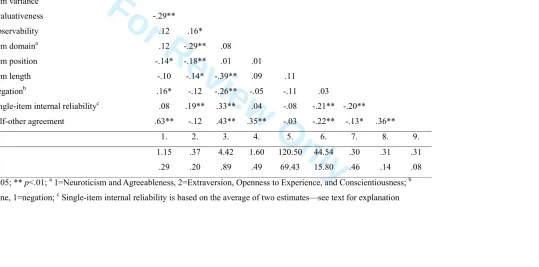
As shown in Table 1, there were some differences in the way the predictor variables
correlated with single-item internal reliability and self-other agreement. The most important
correlates of single-item internal reliability (in order of correlation magnitude) were
observability, item length, negation, and evaluativeness. The most important correlates of
self-other agreement were item variance, observability, item domain, and item length. On the
whole, self-other agreement had a stronger correlation with the predictor variables than
single-item internal reliability. Two noteworthy findings were 1) that item position did not
have a significant relation with single-item internal reliability and self-other agreement,
although the (weak) correlations were in the expected direction, with lower reliability and
self-other agreement when variables were positioned at the end of the questionnaire; and 2)
that observability was unrelated to item domain, although again the weak correlation was in
the right direction, with somewhat higher observability for engagement items.
Table 1
The relations between item variance, evaluativeness, observability, item domain, item
position, item length, and negation on the one hand, and the two criteria variables on the other
hand were tested using AMOS 21.0 (Arbuckle, 2011). As explained in the introduction, we
modelled item variance as a mediator in the relation between evaluativeness and the two
For Review Only
between evaluativeness and item variance, but not between the other item characteristics and
item variance. We did, however, allow all of the item characteristics to be associated with the
two criteria variables, i.e., single-item internal reliability and self-other agreement.
Furthermore, all covariances between the exogenous variables were allowed to be freely
estimated, as well as the covariance between the error terms associated with single-item
internal reliability and self-other agreement. This first model did not fit optimally, with χ2(5)
= 25.97, p < .01; CFI = .95; and RMSEA = .13, p-close < .01. Modification indices showed that three other item characteristics, i.e., observability, item position, and negation, were
significantly related to item variance. Theoretically, a model which includes these three paths
may be defended based on the following observations: a) observability may increase the amount of trait and specific item variance, which in turn may be related to self-other
agreement (Watson et al., 2000); b) items positioned at the end of a questionnaire may invite
more straightlining, and thus item position may be associated with a reduction in item variance; and c) negations may actually result in an increase in item variance because error variance (which may decrease self-other agreement) is added to trait, method, and specific
variance. To probe these possible relations, we conducted an exploratory analyses in which
we freed these three paths. The resulting model fit the data much better, with χ2(2) = 1.02, p = .60; CFI = 1.00; RMSEA = .00, p-close = .75, and thus we decided to retain it for further analyses.
We subsequently checked whether a model with or without a direct effect of
evaluativeness on self-other agreement had a better fit. Model comparison fit indices (∆χ2(1)
= 2.87, p = .09) indicated that a model which excluded the direct path from evaluativeness to self-other agreement did not have a significant worse fit; thus a model without this path was
more parsimonious. The model without a direct effect of evaluativeness on self-other
For Review Only
and is shown in Figure 1 and Table 2. We used the bootstrap procedure in AMOS with 5,000
samples and a 95% bias-corrected Confidence Interval (CI) to check whether the indirect
effect of evaluativeness on self-other agreement through item variance was significant and
found evaluativeness had a significant standardized indirect negative relation with self-other
agreement (γ = -.20; CI = -.13, -.28).8
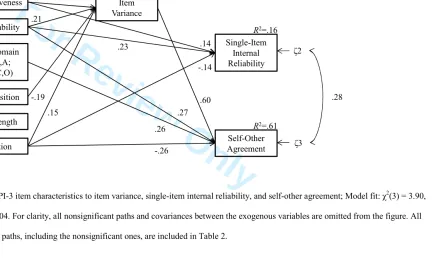
Figure 1
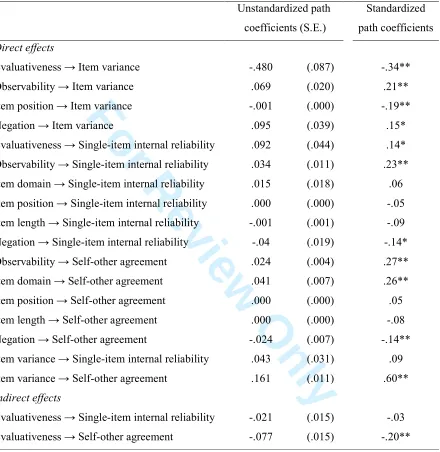
Table 2
The model in Figure 1 shows that observability, evaluativeness, and negation were related
to single-item internal reliability, explaining 16% of its variance, but that except for item
position and item length, all other predictor variables, either directly and/or indirectly through
item variance, were related to self-other agreement, explaining a substantial 61% of its
variance. To check whether the indirect effects of observability and negation on self-other
agreement through item variance were significant, we used the same bootstrap procedure in
AMOS and found significant standardized indirect relations between observability and
selfother agreement, γ = .13 (CI = .06, .19), between item position and selfselfother agreement, γ =
-.11 (CI = -.04, -.20), and between negation and self-other agreement γ = .09 (CI = .02, .17).
Study 1 conclusion and discussion
Study 1 shows that there is only some overlap in item characteristics that predict
item internal reliability and self-other agreement. Compared to self-other agreement,
single-item internal reliability is relatively weakly predicted by three single-item characteristics, i.e., by
evaluativeness, observability, and negation. In contrast, self-other agreement is very strongly
predicted by item variance and item domain, both directly and indirectly by observability and
negation, and indirectly by evaluativeness. Of seven item characteristics, item variance is by
far the most important determinant of self-other agreement and has little impact on
For Review Only
through item variance and a positive direct relation with single-item internal reliability. That
is, higher evaluativeness seems to be associated with lower item variance, and low variance,
in turn, has a negative impact on self-other agreement. Whereas the indirect effect of
evaluativeness on self-other agreement was negative, the direct effect of evaluativeness on
single-item internal reliability was positive. Consequently, high levels of reliability may mask
the unwanted effects of high levels of evaluativeness.
The effects of observability appear to be positive for both single-item internal reliability
and self-other agreement. Consequently, with higher levels of observability of an item, higher
levels of single-item internal reliability and self-other agreement can be expected. A surprise
of this study was, however, that observability was unrelated to item domain. According to
scholars, traits such as Extraversion are more visible than traits such as Neuroticism (Funder
& Dobroth, 1987; John & Robins, 1993; Watson, Hubbard, & Weise, 2000), and additional
analyses confirmed that there was a significant difference in observability of the five NEO
PI-3 traits (F(4, 235) = 17.28, p < .01), with indeed Extraversion as the most observable trait (ME = 5.04, SDE = .73), followed by Conscientiousness (MC = 4.62, SDC = .89), Neuroticism (MN = 4.53, SDN = .75), Agreeableness (MA = 4.14, SDA = .87), and Openness to Experience (MO = 3.79, SDO = .88). As noted in the methods section, self-other agreement of Openness to Experience was relatively high, whereas its observability was relatively low. Item domain
(Altruism versus Engagement) may thus be associated with something else than just
observability. We’ll get back to this point in the general discussion.
The structural equation model did not sustain a significant relation between item length
and the criteria, possibly because its effects were somewhat confounded with those of
observability, with which it shared a negative relation (r = -.39, p < .01). Although item position did have a negative indirect effect on self-other agreement through item variance,
For Review Only
not significantly different from zero, γ = -.07 (CI = -.17, +.04). Similarly, the positive indirect
effect of negation on self-other agreement was compensated with a significant negative direct
effect, resulting in a nonsignificant total effect of negation on self-other agreement, γ = -.05
(CI = -.17, +.07). Consequently, the total effects of item position, item length, and negation on
single-item internal reliability and self-other agreement were weak or absent.
Furthermore, it should be noted that some suppressor effects seemed to occur in the
structural equation model. That is, the zero-order relations of evaluativeness, observability,
and item position with item variance were lower in the correlation matrix than in the structural
equation model and whereas the correlation between evaluativeness and self-other agreement
was nonsignificant in the correlation matrix, the total standardized effect was significant in
the structural equation model, even when the direct effect of evaluativeness on self-other
agreement was included. Consequently, although the results seem to offer by-and-large
support for our expectations with respect to the relevance (item variance and evaluativeness)
and availability (observability and item domain) variables but not for our detection (item
position) and utilization (item length and negation) variables, more research is clearly needed.
Study 2
Study 2 is a replication and extension of Study 1 using a different sample, a different
questionnaire and an additional criterion variable (i.e., retest reliability). First of all, instead of
the NEO PI-3, the HEXACO-PI-R (Ashton & Lee, 2008; De Vries, Ashton, & Lee, 2009; Lee
& Ashton, 2004) was used in Study 2. Second, we used an additional sample from the
Netherlands that provided test-retest data to compare the effects of the predictors on reliability
and self-other agreement with their effects on retest reliability. This addition may be deemed
important, because recent studies have suggested that retest reliability may actually be a more
useful indicator of reliability than internal reliability estimates, such as Cronbach’s alpha (De
For Review Only
variance, evaluativeness, observability, item domain, item length, negation, and item position
will be highly similar for retest reliability and self-other agreement but different for
single-item internal reliability.
Method
Sample and procedure. The effective sample for the analyses of Study 2 consisted of the
entire set of 200 items of the HEXACO-PI-R, described under ‘Instruments.’ The main data
on these 200 items were derived from a sample of respondents, consisting of 4,396
participants, 2,198 of whom were Dutch first year personality psychology students (81.7%
women; Mage=20.2; SDage=2.8). The psychology students filled out a number of personality inventories as part of their coursework and approached a well-acquainted other to obtain
informant reports on their personality. The sample of 2,198 well-acquainted observers (63.2%
women; Mage=26.8; SDage=12.3) consisted of 41.2% friends, 35.9% family members, and 22.9% intimate partners, who on average knew the focal person for 10.6 years (SD=8.0). Both self- and other-ratings were used by another student to write a personality report about the
focal person. The dataset, or parts of it, has been used in other studies (e.g., Allik, De Vries, &
Realo, 2016; De Vries, Ashton, & Lee, 2009; De Vries, Wawoe, & Holtrop, 2016, Studies 1
and 4), but the dataset has not been used for the present purpose.
Instruments
HEXACO-PI-R. The six domain scales that form the HEXACO acronym are represented
each by 32 items and eight items measure the interstitial Altruism facet. The total HEXACO
Personality Inventory-Revised thus consists of 200 items. The Proactivity interstitial facet,
that has recently been added to the Dutch version (De Vries, Wawoe, & Holtrop, 2016), was
not included in this study. All items were answered on a 1 (strongly disagree) to 5 (strongly
agree) rating scale. The domain-level alpha reliabilities of the self/other versions in this
For Review Only
.89/.89 (O) and the convergent correlations between self- and other-ratings (i.e., self-other
agreement) were .49 (H), .63 (E), .64 (X), .53 (A), .63 (C), and .64 (O).
Item variance. Similar to Study 1, the correlation between self- and other-rated item
variance was high (r = .88, p < .01) and thus self- and other-rated item variances were averaged to obtain the composite item variance variable. The mean composite item variance
was .99 (SD = 0.23).
Evaluativeness. Six psychologists (50% women; Mage = 33.3, SDage = 10.4) rated the social desirability (i.e., “the extent to which the individual characteristic described in the item
is viewed as socially desirable by people in general”) of the 200 HEXACO items on a
five-point rating scale (1 = socially very undesirable to 5 = socially very desirable). The inter-rater
agreement was high (ICC(3, k) = .89), and the items were subsequently centered and
transformed to an absolute (0 to 1) Evaluativeness scale similar to Study 1 using the following
transformation: new score=|(old score – 3)/2)|. The scale mean was .33, with a standard
deviation of .21.
Observability and item domain. A different set of eight psychologists (37.5% women;
Mage = 34.1, SDage = 7.5) rated the observability (i.e., “the extent to which the individual characteristic described in the item is difficult or easy to observe for an external observer”) of
the 200 HEXACO items on a five-point (1 = very difficult to observe to 5 = very easy to
observe) scale. The inter-rater agreement was adequate (ICC(3, k) = .80), and the scale mean
was 2.90, with a standard deviation of 0.53. Furthermore, for item domain, we coded items
belonging to the Altruism domains (Honesty-Humility, Emotionality, and Agreeableness) as
‘1,’ and items belonging to the Engagement domains (Extraversion, Conscientiousness, and
Openness to Experience) as ‘2.’
Item position, item length, and negation. In line with Study 1, we included the following
For Review Only
variable was based on the position of the variable in the questionnaire. The items of the
HEXACO questionnaire were presented in a fixed order and thus item position was equal to
the item number in the questionnaire. Per item, all characters—including quotation marks,
commas, brackets, etc. but excluding periods and spaces—were used for the item length
variable, which was obtained by averaging the item lengths across self- and observer versions.
The mean item length was 60.6 characters (SD = 16.9) with a range of 14.5 to 109.5 characters. The negation variable was based on the presence of negations (e.g., not, no,
nothing, never, less, dis-, un-, -less, etc…) in the item. Items that contained a negation were
coded as ‘1,’ items without a negation were coded as ‘0.’ As noted in the introduction, there
were 67 HEXACO-PI-R items (33.5%) with negations.
The criteria variables and sensitivity analysis. The three criteria variables were
single-item internal reliability, retest reliability, and self-other agreement. Single-single-item internal
reliability was operationalized using the same method as in Study 1 (i.e., by averaging
facet-level single-item internal reliabilities and communalities based on a principal axis factoring
analysis). Again, correlations between the two indices were very high, reaching almost parity
for both self- (r = .996, p < .01) and other-ratings (r = .997, p < .01).
Retest reliability was based on an earlier sample of N = 188 students (85.1% women; Mage = 19.7, SDage = 2.3 at T1), who completed the unrevised version of the HEXACO Personality Inventory (De Vries, Lee, & Ashton, 2008; Lee & Ashton, 2004). The students completed the
HEXACO-PI two times in 2006; the first time during a first year personality psychology
course (T1), and a second time after seven months during a second year methodology course
(T2). The retest correlations between the six domain scales ranged from .79 (Agreeableness)
to .90 (Openness to Experience), with a mean of .85. To check for potential score
manipulation by students who had obtained feedback on their HEXACO personality profile
For Review Only
large scale score manipulations by psychology students. That is, none of the means on the
three Altruism dimensions were significantly different, i.e.: Honesty-Humility (Mt1=3.60,
SDt1=.51; Mt2=3.60, SDt2=.53; t(df=187)=.36, p=.72, d=0.03), Emotionality (Mt1=3.41,
SDt1=.47; Mt2=3.42, SDt2=.45; t(df=187)=-.80, p=.43, d=-0.06), and Agreeableness (Mt1=3.01,
SDt1=.48; Mt2=2.97, SDt2=.45; t(df=187)=1.90, p=.06, d=0.14) and although the means on three Engagement dimensions were significantly different, i.e.: Extraversion (Mt1=3.31,
SDt1=.50; Mt2=3.37, SDt2=.49; t(df=187)=-2.93, p<.01, d=-0.21), Conscientiousness
(Mt1=3.30, SDt1=.46; Mt2=3.38, SDt2=.45; t(df=187)=-4.47, p<.01, d=-0.33), and Openness to Experience (Mt1=3.29, SDt1=.54; Mt2=3.35, SDt2=.51; t(df=187)=-3.24, p<.01, d=-0.24), in absolute terms, the mean differences were not very large.
The only difference between the HEXACO-PI and the HEXACO-PI-R is that the former
contained an Expressiveness facet which was replaced by a Social Self-Esteem facet in the
HEXACO-PI-R. Consequently, eight items in the retest sample were different from those
used in the remainder of our study. The values of the eight Social Self-Esteem items were
imputed with the EM algorithm using the self- and other item-rest correlations as predictors.
When using the imputed values, all correlations in Table 3 remained virtually unchanged.
Self-other agreement was obtained by correlating self- and other-ratings on each of the
200 HEXACO items. The average self-other agreement of the items was .30 (ranging from
.09 to .56), with a standard deviation of .09.
With a sample of 200 items and a statistical power of 80%, sensitivity analyses estimated
For Review Only
Table 3Study 2 results
There were again strong differences in correlates of single-item internal reliability on the
one hand and retest reliability and self-other agreement on the other. The only significant
correlate of single-item internal reliability in the HEXACO sample was item variance,
whereas retest reliability and self-other agreement were strongly and consistently related to
item variance, item domain, and (negatively) to item length. In addition, self-other agreement
was also negatively related to evaluativeness and positively to observability. Retest reliability
was also more strongly related to self-other agreement (r = .69, p < .01) than it was to single-item internal reliability (r = .31, p < .01) or than single-item internal reliability was to self-other agreement (r = .43, p < .01). Item position was unrelated to the three criteria variables, although all three correlations were in the expected (negative) direction. Again, as in Study 1,
observability was unrelated to item domain.
As in Study 1, our first structural equations model in AMOS 21.0 (Arbuckle, 2011)
included item variance as a mediator of the relation between evaluativeness and the three
criteria variables but not as a mediator between the other item characteristics and the three
criteria variables. Similar to Study 1, all exogenous variables were allowed to covary as were
the error terms associated with the three criteria variables. This first model fit the data really
well, with χ2(5) = 6.17, p = .29; CFI = 1.00; RMSEA = .03, p-close = .55. To compare our model with the exploratory model in Study 1, we subsequently freed up the paths from
observability, item position, and negation to item variance. The model which included these
paths did not significantly improve model fit (e.g., ∆χ2(3) = 3.82, p = .28) and all of the three paths were not significantly different from zero. Consequently, we decided to retain the
For Review Only
Subsequently, we checked whether a model with or without a direct effect of
evaluativeness on self-other agreement had a better fit. Model comparison fit indices (∆χ2(1)
= 0.09, p = .77) indicated that a model which excluded the direct path was more
parsimonious. This final model, which did not have a direct effect of evaluativeness on
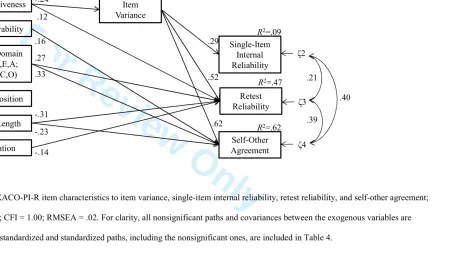
self-other agreement, also fitted well, with χ2(6) = 6.25, p = .40; CFI = 1.00; RMSEA = .02, p -close = .67, and is shown in Figure 2 and Table 4.
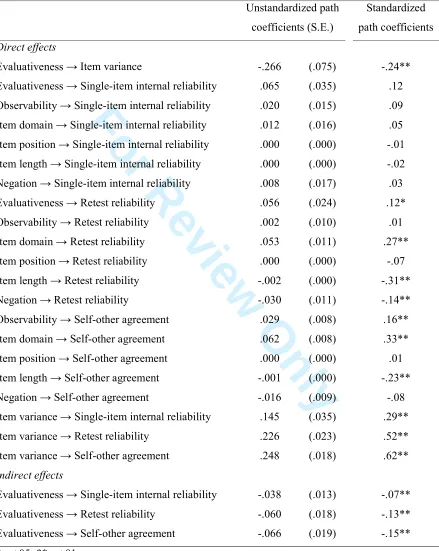
The item characteristics explained 9% of the variance in single-item internal reliability,
47% of the variance in retest reliability, and 62% of the variance in self-other agreement.
Using a bootstrap procedure in AMOS with 5,000 samples and a 95% bias-corrected
Confidence Interval (CI), the standardized parameters of the indirect effects indicated that
evaluativeness had a significant standardized indirect relation with single-item internal
reliability (γ = -.07; CI = -.03, -.13), retest reliability (γ = -.13; CI = -.06, -.21), and self-other
agreement (γ = -.15; CI = -.07, -.23).9 However, evaluativeness only had a significant
standardized total effect on self-other agreement (γ = -.15; CI = -.07, -.23). The standardized
total effects of evaluativeness on single-item internal reliability (γ = .05; CI = -.10, .19) and
retest reliability (γ = -.01; CI = -.13, .12) were nonsignificant.
Figure 2
Table 4
Study 2 conclusion and discussion
The main outcome of Study 2 is that, again, item variance is the main predictor of
self-other agreement and is more strongly related to self-self-other agreement than it is related to
single-item internal reliability. Interestingly enough, the relations of item variance, item
length, and item domain with retest reliability were almost similar to their relations with
self-other agreement, indicating that similar processes may be at work in retest and self-self-other
For Review Only
second time around when there is less variance in the item, when the item is somewhat longer,
and when the questions are about altruism factors instead of engagement factors.
In line with Study 1, evaluativeness was indirectly—through item variance—negatively
related to self-other agreement. Also in line with Study 1, observability and item domain were
positively related to self-other agreement but were unrelated to each other. Additional
analyses showed that there was a significant difference in observability between the six
HEXACO traits (F(5, 186) = 13.99, p < .01), with—as in Study 1—Extraversion the most observable trait (MX= 3.23, SDX= 0.72), followed by Agreeableness (MA= 3.12, SDA = 0.36), Emotionality (ME= 3.08, SDE= 0.39), Conscientiousness (MC= 2.96, SDC= 0.33), Openness to Experience (MO= 2.54, SDO = 0.44), and Honesty-Humility (MH= 2.54, SDH= 0.41). Again, as in Study 1, self-other agreement of Openness to Experience was relatively high,
whereas its observability was relatively low.
As in Study 1, negation and item position had relatively weak or absent relations with the
three criteria variables. Item length was somewhat more strongly related to the criteria and—
in contrast to Study 1—remained a significant predictor in the SEM. Longer items were
associated with somewhat lower levels of retest reliability and self-other agreement than
shorter items.
General Discussion and Conclusions
Recent articles by McCrae and colleagues (McCrae, 2015; McCrae et al., 2011) have
challenged the widespread assumption that a personality inventory is as good as its internal
reliability. Instead, the most important psychometric indices of a scale seem to be high levels
of retest reliability and self-other agreement. In previous research (Allik et al., 2010), variance
was found to be the most important predictor of self-other agreement at the facet level. In two
studies, we replicated this finding at the item level. That is, data obtained from two large
(Finno-For Review Only
Ugric), using two principally different questionnaires, the NEO PI-3 and the HEXACO-PI-R,
showed that item variance is the most important predictor of self-other agreement and retest
reliability and that it is, at the same time, not highly predictive of single-item internal
reliability. Furthermore, data from both studies also suggest that item variance mediates the
negative relation of evaluativeness with retest reliability and self-other agreement. That is,
evaluativeness is an impediment of item variance, and lower levels of item variance may
reduce retest reliability and self-other agreement. Apart from item variance and
evaluativeness, observability and item domain also seem to play a role, with item content
associated with the altruism domain and lower observability being associated with lower
self-other agreement.
The results have important implications for the construction of both long and short
versions of personality questionnaires, although the implications for short versions are
somewhat more pronounced. Based on our findings, when constructing personality
questionnaires we would advise scholars to investigate and report for each item its 1) level of
self-other agreement, 2) level of retest reliability, 3) item variance, 4) evaluativeness, and 5)
observability. Instead of using internal reliability as a screening mechanism, scholars could
use expert raters to assess the face validity of an item with its purported construct and assess
whether items are not tautological to prevent ‘bloated specifics’ (Cattell, 1973). For example,
in the HEXACO-PI-R, 80 items had a retest reliability ≥ .60 and there were ample items from
each domain with sufficient levels of self-other agreement (> .30), item variance (> 1.00), low
levels of evaluativeness (< .30), and high levels of observability (e.g., > 3.00 on a 5-point
scale). The exact combination of the above to screen items and optimize predictive validity
remains to be investigated, but based on previous research (McCrae et al., 2011), internal
reliability (or in our case: single-item internal reliability) does not seem to have much of an