Qualitative interview-based research: An
exploratory study on the role of the agile coach
and how the coach influences the development
of agile teams
Author: Sam Althoff
University of Twente
P.O. Box 217, 7500AE Enschede
The Netherlands
ABSTRACT,
This report presents the results of a descriptive and explorative multi-method study
into the role of agile coaches and their influence on the development of agile teams.
Based on eight interviews with agile coaches, but also informed by the analysis of a
literature study. The conclusion is that the tasks of agile coaches can be categorized
into four roles. These roles are defined by the tasks, but also the setting they are
performed in. These roles are all in support of the common goal agile coaches have
which is enabling ownership. The maturity and hierarchy level of teams determine to
what the degree the coach is able to influence the development of teams and the
organisation. In the study is emphasized which tasks are most important for which
role and what tools a coach uses to which ends. The paper provides an overview of
the roles, tasks, and tools to help agile coaches reflect on their own position and
create an understanding of the importance and value of the coach to use by
managers.
Graduation Committee members:
J.G.W.L. Smits MSc.
Dr. D.H. Dun, van
Keywords
Agile, Scrum, Agile coaching, Organisational change, Transition, Team development, Coaching impact, Agile methodologies, Team performance, Coaching roles.
This is an open-access article under the terms of the Creative Commons Attribution License, which permits the use, distribution, and reproduction in any medium,
1.
INTRODUCTION
Outside of the software development industry, the agile way of working continues to grow in popularity and its applicability in other types of organisations and sectors. The values of ‘being agile’ as noted by the original writers of the Agile manifesto (Beck et al., 2001), describe these, merely in the form of guidelines. When adopted correctly, these can work for every type of organisation. Many organisations now start to realize the potential of positive change and advantages the agile way of working provides to their businesses (CollabNet, 2019). Current literature, describing theories and frameworks, might be incomplete or inapplicable to use for the types of organisations that are not from the software development sector. However, the strength of the agile values is that these organisations can and will have to change and shape the agile values into their own agile structure. These customised frameworks are not uncommon in the software development, but the frameworks that exist, might not be fit for implementation at the new generation of organisations becoming agile (Hoda & Noble, 2017).
Organisational change
The transition to an organisation that is working completely agile requires a complete change. In terms of organisational design, it will have to result in self-organising teams, where members of different backgrounds work together in multi-disciplinary teams, which results in much tighter company cultures (Mutusamy, Simmons, & Wheeler, 2005). But, in terms of organisational performance, the goal is an improvement of performance across all aspects related to previously existing departments, i.e. in order to increase customer satisfaction (Beck et al., 2001). Ultimately, the process towards agile teams will result in a loss of hierarchy, which means a shift of responsibility towards team autonomy, and is most difficult for the manager to accept (Mutusamy et al., 2005). In an agile organisation, the self-organising teams have their own responsibility in drafting, completing and reflecting on the project, which is reflected in the autonomy that agile teams need to take. This autonomy can be divided in different informal roles (Hoda, Noble, & Marshal, 2010). Also, the people in the teams have to be able to fulfil their part of the project, as the teams are often multi-disciplinary. A lack of multidisciplinary approach and high specialisation could pose a problem regarding reorganisation of teams. Besides understanding and mastering the process, the individuals will have to improve their expertise (Jovanović, Mas, Mesquida, & Lalić, 2017). Finally, it calls for the need of an (in)formal system that connects individuals in an organisation, as communication is key in the process of self-organising teams and agility. The multi-disciplinary factor already allows individuals to be connected since they have to work together. But, a more appropriate system, beyond regular emails and phone calls, is necessary (Moe, Dingsøyr, & Dybå, 2008). This facilitation of support can also be facilitated by the agile coach (Rosha & Lace, 2016). The ultimate goal of the agile way of working for most organisations is to increase innovativeness, increasing customer satisfaction, lowering costs, lowering cycle times/ lead times and improving output quality (CollabNet, 2019). This goal is supported by the introduction of the agile way of working to these self-organising, multi-disciplinary teams, who can be compared, to some degree, to self-organised teams as described by (Hackman, 1986).
The change to an agile organisation can only be done when supervised by a person that coaches and directs the process in order for the business to successfully integrate the agile way of working, often this role is still overlooked (Parizi, Gandomani, & Nafchi, 2014). This person is an agile coach, “An agile coach
helps teams or individual adopt and improve agile methods and
practices. A coach will help people rethink and change the way
they go about development” (Kelly). After the teams have had their agile training, they are not yet fully equipped with the skills necessary to lead the agile process as effectively and efficiently as possible. The agile coach helps the team to stay within the scope of the project and directs the meetings to keep them effective. The agile coach is used through different levels of the company and therefore the key in successful team collaborations and effective workflow processes, which is also captured in the coaching capability of an organisation (Adkins, 2010).
1.1
Research objective and design
Agile is a very important topic to this date and because there are articles published frequently, it is important to consider that this research will not be able to cover all aspects known from the literature, as some also fall outside the scope of this research. The literature base keeps expanding and consists of much more than the role of the coach and the influence on the development of agile teams. Other subjects relevant in this research area are the agile transition, which will be a small part of this research, and the scaling of agile in organisations which is at least as important.
The objective of this research is not focused on providing one way of going about the roles of agile coaches and team development. Instead, this research provides an overview of the answers given by agile coaches in agile organisations to increase the understanding of the context surrounding an agile coach in practice. To create an overview, the answers are analysed and presented in the results section. With this overview, agile coaches can reflect upon themselves and their role in the agile team, to
understand what they actually do to influence the teams’
performance and what they can do to improve that performance. This paper can also be helpful for managers of organisations in transition to understand the added value of the coaches. To further help the agile coach, this paper also provides a literature overview of different theories, coaching roles, tasks and tools from different perspectives. Combined and compared with the data from the interviews, a contribution is made to the existing knowledge of agile teams, the performance of self-organising teams and the role of agile coaches within agile origination.
It is critical to understand that each agile coach might work differently and have another approach, this simply has to do with the personality and experience the coach has. There might not be one effective way of working or one solution to the problems (in a transition), as each scenario, project, and organisation is unique (Kropp & Meier, 2015). The coaches’ subjective view on the matter on hand calls for freedom of interpretation of the data and framework. Where many different factors influence the development of agile teams and other dimensions of the agile transition, selecting the best method is the start of the process. therefore, it is important to select the best agile method fitted to the organisation’s needs (Rasnacis & Berzisa, 2017). Since the research area is very large and multi-faceted at the end of this paper limitations and ideas for future research will be discussed. This paper starts with substantiating reasons for the importance of continued research in this field.
1.2
Research question
By using sub-question the research question will be expanded. These questions are needed to be able to answer the research question to the maximum extent, as well as understanding the research context surrounding agile coaching and team development. The questions are meant to fill the gaps in the overarching research question. The sub-questions that expand the research question are:
• What is agile performance and what metrics can be used (by agile coaches) to measure agile team performance?
• What is the importance of an agile coach within the organisation (to guide during transition phase)? • What tools do agile coaches use and what techniques
can the agile coach use to interfere during the meeting to manage team performance?
2.
THEORETICAL BACKGROUND
2.1
What is Agile methodology
2.1.1
Different types of agile methodologies
The 12 principles stated in the Manifesto, only gave guidelines for high-quality development in an agile manner (Beck et al., 2001). They do not propose a formal structure or framework, each organisation can or has to use. The goal of the principles is to motivate practises that facilitate change in demand during the development stage, ergo higher agility. These practises are allowing organisations to bring more value to customers and therefore, customer satisfaction increases. (Dingsøyr, Nerur, Balijepally, & Moe, 2012). There are various agile methods that have been developed since the creation of the Manifesto. An organisation will have to decide which methodology fits best and how to implement this method. The organisation should make sure that the chosen method is best
fitted for the organisation’s design, culture, and goals, which becomes apparent in the amount of (structured) adoption frameworks and adoption solutions that have been developed and proposed by (Gren, Torkar, & Feldt, 2017; Qumer & Henderson-Sellers, 2008; Qumer, Henderson-Henderson-Sellers, & Mcbride, 2007; Rasnacis & Berzisa, 2017; Sharif, 2014; Sidky, 2007; Sureshchandra & Shrinivasavadhani, 2008).
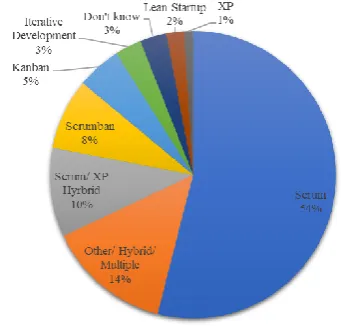
The annual State of Agile is an independent organisation that surveys organisations all around the world to assess the state of agile. This means that they report agile success, metrics, project management tools, agile methods, agile scaling techniques and experiences. The data from 2019 is summarised from 1319 respondents from more than 14 different industries. 97% of the respondents indicated that their organisation works agile. They report that Scrum is still the most used agile method worldwide as can be seen in (Error! Reference source not found.). Scrum is followed by hybrid/multiple methods. Especially this method is interesting to use by organisations. Because it becomes clear here that organisations tailor agile frameworks, or adoption solutions to their own needs and design, even by combining different methods. That way, the organisation is able to implement the agile structure in their organisation with higher rates of success and without it failing, because of mistakes during the design phase. Other agile methodologies can exist which are not represented in (Figure 1). However, these methodologies are used on a very low scale. Either, because they have become outdated when new and better methodologies have been developed, or because the environment of organisations is changing and calls for a different type of approach. The
differences between all these methodologies fall outside the scope of this research and will not be further explained.
2.1.2
Agile Transition
Big changes that have commenced in the world in terms of globalization, innovation, new technologies, different social-values, reduced product life cycles, and quick changes in customer demand have created a dynamic and competitive landscape in which greater emphasis is placed on the organisational need for engagement towards more innovation (Abrahamsson, Warsta, Siponen, & Ronkainen, 2003; Mutusamy et al., 2005). Organisations have to change their organisational design and cultures to be able to meet those challenges and face them. Becoming agile is one way for organisations to do so. The agile way of working implies high levels of autonomy and self-organisation.
Difficulties during the agile transition
[image:3.595.328.499.112.276.2]For an organisation to become agile there is not one decisive and agreed-upon way. Meaning there is no framework or solution for organisations to use in becoming agile that provides a guaranteed success. Resistance to change from employees in the organisation makes a transition difficult. Some reasons for this resistance are lack of experience, fear of the unknown, lack of job security, preference for structure, and a dislike of increased work-load (Magpili & Pazos, 2017; Thursfield, 2015). What makes it even more difficult are the different agile methodologies that exist, which all call for a slightly different and unique approach of adopting into the organisation (Kropp & Meier, 2015). In ‘Different types of agile methodologies’, it is already mentioned that a lot of different adoption frameworks and solutions exists, each has their own techniques, steps and (dis-) advantages. Other relevant issues in the context of agile transition are challenges and obstacles during the transformation process, agile framework development, balancing the coexistence of agile and standard methods and assessment of achieved transformation (Jovanović et al., 2017). During the transition it is especially important to also focus on conflicts between individuals since these pose a significant problem to manage in the process of change management (Wu & Tang, 2015). The question that remains for the organisation is which method suits them best.
Figure 1 Most common used Agile methods. Adapted from "The 13th Annual State of Agile Report", by CollabNet VersionOne,
Agile adoption framework
The way an organisation can decide which adoption framework they want to use is by following a structured approach
to adopting agile practises. One of these approaches is the ‘Agile adoption framework’ (AAF). This model proposed by (Sidky, 2007), allows for a structured approach to find the best agile practises, for an organisation and mentor the agile practices adoption process, without neglecting the organisational factor of the adoption process. This model does not guide the organisation through steps of becoming agile, only in selecting the best practice.
Reviewing databases with peer-reviewed literature, one adoption framework is cited the most and thus, most endorsed by researchers in this research area. It is called the ‘Agile Adoption Improvement Model’ (AAIM) and was created by (Qumer et al., 2007), to assist in introducing, evaluating and improving the agile software development method (procedures or techniques) in a software development organisation. This model is the most exhaustive in its kind because it allows for evaluation and improvement, besides giving a step-by-step approach to adopting agile practises.
The model consists of three ‘agile-blocks’, which represent
the stages of the transition, and each block consists of more sub-steps. At the start of the transition, an organisation is in AAIML
1, called ‘Agile infancy’. The most important aspects are introduced at the start of the transition and are speed, flexibility, responsiveness. Since an organisation is unable to achieve all steps at once, these aspects are necessary for establishing a foundation to accomplish the rest of the agile levels. The model
ends with the last stage, AAIML 6, called ‘agile progress’. In this final stage, the focus lays on lean production and keeping the process agile. Here, the practices are centred around the foundation of a lean production environment (quality creation with least amount of assets and inside a short time period) and to keep the agile processes efficient, which have been established at an earlier stage (Qumer & Henderson-Sellers, 2008). The drawback of this adoption framework is that it is focussed on software development companies. Some organisations may try to tailor this framework to try and fit it for their organisational needs. However, with the ability to choose an adoption method from an extensive list of options, another adoption framework might work better in other types of organisations.
Critical success factors
Conditions of a successful transition are important to keep in mind for an organisation that is becoming agile. It requires the tools, people, processes, environment and a different mindset for successful integration. The success substantially depends on the leading role of an agile coach and the management (Qumer & Henderson-Sellers, 2008; Sidky, 2007). Critical success factors, identified by (Chow & Cao, 2008), are a delivery strategy, agile software engineering techniques, team capability, project management process, team environment and customer involvement. Ranked as the most important is the delivery strategy. This relates to the agile adoption method that the organisation uses. The importance of that is again underlined. Team capability is the second important factor for a successful transition and it relates to self-organising teams.
2.1.3
Self-organising teams
As agile teams are self-organising teams (Hoda et al., 2010; Hoda, Noble, & Marshal, 2013; Mutusamy et al., 2005), self-organisation is very important for the transition of a hierarchal
organisation to an agile organisation. Part of the organisation’s
goal of adopting agile teams is to increase innovativeness. Self-organising team structures have been developed as the optimal
approach to increase flexibility and team performance (Magpili & Pazos, 2017). The innovation is supported by organic structures and flexible work agreements with more autonomy, a greater degree of informality, high degrees of information exchange, and participative decision-making (Mutusamy et al., 2005). Self-organising teams share these characteristics for a large degree and will have a big impact on innovative behaviour (Dunphy & Bryant, 1996). The importance of self-organisation is already mentioned in 1 of the 12 principles from the Agile Manifesto in which it is mentioned as the best architectures, requirements, and designs emerge from self-organising teams (Beck et al., 2001). Self-organising teams manage their own work, planning, and do not depend on a manager or leader (Cockburn & Highsmith, 2001; Magpili & Pazos, 2017). Here it is important that the teams have mutual trust, respect and one clear goal (Cockburn & Highsmith, 2001; Spiegler, Heinecke, & Wagner, 2019). The level of self-organisation is affected by leader coaching and team design. Well-designed teams are able to reach higher levels of self-organisation than poorly designed teams. Where effective coaching has a stronger impact on well-designed teams than poorly well-designed teams as well. During the design phase, it is important for organisations to design the teams correctly, thinking about effort, performance strategy, knowledge and skill. If done correctly the teams are able to exploit effective coaching more for the benefit of self-organisation (Hackman & Wageman, 2005).
Team member’s roles in self
-organising teams
Self-organising agile teams are composed of employees that take responsibility, participate in the decision-making process and manage their tasks, sorting these tasks on importance and fit. (Highsmith, 2004). In order for a team to become self-organising, the team member will take on different informal roles, as a coordinator or mentor (Hoda et al., 2010) in order to fill in the gap left behind by the lack of a clear leader (Slagter & Wilderom, 2017). Agile coaches always take at least one informal role, whilst other team members divide the other informal roles. (Hoda et al., 2013). Understanding that the individuals take different informal roles besides their formal, organisational function, is essential for agile coaches to successfully guide agile teams in the process. In (Hoda et al., 2010) is presented that one person, such as an agile coach, may play the Mentor, Champion, Promoter, and the Terminator roles at the same time, however, each of these self-organisational roles was only ever played by one team member at any given time. This is different from the development role the team member already takes on i.e. as a data analyst or tester in a software development organisation. This means three things. First, agile coaches always take on self-organisational roles. Secondly, members of the agile teams may take on different roles, but each self-organisational role is only taken by one person. Finally, only developing roles can be taken on by team members, besides the self-organisational role.
that the team members are not able to take on a certain role, the coach can take on that role for a period of time. The teams will benefit from the initial mentoring of the coach and perform better (Hoda et al., 2010).
2.2
Team coaching
Coaching approaches
For the functionality of a team, it is important to have a leader, to be managed or to have a coach that guides them through processes, helps them with planning and measures their performance. This is especially evident in the context of organisational change (Grant, 2014; Hawkins, 2008; Lawrence & Whyte, 2017; Rosha & Lace, 2016; Slagter & Wilderom, 2017; Stober, 2008). There is a difference between traditional working teams and self-organising teams as is explained in ‘ Self-organising teams’. For self-organising teams, there is less need for such support system because these teams manage their own work, planning, and do not depend on a manager or leader (Cockburn & Highsmith, 2001; Magpili & Pazos, 2017). However, the importance of a coach for self-organising teams is not rejected by this.
A team coach can choose from multiple approaches which vary across certain dimensions. Some of these approaches are eclectic interventions, process consultation, behavioural models, developmental coaching, solution-focused coaching, goal-focused coaching and a psychodynamic approach (Grant, 2014; Hackman & Wageman, 2005; Segers, Vloeberghs, Henderickx, & Inceoglu, 2011; Thornton, 2010). More interesting is that teams need help with different issues at different stages of their development. And, there are moments in the life cycles of groups where they are more and less open to interventions (Hackman & Wageman, 2005). A coach should acknowledge that there is no approach that works all the time. The instability of an organisation during organisational change and teams that are becoming self-organising, call for flexibility of the coach in order to coordinate this process. The coach will proceed with
“interventions designed to increase the collective capability and performance of a group or team, through the application of the coaching principles of assisted reflection, analysis and
motivation for change” (Cox, Bachkirova, & Clutterbuck, 2014) The tools that the coach uses in order to support the teams
are part of that coach’s toolkit. This toolkit consists of many
different tools and can come from a variety of backgrounds such as psychology, transition management, team leadership, coaching, trainer, etc. These tools are adopted by the coaches on the basis of their own preferences and which they expect to work best (Adkins, 2010). These tools, therefore, differ if a coach takes on different roles.
The coaching role as an act of leadership
An important aspect of the coaching role is the leadership part. The coaching role itself can, therefore, be seen as an act of leadership (Hackman & Wageman, 2005). This is not limited to traditional team designs but is relevant for self-organising teams as well. In these teams, a coach takes the leadership role for a certain period of time before the team is able to take over that role. The coach allows the teams to observe and learn from what the coach does and use that to develop their own internal leadership structure (Bäcklander, 2019). What coaches need to be wary of is a leadership gap (Spiegler et al., 2019), which exists in the role transfer process. This process starts with the coach that demonstrates the role and the employee will observe, the employee will then have to claim and be granted the role. In this phase a leadership gap exists in which the coach is unable to lead
because the employees have to take on the role themselves. In the last step the employee will play the role and the coach will give support, when, where and how it is needed.
Challenges of team coaching
The coaching role is a complex practice and difficult to frame. The coach is helpful for organisations especially during organisational change and can take on many different tasks and roles to do so. In the context of organisational change, there are some challenges to the coaching profession which the coach has to conquer. The transition is time-consuming, there can be a lack of support from managers who keeps sticking to traditional management styles, there is a weak communication in the organisation, organisational culture is very strict, or there is a lack of teamwork. Most problems exist because of people and their mindset, which makes the role of the coach unpredictable and even more important within this context (Hawkins, 2008; Magpili & Pazos, 2017; Medinilla, 2012).
2.3
Agile performance measures and the use
of agile tools
Performance measure methods of agile teams
In a traditional organisation, the use of KPI’s and other sorts
of performance measurements are imperative. In this context,
performance is considered “a task or operation is seen in terms
of how successfully it is performed” (Heini, 2007). The KPI’s are used by managers and play a big role in planning and control, since it helps to monitor current processes, setting goals for the future and assists in decision-making. KPI’s create
organisational knowledge and managers use these KPI’s and
performance measurements to measure their vision of organisational success, this could be the ROI, customer satisfaction, cycle time, or something else (Dickel & de Moura, 2016). It is important that these measurements are reliable and validated, and relates to the quality of the measurements. Other factors influencing that quality are accuracy, resolution and timeliness (Kan, 2002). Examples of methods used to measure performance are Performance Measure Record Sheet, KPI Profiler, and Balanced scorecard. These are tools used to assess
the organisation’s current state. For the measure of project
success organisations tend to use the golden triangle of quality, cost and timing (Drury-Grogan, 2014). As previously explained, these are important tools for a manager to have (Heini, 2007).
The manager can use multiple dimensions to measure project/ team success. Such as, on-time delivery, improved product quality, customer satisfaction, within project budget, increased business revenue, improved managerial effectiveness, improved employee engagement, ability to react to change, reduced project risk, improved project visibility, and improved team dynamics/moral. These are grounded variables of project success within an agile context (Totten, 2017). However, project success is not the most important aspect when measuring performance for a coach.
The coach mainly focusses on team performance in terms of development in the process. Rather, than measuring i.e. lead time and customer satisfaction, which is the task of the manager. The coach measures process efficiency, the accomplishment of sprint goals, and business value (what is the team adding to the organisation in terms of ROI, information and risk). Besides
these ‘hard’ metrics another factor is of importance to the success of the team and for the coach. These are called ‘soft’ metrics and
an example of this is the well-being of the team. This is affected by the degree of stress, work-load, energy level, happiness level, positive attitude and psychological feeling of safety. All of these measurements are used by the coach and are as important for the success of a team as hard metrics (Adkins, 2010; Tanner & von Willingh, 2014). The reason a coach measures the performance is to be able to continually improve the support he or she gives to the team. Another key metric used by agile coaches and managers is the velocity which is an internal measure of productivity. The velocity measures the amount of work that is delivered at the end of a sprint and can be an important assessment for teams to see if they (are able to) meet their goals (Budacu & Pocatilu, 2018). The importance of the coach is to set high expectations, and within that context the team will create their own definition of high performance, which translates back to sprint goals, process efficiency and problems. The coach allows the team to take that autonomy, because ultimately, what matters the most is what the team finds most important (Adkins, 2010).
The performance measure of the agile coach
Although the agile coach does not necessarily contribute directly to the projects, the agile coach does have an important role within the organisation and influence on the teams, leading to the expectation that the performance of the coach plays a factor in the performance of a team. Where it is easier to assess whether or not a team or squad is performing well (examples are given in Performance measurement methods of agile teams), assessing what percentage the coach has in the success of a certain team is difficult. The work-product from the coach is invisible and the
concrete contribution to a team’s success can be invisible for team members, and certainly is for managers. Because of the duality in agile performance in relation to team performance, it is difficult to divide the individual success of a coach from team performance and it’s suggested, that the coach does not divide these performances. If the team did a good job, the coach must have done a good job as well (Adkins, 2010).
2.4
The roles and tasks of an agile coach
Within the literature, it is unclear what the role of the coach exactly is. Agile roles are not titles and can be taken by anyone in the organisation that has the ability to do so (Adkins, 2010). In the literature certain tasks of coaches are mentioned which are grouped into roles, however, these are not regulative for the coach. As explained in previous sections, research into the roles
of coaches and their tasks revolved around leadership, change management, executive management and team and organisational coaching. There is not a description of what the role of the coach is and knowing what a coach should do in which way is nearly impossible, this is often intuitively filled in by coaches (Dingsøyr et al., 2012). What is needed from a coach is flexibility to switch between roles, tasks and tools in order to help the teams accomplish their goals, help them with problems that arise within the process and allow them to take ownership (Bäcklander, 2019; Totten, 2017). The coaching role is an extension of the different needs that a team has. These needs differ because of multiple reasons, it could be because of., the level of agile maturity (Gren et al., 2017), the level of hierarchy (Kropp & Meier, 2015), and the resistance or willingness to change (Parizi et al., 2014), which means the coach has to adapt his practices to that.
One interesting research into the roles of agile coaches is from (Hoda et al., 2013). Here, six roles are identified each with their own tasks description. The six roles are mentor, coordinator, translator, champion, promoter, and terminator. The coach does not take on all these roles at once, for every team, but rather uses these to create an adaptive space in which the team identifies their needs so the coach can use the appropriate approach (Bäcklander, 2019). The most important tasks that come with these roles are providing adaptive leadership, facilitating the process, motivating the teams, removing impediments (Hoda & Murugesan, 2016), be a culture bearer, trainer, change agent, and promotor, prepare individuals and meetings, teach context-sensitivity, observe and monitor the teams, reflect/ provide feedback to the people, create an adaptive space and a feeling of psychological safety (Adkins, 2010; Bäcklander, 2019; Kropp & Meier, 2015). The agile coach in this context is part of the formal support system that works throughout the whole organisation. The lack of a support system is proven to be a barrier to self-organisation, meaning that the agile teams are less capable of autonomy and, therefore, high innovativeness and development. (Moe et al., 2008). Being part of that support system allows coaches to stress their importance to teams and overcome their resistance to change. This research especially wants to show how coaches in practise view these.
The importance and value of the agile coach
For organisations specifically, it is interesting to know the importance of an agile coach during the transition process and the value that the coach offers to the individuals, teams and organisation afterwards. Measuring the performance of the coach
can be a difficult objective, as is seen in ‘Performance measure of the agile coach’. And the value of the coach is as equally objective and difficult to measure. Often times this value-perception is based on the opinion of the manager, making the coach have to explain his or her concrete added value to the success of agile teams (Adkins, 2010). In non-financial terms, coaches bring, for example, more motivation in teams, ability to acquire new skills, ability to face more complex problems and higher levels of self-organisation (Rodríguez, Soria, & Campo, 2016). However, financial benefits such as a higher return on investment and increased sale, are secondary and not measurable
(O’Connor & Duchonova, 2014).
manager makes that difficult. Using the coaching position in executive coaching can be used to build a better relationship between the two, and therefore increase the chances of the manager realising and understanding the importance of the agile coach (Grant, Curtayne, & Burton, 2009).
3.
METHODOLOGY
3.1
Sample and procedure
To be able to understand the context of the role an agile coach has, the data that is collected is compared with the context found in the literature about coaching in organisational change and agile transitions. This includes individual, team and organisational levels of constructs. Literature found in the first context is much more extensive, thus, therefore, it will be used as well, next to what is found in only the agile context.
To be able to make such contribution and framework, as is explained previously, it is necessary to select the best data collection method. That is why various types of data will be gathered to help provide an answer to the research question. The overall design framework is qualitative descriptive research. The leading questions in the data collection and design of this case study are the research question and the sub-questions (can be found in 1.1 Research question). The primary data collection will be qualitative, derived from semi-structured interviews with Agile coaches, the unit of analysis in this study. Purposeful sampling was used to select individuals based on their expertise. Contact with the coaches was made by using online platforms i.e.
organisation’s websites and LinkedIn. Informational emails and a flyer were sent out, inviting agile coaches to contribute to this research. In addition to interviews, an extensive search of the literature was done, focussing on agile coaches, agile transition, change management, leadership theories, self-organising teams, and team performance measures. This research is further depending on the analysis of the semi-structured interviews with agile coaches.
Table 1 Data sources of qualitative research, including pre-study sources and formal interviews
Over a time span of 3 weeks, between June and July of 2019, the interviews were conducted with 8 agile coaches from different backgrounds, ages, genders, companies and industry sectors (All information on respondents can be found under Appendix B: Respondents Table). Each interview took about an
hour and was conducted individually, apart from one interview, in which two coaches were interviewed at the same time. All the interviews have been conducted either in-person at the office of the organisation or through video conferencing software. The interviews were in Dutch -the native language of author and respondents- and was transcribed and analysed in the original language. For the sake of consistency and understandability, the quotes have been translated to English in the result section.
The average age of the respondents was 51 years. And the
coaches’ experience ranged from 2-19 years. 3 of the agile coaches also have or had a formal position as a scrum master product owner or lean trainer. However, all 8 coaches explained that they only did that for a certain period of time before the team has to take over.
Qualitative studies often try to draw conclusions by focussing on a solid and distinct set of circumstances (Yin, 2011). Within the scope of this research, the agile coaches were asked to exemplify their answer by using their experiences from practise. Illustrating and providing examples of situations in which they decided to make use of a certain tool, performance measure or took a role. These examples can be used to formulate the circumstances in which certain variables do or do not apply. Assuming the agile coaches are expert within their field, the ideal interview would be to let the agile coach speak and explain for most of the time. The interviewer should take an inductive stance, so without introducing preconceptions. This way an internal validity is secured. For the interview, an interview protocol was used, however, the order in which the questions were asked, and how the questions were asked differed per interview. During the creation of the interview protocol, two more questions were added to increase the context of understanding. How does the performance of agile teams differ with and without the presence of an agile coach during the meetings? And. How does an agile coach know when to interfere during meetings when the effectiveness goes down? The interview protocol can be found in Appendix C. The interview consisted of open questions only. Probing was part of the interviewing process. This, however, only took place after the coach had given an answer to the main question. This way probes would not lead to advancement into categories, propositions, and meaning based on these misconceptions (Yin, 2011). The probes were sometimes open or closed questions, meant for getting more detailed information on a topic. For the qualitative analysis of the data, a thematic analysis procedure was followed. Because of the theoretical freedom and thus flexibility this procedure gives it is a practical research tool, which can give comprehensive and accurate account of data (Braun & Clarke, 2006).
In order to understand and create the ability to analyse the data from the interviews, the transcriptions were coded. For the coding process, CASDAQ software was used, which provides multiple advantages. The most important advantage is that the software gives the researcher the ability to quickly review codes and allows delicate granularity of coding (MacQueen, McLellan, Kay, & Milstein, 1998). A codebook framework is made from open-, axial- and structured-coding of the semi-structured interviews (DeCuir-Gunby, Marshall, & McCulloch, 2011; MacQueen et al., 1998). Based on the theoretical framework, theory-driven codes were developed of which some are a priori, meaning they were developed before the interviews as part of the deductive side of the research. The other part of the coding process was inductive and done by using the guidelines and codebook designs provided in (DeCuir-Gunby et al., 2011; MacQueen et al., 1998). Open codes are part of the first cycle of the coding process, the goal is to look for ideas/concepts in the data -data-driven-. After each quote is assigned to a code, the
Sources Approx. time
used
Pre-study sources
Text sources Internet documents regarding agile coaches, agile transition, change management, leadership theories, self-organising teams, and team performance measures
Informal meeting Meetings with supervisors, discussing progress and discussing next steps
0,5-1 hour per meeting
Formal study
sources
Interviews Agile coaches (who also take on formal positions as a scrum master, product owner or trainer temporarily)
codes are divided in code groups. Then the second cycle starts, axial codes are developed by reviewing the codes and searching for common grounds. Each topic in the codebook relates to the main research question or the sub-questions. To every quote in the transcription a code is assigned. The codebook that originated from the coding process was analysed to form a grounded theory or framework which is presented in the results part.
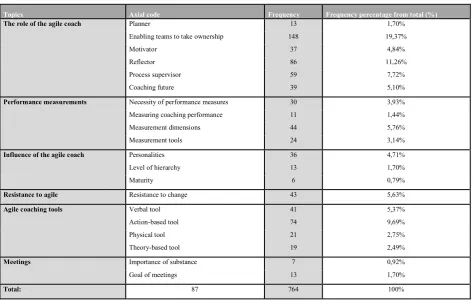
In Table 2, a summarised coding scheme can be found which presents the topics, axial codes and how often these codes are used. The final codes and quotes linked to these codes can all be found in appendix A. The frequencies allow for a more quantitative interpretation and analysis of the qualitative data. This extra method can offer more insight into the data and gives the results more nuance. The information from the respondents, which can be found in Appendix B, is also used in the analysis. Construct validity was used to identify proper framework measures. Strategies used for validity are triangulation, rich, thick description and clarify bias. Reliability was used because the project structure and data collection process are documented for future replication.
4.
RESULTS
4.1
The goal of the agile coach: Enabling
teams to take ownership
4.1.1
The development of agile teams
During the research, in the data collection and analysis period, an interesting feature came forward. Across all coaches, one common goal was established for them. Regardless of the type of organisation, the experience the coach has or the maturity of the agile organisation. The coaches ultimately want to achieve
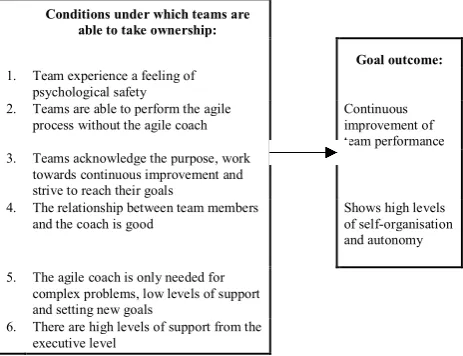
one thing, which is teams to be able to take ownership (Quote 1, AC2*). This is conditioned by certain factors and is summarised in Figure 2.
*AC = Agile coach
The coaches enable that by starting with selecting the right practices, or agile adoption method. Whether this is Scrum, Kanban, or XP, the importance is that it fits with the organisational needs (Quote 2, AC4). Then, the coach will take on the tasks of training the teams to get familiar with the agile process and tools. By providing teams with this knowledge, the agile coaches allow teams to continually keep working on their competencies. During that period, in which teams are learning, it is important that the coach takes on another role. Here, the facilitator role is introduced. the facilitator role is something unique. The agile coach will take on this role because the teams do not have the time or desirability to facilitate most of their needs during the process (Quote 3, AC4). The most important tasks the facilitator takes on are planning sessions, providing teams with the tools necessary, i.e. a task board, and thus providing the stepping stone for the team to build further upon in taking the ownership. During the meetings an interesting approach from the coaches can be used to increase the level of autonomy by forcing team members to organise and coordinate the process themselves. Here, the agile coach makes the deliberate choice to be absent during a meeting. The team members will have to rely on their own strengths, observe their own behaviour and interfere when needed (Quote 4, AC1). Being able to reflect upon oneself is a strong trait in this context.
The success of the coach in enabling the ownership in teams relies on the ability of the coach to create an atmosphere in which a psychological feeling of safety is evident during meetings and within the team or organisation. This is indirectly reliant on the personalities of the coach and the team. If the personality of the coach gets in the way of the team’s goals, for example when the
Topics Axial code Frequency Frequency percentage from total (%)
The role of the agile coach Planner 13 1,70%
Enabling teams to take ownership 148 19,37%
Motivator 37 4,84%
Reflector 86 11,26%
Process supervisor 59 7,72%
Coaching future 39 5,10%
Performance measurements Necessity of performance measures 30 3,93%
Measuring coaching performance 11 1,44%
Measurement dimensions 44 5,76%
Measurement tools 24 3,14%
Influence of the agile coach Personalities 36 4,71%
Level of hierarchy 13 1,70%
Maturity 6 0,79%
Resistance to agile Resistance to change 43 5,63%
Agile coaching tools Verbal tool 41 5,37%
Action-based tool 74 9,69%
Physical tool 21 2,75%
Theory-based tool 19 2,49%
Meetings Importance of substance 7 0,92%
Goal of meetings 13 1,70%
[image:8.595.62.536.91.394.2]Total: 87 764 100%
relationship between the agile coach and the team is not good. There would be a lot of resistance, no motivation and less autonomy in the teams (Quote 5, AC2). The lack of compatibility will block the development of a feeling of safety and in that environment the agile teams will not be able to be productive or efficient (Quote 6, AC4).
Conditions under which teams are able to take ownership:
Goal outcome: 1. Team experience a feeling of
psychological safety
2. Teams are able to perform the agile
process without the agile coach Continuous improvement of team performance 3. Teams acknowledge the purpose, work
towards continuous improvement and
strive to reach their goals
4. The relationship between team members
and the coach is good Shows high levels of self-organisation and autonomy
5. The agile coach is only needed for complex problems, low levels of support and setting new goals
[image:9.595.55.287.141.319.2]6. There are high levels of support from the executive level
Figure 2 Condition under which teams are able to take ownership
4.1.2
Resistance to change
An important challenge for the agile coaches, which they will face continually during the agile transition, is a resistance to change. This resistance exists because people want structure, enjoy their current work, or need clarity for the future etc (Quote 7, AC5). Overcoming the resistance to change is a difficult and time-consuming process, which the agile coach has to manage. It all starts with the choice of the team of becoming agile. If the teams have no decision in becoming agile and it would be forced from the top-down, agile coaches can expect more resistance. On the other hand, executive support is a leading factor in the success of the transition (Quote 8, AC6). This factor is mediated if the teams actually want to become agile. In that case, it means that an intrinsic motivation exists, which is usually fuelled by prior knowledge or positive experiences with agile. If this is not the case and teams are not open for becoming agile, this resistance of change would only become bigger (Quote 9, AC2). The different informal roles a team member would take in the team, i.e. to improve the change process, or if you have a team member that questions everything makes a big difference. The person that always questions the process, and is sceptical, oftentimes show traits of resistance to change. Always questioning the process and participating less than their team members can do much harm to the development process.
From the experience of the coaches that were interviewed, certain tools and techniques are sampled here to make the process of overcoming resistance to change easier. The first technique that can be used is the flexibility of the coach. This means that the coach should be able to coordinate, plan and facilitate around the changing needs of teams that are maturing (Quote 10, AC4). During meetings the coach can use a wide range of tools to manage. Important is that the coaches use the successes of the team and makes these visible to show the team that the agile process can have serious advantages (Quote 11, AC1). Another good technique is repeating or defining the purpose of that team, knowing the goals and sharing that with them, can convince people that it is the right way. Using, what is called colour theory or DISC colours, is a way for coaches to assess the personalities of individuals quickly and easily, this tool has as advantage that
the coach can use it for him or herself as well. Assessing the compatibility of the team and coach is then made a lot easier (Quote 12, AC3). Types of meetings, where the coach can use this technique are the retrospective, review and check-in. Not always does a coach have to do this during a meeting, but the added value of team members being there, sharing the moment and creating the right atmosphere, is something not found outside of the team (quote 13, AC5). If however, the coach is unable to fix the resistance to change and the team cannot develop further a coach can consult other coaches what to do. The combined experience and knowledge, use of an external coach with a different personality might be the key to finally get teams to go along in the process (Quote 14, AC3). To assess whether a team is overcoming the resistance and finally starts developing, the coach can use theory-based tools to assess the maturity level and find accommodating steps in the process to help structure the transition. Examples of such models used by the coaches are the Tuckman-model, Dreyfus-model, Agile fluency model and Shu-Ha-Ri (Quote 15, AC8).
4.2
Defining the roles of the agile coach
4.2.1
Identifying different roles
During the coding and analysis period, it became clear that coaches are not taking on one role at a time. They switch between them quickly or take on multiple at once. For the coach to effectively support the teams he or she needs to understand which role is relevant for which team and which role best supports certain needs during the transition of the organisation (Quote 16, AC3). The coaches mentioned that a lot of the times this choice was intuitively and it had no structural substantiation. One coach mentioned that this could be improved and that there should be a train of thought for the coach to assess the situation and find the appropriate role (Quote 17, AC1). A way of doing that is by using the Agile Coaching Competency Framework. This is a tool developed by the Agile Coaching Institute and mentioned by agile coaches as a tool for assessing roles and understanding the context of those roles (Quote 18, AC7).
In the process of identifying different roles of an agile coach, four major roles were found. The major roles that have been found were planner, motivator, reflector and process supervisor. The roles all possess different tasks and dimensions, appropriate tools and techniques, influence development differently, and are used in different contexts. All of these factors are coded and can be found in Appendix A, where under axial codes all the roles and types of tools are shown. Under the goal of enabling ownership we have seen the importance of the task of being a trainer and a facilitator. For the definition of roles it was important that these were extensive. The task of training is a process which takes place mostly at the beginning of the transition and is not really a part of any role since training was only a small part, it cannot be considered a major role or part of any. Being a facilitator, on the other hand, is a reoccurring task and remains important. Therefore, this would be part of the planners' role.
4.2.2
Planner: plan, prepare, facilitate and set new
goals
of the support system that allows teams to become agile, thus making time to plan for these teams, and facilitate change is very crucial (Quote 19, AC5). For planning in the beginning stages of the transition it can be useful for a coach to make a roadmap together with the team and use the scrum task board. The roadmap allows the coaches and team to keep track of the progress that is made towards long-term goals. The idea is, however, that the team and organisation stay agile, so firmly sticking to that roadmap is not advised. It stays a necessity for an organisation to have the ability to change that roadmap whenever needed i.e. in the case of a change of needs, or unattainable goals (Quote 20, AC8). Herein, is also reflected that once again there is a need for flexibility, the coach should adopt his or her work around what the team thinks is important. By taking distance from the team the coach is able to observe processes in the teams and organisations (Quote 21, AC6). The information from those observations is very valuable as it provides the coach the knowledge of what to do, and when to do it. When planning or facilitating for a team the coach should consider what is most urgent and express that urgency to the team, as well as the team expressing their urgencies towards the coach (Quote 16, AC3).
Not only the level of maturity makes a difference in the dependency on agile coaches as planners. The degree of hierarchy is as equally important. Managers that are not as supportive or quite resistant easily reason that they are higher in hierarchy and can, therefore, avert from the planning the coach makes. Before the manager will accept to use the planning which the coach makes he or she needs to understand the value of agility and importance of the coach during the transition (Quote 22, AC2). This is where the coach starts to facilitate the change of the organisation effectively. Without support from an executive level, the transition is bound to fail (Quote 23, AC4). By using
KPI’s and other performance measures as the progress meter and
deadlines, the coach can show the managers the importance of good planning and facilitation (Quote 24, AC4). Performance measurements can also be used for clarification of programmes and tasks. A coach uses the meetings for explaining the goals of the planning, preparing the teams for the transition, information sharing to and from the team and dividing the tasks. Especially the division of tasks is an important factor here as the team will use this division for self-organisation. An example of these informal roles was already given by (Hoda et al., 2010).
4.2.3
Motivator: motivate, boost and define the
purpose
Being the motivator seems to be a straightforward role, but for coaches to actually motivate team members can be a difficult task (Quote 25, AC2). As motivator, the coach has a boosting function in which it uses the values and thought of agile to convince people. What makes it difficult is that the people can be resistant to change, and since they are not the experts within the field of agile they are less able to understand these values and view them as an advantage for themselves (Quote 26, AC1). Another task the coach has in motivating people is defining the purpose. This means that the coach will use urgency as a tool to motivate people. Explaining the purpose, in order for the teams to get what they want is an effective way of getting them to move on (Quote 27, AC7).
The motivator role is a step ahead of the planner in the agile transition. Usually, when people have experienced the process for a certain amount of time and they think that they know how to do it. They expect results and a return on their efforts. When these results are not directly visible they will start to show old behaviour again, in this context the team members will start to question the agile process and team development will be discontinued (Quote 28, AC5). What the agile coach can do in
that situation is making successes visible (Quote 11, AC1). The agile coach can use multiple performance measurements such as attitude and behaviour, the happiness level, employee satisfaction research and squad health check. These are all measurements to see whether the coach needs to address the problem of dissatisfaction within the team. Using the progress meter or velocity the agile coach can measure the actual performance of teams in numbers and show them their progress and successes. Depending on the team culture there is more or less requirement for ‘hard’ or ‘soft’ measurements (Quote 29, AC2). Coaches in general mention that both types of measurements are important and that the coach cannot do without one or the other (Quote 30, AC7). Providing and confronting the team members with these numbers can bring another incentive in motivating the team. For teams on the executive level, motivating is extra important. The support needed from the managers in order to succeed in the transition means that the coach needs to motivate these managers and that these managers need to motivate the teams on their behalf (Quote 22, AC2).
4.2.4
Reflector: advice, discuss, provide feedback
and holding up a mirror
The most frequently coded role agile coaches report taking on is being a reflector as seen in Table 2. Generally, the coach assesses the teams on the basis of his or her image or opinion on the situation (Quote 31, AC4). The most important tasks from the reflector are giving feedback, holding up a mirror, having discussions and being an advisor. By creating distance with the team the coach is able to assess the team on all relevant dimensions (Quote 32, AC4). The outcome is that the coach can provide feedback. The goal of reflecting in such a manner is that teams are able to learn from it. They will learn to reflect themselves, assess their own performance, and objectively view their own behaviour to develop themselves (Quote 33, AC3).
For the coach to interact with the team members in such a way, he or she can deploy a couple of tools. Especially during meetings, giving feedback and holding up a mirror is evident. All meetings from teams, where coaches are present can be a crucial moment to reflect (Quote 34, AC8). The coach will be able interfere during the process (in a meeting) to provide feedback and confront the people. The initial assessment of the coach that initiates the interference is based on the opinion of the coach, however, with the goal of the coach in mind, he or she will usually not provide this opinion and instead ask the team if they are noticing something. This way the coach gives the ownership back to the team (Quote 35, AC5). By making such quick comments the coach hopes to not disturb the process too much since that can harm development as well (Quote 36, AC6). However, opinions on whether or not to interfere differ between coaches. The relationship between the coach and team will determine to what degree the teams allow the coach to create interventions. If the relationship is not so good, the team can get annoyed quickly and not see the purpose (Quote 37, AC2). Standardizing the performance measurement to assess teams can be useful in this situation as it will allow for general, structural feedback. However, coaches should proceed with caution as the teams and projects are usually unique and a standardized measurement tool, can be misleading.
conversations on a regular basis to assess his performance. This means that he spoke with a manager or client to hear what they have to say about his performance and behaviour (Quote 39, AC8). As assessed before the performance of a coach can be tricky to measure, reflecting on the coaching behaviour can provide useful insight in which way the coach can improve his or her performance.
4.2.5
Process supervisor: observe, coordinate, and
supervise
The final role a coach can take on is that of the process supervisor, essentially this role becomes especially relevant after the teams have taken ownership (Quote 40, AC4). However, during the agile transition coaches show levels of process supervising already (Quote 41, AC3). The coach as supervisor takes on the tasks of coordinating, observing, and supervising where the efficiency of the process is the most important value. A coach that supervises is monitoring, observing and coordinating by taking distance from the team. As mentioned before, the role changes when the team take ownership. First, when teams are still learning, the coach will use the role as supervisor to guard process development by utilizing the other roles and in doing so facilitate the teams to grow. After the teams take ownership, the coach will use the role for finding new challenges and steadily keep improving the process, being wary of the team falling back in old behaviour (Quote 42, AC7).
The supervisor takes notice of the importance of substance during the meetings and coaches to say that they find that the process is as equally important as this substance. The substance, however, is not as important to the coach (Quote 43, AC7). Coaches will often be absent in this role to allow team members to become autonomous. By using a check-in in one of the meetings, the coach will still be able to stay up-to-date on relevant issues and developments (Quote 44, AC7). The measures a coach would use at this point are reliant on team agreements. The type of team and the ownership only underline that the coach should understand what is important for the team (Quote 16, AC3). To know what issues may arise or development the teams are going through the coach can use multiple tools. Examples of models that coaches use to assess team development and maturity are Tuckman, Kotters 8-steps of change, Shu-Ha-Ri, and Dreyfus. All of these were mentioned by the coaches as tools they would use. One coach mentioned in particular that in this context the ultimate self-organisation is captured in Holacracy.
All of the quotes used in the results section are sampled and presented in table 3 which can be found in Appendix D.
5.
DISCUSSION
5.1.1
The future of agile coaches
In the results, a descriptive analysis has been set out to create an overview of the roles of agile coaches and the development of agile teams. From the analysis four roles were identified which are planner, motivator, reflector and process supervisor. In the analysis also came forward that the meeting setting in an agile organisation provides a unique chance for the coach to measure performance, observe the team, provide feedback, supervise the process and ultimately enable the teams to take ownership.
For the future of the coaching role in an organisation that has become more mature, the supervisor role seems to be very important. As explained, this is needed mostly after teams have
taken the ownership. Coaches that have been interviewed say that the role of the coach might become obsolete in the future because teams are able to handle the process themselves. In this phase, the teams should be sufficiently equipped with the knowledge, competency and tools to take the ownership. What rests for the coach is to make sure that it stays this way. Another reason could be that organisations choose to train a manager or team member to take on the role of process supervisor for supporting the teams. The coaching role as it was viewed traditionally would end at that point. On the other hand, coaches also say that organisations are always continually going to develop. If that is the case, and new teams need to be equipped with ownership, the agile coaching role can still exist and play a valuable role.
5.1.2
Differences between literature and study
In the theory, we noticed a gap in identifying the importance and value of a coach during the agile transition and providing a framework or overview of naming and categorizing roles of agile coaches according to the tasks they include. The coaches that were interviewed provided a very large and variable set of tasks from which these roles were developed. Other studies that will name the roles and include the tasks, can have different names for the same role or have categorized the roles differently. Minor differences exist in task description, because of the sampling of experts that were part of the research. Different people use different types of phrasing for explaining themselves. From the research aspect, the choice of codes and interpretation of the researcher can cause these differences as well. The existing literature did include descriptions of what kind of coaching tasks are important during certain stages of the agile transition. In this research the maturity of teams and the transition was a factor in developing the roles.
Limitations of this research
Using theory from outside the agile context, such as team coaching, transition coaching and self-organising teams can offer valuable insights. However, researchers have to be cautious with using this, because it may not be part of the agile context. In this study, we started with researching and analysing agile literature alone. Quickly, it was discovered that existing agile literature draws from other sources such as self-organisation and change management as well. After that, more literature sources, from the self-organisation, leadership, and team coaching context were used to extend the theoretical background in the agile context.
Drawbacks of the data collection method used in this study are coming from the interview setting and the interviewee. The gender, expertise and background of the interviewee can influence the answers they provide. Secondly, the answers can be different when the interviewees adapt their responses to what they find is useful in a certain setting. Clearly defining the research goal, topics and purpose of the interview were used to prevent this from happening. Thirdly, the type of organisation and agile methodology used in the organisation provided different answers. Differences in answers were therefore mentioned in the results.