Munich Personal RePEc Archive
Loss Aversion, Expectations and
Anchoring in the BDM Mechanism
Vassilopoulos, Achilleas and Drichoutis, Andreas C. and
Nayga, Rodolfo
Agricultural University of Athens, University of Arkansas
22 March 2018
Loss Aversion, Expectations and Anchoring in the BDM
Mechanism
∗
Achilleas Vassilopoulos
†1,2, Andreas C. Drichoutis
‡2, and Rodolfo M. Nayga,
Jr.
§31
ICRE8: International Centre for Research on the Environment and the
Economy
2
Agricultural University of Athens
3University of Arkansas
Abstract: We present the results of an economic laboratory experiment that tests be-havioral biases that have been associated with the BDM mechanism. By manipulating the highest random competing bid, the maximum possible loss, the distribution of prices and the elicitation format, we attempt to disentangle the effects of reference-dependence, expec-tations as well as price and loss anchoring on subjects’ bids. The results show that bids are affected by expectations and anchoring on the highest price but not by anchoring on the max-imum possible loss. In addition, results are supportive of the no-loss-in-buying hypothesis of Novemsky and Kahneman (2005).
Keywords: Becker-DeGroot-Marschak (BDM) mechanism; expectations; anchoring; valuation; experiment.
JEL Classification Numbers: C91, D44.
∗We would like to thank Angelos Lagoudakis and Manos Petrakis for helpful research assistance. Approval
for the research was provided by the Board of Ethics and Deontology of the Department of Agricultural Economics & Rural Development at the Agricultural University of Athens (2/2015).
†Corresponding author: Senior Researcher, International Centre for Research on the Environment and the
Economy, Artemidos 6 & Epidavrou, 15125, Maroussi, Athens, Greece and Department of Agricultural Eco-nomics & Rural Development, Agricultural University of Athens, tel:+30-210-6875346, e-mail: [email protected],
‡Assistant professor, Department of Agricultural Economics & Rural Development, Agricultural
Univer-sity of Athens, Iera Odos 75, 11855, Greece, tel: +30-210-5294781, e-mail: [email protected].
§Distinguished Professor and Tyson Endowed Chair, Department of Agricultural Economics &
Agribusi-ness, University of Arkansas, Fayetteville, AR 72701, USA, and NBER, tel:+1-4795752299 e-mail:
1
Introduction
The Becker-DeGroot-Marschak (BDM) mechanism (Becker et al., 1964) is a well known incentive-compatible mechanism, frequently used in experimental economics and in non-market valuation. It is a very important tool for measuring subjects’ valuations both inside and outside the lab and thus widely used in the marketing field for the valuation of novel products and product attributes. In experimental economics, the BDM mechanism is usually employed for the valuation of lotteries or tokens, to examine agents’ risk/time preferences or departures from standard economic models of individual behavior. As a testament to its popularity, Becker et al. (1964) count more than 2,100 citations in Google Scholar as of March 2018. From a theoretical point of view, the mechanism is strategically equivalent to a Vickrey auction against an unknown bidder (Vickrey, 1961) and thus it is often referred to as an additional auction format.
The BDM mechanism is simple and presumed to induce truth-telling since based on Expected Utility Theory (EUT), it is in the best interest of bidders to report their true value for the object, irrespective of other factors such as their risk preferences. In addition, if preferences do not violate the von Neumann-Morgenstern axioms and in particular the dominance axiom, BDM bids should equal one’s true value for the goods, independent of the underlying price distribution from which the binding price is randomly drawn. This is also true even with loss-averse agents in the case that decision weights are linearized to be probabilities.1
However, Karni and Safra (1987) showed that the BDM is not incentive-compatible in valuing lotteries, even for rational agents (i.e., those that do not violate the weak-ordering axiom). They attributed the phenomenon of preference reversals that is of-ten observed in implied choices between lotteries using the BDM, to the violation of the independence axiom. Horowitz(2006) also pointed out that the BDM may not be incentive-compatible even when the objects involve no uncertainty, as in the case of regular products. Other studies (discussed in Section2) have also questioned the usefulness of the mechanism in the presence of behavioral biases, such as expectations-based loss aversion and anchoring. Some researchers doubt that the BDM is appropriate to study these biases, as participants’ bids are not even error-prone signals of true preferences (Cason and Plott, 2014). Addi-tional issues have also been raised related to the effect of wording used in the experimental instructions and subjects’ anonymity (Plott and Zeiler,2004, 2007).
We revisit these behavioral issues associated with the BDM mechanism discussed above. Unlike previous attempts to manipulate expectations through exogenous lotteries (Marzilli
Er-1
icson and Fuster, 2011; Smith, 2012), we use procedures that mimic those of the typical mechanism. Our procedures avoid signaling the “objective” value of the auctioned good or causing misconceptions, especially given the added complexity that exogenous lotteries could introduce to the mechanism.2
In addition, we control for price and loss anchoring effects that may be present in previous studies (e.g., Banerji and Gupta, 2014; Bohm et al., 1997) and are related to the highest price and the maximum possible loss.3
In the BDM format that we employ in this study, the virtual urn used for determining the random binding price has numbered outcomes instead of prices outcomes, with each number mapping onto a price from a predetermined range. This mapping is used as an experimental design variable where for example, the numbers {1, 2, . . . , 120}correspond to prices {e0.1, e0.2, . . . , e12.0} in one treatment and to the prices {e0.1, e0.2, . . . , e6.0} in another. We posit that the use of numbers facilitates decoupling of expectations about getting the auctioned good — which in our design are given by the relative frequencies of the numbered outcomes — with price anchors that are affected by the highest and lowest possible price outcomes. By doing so, we implicitly assume that anchoring of bids on the numbered outcomes is not likely to happen. This is mainly for two reasons: 1) numbers are not expressed on the money scale and are therefore irrelevant as bidding anchors 2) the numbers are implausibly large in relation to a subject’s potential bid (in our experiment numbers in the virtual urn run from 1 to 60 or from 1 to 120). Previous research supports these assumptions, showing that anchors of an item’s value in years of life expectancy did not affect judgments of its dollar value and vice-versa (Chapman and Johnson,1994) or that passive or active number searches or implausible anchors do not affect bids in incentivized willingness-to-pay (WTP) elicitation experiments (Sugden et al., 2013).
Finally, another modification of the mechanism we use in our design is that we do not have a one-to-one correspondence between actual payments (losses) and prices in all treatments, unlike the usual BDM where the maximum amount a subject may pay is her bid. Thus, as explained momentarily, we separate price anchors from loss anchors (which are driven by the highest and lowest possible loss, respectively) that are expected to have opposite effects.
In the next section, we review the biases relevant to the BDM mechanism that we are examining in the current study. We then present our experimental design in Section 3, then
2
For example, the high or low probability of winning the prize to be auctioned later, may be perceived as a signal of good value e.g., a higher probability might indicate a less valuable prize. In addition, in cases where both the draw regarding whether subjects will be able to trade and the random price determination are done simultaneously, the participants might face difficulties to assign the correct probability in each state.
3
the results and conclude in the last section.
2
Behavioral biases and the BDM mechanism
In this section, we discuss the behavioral biases that have been related to the BDM mechanism. We also cite the relevant literature that has tried to explore these biases and discuss how our experiment differs from these past studies.
2.1
Expectations
The idea of expectations-based loss aversion was introduced inK˝oszegi and Rabin(2006) who presented a model that is similar to prospect theory (Kahneman and Tversky, 1979; Tversky and Kahneman, 1991) but where the reference points are formed by expectations (instead of the status-quo). Smith(2008,2012) was the first to test this model in the context of the BDM mechanism. In his experiments, just before the valuation task, subjects took part in a lottery with a university mug as the prize. The high (low) probability group was informed that they would be given the opportunity to get the mug with a probability of 70% (10%). The subjects who were given the opportunity to purchase the mug were allowed to participate in a BDM procedure by stating their maximum WTP for the mug. Results showed that although assignment to the high probability of winning the prize produced a small increase in valuation, this effect was not statistically significant.
Marzilli Ericson and Fuster (2011) elicited willingness-to-accept (WTA) values for a uni-versity mug using a similar design to Smith (2008, 2012). In their high (low) probability treatment, there was a 80% (10%) chance that subjects would get a mug for free (and then participate in a BDM experiment to sell it) and a 10% (80%) chance that they would get nothing (and thus not take part in the subsequent BDM procedure). Besides the elicitation format (WTP vs. WTA), the main difference with the experiments of Smith (2008, 2012) was that subjects submitted their bid before they knew the realized state of nature, namely before they reached the point where they knew whether their bids would actually matter (i.e whether they will have the chance to participate in the BDM). Marzilli Ericson and Fuster (2011) found a 20%-30% higher valuation in the high probability treatment which they attributed to the induced higher expectation of being able to leave the experiment with the mug as compared to the low expectation treatment.
difference in valuations, a result which is in accordance with expectation-based reference points. Bohm et al. (1997) on the other hand, manipulated the uniform price support in a BDM experiment and found a reverse effect of expectations on WTA bids for petrol coupons. Other relevant studies includeMazar et al.(2013) who tested the sensitivity of valuations to the underlying distribution in the BDM using travel mugs and Amazon vouchers; Urbancic (2011) using a within-subjects design and a gift certificate product redeemable for cookies; and Tymula et al. (2016) who used products with higher market values such as a backpack, an iPod Shuffle, and a pair of noise-canceling headphones. Although all these studies did not explicitly refer to expectation-based preferences (with the exception of Tymula et al., 2016) but rather examined the distributional dependence of the valuations, a closer look at their results suggest patterns that are opposite to the ones expected under the K˝oszegi and Rabin (2006) model of behavior.
2.2
Price anchoring
In the BDM mechanism, subjects face a number of anchors and thus anchoring could be a relevant concept in such experiments. For example, the lowest and highest competing price for the auctioned good could anchor subjects’ valuations based on the ideas we discussed in the previous paragraph. The same could be said for prices given in examples during the training stage. Other anchors may be (beliefs of) market prices of similar goods, or feedback from previous rounds (in the case of experiments with multiple rounds). In summary, the discussion above suggests that anchoring may have an effect on subjects’ bids through either or both of these: a) the comparative mechanism that involves a comparison of bids with an anchor first and then forming an estimate and b) basic anchoring, in the sense ofWilson et al. (1996) who showed that mere display of values may anchor judgments, even without any comparison. Although basic anchoring has been found not to be robust in other settings (e.g., Brewer and Chapman, 2002), to our knowledge this has not been tested in the framework of non-market valuation. An exception is Sugden et al. (2013) who rejected basic anchoring with the use of numerical anchor; the difference between Sugden et al.(2013) and our study being that Sugden et al. (2013) examined anchors other than the prices used in the BDM procedure.
2.3
Loss anchoring
Besides price anchors, the amount of potential losses (what we call loss anchors in this paper) could also affect subjects’ bidding behavior in an experiment. We parallel the concept of loss anchoring with that of salience i.e., the phenomenon that when one’s attention is dif-ferentially directed to one portion of the environment rather than to others, the information contained in that portion will receive disproportional weighting in subsequent judgments (Taylor and Thompson, 1982). Bordalo et al. (2012, 2013) introduced models of salience in binary choices between prospects and goods while K˝oszegi and Szeidl (2013) developed models of salience for inter-temporal choices. These models revolve around the idea that decision-makers maximize weighted (expected) utility functions, where states or attributes (utility dimensions) with the largest difference in outcomes are more salient and get extra weight.
any observed effect would always be confounded by salience distortions. Our loss anchoring hypothesis on the other hand, is built on the alternative hypothesis that utility differences are realized before bids are formed (the editing phase according to Kahneman and Tver-sky, 1979) and as such, attention drawn during this stage does not adjust (or at least only partially adjusts) later when bids are formed. Based on the full knowledge on the utility differences associated with the relevant utility dimensions, the greater the differences, the heavier the utility dimensions are weighted.
So how can loss anchoring be related to bidding behavior in the BDM mechanism? In non-market valuation settings, when entering a BDM experiment, subjects realize that they will eventually face a choice task involving trade-offs between cash and the auctioned good. They also realize the utility differences within each of the utility dimensions that may be generated from the outcomes of the experiment.4
In particular, for a subject facing a BDM task, it quickly becomes clear how much of the good they can get from the procedure (that is, one item for single-unit valuation tasks) as well as the ex-ante (i.e., before they start thinking about the problem and forming their bids) maximum amount of money they may end up giving away at the end of the task. Although the loss anchoring mechanism seems to be similar to that of price anchoring, in reality they are distinct from each other since loss anchoring does not embody values that are out of the choice set of decision makers but only feasible ones; i.e., those that will possibly enter the subjects’ utility functions during the course of a choice situation. In addition, loss anchoring is expected to exhibit an opposite pattern from that of price anchors since anchors generating the most vivid differences (either at the high- or at the low-end) can lead to lower valuations due to heavier weighting of the part of utility that is associated with money.
3
Experimental Design and Procedures
An invitation was sent by email to 585 subjects from the undergraduate population of the Agricultural University of Athens in Greece asking them to participate in a computerized experiment at the Laboratory of Behavioral and Experimental Economics Science (LaBEES-Athens). 348 subjects out of 585 signed up for the experiment (about 59.5% acceptance rate) and 307 (88.9% show-up rate) showed up and participated. Seven subjects were excluded from the analysis since they were not undergraduate students (although they had registered as such in the system) so that the final useful sample consisted of 300 subjects. Subjects were recruited using ORSEE (Greiner, 2015) and participated in 24 sessions of 8 to 16 subjects
4
each. All sessions started from 10:00 am and concluded by 3:30 pm, counterbalancing the order of treatments. Although subjects participated in group sessions, there was no interac-tion at any point between subjects and group sessions only served as a means to economize on resources. All sessions lasted approximately an hour.
Upon arrival, subjects were given a consent form to sign and were randomly seated to one of the PC private booths. Subjects were specifically instructed to raise their hand and ask any questions in private and that the experimenter would then share his answer with the group. Subjects received a show-up fee ofe5 and a fee ofe10 for completing the experiment which lasted about an hour. During the experiment, subjects were given the chance to bid to obtain a mug and the binding bid was subtracted from their fees so that average total payouts (on top to the show-up fee) wase9.37 (S.D.=1.45, min=2.9, max=10).
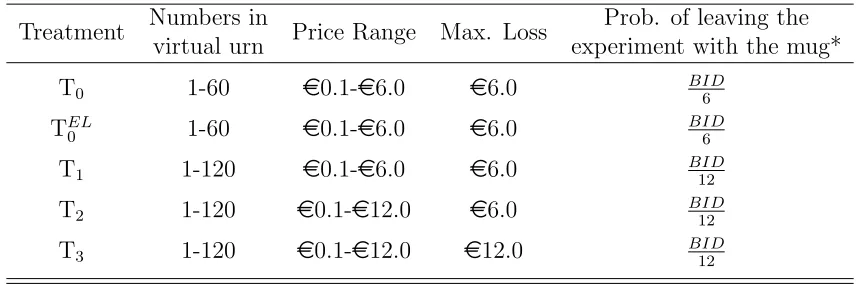
In order to tease out the behavioral biases related to the BDM mechanism, our experi-mental design consisted of five between-subjects treatments using variants of the mechanism. The treatments were designed based on the idea that since a typical BDM involves randomly drawing a price from a uniform distribution, the maximum and minimum of the support de-termine expectations (i.e., the probability of getting the product, conditional on one’s bid). At the same time both of these amounts, can also serve as price and loss anchors as described in Section 2. Table 2summarizes the experimental design that is explained in detail below. The baseline treatment (T0) is used as a benchmark and is a typical one-shot WTP elicita-tion for a mug with a university logo (depicted in FigureA1in the Electronic Supplementary Material). The mug is not available for sale in the market and was custom-made for the purpose of the experiment. We should note that memorabilia with university logos are not typically sold on university stores in Greek universities and certainly not in the university where the experiment took place. Therefore, the mug with university insignia was really unique. Our intention was to elicit valuations for unique products without no close field substitutes so that subjects would not have formed expectations about the market price of the products. Subjects would also not be able to guess the price of the mug since other similar products were not available in the market.5
We used a single experimenter for all sessions (one of the authors). The experiment was fully computerized using the z-Tree software (Fischbacher, 2007). The experimenter read aloud experimental instructions.6
Subjects also had a hard copy of the instructions available in their private booth which they were free to check at any time during the session. They then received extensive training by participating in 10 repetitions of a BDM mechanism
5
Mugs without university logos are not uncommon in the local market, but their price range is very wide thus market price inferencing was a very difficult task.
6
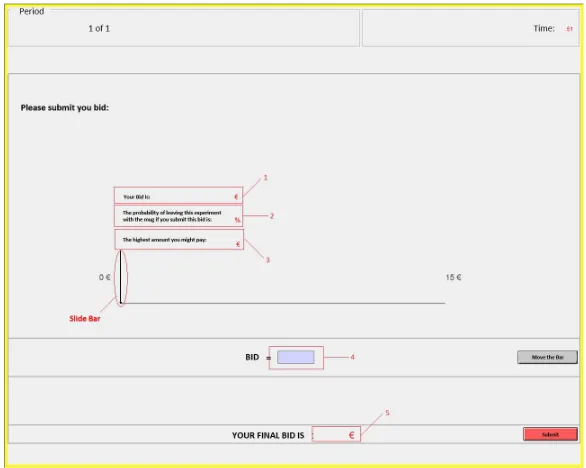
with a non-focal good (a USB flash drive) in order to give them ample opportunity to fully understand the procedure before the actual (single-shot) BDM that would follow where any decision would be binding. Although according to Sugden et al. (2013), the randomly determined prices of dissimilar products are not expected to act as anchors, we used various low, medium and high prices in the examples given in the experimental instructions to avoid such an effect (see Examples 1, 2 and 3 in the Experimental Instructions). In addition, these possible anchors were kept constant across all treatments. A set of seven True/False quiz questions regarding the BDM followed and correct answers were explained aloud. A major difference of our task to other BDM procedures was that in addition to letting subjects freely type their bid, we used an interface where subjects had to scroll a slide bar between 0 and 15 Euros (see figure1 below).7
Figure 1: Bidding screen
Upon sliding the bar horizontally, at any point between or at the two sides, subjects were given a number of relevant information: 1) the bid amount corresponding to the current point where the bar was released 2) the probability of leaving the session with the mug (as part of the instructions, the experimenter explained how the objective probabilities were calculated in detail; see Experimental Instructions) and 3) the highest price they could pay for the mug if they were to submit this bid. We presented this information to subjects having in mind Ratan (2015) who showed that such information alone is unlikely to affect subjects’ bids. Subjects also had the opportunity to move the bar by typing their bid, if they
7
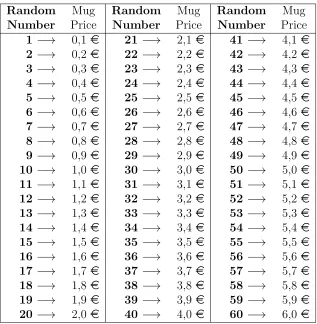
wished to do so. Most importantly, as mentioned before, in order to facilitate decoupling of expectations about the outcome with price anchors, the binding price was determined by a random draw of a set of 60 numbers (1-60) and not prices; each of the sixty numbers corresponded to a price in the following fashion: {1, 2, . . . , 59, 60} → {e0.1, e0.2, . . . , 5.9, e6.0} (see TableA1in the Electronic Supplementary Material). We included a similar table
in the experimental instructions mapping numbers to prices, which subjects could refer to at any point during the experiment.
The first two treatments (T1 and T0EL)were designed to test whether subjects’ behaviors can be explained by standard preferences or whether subjects exhibit signs of loss aversion, and if loss aversion is at play, whether the status-quo or expectations are more likely to act as the respective reference points.
TheT1 treatment was designed to manipulate expectations in a way that would not affect price and loss anchors. The only difference betweenT1and the baseline treatmentT0was that 60 more numbers were added to the virtual urn in T1 (thus, the random draw was between numbers 1-120). The sixty extra number corresponded to a price of 6 euros (see TableA2in the Electronic Supplementary Material), so the new number to price correspondence followed the following fashion: {1, 2, . . . , 59, 60, 61 . . . 119, 120} → {e0.1, e0.2, . . . , e5.9, e6.0, e6.0 . . . , e6.0, e6.0 }. Thus, adding the numbers had no effect the range of possible prices
of the mug (the price of the mug was still expected to be somewhere between e0.1 ande6, as inT0) but it did affect the probability of price realizations: with 50% probability the price would be between e0.1 and e6 and with 50% probability it would be e6. Notice that the loss anchor should not be affected by treatment T1 since the maximum loss that a subject could incur during the experiment is stille6. Similarly, the price anchor is also not affected, since the minimum and maximum price a subject could purchase the mug is e0.1 and e6, respectively. However, as long as expectations are not expected to double one’s equilibrium bid given her true value (but rather to slightly decrease it, see Banerji and Gupta, 2014), treatmentT1 decreases the probability of leaving the experiment with the mug for any value with an interior solution in T0 (i.e., between e0 and e6). Heidhues and K˝oszegi (2014) show how this weakened ‘attachment effect’ is expected to drive bids into lower levels under the K˝oszegi and Rabin (2006) framework. Thus, expectations-based preferences would be supported by a negative treatment effect in T1 when compared to T0. On the other hand, the absence of a treatment effect would lead to rejection of this preference structure but would fail to distinguish between rational agents in the neoclassical sense and agents with reference-dependent preferences whose reference points are formed by the status-quo and not their expectations.
reference-dependent preferences, we designed the Equivalent Loss treatment (TEL
0 ). The T0EL treat-ment was again identical to the baseline treattreat-ment T0, with the exception that instead of subjects bidding to acquire a mug, they bid to avoid returning the piece of mug they have been endowed with at the beginning of the session. If reference points are formed by current status (i.e., having the mug) and subjects are loss averse, leaving the session without the mug would be considered a loss. Thus, the WTP and EL measures are expected to differ (see alsoBateman et al.,1997). On the other hand, since expected utility for each bid is not affected by framing under EUT, the WTP and EL measures of value should be equal under this framework. This would be the case as well, if bidders are loss-averse but expectations rather than the status-quo act as reference points. This is because the probability of leaving the experiment with the mug given a subject’s bid is the same for both the TEL
0 and the T0 treatments, so expectations are not affected.
In essence, theTEL
0 treatment will reveal whether a null effect inT1 is due to expectations acting as reference points or due to reference-dependent preferences in general. In particular, if we do not detect any treatment effect in T1 and we also find a null effect in T0EL, the neoclassical preference structure cannot be rejected; on the contrary, if the treatment effect in TEL
0 is not null while the T1 treatment effect is null, then the concept of reference-dependence would not be rejected, but expectations cannot be considered a valid reference point. In case that a non-null effect is detected in T1, then T0EL becomes a test of the no-loss-in-buying (NLIB) hypothesis of Novemsky and Kahneman (2005). To understand why this is the case, remember that expectations (and, thus, reference points) are the same under both valuation formats (i.e., WTP and EL). However, if the NLIB hypothesis is true, then in the probability space that trading is expected, money given to buy the mug would not be treated as a loss in the WTP treatment. Thus, the respective states are not weighted by the loss aversion coefficient in the expected utility of the decision-makers as the feeling of loss is outweighed by that of a gain (i.e. getting the mug). Under the EL framing however, subjects do perceive money given in the same states as losses, since money are given to avoid losing the product and not to buy it (buying the product would feel like a gain). Table 1 summarizes the hypotheses that would be supported given null or non-null treatment effects for the T1 and T0EL treatments.
Table 1: Treatment effects for the T1 and T0EL treatments (compared to T0) and supported hypothesis
T1
Treatment Effect
TEL
0
Treatment Effect Loss Aversion
NLIB hypothesis
Reference Point Status-Quo Expectations
Null Non-null ✔ ? ✔ ✘
Non-null Null ✔ ✘ ✘ ✔
Null Null ✘ ✘ ✘ ✘
Non-null Non-null ✘ ✔ ✘ ✔
loss anchors between T2 and T1 at the same levels, subjects were explicitly informed in the experimental instructions stage that even though drawn prices could be up to e12, the maximum they could end up paying at the end of the session was e6. So, if the randomly drawn number corresponded to a price of more than e6 and their bid was higher than that, then they would get the mug and paye6; while if the randomly drawn number corresponded to a price less than e6 and their bid was higher than that, then they would get the mug and pay the price corresponding to the randomly drawn number. It is important to note here that we made sure subjects realized this was part of the pricing mechanism and not attached to any discount or any other promotion plan. To do so, we have excluded such words from the experimenter’s vocabulary and explicitly pointed to the mechanism during the examples.8
Based on the above, a positive treatment effect of T2 compared toT1 would indicate an anchoring bias of subjects’ bids on the possible prices of the mug.
In the last treatment (T3) we used the same virtual urn and price correspondence as in treatment T2 but this time the loss censoring was absent. That is, treatment T3 is a typical BDM mechanism where prices are randomly drawn from the price interval e0.1 -e12.0. Compared to treatment T2, price anchors and expected outcomes for bids in the
{e0.1, . . .e6.0} interval remain the same but loss anchors are increased since now subjects are faced with higher possible losses as the mechanism allows payments of up to e12.
The total number of subjects that participated in each treatment was 59 for the base-line treatment T0, and 58, 66, 58 and 59 for treatments T1, T0EL, T2 and T3, respectively. Anonymity and privacy were emphasized in the experimental instructions stage and all sub-jects were reassured of these throughout the experiment. In particular, we closely followed the procedures described inPlott and Zeiler(2004). After signing the consent form, subjects drew a numbered card privately and were then seated to a private booth. In each booth, there was a set of sealed experimental instructions. Subjects were explicitly instructed not to unseal the instructions until they were asked to do so. With the help of a lab assistant,
8
A test on the proportion of bids that are higher than e6 between treatment T2 and treatment T3
(discussed momentarily), where the pricing truncation rule of treatmentT2 was absent, does not reject the
they input their ID number to a field shown in their computer screen; this number was their ID for the rest of the session.
[image:14.612.91.519.412.556.2]At the end of each session and while subjects completed the accompanying questionnaire, the experimenter calculated the amount of money the subjects should receive (i.e., subtract-ing from their fees any payment for the mug) and checked whether they were entitled to get a mug or not. For each subject ID, the experimenter sealed the corresponding amount into an envelop that had the specific number printed on the outside and also compiled a new list with the set of IDs that should receive a mug. Both the envelop and the list were given to another lab assistant that passed them on to a third lab assistant located in another building in the campus, just a few meters away from the lab location. The third lab assistant who received the envelop and the list was instructed to give the envelops and mugs based on the card numbers subjects were holding and was completely unaware of any other details regard-ing the experiment. Therefore, after the session was over, subjects simply left the computer lab holding their ID cards and then walked to the other building to exchange it with the corresponding envelop with their earnings and possibly (depending on the outcome of the experiment) a mug. In the instructions, we also avoided using strong words such as ‘buy’, ‘it’s yours’, ‘you own’ etc. that could potentially affect the behavior of the participants.
Table 2: Designs aspects per Treatment
Treatment Numbers in
virtual urn Price Range Max. Loss
Prob. of leaving the experiment with the mug*
T0 1-60 e0.1-e6.0 e6.0 BID6
TEL
0 1-60 e0.1-e6.0 e6.0
BID 6
T1 1-120 e0.1-e6.0 e6.0 BID12
T2 1-120 e0.1-e12.0 e6.0 BID12
T3 1-120 e0.1-e12.0 e12.0 BID12
* For 0≤BID <6
4
Results
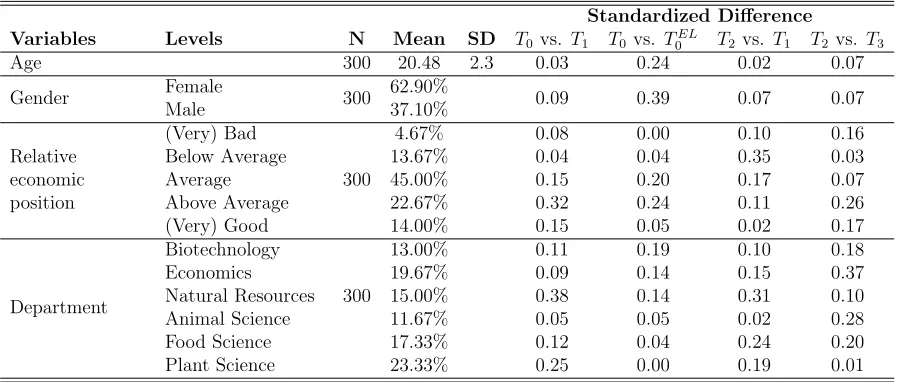
characteristics between treatments and a success of the randomization process. Briz et al. (2017) provide a detailed discussion about the literature that points to the pitfalls of using balance tests (e.g., Deaton and Cartwright, 2017; Ho et al., 2007; Moher et al.,2010; Mutz and Pemantle, 2015). Following Deaton and Cartwright’s (2017) advice, we report instead the standardized difference in means (Imbens and Rubin, 2016; Imbens and Wooldridge, 2009). Table3also reports the standardized differences between the pairs of treatments that are meaningful for the purposes of the experiment for all variables. For continuous vari-ables this difference is calculated as |x¯1−x¯2|/
p
(s2
1+s
2
2)/2 while for the dichotomous ones as |pˆ1 −pˆ2|/
p
[image:15.612.82.533.482.673.2](p1(1−p1) +p2(1−p1))/2 with ¯xj, ˆpj and s2j (j = 1,2) denoting the group means, prevalences and variances, respectively (Austin, 2009). The standardized difference is a scale-free measure andCochran and Rubin’s (1973) rule of thumb establishes a threshold of 0.25, below which the effect size of the difference is expected to be small. As shown in the table, for most of the variables, standardized differences between treatments are very small. There are a few cases for which standardized differences are higher thanCochran and Rubin’s (1973) limit. This might imply that it is necessary to control for the effect of these characteristics on bidding behavior. However, the null of joint insignificance of demographic variables cannot be rejected both by the Wald test using a simultaneous-quantile regression of all deciles of bids with 1000 bootstrap replications (p-value=0.99) as well as by the rank test statistic using the Wilcoxon score (for details, see Gutenbrunner et al., 1993) over the entire range of quantiles (p-value=0.42). As a result, we do not expect treatment effects to be driven by observable differences between the treatment groups.
Table 3: Summary statistics of observable characteristics
Standardized Difference
Variables Levels N Mean SD T0vs. T1 T0 vs. T0EL T2 vs. T1 T2vs. T3
Age 300 20.48 2.3 0.03 0.24 0.02 0.07 Gender Female 300 62.90% 0.09 0.39 0.07 0.07
Male 37.10% Relative economic position (Very) Bad 300
4.67% 0.08 0.00 0.10 0.16 Below Average 13.67% 0.04 0.04 0.35 0.03 Average 45.00% 0.15 0.20 0.17 0.07 Above Average 22.67% 0.32 0.24 0.11 0.26 (Very) Good 14.00% 0.15 0.05 0.02 0.17
Department
Biotechnology
300
13.00% 0.11 0.19 0.10 0.18 Economics 19.67% 0.09 0.14 0.15 0.37 Natural Resources 15.00% 0.38 0.14 0.31 0.10 Animal Science 11.67% 0.05 0.05 0.02 0.28 Food Science 17.33% 0.12 0.04 0.24 0.20 Plant Science 23.33% 0.25 0.00 0.19 0.01
univer-sity offers a 5-year bachelor degree), of average relative income, and split between the six departments of the university in proportion to the size of the population of each department. In order to avoid artificial differences in the analysis of bidding behavior induced by our experimental design (recall that some treatments implemented a price support of {e0.1 . . . , e6.0} while others a support of {e0.1 . . . , e12.0}) and to standardize the analysis across treatments, we censored all bids higher thane6 (15 observations in total or 5% of all observations) to a value of e6 (i.e., these observations were recoded as e6).9
We proceed in this manner because it is the only way to have comparable bids among all treatments since, by design, in treatments T0, T0EL, T1 and T2, bids that are higher than e6 have no quantitative meaning and are only indicative of a valuation that is higher than e6. To understand why, remember that the highest possible price in T0, T1 was e6, so bidding anything above that price yields the same probability of leaving the experiment with the mug (i.e. 100%) and the same expected payment conditional on buying as bidding e6 (i.e., bid/2). ForT2, the expected utility from any bid (b) that is higher thane6 is
1
2(u(m)−3) +
Rb
6(u(m)−6)f(p) dp, with u(m) denoting the utility associated with getting the mug. It is obvious that increasing one’s bid to the highest price maximizes this utility; the same argument can be made for reference-dependent expected utility with status-quo acting as the reference point. For expectations-based reference-dependent expected utility maximizers, the benefit of increasing one’s bid is not only the maximization of the utility part associated with the expected gain from getting the mug at the price of e6, but also minimization of one’s (dis)utility associated with the loss sensation attached to not getting the mug when she expects to do so.
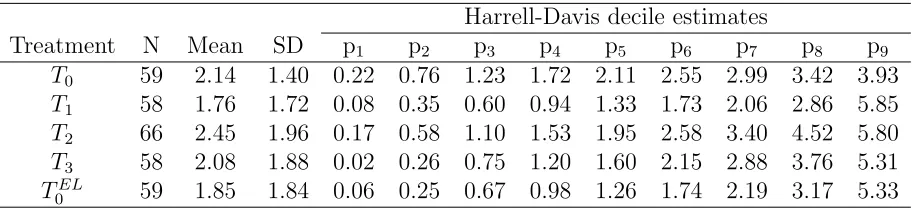
[image:16.612.79.535.553.657.2]Table 4shows descriptive statistics of bids per treatment and Figure 2exhibits box plots of bids. Table 4 also provides estimates of bid deciles by treatment, based on the quantile estimator suggested by Harrell et al. (1982).
Table 4: Descriptives statistics of bids per Treatment
Harrell-Davis decile estimates
Treatment N Mean SD p1 p2 p3 p4 p5 p6 p7 p8 p9
T0 59 2.14 1.40 0.22 0.76 1.23 1.72 2.11 2.55 2.99 3.42 3.93
T1 58 1.76 1.72 0.08 0.35 0.60 0.94 1.33 1.73 2.06 2.86 5.85
T2 66 2.45 1.96 0.17 0.58 1.10 1.53 1.95 2.58 3.40 4.52 5.80
T3 58 2.08 1.88 0.02 0.26 0.75 1.20 1.60 2.15 2.88 3.76 5.31
TEL
0 59 1.85 1.84 0.06 0.25 0.67 0.98 1.26 1.74 2.19 3.17 5.33
Notes: SD stands for standard deviation and p1 to p10 stand for deciles.
At a first glance, everything seems consistent with the behavioral biases presented above.
9
In particular, we observe that in T1, the bids are lower than those in T0 which suggests that lowering expectations of leaving the experiment with the mug given one’s bid induces lower valuations. Also, price anchoring manifests itself in the higher bids observed in T2, relative toT1, while loss anchoring drives T3 bids to lower levels than those in T2.
Figure 2: Box plots of bids per treatment
Table 5 shows the results of various tests for differences between treatments: p-values of Mann-Whitney (Mann and Whitney, 1947) and Mood’s (1954) median tests and decile differences using the Harrell-Davis estimator Harrell et al. (1982) along with the p-values associated with them calculated based on percentile bootstrap (Wilcox et al., 2013). The comparisons are meant to reveal the treatment effects between pairs of treatments for which their difference directly tests the underlying hypotheses discussed in Section3. The first row in Table 5 lists the effect we are testing for and the second column lists the treatments we compare that are relevant in measuring the listed effect.
Table 5: Tests of treatment effects
Test Expectations Loss Aversion Price Anchoring Loss Anchoring Comparison T0 vs. T1 T0 vs. T0EL T2 vs. T1 T2 vs. T3
M-W 0.03 0.05 0.04 0.22
Median 0.01 0.04 0.10 0.47
p1 0.14 (0.33) 0.15 (0.19) 0.09 (0.36) 0.15 (0.14) p2 0.41 (0.17) 0.51 (0.14) 0.23 (0.31) 0.32 (0.30) p3 0.63 (0.05) 0.57 (0.06) 0.50 (0.12) 0.35 (0.35) p4 0.78 (0.04) 0.73 (0.03) 0.58 (0.06) 0.33 (0.32) p5 0.79 (0.03) 0.84 (0.03) 0.62 (0.06) 0.34 (0.37) p6 0.81 (0.02) 0.81 (0.04) 0.85 (0.02) 0.43 (0.43) p7 0.93 (0.05) 0.80 (0.13) 1.34 (0.02) 0.52 (0.39) p8 0.56 (0.41) 0.24 (0.78) 1.67 (0.07) 0.76 (0.33) p9 -0.91 (0.40) -1.4 (0.20) 0.96 (0.20) 0.50 (0.42)
Notes: Row labeled ‘M-W’ shows p-values of Mann-Whitney tests. Row labeled ‘Median’ shows p-values of Pearson’sχ2 test of equality of medians. Rows labeled p
1 to p10show Harrell-Davis
(Harrell et al., 1982) estimator of quantile difference; in parenthesis p-values of Wilcox et al.
(2013) test for quantile differences based on bootstrap samples; in bold, statistically significant differences at the 90% confidence level.
(a)T0 vs T1 vsT0EL (b) T1 vsT2 vs T3
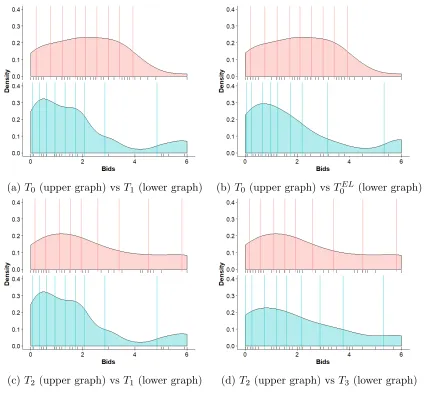
[image:18.612.98.506.537.696.2]These comparisons are projected on the kernel density estimates of bids in each treatment in Figure4. Figure4aand4bshow thatT1 andT0ELbid distributions are more right-skewed compared to that of the baseline treatment T0. On the other hand, Figure 4c and 4d show that bids in the T2 treatment are more spread than in the T1 treatment while the distributions ofT2 and T3 treatments are similar, with theT3 treatment being slightly more positively-skewed than theT2 treatment.
(a) T0 (upper graph) vsT1 (lower graph) (b) T0 (upper graph) vsT0EL (lower graph)
[image:19.612.94.518.187.582.2](c)T2 (upper graph) vs T1 (lower graph) (d)T2 (upper graph) vs T3 (lower graph)
Figure 4: Comparison of Kernel Density Estimates between Treatments
Table 5 in conjunction with the visualization provided in Figure 4 imply that treat-ment effects are not homogeneous as they seem to affect the distribution of bids only in particular locations. More specifically, the effect of expectations on bids is robust and has a particular pattern (see Figure 4a), with a lower density of bids slightly above the me-dian price and a higher density of bids at the tails of the price distribution (mainly at the left). Regarding loss aversion, although TEL
supportive of expectation-based preferences (as mentioned before, we find significant sup-port for expectation-based preferences), the treatment yields interesting results by itself (see Figure 4b). The TEL
0 treatment yields a significant treatment effect, similar to that of T1 when compared to the T0 treatment. When comparing T2 vs. T1, we see that T2 has an effect that is located mainly on the higher quantiles of the bid distribution indicating that anchoring might have a more profound effect on subjects bidding at the higher end of the price distribution. Finally, comparison of T2 with T3 reveals a non-statistically significantly difference.
5
Discussion
The popularity of the BDM mechanism in WTP value elicitation relies on its simplicity and incentive compatibility under EUT. However, red flags have been raised about the usefulness of the mechanism given that subjects’ behavior in the BDM has been found to be driven by several biases that are not included in the EUT paradigm. In this paper, we attempted to examine a number of these biases, such as reference-dependent preferences, expectation-based reference points as well as price and loss anchoring. By varying the amount of numbered labels in a virtual urn and mapping these numbered labels into prices, we were able to disentangle the effect of these biases on bidding behavior in a way that does not deviate from the rational of regular BDM experimental tasks. It is also important to note that we achieved this without having to introduce additional lotteries that would further challenge the cognitive ability of subjects and might cause misconceptions.
Comparing the full distribution of bids across treatments, we identify various treatment effects. The T0 vs. T1 treatments show a significant treatment effect which we can attribute on expectations in the K˝oszegi and Rabin’s (2006) framework. In addition, this result is not in line with other competing models of expectation-based preferences, such as the ‘good-deal model’ ofWenner(2015) or the ‘bad-deal aversion’ model ofIsoni(2011). In particular, based on the ‘good-deal model’ (Wenner,2015), bids in the T1 treatment should have been higher than the baseline T0 treatment, since the mug was more ‘expensive’ (in terms of expected price) inT1 and thus, higher prices should have felt as a better deal to subjects, making them more acceptable. On the other hand, the ‘bad-deal aversion’ model (Isoni, 2011) assumes that in the formulation of the reference price, only those prices that consumers are willing to pay actually matter. In the BDM framework, this corresponds to those prices that are lower than subject’s bid. Since the reference price or the expected price conditional on buying the mug for all bids in the{0.1e, 6.0e}interval was the same in both treatments (equal to bid
that is compatible with the treatment effect we observe is that ofK˝oszegi and Rabin(2006). In reference to the equivalent loss TEL
0 treatment, since our results indicate that bids in
TEL
0 were different than the baseline T0 treatment and since a non-null effect was detected in T1 (when compared to T0), the hypothesis that bidders are loss averse (i.e., they dislike losses relative to a reference point more than they like same-sized gains) cannot be rejected. However, as described in Section 3 and in Table 1, a pair of non-null treatment effects for T1 vs. T0 and T0ELvs. T0 is supportive of the no-loss-in-buying hypothesis ofNovemsky and
Kahneman (2005).
Finally, the mechanism of anchoring on the highest possible price was also found to influence subjects valuations, driving bids to higher levels. In our study, this is manifested by the observed differences between the bid distributions in treatmentsT1 and T2. In contrast, the highest possible loss that could make the utility associated with money more salient, according to our loss anchoring hypothesis, seems not to influence valuations given that the observed differences between treatments treatments T2 and T3 were not statistically significantly different.
References
Austin, P. C. (2009, November). Balance diagnostics for comparing the distribution of base-line covariates between treatment groups in propensity-score matched samples. Statistics in Medicine 28(25), 3083–3107.
Banerji, A. and N. Gupta (2014). Detection, identification, and estimation of loss aversion: Evidence from an auction experiment.American Economic Journal: Microeconomics 6(1), 91–133.
Bateman, I., A. Munro, B. Rhodes, C. Starmer, and R. Sugden (1997). A test of the theory of reference-dependent preferences. Quarterly Journal of Economics 112(2), 479–505.
Becker, G. M., M. H. DeGroot, and J. Marschak (1964). Measuring utility by a single-response sequential method. Behavioral science 9(3), 226–232.
Bohm, P., J. Lind´en, J.n, and J. Sonneg˚ard (1997). Eliciting reservation prices: Becker– degroot–marschak mechanisms vs. markets. The Economic Journal 107(443), 1079–1089.
Bordalo, P., N. Gennaioli, and A. Shleifer (2012). Salience theory of choice under risk. The Quarterly Journal of Economics 127(3), 12431285.
Bordalo, P., N. Gennaioli, and A. Shleifer (2013). Salience and consumer choice. Journal of Political Economy 121(5), 803–843.
Brewer, N. T. and G. B. Chapman (2002). The fragile basic anchoring effect. Journal of Behavioral Decision Making 15(1), 65–77.
Briz, T., A. C. Drichoutis, and R. M. Nayga Jr (2017). Randomization to treatment failure in experimental auctions: The value of data from training rounds. Journal of Behavioral and Experimental Economics 71, 56–66.
Cason, T. N. and C. R. Plott (2014). Misconceptions and game form recognition: Challenges to theoriesof revealed preference and framing.Journal of Political Economy 122(6), 1235– 1270.
Chapman, G. B. and E. J. Johnson (1994). The limits of anchoring. Journal of Behavioral Decision Making 7(4), 223–242.
Cochran, W. G. and D. B. Rubin (1973). Controlling bias in observational studies: A review. Sankhy¯a: The Indian Journal of Statistics, Series A 35(4), 417–446.
Deaton, A. and N. Cartwright (2017). Understanding and misunderstanding randomized controlled trials. Social Science & Medicine (In press).
Fischbacher, U. (2007). z-tree: Zurich toolbox for ready-made economic experiments. Ex-perimental Economics 10(2), 171–178.
Gutenbrunner, C., J. Jureˇckov´e, R. Koenker, and S. Portnoy (1993). Tests of linear hypothe-ses based on regression rank scores. Journal of Nonparametric Statistics 2(4), 307–331.
Harrell, F. E., R. M. Califf, D. B. Pryor, K. L. Lee, and R. A. Rosati (1982). Evaluating the yield of medical tests. JAMA: The Journal of the American Medical Association 247(18), 2543–2546.
Heidhues, P. and B. K˝oszegi (2014, January). Regular prices and sales. Theoretical Eco-nomics 9(1), 217–251.
Ho, D. E., K. Imai, G. King, and E. A. Stuart (2007). Matching as nonparametric preprocess-ing for reducpreprocess-ing model dependence in parametric causal inference.Political Analysis 15(3), 199–236.
Horowitz, J. K. (2006). The becker-degroot-marschak mechanism is not necessarily incentive compatible, even for non-random goods. Economics Letters 93(1), 6–11.
Imbens, G. W. and D. B. Rubin (2016). Causal Inference for Statistics, Social, and Biomed-ical Sciences, An introduction. Cambridge and New York: Cambridge University Press.
Imbens, G. W. and J. M. Wooldridge (2009). Recent developments in the econometrics of program evaluation. Journal of Economic Literature 47(1), 5–86.
Isoni, A. (2011). The willingness-to-accept/willingness-to-pay disparity in repeated markets: loss aversion or ‘bad-deal’ aversion? Theory and Decision 71(3), 409–430.
Kahneman, D. and A. Tversky (1979). Prospect theory: An analysis of decision under risk. Econometrica 47(2), 263–292.
Karni, E. and Z. Safra (1987). “preference reversal” and the observability of preferences by experimental methods. Econometrica, 675–685.
K˝oszegi, B. and M. Rabin (2006). A model of reference-dependent preferences.The Quarterly Journal of Economics 121(4), 1133–1165.
K˝oszegi, B. and A. Szeidl (2013). A model of focusing in economic choice. The Quarterly Journal of Economics 128(1), 53–104.
Mann, H. B. and D. R. Whitney (1947). On a test of whether one of two random variables is stochastically larger than the other. The Annals of Mathematical Statistics 18(1), 50–60.
Marzilli Ericson, K. M. and A. Fuster (2011). Expectations as endowments: Evidence on reference-dependent preferences from exchange and valuation experiments. The Quarterly Journal of Economics, 1–29.
Mazar, N. and D. Ariely (2006). Dishonesty in everyday life and its policy implications. Journal of Public Policy & Marketing 25(1), 117–126.
Moher, D., S. Hopewell, K. F. Schulz, V. Montori, P. C. Gtzsche, P. J. Devereaux, D. El-bourne, M. Egger, and D. G. Altman (2010). CONSORT 2010 explanation and elaboration: updated guidelines for reporting parallel group randomised trials. BMJ 340.
Mood, A. M. (1954). On the asymptotic efficiency of certain nonparametric two-sample tests. The Annals of Mathematical Statistics 25(3), 514–522.
Morewedge, C. K. and D. Kahneman (2010). Associative processes in intuitive judgment. Trends in Cognitive Sciences 14(10), 435–440.
Mutz, D. C. and R. Pemantle (2015). Standards for experimental research: Encouraging a better understanding of experimental methods. Journal of Experimental Political Sci-ence 2(2), 192–215.
Novemsky, N. and D. Kahneman (2005). The boundaries of loss aversion. Journal of Mar-keting Research, 119–128.
Plott, C. R. and K. Zeiler (2004). The willingness to pay/willingness to accept gap, the endowment effect, subject misconceptions and experimental procedures for eliciting valu-ations. American Economic Review 95, 530–530.
Plott, C. R. and K. Zeiler (2007). Exchange asymmetries incorrectly interpreted as evidence of endowment effect theory and prospect theory? The American Economic Review 97(4), 1449–1466.
Ratan, A. (2015). Does displaying probabilities affect bidding in first-price auctions? Eco-nomics Letters 126, 119–121.
Smith, A. (2008). Lagged beliefs and reference-dependent utility. Unpublished paper, Uni-versity of Arizona.
Smith, A. (2012). Lagged beliefs and reference-dependent preferences. working paper, Cali-fornia Institute of Technology.
Sugden, R., J. Zheng, and D. J. Zizzo (2013, December). Not all anchors are created equal. Journal of Economic Psychology 39, 21–31.
Taylor, S. E. and S. C. Thompson (1982). Stalking the elusive ”vividness” effect. Psycho-logical Review 89(2), 155–181.
Tversky, A. and D. Kahneman (1974). Judgment under uncertainty: Heuristics and biases. Science 185(4157), 1124–1131.
Tversky, A. and D. Kahneman (1991). Loss aversion in riskless choice: A reference-dependent model. The Quarterly Journal of Economics 106(4), 1039–1039.
Urbancic, M. (2011). Testing distributional dependence in the becker-degroot-marschak mechanism.
Vickrey, W. (1961). Counterspeculation, auctions, and competitive sealed tenders. The Journal of Finance 16(1), 8–37.
Wenner, L. M. (04/2015). Expected prices as reference pointstheory and experiments. Eu-ropean Economic Review 75, 60–79.
Wilcox, R. R., D. M. Erceg-Hurn, F. Clark, and M. Carlson (2013). Comparing two inde-pendent groups via the lower and upper quantiles. Journal of Statistical Computation and Simulation 84(7), 1543–1551.
Electronic Supplementary Material of
Loss Aversion, Expectations, Price and Loss Anchoring
in the BDM Mechanism
Achilleas Vassilopoulos
∗, Andreas C. Drichoutis
†and Rodolfo M. Nayga, Jr.
‡Experimental Instructions
[This is a translation of the original instructions written in Greek. Instructions were provided in hard copies and each box represents a separate page in the instructions. Differences in instructions between treatments are shown in different color and are included in square brackets. A prefix (T0, T1, T0EL, T2, T3) indicates that a specific part of the text was only included in the treatment indicated by the prefix. Explanatory text for the reader is also colored and included in square brackets.]
Welcome!
Thank you for agreeing to participate in a survey of how people make decisions. Please read carefully the instructions given below.
There are no right and wrong answers to any of the questions you will answer, we just want to know your opinion.
It is very important to follow the instructions carefully. Also, it is very important not to communicate with other participants. If you have any questions at any stage of the experiment, please raise your hand and the experimenter will answer to you in private.
∗Corresponding author: Senior Researcher, International Centre for Research on the Environment and
the Economy, Artemidos 6 & Epidavrou, 15125, Maroussi-Athens, Greece and Department of Agricul-tural Economics & Rural Development, AgriculAgricul-tural University of Athens, tel:+30-210-6875346, e-mail:
[email protected],[email protected].
†Assistant professor, Department of Agricultural Economics & Rural Development, Agricultural
Univer-sity of Athens, Iera Odos 75, 11855, Greece, tel: +30-210-5294781, e-mail: [email protected].
‡Distinguished Professor and Tyson Endowed Chair, Department of Agricultural Economics &
Agribusi-ness, University of Arkansas, Fayetteville, AR 72701, USA, and NBER, tel:+1-4795752299 e-mail:
As you know already, for your participation in the experiment, you will get 10 euros. For practical reasons, money will be given to you at the end of the session along with any items you may get, based on your decisions during the experiment. In any case consider that these money are already in you pocket. [TEL
0 : In addition, you are now given a piece of mug
with the university logo that is in front of you.]
Now, take some time and carefully examine the mug with the university logo in front of you. [At this point the experimenter instructed subjects to put down the instructions and hold the mug. He also described the possible uses (drinking, pencil case, etc.) and advised them to feel the logo while explaining the chemical coating that made it dishwasher-safe. This whole procedure lasted about a minute and at the end, the subjects took again the instructions at hand.]
During this experiment you will be given the opportunity, if you wish, to acquire this mug by paying a price. [TEL
0 : At the end of the experiment you will have to return the mug.
However, during this session you will have the opportunity, if you wish, to acquire this mug by paying a price.]
Below, you are given instructions on how we will determine the price of the mug and whether you will leave the session with or without the mug.
The procedure 6 concrete steps:
You:
Step 1. Examine carefully the mug in front of you.
Step 2. Submit a bid for this mug on the computer. The bid you submit is final and can not be changed after this step.
The Computer:
Step 3. Draws a random number between 1 and 60 [T1,T2,T3: 120]. All numbers in this interval have exactly the same chance of being drawn. Also, this number is different for each of the participants.
Step 4. Assigns this random number to a price based on table 1 given on the last page of this instructions.[ The table was different depending on the treatment: either Table A1, A2 or A3 was placed at the last page of the instructions.]
Step 5. Announces the price to you.
Step 6. Compares the price with the bid you submitted. If your offer is less than this price then you will not leave the experiment with the mug and you will get the full fee ofe10.00 for your participation.
What is the probability of leaving the experiment with the mug?
[image:28.612.76.547.188.499.2]The total number of amounts in Table 1 is 60 [T1,T2,T3: 12]. Each bid corresponds to a unique chance to get the mug at the end of the survey and this is given by the number of table 1 values that are less than or equal to your bid over 60 [T1,T2,T3: 120].
For example, let’s say that your bid is equal toeK. If eK is less than e6.0 [T1,T2: e12.0], then the probability of taking the mug is calculated as follows:
Random Number: 1 , 2 , 3 ,· · ·, X ,· · ·, 57 , 58 , 59 , 60
↓ , ↓ , ↓ ,· · ·, ↓ ,· · ·, ↓ , ↓ , ↓ , ↓
Mug Price: 0,1e, 0,2e, 0,3e,· · ·, Ke
| {z }
N1
,· · ·, 5,7e , 5,8e, 5,9e, 6,0e
| {z }
N2
Probability: N1
N1+N2 =
N1
60%
[T3:
Random No: 1 , 2 , 3 ,· · ·, X ,· · ·, 59 , 60 , 61 , 62 ,· · ·, 119 , 120
↓ , ↓ , ↓ ,· · ·, ↓ ,· · ·, ↓ , ↓ , ↓ , ↓ ,· · ·, ↓ , ↓
Mug Price: 0,1e, 0,2e, 0,3e,· · · , Ke
| {z }
N1
,· · ·, 5,9e ,6,0e, 6,0e, 6,0e ,· · ·, 6,0e , 6,0e
| {z }
N2
Probability: N1
N1+N2 =
N1
120%]
[T1,T2:
Random Number: 1 , 2 , 3 ,· · ·, X ,· · ·, 117 , 118 , 119 , 120
↓ , ↓ , ↓ ,· · ·, ↓ ,· · ·, ↓ , ↓ , ↓ , ↓
Mug Price: 0,1e, 0,2e, 0,3e,· · · , Ke
| {z }
N1
,· · ·, 11,7e, 11,8e, 11,9e , 12,0e
| {z }
N2
Probability: N1
N1+N2 =
N1
120%]
During the experiment, you will not have to do this calculation yourself; the computer will do it for you. It is very important, however, to understand how this probability is calculated. Numerical examples are given below.
FACTS:
• If you bid e0.0, the probability of leaving the experiment with the mug is 0%.
How much will you pay?
2 possible scenarios: [T2: 3 possible scenarios:]
Scen 1: Your bid is less than the price. In this case, you pay nothing since you do not get the mug.
Scen 2: Your bid is greater than or equal to the price [T2: and the price is less than e6]. In this case, you get the mug and you pay an amount equal to the price.
[T2:
Scen 3: T2 only: Your bid is greater than or equal to the price and the price is greater than e6. In this case, you get the mug and you pay e6.]
FACTS:
• It is not possible that you pay an amount that is higher than your bid.
• If your bid ise0.0, you will definitely not pay.
Example 1 [The hypothetical bids for all 3 examples were the same across treatments but price lists, probabilities and outcomes were adjusted based on the specificities of each treatment.]
Let’s assume that instead of the mug we asked you to bid for a USB flash drive with a capacity of 8 GB.
Suppose you submit a bid of e0.8. With this bid, the chance to leave the experiment with the USB flash drive would be:
Random Number
USB Price
Random Number
USB Price
Random Number
USB Price 1 −→ 0,1 e 21 −→ 2,1 e 41 −→ 4,1 e 2 −→ 0,2 e 22 −→ 2,2 e 42 −→ 4,2 e 3 −→ 0,3 e 23 −→ 2,3 e 43 −→ 4,3 e 4 −→ 0,4 e 24 −→ 2,4 e 44 −→ 4,4 e 5 −→ 0,5 e 25 −→ 2,5 e 45 −→ 4,5 e 6 −→ 0,6 e 26 −→ 2,6 e 46 −→ 4,6 e 7 −→ 0,7 e 27 −→ 2,7 e 47 −→ 4,7 e 8 −→ 0,8 e 28 −→ 2,8 e 48 −→ 4,8 e 9 −→ 0,9 e 29 −→ 2,9 e 49 −→ 4,9 e 10 −→ 1,0 e 30 −→ 3,0 e 50 −→ 5,0 e 11 −→ 1,1 e 31 −→ 3,1 e 51 −→ 5,1 e 12 −→ 1,2 e 32 −→ 3,2 e 52 −→ 5,2 e 13 −→ 1,3 e 33 −→ 3,3 e 53 −→ 5,3 e 14 −→ 1,4 e 34 −→ 3,4 e 54 −→ 5,4 e 15 −→ 1,5 e 35 −→ 3,5 e 55 −→ 5,5 e 16 −→ 1,6 e 36 −→ 3,6 e 56 −→ 5,6 e 17 −→ 1,7 e 37 −→ 3,7 e 57 −→ 5,7 e 18 −→ 1,8 e 38 −→ 3,8 e 58 −→ 5,8 e 19 −→ 1,9 e 39 −→ 3,9 e 59 −→ 5,9 e 20 −→ 2,0 e 40 −→ 4,0 e 60 −→ 6,0 e
Probability: 8
8+52 =
8
60 = 13,33%
Example 2
Let’s assume that instead of the mug we asked you to bid for a USB flash drive with a capacity of 8 GB.
Suppose you submit a bid of e5.3. With this bid, the chance to leave the experiment with the USB flash drive would be:
Random Number
USB Price
Random Number
USB Price
Random Number
USB Price 1 −→ 0,1 e 21 −→ 2,1 e 41 −→ 4,1 e 2 −→ 0,2 e 22 −→ 2,2 e 42 −→ 4,2 e 3 −→ 0,3 e 23 −→ 2,3 e 43 −→ 4,3 e 4 −→ 0,4 e 24 −→ 2,4 e 44 −→ 4,4 e 5 −→ 0,5 e 25 −→ 2,5 e 45 −→ 4,5 e 6 −→ 0,6 e 26 −→ 2,6 e 46 −→ 4,6 e 7 −→ 0,7 e 27 −→ 2,7 e 47 −→ 4,7 e 8 −→ 0,8 e 28 −→ 2,8 e 48 −→ 4,8 e 9 −→ 0,9 e 29 −→ 2,9 e 49 −→ 4,9 e 10 −→ 1,0 e 30 −→ 3,0 e 50 −→ 5,0 e 11 −→ 1,1 e 31 −→ 3,1 e 51 −→ 5,1 e 12 −→ 1,2 e 32 −→ 3,2 e 52 −→ 5,2 e 13 −→ 1,3 e 33 −→ 3,3 e 53 −→ 5,3 e 14 −→ 1,4 e 34 −→ 3,4 e 54 −→ 5,4 e 15 −→ 1,5 e 35 −→ 3,5 e 55 −→ 5,5 e 16 −→ 1,6 e 36 −→ 3,6 e 56 −→ 5,6 e 17 −→ 1,7 e 37 −→ 3,7 e 57 −→ 5,7 e 18 −→ 1,8 e 38 −→ 3,8 e 58 −→ 5,8 e 19 −→ 1,9 e 39 −→ 3,9 e 59 −→ 5,9 e 20 −→ 2,0 e 40 −→ 4,0 e 60 −→ 6,0 e
Probability: 53
53+7 =
53
60 = 88,33%
Example 3
Let’s assume that instead of the mug we asked you to bid for a USB flash drive with a capacity of 8 GB.
Suppose you submit a bid ofe10.6. With this bid, the chance to leave the experiment with the USB flash drive would be:
Random Number
USB Price
Random Number
USB Price
Random Number
USB Price 1 −→ 0,1 e 21 −→ 2,1 e 41 −→ 4,1 e 2 −→ 0,2 e 22 −→ 2,2 e 42 −→ 4,2 e 3 −→ 0,3 e 23 −→ 2,3 e 43 −→ 4,3 e 4 −→ 0,4 e 24 −→ 2,4 e 44 −→ 4,4 e 5 −→ 0,5 e 25 −→ 2,5 e 45 −→ 4,5 e 6 −→ 0,6 e 26 −→ 2,6 e 46 −→ 4,6 e 7 −→ 0,7 e 27 −→ 2,7 e 47 −→ 4,7 e 8 −→ 0,8 e 28 −→ 2,8 e 48 −→ 4,8 e 9 −→ 0,9 e 29 −→ 2,9 e 49 −→ 4,9 e 10 −→ 1,0 e 30 −→ 3,0 e 50 −→ 5,0 e 11 −→ 1,1 e 31 −→ 3,1 e 51 −→ 5,1 e 12 −→ 1,2 e 32 −→ 3,2 e 52 −→ 5,2 e 13 −→ 1,3 e 33 −→ 3,3 e 53 −→ 5,3 e 14 −→ 1,4 e 34 −→ 3,4 e 54 −→ 5,4 e 15 −→ 1,5 e 35 −→ 3,5 e 55 −→ 5,5 e 16 −→ 1,6 e 36 −→ 3,6 e 56 −→ 5,6 e 17 −→ 1,7 e 37 −→ 3,7 e 57 −→ 5,7 e 18 −→ 1,8 e 38 −→ 3,8 e 58 −→ 5,8 e 19 −→ 1,9 e 39 −→ 3,9 e 59 −→ 5,9 e 20 −→ 2,0 e 40 −→ 4,0 e 60 −→ 6,0 e
Probability: 60
60 = 100,00%
TRUE-FALSE questions. (Correct answers are highlighted in bold. If you do not agree or do not understand the reaoning, please raise your hand and the experimenter will respond to you in private)[When reading the instructions aloud, the experimenter explained the reasoning behind each of these answers.]
1. If your offer is greater than the cup price then you get the mug and you pay an amount equal to your offer.
A. True B. False
2. If your offer is less than the randomly drawn price, you may get the mug. A. True B. False
3. You may pay less than your offer but you will never pay more. A. True B. False
4. The price of the mug depends on the offers of the other participants in the experiment. A. True B. False
5. The probability to get the mug depends on your offer. A. True B. False
6. The mug price is the same for all participants in the experiment. A. True B. False
How do I submit my bid? When the experiment will start, you will see the following screen on your computer.
To submit a bid you will need to move the bar to where the bid is located. Each point on the horizontal line corresponds to a specific amount. The bar can be moved in 2 ways:
• Left-click on the point you want to move it.
• Writing your bid in square 4 shown in the photo, then left clicking on the gray button “Move the bar”. (The point of the decimal point should be the dot instead of the comma. If you would like to write 94 Euros and 10 cents, you would write 94.1 rather than 94,1)
As you move the bar, just above it, squares 1, 2 and 3 give you some information. Square 1 informs you about the amount that corresponds to the location of the bar.
Square 2 informs you about the probability of leaving the experiment with the mug, should you submit this bid. The way this is calculated is the one explained above.
After you submit your bid, the following screen will appear in your screen:
At the red square you will see your offer, which you CANNOT change. The fields “THE RANDOM NUMBER IS:” and “THE MUG PRICE IS:” will appear empty until you press the red button (bottom right) and the draw takes place.
After clicking on the red button, a new screen informs you of the drawn number and the mug price (based on table 1).
If your bid is lower than the price, the screen will inform you that you will not get the mug at the end of the experiment, and that no amount will be deducted from your fee, thus you will receive e10.00
After clicking OK, a short questionnaire will follow. Please answer as accurately as possible.
If you have finished reading the instructions and have fully understood the procedure, please wait until further instructions are given.
Additional tables and pictures
Table A1: Mapping of numbers in the virtual urn with prices in the T0 and TEL treatments
Random Number
Mug Price
Random Number
Mug Price
Random Number


![table 1 values that are less than or equal to your bid over 60 [T1,T2,T3: 120].](https://thumb-us.123doks.com/thumbv2/123dok_us/181019.515385/28.612.76.547.188.499/table-values-equal-bid-t-t-t.webp)