856
Semantically Equivalent Adversarial Rules
for Debugging NLP Models
Marco Tulio Ribeiro
University of Washington
Sameer Singh
University of California, Irvine
Carlos Guestrin
University of Washington
Abstract
Complex machine learning models for NLP are often brittle, making different predic-tions for input instances that are extremely similar semantically. To automatically de-tect this behavior for individual instances, we present semantically equivalent
ad-versaries (SEAs) – semantic-preserving
perturbations that induce changes in the model’s predictions. We generalize these adversaries into semantically equivalent
adversarial rules(SEARs) – simple,
uni-versal replacement rules that induce ad-versaries on many instances. We demon-strate the usefulness and flexibility of SEAs and SEARs by detecting bugs in black-box state-of-the-art models for three domains: machine comprehension, visual question-answering, and sentiment analysis. Via user studies, we demonstrate that we gener-ate high-quality local adversaries for more instances than humans, and that SEARs in-duce four times as many mistakes as the bugs discovered by human experts. SEARs are also actionable: retraining models us-ing data augmentation significantly reduces bugs, while maintaining accuracy.
1 Introduction
With increasing complexity of models for tasks like classification (Joulin et al.,2016), machine compre-hension (Rajpurkar et al.,2016;Seo et al.,2017), and visual question answering (Zhu et al.,2016), models are becoming increasingly challenging to debug, and to determine whether they are ready for deployment. In particular, these complex models are prone to brittleness: different ways of phrasing the same sentence can often cause the model to
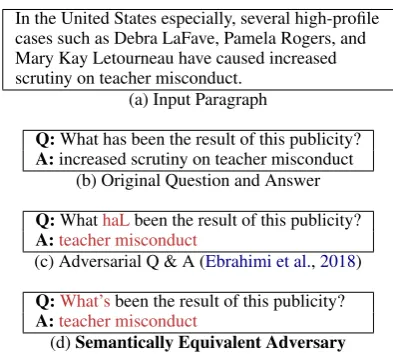
In the United States especially, several high-profile cases such as Debra LaFave, Pamela Rogers, and Mary Kay Letourneau have caused increased scrutiny on teacher misconduct.
(a) Input Paragraph
Q:What has been the result of this publicity? A:increased scrutiny on teacher misconduct
(b) Original Question and Answer
Q:WhathaLbeen the result of this publicity? A:teacher misconduct
(c) Adversarial Q & A (Ebrahimi et al.,2018)
Q:What’sbeen the result of this publicity? A:teacher misconduct
[image:1.595.317.514.218.395.2](d)Semantically Equivalent Adversary
Figure 1: Adversarial examples for question swering, where the model predicts the correct an-swer for the question and input paragraph (1aand
1b). It is possible to fool the model by adversarially changing a single character (1c), but at the cost of making the question nonsensical. ASemantically Equivalent Adversary(1d) results in an incorrect answer while preserving semantics.
output different predictions. While held-out accu-racy is often useful, it is not sufficient: practitioners consistently overestimate their model’s generaliza-tion (Patel et al.,2008) since test data is usually gathered in the same manner as training and vali-dation. When deployed, these seemingly accurate models encounter sentences that are written very differently than the ones in the training data, thus making them prone to mistakes, and fragile with re-spect to distracting additions (Jia and Liang,2017). These problems are exacerbated by the variability in language, and by cost and noise in annotations, making such bugs challenging to detect and fix.
classifi-Transformation Rules #Flips
(WPis→WP’s) 70 (1%) (?→??) 202(3%)
(a) Example Rules
Original:What is the oncorhynchus also called?A:chum salmon Changed: What’sthe oncorhynchus also called?A:keta
(b) Example for (WPis→WP’s)
Original:How long is the Rhine? A:1,230 km
Changed:How long is the Rhine??
A:more than 1,050,000
[image:2.595.81.524.62.121.2](c) Example for (?→??) Figure 2:Semantically Equivalent Adversarial Rules:For the task of question answering, the proposed approach identifies transformation rules for questions in (a) that result in paraphrases of the queries, but lead to incorrect answers (#Flips is the number of times this happens in the validation data). We show examples of rephrased questions that result in incorrect answers for the two rules in (b) and (c).
cation (Szegedy et al.,2014), a domain where one can measure the magnitude of perturbations, and many small-magnitude changes are imperceptible to the human eye. For text, however, a single word addition can change semantics (e.g. adding “not”), or have no semantic impact for the task at hand.
Inspired by adversarial examples for images, we introduce semantically equivalent adver-saries(SEAs) – text inputs that are perturbed in semantics-preserving ways, but induce changes in a black box model’s predictions (example in Figure
1). Producing such adversarial examples systemati-cally can significantly aid in debugging ML models, as it allows users to detect problems that happen in the real world, instead of oversensitivity only to malicious attacks such as intentionally scram-bling, misspelling, or removing words (Bansal et al.,2014;Ebrahimi et al.,2018;Li et al.,2016). While SEAs describe local brittleness (i.e. are specific to particular predictions), we are also inter-ested in bugs that affect the model more globally. We represent these via simple replacement rules that induce SEAs on multiple predictions, such as in Figure2, where a simple contraction of “is”after
Whpronouns (what, who, whom) (2b) makes70
(1%) of the previously correct predictions of the model “flip” (i.e. become incorrect). Perhaps more surprisingly, adding a simple “?” induces mistakes in3%of examples. We call such rulessemantically equivalent adversarial rules(SEARs).
In this paper, we present SEAs and SEARs, de-signed to unveil local and global oversensitivity bugs in NLP models. We first present an approach to generate semantically equivalent adversaries, based on paraphrase generation techniques (Lapata et al.,2017), that is model-agnostic (i.e. works for any black box model). Next, we generalize SEAs into semantically equivalent rules, and outline the properties for optimal rule sets: semantic equiva-lence, high adversary count, and non-redundancy. We frame the problem of finding such a set as a
submodular optimization problem, leading to an accurate yet efficient algorithm.
Including the human into the loop, we demon-strate via user studies that SEARs help users un-cover important bugs on a variety of state-of-the-art models for different tasks (sentiment classification, visual question answering). Our experiments indi-cate that SEAs and SEARs make humans signifi-cantly better at detecting impactful bugs – SEARs uncover bugs that cause3to4times more mistakes than human-generated rules, in much less time. Fi-nally, we show that SEARs are actionable, enabling the human to close the loop by fixing the discov-ered bugs using a data augmentation procedure.
2 Semantically Equivalent Adversaries
Consider a black box modelf that takes a sentence x and makes a prediction f(x), which we want to debug. We identify adversaries by generating paraphrases ofx, and getting predictions fromf until the original prediction is changed.
Given an indicator function SemEq(x, x0)that is1ifxis semantically equivalent tox0and0 oth-erwise, we define asemantically equivalent adver-sary(SEA) as a semantically equivalent instance that changes the model prediction in Eq (1). Such adversaries are important in evaluating the robust-ness off, as each is an undesirable bug.
SEA(x, x0) =1SemEq(x, x0)∧f(x)6=f(x0) (1)
While there are various ways of scoring semantic similarity between pairs of texts based on embed-dings (Le and Mikolov,2014;Wieting and Gimpel,
and then taking the score of back-translating the translations into the original language. This ap-proach scores semantics and “plausibility” simulta-neously (as translation models have “built in” lan-guage models) and allows for easy paraphrase gen-eration, by linearly combining the paths of each back-decoder when back-translating.
Unfortunately, given source sentencesxandz, P(x0|x)is not comparable toP(z0|z), as each has a different normalization constant, and heavily de-pends on the shape of the distribution aroundxor z. If there are multiple perfect paraphrases nearx, they will all share probability mass, while if there is a paraphrase much better than the rest nearz, it will have a higher score than the ones nearx, even if the paraphrase quality is the same. We thus de-fine the semantic scoreS(x, x0)as a ratio between the probability of a paraphrase and the probability of the sentence itself:
S(x, x0) = min
1,P(x
0|x)
P(x|x)
(2)
We define SemEq(x, x0) = 1[S(x, x0) ≥ τ], i.e. x0 is semantically equivalent toxif the similarity score betweenxandx0is greater than some thresh-old τ (which we crowdsource in Section 5). In order to generate adversaries, we generate a set of paraphrasesΠxaroundxvia beam search and get predictions onΠxusing the black box model until an adversary is found, or untilS(x, x0) < τ. We may be interested in the best adversary for a partic-ular instance, i.e.argmaxx0∈Π
xS(x, x
0)SEA
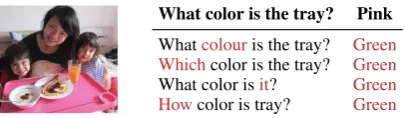
x(x0), or we may consider multiple SEAs for generaliza-tion purposes. We illustrate this process in Figure3, where we generate SEAs for a VQA model by gen-erating paraphrases around the question, and check-ing when the model prediction changes. The first two adversaries with highestS(x, x0)are semanti-cally equivalent, the third maintains the semantics enough for it to be a useful adversary, and the fourth is ungrammatical and thus not useful.
3 Semantically Equivalent Adversarial
Rules (SEARs)
While finding the best adversary for a particular instance is useful, humans may not have time or patience to examine too many SEAs, and may not be able to generalize well from them in order to understand and fix the most impactful bugs. In this section, we address the problem of generaliz-ing local adversaries into Semantically Equivalent
What color is the tray? Pink
Whatcolouris the tray? Green Whichcolor is the tray? Green
[image:3.595.321.524.64.123.2]What color isit? Green Howcolor is tray? Green
Figure 3: Visual QA Adversaries: Paraphrasing questions to find adversaries for the original ques-tion (top, in bold) asked of a given image. Adver-saries are sorted by decreasing semantic similarity.
Adversarial Rules for Text (SEARs), search and re-place rules that produce semantic adversaries with little or no change in semantics, when applied to a corpus of sentences. Assuming that humans have limited time, and are thus willing to look at B rules, we propose a method for selecting such a set of rules given a reference datasetX.
A rule takes the form r = (a→c), where the first instance of the antecedentais replaced by the consequentcfor every instance that includesa, as we previously illustrated in Figure2a. The output after applying ruleron a sentencexis represented as the function callr(x), e.g. ifr =(movie→film), r(“Great movie!”) =“Great film!”.
Proposing a set of rules: In order to generalize a SEAx0into a candidate rule, we must represent the changes that took place fromx→x0. We will usex= “What color is it?” andx0= “Which color is it?” from Figure4as a running example.
One approach is exact matching: selecting the minimal contiguous sequence that turnsxintox0,
(What→Which) in the example. Such changes may
not always be semantics preserving, so we also propose further rules by including the immediate context (previous and/or next word with respect to the sequence), e.g. (What color→Which color). Adding such context, however, may make rules very specific, thus restricting their value. To al-low for generalization, we also represent the an-tecedent of proposed rules by a product of their raw text with coarse and fine-grained Part-of-Speech tags, and allow these tags to happen in the con-sequent if they match the antecedent. In the running example, we would propose rules like
(What color→Which color), (WhatNOUN→Which
NOUN), (WPcolor→Which color), etc.
Figure 4:SEAR process.(1) SEAs are generalized into candidate rules, (2) rules that are not semantically equivalent are filtered out, e.g.r5:(What→Which), (3) rules are selected according to Eq (3), in order to maximize coverage and avoid redundancy (e.g. rejectingr2, valuingr1more highly thanr4), and (4) a user vets selected rules and keeps the ones that they think are bugs.
Selecting a set of rules: Given a set of candidate rules, we want to select a setRsuch that|R| ≤B, and the following properties are met:
1. Semantic Equivalence: Application of the
rules in the set should produce semantically equiv-alent instances. This is equivequiv-alent to considering rules that have a high probability of inducing se-mantically equivalent instances when applied, i.e. E[SemEq(x, r(x))]≥1−δ. This is theFilterstep in Algorithm 1. For example, consider the rule
(What→Which) in Fig4which produces some
se-mantically equivalent instances, but also produces many instances that are unnatural (e.g. “What is he doing?”→“Which is he doing?”), and is thus filtered out by this criterion.
2. High adversary count: The rules in the set should induce as many SEAs as possible in valida-tion data. Furthermore, each of the induced SEAs should have as high of a semantic similarity score as possible, i.e. for each ruler ∈ Rwe want to maximizeP
x∈XS(x, r(x))SEA(x, r(x)). In Fig-ure4,r1induces more and more similar mistakes when compared tor4, and is thus superior tor4.
3. Non-redundancy: Different rules in the set may induce the same SEAs, or may induce different SEAs for the same instances. Ideally, rules in the set should cover as many instances in the validation as possible, rather than focus on a small set of fragile predictions. Furthermore, rules should not be repetitive to the user. In Figure 4 (mid), r1
covers a superset ofr2’s adversaries, makingr2
completely redundant and thus not included inR.
Properties 2 and 3 combined suggest a weighted coverage problem, where a rule r covers an in-stancexif SEA(x, r(x)), the weight of the connec-tion being given byS(x, r(x)). We thus want to
Algorithm 1Generating SEARs for a model
Require: Classifierf, Correct instancesX
Require: Hyperparameters,δ,τ, BudgetB
R ← {}{Set of rules}
for allx∈Xdo
X0 =GenParaphrases(X, τ)
A ← {x0∈X0|f(x)6=f(x0)}{SEAs; §2}
R ← R ∪Rules(A) end for
R ←Filter(R, δ, τ){Remove low scoring SEARs}
R ←SubMod(R, B){high count / score, diverse}
return R
find the set of semantically equivalent rules that:
max
R,|R|<B
X
x∈X
max
r∈R S(x, r(x))SEA(x, r(x)) (3)
While Eq (3) is NP-hard, the objective is monotone submodular (Krause and Golovin,2014), and thus a greedy algorithm that iteratively adds the rule with the highest marginal gain offers a constant-factor approximation guarantee of1−1/eto the optimum. This is theSubModprocedure in Algo-rithm1, represented pictorially in Figure4, where the output is a set of rules given to a human, who judges if they are really bugs or not.
4 Illustrative Examples
Before evaluating the utility of SEAs and SEARs with user studies, we show examples in state-of-the-art models for different tasks. Note that we treat these models as black boxes, not using internals or gradients in any way when discovering these bugs.
Machine Comprehension: We take the
SEAR Questions /SEAs f(x) Flips What isWhat’sthe NASUWT? Trade unions
2%
WhatVBZ→ Teachers in Wales
What’s What isWhat’sa Hauptlied? main hymnVeni redemptor gentium
What resourceWhich resource coalwool
1% WhatNOUN→ was mined in the Newcastle area?
WhichNOUN What healthWhich health nervous breakdown problem did Tesla have in 1879? relations
What wasSo what was Satyagraha
2% WhatVERB→ Ghandi’s work called? Civil Disobedience So whatVERB What isSo what isa new trend Co-teaching
in teaching? educational institutions What didAnd what didTesla an induction motor
2% WhatVBD→ develop in 1887? laboratory
And whatVBD What wasAnd what was journalistsleep Kenneth Swezey’s job?
Table 1: SEARs for Machine Comprehension
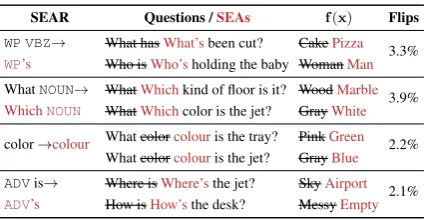
SEAR Questions /SEAs f(x) Flips
WP VBZ→ What hasWhat’sbeen cut? CakePizza 3.3% WP’s Who isWho’sholding the baby WomanMan
WhatNOUN→ WhatWhichkind of floor is it? WoodMarble 3.9% WhichNOUN WhatWhichcolor is the jet? GrayWhite
color→colour What colorcolouris the tray? PinkGreen 2.2% What colorcolouris the jet? GrayBlue
ADVis→ Where isWhere’sthe jet? SkyAirport 2.1%
[image:5.595.76.288.62.212.2]ADV’s How isHow’sthe desk? MessyEmpty
Table 2: SEARs for Visual QA
we display two example questions with the corre-sponding SEA, the prediction (with correcorre-sponding change) and the percentage of “flips” - instances previously predicted correctly on the validation data, but predicted incorrectly after the application of the rule. The rule (WhatVBZ→What’s) general-izes the SEA on Figure1, and shows that the model is fragile with respect to contractions (flips2%of all correctly predicted instances on the validation data). The second rule uncovers a bug with respect to simple question rephrasing, while the third and fourth rules show that the model is not robust to a more conversational style of asking questions.
Visual QA: We show SEARs for a
state-of-the-art visual question-answering model (Zhu et al.,
2016) in Table 2. Even though the contexts are different (paragraphs for machine comprehension, images for VQA), it is interesting that both models display similar bugs. The fact that VQA is fragile to “Which” questions is because questions of this form are not in the training set, while (color→colour) probably stems from an American bias in data col-lection. Changes induced by these four rules flip more than10%of the predictions in the validation data, which is of critical concern if the model is being evaluated for production.
SEAR Reviews /SEAs f(x) Flips
movie→ Yeah, the moviefilmpretty much sucked . NegPos 2% film This is not moviefilmmaking . NegPos
film→ Excellent filmmovie. PosNeg 1% movie I’ll give this filmmovie10 out of 10 ! PosNeg
is→was Ray Charles iswaslegendary . PosNeg 4% It iswasa really good show to watch . PosNeg
this→that Now thisthatis a movie I really dislike . NegPos 1% The camera really likes her in thisthatmovie. PosNeg
[image:5.595.76.289.248.358.2]DET NOUNis The movie isIt isterrible NegPos 1% →it is The dialog isIt isatrocious NegPos
Table 3: SEARs for Sentiment Analysis
Sentiment Analysis: Finally, in Table3we dis-play SEARs for a fastText (Joulin et al., 2016) model for sentiment analysis trained on movie re-views. Surprisingly, many of its predictions change for perturbations that have no sentiment connota-tions, even in the presence of polarity-laden words.
5 User Studies
We compare automatically discovered SEAs and SEARs to user-generated adversaries and rules, and propose a way to fix the bugs induced by SEARs.
Our evaluation benchmark includes two tasks: visual question answering (VQA) and sentiment analysis on movie review sentences. We choose these tasks because a human can quickly look at a prediction and judge if it is correct or incorrect, can easily perturb instances, and judge if two instances in a pair are semantically equivalent or not. Since our focus is debugging, throughout the experiment we only considered SEAs and SEARs on examples that are originally predicted correctly (i.e. every adversary is also by construction a mistake). The user interfaces for all experiments in this section are included in the supplementary material.
5.1 Implementation Details
The paraphrasing model (Lapata et al.,2017) re-quires translation models to and from different languages. We train neural machine translation models using the default parameters of OpenNMT-py (Klein et al., 2017) for English↔Portuguese and English↔French models, on2million and1
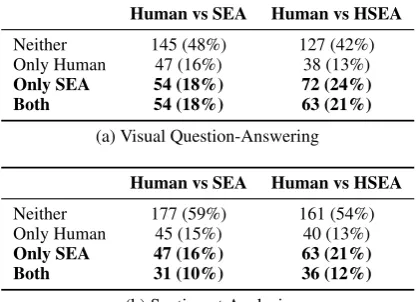
Human vs SEA Human vs HSEA
Neither 145 (48%) 127 (42%) Only Human 47 (16%) 38 (13%) Only SEA 54 (18%) 72 (24%)
Both 54 (18%) 63 (21%)
(a) Visual Question-Answering
Human vs SEA Human vs HSEA
Neither 177 (59%) 161 (54%) Only Human 45 (15%) 40 (13%) Only SEA 47 (16%) 63 (21%)
Both 31 (10%) 36 (12%)
[image:6.595.79.289.64.215.2](b) Sentiment Analysis
Table 4: Finding Semantically Equivalent Ad-versaries:we compare how often humans produce semantics-preserving adversaries, when compared to our automatically generated adversaries (SEA, left) and our adversaries filtered by humans (HSEA, right). There are four possible outcomes: neither produces a semantic equivalent adversary (i.e. they either do not produce an adversary or the adversary produced is not semantically equivalent), both do, or only one is able to do so.
for semantic equivalence. Using these evaluations, we identifyτ = 0.0008as the value that minimizes the entropy in the induced splits, and use it for the remaining experiments. Source code and pre-trained language models are available athttps: //github.com/marcotcr/sears.
For VQA, we use the multiple choice telling
system and dataset of Zhu et al. (2016), using their implementation, with default parameters. The training data consists of questions that begin with “What”, “Where”, “When”, “Who”, “Why”, and “How”. The task is multiple choice, with four pos-sible answers per instance. For sentiment analy-sis, we train a fastText (Joulin et al.,2016) model with unigrams and bigrams (embedding size of50) on RottenTomato movie reviews (Pang and Lee,
2005), and evaluate it on IMDB sentence-sized reviews (Kotzias et al.,2015), simulating the com-mon case where a model trained on a public dataset is applied to new data from a similar domain.
5.2 Can humans find good adversaries?
In this experiment, we compare our method for generating SEAs with user’s ability to discover semantic-preserving adversaries. We take a ran-dom sample of100correctly-predicted instances for each task. In the first condition (human), we display each instance to 3 Amazon Mechanical
Turk workers, and give them10attempts at creating semantically equivalent adversaries (with immedi-ate feedback as to whether or not their attempts changed the prediction). Next, we ask them to choose the adversary that is semantically closest to the original instance, out of the candidates they generated. In the second condition (SEA), we gen-erate adversaries for each of the instances, and pick the best adversary according to the semantic scorer. The third condition (HSEA) is a collaboration be-tween our method and humans: we take the top5
adversaries ranked byS(x, x0), and ask workers to pick the one closest to the original instance, rather than asking them to generate the adversaries.
To evaluate whether the proposed adversaries are semantically equivalent, we ask a separate set of workers to evaluate the similarity between each adversary and the original instance (with the image as context for VQA), on a scale of1(completely unrelated) to5(exactly the same meaning). Each adversary is evaluated by at least10workers, and considered equivalent if the median score≥4. We thus obtain300comparisons betweenhumanand
SEA, and300betweenhumanandHSEA.
The results in Table 4aand 4b are consistent across tasks: both models are susceptible to SEAs for a large fraction of predictions, and our fully au-tomated method is able to produce SEAs as often as humans (left columns). On the other hand, asking humans to choose from generated SEAs (HSEA) yields much better results than asking humans to generate them (right columns), or using the high-est scored SEA. The semantic scorer does make mistakes, so the top adversary is not always seman-tically equivalent, but a good quality SEA is often in the top5, and is easily identified by users.
On both datasets, the automated method or hu-mans were able to generate adversaries at the ex-clusion of the other roughly one third of the time, which indicates that they do not generate the same adversaries. Humans generate paraphrases differ-ently than our method: the average character edit distance of our SEAs is6.2for VQA and9.0for Sentiment, while for humans it is18.1and43.3, re-spectively. This is illustrated by examples in Table
sig-Dataset Original SEA
VQA Where are the men? Where are themales? What kind of meat is on the
boy’s plate?
Whatsortof meat is on the boy’s plate?
Sentiment They are so easy to love, but even more easy to identify with.
They’reso easy to love, but even more easy to identify with.
Today the graphics are crap. Today, graphics arebullshit.
(a) Automatically generated adversaries, examples where hu-mans failed to generate SEAs (Only SEA)
Dataset Original Human-generated SEA
VQA How many suitcases? How many suitcasesare sit-ting on the shelf? Where is the blue van? What isthe blue van’s
loca-tion?
Sentiment (very serious spoilers) this movie was a huge disap-pointment.
serious spoilers this movie did not deliver what I hoped
Also great directing and photography.
Photography and directing were on point.
[image:7.595.77.295.62.148.2](b) Human generated adversaries, examples where our approach failed to generate SEAs (Only Human)
Table 5: Examples of generated adversaries
nificantly change the sentence structure, which the translation-based semantic scorer does not.
5.3 Can experts find high-impact bugs?
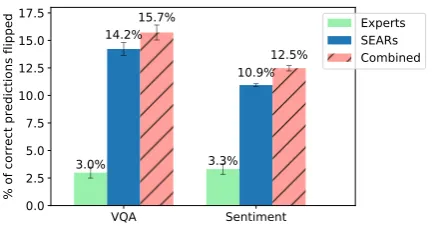
Here we investigate whether experts are able to detect high-impact global bugs, i.e. devise rules that flip many predictions, and compare them to generated SEARs. Instead of AMT workers, we have26expert subjects: students, graduates, or pro-fessors who have taken at least a graduate course in machine learning or NLP1. The experiment setup is as follows: for each task, subjects are given an interface where they see examples in the validation data, perturb those examples, and get predictions. The interface also allows them to create search and replace rules, with immediate feedback on how many mistakes are induced by their rules. They also see the list of examples where the rules apply, so they can verify semantic equivalence. Subjects are instructed to try to maximize the number of mis-takes induced in the validation data (i.e. maximize “mistake coverage”), but only through semantically equivalent rules. They can try as many rules as they like, and are asked to select the best set of at most10rules at the end. This is quite a challeng-ing task for humans (yet another reason to prefer algorithmic approaches), but we are not aware of any existing automated methods. Finally, we
in-1We have an IRB/consent form, and personal information
was only collected as needed to compensate subjects
VQA Sentiment
0.0 2.5 5.0 7.5 10.0 12.5 15.0 17.5
% of correct predictions flipped
3.0% 3.3%
14.2%
10.9% 15.7%
12.5%
[image:7.595.309.526.64.177.2]Experts SEARs Combined
Figure 5: Mistakes induced by expert-generated rules (green), SEARs (blue), and a combination of both (pink), with standard error bars.
VQA Sentiment
0.0 2.5 5.0 7.5 10.0 12.5 15.0 17.5
Minutes
16.9
12.9 10.1
5.4
Discovering rules Evaluating SEARs
Figure 6: Time for users to create rules (green) and to evaluate SEARs (blue), with standard error bars
struct subjects they could finish each task in about
15minutes (some took longer, some ended earlier), in order to keep the total time reasonable.
After creating their rules for VQA and sentiment analysis, the subjects evaluate20SEARs (one rule at a time) for each task, and accept only semanti-cally equivalent rules. When a subject rejects a rule, we recompute the remaining set according to Eq (3) in real time. If a subject accepts more than10rules, only the first10are considered, in order to ensure a fair comparison against the expert-generated rules.
[image:7.595.309.525.249.360.2]Error rate Validation Sensitivity
Visual QA
Original Model 44.4.% 12.6% SEAR Augmented 45.7 % 1.4% Sentiment Analysis
Original Model 22.1% 12.6% SEAR Augmented 21.3% 3.4%
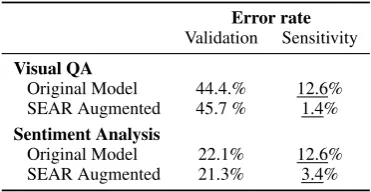
Table 6: Fixing bugs using SEARs: Effect of re-training models using SEARs, both on original validation and on sensitivity dataset. Retraining significantly reduces the number of bugs, with sta-tistically insignificant changes to accuracy.
SEARs than trying to create their own rules (Fig-ure6). SEARs for sentiment analysis contain fewer POS tags, and are thus easier to evaluate for seman-tic equivalence than for VQA.
Discovering these bugs is hard for humans (even experts) without SEARs: not only do they need to imagine rules that maintain semantic equivalence, they must also discover the model’s weak spots. Making good use of POS tags is also a challenge: only50%of subjects attempt rules with POS tags for VQA,36%for sentiment analysis.
Experts accepted8.69rules (on average) out of
20for VQA as semantically equivalent, and17.32
out of 20 for sentiment analysis. Similar to the previous experiment, errors made by the seman-tic scorer lead to rules that are not semanseman-tically equivalent (e.g. Table7). With minimal human intervention, however, SEARs vastly outperform human experts in finding impactful bugs.
5.4 Fixing bugs using SEARs
Once such bugs are discovered, it is natural to want to fix them. The global and deterministic nature of SEARs make them actionable, as they represent bugs in a systematic manner. Once impactful bugs are identified, we use a simple data augmentation procedure: applying SEARs to the training data, and retraining the model on the original training augmented with the generated examples.
We take the rules that are accepted by≥20 sub-jects as accepted bugs, a total of4rules (in Table2) for VQA, and 16 rules for sentiment (including ones in Table3). We then augment the training data by applying these rules to it, and retrain the models. To check if the bugs are still present, we create a sensitivity dataset by applying these SEARs to instances predicted correctly on the validation. A model not prone to the bugs described by these
rules should not change any of its predictions, and should thus have error rate0% on this sensitivity data. We also measure accuracy on the original validation data, to make sure that our bug-fixing procedure is not decreasing accuracy.
Table6shows that the incidence of these errors is greatly reduced after augmentation, with negli-gible changes to the validation accuracy (on both tasks, the changes are consistent with the effect of retraining with different seeds). These results show that SEARs are useful not only for discover-ing bugs, but are also actionable through a simple augmentation technique for any model.
6 Related Work
Previous work on debugging primarily focuses on
explainingpredictions in validation data in order to uncover bugs (Ribeiro et al.,2016,2018;Kulesza et al.,2011), or find labeling errors (Zhang et al.,
2018;Koh and Liang,2017). Our work is com-plementary to these techniques, as they provide no mechanism to detect oversensitivity bugs. We are able to uncover these bugs even when they are not present in the data, since we generate sentences.
[image:8.595.88.274.62.158.2]quality text, there is no guarantee that an example close in the latent space is semantically equiva-lent. Ebrahimi et al.(2018), along with propos-ing character-level changes that are not semantic-preserving, also propose a heuristic that replaces single words adversarially to preserve semantics. This approach not only depends on having white-box access to the model, but is also not able to generate many adversaries (only∼1.6%for sen-timent analysis, compare to∼ 33% for SEAs in Table4b). Developed concurrently with our work,
Iyyer et al.(2018) proposes a neural paraphrase model based on back-translated data, which is able to produce paraphrases that have different sentence structures from the original. They use paraphrases to generate adversaries and try to post-process non-sensical outputs, but they do not explicitly reject non-semantics preserving ones, nor do they try to induce rules from individual adversaries. In any case, their adversaries are also useful for data aug-mentation, in experiments similar to ours.
In summary, previous work on text adversaries change semantics, only generate local (instance-specific) adversaries (Zhao et al., 2018; Iyyer et al., 2018), or are tailored for white-box mod-els (Ebrahimi et al.,2018) or specific tasks (Jia and Liang,2017). In contrast, SEAs expose oversensi-tivity for specific predictions of black-box models for a variety of tasks, while SEARs are intuitive and actionable global rules that induce a high num-ber of high-quality adversaries. To our knowledge, we are also the first to evaluate human performance in adversarial generation (semantics-preserving or otherwise), and our extensive evaluation shows that SEAs and SEARs detect individual bugs and gen-eral patterns better than humans can.
7 Limitations and Future Work
Having demonstrated the usefulness of SEAs and SEARs in a variety of domains, we now describe their limitations and opportunities for future work.
Semantic scoring errors: Paraphrasing is still an active area of research, and thus our semantic scorer is sometimes incorrect in evaluating rules for semantic equivalence. We show examples of SEARs that are rejected by users in Table7– the se-mantic scorer does not sufficiently penalize preposi-tion changes, and is biased towards common terms. The presence of such errors is why we still need humans in the loop to accept or reject SEARs.
SEAR Questions /SEAs f(x)
on→in What is oninthe background? A buildingMountains What is on?in LightsThe television
VBP→is Where areisthe water bottles TableVending Maching Where areisthe people gathered living roomkitchen
VERB on
→ What is on the background? A buildingMountains VERB What are the planes parked on? Concretelanding strip
Table 7: SEARs for VQA that are rejected by users
Other paraphrase limitations: Paraphrase
models based on neural machine translation are biased towards maintaining the sentence structure, and thus do not produce certain adversaries (e.g. Table 5b), which recent work on para-phrasing (Iyyer et al., 2018) or generation using GANs (Zhao et al., 2018) may address. More critically, existing models are inaccurate for long texts, restricting SEAs and SEARs to sentences.
Better bug fixing: Our data augmentation has
the human users accept/reject rules based on whether or not they preserve semantics. Develop-ing more effective ways of leveragDevelop-ing the expert’s time to close the loop, and facilitating more inter-active collaboration between humans and SEARs are exciting areas for future work.
8 Conclusion
We introduced SEAs and SEARs – adversarial ex-amples and rules that preserve semantics, while causing models to make mistakes. We presented examples of such bugs discovered in state-of-the-art models for various tasks, and demonstrated via user studies that non-experts and experts alike are much better at detecting local and global bugs in NLP models by using our methods. We alsoclose
the loopby proposing a simple data augmentation
solution that greatly reduced oversensitivity while maintaining accuracy. We demonstrated that SEAs and SEARs can be an invaluable tool for debug-ging NLP models, while indicating their current limitations and avenues for future work.
Acknowledgements
[image:9.595.310.525.63.154.2]References
Aayush Bansal, Ali Farhadi, and Devi Parikh. 2014. Towards transparent systems: Semantic characteri-zation of failure modes. InEuropean Conference on Computer Vision (ECCV).
Javid Ebrahimi, Anyi Rao, Daniel Lowd, and Deijing Dou. 2018. HotFlip: White-Box Adversarial Exam-ples for NLP. InAnnual Meeting of the Association for Computational Linguistics (ACL).
Matt A Gardner, Joel Grus, Mark Neumann, Oyvind Tafjord, Pradeep Dasigi, Nelson F. Liu, Matthew Peters, Michael Schmitz, and Luke S. Zettlemoyer. 2017. Allennlp: A deep semantic natural language processing platform.
Mohit Iyyer, John Wieting, Kevin Gimpel, and Luke Zettlemoyer. 2018. Adversarial example generation with syntactically controlled paraphrase networks. In North American Association for Computational Linguistics (NAACL).
Robin Jia and Percy Liang. 2017. Adversarial exam-ples for evaluating reading comprehension systems. InEmpirical Methods in Natural Language Process-ing (EMNLP).
Armand Joulin, Edouard Grave, Piotr Bojanowski, and Tomas Mikolov. 2016. Bag of tricks for efficient text classification. arXiv preprint arXiv:1607.01759.
Guillaume Klein, Yoon Kim, Yuntian Deng, Jean Senel-lart, and Alexander M. Rush. 2017. Opennmt: Open-source toolkit for neural machine translation. InAnnual Meeting of the Association for Computa-tional Linguistics (ACL).
Pang Wei Koh and Percy Liang. 2017. Understand-ing black-box predictions via influence functions. In International Conference on Machine Learning (ICML).
Dimitrios Kotzias, Misha Denil, Nando de Freitas, and Padhraic Smyth. 2015. From group to individual la-bels using deep features. In Knowledge Discovery and Data Mining (KDD).
Andreas Krause and Daniel Golovin. 2014. Submod-ular function maximization. InTractability: Practi-cal Approaches to Hard Problems.
Todd Kulesza, Simone Stumpf, Weng-Keen Wong, Margaret M. Burnett, Stephen Perona, An-drew Jensen Ko, and Ian Oberst. 2011. Why-oriented end-user debugging of naive bayes text classification. TiiS1:2:1–2:31.
Mirella Lapata, Rico Sennrich, and Jonathan Mallinson. 2017. Paraphrasing revisited with neural machine translation. In European Chapter of the ACL (EACL).
Quoc V. Le and Tomas Mikolov. 2014. Distributed rep-resentations of sentences and documents. In Inter-national Conference on Machine Learning (ICML).
Jiwei Li, Will Monroe, and Daniel Jurafsky. 2016. Un-derstanding neural networks through representation erasure. CoRRabs/1612.08220.
Seyed-Mohsen Moosavi-Dezfooli, Alhussein Fawzi, Omar Fawzi, and Pascal Frossard. 2017. Univer-sal adversarial perturbations. IEEE Conference on Computer Vision and Pattern Recognition (CVPR).
Bo Pang and Lillian Lee. 2005. Seeing stars: Ex-ploiting class relationships for sentiment categoriza-tion with respect to rating scales. In Annual Meet-ing of the Association for Computational LMeet-inguistics (ACL).
Kayur Patel, James Fogarty, James A. Landay, and Beverly Harrison. 2008. Investigating statistical ma-chine learning as a tool for software development. In Human Factors in Computing Systems (CHI).
Pranav Rajpurkar, Jian Zhang, Konstantin Lopyrev, and Percy Liang. 2016. Squad: 100, 000+ questions for machine comprehension of text. InEmpirical Meth-ods in Natural Language Processing (EMNLP).
Marco Tulio Ribeiro, Sameer Singh, and Carlos Guestrin. 2016. "Why Should I Trust You?": Ex-plaining the Predictions of Any Classifier. In Knowl-edge Discovery and Data Mining (KDD).
Marco Tulio Ribeiro, Sameer Singh, and Carlos Guestrin. 2018. Anchors: High-precision model-agnostic explanations. In AAAI Conference on Ar-tificial Intelligence.
Min Joon Seo, Aniruddha Kembhavi, Ali Farhadi, and Hannaneh Hajishirzi. 2017. Bidirectional attention flow for machine comprehension. InInternational Conference on Learning Representations (ICLR).
Christian Szegedy, Wojciech Zaremba, Ilya Sutskever, Joan Bruna, Dumitru Erhan, Ian Goodfellow, and Rob Fergus. 2014. Intriguing properties of neural networks. InInternational Conference on Learning Representations (ICLR).
Jörg Tiedemann. 2012. Parallel data, tools and inter-faces in opus. InInternational Conference on Lan-guage Resources and Evaluation (LREC).
John Wieting and Kevin Gimpel. 2017. Revisiting re-current networks for paraphrastic sentence embed-dings. In Annual Meeting of the Association for Computational Linguistics (ACL).
Xuezhou Zhang, Xiaojin Zhu, and Stephen Wright. 2018. Training set debugging using trusted items. InAAAI Conference on Artificial Intelligence.
Zhengli Zhao, Dheeru Dua, and Sameer Singh. 2018. Generating natural adversarial examples. In Inter-national Conference on Learning Representations (ICLR).