Proceedings of the BioNLP 2019 workshop, pages 471–477 471
IIT-KGP at MEDIQA 2019: Recognizing Question Entailment using
Sci-BERT stacked with a Gradient Boosting Classifier
Prakhar Sharma, Sumegh Roychowdhury
Indian Institute of Technology Kharagpur, India
{prakharsharma, sumegh01}@iitkgp.ac.in
Abstract
The number of people turning to the Internet to search for a diverse range of health-related subjects continues to grow and with this multi-tude of information available, duplicate ques-tions become more frequent and finding the most appropriate answers becomes problem-atic. This issue is important for question-answering platforms as it complicates the re-trieval of all information relevant to the same topic, particularly when questions similar in essence are expressed differently, and answer-ing a given medical question by retrievanswer-ing sim-ilar questions that are already answered by hu-man experts seems to be a promising solution. In this paper we present our novel approach to detect question entailment by determining the type of question asked rather than focusing on the type of the ailment given. This unique methodology makes the approach robust to-wards examples which have different ailment names but are synonyms of each other. Also it enables us to check entailment at a much more fine-grained level.
1 Introduction
Seeking health-related information is one of the top activities of todays online users via both per-sonal computers and mobile devices. In all, 80 percent of Internet users, or about 93 mil-lion Americans, have searched for a health-related topic online, according to a study released on 16th July 2018 by the Pew Internet & American Life Project (Weaver,2016) .Thats up from 62 percent of Internet users who said they went online to search health topics in 2001, the Washington re-search firm found. China (Guo et al.,2018) also has 194.76 million Internet health users in 2016, increased 28.0% compared with that in 2015. De-spite the widespread need, the search engines often fail in returning relevant and trustworthy health information (Natalia et al.,2012)(Arabella
et al., 2017). In this paper we try to bridge this gap by predicting entailment between questions. We particularly tackle this problem by check-ing entailment of a given consumer health ques-tion (CHQ) with most similar Frequently Asked Question (FAQ). Given two general English sen-tences this Question Entailment system can con-clude whether answer of one question implies the other question’s answer.
Q1: ”Can you mail me patient information about Glaucoma, I was recently diagnosed and want to learn all I can about the disease.”
Q2: ”What is glaucoma?”
In the above two questions the answer of Q1 im-plies the answer of Q2. (Entailment)
Detecting Question Entailment is a challeng-ing task as it involves an amalgamation of tasks like Question Answering and Textual Entailment (Abacha and Demner-Fushman,2019). Question answering is used to generate answers for both the questions and then checking textual entailment be-tween the answers to give predictions possibly in-tegrating Named Entity Recognition(NER) to our advantage. In this paper, we experiment on the MEDIQA 2019 task (Ben Abacha et al., 2019) by presenting an all-together different approach
QSpider which overcomes these challenges by
detecting question types instead of treating it like a pure Textual entailment or Question answering task.
Attempts have been made to tackle this prob-lem, the most notable one being (Abacha and Demner-Fushman,2016) which is the baseline for this task. The Baseline method uses supervised methods like SVM, Logistic Regression, Naive Bayes and used manual feature engineering but it fails to explore over the semantic space of the sen-tence. In this paper, we propose our model QSpi-derto tackle this problem.
state-of-the-art modelSci-BERT used as a multi-class classifier aimed at capturing both question types and semantic relations stacked with a Gradient
Boosting Classifierwhich checks for entailment.
QSpider achieves an accuracy score of 68.4%
which outperforms the baseline model (54.1%) by an accuracy score of 14.3%.
2 Related Work
2.1 Quora Question Pairs
Quora Question Pairs1 is a binary classification task where the goal is to determine if two ques-tions asked on Quora are semantically equiva-lent (Chen et al., 2018). Several works are done on this task with best performing ones being (MT-DNN (Liu et al., 2019), DIIN (Gong et al., 2018)). With MT-DNN’s model incorporating a pre-trained bidirectional transformer language model similar to BERT (Devlin et al.,2018) while the fine-tuning part is leveraging multi-task learn-ing. The DIIN model uses encoders to encode both the sentences and uses an interaction layer on top of it which is fed into a feature extraction layer. Finally the output layer decodes the acquired fea-tures to give predictions.
2.2 Recognizing Question Entailment
While textual entailment in open-domain has been extensively addressed in the literature, RQE has been less addressed for more restricted and spe-cialized fields such as the medical domain. In Rec-ognizing Question Entailment for Medical
Ques-tion Answering (Abacha and Demner-Fushman,
2016) lexical features like Word Overlap and Bi-gram Similarity measures are used. It also tried to account for semantic features by using Nega-tion Scope for Q1 and Q2, recognizing medical entities of 3 type: Problem, Treatment and Test. A different approach of using entailment in the QA problem is done in both the Pascal-RTE Chal-lenge (Dagan et al., 2007), and in the CLEFAVE task (Kouylekov et al., 2006), by considering a question Q turned into an affirmative sentence as the hypothesis, and a text passage containing a candidate answer A as the text (i.e.systems have to decide whether A supports, or entails, Q).
1https://www.kaggle.com/c/
quora-question-pairs
3 Task Description & Dataset
The objective of this task is to identify entailment between two questions in the context of Question Answering. We use the following definition of question entailment: Question A entails a Ques-tion B if every answer to B is also a complete or
partial answer to A. So, basically we need to
pre-dict, given two questions, if they entail each other or not.
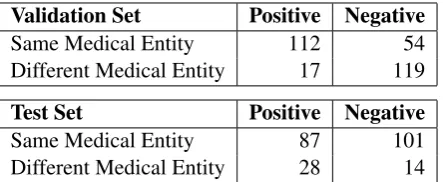
The training corpus of MEDIQA 2019 RQE Shared Task (Ben Abacha et al., 2019) consists of 8,588 training pairs, containing 54.2% positive pairs. The remaining pairs (3,933) are negative examples collected by associating a random short form of NLM dataset question (JW et al., 2000) having at least one common keyword and at least one different keyword for each original question. The validation test corpus contains 302 pairs of questions consisting of 173 negative pairs and 129 positive pairs. Also the hidden test set had in total 230 pairs of questions of which 115 (50%) were true pairs and rest (115) false pairs. The ques-tion pairs in validaques-tion and hidden test set had its first question a Consumer asked Health Question (CHQ) and second question a Frequently Asked Question (FAQ). Upon doing an elementary anal-ysis of the task dataset, we observe there are ex-amples in validation and test set where medical entities are not in same form (either synonyms or abbreviation) in both questions but they still entail each other and vice versa.
Validation Set Positive Negative
Same Medical Entity 112 54
Different Medical Entity 17 119
Test Set Positive Negative
Same Medical Entity 87 101
[image:2.595.308.530.499.590.2]Different Medical Entity 28 14
Table 1: Dataset Statistics : Positive means Entailment & Negative means Not Entailment.
We additionally used an annotated corpus of
Other effects, PersonOrg, Prognosis,
Susceptibil-ity, Other, Not Disease.
4 Models
In this section we will discuss about the various approaches we have used for building our Ques-tion Entailment detecQues-tion model.
• Dependency Tree-LSTM(Tai et al., 2015):
A generalization of LSTM (Long Short-Term Memory) to tree-structured network topolo-gies. The model was aimed to capture the syntactic relations between two questions.
• BERTLarge, uncased (Devlin et al., 2018):
BERT which stands for Bidirectional En-coder Representations from Transformers is designed to train deep bidirectional represen-tations by jointly conditioning on both left and right context in all layers. Language models have demonstrated that rich, unsuper-vised pre-training is an integral part of many language understanding systems. Hence, we try fine-tuning BERT to obtain better results on this task.
• Bio-BERT(Lee et al., 2019): Domain
spe-cific language representation model based on BERT and pre-trained on large-scale bio-medical corpora.
• Sci-BERT + Hinge loss (Beltagy et al.,
2019) : A pre-trained contextualized em-bedding model based on BERT to address the lack of high-quality, large-scale labeled scientific data, fine-tuned with a Hinge loss function. This outperformed all other sys-tems during the validation phase.
Now we describe all our approaches in-detail.
4.1 Dependency Tree-LSTM
We refer to a Child-Sum Tree-LSTM(Tai et al., 2015) applied to a dependency tree as a De-pendency Tree-LSTM. We produced deDe-pendency parses2of the questions in the dataset for our De-pendency Tree-LSTM model. Each Tree-LSTM unit (indexed by j) contains input and output gates ij and oj, a memory cell cj and hidden state hj. The difference between the standard LSTM unit and Tree-LSTM units is that gating
2Dependency parses produced by the Stanford Neural
Network Dependency Parser (Chen and Manning,2014)
vectors and memory cell updates are dependent on the states of possibly many child units. Ad-ditionally, instead of a single forget gate, the Tree-LSTM unit contains one forget gate fjk for each child k. This allows the Tree-LSTM unit to se-lectively incorporate information from each child. Each Tree-LSTM unit takes an input vector xj. We took, each xj as a vector representation of a word in a sentence. The input word at each node depends on the tree structure used for the network. We first produce sentence representations hL
andhRforquestion1andquestion2respectively
in the pair using a Tree-LSTM model over question’s parse tree. Given these sentence repre-sentations, we calculate the entailment probability
ˆ
pθ using a neural network that considers both the distance and angle between the pair(hL, hR):
h×=hLhR,
h+=|hL−hR|,
hs=σ
W(×)h×+W(+)h++b(h)
,
ˆ
pθ = softmax
W(p)hs+b(p)
,
We want pˆθ given model parameters θ to be close to the p. Here y denotes whether it is an entailment. Hence we decide the cost function as the regularized KL-divergence betweenpandpˆθ:
pi =||i−y| −1| i={0,1}
J(θ) = m1 Pmk=1KLp(k) pˆ
(k) θ
+λ2kθk2 2,
wheremis the number of training pairs and the superscriptkindicates the k-th sentence pair.
4.2 BERT
We chose BERTLarge, uncased as our underlying BERT model. It consists of 24-layers, 1024-hidden, 16-heads, and 340M parameters. It was trained on the BookCorpus (800M words) and the English Wikipedia (2,500M words). The two in-put sentences in form ofquestion1andquestion2
question1 question2 Classifier
Feed-forward neural netwrok + softmax
CLS
BERT
TOK 1 TOK 2 ... ECLS E1 E2
C T1 T2 TN
[image:4.595.72.468.69.242.2]EN ... ...
TOK N
Feature vector of size 13
Classifier
Feed-forward neural netwrok + softmax
CLS
BERT
TOK 1 TOK 2 ... ECLS E1 E2
C T1 T2 TN
EN ... ...
TOK N
Feature vector of size 13
Gradient Boosting Classifier
0 1 isDuplicate Output
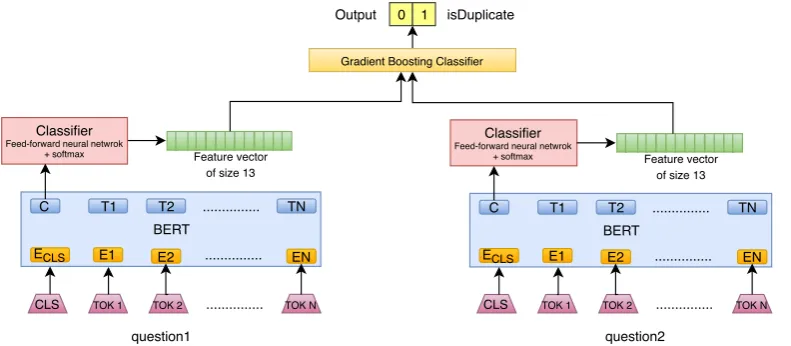
Figure 1: Model - QSpider
We used the PyTorch implementation from
pytorch-pretrained-bert3which had the BERT to-kenizer, positional embeddings, and pre-trained BERT model. Following the recommendation for fine-tuning in the original BERT approach (Devlin et al.,2018), we trained our classifier with a batch size of 32 for 5 epochs. The dropout probability was set to 0.1 for all layers, and Adam optimizer was used with a learning rate of 2e-5 with Binary Cross Entropy Loss as the loss function defined below:
Lentropy(x, class) =−log
exp(x[class]) P
jexp(x[j])
4.3 Sci-BERT + Hinge loss
We then tried using domain specific variants of BERT such as Bio-BERT (Lee et al., 2019) and Sci-BERT (Beltagy et al., 2019). Bio-BERT was pre-trained on biomedical domain corpora (e.g., PubMed abstracts, PMC full-text articles), whereas Sci-BERT consists of a custom-made vo-cabulary (Sci-Vocab) which consists of frequently observed words and subwords in scientific text which may differ from those occurring in general domain text. Sci-BERT outperformed Bio-BERT in this task. Since for binary classification tasks, both Hinge Loss and Cross-Entropy Loss are widely used, we tried incorporating both of these losses in our model. In this task, Hinge Loss did give a better accuracy as reported below. Hence, we focused on finetuning Sci-BERT by chang-ing the loss function from Binary Cross Entropy
3https://github.com/huggingface/
pytorch-pretrained-BERT
...
to Hinge Loss(used in SVMs) which resulted in an increase of accuracy approximately by 2% on the validation set.
Lhinge(f) =Pj6=yimax(0, sj−syi+ 1)
We discuss further about this in later sections.
5 QSpider - System Description
QSpider is a staged system consisting of
Sci-BERT (Beltagy et al.,2019) stacked with a Gradi-ent Boosting Classifier which performed the best in the hidden test set among all the models de-scribed above. This model aims at capturing tion types and use them as features to detect ques-tion entailment. We trained a multi-label classifier (as a question can fall in more than one class) on a annotated corpus (13 question types as mentioned above inSection 3) of consumer health questions (Roberts et al.,2014). For example:
Q: ”Can you mail me patient information about Glaucoma, I was recently diagnosed and want to learn all I can about the disease.” .
Qtype: ”Information” .
Since the available annotated dataset was not sufficient to build our question type classifier model hence we used pre-trained language model to efficiently learn from this small dataset. We used Sci-BERT as language model here as it can easily detect the semantic feature of question. Af-ter training on this dataset we predicted on our original Train, Validation and Test dataset.
vo-cabulary for our model. A vector of 1’s and 0’s of length 13 (number of question types) was ob-tained for each question in our Train, Validation and Test set. We horizontally stacked these vec-tors for question1 andquestion2 and used them as feature vector of shape 26 for our next model. Next we use these feature to train our Gradient
Boosting Classifier4, which predicts whether the
two questions are an entailment or not. We fur-ther fine-tuned our Gradient Boosting Classifier by keeping the number of estimators as 5000, to ob-tain the optimal performance on our hidden Test set without overfitting.
6 Results
This section discusses regarding the results of var-ious approaches we applied in this task. Since the training data-set (Ben Abacha et al.,2019) had less training examples, the systems were made to learn from the training data and tested on the validation data for validation results while for test results the systems learned from the training + validation data and tested on training data. Table 2represents the accuracy of the systems described on the valida-tion and test data.
Taking BERTlarge as our baseline, it gives an
accuracy of 76.2% outperforming Tree-LSTM (64%) and QSpider (62.0%) on validation set. The more domain-specific models like Bio-BERT (77.6%) andSci-BERT + Hinge Loss (80.5%)gave a significant boost. Also, Sci-BERT + Hinge Loss was the best performing systemamong all par-ticipants during Validation phase. For the test set BERTlarge gives an accuracy of 48.1% and simi-lar models like Bio-BERT and Sci-BERT + Hinge Loss gives an accuracy of 49.6% and 51.3% re-spectively. Here the more syntatic models like Tree-LSTM (60.2%) perform much better. Our modelQspider (68.4%)performs the best here and
3rdoverall among all participating systems.
7 Error Analysis
The training examples were much easy to check for entailment, with most of the positive pairs hav-ing common sub-strhav-ings or havhav-ing similar syntac-tic structure. As discussed earlier inSection 3, in the validation set, out of 302 examples, 112 exam-ples had same same medical entities which also
4https://scikit-learn.org/stable/
modules/generated/sklearn.ensemble. GradientBoostingClassifier.html
Model Valid Test
Tree-LSTM 64.0 60.2
BERTlarge, uncased 76.2 48.1
Bio-BERT 77.6 49.6
Sci-BERT + Hinge Loss 80.5 51.3
[image:5.595.324.509.60.148.2]QSpider 62.0 68.4
Table 2: Accuracy results for various models.
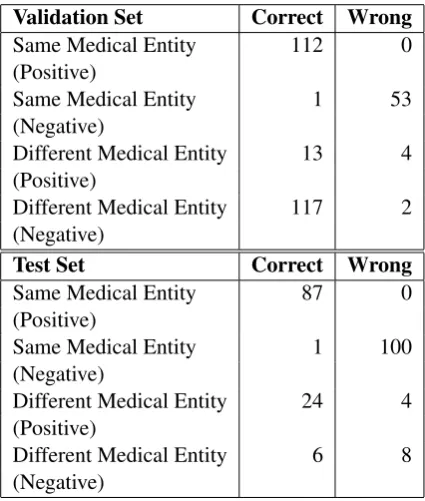
entail each other and 119 examples with differ-ent medical differ-entities which do not differ-entail each other (refer Table 2) because of which attention mod-els like BERT gained a huge success by focusing more on entity name. It is also evident (referTable 3) that these models fail in those cases where there is same medical entity on both sides but the pair is not an entailment.
Validation Set Correct Wrong
Same Medical Entity 112 0
(Positive)
Same Medical Entity 1 53
(Negative)
Different Medical Entity 13 4
(Positive)
Different Medical Entity 117 2
(Negative)
Test Set Correct Wrong
Same Medical Entity 87 0
(Positive)
Same Medical Entity 1 100
(Negative)
Different Medical Entity 24 4
(Positive)
Different Medical Entity 6 8
(Negative)
Table 3: Number of Correct and Wrong predictions made by Sci-BERT on the task dataset. Positive means Entailment & Negative means Not Entailment.
The Hidden Test set had more than 80 % pairs (refer Table 2) where there are same medical en-tity in both questions but still more than 50% pairs among these does not entail each other. Remaining examples are even more complicated like pairs having medical entity names as syn-onyms/abbreviated forms of each other. This caused a huge drop in accuracy of attention
based models like BERT. Here is where QSpider
[image:5.595.310.523.311.562.2]syn-tactic but also on semantic to capture the type of question asked and also not giving high attention to entity name.
QSpider on the other side didn’t perform equally well in the validation set since there are considerable number of examples having different medical entities inquestion1 andquestion2. We didn’t give any attention to entity name while de-signing QSpider keeping in mind the Test set. This is the reason QSpider doesn’t perform well on the Validation set but gives good results on the Test set.
8 Conclusion and Future Work
In this paper we discussed regarding various deep learning approaches and our final modelQSpider. It is evident from the results that even with very small sized data type we were able to generate satisfactory predictions for question type. There is a scope of improvement with the increase in the question type data. We can see that question type plays an important role in capturing ques-tion entailment but if the quesques-tions has same type but different medical entity name then our system might mis-classify. Since, our Test dataset didn’t have such examples with different medical enti-ties, hence we didn’t integrate this withQSpider
then.
We plan to integrate our model with detection of medical entity names of the questions and ap-pend them to our existing feature vector to cap-ture difficult examples. Currently, we are using question types as discrete and independent classes which we pass onto the Gradient Boosting Classi-fier. But in reality, any question asked cannot be always classified into a particular question type. It always consists of a blend of various types of question. So we plan upon using the GloVe em-beddings of the question classes (as mentioned in above sections) as extended features to be passed onto our classifier.
9 Acknowledgements
We would like to thank everyone in the organizing committee and the reviewers for reviewing our pa-per and providing their valuable feedback. We also acknowledge support from theComputer Science
and Engineering Departmentof theIndian
In-stitute of Technology Kharagpur, Indiafor
pro-viding us with the computational resources re-quired for running our models for this task. Lastly,
we would also like to thankT.Y.S.S. Santosh5for proof-reading the paper and providing other valu-able suggestions towards improving the paper.
References
Asma Ben Abacha and Dina Demner-Fushman. 2016. In recognizing ques- tion entailment for medical question answer- ing.
Asma Ben Abacha and Dina Demner-Fushman. 2019. A question-entailment approach to question answer-ing.
Scantlebury Arabella, Booth A, and Hanley B. 2017. Experiences, practices and barriers to accessing health information: A qualitative study.
Iz Beltagy, Arman Cohan, and Kyle Lo. 2019. Scibert: Pretrained contextualized embeddings for scientific text.
Asma Ben Abacha, Chaitanya Shivade, and Dima Demner-Fushman. 2019. Overview of the mediqa 2019 shared task on textual inference, question en-tailment and question answering, acl-bionlp 2019. InProceedings of the BioNLP 2019 workshop, Flo-rence, Italy, August 1, 2019. Association for Com-putational Linguistics.
Danqi Chen and Christopher D. Manning. 2014. A fast and accurate dependency parser using neural net-works.
Z. Chen, H. Zhang, X. Zhang, and L. Zhao. 2018. Quora question pairs.
Ido Dagan, Bill Dolan, Danilo Giampiccolo, and Bernardo Magnini. 2007. The third pascal recog-nising textual entailment challenge.
Jacob Devlin, Ming-Wei Chang, Kenton Lee, and Kristina Toutanova. 2018. Bert: Pre-training of deep bidirectional transformers for language understand-ing.
Yichen Gong, Heng Luo, and Jian Zhang. 2018. Natu-ral languagev inference over interaction space.
Haihong Guo, Xu Na, and Jiao Li. 2018. Qcorp: an an-notated classification corpus of chinese health ques-tions.
Ely JW, Osheroff JA, Gorman PN, Ebell MH, Chamb-liss ML, and Pifer EA. 2000. A taxonomy of generic clinical questions: classification study.British Med-ical Journal, 321:429–432.
Milen Kouylekov, Matteo Negri, Bernardo Magnini, and Bonaventura Coppola. 2006. Towards entailment-based question answering: Itc-irst at clef 2006.
5https://scholar.google.ca/citations?
Jinhyuk Lee, Wonjin Yoon, Sungdong Kim, Donghyeon Kim, Sunkyu Kim, Chan Ho So, and Jaewoo Kang. 2019. Biobert: a pre-trained biomedical languagerepresentation model for biomedical text mining.
Xiadong Liu, Pengcheng He, Weizhu Chen, and Jian-feng Gao. 2019. Multi-task deep neural networks for natural language understanding.
Pletneva Natalia, Vargas A, Kalogianni K, and Boyer C. 2012. Online health information search: what struggles and empowers the users?
Kirk Roberts, Kate Masterton, Marcelo Fiszman, Halil Kilicoglu, and Dina Demner-Fushman. 2014. An-notating question types for consumer health ques-tions.
Kai Sheng Tai, Richard Socher, and Christopher D. Manning. 2015. Improved semantic representations from tree-structured long short-term memory net-works.
Jane Weaver. 2016. More people search for health on-line.
A Supplemental Material
This is the link to our classifier code for QSpi-der which can be used to reproduce the results claimed in the Results section above forQSpider
- https://github.com/Team-IIT-KGP/