Proceedings of the Fourth Conference on Machine Translation (WMT), Volume 2: Shared Task Papers (Day 1) pages 91–102 91
Findings of the First Shared Task on
Machine Translation Robustness
Xian Li1, Paul Michel2, Antonios Anastasopoulos2, Yonatan Belinkov3, Nadir Durrani4, Orhan Firat5, Philipp Koehn6, Graham Neubig2, Juan Pino1, Hassan Sajjad4
1Facebook AI,2Carnegie Mellon University,3Harvard University and MIT, 4Qatar Computing Research Institute,5Google AI,6Johns Hopkins University
Abstract
We share the findings of the first shared task on improving robustness of Machine Translation (MT). The task provides a testbed representing challenges facing MT models deployed in the real world, and facilitates new approaches to improve models’ robustness to noisy input and domain mismatch. We focus on two language pairs (English-French and English-Japanese), and the submitted systems are evaluated on a blind test set consisting of noisy comments on Reddit1and professionally sourced transla-tions. As a new task, we received 23 submis-sions by 11 participating teams from universi-ties, companies, national labs, etc. All submit-ted systems achieved large improvements over baselines, with the best improvement having +22.33BLEU. We evaluated submissions by both human judgment and automatic evalua-tion (BLEU), which shows high correlaevalua-tions (Pearson’sr = 0.94and0.95). Furthermore, we conducted a qualitative analysis of the sub-mitted systems usingcompare-mt2, which revealed their salient differences in handling challenges in this task. Such analysis pro-vides additional insights when there is occa-sional disagreement between human judgment and BLEU, e.g. systems better at producing colloquial expressions received higher score from human judgment.
1 Introduction
In recent years, Machine Translation (MT) sys-tems have seen great progress, with neural mod-els becoming the de-facto methods and even ap-proaching human quality in news domain (Hassan et al., 2018). However, like other deep learning models, neural machine translation (NMT) models are found to be sensitive to synthetic and natural noise in input, distributional shift, and adversarial
1
www.reddit.com
2https://github.com/neulab/compare-mt
examples (Koehn and Knowles, 2017; Belinkov and Bisk,2018;Durrani et al.,2019; Anastasopou-los et al., 2019; Michel et al., 2019). From an application perspective, MT systems need to deal with non-standard, noisy text of the kind which is ubiquitous on social media and the internet, yet has different distributional signatures from cor-pora in common benchmark datasets.
The goal of this shared task is to provide a testbed for improving MT models’ robustness to orthographic variations, grammatical errors, and other linguistic phenomena common in user-generated content, via better modelling, training, adaptation techniques, or leveraging monolingual training data. Specifically, the shared task aims to bring improvements on the following challenges:
• To improve NMT’s robustness to ortho-graphic variations, grammatical errors, infor-mal language, and other linguistic phenom-ena or noise common on social media.
• To explore effective approaches to leverage abundant out-of-domain parallel data.
• To explore novel approaches to leverage abundant monolingual data on the Web (e.g., tweets, Reddit comments, commoncrawl, etc.).
• To thoroughly investigate and understand the overall challenges in translating social me-dia text and identify major themes of efforts which needs more research from the commu-nity.
Jpn→Eng. We describe the dataset and the task setup in Section3. The shared-task attracted a to-tal of 23 submissions from 11 teams. The teams employed a variety of methods to improve robust-ness. A specific challenge was the small size of the in-domain noisy parallel dataset. We summa-rize the participating systems in Section4and the notable methods in Section 5. The contributions were evaluated both automatically and via a hu-man evaluation. The results demonstrate a signifi-cant progress of the state-of-the-art in MT robust-ness, with multiple teams surpassing the shared-task baseline by a large margin. These results are discussed in Section6.
We hope that this task leads to more efforts from the community in building robust MT models.
2 Related Work
The fragility of neural networks (Szegedy et al.,
2013) has been shown to extend to neural machine translation models (Belinkov and Bisk, 2018;
Heigold et al.,2017) and recent work focused on various aspects of the problem. From the identi-fication of the causes of this brittleness, to the in-duction of (adversarial) inputs that trigger the un-wanted behavior (attacks) and making such mod-els robust against various types of noisy inputs (defenses); improving robustness has been receiv-ing increasreceiv-ing attention in NMT.
While Koehn and Knowles (2017) mentioned
domain mismatch as a challenge for neural ma-chine translation, Khayrallah and Koehn (2018) addressed noisy training data and focus on the types of noise occurring in web-crawled corpora.
Michel and Neubig(2018) proposed a new dataset (MTNT) to test MT models for robustness to the types of noise encountered in the Internet and demonstrated that these challenges cannot be over-come by simple domain adaptation techniques alone.
Belinkov and Bisk (2018) and Heigold et al.
(2017) showed that NMT systems are very sensi-tive to slightly perturbed input forms, and hinted at the importance of injecting noisy examples during training, also known as adversarial examples. Fur-ther research proposed several methods of generat-ing and usgenerat-ing noisy examples as NMT input to ad-vance the understanding and improve the transla-tion quality. Following machine vision, two major branches being explored when generating noisy examples,i)white box methods, where adversarial
examples are generated with access to the model parameters (Ebrahimi et al., 2018; Cheng et al.,
2018a,b, 2019) and ii) black-box attacks, where examples are generated without accessing model internals (Zhao et al., 2018; Lee et al., 2018; ?;
Anastasopoulos et al.,2019;Vaibhav et al.,2019); see Belinkov and Glass (2019) for a categoriza-tion of such work. In particular, some have fo-cused on specific variations of naturally-occurring noise, such as grammatical errors produced by non-native speakers (Anastasopoulos et al.,2019) or errors extracted from Wikipedia edits (Belinkov and Bisk, 2018). It has also been shown that adding synthetic noise does not trivially increase robustness to natural noise (Belinkov and Bisk,
2018) and may require specific recipes (Karpukhin et al.,2019).
Michel et al. (2019) recently emphasized the importance of meaning-preserving perturbations and along withCheng et al.(2019) demonstrated the utility of adversarial training without sig-nificantly impairing performance on clean data and domain. Durrani et al. (2019) showed that character-based representations are more robust towards noise compared to such learned using BPE-based sub-word units in the task of machine translation.
3 Task
This is the first year we introduce the robustness
task. The goal of the task setup is to
exam-ine MT systems’ performance on non-standard, noisy, user-generated text, which often resemble mixed challenges around orthographic variations, grammar errors, domain shift and stylistic lexical choice, etc. We use the MTNT dataset (Michel and Neubig, 2018) as a testbed for the above-mentioned robustness challenges. To give readers an idea of the natural “noise” present in the MTNT dataset, and the challenges for MT systems to ro-bustly understand and translate them, we provide some examples of input variations:
• Spelling/typographical errors: accross
(across), recieve (receive), tant (temps)
• Grammatical errors: a tons of, there are less people
• Spoken language and internet slang:
• Code switching:This is so kawaii, C’est trop mainstream
• Profanity/slurs:f*ck, m*rde
Readers are encouraged to refer toMichel and Neubig (2018) for more details. This year’s task probes MT robustness for two language pairs, French to/from English and Japanese to/from En-glish.
3.1 Task Setup
The task includes two tracks,constrainedand un-constrained depending on whether the system is trained on a predefined training datasets or not. The two tracks are evaluated by the same auto-matic and human evaluation protocol, however, they are compared separately.
For the constrained system track, the task speci-fies two types of training data in addition to MTNT train set:
• “Out-of-domain” parallel data: This facil-itates MT model’s capability to perform su-pervised learning from examples with differ-ent distribution such as lexical choice, lan-guage style, genre etc. For example, paral-lel corpora from WMT news translation task, subtitles and TED talks are specified.
• Monolingual data: We encourage
partic-ipants to develop novel solutions to learn from unlabelled data, improve existing semi-supervised approach such as backtranslation. We provide both in-domain (MTNT) and out-of-domain (News Commentary, News Crawl, etc) monolingual data.
3.2 Training Data
In the constrained setting, participants were
al-lowed to use the WMT15 training data3 for
Eng↔Fra and any of the KFTT (Neubig, 2011), JESC (Pryzant et al.) and TED talks (Cettolo et al.,
2012) corpora for Jpn↔Eng. Additionally, the use of the MTNT corpus (Michel and Neubig,2018) was allowed in order to adapt models on limited in-domain data.
3.3 Test Data
The test sets were collected following the same protocol as the MTNT dataset,i.e. collected from
3http://www.statmt.org/wmt15/
translation-task.html
Reddit, filtered out for noisy comments using a sub-word language modeling criterion and trans-lated by professional translators. The statistics of the test sets are reported in Table1.
3.4 Evaluation protocol
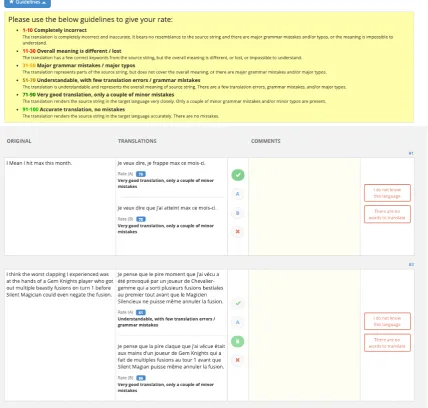
The system outputs were evaluated by profes-sional translators. The translators were presented the original source sentence, the reference and the system output side by side. The order between the reference and the system output was randomized by the user interface. The translators rated both the reference and the translation on a scale from 1 to 100. For both the original source sentence and the reference, the original text was presented except for Eng-Jpn where the Japanese reference tokenized with KyTea was presented in order to be consistent with the systems’ outputs. The user interface for annotation is illustrated in Figure1.
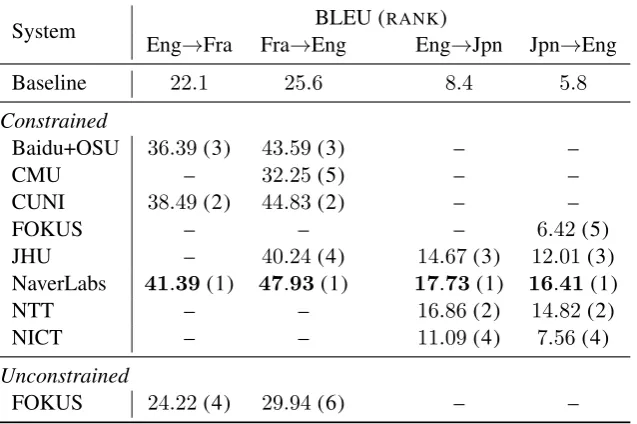
We also evaluated BLEU (Papineni et al.,2002) for each system using SacreBLEU (Post, 2018). For all language pairs except Eng-Jpn, we used the original reference and SacreBLEU with the default options. In the case of Eng-Jpn, we used the reference tokenized with KyTea and the option
--tokenize none.
4 Participants and System Descriptions
We received 23 submissions from 11 teams. Ex-cept two submissions on the Eng-Fra language pair, all systems used the constrainedsetup. Be-low we briefly describe the systems from the 8 teams which submitted corresponding system de-scription papers:
Baidu & Oregon State University’s submission (Zheng et al., 2019): Their system is based on the Transformer implementation in OpenNMT-py (Klein et al., 2017). The main methods ap-plied in their submission are: domain-sensitive data mixing and data augmentation with back-translation. For data mixing, they used a special symbol on the source side to indicate the data do-main. For data augmentation, they back-translate from a target language to its noisy source. The intuition, also observed by Michel and Neubig
Eng-Fra Fra-Eng Eng-Jpn Jpn-Eng
# samples 1,401 1,233 1,392 1,111
# source tokens 20.0k 19.8k 20.0k 18.7k
# target tokens 22.8k 19.2k 33.6k 13.4k
Table 1: Statistics of the test sets.
The team experimented with the Fra→Eng and Eng→Fra translation directions, obtaining 43.6 and 36.4 BLEU-cased, respectively (3rd place in both). Their ablations show significant benefit from domain-sensitive training (+3 BLEU), with additional improvements from back-translation and ensembling.
CMU’s submission (Zhou et al., 2019): This submission only participated in the Fra→Eng di-rection. They proposed the use of tied multitask learning, where the noisy source sentences are first decoded by a same-language denoising de-coder, and both information is passed on to the translation decoder. This approach requires data triples of noisy source, clean source, translation, which they created by data augmentation over the provided data, using tag-informed translation sys-tems trained on either noisy (MTNT) or clean (Eu-roparl) data. As the participants point out though, their performance improvements seems to be at-tributed to data augmentation and not to the inter-mediate denoising decoder.
CUNI’s submission (Helcl et al., 2019): They participated in Eng→Fra and Fra→Eng direc-tions, following a classical two stage approach, i) training of a base model using a mix of parallel (WMT15 Eng-Fra News Translation) and back-translated monolingual data (from News Crawl and Europarl - excluding News Discussions), ii) fine-tuning of the base model using the training portion of the MTNT dataset. All models follow the Transformer-Big architecture, with the hyper-parameters and optimization recipe from the 2018 WMT News Translation shared task submission of CUNI, without ensembles. For both Eng-Fra and Fra-Eng directions, fine-tuning brought about 2+ BLEU points on top of the base models with the Transformer-Big architecture, whereas improve-ments were substantially larger when the base models were RNN-Based MTNT baselines, about
8+ BLEU points. Participants emphasized the
importance of their strong Transformer-Big base
model which was already 10+ BLEU points better than the MTNT baseline provided by the shared task. The effect of individual partitions of the base model training set (parallel and backtranslated-mono) on final system quality is not experi-mented. Finally, participants point out one pecu-liarity they’ve noticed in the train/validation par-titioning of the original MTNT dataset; validation source sentences being started with the letter “Y” followed by alphabetically sorted sentences (test partition not effected).
FOKUS’ submission (Grozea, 2019): This
team participated in three directions: Eng→Fra, Fra→Eng and Jpn→Eng. For the Eng→Fra and Fra→Eng language pairs, the submissions are un-constrainedsystems, where the model was trained on the medical domain corpus provided by the WMT biomedical shared task4. Despite the train-ing data betrain-ing out-of-domain, removtrain-ing “low-quality” parallel data such as “Subtitles” as the au-thor hypothesized helped to bring 2 to 4 BLEU points improvement over the baseline models. Their Jpn→Eng submission is aconstrained sys-tem, using the same model architecture as the Eng→Fra language pair. To improve robustness, they introduced synthetic noise (omitting and du-plicating letters) in the training data to both source and target sentences.
JHU’s submission (Post and Duh,2019): This
submission participated in the Fra→Eng and
Jpn↔Eng tasks. The participants used data dual cross-entropy filtering for reducing the monolin-gual data, then back-translate these, and train their Transformer models (Vaswani et al.,2017). They compared Moses tokenization+Byte Pair Encod-ing (BPE) (Sennrich et al., 2016), and sentence-piece (Kudo and Richardson, 2018) (without any pre-processing) and found the two comparable, and that using larger sentence-piece models im-proved over smaller ones. For Jpn↔Eng (both
di-4
rections) they first used both in-domain (MTNT) and out-of-domain data (other constrained), and then continued training (fine-tune) using MTNT only. They also reported many results from their hyper-parameter search (albeit without a clear rec-ommendation). The final submission is an ensem-ble of 4 models.
NaverLabsEurope(NLE)’ submission (B´erard
et al., 2019): The participants carried substan-tial effort to clean the CommonCrawl data, ap-plying length filtering (length ratio threshold), language identification-based filtering, and atten-tion based filtering. They used the Transformer-Big architecture for Fra→Eng and Jpn→Eng, and Transformer-Base for the Eng→Jpn direction.
The participants incorporated several methods to encourage robustness (detailed ablations on the effect of each method were not provided). They lowercase all data. However in order to preserve casing information in the input, they propose a technique called inline casing which adds addi-tional casing tags (one per non-lowercased sub-word) in the sequence. Emojis were replaced with a special symbol. Natural noise based on manually defined noise rules was added on the source side of the training data. Lastly, MTNT monolingual data was back-translated to be used during training of the final system. They trained their system on all available data with special tags for each domain and for each data type e.g. real, back-translated, or noisy data. They found that adding tags is as good as fine-tuning the system, allowing for more flex-ibility at test time. Their final submission with an ensemble of 6 systems for Eng→Jpn and ensem-bles of 4 systems for the other language directions performed the best in the evaluation campaign.
NICT’s submission (Dabre and Sumita,2019):
The authors used Transformer models to train their systems and employed two strategies namely: i) mixed fine-tuning and ii) multilingual models for making the systems robust. The former helps as the in-domain data is available in a very small
quantity. Using a mix of in-domain and
out-domain data for fine-tuning helps overcome the problem of adjusting learning rate, applying better regularization and other complicated strategies. It is not clear how these two methods contributed to-wards making the models more robust. According to the authors, mixed fine-tuning and multilingual training (bidirectional) helped. In the error
analy-sis, they found that their system performs poorly in translating emojis. The segmentation errors gen-erated by KyTea resulted in further errors in the translation.
NTT’s submission (Murakami et al., 2019):
The participants submitted systems for the Eng→Jpn and Jpn→Eng directions in the con-strained setting. Their techniques include the placeholder mechanism for copying non-standard tokens (emojis, emoticons, etc), back-translation, fine-tuning on in-domain corpus, and ensem-ble. Especially, the placeholder mechanism pro-vides +1.4 BLEU and +0.7 BLEU points for Jpn→Eng and Eng→Jpn respectively. Finetun-ing provides a larger improvement for Eng→Jpn (+1.2 BLEU) than Jpn→Eng (-0.3 BLEU). Their model is Transformer-Base configuration, where they demonstrated its capacity to noise-robustness can be further improved by the above-mentioned techniques.
5 Summary of Methods
In this section, we give a common theme and sum-mary of methods applied by the various partici-pants.
Data Cleaning Data cleaning played an
impor-tant part in training successful MT systems in this campaign. Unlike other participants, the win-ning team Naver Labs B´erard et al. (2019) and NTT (Murakami et al.,2019) applied data clean-ing techniques in order to filter noisy parallel sen-tences. They filtered i) identical sentences on source and target side, ii) sentences that belonged to a language other than the source and target lan-guage, iii) sentences with length mismatch, and iv) also applied attention-based filtering. Data clean-ing gave an improvement of more than 5 BLEU points with substantial reduction in the hallucina-tion of the model for the winning team.
Placeholders Training and test data contained tokens (such as emoticons) which do not require translation. Murakami et al. (2019) and B´erard et al. (2019) preserved these in a preprocessing step using special placeholders and copied them in the translation output. Murakami et al. (2019) reported a gain of up to 1.4 BLEU points by using placeholders.
Data Augmentation Other than handling noisy
data sparsity. All the participants back-translated in-domain monolingual data and used synthetic data as part of their training pipeline. In addition,
B´erard et al.(2019) created a noisy version of all the available in-domain and out-of-domain data by randomly replacing words with their noisy vari-ants. For training, they appended source sentences with a tag<noisy>to distinguish them from the original data. Zhou et al.(2019) used translation systems using placeholders in order to create both clean versions of the noisy in-domain datasets, as well as noisy versions of the clean out-of-domain dataset. To get additional data, other than back-translation, the JHU team (Post and Duh, 2019) used cross-entropy based filtering to select top 1 million sentences from Gigaword, CommonCrawl and the UN corpus. Adding large filtered data gave then an improvement of +5.8 BLEU points.
Domain-aware Training In order to differenti-ate different data, real from synthetic, in-domain from out-domain, several participants used addi-tional tags. Zheng et al. (2019); B´erard et al.
(2019) used domain tags during training to in-dicate data domain. B´erard et al. (2019) addi-tionally included data type tags (real or back-translated) for further categorization of the train-ing data. Compared to fine-tuntrain-ing, addtrain-ing tags provides them additional flexibility, resulting in a generalized system, robust towards a variety of in-put data.
Fine-tuning Along with the noisy in-domain
MTNT data, general domain data typically made available for WMT campaign was also allowed for this task. Most participants (Murakami et al.,
2019;Dabre and Sumita,2019;Helcl et al.,2019) trained on general domain data and fine-tuned the models towards the task. Murakami et al.(2019) did not see a consistent improvement with fine-tuning. Due to the small size of the in-domain data,Dabre and Sumita(2019) fine-tuned on a mix of in-domain and a subset of the out-of-domain data.
Ensembles To benefit from the different trained models and to make the performance more stable,
many participants performed ensemble over
their models.Murakami et al.(2019),B´erard et al.
(2019), Zheng et al. (2019), and Post and Duh
(2019) ensembled between 4 and 6 checkpoints of their model for the final submission. They observed a consistent performance improvement
over using a single model.
6 Results
In this section we describe quantitative results, and also perform a qualitative analysis of the results.
6.1 Quantitative Results
The quantitative analysis of the submitted systems yields fairly consistent results. On automatic eval-uation (BLEU) the best system across all transla-tion directransla-tions is the NaverLabsEurope(NLE) one. The same system received also the highest hu-man judgment scores, with the exception of the Eng→Jpn task, where the NTT system was ranked higher. Overall, the correlation between human judgments and BLEU is very high. For Eng→Fra, the Pearson’s correlation coefficient is0.94, while for the other three tasks it is over0.97.
Human Evaluation The results of human
eval-uation following the evaleval-uation protocol described in Section3.4are outlined in Table2.
Automatic Evaluation The automatic
evalua-tion (BLEU) results of the Shared Task are sum-marized in Table3.
6.2 Qualitative Analysis
In order to discover salient differences be-tween the methods, we performed analysis using
compare-mt(Neubig et al.,2019), and present a few of the salient findings below.
Stronger Submissions were Stronger at Every-thing: The submissions to the track achieved a wide range of BLEU and human evaluation scores. In our analysis we found that the systems at the higher end of the spectrum with regards to BLEU also tended to be the best by most other measures (human evaluation, word F-measure by various frequency buckets, sentence-level scores, etc.). Because of this, we limit our remaining anal-ysis to the top three systems in the Fra→Eng and Eng→Fra tracks, and the top two systems in the Eng→Jpn and Jpn→Eng tracks.
Generalization to Words not in Adaptation
Data is Essential: The MTNT corpus provides
System Human judgment scores (RANK)
Eng→Fra Fra→Eng Eng→Jpn Jpn→Eng
Constrained
Baidu+OSU 71.5(2) 80.6(3) – –
CMU – 58.2(6) – –
CUNI 66.3(3) 82.0(2) – –
FOKUS – – – 48.5(5)
JHU – 76.3(4) 58.5(3) 65.4(3)
NaverLabs 75.5(1) 85.3(1) 63.9(2) 74.1(1)
NTT – – 66.5(1) 71.3(2)
NICT – – 44.7(4) 49.1(4)
Unconstrained
[image:8.595.144.456.63.256.2]FOKUS 52.5(4) 62.6(5) – –
Table 2: Average human judgments over all submitted systems (the higher the better). The systems’ rank for each translation direction is shown in parentheses. The best system ishighlighted.
<1 1 2 3 4
[5,10) [10,100)
[100,1000) >=1000
frequency 0.0
0.1 0.2 0.3 0.4 0.5 0.6 0.7 0.8
fmeas
BDOSU CUNI NLE
Figure 2: Word F-measure by frequency in the MTNT training data for Fra-Eng.
performance on words that were not included in this training data that nonetheless appeared in the test set. We show the example of word-level F-measure bucketed by frequency of the words in the MTNT test set for Fra→Eng in Figure2. From this figure we can see that the NLE system does a bit better in all frequency categories, but the dif-ference is particularly stark for words that appear only once or not at all in the MTNT training set.
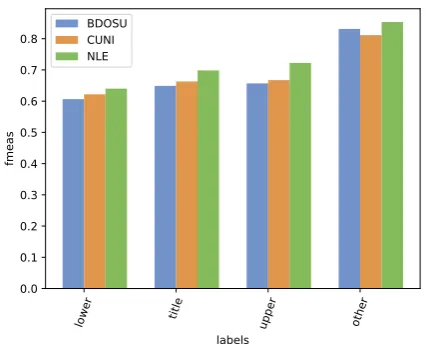
Proper Handling of Casing is Important: One
other innovation performed by the NLE team was lowercasing of words and separate prediction of casing information. This modeling decision appar-ently resulted in significantly better results
partic-lower title upper other
labels 0.0
0.1 0.2 0.3 0.4 0.5 0.6 0.7 0.8
fmeas
[image:8.595.309.524.312.485.2]BDOSU CUNI NLE
Figure 3: Word F-measure by casing of the words in the target: all lower-case, title case, all upper-case, or other.
ularly on words that were written in all upper-case, as demonstrated in the results of word F-measure by casing in the target language, demonstrated for Eng→Fra in Figure3. In addition, we show an example for Fra→Eng in Table4, where the NLE system translates upper-case characters perfectly, but the CUNI system struggles.
[image:8.595.77.291.312.500.2]char-System BLEU (RANK)
Eng→Fra Fra→Eng Eng→Jpn Jpn→Eng
Baseline 22.1 25.6 8.4 5.8
Constrained
Baidu+OSU 36.39(3) 43.59(3) – –
CMU – 32.25(5) – –
CUNI 38.49(2) 44.83(2) – –
FOKUS – – – 6.42(5)
JHU – 40.24(4) 14.67(3) 12.01(3)
NaverLabs 41.39(1) 47.93(1) 17.73(1) 16.41(1)
NTT – – 16.86(2) 14.82(2)
NICT – – 11.09(4) 7.56(4)
Unconstrained
[image:9.595.141.460.64.276.2]FOKUS 24.22(4) 29.94(6) – –
Table 3: Automatic evaluation (BLEU, cased) over all submitted systems, with the system’s rank in parentheses. The best system ishighlighted.
Output BLEU+1
Ref From Sri Lanka , to Russia , to the United States , to Japan I mean it ’s a market THAT GOES EVERYWHERE .
CUNI from sri lanka , to russia , to the united states , to japon I mean it ’s a market QUI VA PARTOUT .
33.0
NLE From Sri Lanka , to Russia , to the United States , to Japan I mean it ’s a market THAT GOES EVERYWHERE .
[image:9.595.102.496.321.430.2]100
Table 4: An example of handling of casing in two Fra→Eng systems
Output BLEU+1
Ref Kawaii (*・ω・人)
NTT Cute (*・ω・人) 76.0
NLE It ’s cute . 0.0
Ref
NTT 0.0
NLE 100
Table 5: Examples of translation results on special characters.
acters, while the NLE system performed better on Unicode-standard Emojis, as shown in Table5.
Non-standard Sentence Structure can be Diffi-cult: Some systems also found sentences with unusual structures, including brackets or other types of punctuation interspersed with actual text, particularly difficult. For example, Table6shows
an example of Jpn→Eng sentences where the
NTT system had trouble generating the appropri-ate number of symbols in the appropriappropri-ate places, while the NLE system was more robust in this re-gard.
Colloquial Expressions are Key: There was
[image:9.595.72.297.469.587.2]Output BLEU+1
Ref * * ] ( # mm-e9 ) [ * * Because there ’s now protection * * ] ( # mm-e4 )
NTT * * * * ) ( # m-e9 ) [ * * * * * * * * * * * * * * * * * -e4 because there is more protection . )
14.3
NLE * * * ( # mm-e9 ) [ * * Because there is already protection * * ] ( # mm-e4 )
[image:10.595.103.493.62.170.2]72.0
Table 6: An example of translation results on as sentence with an unusual number of special symbols.
n-gram NTT NLE
1. ていない 5 0
2. だけど 4 0
3. 多くの 4 0
4. ね 3 0
5. だけど、 3 0
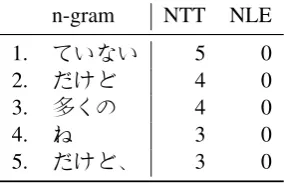
Table 7: Examples of n-grams where one the NTT Eng→Jpn system was more accurate than the NLE sys-tem
performed fine-tuning on the MTNT data, moving it towards a more appropriately colloquial register.
7 Conclusions
As a new WMT shared task, this year we focused on building MT systems which are robust to in-put variations commonly observed in informal lan-guage, social media text etc.
From a methodological perspective, the “con-strained” setup of the task encouraged participants to leverage both out-of-domain parallel data and in-domain monolingual data to improve perfor-mance. Some techniques were utilized by multi-ple participants and proved their effectiveness in boosting MT models’ robustness to noisy input and domain mismatch, including data cleaning, domain-aware training, data augmentation (in-cluding backtranslation and copying place-holder tags), finetuning, etc.
In terms of evaluation, we found an automatic metric (BLEU) to be roughly consistent with hu-man judgment. Qualitative analysis found that strong baseline systems were important, but on top of this additional methods specifically aimed at trying to handle various types of noise found in social media text were effective and necessary to further improve within the upper echelons of sys-tems submitted to the shared task.
There are several directions to be explored in the future editions of the task. First, it can exhibit a separate track for “probing” models’ robustness so as to understand current models’ weaknesses. Sec-ond, it could further disentangle improvements for different challenges, e.g., due to noise in training data or due to distribution shift at test time. Con-trolling the kind of noise introduced, e.g. natural vs. artificial, may be useful in this regard.
Acknowledgements
We thank Facebook for funding the human evalu-ation and blind test set creevalu-ation.
References
Antonios Anastasopoulos, Alison Lui, Toan Q. Nguyen, and David Chiang. 2019. Neural machine translation of text from non-native speakers. In
Proc. NAACL HLT.
Yonatan Belinkov and Yonatan Bisk. 2018. Synthetic and natural noise both break neural machine transla-tion. InInternational Conference on Learning Rep-resentations (ICLR).
Yonatan Belinkov and James Glass. 2019. Analysis methods in neural language processing: A survey.
Transactions of the Association for Computational Linguistics (TACL), 7:49–72.
Alexandre B´erard, Ioan Calapodescu, and Claude Roux. 2019. Naver Labs Europe’s Systems for the WMT19 Machine Translation Robustness Task. In Proceedings of the 2019 Shared task on chine Translation Robustness, Conference on Ma-chine Translation (WMT).
Mauro Cettolo, Christian Girardi, and Marcello Fed-erico. 2012. Wit3: Web inventory of transcribed and translated talks. In Proceedings of the 16th Con-ference of the European Association for Machine Translation (EAMT), pages 261–268.
[image:10.595.110.255.214.306.2]Yong Cheng, Lu Jiang, and Wolfgang Macherey. 2019. Robust neural machine translation with doubly ad-versarial inputs. InACL. Association for Computa-tional Linguistics.
Yong Cheng, Zhaopeng Tu, Fandong Meng, Junjie Zhai, and Yang Liu. 2018b. Towards robust neural machine translation.CoRR, abs/1805.06130.
Raj Dabre and Eiichiro Sumita. 2019. NICT’s Super-vised MT Systems for the Translation Robustness Task in WMT19. InProceedings of the 2019 Shared task on Machine Translation Robustness, Confer-ence on Machine Translation (WMT).
Nadir Durrani, Fahim Dalvi, Hassan Sajjad, Yonatan Belinkov, and Preslav Nakov. 2019. One size does not fit all: Comparing NMT representations of different granularities. In Proceedings of the 2019 Conference of the North American Chapter of the Association for Computational Linguistics: Hu-man Language Technologies, Volume 1 (Long and Short Papers), pages 1504–1516, Minneapolis, Min-nesota. Association for Computational Linguistics.
Javid Ebrahimi, Daniel Lowd, and Dejing Dou. 2018. On adversarial examples for character-level neural machine translation. InProceedings of the 27th In-ternational Conference on Computational Linguis-tics, Santa Fe, New Mexico, USA. Association for Computational Linguistics.
Cristian Grozea. 2019. The submission of FOKUS to the WMT 19 robustness task. InProceedings of the 2019 Shared task on Machine Translation Robust-ness, Conference on Machine Translation (WMT).
Hany Hassan, Anthony Aue, Chang Chen, Vishal Chowdhary, Jonathan Clark, Christian Feder-mann, Xuedong Huang, Marcin Junczys-Dowmunt, William Lewis, Mu Li, et al. 2018. Achieving hu-man parity on automatic chinese to english news translation. arXiv preprint arXiv:1803.05567.
Georg Heigold, G¨unter Neumann, and Josef van Genabith. 2017. How robust are character-based word embeddings in tagging and mt against wrod scramlbing or randdm nouse? arXiv preprint arXiv:1704.04441.
Jindˇrich Helcl, Jindˇrich Libovick´y, and Martin Popel. 2019. CUNI System for the WMT19 Robustness Task. In Proceedings of the 2019 Shared task on Machine Translation Robustness, Conference on Machine Translation (WMT).
Vladimir Karpukhin, Omer Levy, Jacob Eisenstein, and Marjan Ghazvininejad. 2019. Training on synthetic noise improves robustness to natural noise in ma-chine translation.CoRR, abs/1902.01509.
Huda Khayrallah and Philipp Koehn. 2018. On the impact of various types of noise on neural machine translation. InProceedings of the 2nd Workshop on Neural Machine Translation and Generation, pages 74–83, Melbourne, Australia. Association for Com-putational Linguistics.
Guillaume Klein, Yoon Kim, Yuntian Deng, Jean Senellart, and Alexander M. Rush. 2017. Open-NMT: Open-source toolkit for neural machine trans-lation. InProc. ACL.
Philipp Koehn and Rebecca Knowles. 2017. Six challenges for neural machine translation. arXiv preprint arXiv:1706.03872.
Taku Kudo and John Richardson. 2018. Sentence-Piece: A simple and language independent subword tokenizer and detokenizer for neural text processing. InProceedings of the 2018 Conference on Empirical Methods in Natural Language Processing: System Demonstrations, pages 66–71, Brussels, Belgium. Association for Computational Linguistics.
Katherine Lee, Orhan Firat, Ashish Agarwal, Clara Fannjiang, and David Sussillo. 2018. Hallucina-tions in neural machine translation. In Interpretabil-ity and Robustness in Audio, Speech, and Language Workshop Conference on Neural Information Pro-cessing Systems.
Paul Michel, Xian Li, Graham Neubig, and Juan Miguel Pino. 2019. On evaluation of ad-versarial perturbations for sequence-to-sequence models. InProc. NAACL HLT.
Paul Michel and Graham Neubig. 2018. MTNT: A testbed for Machine Translation of Noisy Text. In Proceedings of the 2018 Conference on Em-pirical Methods in Natural Language Processing (EMNLP).
Soichiro Murakami, Makoto Morishita, Tsutomu Hi-rao, and Masaaki Nagata. 2019. NTT’s Machine Translation Systems for WMT19 Robustness Task. In Proceedings of the 2019 Shared task on chine Translation Robustness, Conference on Ma-chine Translation (WMT).
Graham Neubig. 2011. The Kyoto free translation task. http://www.phontron.com/kftt.
Graham Neubig, Zi-Yi Dou, Junjie Hu, Paul Michel, Danish Pruthi, and Xinyi Wang. 2019. compare-mt: A tool for holistic comparison of language genera-tion systems. In Proceedings of the 2019 Confer-ence of the North American Chapter of the Asso-ciation for Computational Linguistics (Demonstra-tions), pages 35–41, Minneapolis, Minnesota. Asso-ciation for Computational Linguistics.
Kishore Papineni, Salim Roukos, Todd Ward, and Wei-Jing Zhu. 2002. Bleu: a method for automatic eval-uation of machine translation. In Proceedings of 40th Annual Meeting of the Association for Com-putational Linguistics, pages 311–318, Philadelphia, Pennsylvania, USA. Association for Computational Linguistics.
Matt Post and Kevin Duh. 2019. JHU 2019 Robust-ness Task System Description. InProceedings of the 2019 Shared task on Machine Translation Robust-ness, Conference on Machine Translation (WMT).
R. Pryzant, Y. Chung, D. Jurafsky, and D. Britz. Jesc: Japanese-english subtitle corpus.ArXiv e-prints.
Rico Sennrich, Barry Haddow, and Alexandra Birch. 2016. Neural machine translation of rare words with subword units. InProceedings of the 54th An-nual Meeting of the Association for Computational Linguistics (Volume 1: Long Papers), pages 1715– 1725, Berlin, Germany. Association for Computa-tional Linguistics.
Christian Szegedy, Wojciech Zaremba, Ilya Sutskever, Joan Bruna, Dumitru Erhan, Ian Goodfellow, and Rob Fergus. 2013. Intriguing properties of neural networks. arXiv preprint arXiv:1312.6199.
Vaibhav Vaibhav, Sumeet Singh, Craig Stewart, and Graham Neubig. 2019. Improving robustness of ma-chine translation with synthetic noise. In Proceed-ings of the 2019 Conference of the North American Chapter of the Association for Computational Lin-guistics: Human Language Technologies, Volume 1 (Long and Short Papers), pages 1916–1920, Min-neapolis, Minnesota. Association for Computational Linguistics.
Ashish Vaswani, Noam Shazeer, Niki Parmar, Jakob Uszkoreit, Llion Jones, Aidan N Gomez, Łukasz Kaiser, and Illia Polosukhin. 2017. Attention is all you need. InAdvances in neural information pro-cessing systems, pages 5998–6008.
Zhengli Zhao, Dheeru Dua, and Sameer Singh. 2018. Generating natural adversarial examples. In Inter-national Conference on Learning Representations.
Renjie Zheng, Hairong Liu, Mingbo Ma, Baigong Zheng, and Liang Huang. 2019. Robust Machine Translation with Domain Sensitive Pseudo-Sources: Baidu-OSU WMT19 MT Robustness Shared Task System Report. InProceedings of the 2019 Shared task on Machine Translation Robustness, Confer-ence on Machine Translation (WMT).